Storage Ottomans for Small Living Rooms: 5 Fit-First Options to Check Before You Buy
A storage ottoman can look easy to place because it is smaller than a sofa, chair, or full-size table.
But the dimensions on a product page usually describe the closed furniture body.
That is only one state.
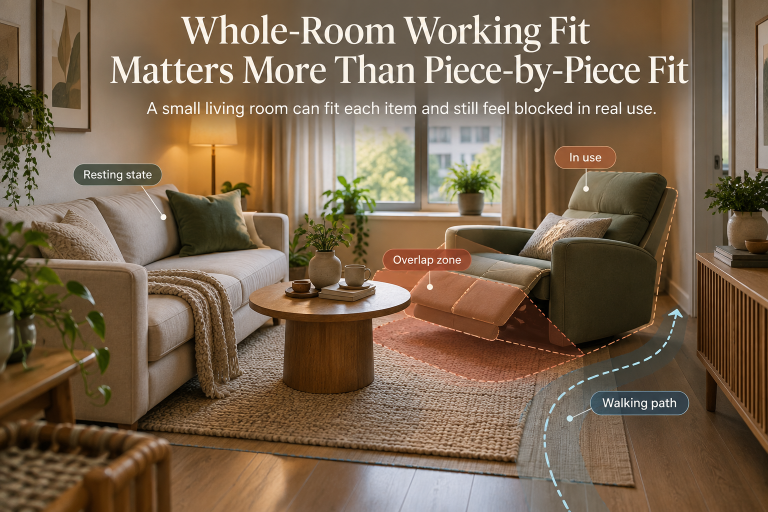
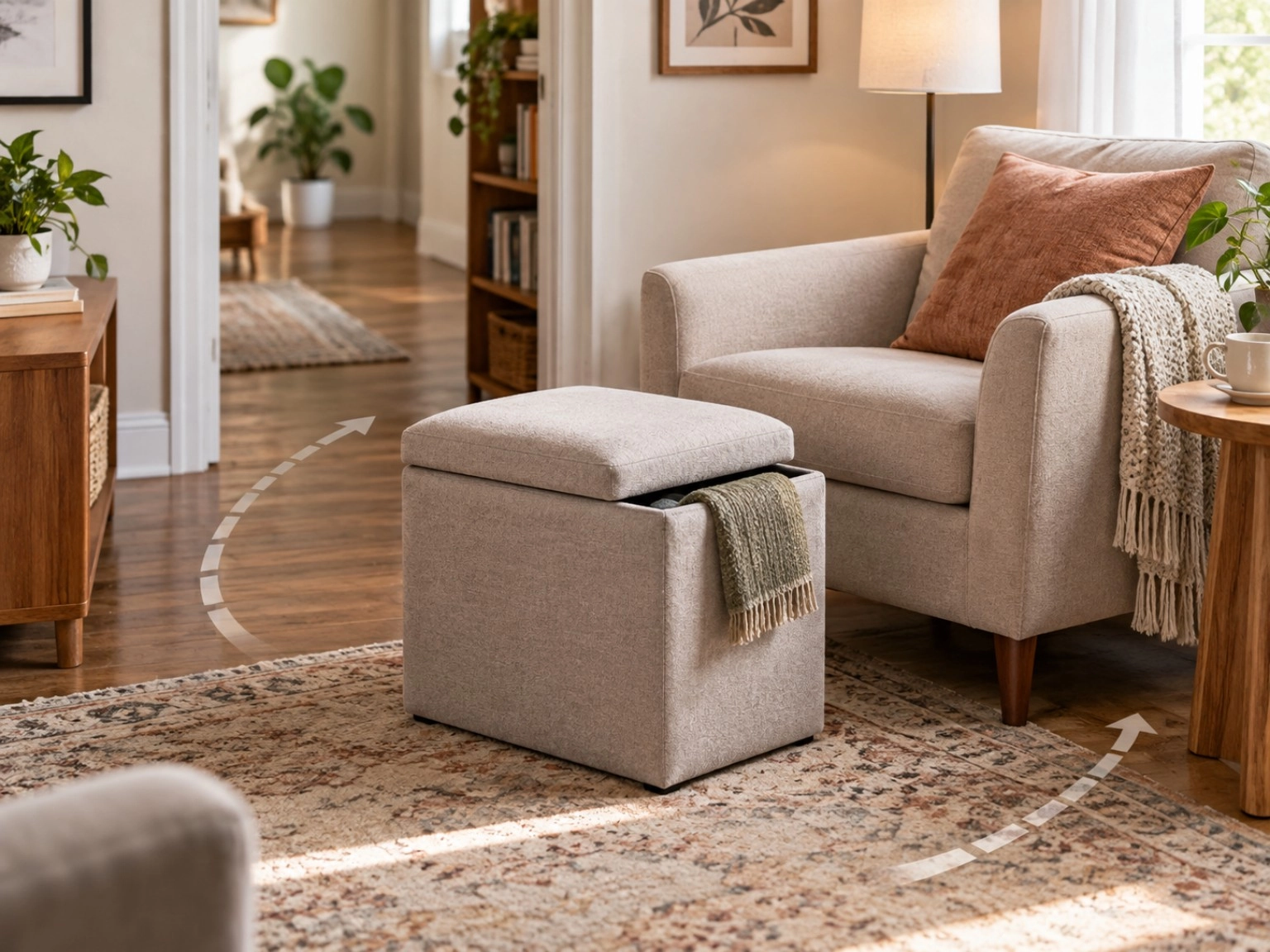
Once you actually use the ottoman, you may need to remove a top, lift a lid, reach into the storage compartment, move around it, sit beside it, or fold it away.
That changes the buying question.
Instead of asking only:
Will this ottoman fit in the empty space?
ask:
Will it still work when I open it, access the storage, move around it, and use the surrounding seating?
For a small living room, the better sequence is:
closed footprint → lid / access state → walking path → seating / sofa relationship → fold-away state where applicable → storage access → product role
The five products below are not ranked from best to worst.
They represent five different fit problems.
Start with the closed footprint — but do not stop there
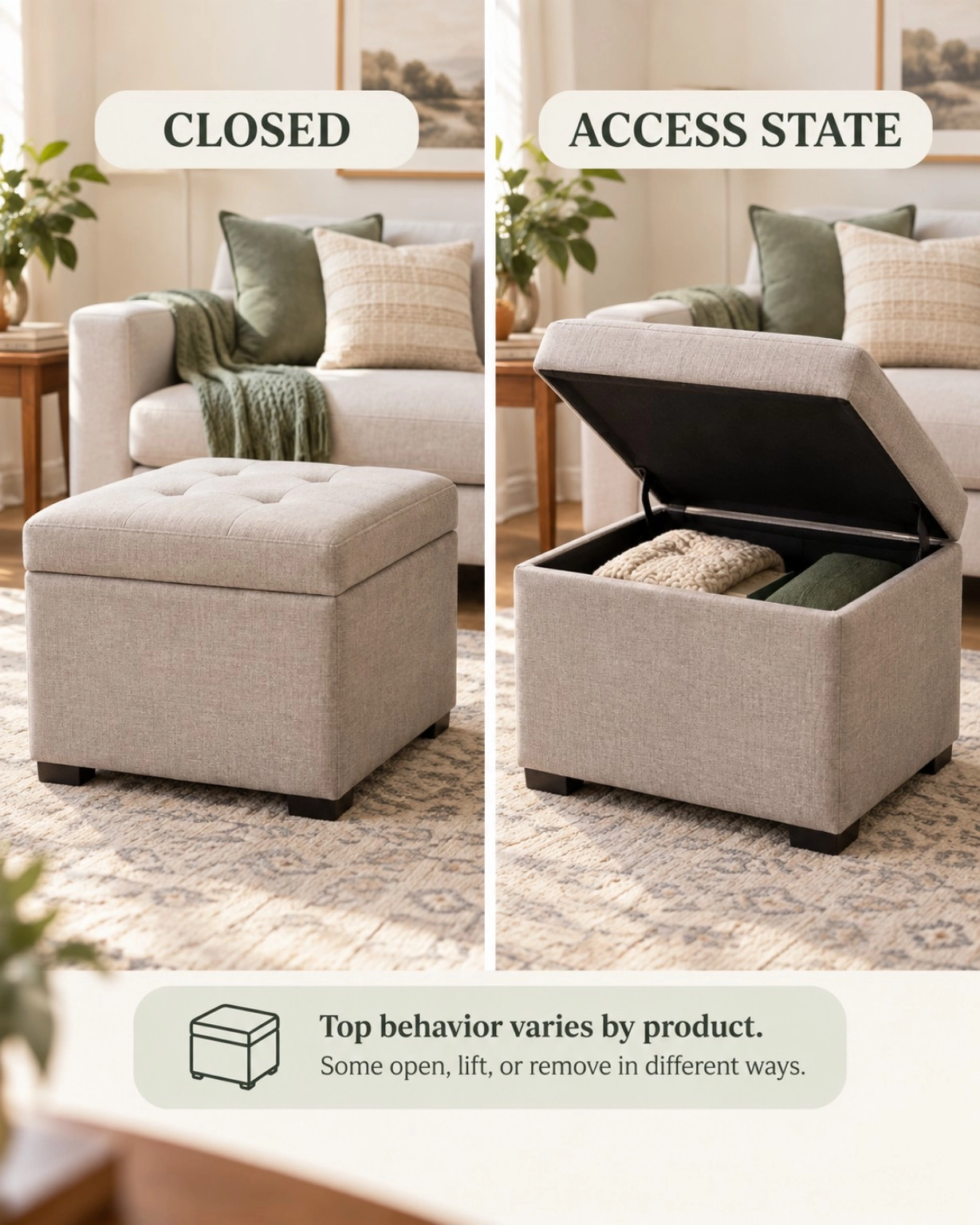
Width, depth, and height tell you how much room the ottoman occupies while it is sitting closed.
That matters.
A narrow walkway can become tighter if the ottoman is too deep. A bench-length ottoman can take more wall or sofa frontage than expected. A compact cube may fit easily beside a chair.
But closed dimensions do not automatically tell you:
- how the storage opens;
- where the top goes if it is removable;
- how much room a hinged lid needs;
- whether the ottoman folds away;
- how much standing space you need while reaching into storage;
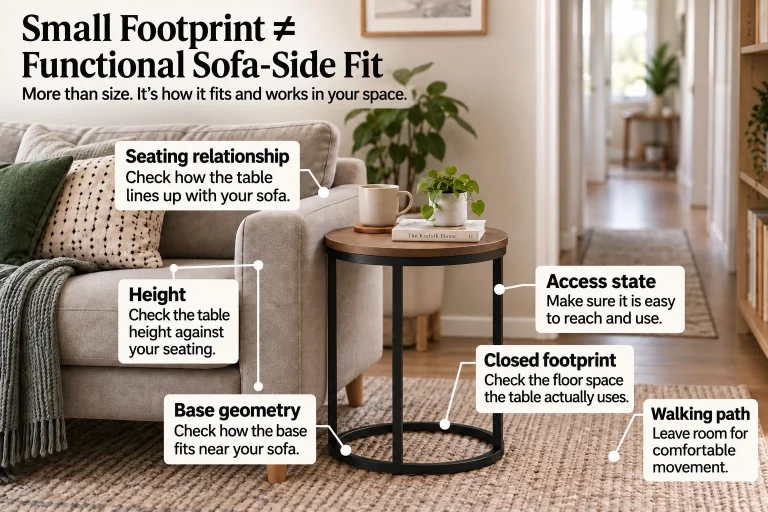
- how the ottoman changes the walking path when it sits in front of a sofa.
This is why a storage ottoman needs at least two checks:
1. Closed-state fit
Tape or map the published footprint where you plan to place the ottoman.
Look at the surrounding furniture, door path, chair movement, and main route through the room.
2. Access-state fit
Then ask what must happen when you use the storage.
The answer depends on the product.
A removable top behaves differently from a hinged lid.
A fold-away ottoman creates a different decision from a fixed-frame ottoman.
And a deep ottoman used as a sofa extension changes the circulation problem again.
There is no single universal clearance number that works for every room or every access mechanism.
Quick comparison: 5 storage-ottoman roles
| Product | Role | Closed size | Access / use state | Main fit guard |
|---|---|---|---|---|
| SONGMICS ULSF100B01 | Ultra-compact fold-away | 16.1 W × 12.2 D × 12.2 H in | Fold-away behavior verified; exact lid mechanism unknown | Do not assume folded size or storage-access clearance |
| IKEA STRANDMON 306.213.57 | Compact fixed-frame / chair-side | 23 5/8 W × 15 3/4 D × 17 3/8 H in | Hidden storage under seat; exact top mechanism unknown | Check access beside the chair and along the walking path |
| CHITA Cube Storage Ottoman | Removable / reversible-top cube | UNKNOWN | Removable top; top can be flipped | Keep a place for the removed top; do not treat it like a hinged lid |
| Simpli Home Afton AXCOTAFT-18-BL | Bench-length hinged lift-top | 48.0 W × 17.7 D × 18.5 H in | Lift-top lid with manufacturer-described child-safety hinge | Long body plus lid-opening state both matter |
| IKEA KIVIK 894.405.00 | Deeper sofa-extension | 35 3/8 W × 27 1/2 D × 16 7/8 H in | Storage under seat; exact top mechanism unknown | Deep closed footprint can materially change sofa-side circulation |
Important: the table compares only published closed dimensions and verified access behavior.
It does not calculate a universal "working footprint."
For the CHITA cube, current official numeric width, depth, and height are not established in this research package, so they remain UNKNOWN rather than being filled from another source or guessed.
1. SONGMICS ULSF100B01 — the ultra-compact fold-away role
The SONGMICS ULSF100B01 is the smallest published closed footprint in this set.
SONGMICS lists the product at:
- Width: 16.1 inches
- Depth: 12.2 inches
- Height: 12.2 inches
The official product identity also states a product-specific static load of 286 lb.
For a small living room, the useful part of this product is not simply that the body is compact.
Its role is different because the model is designed to fold away when not needed.
That creates two separate fit questions.
Closed and in-use
At 16.1 by 12.2 inches, the closed body can fit into places where a larger bench or deeper ottoman would be harder to position.
That can make it easier to test beside a chair, near the end of a sofa, or in another small unused zone.
But the small body does not tell you how much room you need while opening the storage.
The exact lid mechanism is not locked in this evidence package.
So do not assume how the top moves.
Fold-away state
The fold-away behavior is verified.
The folded dimensions are not.
That matters because "fold-away" should not be converted into an invented storage thickness.
If your main reason for choosing this role is that you want to put the ottoman away between uses, verify the folded form on the current product documentation before assigning it a cabinet, closet, or under-furniture storage spot.
Best fit question for this role
Do I need the smallest closed footprint in the set, and is fold-away storage more important than having a fixed furniture frame?
2. IKEA STRANDMON 306.213.57 — the compact fixed-frame / chair-side role
The IKEA STRANDMON takes a different approach.
IKEA lists:
- Width: 23 5/8 inches
- Depth: 15 3/4 inches
- Height: 17 3/8 inches
IKEA describes hidden storage under the seat and says the ottoman can also be used as an extra seat.
Its natural role is beside a chair or in another compact seating zone.
Why the fixed frame matters
Unlike the SONGMICS fold-away role, this is a piece you plan around as furniture.
The closed footprint is still relatively compact compared with the larger roles in this guide, but it remains in the room.
That means the question is not only whether the ottoman fits beside the chair.
You also need to test:
- whether you can reach the storage;
- whether access interferes with the chair;
- whether the ottoman narrows the route around the seating area;
- whether it is easy to reposition when the room needs to work differently.
What we do not know
The official product evidence confirms storage under the seat.
It does not establish a specific lid mechanism in this locked package.
So we do not call it hinged, removable, or reversible.
And we do not create an open-state clearance number.
Best fit question for this role
Can this ottoman stay beside my chair without turning storage access or everyday circulation into a hassle?
3. CHITA Cube Storage Ottoman — the removable / reversible-top access-state role
The CHITA cube is here for a completely different reason.
Its current locked evidence does not provide an approved numeric width, depth, or height for this article.
Those values remain:
UNKNOWN
That means this product is not used to claim that one ottoman is smaller or larger than another.
Its value is the access mechanism.
CHITA states that the top is removable, revealing the storage compartment.
The top can also be flipped.
Removable is not hinged
This distinction sounds simple, but it changes the room-use test.
A hinged lid stays attached to the furniture.
A removable top does not.
When you open this ottoman, you need to think about where the top goes while you access the storage.
That may be easy in one layout and irritating in another.
For example, the ottoman may fit neatly beside a sofa while closed, but the nearest practical place to set the removed top may already be occupied.
Why this is not a coffee-table comparison
The manufacturer describes a flipped-top use state.
For this guide, that feature is only relevant because it changes the top state and storage-access sequence.
This article is not ranking storage ottomans as coffee-table substitutes.
The decision stays focused on:
- how the storage is accessed;
- what happens to the top;
- whether the surrounding seating and walking path still work.
Best fit question for this role
Do I have a convenient place to handle a removable top every time I use the storage?
4. Simpli Home Afton AXCOTAFT-18-BL — the bench-length hinged lift-top role
The Afton changes the scale of the decision.
Simpli Home lists:
- Width: 48.0 inches
- Depth: 17.7 inches
- Height: 18.5 inches
The internal compartment is listed at:
- Width: 45 inches
- Depth: 15.4 inches
- Height: 11.4 inches
The product has a lift-top lid.
The manufacturer describes a child-safety hinge that holds the lid open at an angle and helps prevent slamming.
Simpli Home also lists a product-specific 250 lb load rating.
The main fit issue is length
At 48 inches wide, this is not a compact cube.
It is a bench-length ottoman.
That can work well along a wall, in front of a sofa, near an entry zone, or at another long furniture edge.
But a 48-inch body can also take over a larger portion of the available route.
Measure the full closed width in the actual room rather than treating "ottoman" as shorthand for "small."
The lid creates a second state
The hinged lift-top means the storage can be accessed without completely removing the top.
But that does not give us a verified open-lid clearance dimension.
We know how the manufacturer describes the hinge.
We do not know a universal amount of free space that every room must reserve above or behind the ottoman.
So test the intended placement against nearby furniture and surfaces rather than creating a formula.
Assembly note
The manufacturer says the main body arrives assembled and the four feet are attached with the included washers.
That is a product-specific assembly fact, not a general rule for storage ottomans.
Best fit question for this role
Can my room handle a 48-inch bench both while closed and while the lift-top storage is being used?
5. IKEA KIVIK 894.405.00 — the deeper sofa-extension role
The KIVIK is the deepest closed footprint among the products in this set with locked numeric dimensions.
IKEA lists:
- Width: 35 3/8 inches
- Depth: 27 1/2 inches
- Height: 16 7/8 inches
IKEA describes storage under the seat and says the ottoman can be used as a comfortable extension of the sofa.
That sofa-extension role is why its fit logic is different.
Depth becomes the important variable
A 27 1/2-inch depth can project substantially into the room.
Whether that works depends on where the ottoman sits.
If it extends the sofa, you should check the combined seating zone rather than measuring the ottoman in isolation.
Ask:
- what route remains around the extended seating;
- whether another chair still moves normally;
- whether you can reach the storage;
- whether the room still works when the ottoman is not tucked close to the sofa.
Storage access still needs a separate check
The storage under the seat is verified.
The exact top mechanism is not locked as a hard product specification in this package.
So we do not label it hinged or removable here.
We also do not calculate an open-state depth.
About the 242-lb test context
IKEA states that this seating furniture is tested to relevant strength and durability standards and that the tests are based on use by persons weighing up to 242 lb.
That is manufacturer test context for this product.
It is not presented here as a universal storage-ottoman weight limit.
Best fit question for this role
If I use the ottoman as a sofa extension, does the deeper combined seating footprint still leave the room functional?
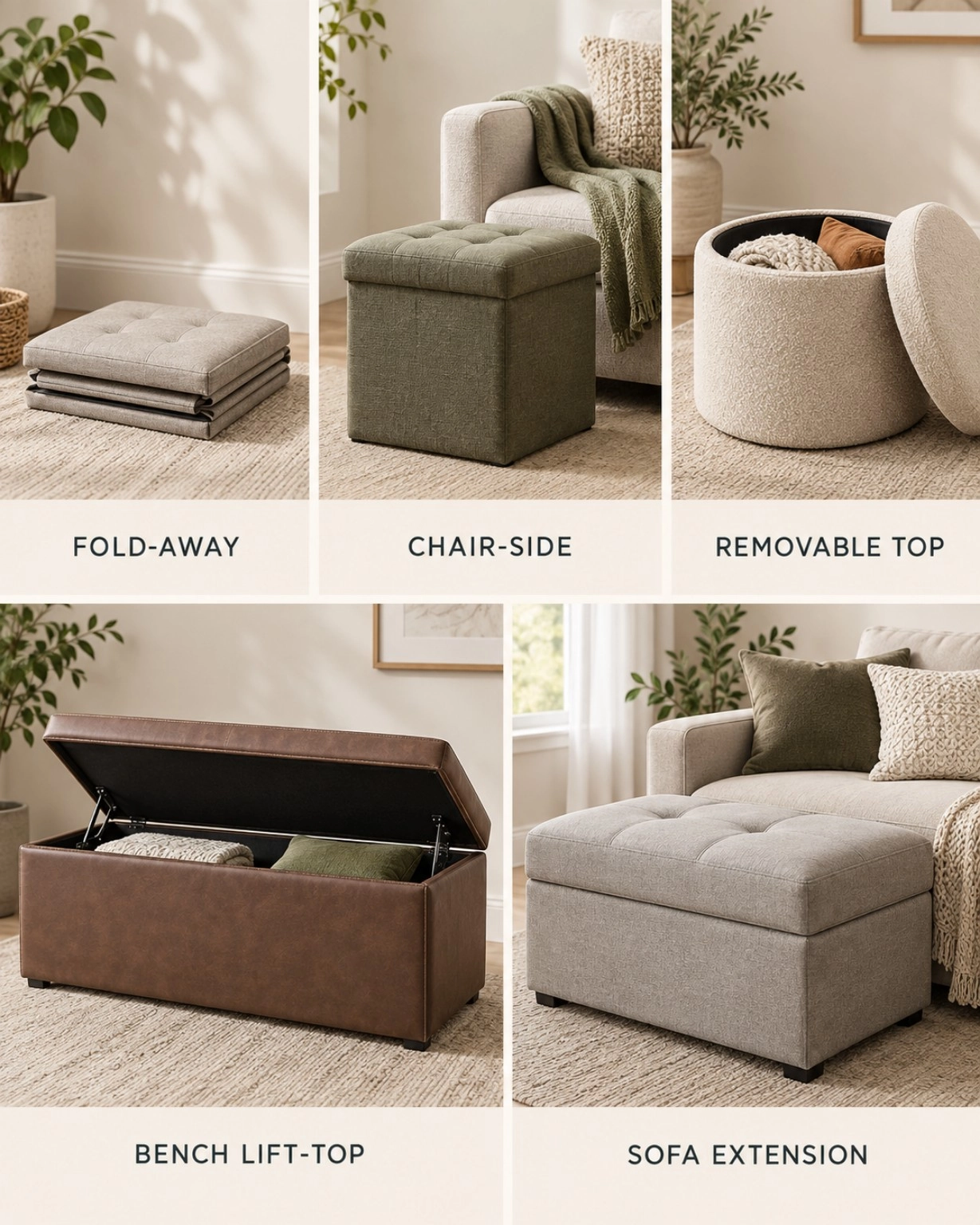
Which storage-ottoman role should you compare first?
Start with the problem your room actually has.
Choose the ultra-compact fold-away role first if:
- floor space is very limited;
- you do not want a fixed ottoman permanently occupying the room;
- putting the piece away between uses is a major priority.
That points you toward the SONGMICS role.
Choose the compact fixed-frame / chair-side role first if:
- you want the ottoman to stay beside a chair;
- you want a conventional furniture form with hidden storage;
- the main question is how storage access works inside a compact seating zone.
That points you toward IKEA STRANDMON.
Choose the removable / reversible-top role first if:
- top handling is part of your decision;
- you want to compare removable-top access against attached-lid access;
- you have a practical place to set or reposition the top.
That points you toward CHITA.
Remember: the current approved numeric dimensions for this product are UNKNOWN, so make the final footprint check directly from current official product information before purchase.
Choose the bench-length hinged role first if:
- you want a longer seating/storage form;
- you have enough wall or sofa frontage for a 48-inch body;
- a lift-top access mechanism is useful for your layout.
That points you toward the Simpli Home Afton.
Choose the deeper sofa-extension role first if:
- you specifically want the ottoman to work with the sofa;
- a deeper footprint is acceptable;
- you are willing to plan the room around the combined seating zone.
That points you toward IKEA KIVIK.
How to check a storage ottoman in your own room
You do not need a universal clearance rule.
You need a room-specific test.
Step 1: Mark the closed footprint
Use painter’s tape, paper, cardboard, or another temporary marker.
Map the published width and depth on the floor.
For the CHITA model in this guide, do not create a footprint from this article because the locked dimensions are unknown.
Use the current official product dimensions when you perform your own check.
Step 2: Walk the normal route
Do not stand at the edge and decide that it "looks fine."
Walk the path you actually use.
Move between the sofa, doorway, chair, TV zone, and other furniture.
Watch for places where the ottoman forces you to turn sideways or reroute.
Step 3: Recreate the access state
Use the verified mechanism.
If the top is removable, decide where you will put it.
If the lid is hinged, check the surrounding furniture without inventing an open-clearance number.
If the exact mechanism is unknown in the current evidence, verify it before making a final access plan.
Step 4: Test the seating relationship
An ottoman beside a chair creates a different room shape from an ottoman extending a sofa.
Move the chair if it normally moves.
Sit where you normally sit.
Check whether the ottoman creates a useful relationship or simply occupies the route.
Step 5: Check the storage behavior
Ask what you will actually store.
Frequently used items make access friction more important.
Occasional storage may tolerate a more involved opening sequence.
The best storage volume is not automatically the best fit if opening the ottoman becomes inconvenient.
Step 6: Check fold-away claims separately
If a model folds away, verify the actual folded form and dimensions before assigning it a storage location.
"Fold-away" does not automatically tell you how thin, short, or compact the folded product becomes.
Common mistakes to avoid
Mistake 1: comparing only width
Width can matter, but a narrow ottoman can still be deep.
Always check width and depth together when both values are known.
Mistake 2: treating closed depth as full working depth
Closed depth describes the body.
It does not automatically include the storage-access state.
Mistake 3: calling every top a lid
A removable top and a hinged lid behave differently.
That difference changes how you use the storage.
Mistake 4: assuming "folding" tells you the folded size
It does not.
Use an actual published folded measurement if you need to know whether the folded ottoman fits a storage location.
Mistake 5: turning a storage ottoman into a coffee-table decision
A manufacturer may show or describe another use state.
But the main buying problem in this guide is storage access and living-room fit, not replacing a coffee table.
Mistake 6: applying one load number to every product
Product-specific load or test information belongs to that product.
Do not generalize it across the category.
Methodology and source transparency
This guide uses manufacturer and official brand product information for the locked product set.
We compare:
- published closed dimensions where available;
- verified storage access descriptions;
- verified removable, lift-top, fold-away, or sofa-extension behavior where available;
- product-specific assembly or load information only when the official source explicitly supports it.
When a value is not established in the locked evidence, it is shown as UNKNOWN or omitted.
We do not convert product dimensions into a universal room-clearance formula.
We also do not treat price, current stock, seller identity, or a temporary offer as core fit evidence.
We did not physically test these products
Renternook did not physically test the five products in this article.
This is an evidence-based buying guide built from official product information and a Fit-First room-planning method.
Before buying, verify the current manufacturer specifications for the exact variant you plan to order, especially if a dimension, mechanism, assembly detail, or load statement is important to your room.
Final buyer checklist
Before choosing a storage ottoman for a small living room, check:
- [ ] I know the closed width and depth where published.
- [ ] I mapped the closed footprint in the actual room.
- [ ] I know whether the top is removable, hinged, fold-away, or still needs verification.
- [ ] I checked where the top or lid goes during storage access.
- [ ] I walked the normal route with the ottoman footprint in place.
- [ ] I checked the ottoman against the sofa or chair it will actually sit near.
- [ ] I did not assume a universal walking-clearance number.
- [ ] I did not assume closed depth equals working depth.
- [ ] I kept UNKNOWN specifications unknown instead of guessing.
- [ ] I treated any load or safety-related statement as product-specific.
- [ ] If the product folds, I verified the actual folded form before planning where to store it.
- [ ] I verified the current official specifications for the exact product or variant before ordering.
The right storage ottoman is not simply the one with the smallest body or the biggest storage compartment.
It is the one whose closed footprint, access state, surrounding walking path, and seating relationship all work in the same room.