Small Coffee Table Buying Guide: Check the Full Living-Room Fit Before You Buy
A small coffee table can fit on the floor and still make the seating area harder to use.
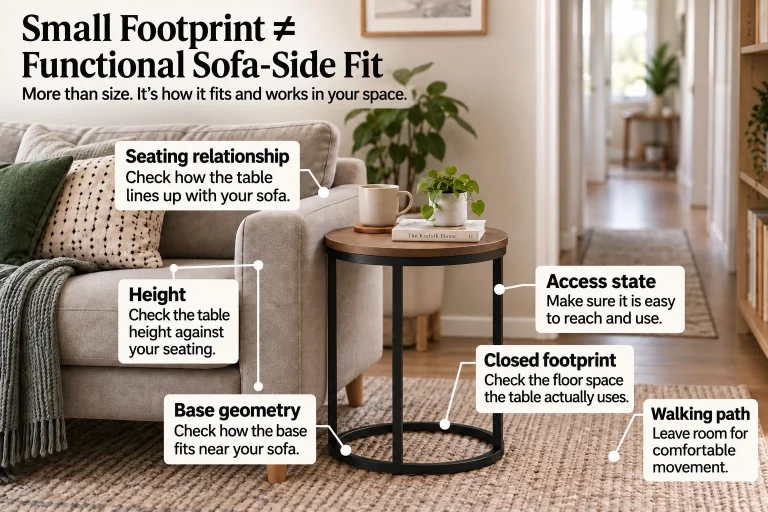
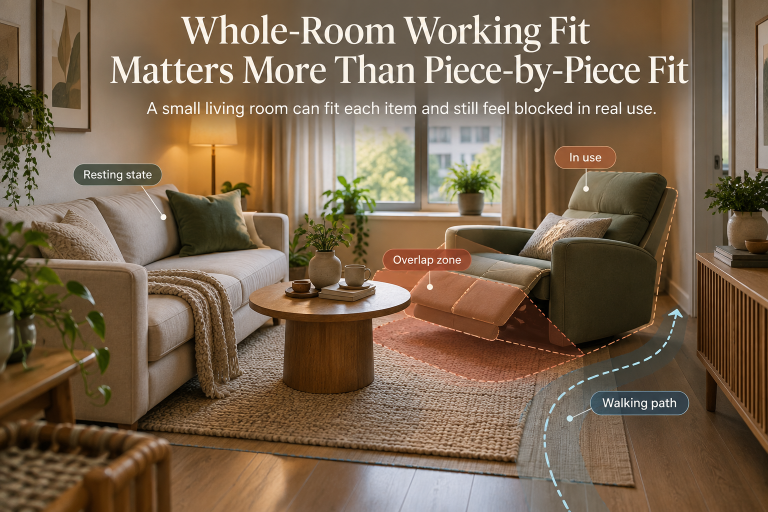
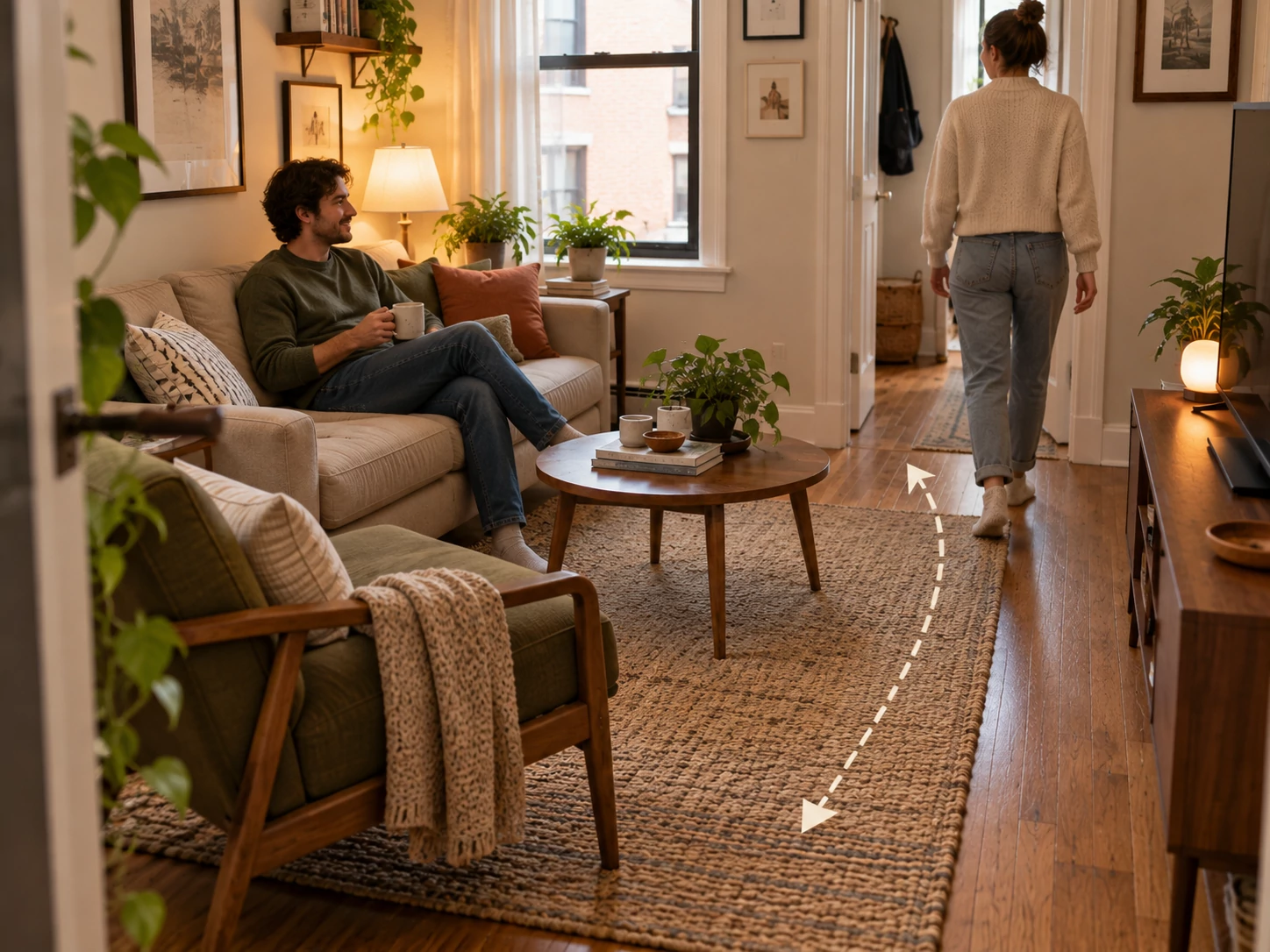
The tabletop is only one part of the real footprint. Once you place the table in front of a sofa, add chairs, leave a route for people to walk through the room, or open a lift top or drawer, the amount of usable space can change.
Before choosing a coffee table, check four things:
- the table by itself,
- how it relates to the sofa and other seating,
- the walking path while the seating area is in use,
- and any open, lifted, nested, or storage-access state you expect to use.
Tabletop size is not the same as real in-use fit.
Step 1: Measure the Table-Only Footprint
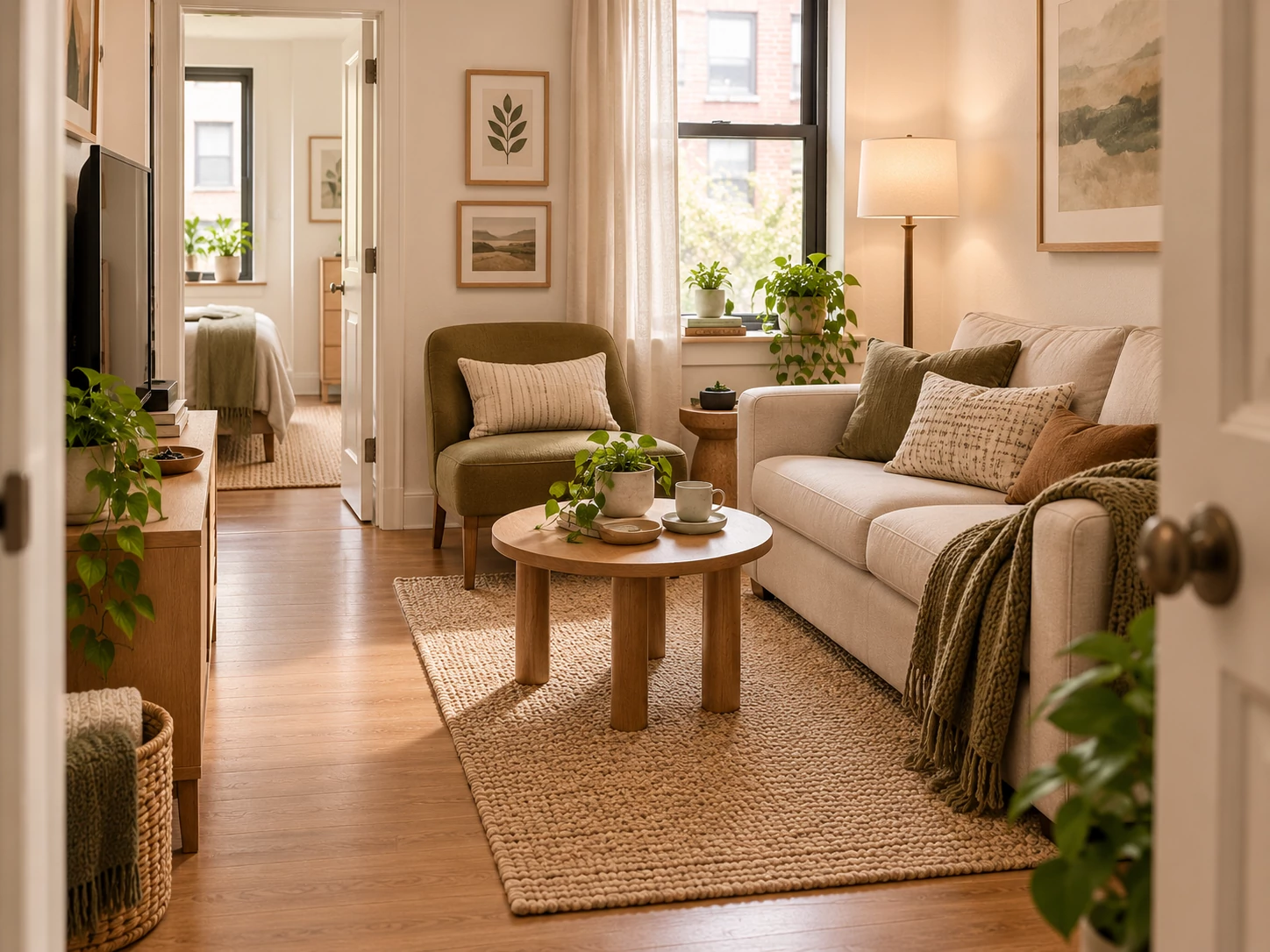
Start with the space the coffee table physically occupies.
Measure the actual zone where you plan to place the table, then compare it with the product’s verified length, width, depth, or diameter.
Do not rely only on the word “small.”
A narrow rectangular table, a square table, and a round table can all occupy the room differently even when their listed dimensions look similar on a product page.
Also check what surrounds the table zone:
- sofa edges,
- lounge chairs,
- ottomans,
- cabinets,
- doors,
- and any route that people regularly use to cross the room.
The first question is simple:
Does the table itself fit the floor area you actually have?
But that is only the first layer.
Step 2: Check the Sofa and Seating Relationship
A coffee table normally sits inside a seating arrangement, not by itself.
That means the table needs to work with the sofa, chairs, and the way people actually sit down, stand up, and reach the table.
Rather than relying on one universal clearance number, test the furniture you already own.
Check where the sofa ends.
Check whether a lounge chair angles toward the table.
Check whether someone can sit comfortably without the table interfering with the position they actually use.
Also look at the shape of the table.
A rectangular table and a round table create different edge geometry. That does not mean one shape is automatically better.
It means the shape needs to work with your actual seating layout.
Table width is not the same as verified usable seating-area fit.
Step 3: Check the Walking Path While the Seating Area Is in Use
Now test the room in its real use state.
Imagine someone is already sitting on the sofa.
Can another person still walk through the route the room normally needs?
This matters especially when the coffee-table zone sits:
- between a sofa and a doorway,
- near the main route through a living room,
- beside a chair that pulls or angles outward,
- close to a media cabinet,
- or inside a multipurpose room.
The goal is not simply to make the coffee table fit.
The goal is to make the seating area remain usable while the coffee table is there.
Do not assume that a table is suitable just because its tabletop dimensions fit inside the available floor space.
Moving and Storage Coffee Tables Need More Than One Measurement
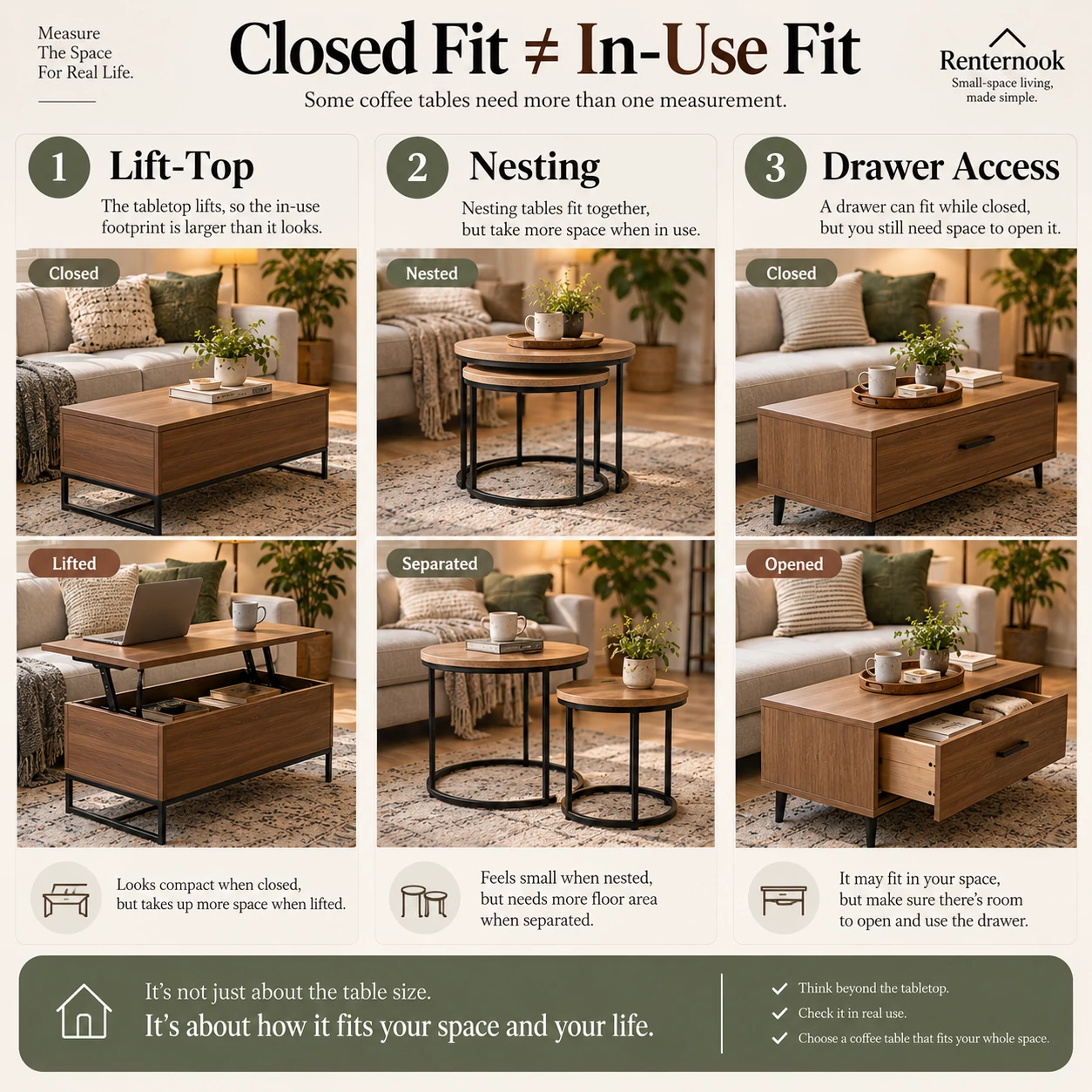
Some coffee tables change their usable footprint after you start using them.
If the product lifts, opens, separates, or has drawers, measure the state you expect to use — not only the state you see when everything is closed.
Lift-Top State
A lift-top coffee table can occupy one footprint while closed and a different one when the top is raised and moved forward.
That matters because the open tabletop may move toward the sofa or into another part of the seating zone.
Measure both states:
closed state ≠ lifted / in-use state
Nesting State
Nesting tables are designed to use space differently depending on how they are arranged.
A set can fit neatly while the tables are pushed together but require a larger overall area when the pieces are separated for use.
Do not assume the nested footprint represents the deployed footprint.
Test the arrangement you actually expect to use.
Drawer Access State
A storage coffee table may fit between your seating furniture while the drawers are closed.
That does not automatically mean the drawers can open in the same layout.
If the table includes drawers, check the actual opening direction and the space available beside the sofa, chairs, or other nearby furniture.
Do not invent a clearance number.
Test the real opening zone.
5 Coffee Table Fit Roles for Small Spaces
1. IKEA LACK Coffee Table — Article 904.499.05
Verified dimensions:
35 3/8 L × 21 5/8 W × 17 3/4 H in
Fit role:
Fixed rectangular footprint
The LACK represents the simplest fit role in this set because its tabletop footprint does not change between configurations.
That makes it useful for checking the basic relationship between the table, sofa, and walking path.
Check before buying:
Do not stop at the tabletop dimensions. Place the verified footprint inside your actual seating zone and check how the sofa, chairs, and walking route work around it.
IKEA lists the LACK at 35 3/8 inches long, 21 5/8 inches wide, and 17 3/4 inches high.
2. IKEA JAKOBSFORS Coffee Table — Article 905.001.21
Verified footprint:
31 1/2 in diameter
Verified height:
16 1/2 in
Fit role:
Round geometry
The JAKOBSFORS introduces a different fit question.
Instead of only asking how long and wide the table is, you need to consider how a circular tabletop interacts with the seating positions around it.
A round table may change where its edges sit relative to a sofa or chair, but that does not automatically mean it will fit every small room better.
Check before buying:
Test the actual circle inside your seating arrangement rather than assuming the round shape solves the fit problem.
IKEA lists the JAKOBSFORS at 31 1/2 inches in diameter and 16 1/2 inches high.
3. HOMCOM Lift-Top Coffee Table — SKU 839-135AK
Closed dimensions:
41.25 × 19.75 × 19.25 in
Lifted / unfolded dimensions:
41.25 × 28 × 24.5 in
Fit role:
Closed-state vs open-state fit
This product shows why a single measurement can be misleading.
The table is much shallower while closed than it is when the top is lifted forward.
The important question is therefore not only:
Does the closed table fit?
It is also:
Does the table still work with the sofa and walking path when the lift top is in the position you actually use?
Check before buying:
Measure both the closed and lifted configurations against your seating layout.
Aosom lists the closed overall size as 41.25 × 19.75 × 19.25 inches and the unfolded state as 41.25 × 28 × 24.5 inches.
4. IKEA SONHULT Nesting Tables — Article 305.785.56
Verified tabletop sizes:
21.5 × 21.5 in
27.5 × 15.75 in
Fit role:
Nested-state vs deployed-state fit
The SONHULT set includes two separate tabletops that can be positioned partly together, separately, or pushed completely together.
That makes the set useful for showing why the stored arrangement is not necessarily the same as the in-use arrangement.
Check before buying:
Test the configuration you expect to use most often.
If you plan to separate both tables, check where both pieces will actually go.
Do not create a combined deployed-footprint number unless you have measured your own intended arrangement.
IKEA confirms the two tabletop sizes and that the tables can be positioned partly together, separately, or completely together.
5. IKEA TONSTAD Coffee Table — Article 904.915.60
Verified dimensions:
33 1/8 L × 32 1/4 W × 13 3/4 H in
Storage:
Two soft-closing drawers, one on each side
Fit role:
Drawer / access-state fit
The TONSTAD adds another layer to the coffee-table footprint.
The table itself may fit between the seating furniture, but the storage still needs to remain usable.
Check before buying:
Look at the direction each drawer opens and test whether the sofa, chairs, or other nearby furniture interfere with access.
Do not rely on an invented drawer-clearance number.
IKEA lists the TONSTAD at 33 1/8 by 32 1/4 inches, 13 3/4 inches high, and confirms two soft-closing drawers, one on each side.
Quick Comparison
| Product | Type | Verified Geometry / State | Fit Role | Check Before Buying |
|---|---|---|---|---|
| IKEA LACK | Fixed rectangle | 35 3/8 × 21 5/8 in | Fixed footprint | Sofa + walking path |
| IKEA JAKOBSFORS | Round | 31 1/2-in diameter | Round geometry | Actual seating layout |
| HOMCOM 839-135AK | Lift-top | 41.25 × 19.75 closed → 41.25 × 28 open | Open-state fit | Measure both states |
| IKEA SONHULT | Nesting set | 21.5 × 21.5 + 27.5 × 15.75 in tabletops | Deployed-state fit | Test together + separate |
| IKEA TONSTAD | Drawer storage | 33 1/8 × 32 1/4 in | Access-state fit | Drawer opening zone |
Before You Buy a Small Coffee Table
Before choosing a table, check the full seating-area setup:
- Measure the actual coffee-table zone.
- Verify the current product dimensions.
- Check table shape, not only width or diameter.
- Position the sofa and chairs the way they are actually used.
- Test the normal walking route while someone is seated.
- Measure a lift-top table in both closed and open states.
- Test nesting tables both together and deployed.
- Check drawer or storage-opening access.
- Check nearby doors, cabinets, and other furniture.
- Do not assume the word “small” means the full seating area will work.
The best small coffee table is not automatically the one with the smallest tabletop.
A better choice starts with how the whole seating area actually works: where the table sits, where people sit, where people walk, and what parts of the table need to open or move.
Measure those conditions first, then choose the table geometry that fits them.