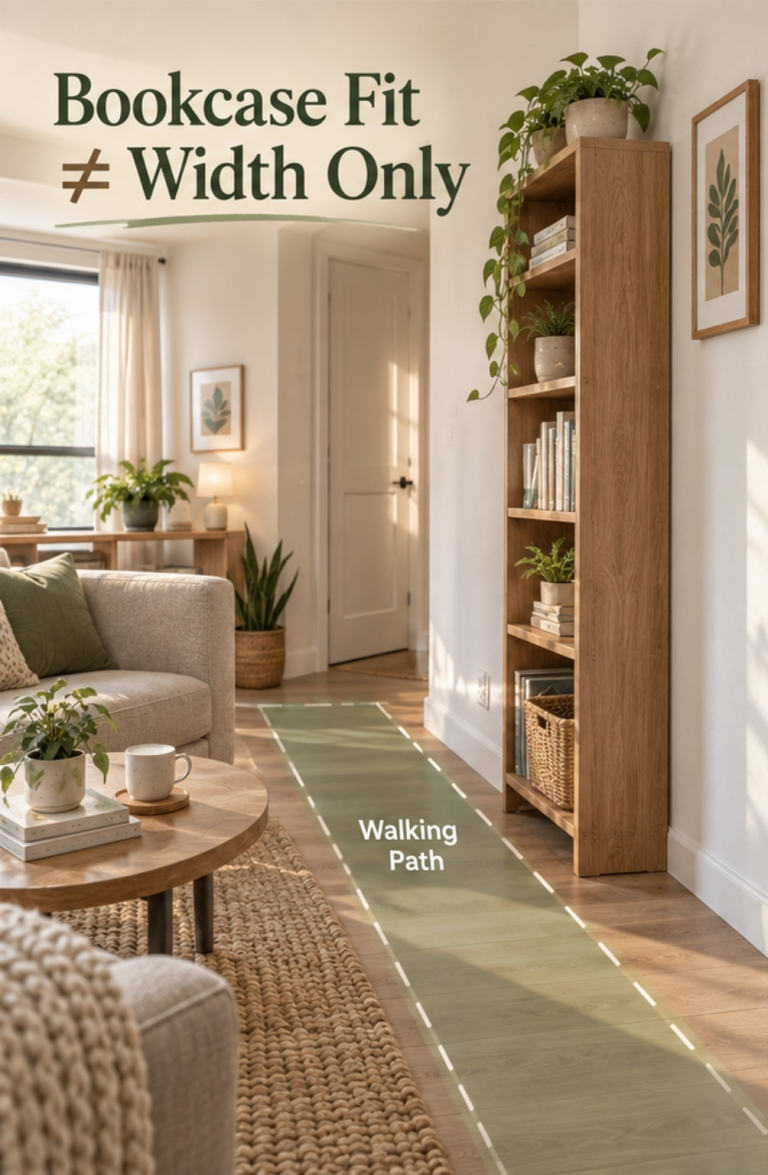
Small Dressers for Small Bedrooms: 5 Fit-First Options to Check Before You Buy
A dresser can fit neatly against the wall and still be the wrong fit for a small bedroom.
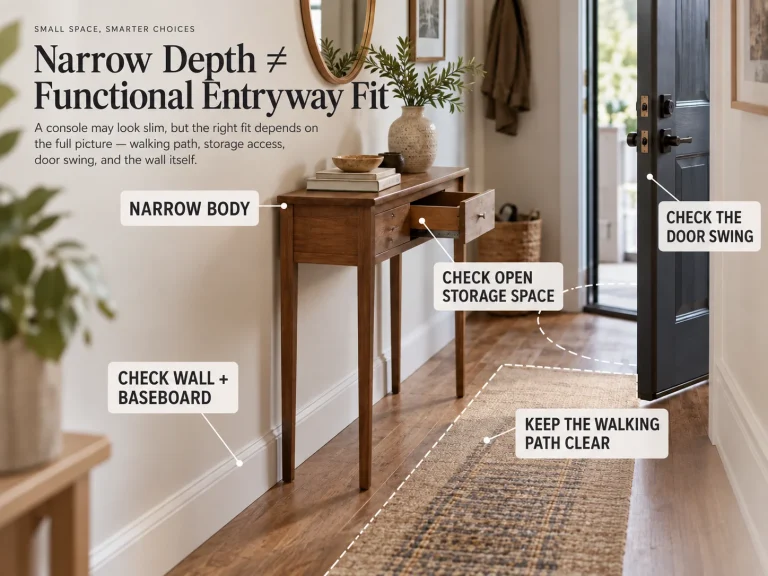
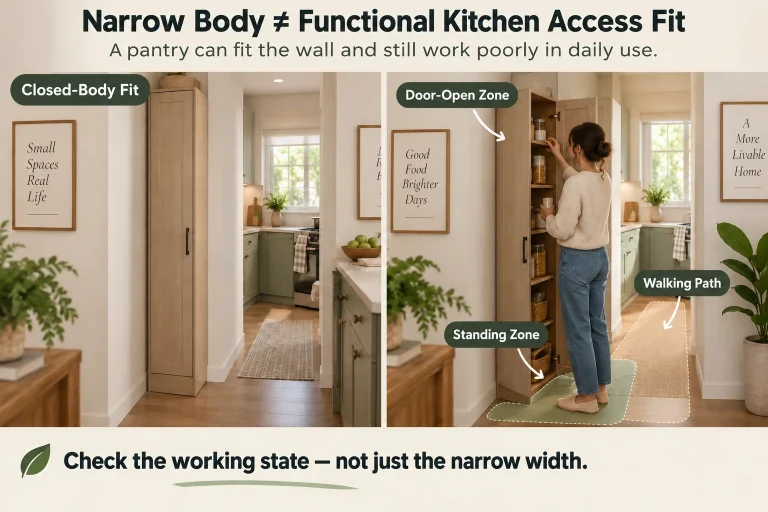
The problem is that the dimensions you see first on a product page usually describe the closed furniture body.
They do not automatically tell you what happens when a drawer is pulled out, when you stand in front of it, when the bed sits only a short distance away, or when the dresser has to be anchored to the wall.
For a compact bedroom, the better sequence is:
body width → body depth → drawer-open state → walking path → height / wall use → product-specific anchoring or installation
The five dressers below solve different small-space problems. They are not ranked from best to worst.
The useful question is:
Which dresser fits both when it is parked against the wall and when you actually use the drawers?

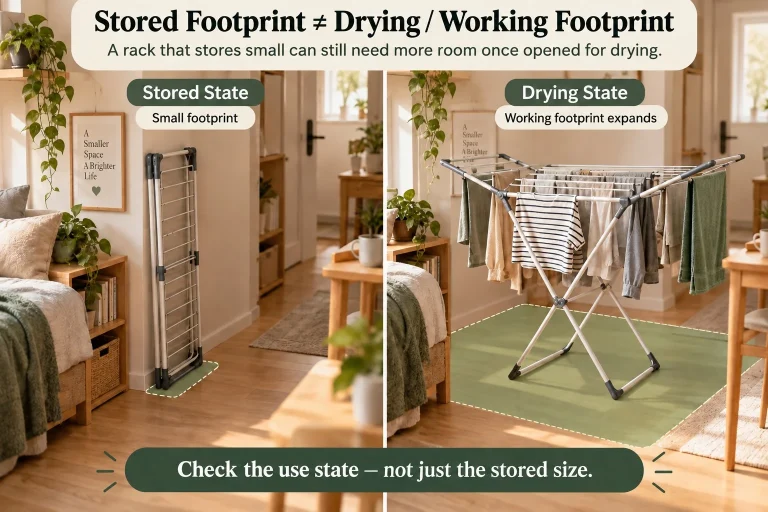
Start with two footprints: closed and in use
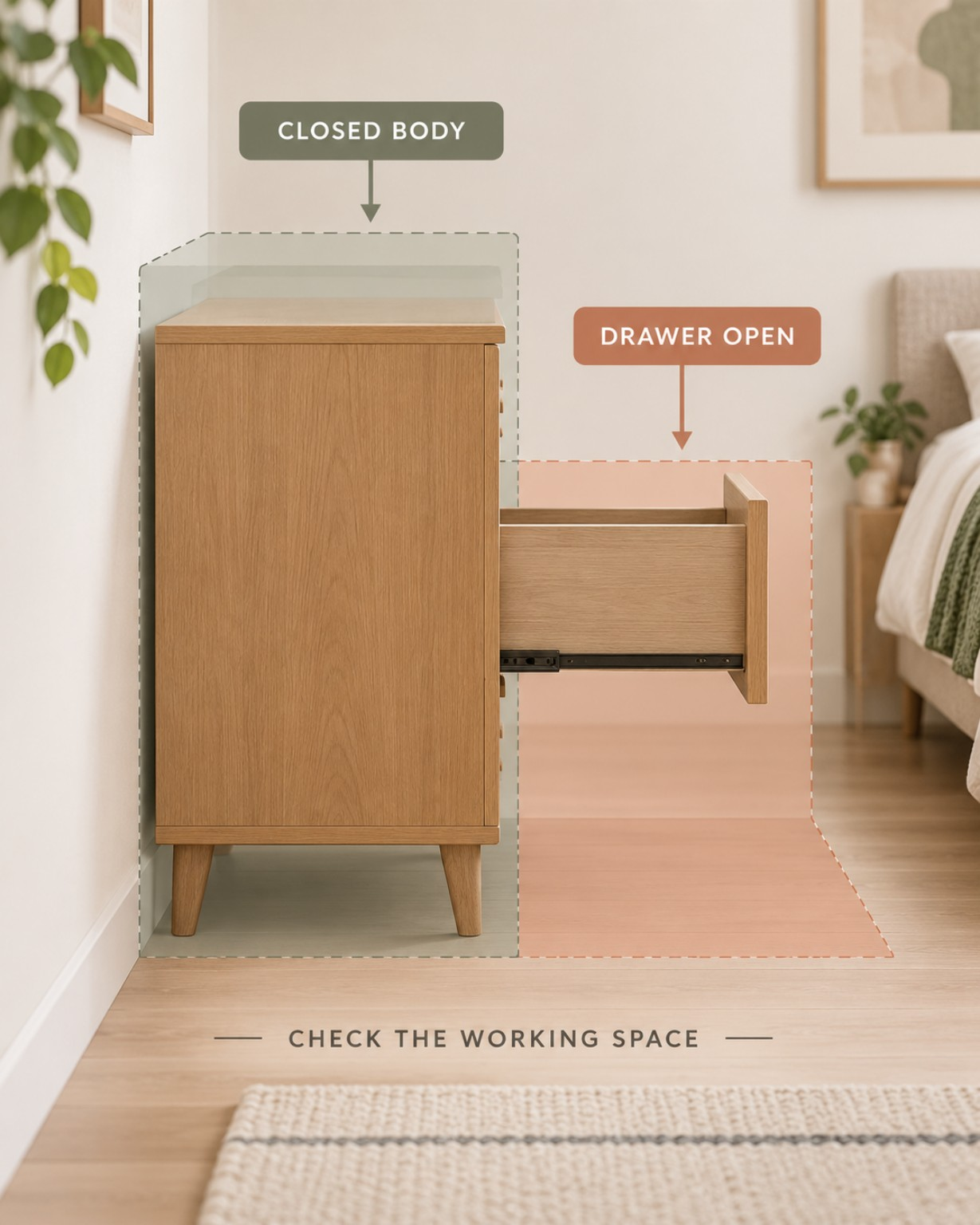
A dresser has at least two important states.
Closed state
This is the footprint described by the published width, depth, and height.
It tells you whether the furniture body can physically occupy the wall zone.
Drawer-open state
This is the operating state.
The drawer moves forward from the dresser body and uses additional room in front of the furniture.
That matters when the dresser faces:
- the side of a bed;
- the foot of a bed;
- a doorway;
- a desk chair;
- a closet door;
- another storage piece;
- the main walking path through the bedroom.
For the products in this guide, IKEA publishes a drawer pull-out measurement. We keep that as a separate product-specific variable.
We do not turn body depth plus drawer pull-out into a universal “required room depth” number, because a product page measurement should not be stretched into a room-layout guarantee.
Instead, use the published body dimensions and drawer pull-out as inputs to a real room test.
Tape out the dresser body on the floor, then check how much operating space you need in front of it while standing, opening the drawer, and moving through the room.
Quick comparison: 5 small-dresser roles
| Product | Small-space role | Overall size | Drawers / storage | Published drawer pull-out | Main fit guard |
|---|---|---|---|---|---|
| IKEA RAST 705.821.65 | Ultra-shallow / low compact | 24 3/8″W × 13 3/4″D × 26 3/4″H | 3 drawers | 6 1/2 in | Very shallow body, but anchoring still belongs in the decision |
| IKEA STORKLINTA 205.592.85 | Ultra-narrow / tall vertical | 15 3/4″W × 18 7/8″D × 47 1/4″H | 5 drawers | 10 7/8 in | Narrow width does not mean shallow depth; Anchor and Unlock behavior is product-specific |
| IKEA BRIMNES 205.728.33 | Tall medium-width | 30 3/4″W × 18 1/8″D × 48 7/8″H | 4 drawers | 7 3/4 in | Uses more wall width than STORKLINTA and still needs a front operating zone |
| IKEA FÅGELFJÄLLET 306.279.91 | Lower / wider / deeper-body tradeoff | 32 1/4″W × 20 1/8″D × 30 3/4″H | 3 drawers | 9 3/4 in | Lowest tall-vs-wide tradeoff in this set, but deepest body |
| IKEA HAUGA 105.815.31 | Dresser + upper-shelf vertical-use hybrid | 27 1/2″W × 18 1/8″D × 45 5/8″H | 3 drawers + upper shelf | 9 in | Uses vertical wall space differently; anchoring and multi-drawer behavior are product-specific |
Important: drawer pull-out is not the same measurement as interior drawer depth, and neither one is a universal walking-clearance requirement.
1. IKEA RAST 705.821.65 — the ultra-shallow / low compact role
The RAST is the shallowest dresser body in this five-product set.
IKEA lists:
- Width: 24 3/8 inches
- Depth: 13 3/4 inches
- Height: 26 3/4 inches
- Drawers: 3
- Drawer pull-out: 6 1/2 inches
That 13 3/4-inch body depth is the main reason this product is useful as a comparison point for a tight bedroom.
If your biggest problem is furniture projecting too far into the walking path, a shallower body can make the room easier to plan.
But do not stop at the closed-state measurement.
The drawer still moves into the room when opened, and you still need space for your body to stand in front of the dresser.
The RAST is also low at 26 3/4 inches. That can be useful under a window or where taller furniture would interfere with wall features, but low height is a layout characteristic—not proof that it will fit every small bedroom.
IKEA includes wall-anchoring hardware and says the dresser should be anchored. That requirement should be checked before purchase rather than treated as an afterthought.
Check before buying
This role is worth comparing if depth is your strongest constraint.
Verify:
- the 24 3/8-inch width against the real wall opening;
- the 13 3/4-inch body depth against the closed walking path;
- the 6 1/2-inch published drawer pull-out as a separate operating-state variable;
- the bed-to-dresser relationship while a drawer is open;
- the current anchoring instructions and whether they can be followed in your home.
2. IKEA STORKLINTA 205.592.85 — the ultra-narrow / tall vertical role
The STORKLINTA solves a different problem.
Its published width is only 15 3/4 inches, which makes it the narrowest dresser body in this set by wall width.
IKEA lists:
- Width: 15 3/4 inches
- Depth: 18 7/8 inches
- Height: 47 1/4 inches
- Drawers: 5
- Drawer pull-out: 10 7/8 inches
This is a good example of why narrow does not mean shallow.
The STORKLINTA uses very little wall width, but its 18 7/8-inch body depth is substantially greater than the RAST’s 13 3/4 inches.
Its five-drawer vertical format also means the decision is not only about floor space. You are trading a narrow wall footprint for more height.
The product has IKEA’s Anchor and Unlock function. The current product information says that before the dresser is anchored to the wall, only one drawer can be opened at a time. Once correctly anchored, the safety feature is unlocked so multiple drawers can be opened.
That is product-specific behavior. It should not be generalized to other dressers.
Check before buying
Choose this role for comparison when wall width is scarce but vertical wall space is available.
Verify:
- the 15 3/4-inch wall width;
- the 18 7/8-inch body depth;
- the 47 1/4-inch height against shelves, switches, windows, artwork, or sloped ceilings;
- the 10 7/8-inch drawer pull-out in the actual room;
- whether the anchoring requirement can be completed correctly.
The critical lesson here is simple:
A very narrow dresser can still need meaningful room depth.
3. IKEA BRIMNES 205.728.33 — the tall medium-width 4-drawer role
The BRIMNES gives you a taller dresser without going as narrow as the STORKLINTA.
IKEA lists:
- Width: 30 3/4 inches
- Depth: 18 1/8 inches
- Height: 48 7/8 inches
- Drawers: 4
- Drawer pull-out: 7 3/4 inches
This creates a middle role in the comparison.
It is tall, but it uses almost twice the wall width of the STORKLINTA. Its body depth is a little shallower than the STORKLINTA, and its published drawer pull-out is shorter.
That does not make one product universally better.
It means the products solve different geometry problems.
A bedroom with a short piece of free wall may favor the narrow STORKLINTA role. A room with more wall width but a different front-clearance problem may make the BRIMNES geometry easier to work with.
IKEA includes a wall-anchoring kit and describes the drawer extension as part of its product-specific tip-over-risk solution together with wall anchoring.
Again, keep that safety language attached to this exact product rather than turning it into a rule for every dresser.
Check before buying
Measure:
- 30 3/4 inches of wall width;
- 18 1/8 inches of closed body depth;
- the 48 7/8-inch height against the full wall zone;
- the 7 3/4-inch drawer pull-out against the bed and walking path;
- the current anchoring instructions.
If your bedroom already has a narrow passage beside the bed, the front operating state matters just as much as the closed body.
4. IKEA FÅGELFJÄLLET 306.279.91 — the lower / wider / deeper-body tradeoff
The FÅGELFJÄLLET moves in the opposite direction from a tall narrow dresser.
IKEA lists:
- Width: 32 1/4 inches
- Depth: 20 1/8 inches
- Height: 30 3/4 inches
- Drawers: 3
- Drawer pull-out: 9 3/4 inches
It is lower than the STORKLINTA, BRIMNES, and HAUGA options in this set, but it is also the widest and deepest dresser body among the five.
That makes it useful for a very specific decision:
Do you have more wall width and room depth available, but less usable height?
For example, a lower dresser may fit below wall decor or a window zone that would block a tall chest.
But the 20 1/8-inch depth means you should not call this a “small-space winner” simply because it is shorter.
IKEA says this product must be securely anchored. It also has a product-specific drawer mechanism: if a second drawer is opened without closing the first, the first drawer closes automatically.
That behavior belongs to the FÅGELFJÄLLET itself. It is not a general dresser feature.
Check before buying
Verify:
- the 32 1/4-inch wall width;
- the 20 1/8-inch body depth;
- the 30 3/4-inch height against the wall zone;
- the 9 3/4-inch published drawer pull-out;
- the open-drawer relationship with your bed or walkway;
- the current anchoring instructions and product-specific drawer behavior.
This is the strongest reminder in the set that lower does not mean smaller in every dimension.
5. IKEA HAUGA 105.815.31 — the dresser + upper-shelf vertical-use role
The HAUGA in this guide combines a three-drawer dresser body with an upper shelf.
IKEA lists:
- Width: 27 1/2 inches
- Depth: 18 1/8 inches
- Height: 45 5/8 inches
- Drawers: 3
- Upper shelf: yes
- Drawer pull-out: 9 inches
This makes it different from a conventional flat-top dresser.
The extra shelf uses the wall zone above the drawer body for display or accessible storage.
That may be useful when you want to use vertical space without moving to a full five-drawer chest.
But the upper shelf also becomes part of the fit check.
Measure the complete 45 5/8-inch height against:
- wall shelves;
- mirrors;
- switches;
- windows;
- artwork;
- sloped ceilings;
- anything you expect to place above the dresser.
IKEA says the HAUGA must be securely anchored and that its product-specific solution requires wall anchoring to open more than one drawer at a time.
Check before buying
Compare:
- 27 1/2 inches of wall width;
- 18 1/8 inches of body depth;
- the 45 5/8-inch full height;
- the 9-inch drawer pull-out;
- whether the upper shelf helps or conflicts with your wall layout;
- whether the anchoring requirement can be followed correctly.
Choose this role for comparison when you want the dresser and the wall above it to function as one storage zone.
Drawer pull-out: useful evidence, but not a shortcut to a room-fit guarantee
A published drawer pull-out measurement is valuable because it tells you something about the dresser’s operating state.
But it should not be misused.
For example, this guide does not calculate:
body depth + drawer pull-out = guaranteed total working depth
That would imply more geometric certainty than the product information supports.
The published pull-out tells you how far the drawer is specified to extend. Your real working space also depends on:
- where you stand;
- the shape of the drawer front and handles;
- whether you need to bend or turn;
- the bed or furniture opposite the dresser;
- the main circulation route;
- room-specific trim and wall geometry.
The better method is physical layout testing.
Use painter’s tape or removable markers to outline the closed dresser body on the floor. Then simulate the drawer-open state in front of it and walk the route you would use every day.
The goal is not to hit a universal number.
The goal is to confirm that your room still works.
Width vs depth: decide which constraint is actually hurting the bedroom
Small bedrooms can fail in different ways.
If wall width is the main constraint
The STORKLINTA is the clearest narrow-width role in this set at 15 3/4 inches wide.
But remember that it is 18 7/8 inches deep.
If room projection is the main constraint
The RAST is the shallowest body in this set at 13 3/4 inches deep.
But it uses 24 3/8 inches of wall width.
If usable height is limited
The RAST and FÅGELFJÄLLET are lower than the tall-chest options.
But the FÅGELFJÄLLET uses the most depth and width in this comparison.
If you want to use vertical wall space
The STORKLINTA, BRIMNES, and HAUGA all create taller storage roles in different ways.
The right answer depends on the specific bottleneck.
Do not let the search label—“small,” “narrow,” “compact,” or “tall”—replace the room measurements.
Anchoring is part of the fit decision
Every dresser in this set has product-specific stability or anchoring guidance on the current IKEA product information used for this guide.
That does not mean every dresser uses the same mechanism.
The differences matter:
- RAST: wall-anchoring hardware is included and the dresser is intended to be anchored.
- STORKLINTA: its Anchor and Unlock system changes drawer-opening behavior after anchoring.
- BRIMNES: IKEA pairs reduced drawer extension with wall anchoring as part of the product-specific stability approach.
- FÅGELFJÄLLET: it must be anchored and has its own multi-drawer behavior.
- HAUGA with shelf: it must be anchored and its product solution requires anchoring to open more than one drawer at a time.
For a renter, the correct question is not:
“Can I skip anchoring because the dresser is small?”
It is:
“Can I install this product according to the manufacturer’s current instructions in this room and under my housing constraints?”
Do not call a dresser renter-friendly or no-drill unless the exact product information supports that claim.
This guide does not make that claim for these five products.
Before-you-buy measurement checklist
Before ordering any small dresser, record these values for your actual bedroom.
Room
- available wall width;
- maximum furniture depth you can give up while closed;
- the bed-to-dresser or furniture-to-dresser gap;
- location of doors and closet doors;
- baseboards and trim;
- outlets and switches;
- windows and sill height;
- usable wall height;
- the main walking route.
Product
- exact width;
- exact overall depth;
- exact height;
- drawer count and configuration;
- published drawer pull-out if available;
- current assembly instructions;
- current anchoring / anti-tip instructions;
- any product-specific drawer-opening behavior.
Working-state test
Ask:
- Can the drawer open where I intend to place the dresser?
- Can I stand in front of the open drawer?
- Can another person still move through the room if needed?
- Does an open drawer collide with the bed, door, closet, chair, or another storage piece?
- Can the required anchoring be completed correctly?
- Does the dresser still fit if baseboards keep it slightly away from the wall?
This is the difference between furniture-body fit and working-room fit.
Which dresser role should you compare first?
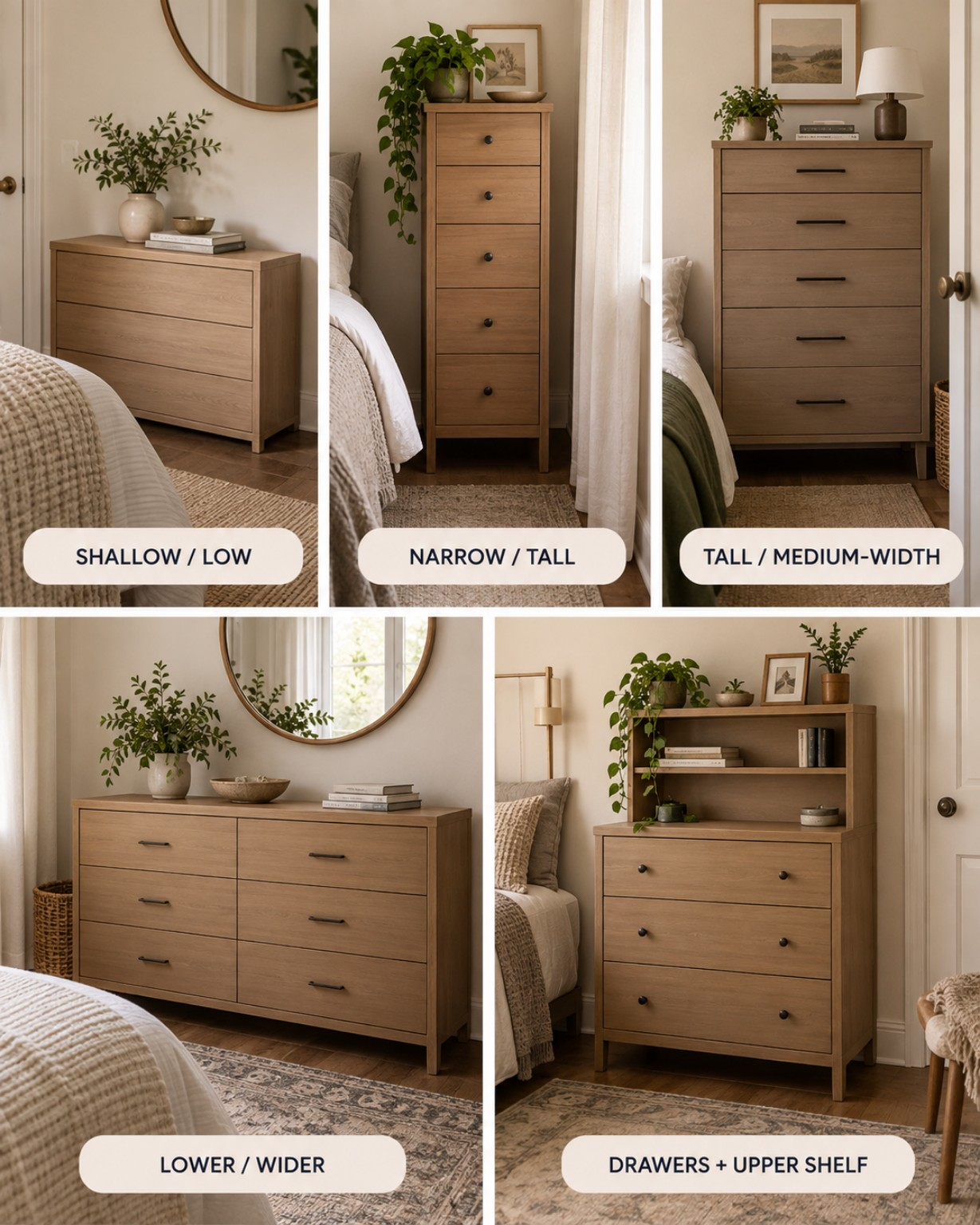
Use the room problem to narrow the set.
| Your main constraint | Start with this role |
|---|---|
| The dresser cannot project far into the room | RAST — ultra-shallow / low compact |
| You have very little wall width but more height | STORKLINTA — ultra-narrow / tall vertical |
| You have moderate wall width and want a tall 4-drawer format | BRIMNES — tall medium-width |
| You prefer a lower dresser and have more width / depth available | FÅGELFJÄLLET — lower / wider / deeper-body tradeoff |
| You want drawers plus a usable upper-shelf zone | HAUGA with shelf — vertical-use hybrid |
This table is a role map, not a winner ranking.
A product becomes useful only when its dimensions, operating state, and installation requirements match the actual room.
Methodology and source transparency
For this guide, Renternook reviewed current IKEA U.S. exact-product information and assembly / safety information for the five product IDs listed above.
Decision-relevant facts in the comparison—such as width, depth, height, drawer count, drawer pull-out, and product-specific anchoring behavior—come from those current product records.
Renternook has not physically tested these five dressers.
We did not treat price, local stock, seller availability, or delivery timing as evergreen product facts for this guide.
We also did not infer a universal drawer-open working envelope or walking-clearance number from the product dimensions.
Product specifications and installation guidance can change. Check the current exact-product page and assembly instructions before purchase or installation.
Product sources used
- IKEA U.S. — RAST 3-drawer dresser, Article 705.821.65
- IKEA U.S. — STORKLINTA 5-drawer dresser, Article 205.592.85
- IKEA U.S. — BRIMNES 4-drawer dresser, Article 205.728.33
- IKEA U.S. — FÅGELFJÄLLET 3-drawer dresser, Article 306.279.91
- IKEA U.S. — HAUGA 3-drawer dresser with shelf, Article 105.815.31
Final takeaway
A small dresser is not the dresser with the smallest-looking product photo.
And the right dresser is not automatically the narrowest one.
The useful question is:
Does the dresser fit the wall when closed, and does the bedroom still work when the drawers are open?
Check width, body depth, drawer pull-out, walking path, height, wall use, and product-specific anchoring as separate variables.
That is the difference between a dresser that fits on paper and a dresser that actually works in a small bedroom.