
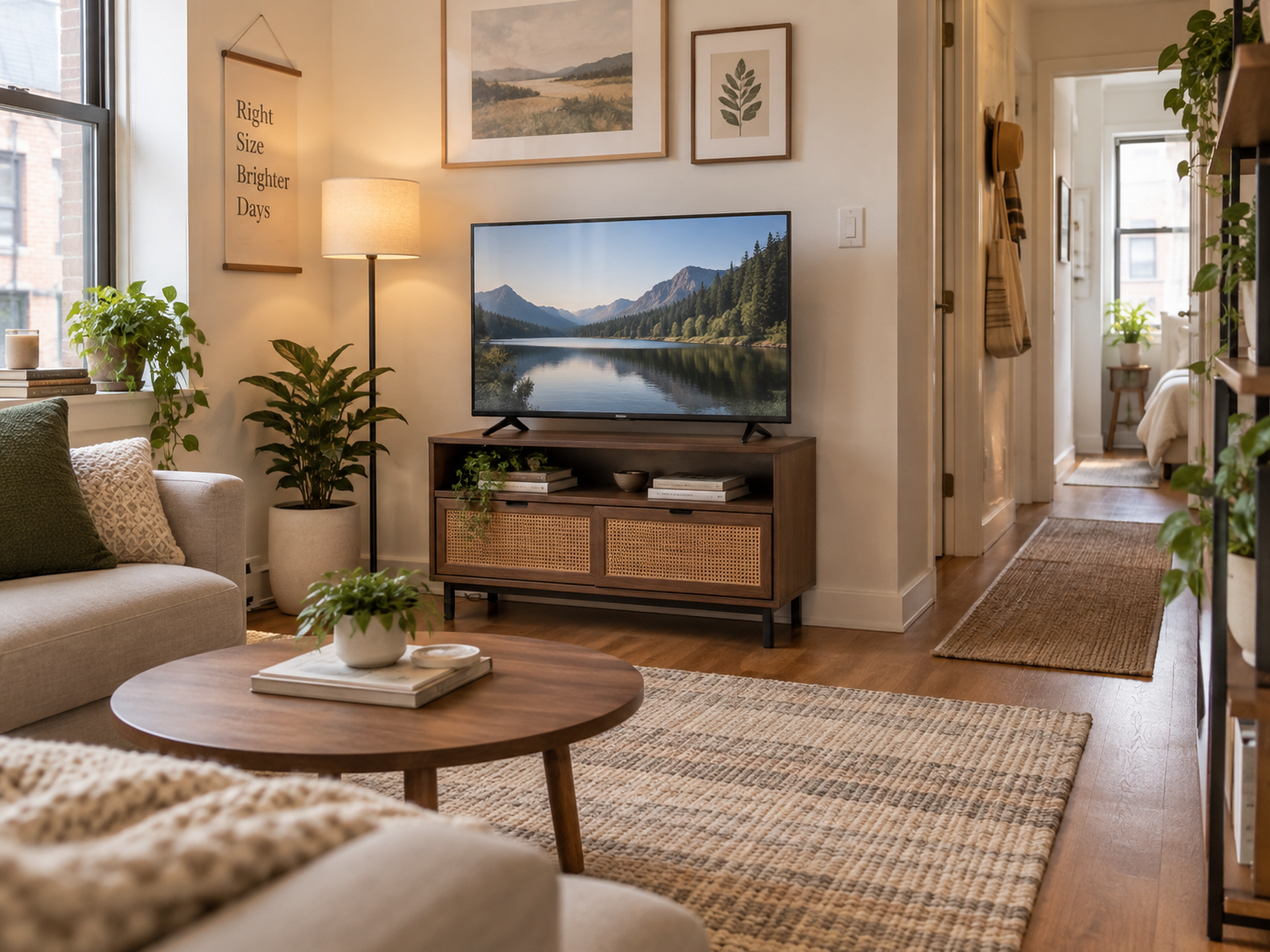
Small TV Stands for Small Spaces: 5 Fit-First Options to Check Before You Buy
A TV stand can look compact on a product page and still be the wrong fit for your room.
The mistake is usually simple: measuring only the stand.
For a small living room, bedroom, studio, or rental, there are really two different fit questions:
- Will the TV stand fit the room?
- Will your actual TV fit safely on that stand?
Those are not the same thing.
A stand may be wide enough according to a retailer’s screen-size recommendation, but that still does not prove that your TV’s pedestal or feet will sit fully on the usable top surface. A cabinet may fit neatly against the wall, but drawers or doors may need more space when opened. An open media stand may help keep AV components less enclosed, but that does not create one universal ventilation-clearance number for every device.
That is why this guide uses a Fit-First sequence:
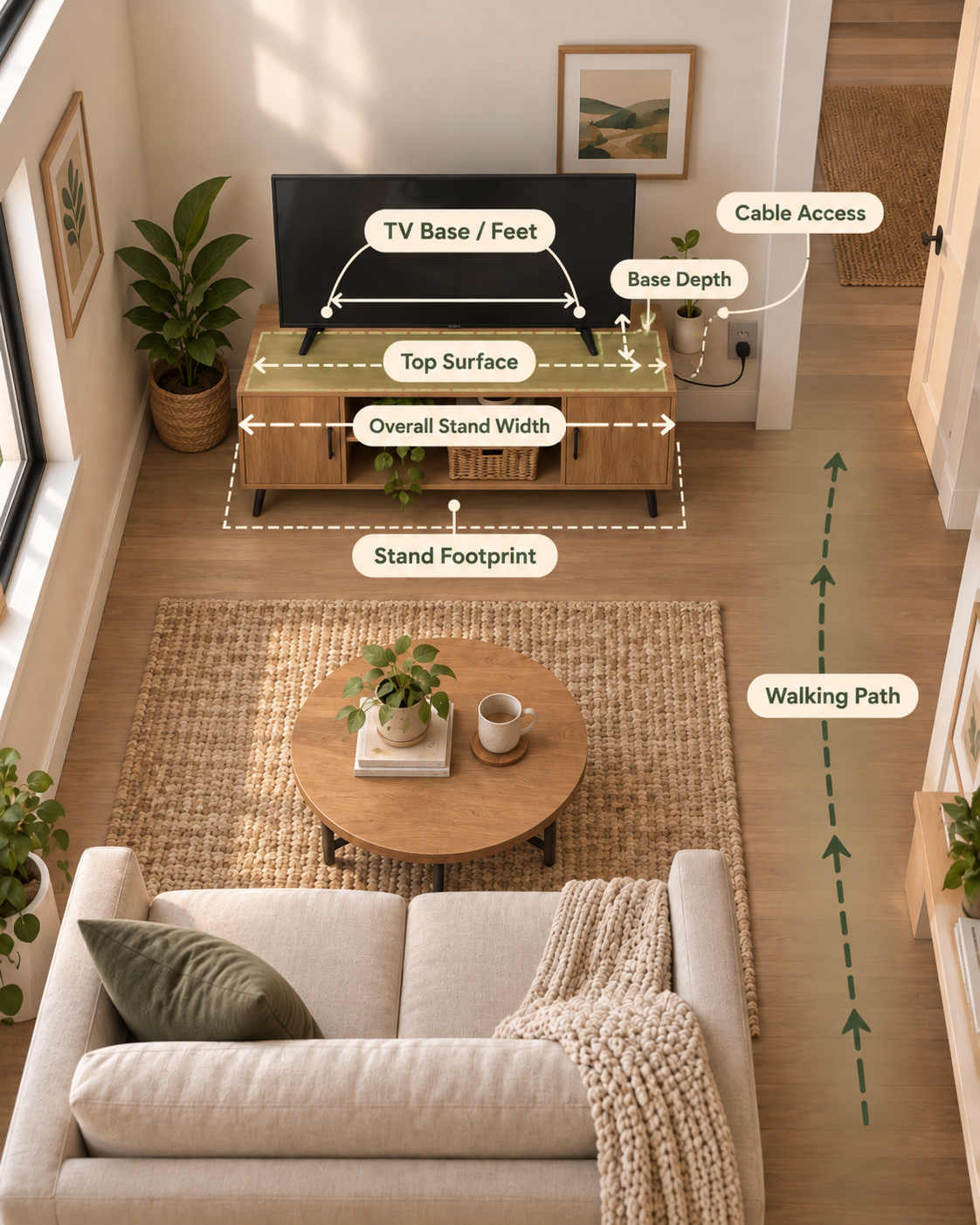
TV base / feet fit → top-surface depth → stand footprint → cable / ventilation space → door / drawer opening → walking clearance
The five options below fill different small-space roles. They are not ranked from “best” to “worst.” The useful question is which role matches your room, your TV, and the way you actually use the storage.
The first measurement is not the TV’s diagonal
Retailers often describe a stand as suitable for a TV up to a certain screen size. That can be useful as a first filter, but it is not enough to establish physical fit.
Before you choose a stand, measure your own TV.
At minimum, check:
- the distance between the outermost contact points of the TV feet, or the full width of a center pedestal;
- the front-to-back depth of the TV feet or pedestal;
- the TV’s actual weight;
- whether cables, power plugs, or adapters project behind the TV;
- whether the TV manufacturer requires specific ventilation or placement clearances.
Then compare those measurements with the stand’s actual usable top surface.
If a product page does not separately state usable top-surface dimensions, keep that field as unknown until you can verify it. Do not assume that the overall cabinet width or depth is identical to the flat area available for your TV.
Quick comparison: 5 small-space TV-stand roles
| Product | Role | Overall size | Stated TV-size compatibility | Verified TV weight limit | Cable / storage notes | Important fit guard |
|---|---|---|---|---|---|---|
| IKEA LACK 906.314.00 | Ultra-compact open low stand | 35 3/8" W × 14 1/8" D × 17 3/4" H | Up to 32" | 22 lb | Open shelf; rear wire-management opening | TV base / feet fit is not stated |
| IKEA BRIMNES 905.694.84 | Compact drawer-storage stand | 47 1/4" W × 16 1/8" D × 20 7/8" H | Up to 45" | 35 lb | Cable outlets; drawer storage | Drawer-open clearance is not stated |
| Crosley Camden Corner TV Stand | Corner-oriented cabinet stand | 47.75" W × 20" D × 22" H | Up to 50" | UNKNOWN | Cabinets, open center shelf, two cable holes | 100 lb total hold capacity is not verified max TV weight |
| TransDeco Multifunction AV Stand A-91701064 | Tall open AV / media stand | 32" W × 19.5" D × 30" H | Up to 35" | Top shelf listed at 150 lb | Open shelving; cable management | Retailer airflow statement applies to the open-shelf design, not a universal clearance |
| IKEA BESTÅ 705.660.33 | Shallow modular floor-or-wall TV bench | 47 1/4" W × 15 3/4" D × 15" H | Up to 45" | 35 lb | Several cord outlets; optional doors/interiors sold separately | Wall-mountability is not automatically renter-safe |
Important: the stated screen-size compatibility in this table is the manufacturer or retailer’s published guidance. It does not prove that a particular TV pedestal or pair of feet will fit the stand.
1. IKEA LACK 906.314.00 — the ultra-compact open option
The 35 3/8-inch-wide LACK is the smallest overall footprint in this five-product set.
Its published dimensions are:
- Width: 35 3/8 inches
- Depth: 14 1/8 inches
- Height: 17 3/4 inches
- Maximum TV weight: 22 lb
- Maximum shelf load: 31 lb
IKEA states that this bench suits a TV up to 32 inches, and the opening at the back is designed to help gather and organize wires.
For a genuinely tight room, that narrow overall width is useful because it gives you a clear baseline for how little floor and wall length a conventional TV unit can occupy.
But this is also the product that makes the Fit-First rule especially important.
A 32-inch screen recommendation does not tell you the spacing between your TV’s feet. The stand’s separately measured usable top surface is not stated in the evidence used for this guide. So you still need to compare your own TV pedestal or feet with the actual top before purchase.
Check before buying
Choose this role if your priority is a simple, open, low-footprint stand and you do not need closed storage.
Measure:
- your TV base or foot spacing;
- your TV’s weight against the 22 lb limit;
- the 14 1/8-inch overall stand depth against your wall zone;
- the path of power and HDMI cables through the rear opening;
- your remaining walking space after the stand is placed.
IKEA also publishes a tipping-hazard warning requiring the unit to be securely anchored. For renters, that means the anchoring requirement belongs in the buying decision, not after the furniture arrives.
2. IKEA BRIMNES 905.694.84 — compact footprint with drawer storage
The BRIMNES changes the role from open-and-simple to compact storage furniture.
Its published dimensions are:
- Width: 47 1/4 inches
- Depth: 16 1/8 inches
- Height: 20 7/8 inches
- Maximum TV weight: 35 lb
- Maximum shelf load: 29 lb
- Maximum drawer load: 20 lb
IKEA states that this TV unit suits a TV up to 45 inches. It also includes cable outlets at the back and drawer storage.
The key small-space advantage is obvious: cables and media accessories do not all have to remain visible on open shelves.
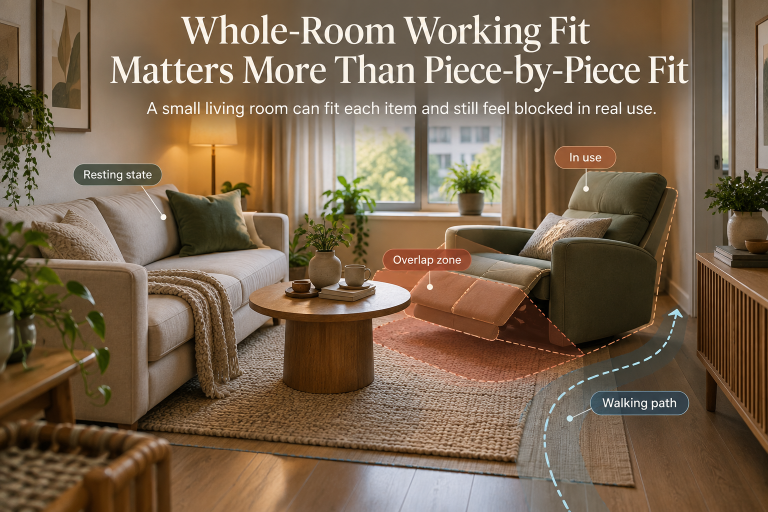
The key Fit-First issue is less obvious: a drawer changes the working footprint.
The cabinet may fit while closed, but you still need enough usable room in front of it to open the drawer and stand there comfortably. The source material used here does not state a required drawer-open clearance, so this guide does not invent one.
Check before buying
Measure the closed cabinet first, then treat drawer use as a second state.
Ask:
- Does the 16 1/8-inch cabinet depth work on the wall?
- Where will the drawer extend relative to a coffee table, bed, sofa, or walking path?
- Can cables reach the rear outlets without being sharply bent or crushed?
- Does your TV remain within the stated 35 lb maximum TV weight?
- Do the TV feet or pedestal fit the real top surface?
BRIMNES also carries anchoring guidance, and its drawer front includes tempered glass. Those are product-specific constraints worth preserving in the decision rather than treating the stand as a generic 47-inch cabinet.
3. Crosley Camden Corner TV Stand — use the corner, but measure the corner
A corner TV stand solves a different problem from a straight media bench: it can use a part of the room that standard rectangular furniture may leave awkwardly occupied.
The Target listing used for this guide gives the Camden Corner TV Stand these specifications:
- Width: 47.75 inches
- Depth: 20 inches
- Height: 22 inches
- Listed TV screen size: up to 50 inches
- Total hold capacity: 100 lb
- Maximum shelf capacity: 15 lb
- Storage: two cabinet areas plus open center storage
- Cable management: two pre-cut holes in the back
- Assembly: adult assembly required; tools not provided
The center section and cabinets use adjustable or removable shelves, which gives this product a different storage role from the open LACK and drawer-based BRIMNES.
But two evidence guards matter here.
First, 100 lb total hold capacity is not the same field as a verified maximum TV weight. The listing gives a total hold capacity, but the evidence used here does not separately establish a TV-only maximum load. This guide therefore keeps the max-TV-weight field as UNKNOWN.
Second, “corner TV stand” does not mean “fits every corner.”
Check before buying
Do not measure only the two walls.
Also look at:
- baseboards or trim that prevent the stand from sitting where you expect;
- the stand’s 20-inch depth relative to the usable corner;
- the actual TV feet or pedestal;
- cabinet-door opening paths;
- nearby doors, curtains, heaters, or vents;
- walking clearance around the front edges of the stand.
The corner role can save usable wall length, but only if the furniture geometry works with the real corner geometry.
4. TransDeco Multifunction AV Stand A-91701064 — a taller open AV role
The TransDeco option is not a low media bench. Its role is a taller, open AV stand.
The product description used for this guide states:
- Width: 32 inches
- Depth: 19.5 inches
- Height: 30 inches
- Listed TV screen size: up to 35 inches
- Top shelf capacity: 150 lb
- Middle shelf capacity: 80 lb
- Bottom shelf capacity: 185 lb
- Cable management: integrated cable-management system
- Design: open shelving
Target’s product copy says the open shelf design increases airflow around AV components.
That statement is useful, but it has a strict boundary: it is a claim about this open-shelf configuration. It does not establish one universal ventilation distance for televisions, amplifiers, game consoles, or other electronics.
If a device manufacturer specifies required airflow or clearances, follow the device-specific instructions.
Check before buying
This role makes the most sense when vertical media storage is more useful than a long, low cabinet.
Measure:
- the 32-inch stand width;
- the deeper 19.5-inch footprint;
- sight line and viewing height for your own seating position;
- TV pedestal or feet;
- cable routes behind and between shelves;
- the size and ventilation needs of each AV component.
The top-shelf load figure is evidence for shelf capacity, but it still does not prove that a particular TV base geometry will fit the top.
5. IKEA BESTÅ 705.660.33 — shallow, modular, and installation-sensitive
BESTÅ is the shallow modular role in this set.
Published measurements are:
- Width: 47 1/4 inches
- Depth: 15 3/4 inches
- Height: 15 inches
- Maximum TV weight: 35 lb
IKEA states that this bench suits a TV up to 45 inches and provides several cord outlets at the back.
The main difference is configuration.
The unit can stand on the floor or be mounted on the wall, while doors, hinges, and interior components are sold separately.
That flexibility can be valuable in a small room because a shallow, low bench gives you several layout paths. But it also creates more installation questions.
IKEA states that a floor-standing TV bench must be fixed to the wall, and that wall-hung load depends on the wall material. It also gives specific support requirements for the 47 1/4-inch-wide bench.
Check before buying
For a renter, treat “can be wall-mounted” as an installation fact, not as a universal recommendation.
Before committing, verify:
- whether your lease permits the required wall fixing;
- the actual wall construction and suitable fasteners;
- whether you will use the unit floor-standing or wall-mounted;
- whether optional doors or interiors are part of your planned configuration;
- door-opening clearance if you add doors;
- your TV base geometry and 35 lb TV weight limit;
- cable access through the rear outlets.
Do not assume the optional doors, hinges, or interiors are included with the base TV unit.
A screen-size label is only one filter
Suppose two stands both say “up to 45-inch TV.”
That does not make them equivalent.
Your TV may use:
- two widely spaced feet near the screen edges;
- a narrow center pedestal;
- a deep pedestal that projects backward;
- an external power brick;
- HDMI plugs that need extra rear room.
So the safest buying sequence is:
1. Measure the TV base first
Record:
- outer foot-to-foot span;
- pedestal width;
- base depth;
- TV weight.
2. Check the stand’s usable top
If the manufacturer gives only overall stand dimensions and does not separately state the usable top, do not assume those numbers are identical.
3. Check the stand footprint in the room
Mark the full width and depth on the floor or wall zone.
Painter’s tape can make this easier without moving furniture.
4. Add the working state
For closed storage, ask what changes when you open a drawer or cabinet door.
For a corner stand, check the actual corner and the furniture edges.
For a wall-mounted unit, include mounting and wall constraints.
5. Check cable and ventilation needs separately
A cable-management hole tells you that there is a route for cables. It does not tell you that every connector, adapter, or power brick will fit.
Likewise, open shelving can reduce enclosure around electronics, but this guide does not use a universal ventilation-clearance number. Check the instructions for the TV and AV devices you plan to use.
6. Preserve the walking path
A TV stand is not a good small-space fit if the cabinet technically fits but forces people to squeeze between the stand and the sofa, bed, table, or doorway.
The room has to work after the furniture is installed.
Which role should you shortlist?
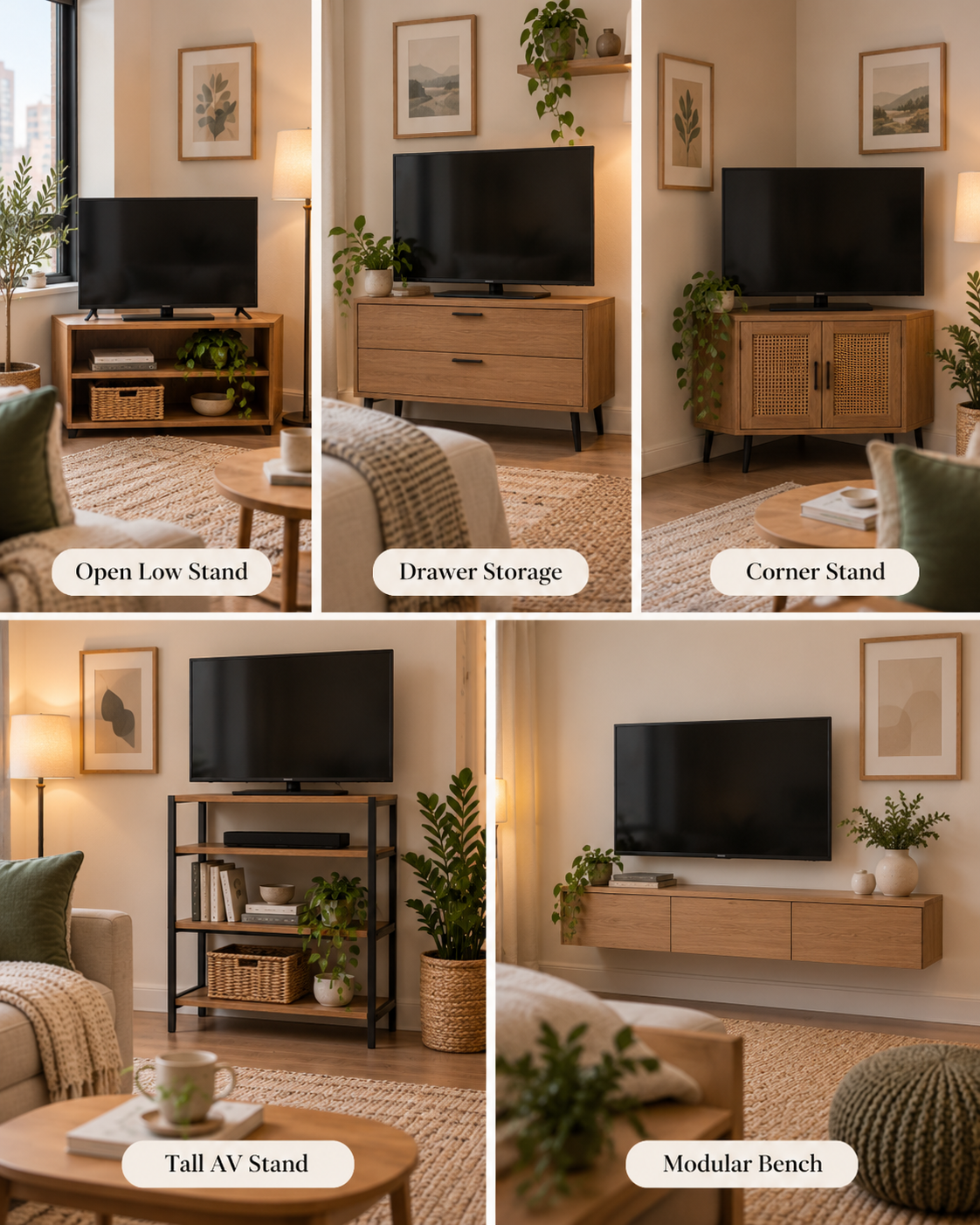
Use the five products as role examples rather than as a universal ranking.
Choose the LACK role if your main problem is minimizing the stand’s footprint and you are comfortable with open storage.
Choose the BRIMNES role if you want a compact cabinet with drawers and can provide the extra working space needed to use them.
Choose the Camden corner role if a corner is genuinely the best placement zone and you can verify the real corner geometry.
Choose the TransDeco role if vertical AV storage and open shelving matter more than a low media-bench profile.
Choose the BESTÅ role if you want a shallow modular bench and are prepared to resolve the anchoring, wall, support, and optional-component questions before installation.
The final choice should come after your TV-base measurement, not before it.
Fit-first checklist before you buy
Before ordering any small TV stand, confirm all of these:
- [ ] TV foot-to-foot span or pedestal width measured
- [ ] TV base depth measured
- [ ] TV weight checked
- [ ] Stand’s actual usable top verified where available
- [ ] Stand width, depth, and height marked in the room
- [ ] Cable route checked
- [ ] Device-specific ventilation requirements checked
- [ ] Drawer or door opening zone checked
- [ ] Corner geometry checked if applicable
- [ ] Walking path remains usable
- [ ] Anchoring / wall requirements understood
- [ ] Optional components distinguished from included components
- [ ] Delivery and assembly requirements reviewed
If one of those fields is still unknown, keep it unknown until you can verify it.
That is safer than turning a retailer category label into a fit guarantee.
Methodology and source transparency
We did not physically test these five TV stands.
This guide compares currently published manufacturer and retailer information for the exact product identities listed above. We used source-backed dimensions, stated TV-size compatibility, weight limits where specifically surfaced, storage configuration, cable-management features, assembly information, and product-specific warnings.
Where the available source did not provide a field — such as exact TV pedestal/feet compatibility, separately stated usable top-surface dimensions, drawer-open clearance, or a product-specific maximum TV weight for the Crosley Camden — that field remains UNKNOWN / NOT SURFACED.
We did not infer specifications from adjacent models.
We also did not treat retailer-stated screen-size compatibility as proof that a specific television’s feet or pedestal will fit.
Product specifications and availability can change, so verify the current product page and your own TV dimensions before purchase.
Product sources used
- IKEA U.S. — LACK TV unit, Article 906.314.00
- IKEA U.S. — BRIMNES TV unit, Article 905.694.84
- Target U.S. — Crosley Camden Corner TV Stand for TVs up to 50"
- Target U.S. — TransDeco Multifunction AV Stand for up to 35" LCD / LED TVs, A-91701064
- IKEA U.S. — BESTÅ TV unit, Article 705.660.33
Final takeaway
For a small room, the right TV stand is not simply the narrowest cabinet or the one with the biggest screen-size label.
The useful question is:
Does my TV fit the stand, and does the stand still let the room work?
Measure the TV base. Check the usable top. Map the full furniture footprint. Account for cables, opening storage, anchoring, and the walking path.
That is the difference between a stand that technically fits against the wall and a TV setup that actually fits your space.


One Comment