
Desks for Small Spaces: A Fit-First Guide to Width, Depth, and Chair Clearance
A desk can fit the wall and still fail the room.
That is the core problem with shopping for desks in a small apartment, bedroom, studio, or compact home office. A product listing might show a desk that looks slim and space-saving, but the listed width is only one part of the real footprint.
You also need to think about:
- how far the desk projects into the room;
- whether your chair can move in and out comfortably;
- whether a drawer, closet door, or bedroom door can still open;
- whether your monitor, laptop, keyboard, and other gear actually fit the work surface;
- and whether the desk still works once you account for the space around it.
This guide uses a Fit-First approach. Instead of starting with style or marketing labels, we start with the room, then compare published product dimensions and features.
Renternook did not physically test the desks in this article. Product details below are based on manufacturer and retailer specifications available during research. Recheck current dimensions and availability before buying.
Measure Before You Shop
Before opening product pages, measure the space where the desk will actually live.
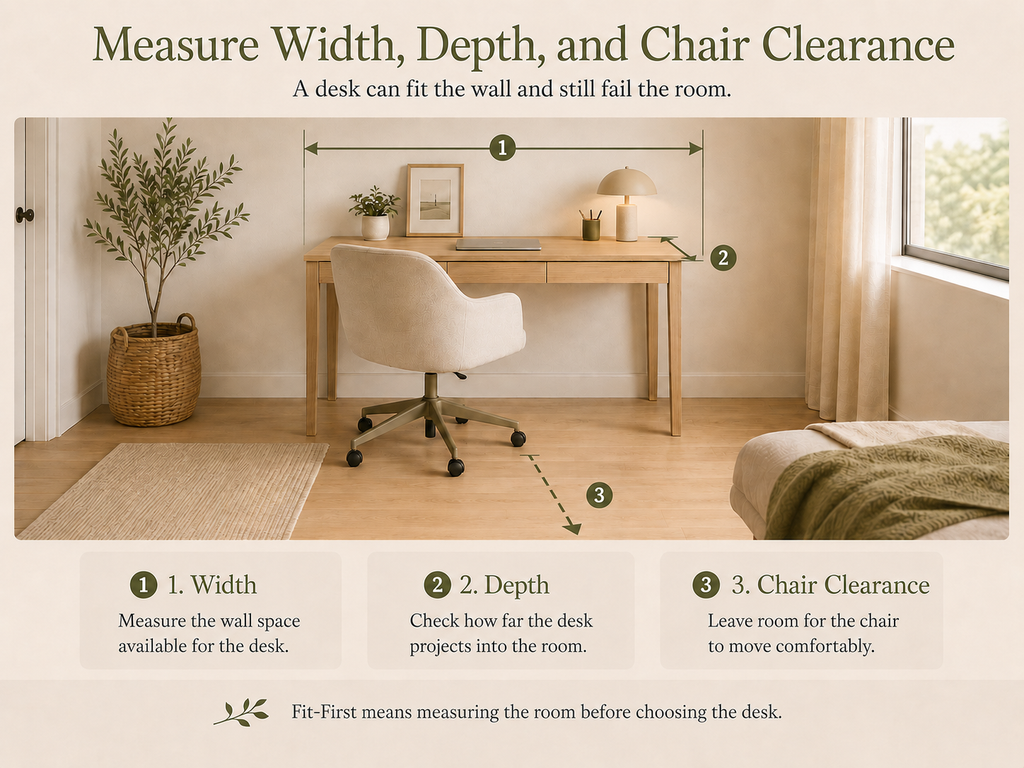
1. Measure the available width
Measure the usable wall, nook, or corner width—not just the empty stretch you can see.
Check for:
- baseboards or trim;
- nearby furniture;
- door frames;
- drawers or cabinet doors that need to open;
- outlets or cables that may affect placement.
A desk that is 36 inches wide needs more than a theoretical 36-inch line on the wall if nearby objects make part of that space unusable.
2. Measure the available depth
Depth is the measurement from the wall toward the center of the room.
This is where many “small” desks become less small than expected.
The 28.75-inch-wide IKEA MICKE, for example, is still 19.625 inches deep, while a wider desk may be shallower. Width and depth solve different problems, so measure both.
3. Check your actual chair movement
Chair clearance is a user-space planning constraint, not a desk specification.
There is no single residential number in this research that should be treated as the universal required space behind every desk.
A safer method is to use your real chair:
- mark the desk footprint on the floor;
- place the chair where you would normally sit;
- pull the chair back as you normally would to sit down or stand up;
- check whether it collides with a bed, wall, closet, door, or other furniture;
- if someone needs to walk behind you, check that separately.
This gives you a room-specific answer instead of relying on a generic number that may not match your chair or layout.
4. Check equipment before assuming a shallow desk will work
A shallow desk saves floor depth, but it also gives you less front-to-back work surface.
If you use a monitor, remember that workstation guidance and desk depth are not the same thing. OSHA’s monitor guidance says to place the monitor directly in front of the user and at least 20 inches away; it also notes that a generally preferred viewing distance is 20 to 40 inches. That does not mean every desk must be 20 inches deep. Your monitor stand, keyboard position, viewing distance, and room layout all affect the final setup. Source: https://www.osha.gov/etools/computer-workstations/components/monitors
Product Specs vs. Room Constraints
A Fit-First decision gets easier when you separate what the product page can prove from what only you can measure in your home.
| Product specifications | User-space planning constraints |
|---|---|
| Desk width | Available wall/nook width |
| Desk depth | How far the setup can project into the room |
| Desk height | Your chair and seated position |
| Drawer/shelf dimensions when published | Whether the storage is useful for your gear |
| Under-desk or chair-opening dimensions when published | Your body, chair, posture, and movement |
| Folded/open dimensions when published | Where the desk and chair go while folding |
| Assembly or wall-mount requirement | Lease rules, wall type, placement, and circulation |
The key rule is simple:
Do not turn a room-planning constraint into a manufacturer specification.
5 Desks for Small Spaces at a Glance
Product links below are direct, non-affiliate links to the manufacturer or a current major-retailer product page.
| Desk | Published dimensions | Fit-First role |
|---|---|---|
| IKEA MICKE | 28.75 × 19.625 × 29.5 in | Narrow non-folding option |
| Ashley Jaspeni 36” Desk | 36 × 18 × 29.5 in | Shallower open-frame option |
| West Elm Mid-Century Mini Desk | 36 × 20 × 30 in | Compact drawer desk |
| Branch Daily Desk 36” | 36 × 24 × 28.5 in | Deeper work-surface option |
| Costway 31” Folding Desk | 31 × 18 × 29 in (manufacturer-listed L × W × H) | Fold-away option |
Quick caveats
- IKEA MICKE: narrow width does not eliminate depth or chair-planning needs.
- Ashley Jaspeni: published chair-opening dimensions are not the same as room clearance.
- West Elm Mini: check drawer and leg geometry against your actual chair.
- Branch Daily Desk: deepest option in this shortlist.
- Costway: check the open footprint, folding path, folded state, and chair storage separately.
1. IKEA MICKE — Narrow Conventional Desk With a Drawer
Published dimensions: 28.75”W × 19.625”D × 29.5”H
Model: IKEA MICKE, 302.130.76
Check current product page (non-affiliate): https://www.ikea.com/us/en/p/micke-desk-white-30213076/
The MICKE is the narrowest non-folding desk in this shortlist by published width.
IKEA also lists:
- height under furniture: 24.75”;
- drawer interior: 24.375”W × 14.125”D;
- built-in cable management;
- assembly required.
Why it can make sense in a small room
If your main constraint is wall width, the MICKE gives you a relatively narrow 28.75-inch footprint while still functioning like a conventional desk with a drawer.
That makes it easier to compare against spaces where a 36-inch-wide desk may simply be too wide.
What to check before buying
Do not stop at the width.
Its listed overall depth is 19.625 inches—nearly 20 inches before you account for chair movement or circulation.
Also check whether the published under-desk height and drawer position work with your actual chair and seated posture.
Fit-First takeaway: strong candidate when width is the main constraint, but depth and chair movement still need their own check.
2. Ashley Jaspeni — Shallower Open-Frame Option
Published dimensions: 36”W × 18”D × 29.5”H
Model: Ashley Jaspeni H020-110
Check Ashley product page (non-affiliate): https://www.ashleyfurniture.com/p/jaspeni_home_office_desk/H020-110.html
The Jaspeni is wider than the MICKE, but it is shallower.
Ashley publishes:
- 36” width;
- 18” depth;
- 29.5” height;
- chair opening: 27.75”W × 14.88”D × 22.63”H;
- assembly required.
Why it can make sense in a small room
This is a good example of why “small desk” should not mean “small width only.”
At 36 inches wide, it needs more wall space than the MICKE. But its 18-inch depth may be easier to place in a room where front-to-back floor space is the bigger problem.
What to check before buying
The published chair opening describes the geometry under the desk. It does not tell you how much room your chair needs behind the desk to move, sit, stand, or allow someone to walk past.
That part still depends on your real chair and room.
Fit-First takeaway: consider it when a shallow desk matters more than minimizing width.
3. West Elm Mid-Century Mini Desk — Compact Drawer Desk
Published dimensions: 36”W × 20”D × 30”H
Check West Elm product page (non-affiliate): https://www.westelm.com/products/7706880/?sku=7706880
West Elm publishes several useful dimensions for the 36-inch Mid-Century Mini Desk:
- overall size: 36”W × 20”D × 30”H;
- drawer: 34”W × 16”D × 3”H;
- front leg spacing: 31.8”;
- back-to-front leg spacing: 15.9”;
- clearance underneath: 25”;
- assembly required.
Why it can make sense in a small room
This option gives you several published dimensions beyond the overall size.
That does not guarantee fit, but it helps you make a more informed comparison—especially if you want a drawer and need to understand how the desk structure may interact with your chair.
What to check before buying
A 20-inch depth sits between the shallower Jaspeni and the deeper Branch Daily Desk in this shortlist.
If you are placing the desk in a bedroom or narrow passage, measure the full room depth with the chair pulled out—not only the desk itself.
Fit-First takeaway: useful if you want a compact furniture-style desk with a published 34”W drawer and more published under-desk geometry.
4. Branch Daily Desk 36” — Deeper Conventional Work Surface
Published dimensions: 36”W × 24”D × 28.5”H
Check current product page (non-affiliate): https://www.branchfurniture.com/products/daily-desk
Branch lists the 36-inch Daily Desk with:
- 36” width;
- 24” depth;
- 28.5” height;
- laminated MDF surface;
- powder-coated steel frame;
- assembly required.
Why it can make sense in a small room
This is the deepest desk in the five-product shortlist.
That may sound like a disadvantage in a small room, but depth is a trade-off—not automatically a flaw.
Its 24-inch listed depth gives it more front-to-back surface depth than the other shortlisted desks, while also taking more room depth.
What to check before buying
This is the option where measuring only width would be especially misleading.
It shares a 36-inch width with the Ashley and West Elm desks, but its 24-inch depth changes the real footprint considerably.
Fit-First takeaway: compare this desk when work-surface depth matters enough to justify greater room intrusion.
5. Costway 31” Folding Desk — Fold-Away Option for Multipurpose Rooms
Published unfolded size: 31” × 18” × 29” (manufacturer-listed L × W × H)
Check current product page (non-affiliate): https://www.costway.com/31-space-saving-folding-computer-desk-for-home-office.html
Published folded dimensions: 31” × 3.5” × 29” (manufacturer-listed L × W × H)
Costway lists:
- unfolded size:
31" × 18" × 29" (L × W × H); - folding size:
31" × 3.5" × 29" (L × W × H).
Dimension note: Costway’s own product page is internally inconsistent about the folded-size order. Its feature text says the desk folds to
31" × 29" × 3.5", while the specifications table lists31" × 3.5" × 29" (L × W × H). Because those two source presentations conflict, this guide keeps the specifications-table order when quoting the folded size and does not relabel3.5"as a depth or width. For the open state, use31 × 18 inchesonly as the two-dimensional footprint.
- no assembly required;
- powder-coated metal frame and wood board.
Why it can make sense in a small room
A folding desk changes the question from:
“How much space does the desk use?”
to:
“How much space does it use while working, while folding, and while stored?”
That can be useful in a bedroom, studio, or multipurpose room where the workstation does not need to remain open all day and a thinner folded profile matters.
What to check before buying
The folded state has a much thinner profile, but the room still needs:
- enough open floor space for the manufacturer-listed 31” × 18” horizontal footprint;
- a clear folding/unfolding path;
- somewhere for the chair to go when the desk is folded;
- a practical storage position for the folded desk.
Do not treat “folding” as the same thing as “zero-space.”
Fit-First takeaway: potentially useful when the room has to switch functions, but check both the open and stored states.
Width vs. Depth: The Trade-Off That Changes the Room
The shortlist shows why one “small desk” label is not enough.
Narrower does not always mean shallower
The IKEA MICKE is only 28.75 inches wide, but its listed depth is 19.625 inches.
The Ashley Jaspeni is much wider at 36 inches, yet shallower at 18 inches.
So if your wall is short, MICKE may be easier to place. If the room is narrow from wall to walkway, the Jaspeni may be easier to plan around.
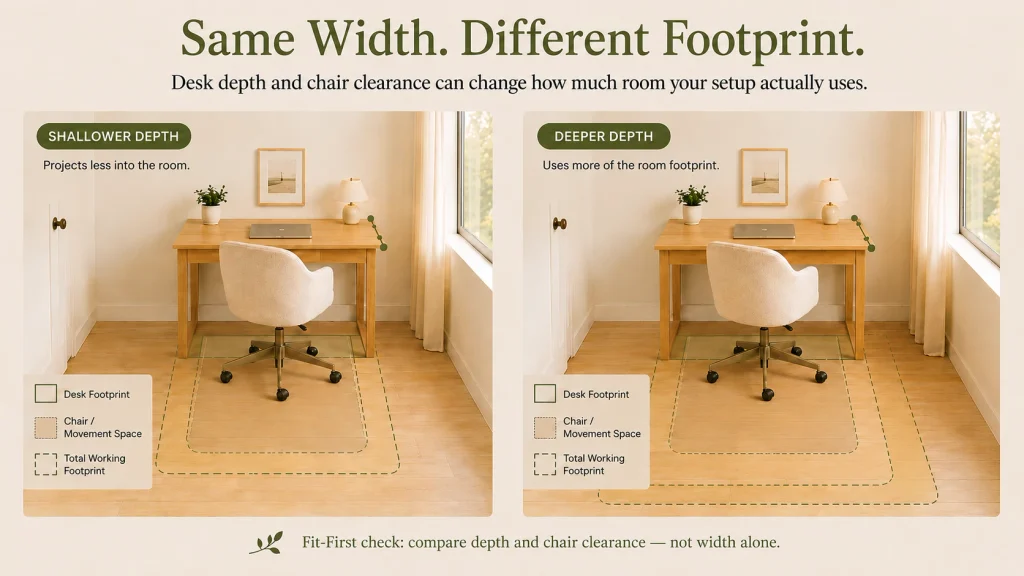
Same width can produce very different footprints
Three desks in this guide are around 36 inches wide:
- Ashley Jaspeni: 18” deep
- West Elm Mid-Century Mini: 20” deep
- Branch Daily Desk: 24” deep
That six-inch depth spread can materially change how far the workstation projects into a bedroom or home office.
The better question is not:
“Which desk is smallest?”
It is:
“Which set of dimensions fits the constraint I actually have?”
Chair Clearance: The Measurement People Forget
Chair clearance is one of the easiest parts of a desk setup to underestimate because it usually does not appear as a single product dimension.
Some manufacturers publish under-desk measurements such as:
- chair-opening dimensions;
- under-furniture height;
- leg spacing;
- apron or drawer geometry.
Those are useful product specifications, but they still do not tell you how far your chair needs to move behind the desk.
A practical Fit-First chair test
Before buying:
- Tape or mark the desk’s published width and depth on the floor.
- Put your current chair in the expected seated position.
- Sit down and pull the chair back naturally.
- Stand up as you normally would.
- Check the nearest bed, wall, closet, or door.
- If someone needs to walk behind you, test that separately.
This method avoids pretending there is one universal residential number that works for every room, person, and chair.
Small-Space and Renter Considerations
Renters often have an extra constraint: they may want a workspace that does not require a permanent installation.
That is one reason the core shortlist here favors freestanding options.
But even then, be precise:
- freestanding does not automatically mean no drilling;
- anti-tip or safety instructions may still apply to some furniture;
- lease rules are property-specific;
- wall-mounted desks require a separate installation decision;
- folding desks reduce stored footprint but still need a working footprint and a place for the chair.
The Costway folding desk is the clearest example in this shortlist of offering a thinner folded profile without adding a wall-mounted installation requirement on the cited product page.
That does not make it universally “better for renters.” It simply creates a different installation and storage trade-off.
What Renters Should Check
For renters, the useful distinction is not whether a desk is marketed as “renter-friendly,” but what the product actually requires for placement, assembly, storage, and safety:
- Freestanding shortlist: the five core picks do not require a wall-mounted desk installation on their cited product pages.
- Fold-away option: Costway adds a storage-state trade-off that can matter in a multipurpose rental room.
- Installation caveat:
freestandingis not automatically the same asno-drill; product safety instructions and lease conditions remain separate checks. - Lease boundary: Renternook does not claim that any desk is universally approved for rentals or that a renter may ignore wall/anti-tip requirements.
This keeps the guidance useful without turning it into an unsupported product-performance or lease-compliance claim.
Common Mistakes When Buying a Desk for a Small Space
Mistake 1: Measuring only the wall width
Width tells you whether the desk fits side-to-side.
It does not tell you how much room the desk, chair, and person need front-to-back.
Mistake 2: Ignoring depth
A deeper desk can improve usable work-surface space while also making a small room feel tighter.
Measure room depth, not just desk width.
Mistake 3: Ignoring under-desk geometry
Drawers, aprons, shelves, and leg positions can change how a chair fits even when the overall desk dimensions look fine.
Use published chair-opening or under-desk dimensions when available.
Mistake 4: Forgetting the chair
The desk footprint is not the entire working footprint.
Test your actual chair movement.
Mistake 5: Assuming the word “small” proves fit
“Compact,” “small,” and “space-saving” are marketing descriptions.
Your tape measure is more useful.
Mistake 6: Assuming foldable means zero storage burden
A folding desk still needs a place to open, close, store, and pair with a chair.
Measure all of those states.
FAQ
What desk depth works for a laptop?
There is no single depth that fits every laptop setup.
Start with the laptop’s real footprint, how far you prefer the screen from your eyes, whether you use an external keyboard or mouse, and how much front-to-back room you have.
A shallow desk may be enough for a simple laptop setup, but it can become more restrictive as you add equipment.
What if I use a monitor?
Plan the workstation around the monitor, stand or arm, keyboard, and preferred viewing distance—not the desk depth alone.
OSHA’s monitor guidance says to place the monitor directly in front of the user and at least 20 inches away. Treat that as workstation guidance, not a rule that the desk itself must be 20 inches deep. Source: https://www.osha.gov/etools/computer-workstations/components/monitors
How do I measure chair clearance?
Use your actual chair.
Mark the proposed desk footprint, place the chair where you would sit, then pull it back and stand up normally. Check walls, beds, closets, doors, and any circulation path behind you.
Is a wall-mounted desk renter-friendly?
It can work in some rentals, but wall mounting introduces questions about wall material, fasteners, lease rules, repair obligations, and installation.
Do not assume a wall-mounted desk is automatically acceptable in a rental.
Is a folding desk better for a bedroom?
It may be useful when a bedroom has to serve multiple functions because the desk has a thinner folded profile when not in use.
But “better” depends on whether the room has a practical folding path, storage position, chair location, and enough open workspace when the desk is in use.
Final Takeaway
For a small home office, bedroom, studio, or apartment, the goal is not to find the desk with the smallest marketing label.
The goal is to find the desk whose trade-offs fit your room.
Use this order:
- Measure the room first.
- Compare published desk width and depth.
- Check under-desk geometry when the manufacturer publishes it.
- Test your actual chair movement.
- Check doors, closets, beds, and circulation.
- Then choose the desk whose footprint and function make sense for your space.
A desk can fit the wall and still fail the room.
Fit-First means checking both before you buy.
Sources and Methodology
Renternook did not physically test the desks in this guide. Product dimensions and decision-relevant features were checked against the primary manufacturer or brand/retailer pages used in the Article #002 Research Evidence Pack.
Primary product sources
- IKEA MICKE Desk (302.130.76): https://www.ikea.com/us/en/p/micke-desk-white-30213076/
- Ashley Jaspeni Home Office Desk (H020-110): https://www.ashleyfurniture.com/p/jaspeni_home_office_desk/H020-110.html
- West Elm Mid-Century Mini Desk (36-inch version): https://www.westelm.com/products/7706880/?sku=7706880
- Branch Daily Desk: https://www.branchfurniture.com/products/daily-desk
- Costway 31-inch Space-Saving Folding Computer Desk: https://www.costway.com/31-space-saving-folding-computer-desk-for-home-office.html
Workstation guidance
- OSHA Computer Workstations eTool — Monitors: https://www.osha.gov/etools/computer-workstations/components/monitors
- OSHA Computer Workstations eTool — Desks: https://www.osha.gov/etools/computer-workstations/components/desks
- OSHA Computer Workstations eTool — Work Space: https://www.osha.gov/etools/computer-workstations/components/work-space
OSHA’s monitor-distance guidance is used here as workstation guidance only. It is not treated as a rule that a desk must be a specific depth.
Availability note: Product availability, pricing, dimensions, and listing content can change. Recheck the current product page before buying.

One Comment