Under-Bed Storage for Small Apartments: A Fit-First Guide to Clearance, Bin Height, and Pull-Out Space
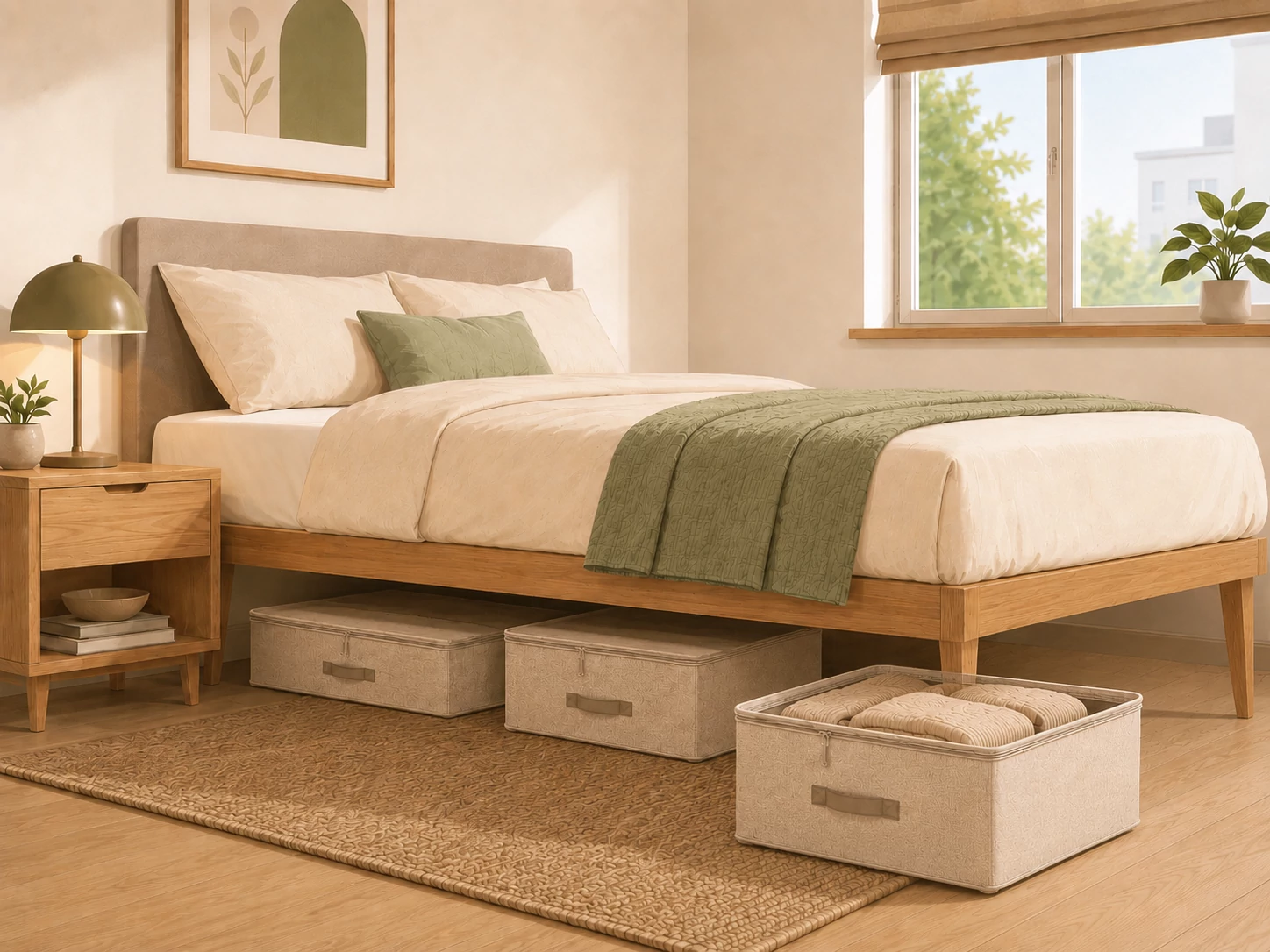
In a small apartment, under-bed space can add useful storage—but only if the container fits both the bed and the room around it.
Height is only the first check. You also need enough usable length and width, an accessible side of the bed, and a retrieval path that lets you pull out or open the storage in the direction your room allows.
That is the Fit-First approach used in this guide.
Instead of starting with capacity or a list of products, start with the space you already have:
Measure the bed → verify the container → check the retrieval path → choose the storage role.
The five products below represent five different ways under-bed storage can work: a low-profile rigid bin, a wheeled bin with directional movement, a handled fabric bin, a soft-sided storage case, and a front-access drawer.
Renternook did not physically test these products. The dimensions and access details in this guide are based on manufacturer or retailer information reviewed for this article.
Start Here: Measure the Space Under Your Bed
Before comparing products, measure the usable space under the bed—not just the nominal gap you can see.
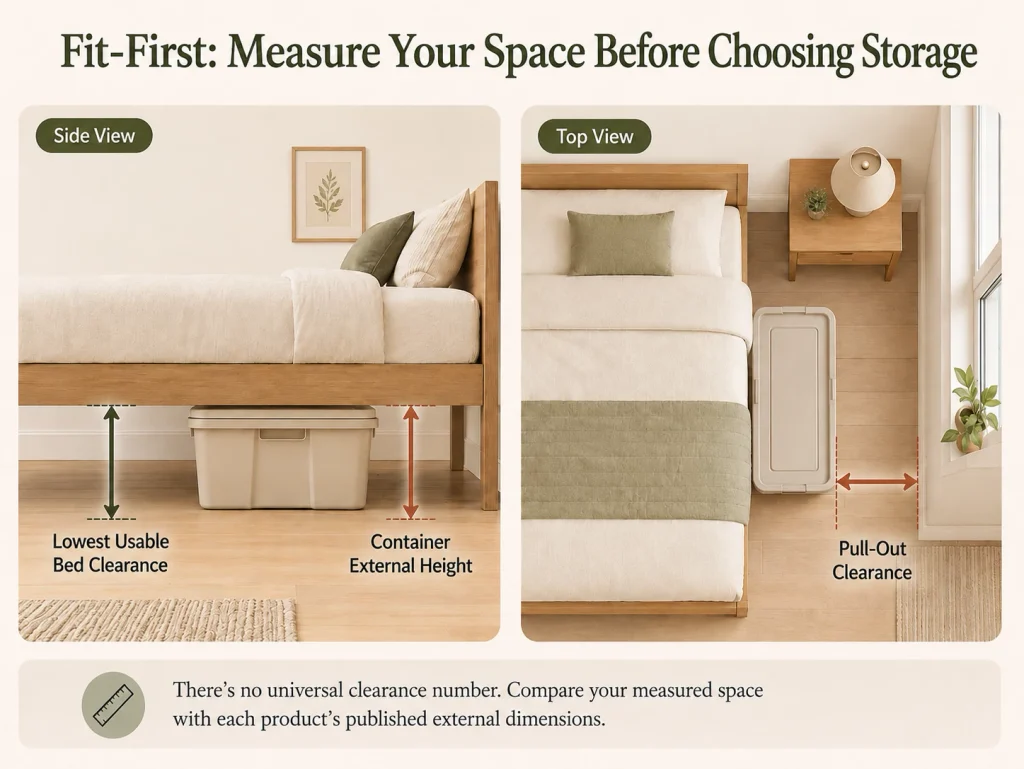
1. Measure the lowest usable clearance
Do not measure only the most open-looking part under the bed.
Look for the lowest point that could limit a container, such as a rail, support, upholstered edge, hardware, or another part of the bed frame.
That lowest usable clearance is the number you should compare with the external height of the storage product.
There is no single under-bed clearance number that works for every bed.
2. Measure the usable length and width
A bin may be short enough to clear the bed but still be too long or too wide for the usable footprint underneath it.
Measure the area that is actually available, not just the full footprint of the mattress or bed frame.
3. Decide which side you can pull from
In a small bedroom, one side of the bed may be against a wall, close to a nightstand, or blocked by another piece of furniture.
That matters because different storage formats move and open in different ways.
A drawer needs room in front of the drawer face. A wheeled bin may have a preferred direction of movement. A lidded bin may need to be pulled far enough out for you to reach the top.
4. Think about how often you need access
Storage for seasonal bedding may not need the same access pattern as items you use every week.
The right product role depends on both physical fit and how you plan to retrieve the contents.
The Fit-First Rule: Clearance Before Capacity
A large capacity number can be tempting, but capacity does not matter if the container does not fit beneath the bed or cannot be accessed in the room.
Use this order instead:
- Lowest usable bed clearance
- Product external height
- Usable under-bed footprint
- Pull-out or opening direction
- Storage role and capacity
The phrase “under-bed storage” on a product page is a category label, not proof that the item will fit your bed.
Use the product’s exact external dimensions instead.
Quick Comparison: 5 Under-Bed Storage Roles
| Product | Fit Role | Verified External Dimensions | Key Fit Check | Access Style | Main Trade-Off |
|---|---|---|---|---|---|
| Brightroom 28qt Clear Under Bed Storage Box | Low-clearance rigid lidded | 22.88” L × 16.62” W × 6” H | Compare 6” height with your lowest usable clearance | Pull whole bin + open top lid | Low height, but top-lid access differs from a drawer |
| Brightroom 60qt Underbed Clear Storage Bin with Latches | Wheeled rigid / directional pull | 35.5” L × 18.875” W × 7” H | Check whether the accessible side matches the usable wheel direction | Non-swivel wheels | Wheels are present, but movement direction is constrained |
| Brightroom Underbed Fabric Bin with Lid | Handled fabric / half-lid | Target lists 6.5” H × 12.75” W × 24.75” D | Check height and whether a handle side stays reachable | Handles on short and long sides + half-lid | Half-lid + multi-side handles create a different access pattern; handles do not prove easy sliding |
| IKEA SKUBB Storage Case | Soft-sided handled case | 35.5” W × 20.75” D × 7.5” H | Check 7.5” height and access to the handle side | Handle pull | Soft-sided form; manufacturer dust-protection claim does not mean waterproof |
| IRIS USA Underbed Storage Stackable Sliding Drawer 22 Qt 2 Pack | Drawer-style front access | 23.69” L × 17.81” W × 6” H | Make sure there is room in front of the drawer face | Sliding drawer + molded handle | No top-lid removal, but front-access space is still required |
5 Under-Bed Storage Options, Compared by Fit Role
1. Brightroom 28qt Clear Under Bed Storage Box — Low-Clearance Rigid Lidded
Target lists the Brightroom 28qt Clear Under Bed Storage Box at 22.88 inches long × 16.62 inches wide × 6 inches high.
That 6-inch external height makes it one of the lowest-height products in this five-role shortlist.
The storage box has a clear plastic base and a snap-on lid. In this shortlist, it fills the rigid-lidded role at a listed external height of 6 inches.
Fit-first check
Compare the listed 6-inch external height with the lowest usable point under your bed.
Do not assume that a bed with a nominal six-inch gap will automatically work. Your own frame geometry and obstructions determine usable clearance.
Access pattern
This is a top-lid container, so the practical question is not only whether the box slides underneath the bed. You also need to be able to pull it far enough out to reach and open the lid.
Consider it if
- vertical clearance is one of your tightest constraints;
- you want a rigid, lidded format;
- you can pull the container out far enough to access the top.
Reconsider it if
- you want to access contents without pulling out the full container;
- the room layout makes top-lid access awkward.
2. Brightroom 60qt Underbed Clear Storage Bin with Latches — Wheeled, but Direction Matters
Target lists the Brightroom 60qt Underbed Clear Storage Bin with Latches at 35.5 inches long × 18.875 inches wide × 7 inches high.
It has latches and wheels, but the wheel design creates an important Fit-First detail.
According to Target’s brand-expert Q&A, the wheels do not swivel, and the bin is maneuvered by the shorter sides.
Fit-first check
Before choosing it, look at the actual side of the bed you can access.
A wheeled bin is not automatically useful from every direction. The bin’s orientation under the bed needs to work with the side from which you can realistically pull it.
Access pattern
This is a full-bin pull-out format. The wheels change the movement mechanism, but they do not create omnidirectional access.
Consider it if
- you want a larger rigid storage format;
- your available pull direction works with the shorter-side movement described by the retailer;
- your measured lowest usable clearance can accommodate the listed 7-inch external height.
Reconsider it if
- your only usable access side conflicts with the bin’s movement direction;
- you need a product that can be pulled from any side.
3. Brightroom Underbed Fabric Bin with Lid — Multi-Side Handles and Half-Lid Access
Target lists this Brightroom Underbed Fabric Bin as 6.5 inches high × 12.75 inches wide × 24.75 inches deep.
The source presents the dimensions in that order, so this guide preserves that labeling rather than rearranging the axes.
The product uses fabric/cardboard construction, has a hinged lid that opens one half at a time, and includes built-in handles on both the short and long sides.
Fit-first check
First compare the 6.5-inch height with your lowest usable clearance.
Then think about orientation. Because handles are located on multiple sides, you have more than one possible grip position—but that does not mean the bin will slide equally well on every floor surface.
Access pattern
The half-lid changes the way you reach the contents compared with a rigid box that uses a removable or snap-on top.
The verified point is that the half-lid opens one half at a time. How far the bin must be pulled out still depends on the bed and room layout.
Consider it if
- you want a fabric storage format;
- multiple handle positions could help with your room orientation;
- the half-lid access pattern suits how you plan to use the contents.
Reconsider it if
- you specifically need a rigid-shell container;
- you require waterproof or moisture-proof performance, which is not established here.
4. IKEA SKUBB Storage Case — Soft-Sided Handled Storage
IKEA lists the SKUBB Storage Case at 35.5 inches wide × 20.75 inches deep × 7.5 inches high.
The case uses polyester fabric with a polypropylene insert and includes handles and ventilation nets.
IKEA states that the case helps protect clothes and bed linen from dust and that the handles assist with pulling it out.
That dust-protection language should be treated as a manufacturer claim, not as independent testing and not as evidence that the case is waterproof or moisture-proof.
Fit-first check
The external height is 7.5 inches, so measure the lowest point under your bed carefully before buying.
Also check whether the handle side will be reachable from the side of the bed you actually use for access.
Access pattern
This is a handled, soft-sided case rather than a rigid bin or drawer.
Its role in this comparison is the different storage form and handle-based retrieval method. The evidence does not establish that it will glide easily on every surface.
Consider it if
- you want a soft-sided case for clothes or bedding;
- you can accommodate the 7.5-inch height;
- handle-based retrieval works with your room layout.
Reconsider it if
- your under-bed clearance is tighter than the listed external height;
- you specifically need waterproof or independently tested protective performance.
5. IRIS USA Underbed Storage Stackable Sliding Drawer 22 Qt 2 Pack — Front-Access Storage
IRIS USA lists its 22 Qt Underbed Storage Stackable Sliding Drawer at 23.69 inches long × 17.81 inches wide × 6 inches high.
It uses a sliding drawer with a built-in molded handle.
Unlike a top-lid bin, the drawer lets you access the contents without removing and replacing a lid.
Fit-first check
The listed height is 6 inches, but vertical clearance is only part of the decision.
You also need enough usable space in front of the drawer face to open it from the side of the bed you can reach.
Access pattern
This is the drawer-style front-access option in the shortlist.
It changes the fit question from top-lid access to room in front of the drawer face. Front access still requires retrieval space.
Consider it if
- you want access without removing a top lid;
- your accessible bed side lines up with the drawer face;
- you have room to open the drawer in front of it.
Reconsider it if
- the drawer face would point toward a wall or blocked side;
- your room does not provide enough front access for the drawer movement.
How to Choose the Right Under-Bed Storage Type
The five products above are useful because they represent different storage mechanics, not because one product is universally better than the others.
Low-profile rigid storage
A lower external height can matter when vertical clearance is tight.
The Brightroom 28qt and the IRIS drawer are both listed at 6 inches high, but they solve access differently: one is a lidded bin, while the other uses a front drawer.
So identical height does not mean identical fit.
Rigid bin vs soft-sided case
The rigid-bin finalists use plastic container forms, while the Brightroom Fabric Bin and IKEA SKUBB use fabric-based constructions with different lid and handle arrangements.
Do not assume one format is more durable, protective, or easier to move unless the product evidence specifically supports that claim.
Drawer vs pull-out container
A drawer changes the retrieval sequence.
Instead of pulling out a full top-lid container before opening it, a drawer is accessed from its front face.
That shifts the fit check toward whether the room provides enough space in front of the drawer to open it.
Wheeled vs non-wheeled
For wheeled storage, wheel design is part of the fit check.
The Brightroom 60qt illustrates why: its verified non-swivel wheels make orientation and pull direction relevant before purchase.
Don’t Forget the Space Needed to Pull It Out
This is a fit check worth making before purchase.
A storage box may clear the bed but still fail the intended retrieval path if the room blocks the needed access direction.
Before buying, ask:
- Which side of the bed can I actually reach?
- Is there a wall, nightstand, dresser, or other obstruction there?
- Does the storage product need to be pulled out completely?
- Does it open from the top, front, or one side?
- Are the handles located where I can reach them?
- If it has wheels, which direction do they support?
There is no universal pull-out clearance number that applies to every product and every room.
The required space depends on both the product mechanism and your bedroom layout.
Common Fit-First Mistakes to Avoid
Buying because the label says “under-bed”
“Under-bed” describes the product category. It does not prove compatibility with your specific bed.
Use exact external dimensions.
Measuring only the easiest part of the bed
Measure the clearance at the lowest usable point, not the highest open section.
Ignoring the product’s access mechanism
Wheels, drawer faces, handles, and lid styles can all change how a product needs to be retrieved.
Choosing capacity before footprint
A larger storage volume is not useful if the container cannot fit the available length, width, or height.
Forgetting the accessible side of the room
A product can fit beneath the bed and still fail the real-world layout if the only usable access side is blocked.
Before You Buy: Fit-First Checklist
How Renternook Verified These Picks
Renternook did not physically test the products in this guide.
The comparison is based on product information from manufacturer and major-retailer sources reviewed for this article.
For the five shortlisted products, we focused on details that affect physical fit and retrieval, including:
- external dimensions;
- source-stated dimension order;
- product height;
- lid or drawer design;
- handle placement;
- wheel behavior where verified;
- product-specific limitations.
Where a source presented an ambiguous dimension or unresolved fit issue, that candidate was excluded rather than silently interpreted.
Product pages, availability, prices, and seller details can change after publication. Your own measured bed clearance, under-bed footprint, and access direction remain the final fit test.
If under-bed storage is only one part of the bedroom problem, use the bedroom-storage system decision guide to compare closet, dresser, wardrobe, and bed-storage roles before adding another container.
Final Fit-First Takeaway
The right under-bed storage choice is not determined by capacity or feature count alone.
It depends on whether the product’s verified dimensions and access mechanism match the space you actually have.
Use this order:
Measure the bed → verify the container → check the retrieval space → choose the storage role.
A 6-inch rigid bin, a 7-inch wheeled box, a handled fabric bin, a 7.5-inch soft-sided case, and a 6-inch sliding drawer may all be sold for under-bed use—but they do not solve the same Fit-First problem.
That difference is what you should compare before you buy.