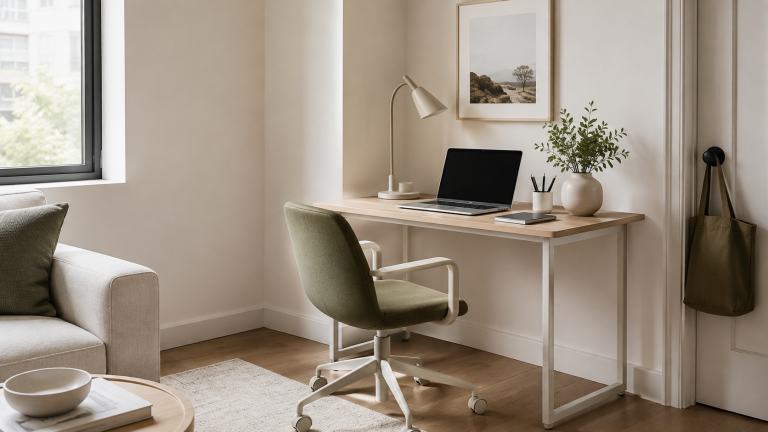
Compact Office Chairs for Small Desks: 4 Fit-First Options to Check Before You Buy
A chair can look compact on a product page and still be awkward with a small desk.
The chair body might fit in the room, but that does not tell you whether the arms clear the desk, whether the base can move where you need it, or whether you can roll the chair back far enough to sit down and stand up.
That is the fit-first rule for this guide:
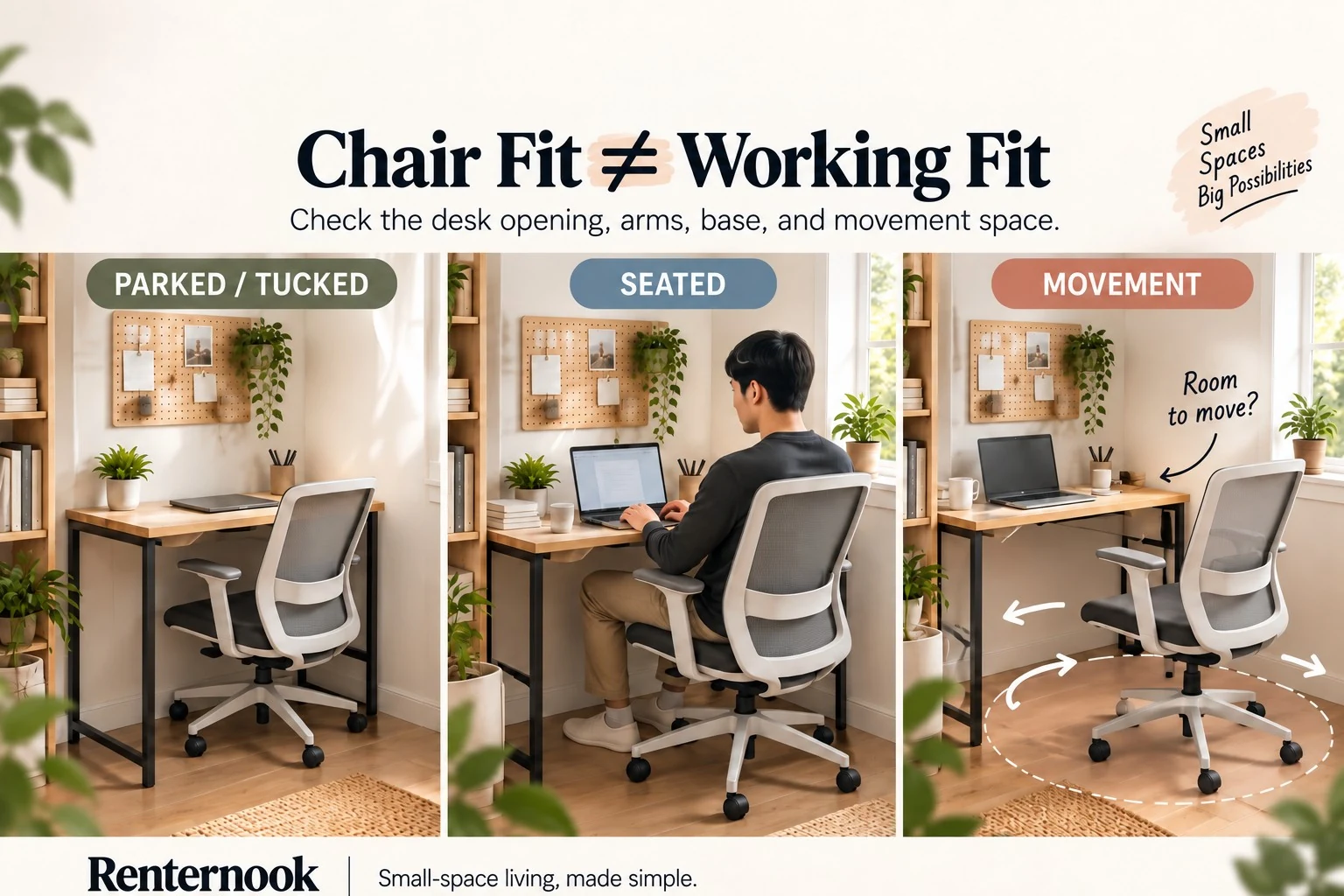
CHAIR BODY FIT ≠ DESK-TUCK / BASE / MOVEMENT FIT
For a small workspace, it helps to think about three different questions:
- Body fit: Does the chair itself fit in the available floor area?
- Tuck-under fit: Can the chair move toward the desk without the arms, seat, frame, or base creating a conflict?
- Movement fit: Is there enough usable space for swiveling, rolling, tilting, sitting down, and getting back out?
The four chairs below represent four different fit roles. They are not ranked from best to worst.
The point is to show how different arm designs, base dimensions, seat-height ranges, and movement features change what you need to measure.
What “Compact” Does — and Does Not — Mean
“Compact office chair” is useful as a shopping phrase, but it is not a fixed size class in this guide.
A chair can be relatively narrow in one measurement and still need more room somewhere else.
For example, seat width is not the same thing as total chair width. Total chair width is not the same thing as base size. And none of those measurements tells you the exact space needed to swivel, roll, tilt, or get in and out of the chair.
The same problem applies to armrests.
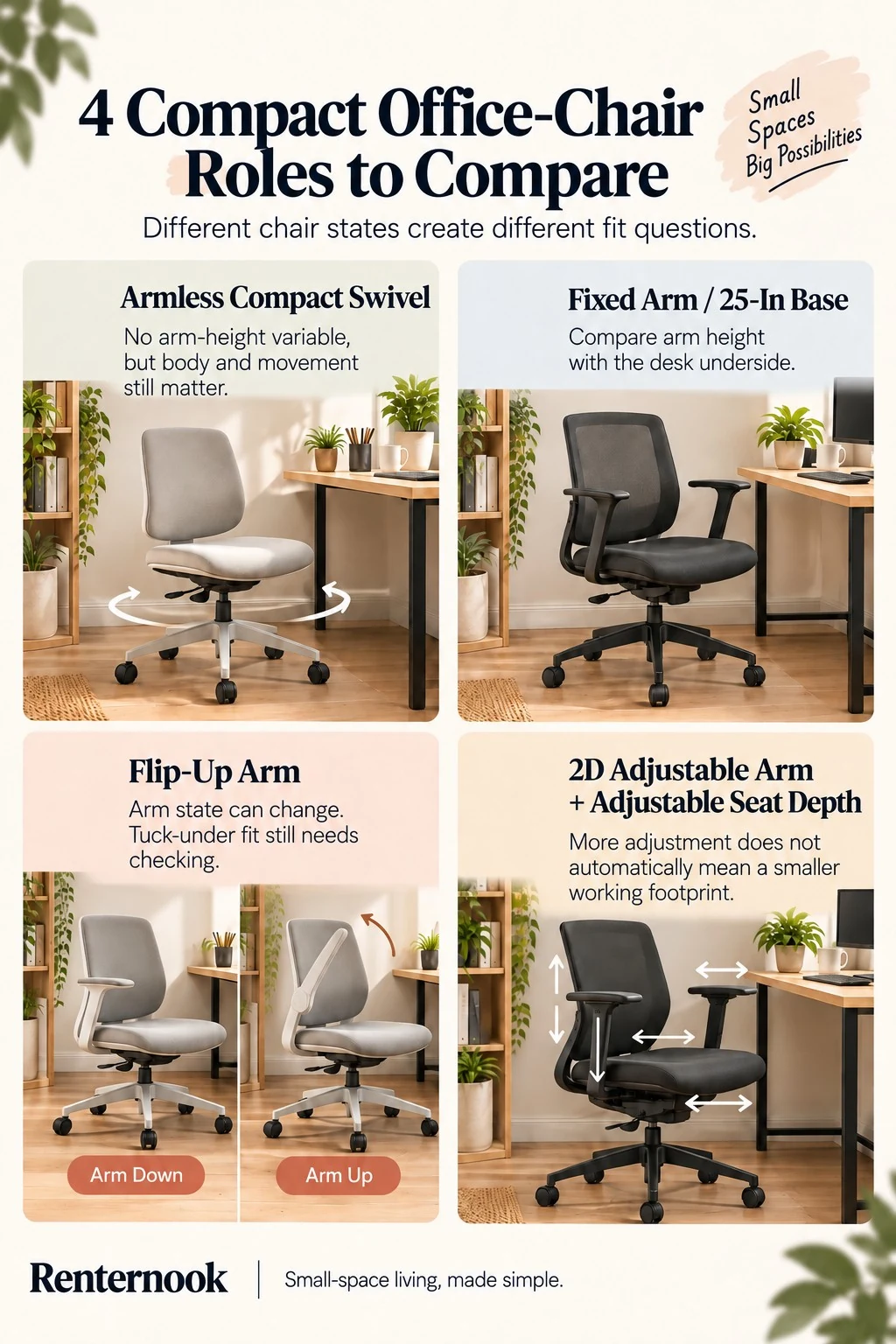
An armless chair removes the arm-height interference variable, but that does not prove the chair will tuck under your desk.
A chair with flip-up arms can change its tuck-under state, but arms-up does not automatically mean the chair fits.
An adjustable-arm chair gives you more variables to work with, but more adjustment does not automatically create a smaller working footprint.
Use the published measurements as inputs to your own desk-and-room check, not as a universal fit result.
Measure Your Desk Before Comparing Chairs
Start with the desk you actually have — or the exact desk you plan to buy.
Do not compare chair width with desk width and stop there.
Check these areas separately:
- Desk opening width: Measure the usable opening where the chair, legs, and base actually need to move.
- Underside or apron height: Measure the lowest structure beneath the desktop, not only the top surface height.
- Available floor depth: Check how much floor space exists from the desk toward the wall, bed, sofa, cabinet, or walking path behind you.
- Side clearance: Look for drawer units, desk legs, shelves, walls, or other furniture that can limit rolling or swiveling.
- Path behind the chair: Make sure you are measuring the space needed to sit down, stand up, and move through the room — not only the parked chair position.
If the desk has drawers or a low apron, arm height may matter before chair width does.
If the desk has an open underside but a narrow leg spacing, the base may become the limiting geometry.
If the workspace sits between a bed and a wall, the path behind the chair may be the real constraint.
That is why the chair and desk should be checked as one working setup.
The Fit States That Matter
Parked / Tucked
This is the state people often picture first: the chair pushed toward the desk when it is not being used.
Check the chair body, arm architecture, desk opening, underside height, and base position.
Do not assume that a narrower seat means a narrower tucked state.
Seated
Once someone sits down, the chair may be farther from the desk than it was when parked.
Seat-height adjustment also changes the relationship between the chair, your legs, the desk underside, and any armrests.
The published measurements can help you screen the setup, but they do not establish one universal seated position.
Swivel / Rolling
A chair with casters and swivel movement needs usable floor space around its base.
A published base diameter is useful when available, but it still does not establish the full rolling or swivel envelope.
Furniture, walls, rugs, cords, and the path behind the chair can all change how the chair actually moves.
Tilt / Recline
If a chair tilts, the working state can differ from its upright body dimensions.
Do not turn a feature name such as “spring tilt” or “synchronized tilt” into a numeric movement envelope unless the exact projection is published.
For the chairs in this guide, those movement envelopes remain unknown unless specifically stated otherwise.
Quick Comparison: 4 Compact Office-Chair Roles
| Product | Role | Overall width | Overall depth | Seat height | Arm type | Arm height | Base size | Movement feature |
|---|---|---|---|---|---|---|---|---|
| IKEA LOBERGET / MALSKÄR 093.319.39 | Armless compact swivel / narrow-seat role | 26 3/8 in | 26 3/8 in | 18 1/8–22 1/2 in | Armless | N/A | — | Swivel + safety-braking casters |
| Boss B6456-BK | Fixed-arm compact task chair / 25-in base role | 25 in | 25 in | 18–20 in | Fixed | 25–27 in from floor | 25-in nylon base | Swivel + spring tilt + tilt tension + upright lock |
| Boss B6366BK-BK | Flip-up-arm compact task chair | 24.5 in | 25.5 in | 18.5–21.5 in | Flip-up | 26.5–29.5 in from floor | 25-in nylon base | Swivel + spring tilt + tilt tension + upright lock |
| IKEA HATTEFJÄLL 205.389.76 | 2D adjustable-arm + adjustable-seat-depth task chair | 26 3/4 in | 26 3/4 in | 18 1/8–22 in | 2D adjustable: height + width | — | — | Synchronized tilt + automatic tension + 3-position tilt lock |
Unknown / “—” does not mean zero. It means the published sources used for this guide do not establish that value.
The table is not a ranking. Each role changes a different part of the desk-fit problem.
1. IKEA LOBERGET / MALSKÄR 093.319.39 — Armless Compact Swivel Role
What This Role Adds
LOBERGET / MALSKÄR removes one common fit variable: armrest height.
That can simplify the desk-interface check because there are no chair arms competing with a low desk apron or drawer unit.
But armless does not mean “fits under any desk.”
The chair still has a published overall body of 26 3/8 in wide × 26 3/8 in deep × 35 3/8 in high, and its base and movement still occupy floor space.
Published Size and Seat State
The published seat measurements are:
- 15 3/4 in wide
- 16 7/8 in deep
- 18 1/8–22 1/2 in seat height
The relatively narrow seat is only one part of the chair.
Do not use the 15 3/4-in seat width as a substitute for the chair’s 26 3/8-in overall width when planning floor space.
The chair swivels and uses casters with a published safety-braking function.
Assembly is required, and the published product information identifies 3 packages.
What to Measure Before Buying
Check:
- the desk opening against the 26 3/8-in overall chair width;
- the floor space available for the chair body and caster movement;
- the desk underside relative to the seat-height range;
- the path needed to roll back, sit down, and stand up;
- nearby furniture that could restrict swivel or rolling movement.
Because the chair is armless, you do not have an arm-height collision to solve. You still have a body, base, and movement problem to solve.
What Remains Unknown
The current published sources do not establish:
- separate base diameter;
- exact swivel clearance;
- exact rolling clearance;
- entry / exit space;
- true desk-tuck compatibility.
Treat those as room-specific checks.
2. Boss B6456-BK — Fixed-Arm / 25-In Base Role
What This Role Adds
The B6456-BK makes the arm-height question explicit.
Its fixed arms are published at 25–27 in from the floor.
That gives you a concrete number to compare with the underside of your desk, apron, drawer unit, or keyboard structure.
It does not prove that the chair will tuck under your desk.
Published Size, Arms, and Base
Published overall dimensions are:
- 25 in wide
- 25 in deep
- 37–39 in high
The seat is:
- 18.5 in wide
- 18.5 in deep
- 18–20 in high
The chair uses:
- fixed arms;
- a 25-in nylon base;
- 2-in dual-wheel nylon casters;
- swivel;
- spring tilt;
- tilt tension;
- upright lock.
Assembly is required.
Package dimensions remain unknown in the current published sources.
A secondary source lists a 25.5-lb shipping weight, which is not the product weight.
Product weight remains unknown.
What to Measure Before Buying
Start with the arm height.
Measure the lowest desk structure that the arms would need to pass under.
Then check:
- whether 25–27 in arm height conflicts with the desk underside;
- whether the 25-in base can occupy and move through the desk opening;
- whether the 25 × 25-in overall body works in the available floor area;
- whether you have enough room behind the chair for sitting, standing, and rolling;
- whether tilt movement can occur without hitting a wall or furniture behind you.
A desk can be wide enough for the seat and still fail at the arms or base.
What Remains Unknown
The current published sources do not establish:
- true tuck-under fit;
- actual arm / desk compatibility;
- numeric tilt projection;
- exact swivel envelope;
- exact rolling clearance.
Those values should not be inferred from the chair photo or feature list.
3. Boss B6366BK-BK — Flip-Up-Arm Compact Task-Chair Role
What This Role Adds
The B6366BK-BK changes one part of the desk interface by using flip-up arms.
That creates at least two arm states: arms down and arms up.
This can matter when a fixed arm would otherwise meet a desk edge or apron.
But the correct conclusion is not “arms up = fits under the desk.”
The chair body, base, seat position, desk geometry, and movement space still have to work together.
Published Size, Arms, and Base
Published overall dimensions are:
- 24.5 in wide
- 25.5 in deep
- 38–41 in high
The seat is:
- 19.5 in wide
- 18.5 in deep
- 18.5–21.5 in high
The published arm height is:
- 26.5–29.5 in from the floor
The chair uses:
- flip-up arms;
- a 25-in nylon base;
- 2-in dual-wheel nylon casters;
- swivel;
- spring tilt;
- tilt tension;
- upright lock.
The current exact retail specification used for this guide records recline = no.
Assembly is required.
Published package information lists 26 L × 12 W × 24 H in, with a 27-lb shipping weight.
Product weight remains unknown.
What to Measure Before Buying
Check the chair in both arm states.
Measure:
- the desk underside and any apron or drawer structure;
- the chair’s 24.5-in overall width;
- the 25-in base;
- the path needed to roll back from the desk;
- the floor area needed to swivel;
- the space behind the chair if you use the tilt function.
The useful question is not only whether the arms can move up.
It is whether the whole chair still works with the desk once you include the base and the way you actually enter, sit, move, and leave the workstation.
What Remains Unknown
The current published sources do not establish:
- total arm-up envelope;
- true desk-tuck clearance;
- exact desk interaction;
- exact swivel envelope;
- exact rolling envelope;
- entry / exit space.
Keep those unknown rather than turning the flip-up-arm feature into a universal fit claim.
4. IKEA HATTEFJÄLL 205.389.76 — Adjustable-Arm + Adjustable-Seat-Depth Role
What This Role Adds
HATTEFJÄLL introduces more adjustment variables.
The armrests are published as 2D adjustable, with height and width adjustment. The seat depth is also adjustable.
That can change how you configure the chair for a desk.
But more adjustment does not automatically mean a smaller working footprint.
The overall chair body still measures 26 3/4 in wide × 26 3/4 in deep, and several fit-critical ranges are not established in the current published sources.
Published Size and Adjustment State
Published measurements are:
- 26 3/4 in overall width
- 26 3/4 in overall depth
- 44 7/8 in maximum overall height
- minimum overall height: unknown
- 19 5/8 in seat width
- 15 3/4 in published nominal seat depth
- 18 1/8–22 in seat height
The chair includes:
- 2D adjustable armrests: height + width;
- adjustable seat depth;
- synchronized tilt;
- automatic tilt tension;
- 3-position tilt lock;
- casters with a published safety-lock function.
Assembly is required.
Published package information is:
- 25 1/4 in wide
- 15 in high
- 27 in long
- 44 lb 10 oz package weight
Product weight remains unknown.
What to Measure Before Buying
Do not treat the adjustment list as proof of desk compatibility.
Check:
- the 26 3/4-in body width and depth against the room;
- the desk opening width;
- the underside or apron height;
- the actual arm position you would use;
- the floor area needed for rolling and swiveling;
- the space behind the chair for its tilt state;
- whether the seat-depth setting changes how you position yourself relative to the desk.
If arm height is a critical constraint, verify the current exact arm-height adjustment range before relying on it.
What Remains Unknown
The current published sources do not establish:
- arm-height adjustment range;
- base diameter;
- exact seat-depth adjustment range;
- tilt movement envelope;
- true desk-tuck compatibility;
- rolling clearance;
- minimum overall height.
Those unknowns matter because adjustable does not mean universally compatible.
How to Choose Between the Four Roles
These four chairs solve different fit problems. They are not a best-to-worst list.
Start with the constraint that is hardest to change in your workspace.
If arm-height interference is the main problem, an armless role removes that variable, while a flip-up or adjustable-arm role changes how the variable can be managed. You still need to check the chair body and base.
If base footprint is important, use published base size where it is available. Both Boss chairs in this set publish a 25-in nylon base. For the two IKEA chairs here, a separate base diameter is not established in the current published sources.
If desk height or underside structure is restrictive, compare the actual underside or apron height with the chair’s arm architecture and seat-height state. Do not compare only desktop height.
If movement behind the chair is the real constraint, focus on rolling, swivel, tilt, and entry / exit space. Static width alone will not answer that question.
If adjustability matters, treat each adjustable feature as another state to verify. More settings can give you more ways to configure the chair, but they do not erase the overall body or movement envelope.
The useful sequence is:
- measure the desk;
- mark the chair body and base;
- check the arm-to-desk relationship;
- check the seated position;
- check rolling and swivel space;
- check tilt movement where applicable;
- check the path needed to sit down and stand up.
Final Fit-First Checklist
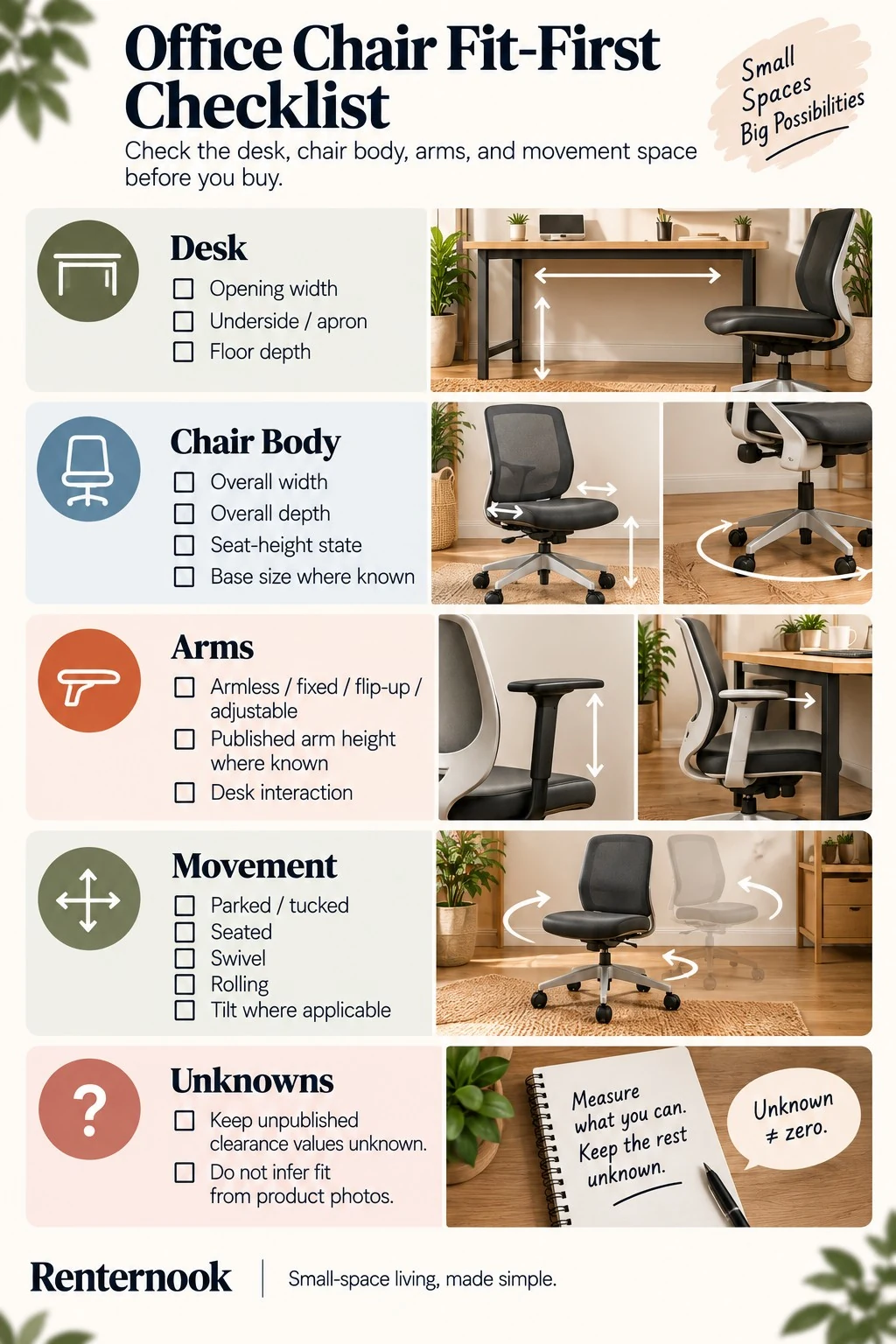
Before buying a compact office chair for a small desk, check:
Desk
- usable opening width;
- underside / apron height;
- desk legs or drawer units;
- available floor depth;
- side obstacles.
Chair Body
- overall width;
- overall depth;
- seat-height range;
- seat width and depth;
- base size where published.
Arms
- armless, fixed, flip-up, or adjustable;
- arm height where published;
- desk underside interaction;
- whether a changed arm state actually changes the full chair fit.
Movement
- parked / tucked state;
- seated state;
- swivel space;
- rolling space;
- tilt state where applicable;
- entry / exit space;
- walking path behind the chair.
Unknowns
If the manufacturer does not publish a fit-critical value, keep it unknown.
Do not guess:
- swivel envelope;
- rolling clearance;
- tilt projection;
- tuck-under compatibility;
- arm clearance;
- movement space from a product photo.
The chair that looks smallest on a product page is not automatically the chair with the smallest working footprint in your room.
Start with the desk.
Then check the chair body.
Then check the states the chair creates when you actually use it.
Product Sources
- IKEA LOBERGET / MALSKÄR Swivel chair + pad — Article 093.319.39
https://www.ikea.com/us/en/p/loberget-malskaer-swivel-chair-pad-white-black-dark-gray-s09331939/ - Boss Office Products Boss Mesh Task Chair, Black — Model B6456-BK
https://boss-chair.com/product/boss-mesh-task-chair-black/ - Boss Office Products Boss Black Mesh, Flip Arm, Task Chair, Black Frame — Model B6366BK-BK
https://boss-chair.com/product/boss-black-mesh-flip-arm-task-chair-black-frame/ - IKEA HATTEFJÄLL Office chair with armrests — Article 205.389.76
https://www.ikea.com/us/en/p/hattefjaell-office-chair-with-armrests-gunnared-dark-gray-black-20538976/
Source / Testing Note
This guide uses published product specifications and the current primary product pages for the four chairs covered here.
Renternook did not physically test these chairs.
Published specifications can establish body dimensions, seat measurements, arm architecture, base size where provided, package information, and named movement features.
They do not automatically establish desk-tuck compatibility or the full space needed to swivel, roll, tilt, sit down, or stand up.
Where the published sources do not establish a fit-critical value, that value is left unknown rather than estimated.