Small Sofas for Small Spaces: How to Check Working Fit Before You Buy
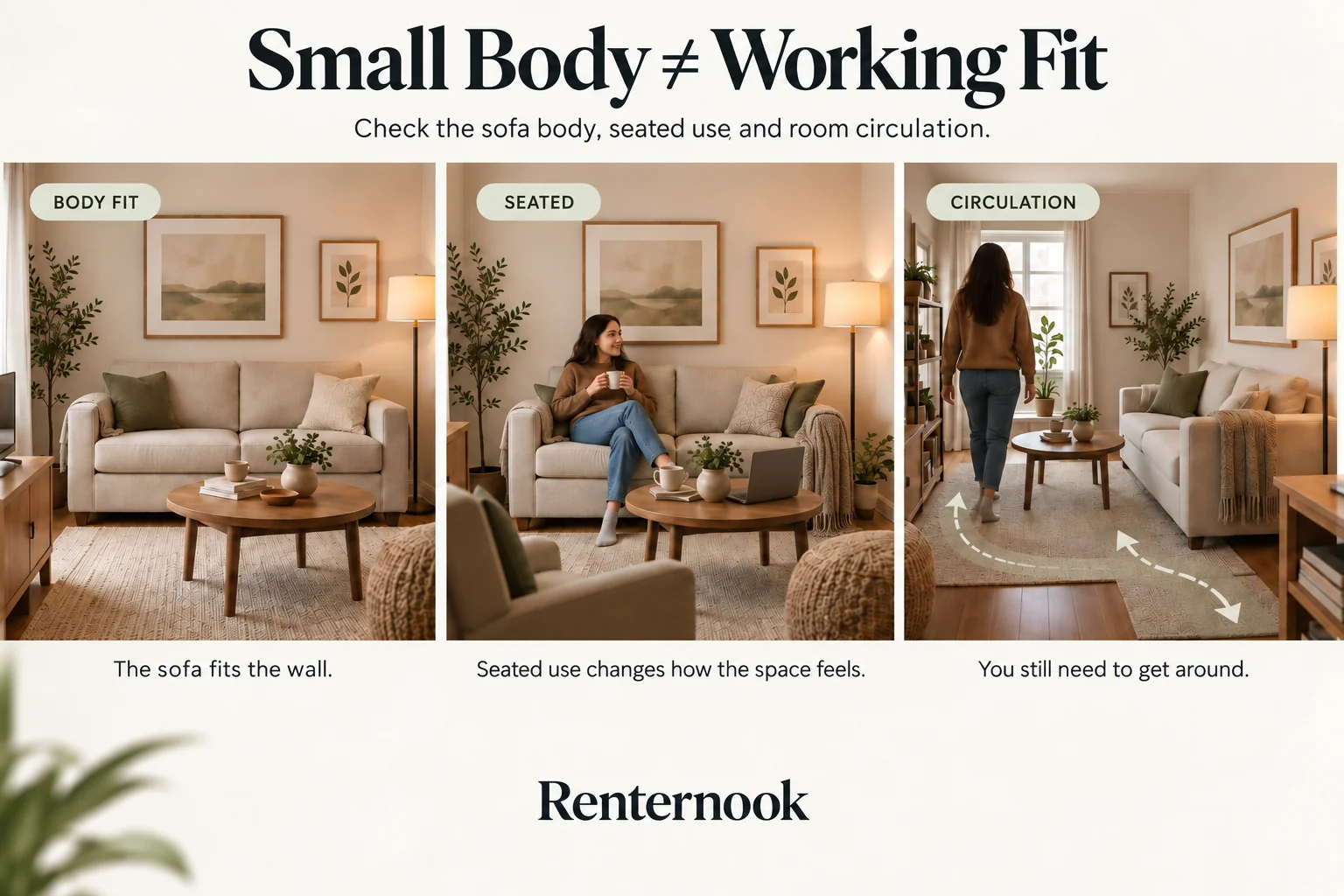
A sofa can be called “small,” fit neatly into the dimensions you measured, and still be wrong for the room.
That is because sofa body size is only one part of the fit question.
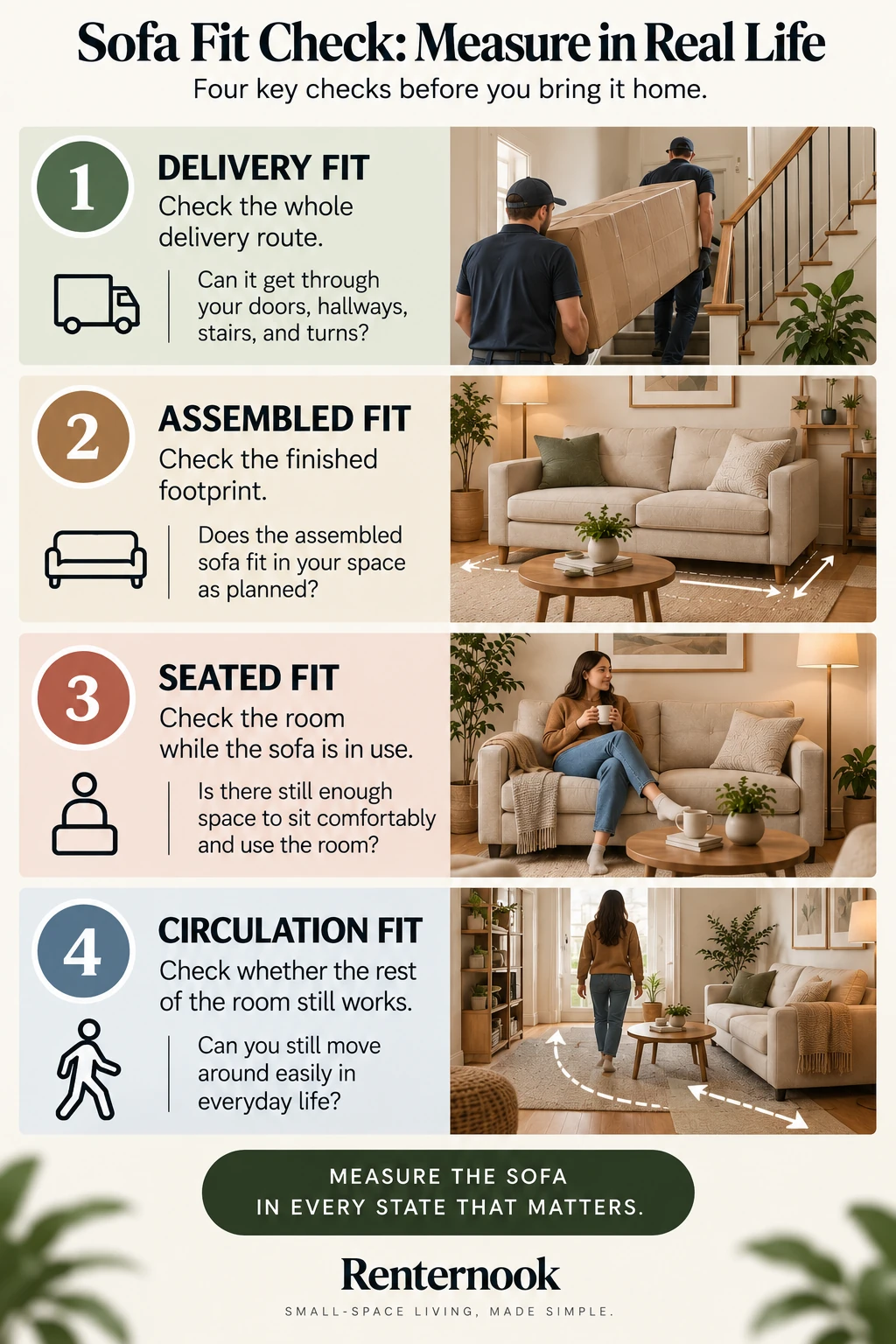
In a small living room, the real test is whether the sofa works through four different states:
Delivery fit → Assembled fit → Seated fit → Circulation fit
Miss any one of those, and a sofa that looked perfect on the product page can become an expensive obstacle in real life.
Here is how to check each one before you buy.
Why a “small” sofa can still fail in a small room
Most people start with one measurement:
“How wide is the sofa?”
Width matters, but it does not tell you the whole story.
A 60-inch sofa might fit along a 70-inch wall. That does not automatically tell you whether:
- the delivery package can get through your entrance,
- the sofa can make a turn through a hallway,
- the assembled depth works with the rest of the room,
- the seat depth suits the way you plan to use the space,
- or people can still move through the room once the sofa is there.
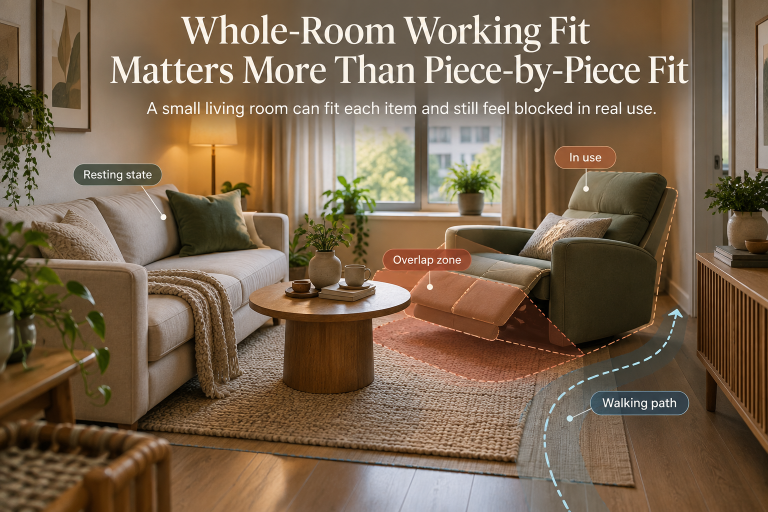
This is the difference between physical fit and working fit.
The goal is not simply to find a sofa that fits inside the room.
The goal is to find one that lets the room keep working.
1. Check delivery fit before room fit
Before thinking about the final position of the sofa, start farther away.
Start at the delivery truck.
Then follow the real path the sofa has to travel:
Building entrance → elevator or stairs → hallway → apartment door → interior turns → final room
Measure the narrowest and most awkward points along that path.
Do not assume that a sofa will fit through an opening simply because its finished width or depth looks manageable.
The item may arrive inside a box that has very different dimensions.
A modular sofa may arrive in separate components.
Some sofas have removable parts.
Those details can make delivery easier to plan, but none of them automatically guarantee that the sofa will make it through your specific route.
A package dimension is useful information.
It is not a delivery guarantee.
2. Check the assembled footprint
Once the sofa reaches the room, look at its actual assembled body.
This is where the usual width × depth measurements matter most.
But do not measure only the empty wall.
Use painter’s tape on the floor to mark the sofa’s real footprint.
Then leave the tape there for a while.
Walk past it.
Open nearby doors.
Approach a window.
Use the coffee table.
Cross the room the way you normally would.
That simple test often reveals problems that are difficult to see from numbers alone.
A sofa can technically fit between two walls and still make the room feel awkward because its depth pushes too far into the usable floor area.
Fits the wall does not necessarily mean access still works.
3. Check seated fit, not just sofa depth
Two sofas with similar exterior dimensions can use their interior space differently.
Seat depth matters because it affects how much usable room the sofa occupies when someone is actually sitting on it.
Think beyond the furniture outline.
Imagine the sofa in use:
- Where do your legs go?
- Is there another piece of furniture directly in front of the seat?
- Will someone regularly walk through that area?
- Does the sofa face a desk, table, TV unit, doorway, or balcony door?
There is no single sofa-to-table gap that works for every room and every person.
That is why it is better to test your own layout than to depend on one universal clearance number.
The furniture has to work with your body, your movement, and your floor plan.
4. Check circulation fit
This is the part small-room shopping often misses.
After the sofa is installed and someone is sitting on it, can the room still function?
Look at the routes you use every day.
For example:
Door → sofa → kitchen
Hallway → balcony
Bedroom → front door
Sofa → storage cabinet
A sofa does not need to block a doorway completely to create a problem.
If it turns a frequently used route into a squeeze, forces people to walk around furniture, or interferes with another piece that needs to open, the room may no longer work the way you expected.
There is no universal walking-clearance number that applies to every home.
Instead, identify the circulation routes that matter in your specific room and test them before ordering.
Four sofas that illustrate different small-space fit roles
These four examples are not ranked.
Each one highlights a different part of the fit problem you may want to investigate.
| Sofa | Fit role | Key dimensions | What to check |
|---|---|---|---|
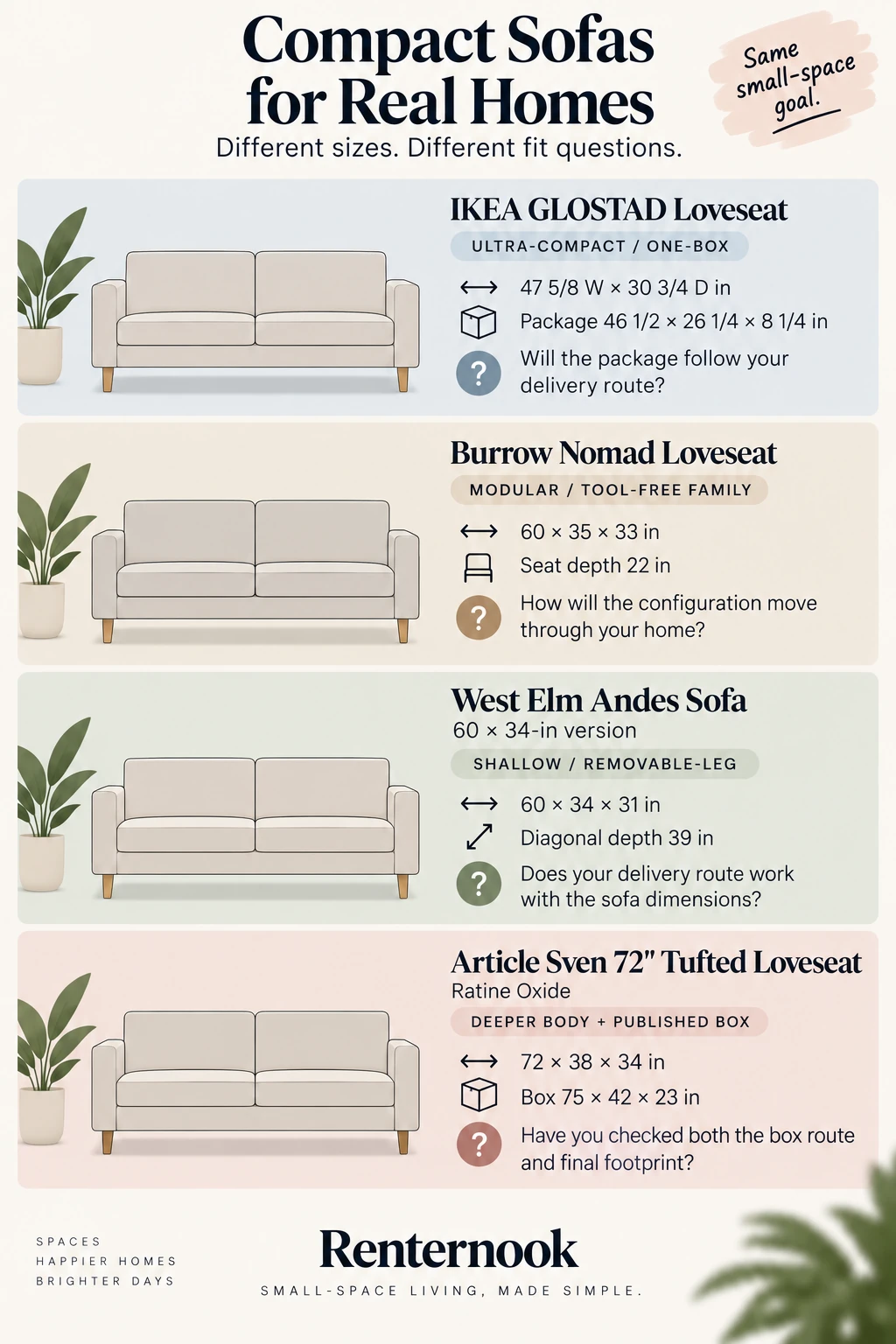
| IKEA GLOSTAD Loveseat | Ultra-compact, one-box loveseat | 47⅝" W × 30¾" D; seat depth 21¼" | Package route, final footprint, circulation |
| Burrow Nomad Loveseat | Modular / tool-free family | 60" L × 35" D × 33" H; seat depth 22" | Current configuration, component delivery, assembled footprint |
| West Elm Andes Sofa — 60" × 34" version | 60-inch shallow sofa with removable legs | 60" W × 34" D × 31" H; seat depth 21" | Delivery route, removable-leg limitation, final 34" depth |
| Article Sven 72" Tufted Loveseat — Ratine Oxide | Deeper 72-inch loveseat with published box dimensions | 72" W × 38" D × 34" H; seat depth 24" | Box route, deeper footprint, seated and circulation space |
IKEA GLOSTAD Loveseat: a compact body with one published package
The GLOSTAD shows why it helps to look at both the sofa and the package.
Its published dimensions are 47⅝ inches wide and 30¾ inches deep, with a 21¼-inch seat depth. IKEA lists the product as one package measuring 46½ inches long × 26¼ inches wide × 8¼ inches high. (ikea.com)
That gives you two separate things to test.
First, can the packaged product travel through your delivery route?
Second, does the assembled 30¾-inch depth work once it reaches the room?
Those are different questions.
The relatively compact body may make the GLOSTAD worth examining where floor area is tight, but the measurements still need to be tested against the actual room and access path.
Burrow Nomad Loveseat: modular and tool-free does not eliminate the need to measure
The Burrow Nomad Loveseat illustrates another fit strategy.
Burrow lists the Nomad Loveseat at 60 inches long × 35 inches deep × 33 inches high, with a 22-inch seat depth. The Nomad collection is modular, and Burrow describes its components as connecting without tools. (burrow.com)
That modular construction can change how you think about the delivery problem.
Instead of looking only at one finished sofa body, you also need to understand how the particular configuration arrives and how its parts move through your home.
But “modular” and “tool-free” should not be translated into “guaranteed to fit.”
You still need to verify the current configuration, the delivery path, and the finished footprint.
The Nomad is sold as a configurable family, so fabric, leg finish, arm style and availability can vary. For that reason, it makes more sense to treat Burrow Nomad Loveseat as the product family here rather than depend on a single configuration SKU.
West Elm Andes 60" × 34": shallow body, but access still needs checking
The Andes Sofa is available in multiple sizes and depths.
For this comparison, the relevant version is specifically the 60-inch sofa with 34-inch depth.
West Elm publishes its dimensions as 60 inches wide × 34 inches deep × 31 inches high, with a 21-inch seat depth and a 39-inch diagonal depth. West Elm also states that the legs can be removed. (westelm.com)
The removable legs are useful information when planning an access route.
They are not proof that the sofa will fit through a particular doorway, stairwell, elevator, or turn.
That distinction matters.
When access is tight, record the sofa dimensions and the actual dimensions of your route instead of assuming removable parts solve the problem automatically.
Once inside the room, test the full 60 × 34-inch body footprint against the surrounding furniture and circulation paths.
Article Sven 72" Tufted Loveseat: when the box matters as much as the sofa
The Sven provides a useful example of why delivery dimensions deserve their own check.
Article lists the Sven 72" Tufted Loveseat in Ratine Oxide at 72 inches wide × 38 inches deep × 34 inches high, with a 24-inch seat depth.
The published shipping box is 75 inches long × 42 inches wide × 23 inches high. (article.com)
Notice what happened there.
The finished loveseat is 38 inches deep, while one dimension of the box reaches 42 inches.
If you measured only the finished sofa, you would be missing an important part of the delivery equation.
That still does not mean a 42-inch box automatically requires any particular doorway width. Delivery involves orientation, turns, obstacles, and the complete route.
The useful point is simpler:
Measure the package and the route separately from the final sofa footprint.
Once the Sven is in the room, its 38-inch body depth and 24-inch seat depth also deserve attention because the room has to work while the loveseat is being used, not just while it is sitting empty.
A fit-first buying checklist
Before ordering a sofa for a small living room, work through these checks.
Delivery state
- Find the manufacturer’s current delivery or package information where available.
- Measure your building entrance.
- Measure the elevator opening or stair route if relevant.
- Measure your apartment or house entrance.
- Check narrow hallways and interior doors.
- Look for sharp turns instead of measuring openings in isolation.
- Do not assume removable legs or modular construction guarantee access.
Assembled state
- Record the exact width and depth of the configuration you are buying.
- Mark that footprint on the floor with tape.
- Check nearby doors, cabinets, drawers and other furniture that needs to open.
- Look at the whole occupied floor area, not only the wall length.
Seated state
- Check the published seat depth.
- Sit in a similarly sized sofa if possible.
- Think about where knees and feet will extend when someone is sitting normally.
- Test how that occupied zone interacts with a table or circulation route.
Circulation state
- Identify the routes people actually use through the room.
- Walk those routes around the taped sofa footprint.
- Test the layout with nearby furniture in its normal position.
- Check whether doors, drawers or storage still operate the way you need them to.
The simple rule: measure the sofa in every state that matters
Buying a sofa for a small room is not just a search for the smallest number.
It is a sequence of fit checks.
A sofa has to get into the home.
Then it has to fit once assembled.
Then it has to work while someone is sitting on it.
And the rest of the room still has to function around it.
That is why the useful question is not:
“Will this sofa fit?”
It is:
“Will this sofa fit the way this room actually works?”
Measure that before you buy, and you are far less likely to discover the answer after the sofa is already in the room.