Small End Tables for Small Living Rooms: 5 Fit-First Options to Check Before You Buy
A small end table can look like one of the easiest pieces of furniture to buy for a small living room.
Find an empty spot beside the sofa.
Pick a table with a small footprint.
Done.
Except that is exactly where the wrong purchase can happen.
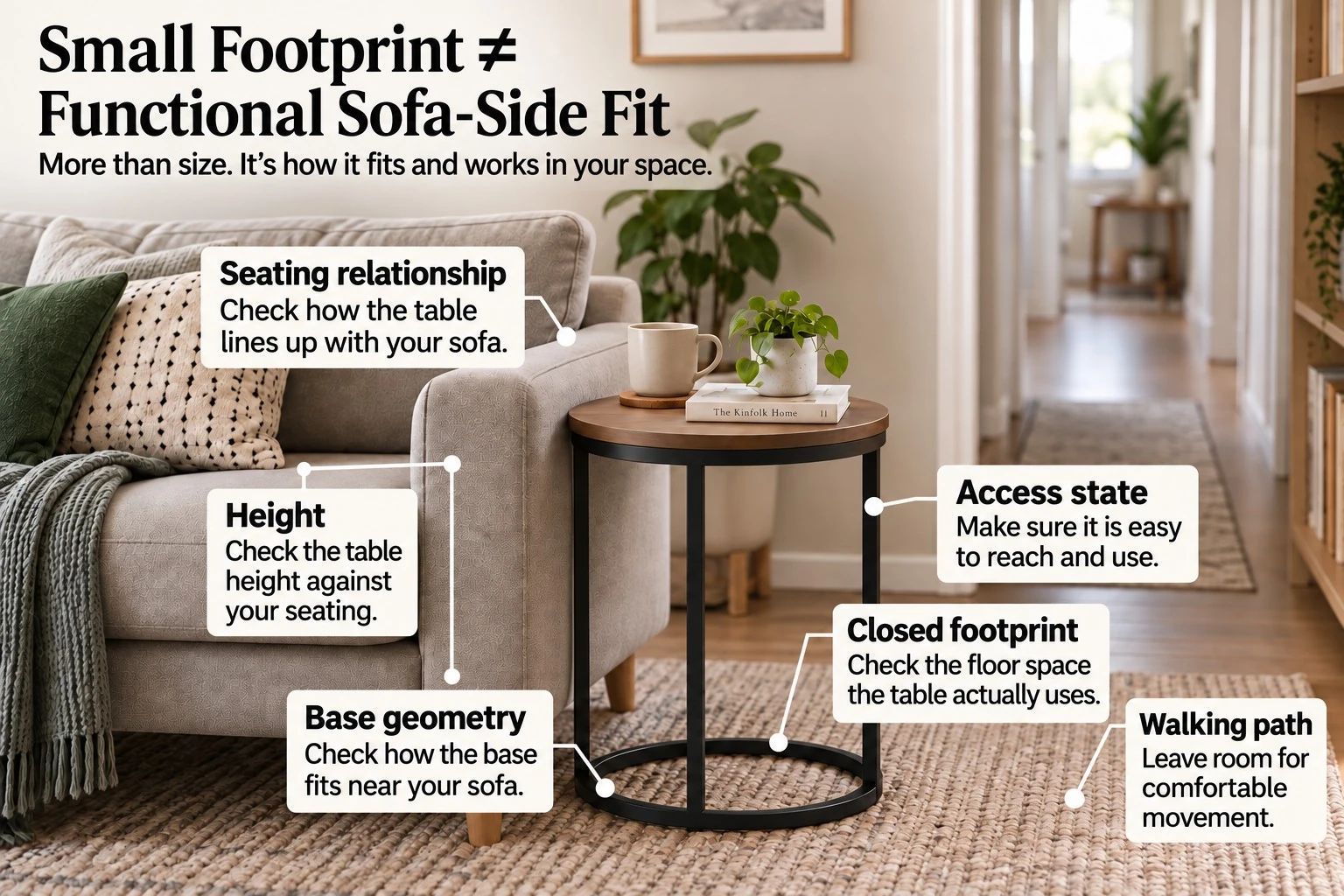
Small footprint does not automatically mean functional sofa-side fit.
A table can look compact on a product page and still become awkward once you account for:
- the actual width and depth beside your seating;
- table height relative to how you use the sofa or chair;
- drawers or cabinet doors;
- a C-table base that needs to slide under furniture;
- nesting tables that occupy more space when deployed;
- cords and outlets on powered models;
- and the walking path around the seating area.
This guide does not rank five tables from “best” to “worst.”
Instead, it compares five different small-table roles and asks a more useful question:
Which table geometry matches the way you actually use the space beside your seating?
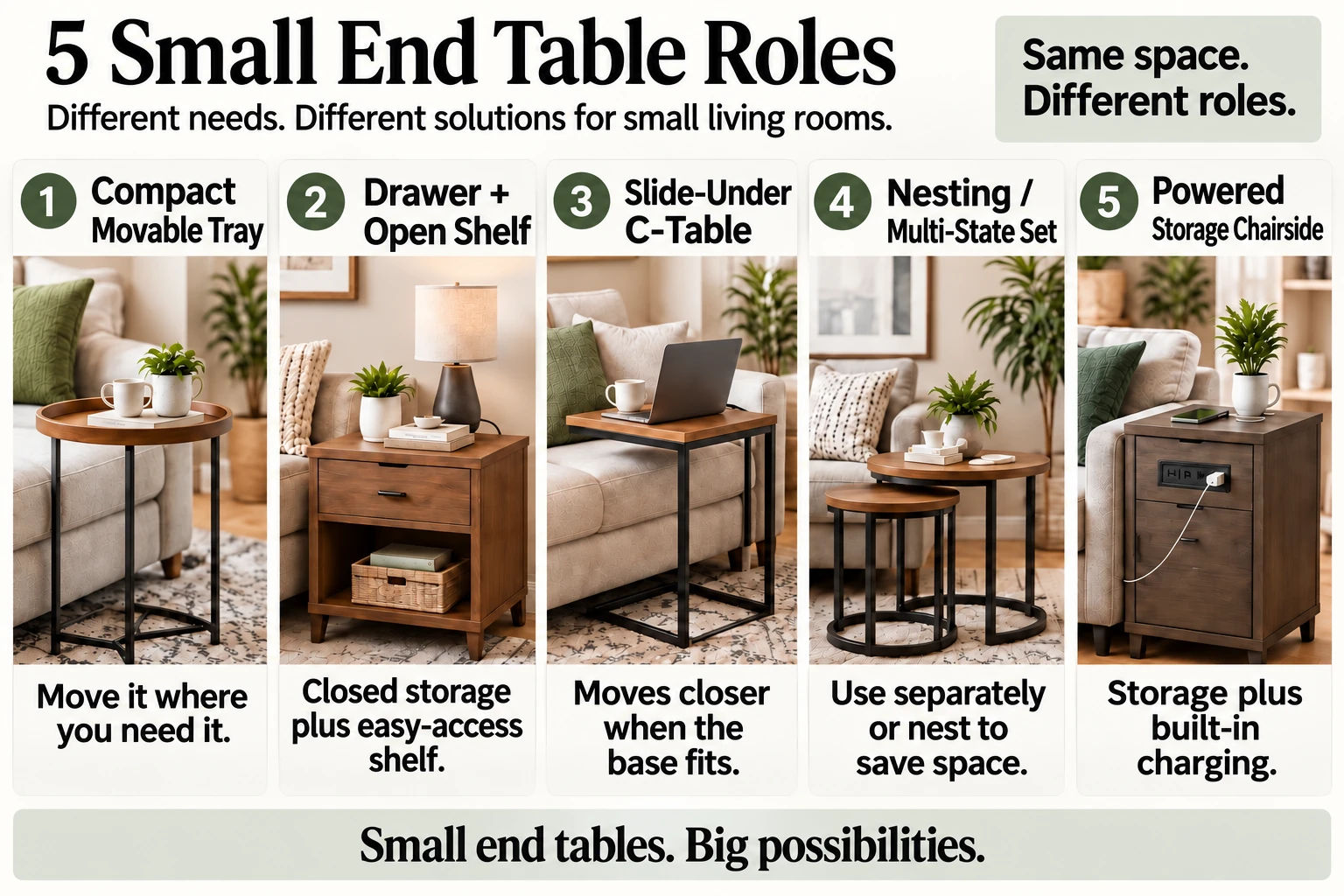
The five products are:
- IKEA GLADOM — compact movable tray table;
- IKEA TONSTAD — drawer + open-shelf side table;
- Walnutry Suiseki C-Table — product-specific slide-under C-table;
- IKEA LACK Nesting Tables — nesting / multi-state table set;
- Ashley Realyn T523-7 — narrow powered storage chairside table.
Before choosing between them, start with the space and the access state—not the style.
Before You Buy: Measure the Working Area, Not Just the Empty Spot
The first mistake is measuring only the patch of floor beside the sofa.
A side table is used in motion.
You reach across it.
You may open a drawer or cabinet.
You may slide a C-table base under the sofa.
You may pull a nesting table out and use it somewhere else.
You may run a power cord toward an outlet.
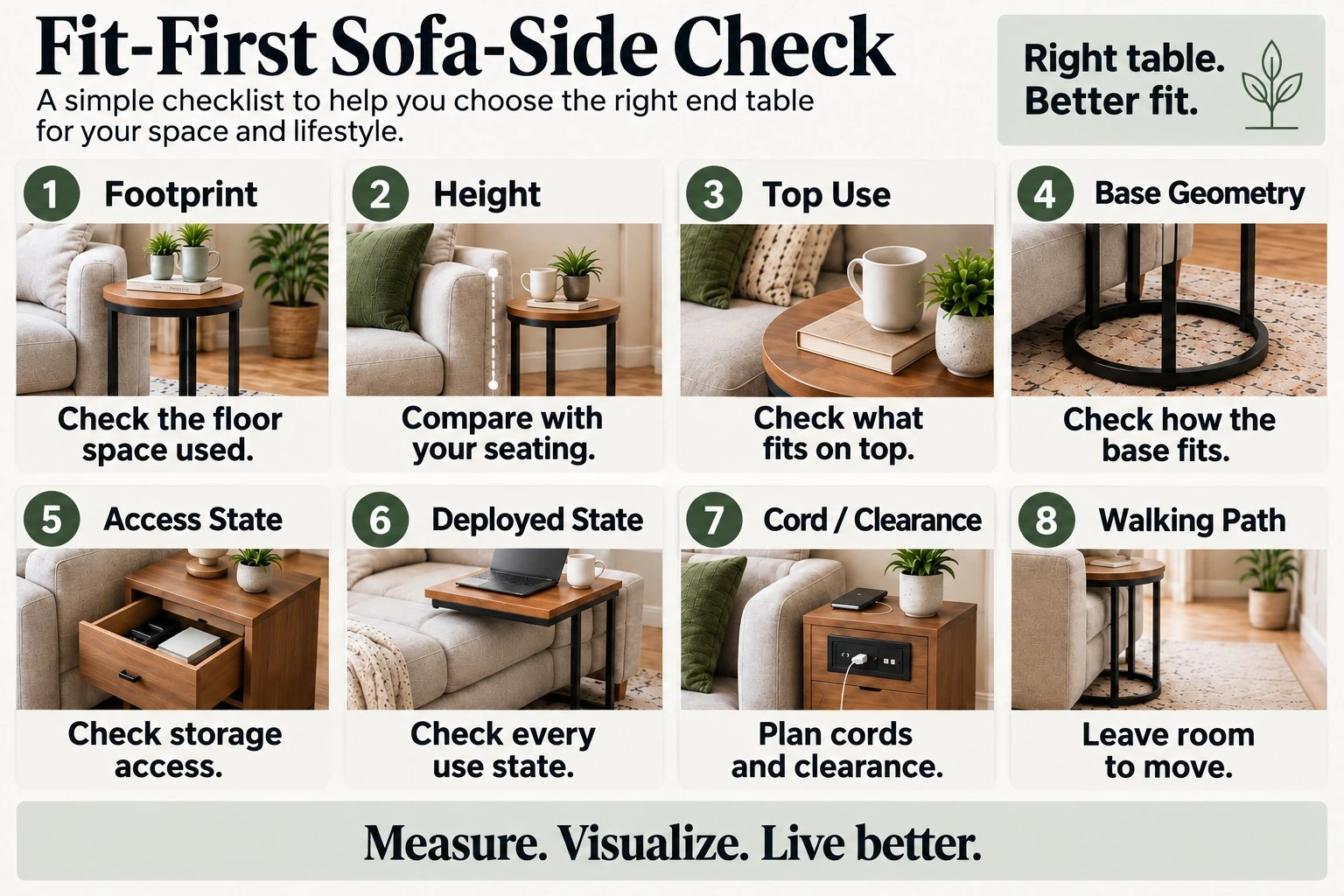
That means the useful fit check is a sequence:
- closed horizontal footprint;
- overall height;
- usable top geometry;
- base / leg geometry;
- drawer, cabinet, or shelf access;
- slide-under clearance where product-specific;
- nested vs deployed state;
- cord / outlet placement where applicable;
- walking and access around the seating area.
There is no single universal sofa-side clearance number in this guide.
There is also no universal rule that one table height fits every sofa arm.
The correct fit depends on the actual seating, floor plan, product geometry, and how you intend to use the table.
1. Start With the Closed Footprint — But Do Not Stop There
Published width, depth, length, or diameter tells you how much horizontal space a table occupies in its normal closed state.
That matters.
But different products describe that geometry differently.
A round tray table may publish a diameter.
A rectangular side table may publish length and width.
A C-table may publish top dimensions while the base geometry determines whether it can slide under your seating.
A nesting set has more than one footprint because the tables can be stored together or used separately.
So do not force every product into one neat width-by-depth comparison if the source does not support that normalization.
Published geometry should stay attached to the way the manufacturer actually defines it.
This is especially important for the IKEA TONSTAD in this guide: the current source publishes Length 25 1/4 in and Width 15 3/4 in. Until the orientation is separately verified, those axis labels should remain exactly as published.
2. Check Height Against the Way You Actually Use the Seat
End-table height matters because it changes how you reach the surface from the sofa or chair.
But this guide does not use a universal rule such as “the table must be exactly level with the sofa arm.”
That would ignore:
- different sofa-arm heights;
- armless seating;
- different sitting positions;
- whether you mainly place drinks, a lamp, a laptop, or a phone on the table;
- and the way the table base fits beside the seat.
Instead, compare the published table height with your actual seating and intended use.
For example:
- IKEA GLADOM is 20 5/8 in high;
- IKEA TONSTAD is 17 3/4 in high;
- Walnutry Suiseki lists a 23.2 in working height;
- the large IKEA LACK nesting table is 17 3/4 in high;
- Ashley Realyn T523-7 is 23.13 in high.
Those numbers are product facts.
They are not universal compatibility guarantees.
3. Storage Creates an Access State
A table with a drawer or cabinet does not occupy only its closed footprint while you use it.
The IKEA TONSTAD has a soft-closing drawer and an open shelf.
The Ashley Realyn has cabinet storage plus an open display shelf.
That means you need to check whether the storage can actually be used where the table will sit.
Ask:
- Can you stand or reach in front of the drawer or door?
- Does the sofa block your hand position?
- Does the table sit too close to another object?
- Does the door or drawer move into a walking path?
For TONSTAD, the exact drawer-open projection is still UNKNOWN because the product information we found does not give that measurement.
For Realyn, the exact door-swing projection is also UNKNOWN.
Do not invent those numbers from photos.
Unknown access geometry stays unknown until a source establishes it.
4. C-Tables Need Base Clearance, Not Just Top-Surface Space
A C-table solves a different problem from a conventional four-leg end table.
Its cantilevered shape can bring the top closer to a seated user while the base slides under the furniture.
But that only works if the furniture itself allows it.
For the Walnutry Suiseki C-Table, the manufacturer publishes a 1.5 in furniture-clearance requirement for its slide-under use.
That is useful product-specific evidence.
It is not a universal standard.
Do not turn it into:
“All sofas need 1.5 inches of clearance for a C-table.”
The correct rule is narrower:
This specific table needs the published clearance, so compare that requirement with the actual base clearance of your sofa or chair.
Also check whether sofa legs, a low frame, a recliner mechanism, or another obstruction occupies the area where the C-table base needs to travel.
5. Nesting Tables Have More Than One Footprint
Nesting tables are useful because they can reduce the amount of floor area occupied when they are stored together.
But that stored state is not the same as the working state.
The IKEA LACK set includes:
- a large table at 21 5/8 × 21 5/8 in, height 17 3/4 in;
- a small table at 13 3/4 × 13 3/4 in, height 13 3/4 in.
The manufacturer supports using them separately, together, or sliding the smaller table under the larger table to save space.
The product information we found does not give a separate exact total occupied envelope for the nested state.
So the buying decision should focus on the state change:
- Where will both tables sit when deployed?
- Will one become a temporary drink table or laptop surface?
- Is there a place to return the smaller table after use?
- Does the larger table still work beside the sofa when the smaller one is stored underneath?
Nesting saves space only if the stored state and the deployed state both work in your room.
6. Narrow Width Can Still Hide a Deep Table
The Ashley Realyn T523-7 makes the core thesis especially clear.
Its published width is only 14 in.
That sounds narrow.
But its published depth is 24 in.
So if you look only at width, you miss the dimension that may matter more beside the sofa.
Narrow width ≠ shallow footprint.
This model also adds:
- an open display shelf;
- cabinet storage with a shelf;
- two electrical outlets;
- USB charging ports;
- an included UL-listed power cord.
Those features can be useful, but they add new fit questions:
- Can the cabinet door be used in the chosen position?
- Where will the power cord run?
- Is the outlet location practical?
- Will the 24-in depth project too far into the room?
The current evidence does not establish the exact door-swing projection.
Keep that unknown intact.
And keep the charging claim attached only to this exact model.
Quick Comparison
| Product | Best-fit role | Key published geometry | Storage / access | Special state | Main question before buying |
|---|---|---|---|---|---|
| IKEA GLADOM 504.119.90 | Compact movable tray | 17 1/2 in diameter × 20 5/8 in H | Open / removable tray | Can be moved between seating areas | Is the small round top enough for your actual use? |
| IKEA TONSTAD 205.284.73 | Drawer + open shelf | 25 1/4 in Length × 15 3/4 in Width × 17 3/4 in H | Soft-closing drawer + open shelf | Drawer-open projection UNKNOWN | Can you use the drawer where the table will sit? |
| Walnutry Suiseki C-Table | Slide-under work/use surface | Top 22.4 × 14.6 in; 23.2 in working H | Open | Requires 1.5 in furniture clearance | Does your actual sofa/chair base clear this specific requirement? |
| IKEA LACK Nesting Tables 594.427.27 | Multi-state / extra surface | Large 21 5/8 in square; Small 13 3/4 in square | Open | Nested vs deployed | Where will the second table go when it is pulled out? |
| Ashley Realyn T523-7 | Powered narrow storage chairside table | 14 W × 24 D × 23.13 H in | Open shelf + cabinet | Door access + power cord | Does the 24-in depth and cord path work beside your seating? |
The table above is a decision map, not a ranking.
Each role solves a different problem.
1. IKEA GLADOM 504.119.90 — When You Want a Compact, Movable Surface
The IKEA GLADOM is the simplest access-state role in this set.
Its published dimensions are:
- diameter: 17 1/2 in;
- height: 20 5/8 in.
The top is a removable round tray, and the published maximum load is 22 lb.
There is no drawer or cabinet door to account for.
That means the main fit problem is the closed round footprint plus the way you use the top.
The manufacturer also supports moving the table from the sofa to a reading chair, which makes mobility part of this product’s use case.
Check before buying
- Does a 17 1/2-in round footprint fit beside the seating without crowding the path?
- Is the 20 5/8-in height comfortable for the way you reach from your sofa or chair?
- Is the removable tray useful for your routine?
- Is the top large enough for the items you actually place beside the sofa?
- Can you assemble and move the table safely as intended?
Good role match
This role makes sense when you want a compact open surface that can move between seating positions and you do not need enclosed storage.
Important limitation
The small footprint does not establish universal sofa compatibility.
Measure your actual space.
2. IKEA TONSTAD 205.284.73 — When You Want a Drawer and an Open Shelf
The IKEA TONSTAD adds storage while keeping a conventional side-table form.
The current source publishes:
- Length: 25 1/4 in
- Width: 15 3/4 in
- Height: 17 3/4 in
- Height under furniture: 3 7/8 in
The table includes:
- a soft-closing drawer;
- an open shelf.
Published load limits are:
- top: 44 lb;
- shelf: 22 lb.
The most important editorial boundary is the axis labeling.
The source uses Length and Width.
Until the orientation is verified, do not silently relabel one axis as depth.
The second boundary is the drawer.
The exact drawer-open projection is UNKNOWN.
So closed body dimensions do not tell you the complete access envelope.
Check before buying
- Compare the published Length and Width with the actual space beside your sofa.
- Compare the 17 3/4-in height with your seating and intended use.
- Check whether you can reach and open the drawer in the proposed position.
- Make sure the open shelf remains accessible.
- Do not assume the drawer needs a particular amount of front clearance unless you establish it separately.
Good role match
This role may fit buyers who want a mix of concealed small-item storage and an open shelf.
Important limitation
The product information we found does not give an exact drawer-open projection.
Do not infer it from product photography.
3. Walnutry Suiseki C-Table — When Slide-Under Geometry Is the Main Job
The Walnutry Suiseki C-Table is the most geometry-specific product in this group.
Published evidence includes:
- top: 22.4 × 14.6 in;
- working height: 23.2 in;
- rated capacity: 25 lb;
- product-specific furniture clearance requirement: 1.5 in.
Its cantilevered C-table architecture is designed around sliding the base under compatible furniture.
That makes the buying question very different from a normal side table.
You are not only asking:
“Does the top fit beside the sofa?”
You are also asking:
“Can the base physically travel under my seating?”
Check before buying
- Measure the actual clearance under your sofa or chair where the base needs to enter.
- Compare it with this product’s published 1.5-in requirement.
- Check for low rails, recliner hardware, crossbars, or other obstructions.
- Compare the 23.2-in working height with your intended seated use.
- Confirm the top size works for your laptop, drink, remote, or other intended items.
Good role match
This role makes sense when you specifically want a surface that can sit closer to the seated user and your furniture base supports the product’s slide-under geometry.
Important limitation
The 1.5-in requirement belongs to this product.
It is not a universal sofa-clearance rule and does not prove compatibility with any sofa that happens to have a similar gap.
4. IKEA LACK Nesting Tables 594.427.27 — When You Need a Surface That Can Expand and Contract
The IKEA LACK set uses two tables rather than one fixed footprint.
Published dimensions are:
Large table
- 21 5/8 × 21 5/8 in
- height: 17 3/4 in
Small table
- 13 3/4 × 13 3/4 in
- height: 13 3/4 in
The manufacturer supports three basic states:
- use the tables separately;
- use them together;
- slide the smaller table under the larger one to save space.
That makes this a useful option to think about when your living room sometimes needs an extra surface but not all the time.
The important fit question is not just the nested state.
It is the transition between states.
Check before buying
- Does the large table work in the normal sofa-side position?
- Is there a useful place for the small table when it is pulled out?
- Can you deploy the second table without blocking the walking path?
- Is the lower 13 3/4-in height useful for the way you intend to use the smaller table?
- Where will the small table return after use?
Good role match
This role makes sense when you value a variable number of surfaces more than drawers, cabinets, or charging hardware.
Important limitation
The product information we found does not separately give the exact total occupied envelope for the nested state.
Do not invent it.
5. Ashley Realyn T523-7 — When You Want Narrow Width, Storage, and Built-In Power
The Ashley Realyn T523-7 is a strong reminder
that one small dimension does not make the whole table small.
Published dimensions are:
- width: 14 in;
- depth: 24 in;
- height: 23.13 in.
The storage configuration includes:
- an open display shelf;
- cabinet storage with a shelf.
The model also includes:
- 2 electrical outlets;
- USB charging ports;
- an included UL-listed power cord.
The 14-in width can make the table look narrow from the front.
But the 24-in depth is the dimension that may dominate the floor plan beside a sofa or chair.
Check before buying
- Does the 24-in depth project too far into the walking path?
- Does the 23.13-in height work for how you use the seating?
- Can the cabinet door be accessed in the proposed position?
- Where will the power cord travel?
- Is there a practical nearby outlet?
- Can the table sit where you want it without creating a cable problem?
Good role match
This role may fit buyers who want integrated charging and storage and have enough depth available beside the seating.
Important limitation
The exact cabinet-door swing projection is UNKNOWN.
The charging features are verified only for this model and should not be generalized to other small end tables.
Which Role Fits Your Small Living Room?
Instead of asking which table is “best,” match the role to the actual problem.
Choose the compact movable tray role if:
- floor space is tight;
- you mainly need a small open surface;
- moving the table between seating positions is useful;
- enclosed storage is not important.
Role: IKEA GLADOM.
Choose the drawer + shelf role if:
- you want both concealed and open storage;
- you have enough space to use the drawer;
- a lower table height works for your seating.
Role: IKEA TONSTAD.
Choose the slide-under C-table role if:
- you want the surface closer to the seated user;
- your actual sofa or chair base satisfies the product-specific clearance requirement;
- you do not need enclosed storage.
Role: Walnutry Suiseki C-Table.
Choose the nesting role if:
- you sometimes need a second surface;
- you want the room to contract again after use;
- you have a clear place for both deployed tables.
Role: IKEA LACK Nesting Tables.
Choose the powered storage role if:
- charging access is useful beside your seating;
- you want both open and closed storage;
- the 24-in body depth works in your actual room;
- the cord path and cabinet access can be managed safely.
Role: Ashley Realyn T523-7.
Fit-First Measurement Checklist
Before ordering a small end table, record these measurements and conditions in your own room.
1. Available horizontal floor area
Measure the real space beside the sofa or chair.
Do not measure through:
- a walkway;
- another furniture footprint;
- a door path;
- a floor vent;
- or another area that needs to remain usable.
2. Seating geometry
Record:
- seat / arm position relevant to your use;
- base clearance if considering a C-table;
- any low rail, recliner hardware, or obstruction near the floor.
Do not rely on a universal side-table-height rule.
3. Access state
If the table has a drawer or cabinet:
- test the area needed to reach it;
- check whether your body can occupy the access zone;
- check whether another object blocks it.
If the exact open projection is unknown, do not pretend it is known.
4. Deployed state
For nesting tables, map both:
- stored / nested state;
- deployed state.
A set that stores neatly can still crowd the room when both tables are in use.
5. Cord path
For powered furniture:
- identify the nearest usable outlet;
- map where the cord will run;
- avoid creating a path where the cord becomes an obstacle.
6. Intended top use
Ask what actually needs to fit on the table:
- drink;
- lamp;
- phone;
- remote;
- laptop;
- book;
- small tray.
A small table that fits the floor but cannot perform the intended job is not a functional fit.
Common Small End Table Buying Mistakes
Mistake 1: Buying by the word “small”
“Small” is a marketing description, not a room-fit guarantee.
Read the published geometry.
Mistake 2: Looking at only one dimension
A 14-in width can coexist with a 24-in depth.
Check the full product geometry that is actually published.
Mistake 3: Ignoring access state
Drawers and cabinet doors change how the table uses space.
Closed footprint is not the whole story.
Mistake 4: Assuming every C-table fits under every sofa
Slide-under fit is product-specific and furniture-specific.
Check the exact table requirement against your actual seating.
Mistake 5: Treating nested size as working size
Nesting tables can expand into more floor area when deployed.
Map both states.
Mistake 6: Treating charging hardware as a free feature
Power requires a usable outlet and a sensible cord path.
The electrical feature can solve one problem and create another if the room layout is ignored.
Mistake 7: Inventing a universal height rule
Your sofa, chair, arm height, reach, and intended use matter more than a one-number rule copied from another room.
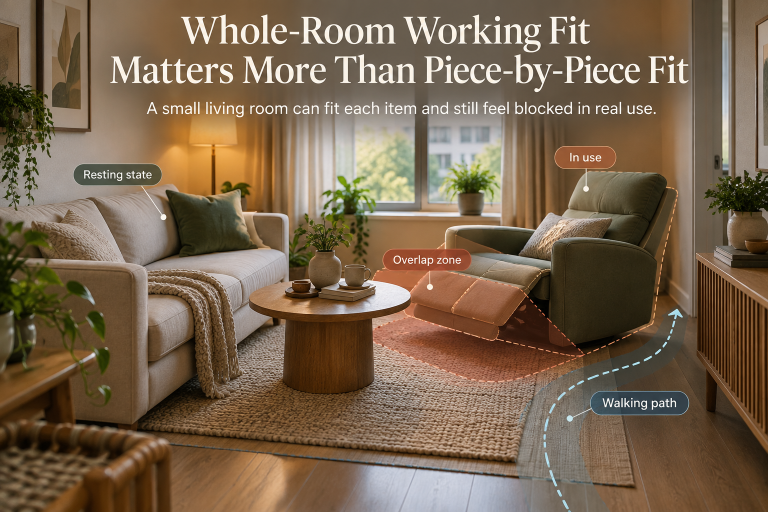
Before choosing the end table in isolation, use the whole-living-room working-fit method to check sofa-side placement, access, circulation, and nearby furniture together.
Final Takeaway
The best small end table is not automatically the one with the smallest published footprint.
It is the one whose full use state works beside your actual seating.
That may mean:
- a compact movable tray;
- a drawer + shelf table;
- a slide-under C-table;
- a nesting set;
- or a deeper powered storage table.
The fit-first sequence is simple:
FOOTPRINT → HEIGHT → TOP USE → BASE GEOMETRY → ACCESS STATE → DEPLOYED STATE → CORD / CLEARANCE → WALKING PATH
Then choose the role that solves your real sofa-side job.
Because in a small living room:
small footprint is only the beginning of the fit check.
How We Researched This Guide
Renternook compared manufacturer / brand product information for the exact products and variants listed in this guide. We did not physically test these products.
We include dimensions, load limits, storage configuration, slide-under requirements, power features, and assembly-related facts only when the product information we reviewed supports them.
Where a field was not established—such as TONSTAD drawer-open projection, Realyn door-swing projection, or an exact LACK nested-state occupied envelope—it remains UNKNOWN rather than being inferred from photos or nearby dimensions.
Product availability, pricing, seller conditions, and term-level demand magnitude can change and are not treated here as durable product facts.