Narrow Pantry Cabinets for Small Kitchens: 4 Fit-First Options to Check Before You Buy
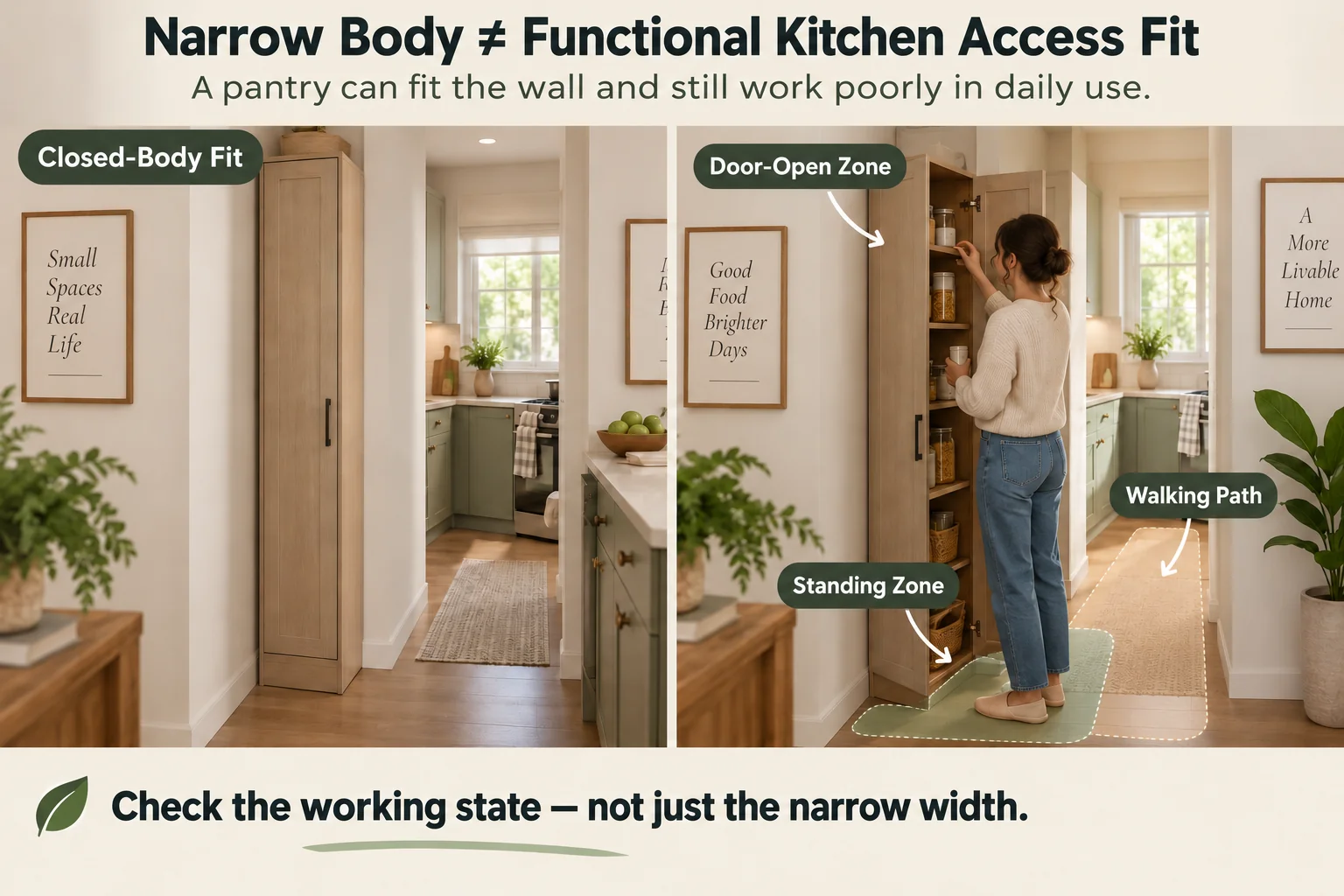
A narrow pantry cabinet can fit along a kitchen wall and still be awkward to use.
The reason is simple: cabinet width is only one part of the real footprint.
A pantry also needs enough depth for your room, enough space for its doors to open, enough access to reach the shelves, and enough clearance for people to move through the kitchen while the cabinet is in use. Some models also need wall anchoring, which can matter just as much as the cabinet dimensions.
That is why a narrow body does not automatically mean a good small-kitchen fit.
This guide compares four narrow pantry cabinet roles by:
- closed cabinet width, depth, and height;
- door architecture;
- storage layout;
- anchoring information where it is published;
- and the open-state questions you still need to verify in your own kitchen.
There is no single “best” pantry here. The useful comparison is which cabinet role fits your room, access pattern, and installation limits.
Quick Comparison: 4 Narrow Pantry Cabinet Roles
| Product | Body size | Pantry role | Main fit question |
|---|---|---|---|
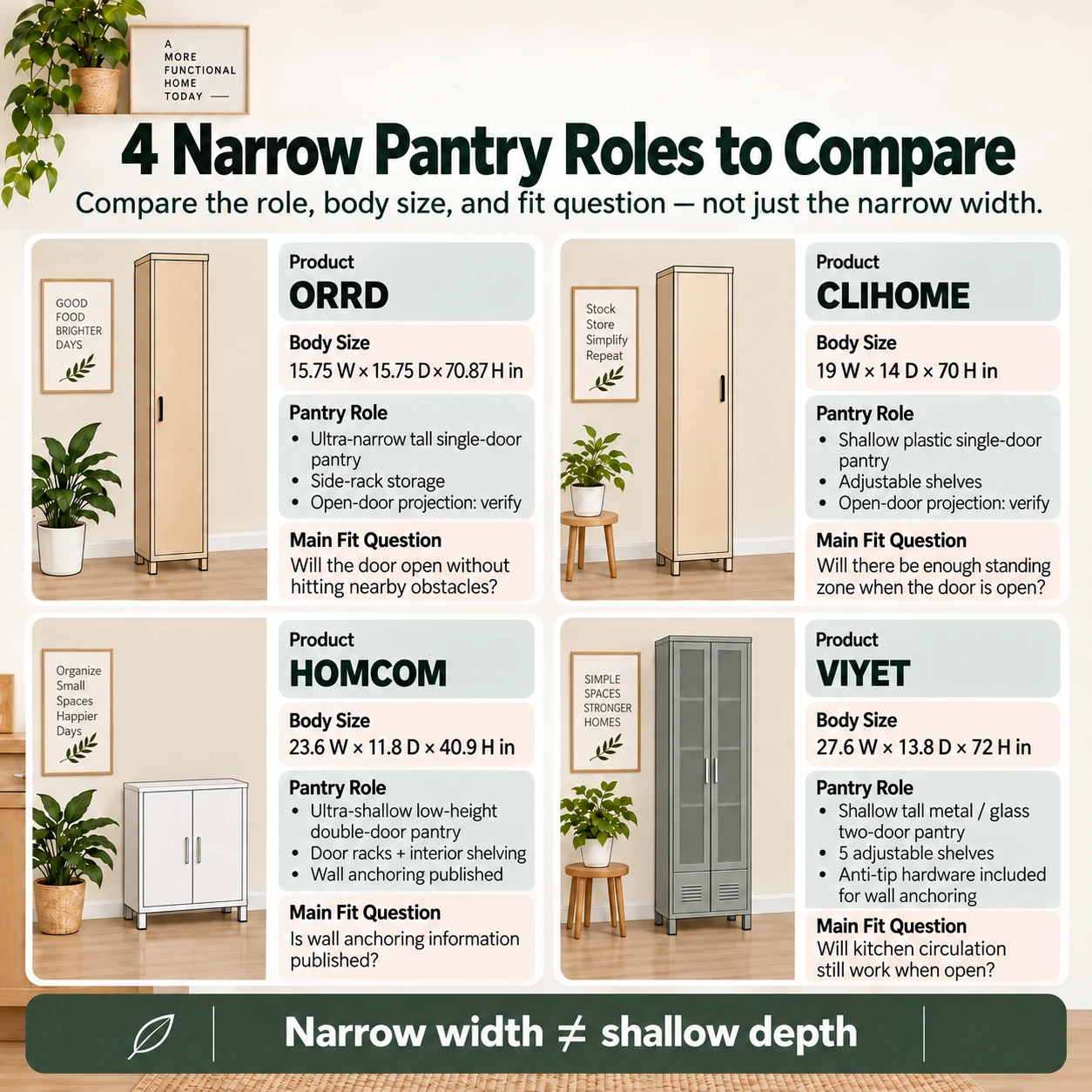
| ORRD White Freestanding Kitchen Pantry Cabinet | 15.75 W × 15.75 D × 70.87 H in | Ultra-narrow tall single-door pantry with side-rack storage | Is the extra depth and single-door swing workable in your kitchen? |
| Clihome Gray Plastic Pantry Buffet | 19 W × 14 D × 70 H in | Shallow plastic single-door pantry with adjustable shelves | Does the door swing work without blocking the route beside it? |
| HOMCOM 41″ Kitchen Pantry Cabinet | 23.6 W × 11.8 D × 40.9 H in | Ultra-shallow low-height double-door pantry with door racks | Is a wider but shallower cabinet better than a taller narrow one for your space? |
| VIYET White Metal Freestanding Kitchen Pantry Cabinet | 27.6 W × 13.8 D × 72 H in | Shallow tall metal-and-glass two-door pantry with adjustable shelves | Do you have enough wall width, door-opening space, and anchoring compatibility? |
The measurements above describe the cabinet bodies. They do not tell you how far the doors project when open. That open-state measurement was not established for these four products, so you should not treat body depth as the full working depth.
What “Narrow” Should Mean in a Small Kitchen
It is easy to shop by width first.
That makes sense when you have a tight wall gap, but width alone can hide several other fit problems.
A cabinet can be narrow and still:
- project too far into a walkway;
- need more room in front when its doors are open;
- interfere with another cabinet, appliance, or doorway;
- require wall anchoring that does not work for your installation;
- or place frequently used storage behind a door that is awkward to open in a tight aisle.
So before comparing styles, divide the problem into two states:
1. Closed-body fit
Check:
- cabinet width;
- cabinet depth;
- cabinet height;
- nearby trim, counters, appliances, and doors;
- and the path people use when the pantry is closed.
2. Open-access fit
Then check:
- how the pantry door or doors open;
- whether the open door conflicts with a wall, refrigerator, base cabinet, or room door;
- whether you can stand in front of the pantry and reach the shelves;
- and whether another person can still move through the kitchen while the pantry is being used.
There is no universal aisle or door-clearance number that works for every kitchen. The useful measurement is the actual space in your room.
1. ORRD White Freestanding Kitchen Pantry Cabinet with Doors & Shelves
Body size: 15.75 W × 15.75 D × 70.87 H in
The ORRD is the narrowest cabinet in this group by body width.
Its role is an ultra-narrow tall single-door pantry with side-rack storage. That makes it worth checking when your main constraint is a tight wall width and you still want a full-height pantry form.
But the important tradeoff is depth.
At 15.75 inches deep, it is deeper than the other three cabinets in this comparison. A cabinet can save wall width while still projecting farther into the room.
Good role match
The ORRD is most relevant when:
- your available wall width is very limited;
- a tall vertical pantry makes sense for the room;
- and the 15.75-inch depth does not create a walking-path problem.
Check before buying
The door’s open-state projection was not established in the product information reviewed for this guide.
That means you should measure more than the closed cabinet footprint. Check the actual door-swing area in your kitchen before deciding whether the narrow body is enough.
The anti-tip or wall-anchoring requirement was also not established here, so do not assume that this cabinet is a no-drill option or that it can be used safely without anchoring. Verify the installation instructions for the exact unit before purchase.
Important limitation
The ORRD is a good example of why narrow width is not the same as shallow depth.
Its 15.75-inch width is compact, but its 15.75-inch depth still needs to work with your aisle, adjacent cabinets, and door-opening space.
2. Clihome Gray Plastic Pantry Buffet with 4 Adjustable Shelves, Single Door
Body size: 19 W × 14 D × 70 H in
The Clihome takes a different approach.
It is a shallow plastic single-door pantry with adjustable shelves, so the main appeal is not simply narrow width. It combines a relatively slim 19-inch body with a 14-inch depth and adjustable interior storage.
Good role match
This model is most relevant when:
- you want a tall single-door pantry;
- you prefer a shallower body than the ORRD;
- and adjustable shelf positions matter for the items you plan to store.
Check before buying
The door’s open-state projection was not established.
That matters because a 14-inch-deep cabinet can still need more usable space once the door is open and someone is standing in front of it.
The anchoring requirement was also not established in the information used for this comparison. Do not infer that the absence of a published anchoring detail means no anchoring is needed.
Check the current installation instructions for the exact model before treating it as suitable for a rental or a no-drill installation.
Important limitation
The Clihome is shallower than the ORRD, but it is also wider.
That tradeoff may be useful in one kitchen and wrong in another. If your problem is wall width, the ORRD may fit where the Clihome does not. If your problem is depth into the aisle, the Clihome may be easier to place.
3. HOMCOM 41″ Kitchen Pantry Cabinet with 12 Door Shelves, Double Doors, and 5-Tier Shelving
Body size: 23.6 W × 11.8 D × 40.9 H in
The HOMCOM is the shallowest cabinet in this group.
Its role is an ultra-shallow, low-height, double-door pantry with door-rack storage.
That makes it different from the three taller cabinets here. Instead of maximizing vertical height, it uses a wider body with a depth of 11.8 inches.
Good role match
The HOMCOM is most relevant when:
- shallow depth matters more than minimizing wall width;
- a lower cabinet works in your layout;
- and you want storage that includes shelves on the doors as well as interior shelving.
Check before buying
The open-state door projection was not established in the reviewed product information.
That is especially important on a double-door cabinet. The 11.8-inch body depth is only the closed footprint. Measure the space in front of the unit based on how the doors will actually open in your room.
Anti-tip hardware is provided, and wall anchoring is published for this model.
However, the exact wall type and fastener requirement were not established here. Check the installation instructions and make sure the supplied or required hardware is appropriate for your wall.
Important limitation
The HOMCOM is a useful reminder that shallow does not mean narrow.
At 23.6 inches wide, it needs more wall width than the ORRD or Clihome even though it projects less into the room.
For some kitchens, that is a better trade. For others, it removes the main reason to shop for a narrow pantry in the first place.
4. VIYET 27.6-in W × 13.8-in D × 72-in H White Metal Freestanding Kitchen Pantry Cabinet
Body size: 27.6 W × 13.8 D × 72 H in
The VIYET is the widest cabinet in this comparison.
Its role is a shallow tall metal-and-glass two-door pantry with five adjustable shelves.
This is the option to consider when you have more wall width available but still want to keep body depth under control.
Good role match
The VIYET is most relevant when:
- you can accommodate a 27.6-inch cabinet width;
- you want a tall pantry form;
- adjustable shelves are useful for your storage plan;
- and a 13.8-inch closed depth works with your kitchen layout.
Check before buying
The door’s open-state projection was not established.
Because this is a two-door cabinet, you should measure the usable area in front of the cabinet rather than relying only on the 13.8-inch body depth.
Anti-tip hardware is included for wall anchoring.
The exact wall-type and fastener compatibility were not established here, so verify that the installation method is appropriate for your wall before purchase.
Important limitation
The VIYET has the largest body width in this set.
It may still be shallow enough for a compact kitchen, but it is not the choice for a very narrow wall gap. Its main fit question is whether the extra width gives you a better storage layout without creating conflicts elsewhere in the room.
How to Measure for a Narrow Pantry Cabinet
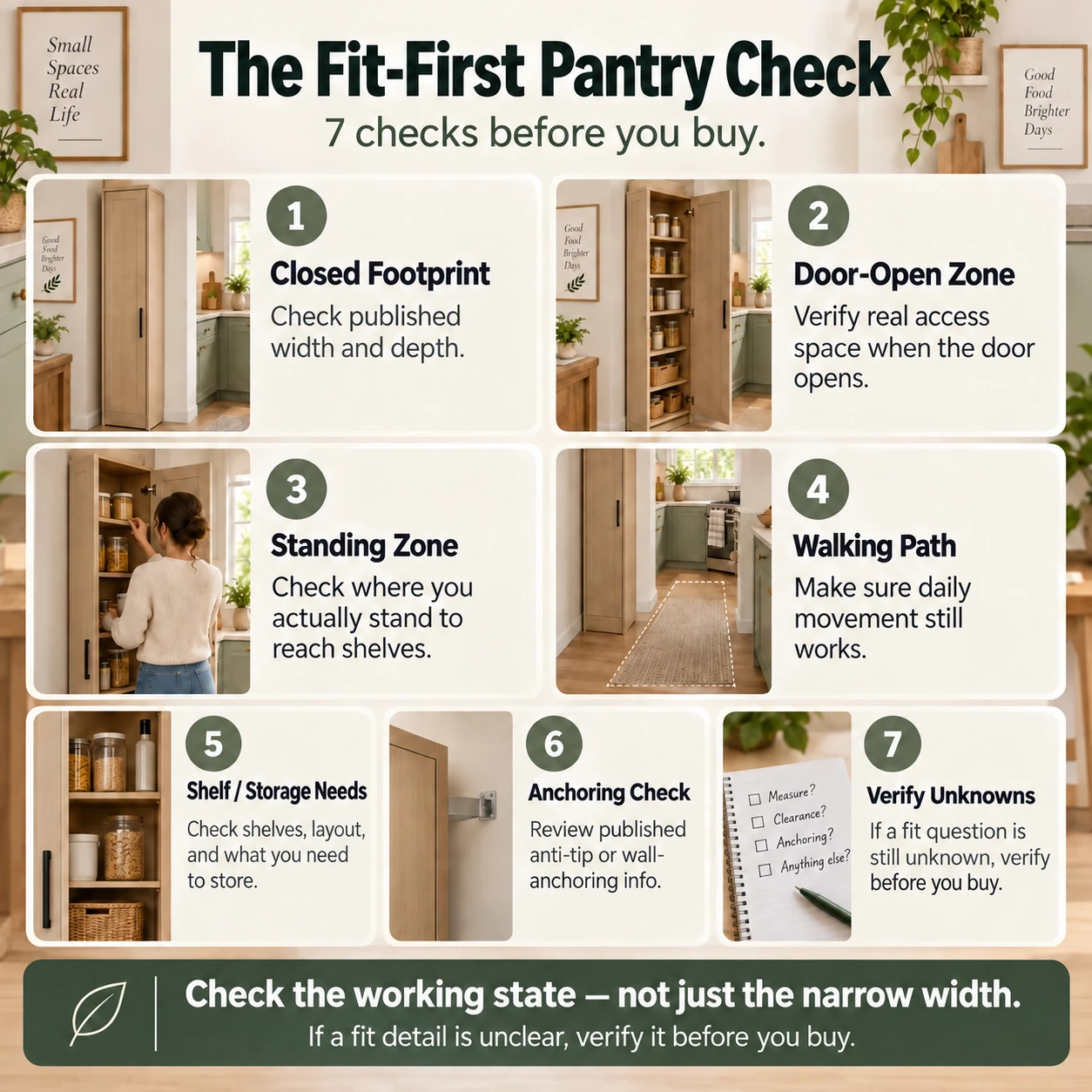
A simple wall-width measurement is not enough.
Use this sequence instead.
Step 1: Measure the closed footprint
Record the maximum width, depth, and height available for the cabinet.
Also note anything that reduces usable space, such as:
- baseboards;
- countertop overhangs;
- door trim;
- refrigerator handles;
- wall switches or outlets;
- and nearby cabinet doors.
Step 2: Map the door-opening zone
Look at where the pantry door or doors will move.
Do not estimate the open position from the cabinet depth. The products in this guide do not have an established open-door projection measurement here.
Instead, confirm the actual door behavior for the model and compare it with your kitchen layout.
Step 3: Check the standing zone
You need space not only for the door, but also for the person using the pantry.
Ask:
- Can I stand in front of the open cabinet?
- Can I reach the lower shelves?
- Can I reach the upper shelves safely?
- Does my body block the entire kitchen path while I am using it?
Step 4: Check the walking path
Imagine the cabinet in normal daily use.
Then ask whether someone can pass through the kitchen while:
- the pantry is closed;
- the pantry door is open;
- and someone is standing in front of it.
You do not need a universal clearance rule. You need a layout that works in your actual room.
Step 5: Verify anchoring before you buy
Anchoring varies by product.
For this group:
- the anchoring requirement was not established here for the ORRD;
- the anchoring requirement was not established here for the Clihome;
- the HOMCOM publishes wall anchoring and includes anti-tip hardware;
- the VIYET includes anti-tip hardware for wall anchoring.
Do not treat an unconfirmed anchoring detail as proof that no anchoring is required.
If drilling, wall type, or fastener compatibility matters in your home, verify the exact installation instructions before buying.
Which Pantry Role Fits Which Constraint?
If your main problem is very limited wall width, start by comparing the ORRD and Clihome.
If your main problem is depth into the kitchen, the HOMCOM has the shallowest closed body in this set.
If you want a tall pantry with more wall width available, the VIYET gives you a different role: wider than the others, but still relatively shallow compared with its height.
The point is not to choose the smallest number.
The point is to identify which dimension is actually limiting your kitchen.
A cabinet that wins on width can lose on depth.
A cabinet that wins on depth can need more wall width.
A tall cabinet can add vertical storage but also bring installation and access questions.
A double-door cabinet can create a different open-state footprint from a single-door cabinet.
That is why a narrow pantry should be evaluated as a working object, not just a rectangle in a product listing.
Fit-First Checklist
Before ordering a narrow pantry cabinet, confirm:
- cabinet width;
- cabinet depth;
- cabinet height;
- available wall width;
- nearby door, appliance, and cabinet conflicts;
- door-opening direction and open-state space;
- standing space in front of the pantry;
- walking path while the pantry is open;
- shelf layout and adjustability where relevant;
- anchoring requirement;
- wall type and compatible fasteners where anchoring is required;
- and whether the installation method works for your home.
If a measurement or installation detail is not published, do not fill in the blank with an assumption. Verify it before buying.
How We Researched This Guide
This guide compares published product specifications and product information for four pantry cabinets that represent different narrow- and shallow-storage roles.
We use published dimensions where they are available and avoid estimating measurements that were not established in the product information reviewed for this guide.
Open-door projection was not established for the four products compared here, so this guide does not assign a universal door-opening clearance.
Anchoring information is also treated product by product rather than assumed across the category.
Prices and stock can change and are not used as durable fit claims in this guide.
Final Takeaway
A narrow pantry cabinet can save wall width without solving the real kitchen-fit problem.
The better question is:
Does the cabinet still work once its depth, doors, access zone, walking path, and installation requirements are part of the footprint?
The ORRD, Clihome, HOMCOM, and VIYET each solve a different space problem.
Measure the kitchen first, identify the dimension that is actually limiting you, then choose the pantry role that fits both the closed footprint and the way you will use it every day.