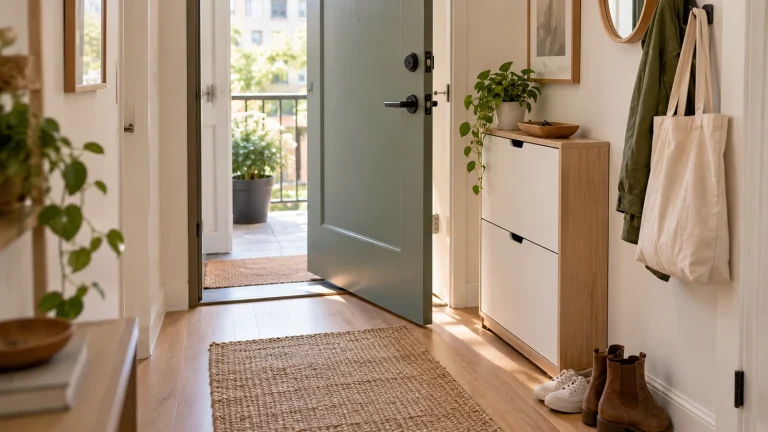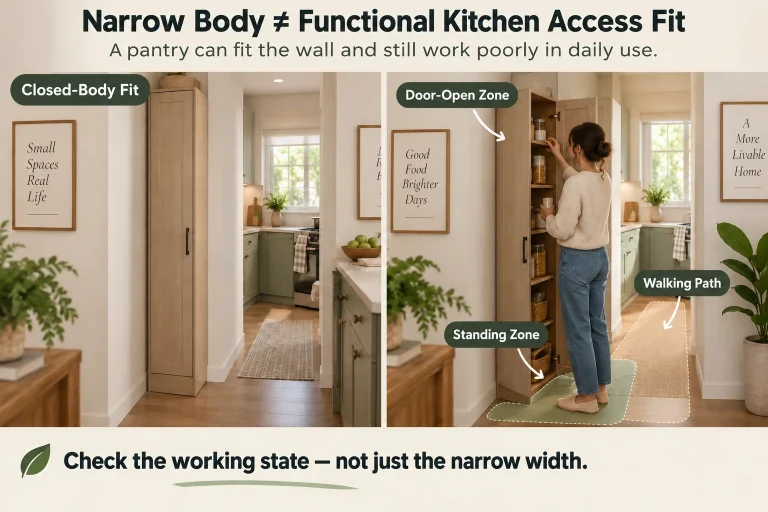
Narrow Console Tables for Small Entryways: 5 Fit-First Options to Check Before You Buy
A narrow console table can look like the obvious answer for a small entryway.
It sits against the wall.
It gives you a place for keys, mail, a bag, or a small tray.
Some models add drawers, shelves, or cabinet storage.
But there is a problem with judging a console by the word “narrow” alone:
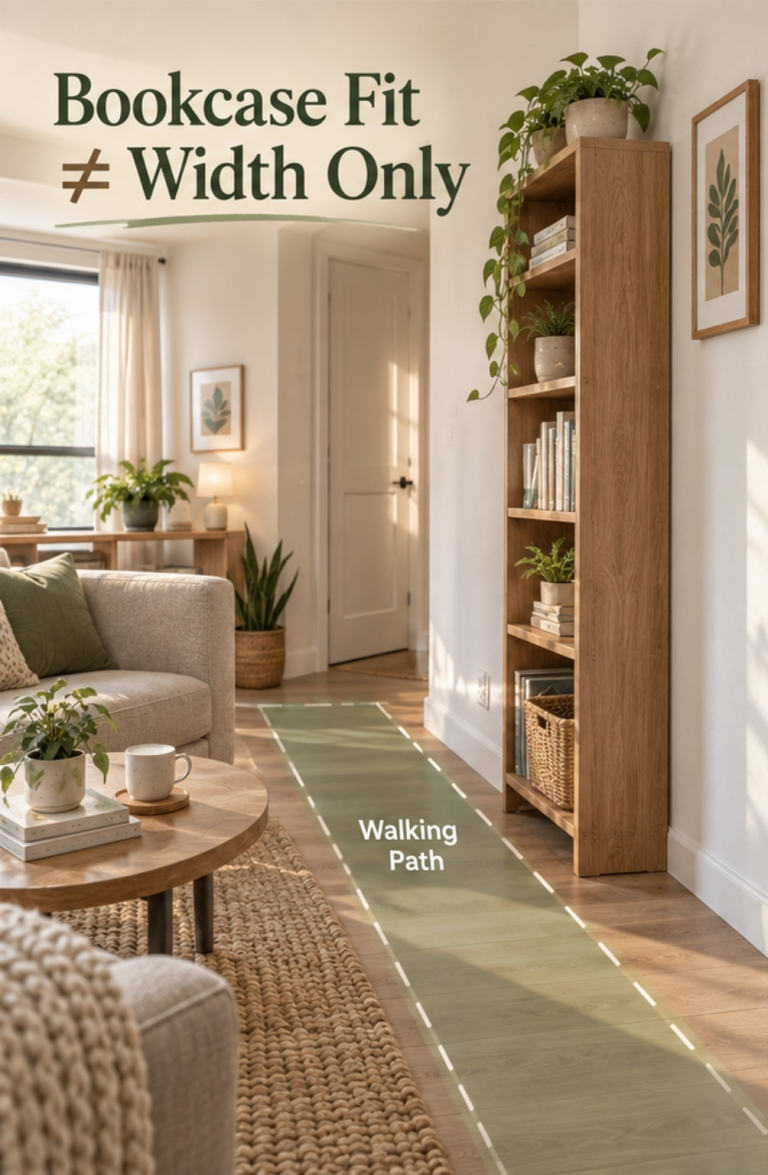
Narrow depth does not automatically mean functional entryway fit.
A console can be shallow enough for the wall and still cause problems once you account for:
- the walking path;
- the front door;
- nearby doors;
- drawers or cabinet doors that open into the room;
- baseboards and trim;
- wall anchoring or anti-tip requirements;
- and the way you actually use the top as a drop zone.
That is why this guide does not rank five console tables from “best” to “worst.”
Instead, it compares five materially different console roles and asks a more useful question:
Which role fits the way your entryway actually works?
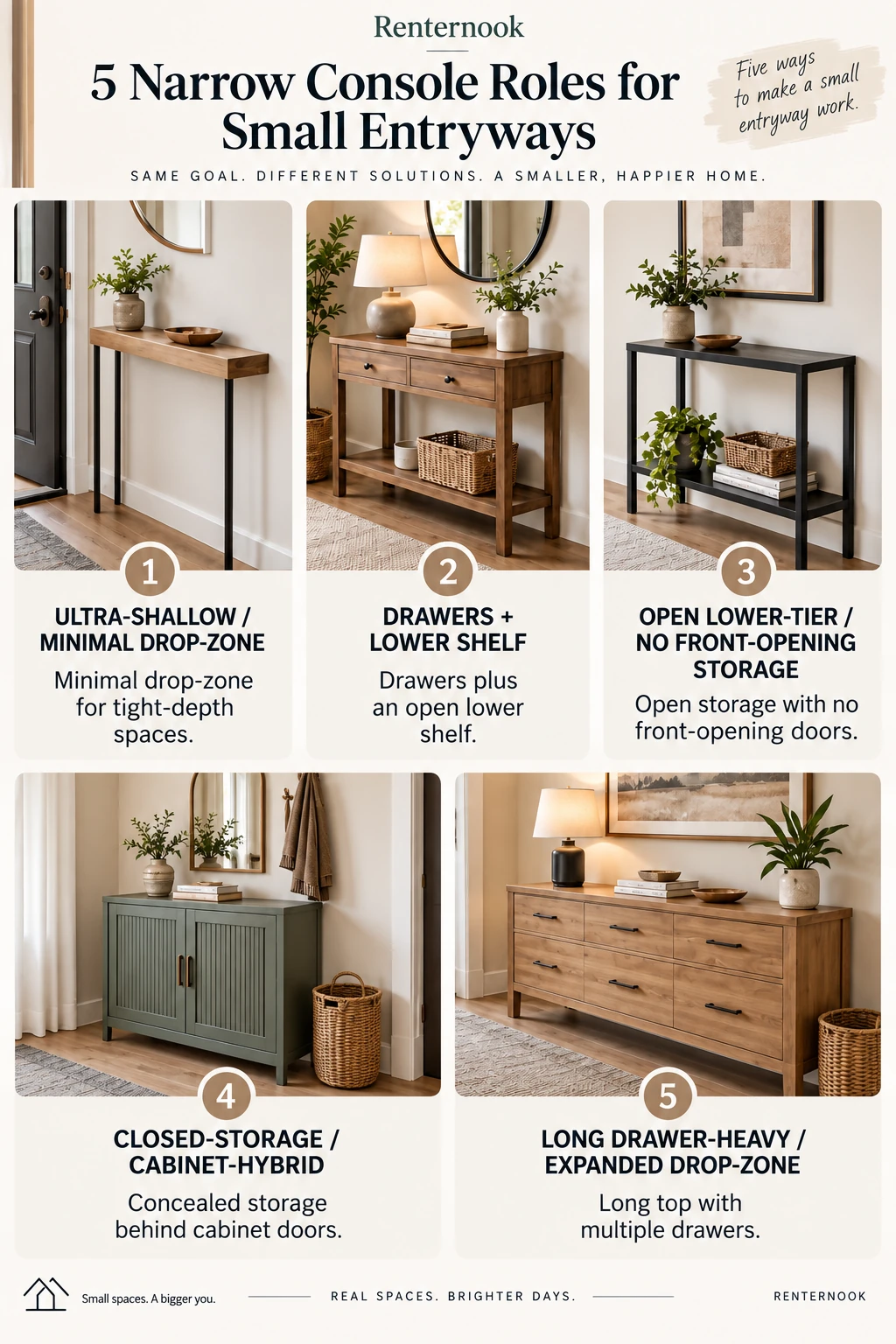
The five products in this guide are:
- Yamazaki Home Narrow Entryway Console Table — ultra-shallow minimal drop-zone;
- Pottery Barn Townes Console Table (48") — drawers plus lower shelf;
- Nathan James Virgo Modern Farmhouse Wood Console Table — open lower tier with no front-opening storage;
- Simpli Home Artisan Entryway Storage Cabinet — shallow closed-storage cabinet-hybrid;
- Walker Edison 59in Modern Black Console Entry Table with Storage — long drawer-heavy expanded drop-zone.
Before comparing them, start with the space.
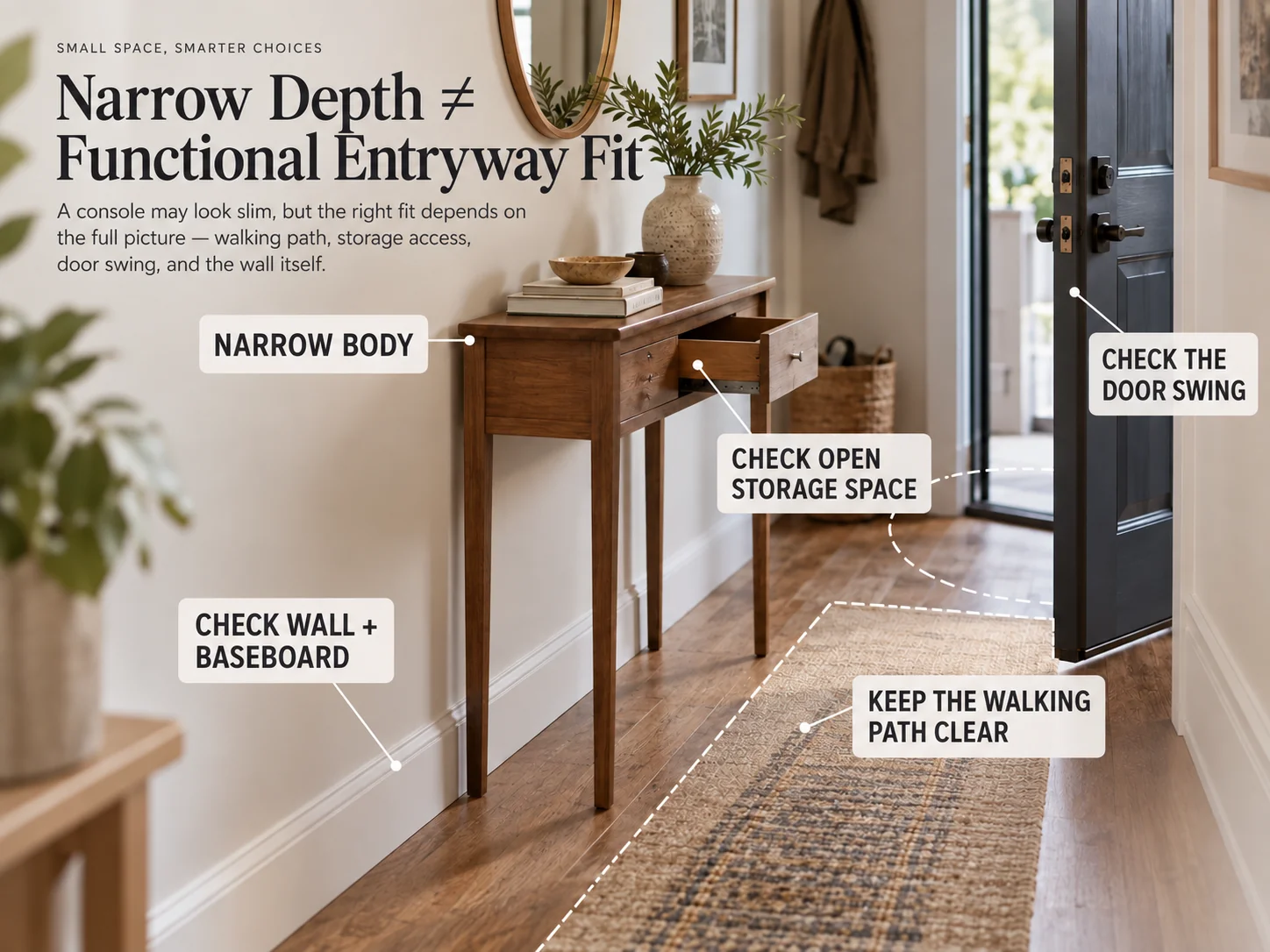
Before You Buy: Measure More Than the Empty Wall
The first mistake is measuring only the rectangle where you hope the console will go.
An entryway is not a static display area.
People walk through it.
Doors move through it.
Bags, coats, shoes, and deliveries move through it.
A console may also change shape in use if it has drawers or cabinet doors.
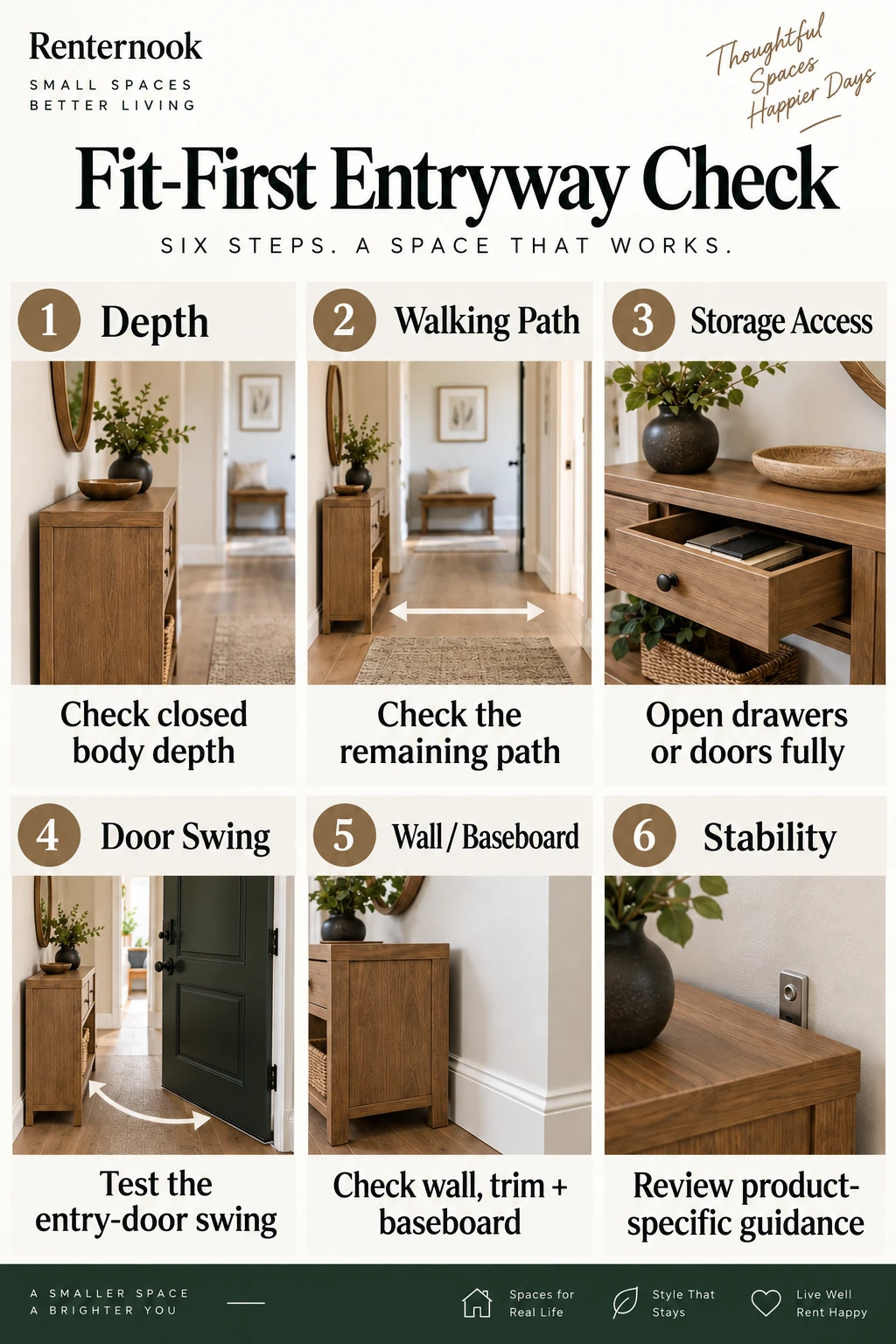
So the fit check should follow this order:
- body depth;
- walking path;
- drawer / door / storage access;
- entry-door swing;
- wall / baseboard / trim relationship;
- product-specific stability / anchoring / assembly.
Do not reverse that order and start with style.
A console that looks right but blocks the entry is still the wrong console.
1. Start With Body Depth
Published product depth tells you how far the console body projects from the wall when it is in its normal closed state.
That number matters.
But it is only the first number to check.
A 7.28-inch-deep console and a 15-inch-deep console affect the room very differently.
At the same time:
Body depth ≠ working depth.
If the product has drawers or doors, the space it needs while being used can be larger than the closed body depth.
Do not convert the listed body depth into a claim such as:
“This console only needs 12 inches of space.”
That statement would ignore the access state.
Use body depth as a product specification—not as a universal fit guarantee.
2. Check What Happens to the Walking Path
A small entryway is usually a circulation zone first and a furniture zone second.
After marking the proposed console depth, walk through the entry normally.
Try the things that actually happen there:
- enter while carrying a bag;
- leave while holding keys or a phone;
- bring in a package;
- pass another person;
- reach for a light switch;
- open a nearby closet;
- stand in front of the console and use it.
There is no single universal walking-clearance number that works for every entryway in this guide.
The correct question is not:
“Does the console meet one magic clearance number?”
It is:
“Does the remaining path still work in my actual entry?”
3. Check the Open State, Not Just the Closed State
This matters most for the products with drawers or doors.
A console can look compact when everything is closed and become awkward when you need to open the storage.
For drawers, verify:
- whether you can stand in front of them;
- whether the front door moves through the same area;
- whether another door conflicts with the drawer path;
- whether the drawer can be opened far enough for normal use.
For cabinet doors, verify the same idea.
Do not use drawer interior depth as a substitute for drawer-open projection.
For example, a drawer can have an 8.75-inch interior depth without that number telling you how far the drawer projects into the room when open.
Drawer interior depth ≠ drawer-open working depth.
The same logic applies to cabinet doors.
Cabinet body depth ≠ door-open working depth.
4. Map the Entry-Door Swing
A console can fit the wall and still interfere with the front door.
Open the door through its normal travel path before deciding where the console belongs.
Check:
- the door slab;
- the handle;
- any door stop;
- a nearby closet or utility door;
- the area where a person stands while entering.
Do not assume that “narrow console” means “safe beside any front door.”
The product dimensions cannot tell you your door geometry.
That must be checked in the room.
5. Check Baseboards, Trim, Outlets, and Wall Conditions
Baseboards can keep furniture from sitting fully flush against the wall.
Trim can reduce usable width.
Outlets and switches can make an otherwise empty wall less usable.
And some products include or require anti-tip or wall-securement measures.
Before buying, check:
- usable wall width;
- baseboard thickness and height;
- outlet locations;
- switch locations;
- floor level;
- wall material;
- installation instructions for the exact product.
Do not generalize one product’s anchoring instructions to all five products.
Each product must be treated separately.
Quick Comparison
| Product | Role | Published body dimensions | Storage type | Front-opening storage | Assembly / anchoring evidence | Main fit tradeoff |
|---|---|---|---|---|---|---|
| Yamazaki Home Narrow Entryway Console Table | Ultra-shallow minimal drop-zone | 23.62"W × 7.28"D × 31.7"H | Slim top + 4 hooks | No drawer / cabinet door | Assembly required; exact anti-tip / anchoring wording not verified in the product information we reviewed | Small body depth, but limited concealed storage |
| Pottery Barn Townes Console Table (48") | Drawers + lower shelf | 48"W × 14"D × 30"H | 2 drawers + 1 fixed shelf | Yes — drawers | Anti-tip kit included; wall securement instruction present | Useful storage, but drawers create an additional access state |
| Nathan James Virgo | Open lower-tier console | 40"W × 13.8"D × 29.5"H | Open lower shelf | No front-opening drawer / door | Anti-tip hardware included; assembly required | No drawer-opening envelope, but body depth still affects circulation |
| Simpli Home Artisan Entryway Storage Cabinet | Closed-storage cabinet-hybrid | 36"W × 12"D × 36"H | 2 drawers + 2 doors + 2 adjustable shelves | Yes — drawers + doors | Anti-tip hardware included; two-person assembly; wall anchoring required by current source | Shallow closed body, but the access state is more complex |
| Walker Edison 59in Modern Black Console Entry Table with Storage | Long drawer-heavy expanded drop-zone | 59.2"W × 15"D × 31.5"H | 4 drawers | Yes — drawers | Assembly required; exact anti-tip evidence not verified in the product information we reviewed | Large top and concealed storage require much more wall width |
The important comparison is not just which console is shallowest.
It is how each console uses the entryway differently.
1. Yamazaki Home Narrow Entryway Console Table — When Body Depth Is the Main Constraint
The Yamazaki Home Narrow Entryway Console Table is the most minimal role in this group.
Its current verified body dimensions are:
- Width: 23.62 inches
- Depth: 7.28 inches
- Height: 31.7 inches
It provides a slim top and includes four hooks.
That makes it fundamentally different from the drawer and cabinet options later in this guide.
There is no front-opening drawer or cabinet door to account for.
The main functional job is simpler:
Create a small drop-zone surface without projecting far into the room.
This can be useful in an entry where the first constraint is floor depth.
The top can serve as a place for a key tray or small everyday items, while the hooks add another type of organization without introducing a drawer-opening path.
But the small body depth does not prove that it will fit every narrow entryway.
You still need to check:
- the remaining walking path;
- front-door movement;
- baseboards and trim;
- the wall width available;
- whether the top size is useful for what you actually drop there.
Check before buying
- Do you have at least 23.62 inches of usable wall width?
- Does the 7.28-inch body depth leave a practical walking path in your entry?
- Will the front door or its handle move through the same area?
- Will baseboards keep the frame from sitting where you expect?
- Is a small top plus hooks enough for your daily routine?
- Can you follow the exact assembly instructions for the product?
Good role match
This role makes sense when your biggest problem is body depth and you mainly need a small landing surface rather than concealed storage.
Important limitation
Do not turn “ultra-shallow” into a universal fit claim.
A 7.28-inch body depth is a verified product dimension.
It is not a verified statement about how much walking space your home needs.
Also, the product information we reviewed does not establish a universal no-drill or renter-friendly claim.
2. Pottery Barn Townes Console Table (48") — When You Want Drawers and an Open Lower Shelf
The Pottery Barn Townes Console Table uses a different storage strategy.
Its current verified body dimensions are:
- Width: 48 inches
- Depth: 14 inches
- Height: 30 inches
It includes:
- 2 drawers
- 1 fixed shelf
The drawer interiors are listed at:
- 18.75 inches wide
- 8.75 inches deep
- 2.75 inches high
The lower shelf is listed at:
- 46 inches wide
- 12.5 inches deep
That gives this console two useful storage modes:
- concealed small-item storage in the drawers;
- an open lower shelf.
The tradeoff is that the drawers create an access state that the minimal Yamazaki console does not have.
A 14-inch body depth may fit the wall.
But you must also be able to stand in front of the console and use the drawers.
The source does not provide a verified universal drawer-open working depth.
So do not invent one.
Anti-tip / wall-securement note
Current first-party evidence states that an anti-tip kit is included and instructs that the item should be securely fixed to the wall.
Keep that statement attached specifically to the Townes.
Do not turn it into a general claim about all console tables.
Check before buying
- Does the 48-inch width fit the usable wall section?
- Does the 14-inch closed body depth work with your walking path?
- Can the two drawers open without conflicting with the entry door?
- Can you stand in front of the console while using a drawer?
- Does the lower shelf remain useful without becoming an obstacle?
- Can you follow the wall-securement instructions for your wall type?
Good role match
This role may make sense when you want concealed storage for small items but still value an open shelf below.
Important limitation
The 8.75-inch drawer interior depth does not tell you the drawer-open projection.
Do not use it as a working-clearance number.
3. Nathan James Virgo — When You Want Open Storage Without Drawer or Cabinet-Door Access
The Nathan James Virgo Modern Farmhouse Wood Console Table provides an open lower tier rather than front-opening storage.
Current verified dimensions are:
- Width: 40 inches
- Depth: 13.8 inches
- Height: 29.5 inches
SKU:
- 37303
The manufacturer also publishes:
- bottom tier height: 7.48 inches
- internal area depth: 12 inches
This role is important because it separates two ideas that are often mixed together:
- storage capacity;
- front-opening access.
The Virgo gives you a lower shelf, but there is no drawer or cabinet door that needs to swing or pull into the walking path.
That removes one access-state problem.
It does not remove the body-depth problem.
A 13.8-inch console still projects 13.8 inches into the room in its normal orientation.
So the fit check becomes simpler, but it does not disappear.
Assembly / safety
The current manufacturer source includes anti-tip hardware and states that assembly is required.
Again, keep that product-specific.
Check before buying
- Does the 40-inch width work on your wall?
- Does the 13.8-inch body depth preserve a practical path?
- Can you use the lower shelf without items projecting into circulation?
- Does the entry door clear the console?
- Can you install the included anti-tip hardware as directed?
- Do baseboards or trim change how the console sits?
Good role match
This role may make sense when you want a top plus open lower storage but do not want drawers or cabinet doors opening into the entry.
Important limitation
“No front-opening storage” does not mean “automatic small-entryway fit.”
The closed body footprint still has to work.
4. Simpli Home Artisan Entryway Storage Cabinet — When Concealed Storage Is the Priority
The Simpli Home Artisan is the most cabinet-like product in this group.
Model:
- AXCART47-RUS
Current verified body dimensions are:
- Width: 36 inches
- Depth: 12 inches
- Height: 36 inches
Storage includes:
- 2 drawers
- 2 tempered-glass doors
- 2 adjustable shelves
The manufacturer lists drawer interiors at:
- 13 inches wide
- 8 inches deep
- 3.15 inches high
The cabinet interior is listed at:
- 14.9 inches wide
- 9.9 inches deep
- 22.9 inches high
A 12-inch closed body depth may look attractive in a small entryway.
But this product demonstrates the core thesis of this guide especially well:
A shallow closed body does not tell you the full working footprint.
There are multiple access states:
- drawers opening;
- cabinet doors opening;
- standing in front while using the storage.
The current source confirms the existence of the doors and drawers.
It does not provide a responsible universal door-open or drawer-open clearance number for your home.
So measure the room instead of inventing one.
Assembly / wall anchoring
Current source evidence states:
- two-person assembly;
- anti-tip hardware included;
- wall anchoring required by the current source.
That installation requirement is part of the fit decision.
Check before buying
- Does the 36-inch width fit the usable wall?
- Does the 12-inch closed body depth work before any storage is opened?
- Can the two doors open without contacting the front door or another obstacle?
- Can the drawers open while someone still has room to stand there?
- Can you comply with the wall-anchoring requirement?
- Will baseboards affect placement or anchoring?
Good role match
This role may make sense when concealed storage matters more than having the simplest access state.
Important limitation
Never describe this as “only 12 inches deep” in a way that implies 12 inches is the total working space it needs.
That would ignore both drawer and door use.
5. Walker Edison 59in Modern Black Console Entry Table with Storage — When You Want a Long Drop-Zone and More Drawer Storage
The Walker Edison 59in Modern Black Console Entry Table with Storage is the longest and deepest body in this five-product set.
SKU:
- W2729P298159
Current verified body dimensions are:
- Width: 59.2 inches
- Depth: 15 inches
- Height: 31.5 inches
Storage:
- 4 drawers
This role is not trying to be the smallest console in the guide.
Its main tradeoff is different:
Give more wall space to the console in exchange for a much larger top and more concealed drawer storage.
That can make sense in an entryway that is small in overall square footage but still has a long usable wall.
It can also be the wrong move in a very tight passage where 15 inches of closed body depth already feels intrusive.
And because there are four drawers, you still need to check the open state.
The current product information we reviewed does not provide a verified drawer-open projection.
So do not infer one.
Check before buying
- Do you actually have 59.2 inches of clear wall width?
- Does the 15-inch closed depth preserve a practical walking path?
- Can all four drawers be used without conflict with the front door?
- Will people still be able to pass while a drawer is open?
- Are there outlets, switches, trim, or vents along the long wall area?
- Can you complete the required assembly correctly?
Good role match
This role may make sense when you have a long wall, want a larger drop-zone surface, and value more concealed drawer storage.
Important limitation
“Long” and “slim” are relative marketing concepts.
The verified fact is the product dimension:
59.2"W × 15"D × 31.5"H
Whether that is slim enough for your entryway must be decided in the room.
Which Console Role Fits Your Entryway?
Instead of asking which product is “best,” match the role to the job.
Choose an ultra-shallow minimal drop-zone if:
- body depth is your biggest constraint;
- you need a small place for keys or everyday items;
- concealed drawer storage is not essential;
- a smaller wall footprint is useful.
Role: Yamazaki Home Narrow Entryway Console Table
Choose drawers + a lower shelf if:
- you want some concealed small-item storage;
- you also want an open lower surface;
- your entry has enough depth for the body and drawer-access state;
- wall securement can be handled correctly.
Role: Pottery Barn Townes Console Table
Choose an open lower-tier console if:
- you want storage without drawer or cabinet-door opening paths;
- open storage works for your routine;
- the 13.8-inch body depth fits;
- anti-tip installation can be handled correctly.
Role: Nathan James Virgo
Choose a closed-storage cabinet-hybrid if:
- concealed storage is a priority;
- drawers plus cabinet space are useful;
- you have enough operating space for both drawers and doors;
- two-person assembly and wall anchoring are acceptable.
Role: Simpli Home Artisan Entryway Storage Cabinet
Choose a long drawer-heavy console if:
- you have a long clear wall;
- you want a larger top / drop-zone;
- four drawers are useful;
- the 15-inch body depth and drawer-access state work in the room.
Role: Walker Edison 59in Modern Black Console Entry Table with Storage
A Fit-First Measurement and Access Checklist
Before ordering any console, check every item below.
Wall and body fit
- [ ] Usable wall width measured
- [ ] Product width checked against the usable wall
- [ ] Product body depth marked on the floor
- [ ] Product height checked against switches, artwork, and wall fixtures
- [ ] Baseboard / trim relationship checked
- [ ] Outlets and vents checked
Walking path
- [ ] Remaining walking path tested with the console footprint marked
- [ ] Normal entry and exit tested
- [ ] Bag / package carrying tested
- [ ] Space for another person considered
Door movement
- [ ] Front-door swing checked
- [ ] Door handle / hardware checked
- [ ] Closet or utility door swing checked
- [ ] Console placement kept outside conflicting door travel
Storage access
- [ ] Drawer-opening area checked where applicable
- [ ] Cabinet-door swing checked where applicable
- [ ] Standing position in front of storage checked
- [ ] Lower shelf remains usable without blocking circulation
- [ ] Drop-zone top is large enough for the items you actually use
Installation / stability
- [ ] Assembly instructions reviewed
- [ ] Anti-tip hardware requirements checked
- [ ] Wall anchoring requirements checked
- [ ] Wall type and fastening method checked
- [ ] Unknown safety fields treated as unknown—not assumed safe or optional
If one of these remains unknown, treat it as a question that still needs answering.
Do not turn an unknown into a pass because the product looks narrow in a photo.
The Buying Decision Framework
A useful buying sequence is:
Step 1 — Define the job
What does the console actually need to do?
- key / mail drop-zone;
- open lower storage;
- concealed drawers;
- cabinet storage;
- long display / everyday surface.
Do not buy a storage-heavy console if you only need a small landing surface.
And do not buy a minimal console if you really need concealed storage.
Step 2 — Mark the closed body footprint
Use the manufacturer’s current width and depth.
Mark that footprint in the room.
Do not estimate from product photography.
Step 3 — Test circulation
Walk through the entry normally.
Open the front door.
Carry a bag.
Stand in front of the proposed console position.
If the room already feels compromised with the closed body footprint, adding drawers or doors will not solve that.
Step 4 — Add the access state
For drawer products, test the space in front.
For cabinet products, test the door swing.
If the manufacturer does not publish the open projection, do not invent one.
Use the product’s real installation geometry when you have it, or verify it before purchase.
Step 5 — Check the wall
Look at:
- baseboards;
- trim;
- outlets;
- switches;
- vents;
- wall material;
- anchoring points.
A product can fit the floor rectangle and still fail the wall.
Step 6 — Check stability and assembly product by product
Do not treat all five products as if they have the same safety instructions.
Some current sources include anti-tip hardware or wall-securement instructions.
Some product information we reviewed does not establish those details.
Follow the exact manufacturer instructions for the exact product you buy.
Bottom Line
The right narrow console table is not automatically the one with the smallest depth number.
A useful entryway fit depends on several things working together:
- the closed body footprint;
- the walking path that remains;
- the way drawers, doors, or shelves are accessed;
- the movement of the entry door;
- the wall, baseboard, and trim relationship;
- the product-specific assembly and stability requirements;
- the job you actually need the console to perform.
The Yamazaki role protects floor depth and keeps the function minimal.
The Townes adds drawers and a lower shelf but introduces a drawer-access state.
The Virgo uses open lower storage without front-opening drawers or doors.
The Artisan gives you more concealed storage but requires checking both drawer and cabinet-door use.
The Walker Edison provides the largest top and four drawers, but asks for much more wall width and a deeper closed footprint.
So start with the room.
Then choose the console role.
Then verify the exact product.
That sequence is more reliable than buying something because the listing calls it “narrow” and hoping the entryway works around it.
Methodology
Renternook compares current manufacturer / brand specifications, product configuration, storage-access state, installation information, and small-space fit considerations.
The products in this guide were selected to represent materially different console roles rather than five cosmetic variations of the same design.
Product dimensions are treated as product specifications—not as universal fit guarantees.
Where an open-drawer or open-door working dimension is not verified, it is treated as unknown rather than estimated.
Physical-testing disclosure
Renternook has not physically tested these products unless explicitly stated. This guide is based on manufacturer / brand specifications, product configuration, and fit-first analysis.
Availability / specification disclosure
Product specifications, finishes, availability, and manufacturer instructions can change. Verify the current product page and installation instructions before purchasing or installing.