Small Recliners for Small Spaces: 4 Fit-First Options to Check Before You Buy
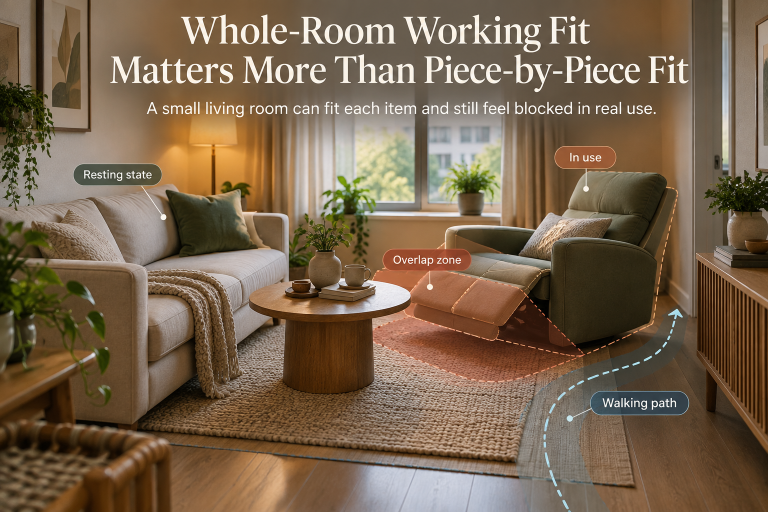
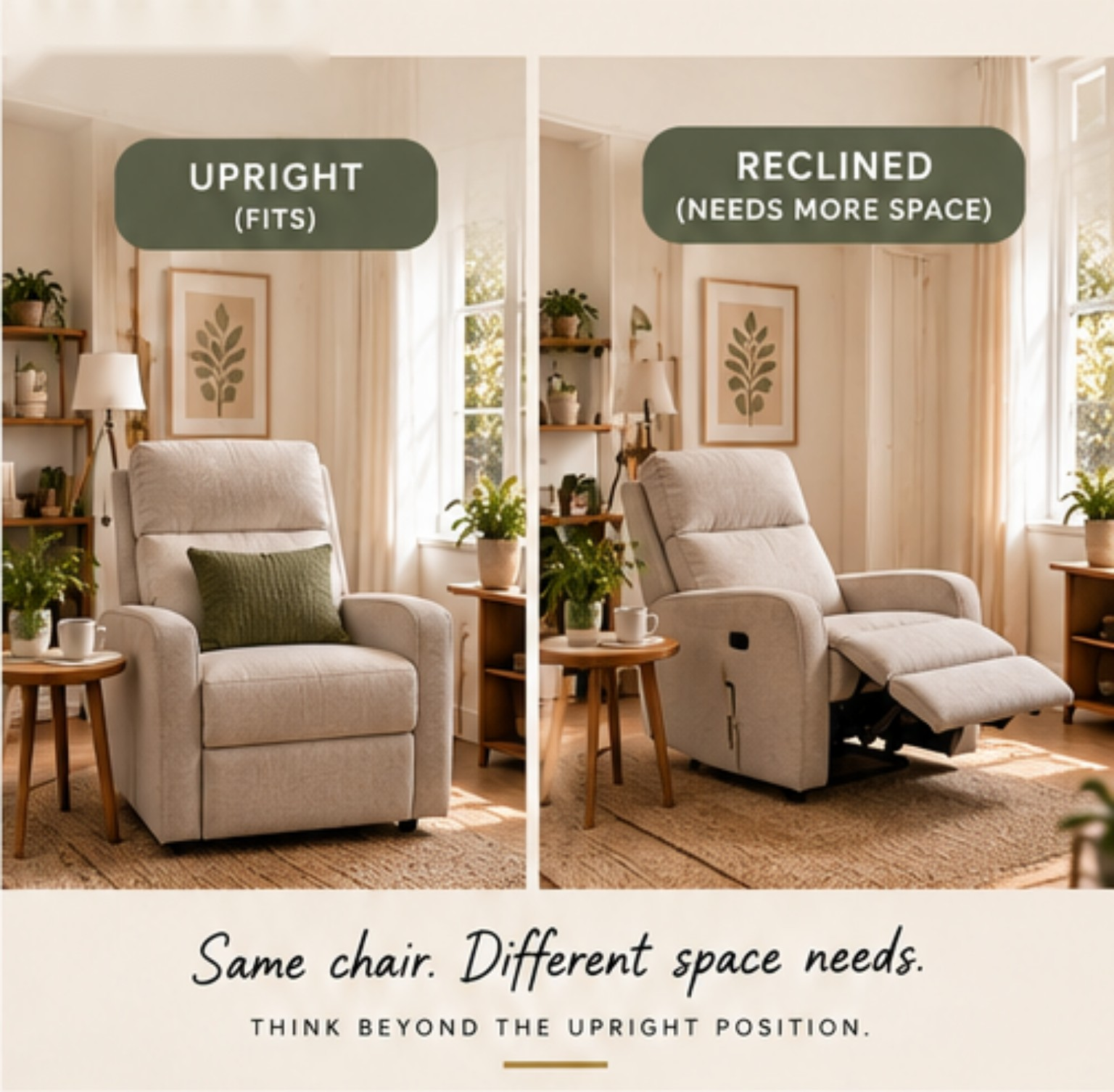
A recliner can look compact when it is upright and still take over a small room once the footrest comes out and the back moves into a deeper reclined position.
That is the fit problem this guide is built around.
For a small-space buyer, the useful question is not simply:
“How wide is the chair?”
It is:
“Will this recliner fit through the delivery path, fit in the room while upright, open into its working position, keep enough clearance from the wall, and still leave the room usable?”
That means checking the chair in more than one state.
A compact recliner may need to pass through a doorway before assembly. A wall recliner may move forward as it opens. A swivel-glider needs movement space around the chair, not just underneath it. A power recliner also needs an electrical connection in a place that does not create an awkward cord path.
This guide compares four different recliner roles so you can see how those fit decisions change from one mechanism to another.
Quick fit-first rule
Use this sequence before you buy:
Delivery fit → Upright footprint → Reclined / footrest-open footprint → Wall + walking clearance → Power / swivel / glider dependencies
If a chair passes only the upright measurement, the fit check is not finished.
The 5 things to check before choosing a small recliner
1. Delivery fit
Start before the chair reaches the room.
Check the narrowest doorway, hallway turn, stair landing, elevator opening, and final-room entrance against the delivery information the manufacturer or retailer actually publishes.
Do not assume the finished chair dimensions are the same as the shipping package.
Some recliners arrive with removable backs or partial assembly. Others do not publish enough delivery geometry to prove the route in advance.
When package dimensions are not published, treat that as an unknown—not as permission to guess.
2. Upright footprint
The upright width and depth tell you how much floor area the chair occupies in its parked seating position.
That is useful for checking:
- wall placement,
- side-table spacing,
- nearby door swing,
- cabinet access,
- and the walking path when the recliner is closed.
But upright dimensions are only the first state.
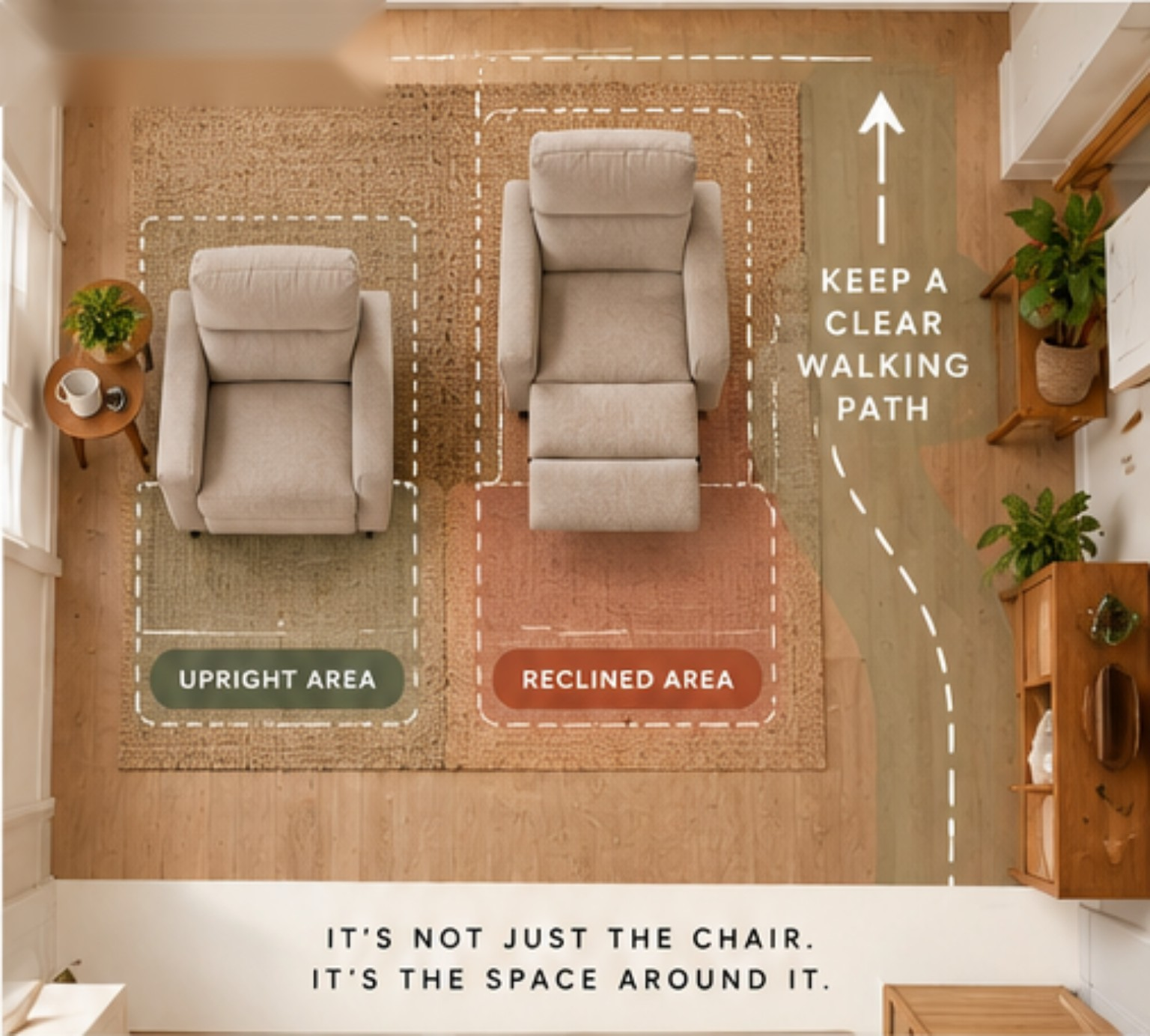
3. Reclined and footrest-open footprint
A recliner changes shape while you use it.
The back may move rearward. The seat may shift forward. The footrest extends into the room. Some chairs do both.
That makes the fully reclined or fully extended depth one of the most important numbers in a small room.
A chair that is roughly 36–39 inches deep while upright can extend well past 50 or 60 inches when opened.
4. Wall and walking clearance
Wall clearance is mechanism-specific.
A conventional push-back recliner may need noticeably more room behind it. A wall recliner may move forward and need less rear clearance. A swivel-glider can add a different movement envelope around the sides.
Do not use one universal “recliner clearance” rule for every mechanism.
Use the exact wall-clearance figure only when the current product source publishes one.
5. Power, swivel, and glider dependencies
Some fit problems are not visible in the chair’s width and depth.
A power recliner needs a plug. A swivel recliner needs enough surrounding space for rotation. A glider needs room for its movement path. A powered swivel-glider may combine all three.
Those operating dependencies belong in the fit decision before purchase, not after delivery.
Small recliners compared
| Product / role | Upright W × D × H | Fully reclined / extended depth | Published wall clearance | Delivery evidence | Motion | Power |
|---|---|---|---|---|---|---|
| Alcott Hill Bridin — compact manual push-back | 32.25" × 39" × 40.5" | 64" | 16.5" to fully recline | Published minimum door width: 32.25"; exact shipping-box dimensions unknown | No-motion base | Manual / no power |
| La-Z-Boy Pinnacle Wall Recliner — space-saving wall recliner | 33" × 38.5" × 41" | 66" fully extended | Approximately 7" from a wall | Package / delivery geometry unknown | Moves slightly forward; does not rock | Manual side handle |
| CHITA Elysian Power Swivel Glider Recliner — swivel / glider role | 32.7" × 38.6" × 41.7" | 65" | 12.2" | 1 box: 38.6" W × 46.5" D × 17.3" H; manufacturer says it fits through doorways 31" or wider | 270° swivel + glider | Power recline + power headrest; USB + Type-C |
| Latitude Run 30.7" Compact Power Recliner with USB — fixed compact power role | 30.7" × 36.2" × 40.9" | 55" | Unknown | Published minimum door width: 36.1"; exact shipping-box dimensions unknown | No-motion base | Plug-in single-motor power recline + USB |
Important: “Unknown” means the current product information reviewed for this guide did not establish that field. It does not mean zero clearance or no requirement.
1. Alcott Hill Bridin — compact manual push-back role
The Alcott Hill Bridin is the simplest operating role in this comparison: a manual push-back recliner with a fixed, no-motion base and no power dependency.
Its published upright dimensions are 32.25 inches wide, 39 inches deep, and 40.5 inches high. The fully reclined depth is 64 inches.
That change is the first reason to measure the working footprint instead of stopping at the upright dimensions.
Why the fit changes when it opens
The chair is 39 inches deep while upright but extends to 64 inches when fully reclined.
That is a 25-inch difference in overall depth between the two published states.
The source also specifies 16.5 inches of wall clearance to fully recline.
For a tight room, those two facts matter more than the word “compact” in a product description.
Delivery check
The product information publishes a minimum door width of 32.25 inches.
However, the exact shipping-box dimensions are not established in the product information used for this guide.
That means the safe pre-buy workflow is:
- measure the narrowest delivery opening,
- compare it with the published doorway information,
- confirm the current packaging or delivery configuration if your route is tight.
Do not treat the 32.25-inch finished chair width as a substitute for unpublished box dimensions.
Best fit-first use case for this role
This role makes the most sense when you want:
- a conventional manual recliner,
- no outlet or cord dependency,
- no swivel or gliding movement,
- and you have enough rear and forward room for a conventional reclining envelope.
The trade-off is that the rear wall requirement is materially larger than the wall-recliner example in this guide.
2. La-Z-Boy Pinnacle Wall Recliner — space-saving wall-recliner role
The La-Z-Boy Pinnacle shows why recliner mechanisms cannot be compared by upright size alone.
Its upright dimensions are 33 inches wide, 38.5 inches deep, and 41 inches high. Its published fully extended depth is 66 inches.
That full depth is not especially small.
The difference is how the chair uses the space near the wall.
The key wall-fit difference
La-Z-Boy states that the Pinnacle Wall Recliner can be placed approximately 7 inches from a wall and fully recline.
The manufacturer also explains that the recline function moves the chair slightly forward instead of back toward the wall.
That makes it a useful role to compare against a conventional push-back recliner.
The important wording is wall recliner and approximately 7 inches from a wall for this specific product.
Do not turn that into a universal “zero-clearance recliner” rule.
What is still unknown
The current manufacturer information used here does not establish:
- package dimensions,
- a delivery-box geometry,
- an assembly state for delivery planning,
- or a published weight-capacity figure for this comparison.
Those fields should stay unknown unless the current source is updated or another reliable product document establishes them.
Best fit-first use case for this role
This role is useful when rear wall space is the limiting constraint.
But rear clearance is only one part of the fit.
Because the chair reaches 66 inches fully extended, you still need to check the forward working area and walking path in front of the chair.
A wall-saving mechanism does not make the open footprint disappear.
3. CHITA Elysian — compact power swivel-glider role
The CHITA Elysian adds another layer to the fit problem because it does more than recline.
It is a power recliner, a 270-degree swivel chair, and a glider.
The published upright dimensions are 32.7 inches wide, 38.6 inches deep, and 41.7 inches high. The fully reclined depth is 65 inches, and the published wall clearance is 12.2 inches.
The footprint is not just front-to-back
For this role, the fit check has at least three movement questions:
- Does the reclined chair fit front-to-back?
- Does the chair have enough surrounding space for the swivel movement you intend to use?
- Does the gliding movement conflict with a wall, table, cabinet, or walking path?
A static floor-plan rectangle cannot answer all three.
Delivery evidence is unusually useful here
CHITA publishes a single-box size of 38.6 inches wide × 46.5 inches deep × 17.3 inches high and states that the box fits through doorways 31 inches or wider.
The manufacturer also describes the chair as having a removable back with tool-free assembly.
That gives a small-space buyer more usable delivery information than a listing that publishes only finished chair dimensions.
Power dependency
The Elysian uses powered reclining functions and a powered headrest. It also includes USB and Type-C charging ports.
That means the placement plan should include the electrical connection before the chair arrives.
The outlet location matters because a chair that fits geometrically can still be awkward if the plug or cord path crosses the circulation zone.
Best fit-first use case for this role
This role is most relevant when you want multiple motion functions in one compact chair and you can dedicate enough surrounding space for the movement envelope.
It gives you more movement options than the other roles here, but that flexibility creates more fit variables to verify.
4. Latitude Run 30.7" Compact Power Recliner with USB — fixed compact power role
The Latitude Run 30.7-inch compact power recliner is the narrowest chair in this four-product comparison by published overall width.
Its upright dimensions are 30.7 inches wide, 36.2 inches deep, and 40.9 inches high. Its published full-recline depth is 55 inches.
It uses a no-motion base with a plug-in, single-motor push-button power recline and a built-in USB port.
Why this role is different from the CHITA
Both chairs use power, but the movement architecture is different.
The Latitude Run is a fixed no-motion base.
The CHITA adds swivel and glider movement.
That distinction matters in a small room because the fixed power recliner has a simpler side-to-side movement envelope.
The wall-clearance field is unknown
The current product information reviewed for this guide does not establish a wall-clearance requirement for this chair.
That value must stay unknown.
Do not subtract the upright depth from the fully reclined depth and call the result “required wall clearance.” Those numbers describe different overall states, not a published installation rule.
Delivery check
The listing publishes a minimum door width of 36.1 inches.
The exact shipping-box dimensions are not established here, so a tight delivery route still deserves a current packaging check before purchase.
Best fit-first use case for this role
This role is useful when you want:
- a narrow overall chair,
- powered reclining,
- a fixed base rather than swivel/glider motion,
- and a shorter published full-recline depth than the other three examples in this guide.
The trade-off is a meaningful evidence gap: the wall-clearance requirement is not established in the product information reviewed for this guide.
How to measure a recliner for a small room
A small-room recliner check works better if you mark two footprints, not one.
Step 1: Mark the upright footprint
Use painter’s tape to mark the published upright width and depth on the floor.
Check:
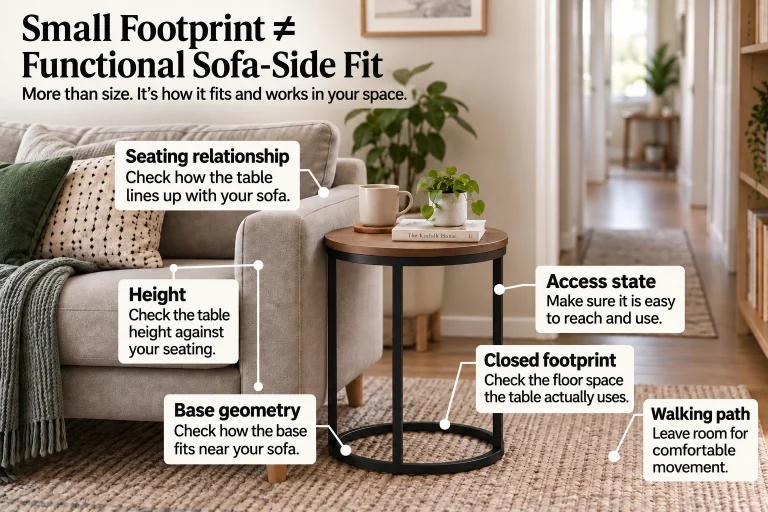
- side-table clearance,
- door swing,
- cabinet doors,
- baseboards,
- and the normal walking path.
Step 2: Mark the fully reclined depth
Extend the floor mark to the published fully reclined or fully extended depth.
Then ask:
- Can someone still walk past?
- Does the footrest block the main route?
- Does the open chair conflict with a coffee table?
- Does it block a closet, doorway, or media cabinet?
Step 3: Add the wall requirement only if it is published
If the manufacturer states a wall-clearance requirement, use that product-specific value.
For this comparison:
- Bridin: 16.5 inches
- Pinnacle Wall Recliner: approximately 7 inches
- CHITA Elysian: 12.2 inches
- Latitude Run compact power recliner: unknown
Do not replace an unknown field with a typical industry number.
Step 4: Add movement space
For swivel and glider chairs, test the area around the chair as well as the front-to-back footprint.
The exact movement area depends on the chair, placement, surrounding furniture, and how much of the swivel or glide range you intend to use.
Step 5: Add the outlet location for powered chairs
For a power recliner, mark the outlet and the cord route.
A clean geometric fit can still become an operational problem if the plug location forces the cord through a walking path.
Manual push-back vs wall recliner vs swivel-glider vs fixed power
These four roles solve different problems.
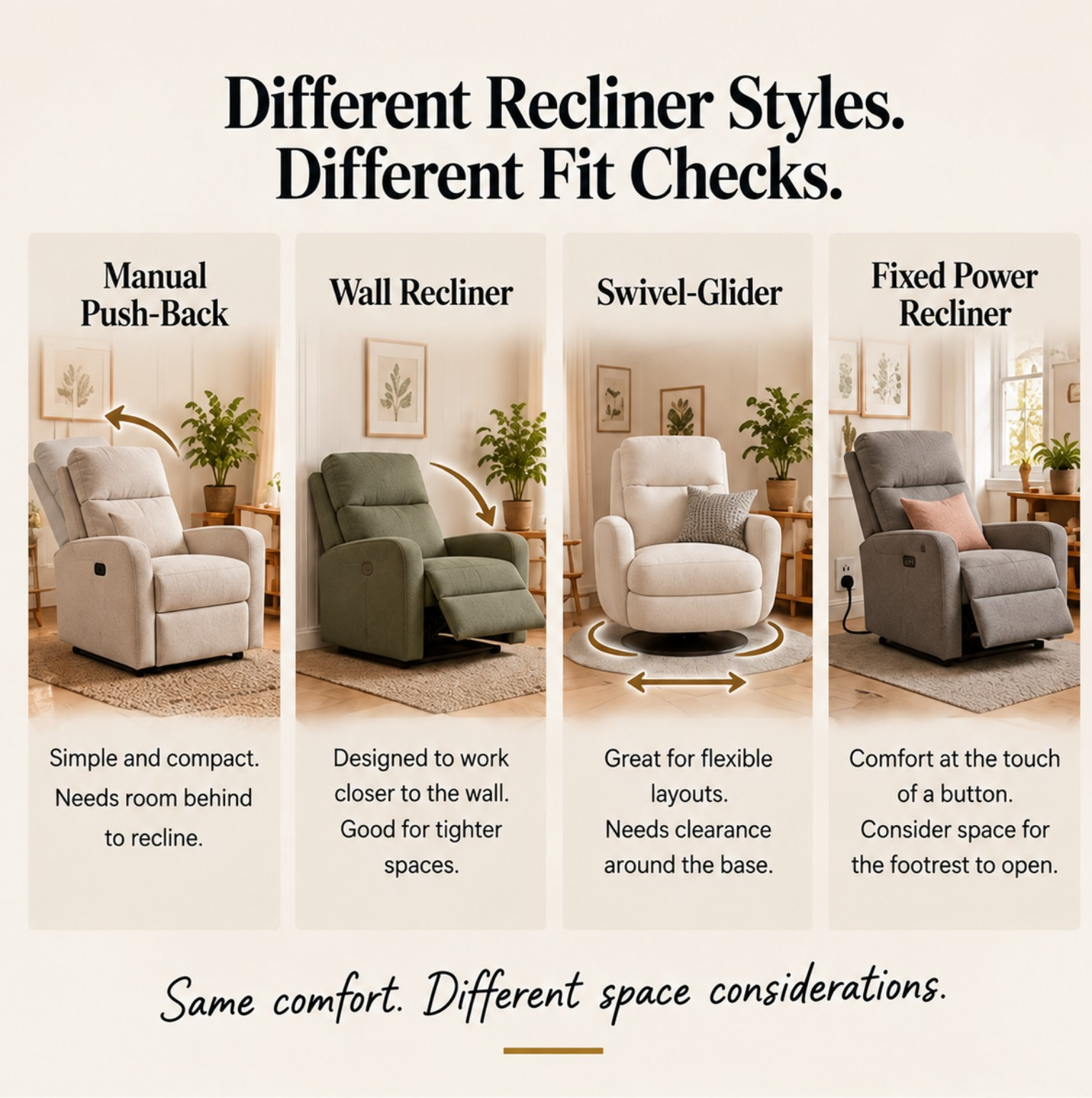
Choose a manual push-back role when:
You want a simple mechanism with no power dependency and you have enough wall and open-floor space for a conventional reclined footprint.
Choose a wall-recliner role when:
Rear wall clearance is one of your hardest constraints and the product publishes a wall-saving mechanism and clearance figure that works for your room.
Choose a swivel-glider role when:
You value multiple movement modes and can give the chair enough surrounding space for recline, swivel, and glide.
Choose a fixed power-recliner role when:
You want powered adjustment without adding swivel or gliding movement, and your outlet location works with the placement.
None of these roles is automatically the right choice for every small space.
The correct role depends on which part of the working footprint is hardest to accommodate.
A delivery-fit check can change the decision
The delivery path deserves its own measurement pass because recliners can have bulky backs, arms, boxes, and partial-assembly states.
Before ordering, write down:
- narrowest doorway width,
- narrowest hallway width,
- tightest corner,
- elevator opening if applicable,
- stair width and landing depth,
- final-room doorway,
- and any removable-door or removable-back plan you are actually willing and able to use.
Then compare those measurements with the current delivery or package information for the exact product.
Do not assume a chair will “probably fit” because its finished width is smaller than the doorway.
The packaging and entry orientation may be different.
What “unknown” means in this guide
An unknown field is not a flaw in the comparison.
It is a warning that the purchase decision still has an unanswered question.
For example:
- The R2 package geometry is unknown here.
- The R4 wall-clearance requirement is unknown here.
- The R3 public model code was not surfaced in the product information used for this guide.
Those gaps are more useful when they stay visible.
If a missing field matters in your room, confirm it with the current manufacturer or retailer before ordering.
Final pre-buy checklist
Before choosing a small recliner, confirm all of the fit states that apply to your chair:
- Delivery: Can the package or assembly configuration reach the room?
- Upright: Does the chair fit in its normal parked position?
- Reclined: Does the full open depth fit without blocking the room?
- Wall: Is the product-specific rear clearance known and workable?
- Footrest: Does the open footrest steal the main walking path?
- Swivel: Is there enough side clearance for the rotation you plan to use?
- Glider: Can the chair move without contacting nearby furniture or walls?
- Power: Is there a practical outlet and cord route?
- Unknowns: Have you resolved any missing field that matters in your specific room?
If one of those states fails, the recliner does not fully fit your room—even if the upright chair looks compact on paper.
How this guide was researched
Renternook did not physically test the four recliners in this guide.
The comparison is based on published product information reviewed from the current manufacturer and retailer pages for the specific products listed below.
The guide focuses on fit-related fields such as:
- upright dimensions,
- fully reclined / extended depth,
- published wall clearance,
- delivery / doorway information,
- assembly state,
- movement functions,
- and power dependencies.
When a fit-critical field was not established by the source information reviewed, it is shown as unknown rather than estimated.
Product information can change. Recheck the exact product page before ordering, especially if a dimension, package configuration, mechanism, or clearance figure is critical to your room.
Sources used for this article
- Alcott Hill Bridin, Wayfair — SKU W006117783
https://www.wayfair.com/furniture/pdp/alcott-hill-bridin-upholstered-manual-push-back-recliner-chair-with-nailheads-w006117783.html - La-Z-Boy Pinnacle Wall Recliner — Style 016512
https://www.la-z-boy.com/p/living-room/recliners/wall-recliners/pinnacle-wall-recliner/R-016512 - CHITA Elysian Power Swivel Nursery Glider Recliner with Adjustable Headrest
https://chitaliving.com/products/elysian-power-swivel-glider-recliner-with-adjustable-headrest - Latitude Run 30.7" W Compact Power Recliner with USB, Wayfair — SKU W011140072
https://www.wayfair.com/furniture/pdp/latitude-run-307-w-compact-power-recliner-with-usb-w011140072.html
Before ordering, use the whole-room working-fit method to check active recline and circulation with the rest of the room, and the furniture-delivery route method to check whether the chair can actually reach the room.
Final takeaway
For a small room, the most important recliner measurement is not always the width.
It is the difference between the chair’s upright fit and its working fit.
Check the delivery path first. Then measure the upright footprint, the fully reclined depth, the wall relationship, and any movement or power dependency that changes how the chair uses the room.
A recliner is a good fit only when the room still works after the chair does.