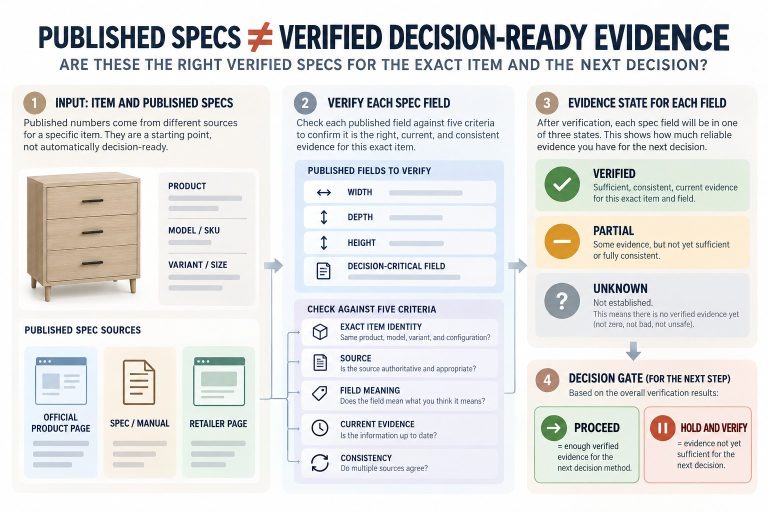
How to Measure Furniture for Delivery: Check the Full Route Before You Buy
A sofa can fit perfectly along the wall you measured and still never reach that wall.
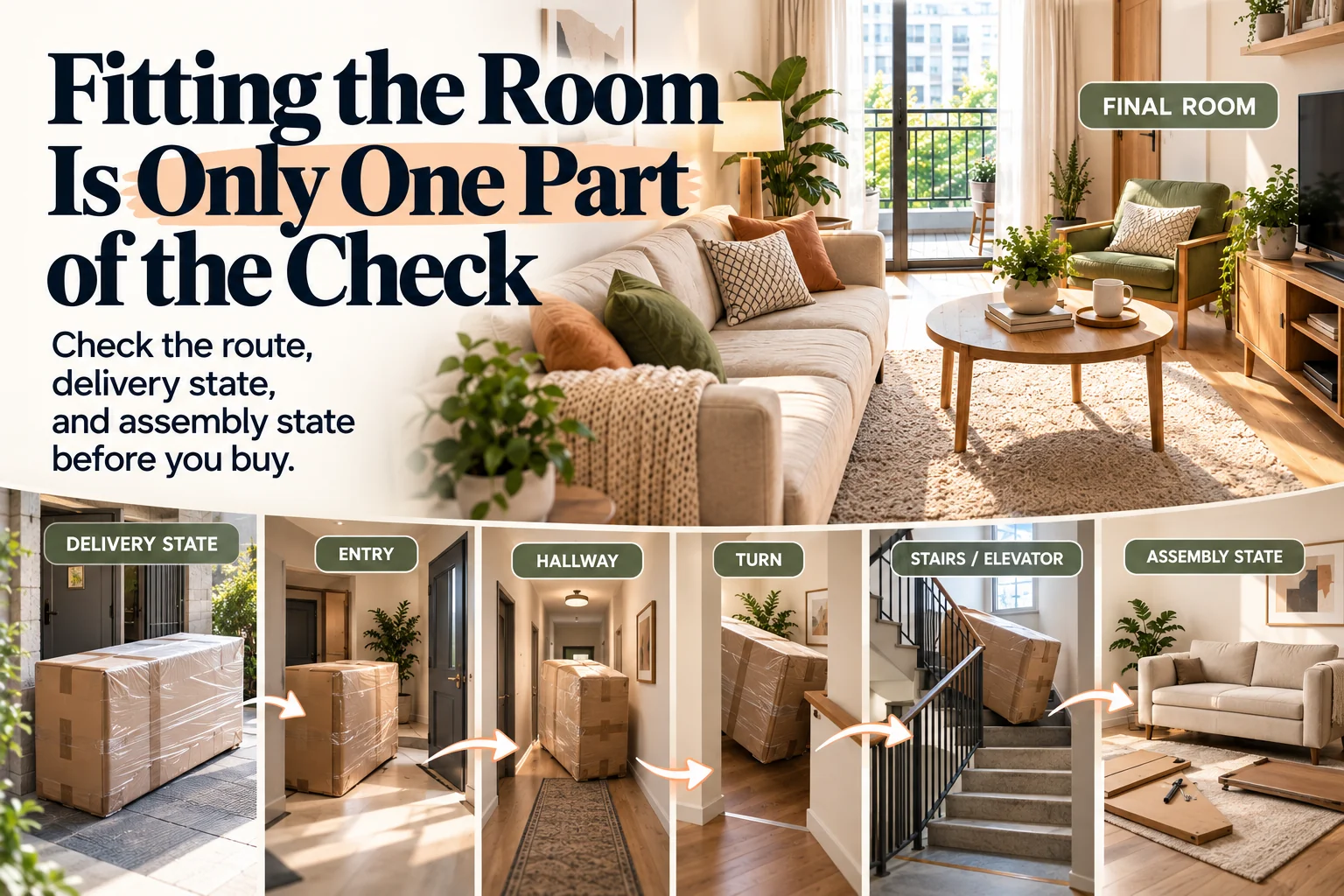
The problem may happen at the building entrance, a narrow hallway, a turn at the end of the corridor, a stair landing, an elevator door, the bedroom doorway, or the space needed to assemble the item after the boxes arrive.
That is why learning how to measure furniture for delivery is not the same as checking whether the finished furniture fits the room.
The three questions are different:
- Final room fit: Will the assembled furniture fit where you want it?
- Delivery-route fit: Can the item, package, or delivery state travel through the actual route to that room?
- Assembly-state fit: Can the item be assembled and positioned there using the exact process the product requires?
A pass on the first question does not automatically answer the other two.
This guide gives you a practical pre-purchase method for checking the full route without relying on a single doorway measurement, a universal turning formula, or a delivery guarantee.
Why the Front Door Is Only One Part of the Route
A common mistake is to measure the furniture, measure the front door, and stop there.
But the delivery route is a sequence.
It can include:
- the building entrance;
- lobby or shared entry doors;
- hallways;
- narrow sections;
- corners and turns;
- stairs;
- landings;
- elevator doors and elevator interiors;
- the final room doorway;
- the room where assembly takes place;
- the path from that assembly state to the intended final position.
The narrowest doorway may not be the hardest part.
A package can clear a door and still fail at the next turn. A long component can enter a stairwell and still have an unproven landing maneuver. An item can fit inside an elevator but have an uncertain route through the elevator doorway. A flat-pack product can reach the room but still need an assembly state that has not been checked.
So the better question is not:
“Is the door wider than the furniture?”
It is:
“Can this specific delivery state travel through every material bottleneck in the actual route and reach a valid assembly and positioning state?”
If that has not been established, treat the route as unknown, not as a pass.
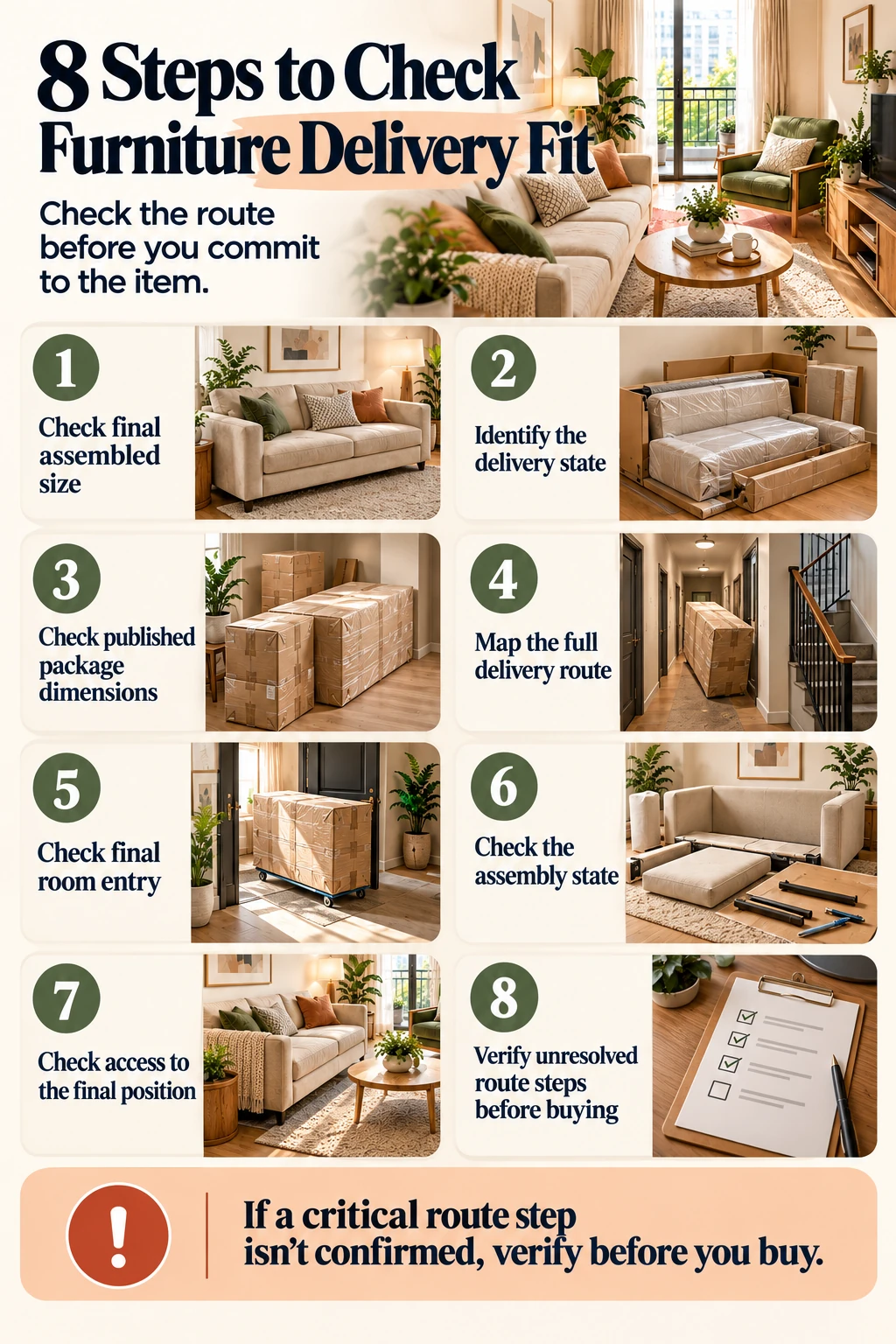
The 8-Step Furniture Delivery Fit Method
Step 1 — Identify the Exact Final Assembled Size
Start with the finished item.
Record the manufacturer-published assembled dimensions for the exact product and configuration you are considering.
Depending on the product, that may include:
- overall width;
- overall depth;
- overall height;
- sectional or modular configuration;
- headboard or back height;
- arm height;
- leg or base configuration;
- any fixed component that changes the final envelope.
The purpose of this step is not to prove delivery fit.
It is to answer the first question:
Will the finished item fit the intended final location?
If the final assembled item does not fit the room, there is no reason to continue the delivery-route check for that position.
But if it does fit, you are only at the beginning.
Assembled size ≠ delivery-route fit.
Step 2 — Identify the Actual Delivery State
Next, find out what physically arrives.
Do not assume the delivered item has the same dimensions as the finished furniture.
The delivery state may be:
- fully assembled;
- partially assembled;
- flat-pack;
- modular;
- split into multiple components;
- packed in one box;
- packed in several boxes;
- delivered with removable parts packed separately.
This distinction matters because the object moving through the building may be very different from the object you eventually use.
For example, a finished sofa may fit a room easily, while the delivered body is large and mostly assembled. Another product may arrive as several smaller packages. A storage bed may have a finished footprint that tells you very little about the dimensions of the boxes that must reach the bedroom.
Before buying, record the delivery state as precisely as the retailer or manufacturer provides it.
If the delivery state is unclear, mark it unknown and verify it.
Do not convert uncertainty into an assumption such as “it probably comes apart.”
Step 3 — Check Published Package or Box Dimensions Where Available
If the manufacturer or retailer publishes package dimensions for the exact item, record them.
For a multi-box item, record each package separately.
Useful fields can include:
- package length;
- package width;
- package height;
- package weight;
- number of packages;
- which components are packed separately.
Package dimensions are especially useful because they describe the actual objects that may need to pass through the route.
But they still do not prove the route will work.
Package size ≠ assembled size.
And:
Package width alone ≠ route fit.
A long package may clear a doorway but still encounter an uncertain turn. A box may fit through a hall but not have a proven route on a stair landing. A package may enter an elevator but still face an unresolved orientation change at the exit.
Use package dimensions as evidence for screening the route, not as a universal fit guarantee.
If exact package dimensions are not published, do not invent them.
Record:
Package dimensions: unknown — verify before purchase.
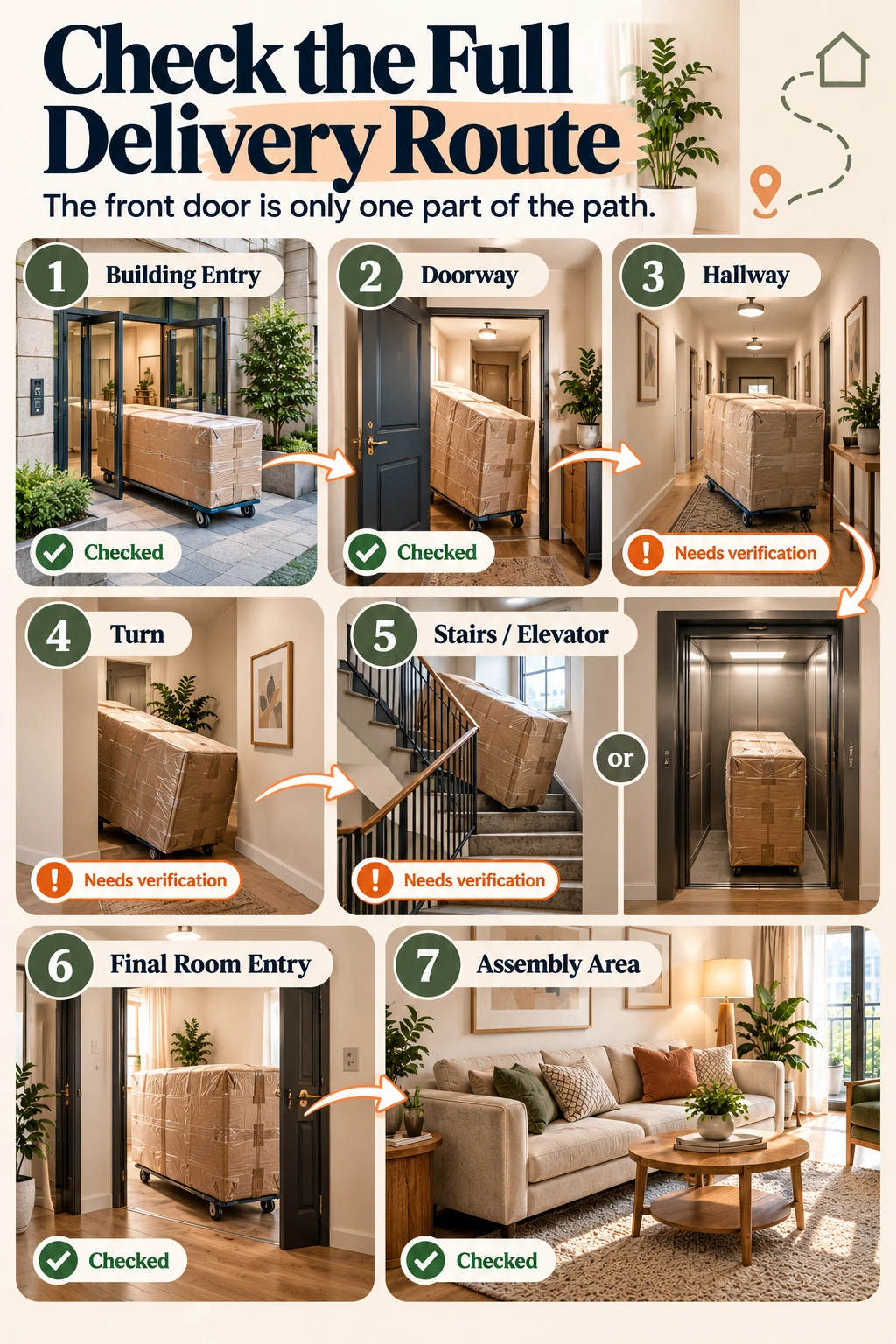
Step 4 — Map the Real Delivery Route
Now map the actual route from the delivery point to the room.
Do this in order.
A useful route record may look like:
Building entry → lobby → hallway → turn → elevator → upper-floor hallway → room door → assembly area
or:
Front door → narrow passage → 90-degree turn → stairs → landing → bedroom door → assembly area
The route will be different for every home and building.
For each material section, record the actual constraints that matter.
Building and Entry Doors
Record the usable opening, not just the nominal door size.
Note anything that reduces the usable opening, such as:
- door stops;
- handles;
- frames;
- closers;
- security hardware;
- fixed screens;
- adjacent walls;
- other permanent obstructions.
Do not use the simple rule:
furniture width < door width = fit
That comparison can be useful as an early screen, but it does not prove the complete maneuver.
Hallways and Narrow Segments
Measure the narrowest relevant portions of the route.
Also note:
- projections from walls;
- built-in cabinets;
- radiators;
- rails;
- fixed furniture;
- changes in hallway width;
- doors that open into the route.
A hallway may be wide enough along most of its length but still have one local bottleneck.
Turns and Corners
Turns deserve their own check.
Do not assume that clearing the two adjoining hallway widths proves the turn.
The ability to rotate or reorient an item depends on the actual object, its delivery state, the surrounding geometry, and the available maneuvering space.
There is no single universal turning formula in this guide.
Record the turn as one of three states:
- supported: exact product/delivery evidence or provider confirmation supports the maneuver;
- failed: a known route constraint prevents the delivery state from passing;
- unknown: the maneuver has not been proven.
When unknown, verify rather than estimate.
Stairs and Landings
For a stair route, check more than stair width.
Relevant constraints can include:
- narrow stair sections;
- handrails;
- low ceilings;
- overhead obstructions;
- changes in direction;
- intermediate landings;
- doors at the top or bottom;
- the space available to reorient the delivery state.
A long package may fit the stair width and still have an unproven landing turn.
Do not convert one successful measurement into a stair-fit guarantee.
Elevators
For an elevator route, record:
- clear elevator door opening;
- interior dimensions if available;
- fixed rails or panels that reduce usable space;
- the approach to the elevator;
- the exit route from the elevator;
- any turn immediately before or after the elevator.
“Fits inside the elevator” and “can enter and exit the elevator in the required orientation” are not automatically the same result.
If building management publishes delivery rules or elevator restrictions, include those in your pre-purchase check.
Step 5 — Check the Final Room Entry
The item can make it through the building and still fail at the last doorway.
Treat the final room entry as its own bottleneck.
Check:
- the usable door opening;
- the hallway or approach immediately outside the room;
- the space immediately inside the room;
- nearby walls, closets, radiators, built-ins, or other fixed obstacles;
- any orientation change required at the doorway.
This is where final-room measurements and delivery-route measurements meet.
The finished furniture may fit once positioned inside, while the delivery state still has an unproven route through the room entrance.
If the final entry requires a specific maneuver that has not been demonstrated, preserve that uncertainty.
Do not call it a pass simply because the room is large enough.
Step 6 — Check the Assembly State
Some products must reach the room before assembly.
Others may arrive partially assembled and require additional work before they reach their final state.
This creates a separate practical question:
Can the exact product be assembled in the intended location using the manufacturer’s required process?
Start with the exact assembly instructions when they are available.
Check whether the instructions indicate:
- where major components are joined;
- whether the item must be assembled in the room;
- whether panels or frames change orientation during assembly;
- whether components must lie flat;
- whether the product must be lifted or repositioned during the process;
- whether wall fixing or anchoring is required;
- whether assembly must happen before the item reaches its final position.
Then inspect the actual work area.
You are not looking for a universal “assembly clearance” number.
No single number can represent every product, tool sequence, panel length, orientation change, or room condition.
If the manufacturer does not state an exact requirement and the available space has not been proven adequate for the required assembly sequence, record:
Assembly working space: unknown — verify for this exact product and room.
That is a valid result.
Unknown ≠ pass.
Step 7 — Confirm the Item Can Reach Its Intended Final Position
After delivery and assembly, one final positioning check remains.
This is still part of the delivery and setup decision.
It is not a whole-room operating-state analysis.
Ask:
- Can the assembled or partially assembled item move from the assembly location to the intended position?
- Does the final repositioning require another doorway, narrow passage, or orientation change?
- Does a wall, built-in, fixed cabinet, or other permanent feature block that movement?
- Does the manufacturer require final anchoring or installation at the destination?
Stop the analysis at delivery, assembly, and positioning fit.
Do not expand this step into questions such as whether another chair can recline at the same time or whether the room circulation works when several products are active. Those are whole-room use-state questions and belong to a different decision method.
Step 8 — Stop When Route Fit Is Not Proven
This is the most important control in the method.
Do not force an uncertain route into a yes/no answer.
If an important turn, stair, elevator, room entry, package state, or assembly sequence remains unresolved, stop before purchase and verify.
Depending on the missing information, that may mean contacting:
- the retailer;
- the manufacturer;
- the delivery provider;
- building management;
- the property manager.
Useful questions include:
- What are the exact package dimensions for this item?
- How many packages are delivered?
- Does the item arrive fully assembled, partially assembled, or flat-pack?
- Can specific components be removed for delivery?
- Does the delivery provider have route requirements for this product?
- Are there building delivery restrictions?
- Is a freight or service elevator required?
- Does the manufacturer require assembly in the final room?
- Are there exact installation or anchoring requirements?
A pre-purchase measurement is a screening and qualification process.
It is not a guarantee that a delivery crew can complete every maneuver.
When a critical route state remains unproven, the correct status is:
UNKNOWN — VERIFY BEFORE BUYING.
Practical Example: The Sofa Fits the Room, but the Route Is Still Unknown
Imagine you are buying a sofa for a small apartment.
You have measured the living-room wall and confirmed that the finished sofa fits the intended location.
That is useful, but it proves only final room fit.
Now run the delivery method.
1. Final assembled size
The manufacturer publishes the finished dimensions.
The planned location can accommodate the assembled sofa.
Final room fit: supported.
2. Delivery state
The retailer states that the sofa arrives largely assembled, with some removable components.
Delivery state: identified.
3. Package or delivery dimensions
Published delivery dimensions are available for the exact item.
Record them without changing or estimating the numbers.
Package state: supported by exact-product information.
4. Building route
The building entrance and main hallway appear workable.
Then you reach a turn before the elevator.
The delivery state can approach the turn, but you do not have enough evidence to establish that it can rotate through it.
Turn fit: unknown.
5. Elevator and room entry
You can record the elevator doorway, elevator interior, upper-floor hall, and living-room doorway, but those later checks do not erase the unresolved turn.
A route is a chain.
An unresolved earlier bottleneck remains unresolved.
6. Assembly state
If the sofa requires final assembly in the room, review the exact instructions and the available work area.
If no exact working-space requirement is published and the sequence cannot be demonstrated from the information available:
Assembly state: unknown.
7. Final positioning
The assembled sofa can occupy the planned final location.
But that does not convert the unknown route and assembly states into passes.
8. Stop and verify
Before buying, send the exact product and route information to the retailer or delivery provider and ask whether they can confirm the unresolved maneuver.
The key lesson is simple:
A furniture item can fit the room while its delivery route remains unproven.
What to Measure and Record Before You Buy
You do not need a complicated engineering drawing.
You do need a route record that is complete enough to reveal the bottlenecks.
Product and Delivery Information
Record:
- exact product name and configuration;
- assembled width;
- assembled depth;
- assembled height;
- delivery state;
- number of packages;
- exact published package dimensions where available;
- removable components if officially documented;
- manufacturer assembly instructions;
- retailer or delivery-provider requirements.
Building and Route Information
Record the sequence from delivery point to final room.
For each relevant section, note:
- clear entry opening;
- hallway or passage width at narrow points;
- fixed obstructions;
- turns;
- stairs;
- landings;
- low overhead areas;
- elevator door opening;
- elevator interior;
- route immediately before and after the elevator;
- final room doorway;
- fixed obstacles near the final room entry.
Assembly and Positioning Information
Record:
- room where assembly is intended;
- exact assembly instructions;
- required orientation changes shown by the instructions;
- fixed obstacles in the work area;
- final destination in the room;
- any required anchoring or installation.
If a value or requirement is not published or cannot be established, write unknown.
That is more useful than filling the gap with an estimate.
A Simple Pre-Purchase Route Record
You can use a table like this before ordering:
| Route stage | What you know | Status |
|---|---|---|
| Final assembled size | Exact manufacturer dimensions | Supported / Failed / Unknown |
| Delivery state | Assembled / partial / flat-pack / multi-box | Supported / Unknown |
| Package dimensions | Exact published package data | Supported / Unknown |
| Building entry | Clear opening + fixed obstructions | Supported / Failed / Unknown |
| Hallway | Narrowest relevant segments | Supported / Failed / Unknown |
| Turn | Actual turn geometry and delivery state | Supported / Failed / Unknown |
| Stairs / landing | Route-specific constraints | Supported / Failed / Unknown |
| Elevator | Door + interior + approach/exit | Supported / Failed / Unknown |
| Final room entry | Door + approach + inside space | Supported / Failed / Unknown |
| Assembly state | Exact instructions + usable work area | Supported / Failed / Unknown |
| Final positioning | Route from assembly state to intended location | Supported / Failed / Unknown |
The important part is not the table format.
It is the discipline of refusing to skip a material bottleneck.
Common Mistakes to Avoid
Mistake 1 — Measuring Only the Finished Furniture
The finished item tells you whether it can fit the destination.
It does not tell you what arrives at the building.
Check the delivery state and exact package information where available.
Mistake 2 — Measuring Only the Front Door
The front door is one point in a chain.
A later hallway, turn, stair landing, elevator, or room doorway may be more restrictive.
Mistake 3 — Assuming Flat-Pack Means Easy Delivery
Flat-pack can reduce the size of the delivered components, but it does not automatically prove the route.
Long packages, multiple boxes, stair turns, elevator access, and final room entry still need to be checked.
Mistake 4 — Treating One Dimension as a Fit Formula
A width comparison can be useful as an early screen.
It cannot prove every turn, rotation, landing, or orientation change in the route.
Mistake 5 — Guessing Assembly Space
Assembly requirements vary by product and instruction sequence.
If the manufacturer does not publish an exact requirement and the working state has not been proven, preserve the unknown instead of inventing a clearance number.
Mistake 6 — Confusing Delivery Fit With Everyday Room Fit
Delivery fit ends when the item has reached a valid assembly and final positioning state.
Questions about several pieces being used together, open states, occupied states, and whole-room circulation are a separate room-planning decision.
Where This Method Fits With Other Renternook Guides
Use this article as the cross-category delivery-route check before committing to bulky furniture.
Then combine it with the product-specific fit questions that matter for the item you are buying.
For example:
- a storage bed still needs its product-specific storage-access, mattress/foundation, and installation checks;
- a sofa bed still needs its use-state and open-state checks once it is in the room;
- a recliner still needs its active-state check;
- a small sofa still needs its seated-use and everyday circulation check.
For storage beds specifically, see Storage Beds for Small Bedrooms: 4 Fit-First Options to Check Before You Buy:
https://renternook.com/2026/09/24/storage-beds-small-bedrooms/
The delivery-route method does not replace those product-level decisions.
It answers a different question:
Can the furniture reach the room and reach a valid assembly and positioning state in the first place?
Final Furniture Delivery Checklist
Before you buy, confirm each stage separately.
Product
- [ ] I have the exact final assembled dimensions.
- [ ] I know the actual delivery state.
- [ ] I know how many packages are delivered.
- [ ] I have exact published package dimensions where available.
- [ ] I have not invented missing package measurements.
Delivery Route
- [ ] I mapped the route from delivery point to final room.
- [ ] I checked the building entry.
- [ ] I checked relevant hallway bottlenecks.
- [ ] I checked every material turn.
- [ ] I checked stairs and landings where relevant.
- [ ] I checked the elevator doorway, interior, approach, and exit where relevant.
- [ ] I checked the final room entry.
- [ ] I did not treat door width alone as proof of route fit.
Assembly
- [ ] I reviewed the exact manufacturer assembly instructions.
- [ ] I know where assembly is intended to happen.
- [ ] I checked the actual work area for that product-specific sequence.
- [ ] I did not apply a universal assembly-clearance number.
- [ ] Any unproven assembly requirement remains marked unknown.
Final Position
- [ ] The item can reach its intended position after delivery and assembly.
- [ ] I stopped the analysis at delivery, assembly, and positioning fit.
- [ ] I did not confuse this with whole-room active-state fit.
Stop / Verify
- [ ] Every material bottleneck is supported, failed, or explicitly unknown.
- [ ] I will verify unresolved route questions before purchase.
- [ ] I understand that this measurement process is a pre-purchase screening method, not a delivery guarantee.
The Final Rule
When you measure furniture for delivery, do not ask only whether the finished item fits the room.
Check the entire chain:
final assembled size → delivery state → package dimensions → building entry → hallway → turn → stairs/elevator → room entry → assembly state → final position
A room-fit pass does not prove a delivery-route pass.
A package-fit pass at one doorway does not prove the next turn.
And when a critical route state is not proven, the correct answer is not “probably.”
It is:
Unknown — verify before you buy.