Over-the-Sink Cutting Boards for Small Kitchens: Measure Sink Span, Faucet Clearance, and Prep Workflow Before You Buy
An over-the-sink cutting board can create useful prep space in a kitchen where counter area is limited.
But the buying decision is not simply whether a board is large enough to cover part of the sink.
The real fit question is whether the board can sit securely on the actual sink geometry, stay clear of the faucet and nearby fixtures, preserve enough basin access for the way you cook, and still be practical to clean and put away after use.
That creates the Fit-First rule for this guide:
An over-the-sink cutting board is not a small-kitchen fit simply because its published dimensions look wider than the sink. The board has to match the support points around the sink, avoid faucet interference, leave a workable prep zone, and fit the storage routine after food prep is finished.
This article compares three locked product roles:
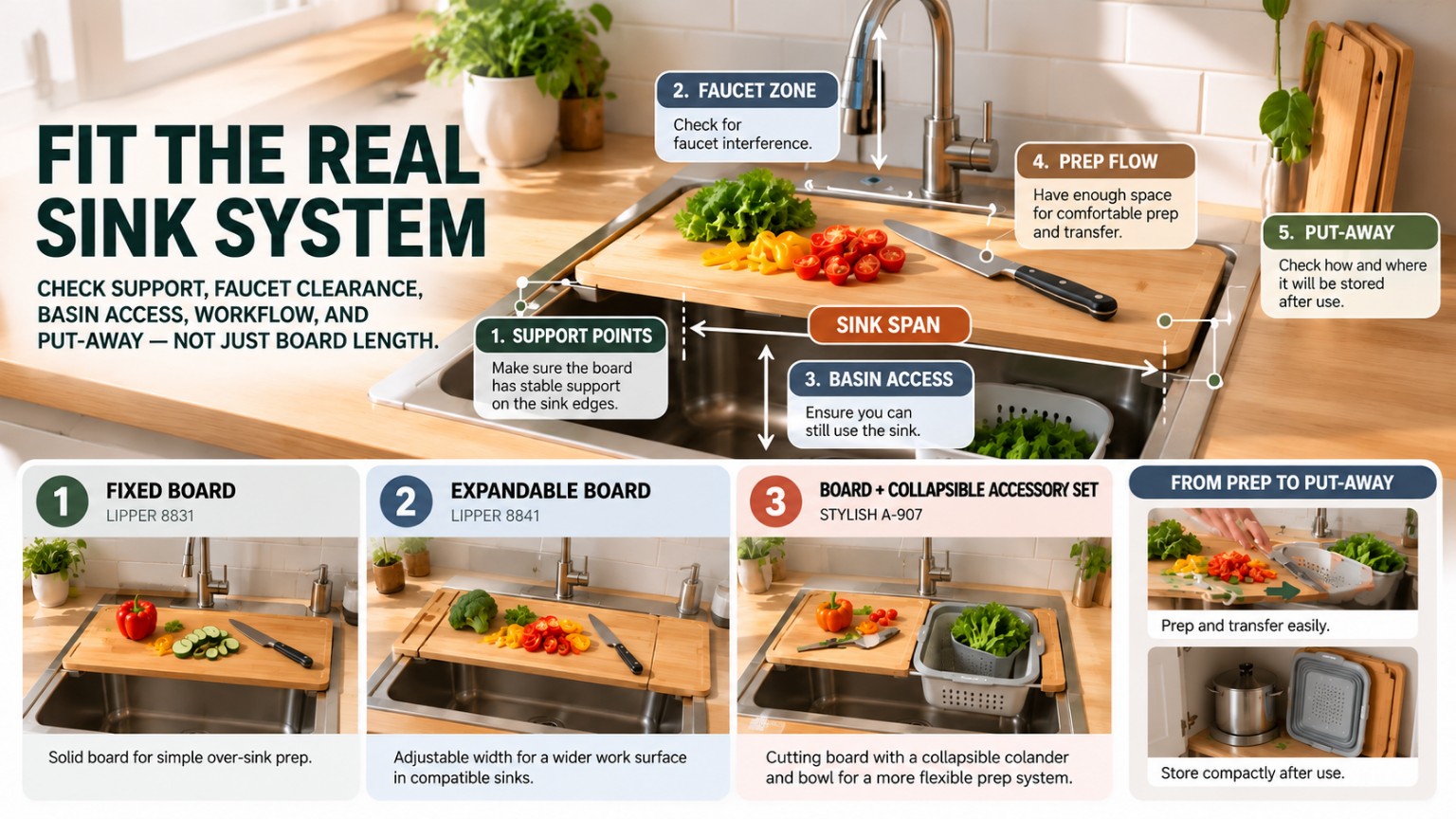
- Lipper International Bamboo Over-the-Sink or Stove Cutting Board, item 8831 — fixed sink-spanning work surface
- Lipper International Bamboo Over-the-Sink Expandable Cutting Board, item 8841 — expandable prep surface
- Stylish International Over the Sink Large Cutting Board with Colander Set, model A-907 — board plus included collapsible food-prep accessories
They are not ranked from best to worst.
The purpose is to show how three different product architectures change the measurements and workflow checks a small-kitchen buyer should make before purchasing.
The product set is locked to these three models.
Start With the Sink, Not the Board
The easiest mistake is to start with a product page and ask whether the board looks wide enough.
Start with the sink instead.
An over-the-sink board depends on support.
That support may come from sink rims, surrounding counter edges, a ledge, or another product-specific contact arrangement. The exact support geometry is not established here for these products, so the buyer should not infer a supported sink-span range from the board’s overall length alone.
Before comparing products, identify:
- the outside width of the sink area
- the usable sink opening
- the locations where a board could actually make contact
- faucet position
- faucet base or deck hardware
- handles, sprayers, soap dispensers, or other fixtures near the board path
- how much basin access you need while prepping
- where scraps, rinsed produce, or utensils will go
- where the board will be stored after use
A board can be long enough to cross the sink and still fail the workflow.
It may interfere with the faucet, occupy too much of the basin, sit on unsuitable contact points, or force the user to remove it every time the sink is needed.
That is why published dimensions are a starting specification, not proof of universal sink fit.
The Seven-Part Fit Check
The buyer job for ARTICLE_061 centers on seven parts of the real setup.
1. Sink span
Measure the distance that matters for the way the product will be supported.
Do not automatically use the inside bowl width, outside sink width, or countertop cutout as the answer.
The correct measurement depends on where the board actually contacts the sink or surrounding surface.
For all three locked products, the supported sink-span range remains unknown.
That means no article should convert overall product length into a guaranteed compatible sink width.
2. Support points
A board needs more than enough length.
It needs stable contact at the places that carry the board during use.
The locked research does not establish the exact sink-contact geometry for these products.
For the expandable Lipper 8841, the extended overall length of 34 inches is useful for understanding the product’s maximum published state, but it is not proof that the board supports every sink opening up to that width.
For the fixed Lipper 8831 and Stylish A-907, the same principle applies: overall board dimensions do not establish the minimum amount of ledge, rim, or counter contact required for safe or stable use.
3. Board size
Board dimensions matter because the product has to occupy real space in the kitchen.
The locked dimensions are:
- Lipper 8831: 20.5 × 11.5 × 2 inches
- Lipper 8841 closed: 23.75 × 11.5 × 0.75 inches
- Lipper 8841 extended: 34 × 11.5 × 0.75 inches
- Lipper 8841 cutting section: 20.5 × 9.25 × 0.75 inches
- Stylish A-907 board: 15 7/8 × 18 × 1 inch
Those numbers describe the products.
They do not establish compatibility with a specific sink.
Use them to compare the product envelope with the actual sink zone, nearby fixtures, and available storage.
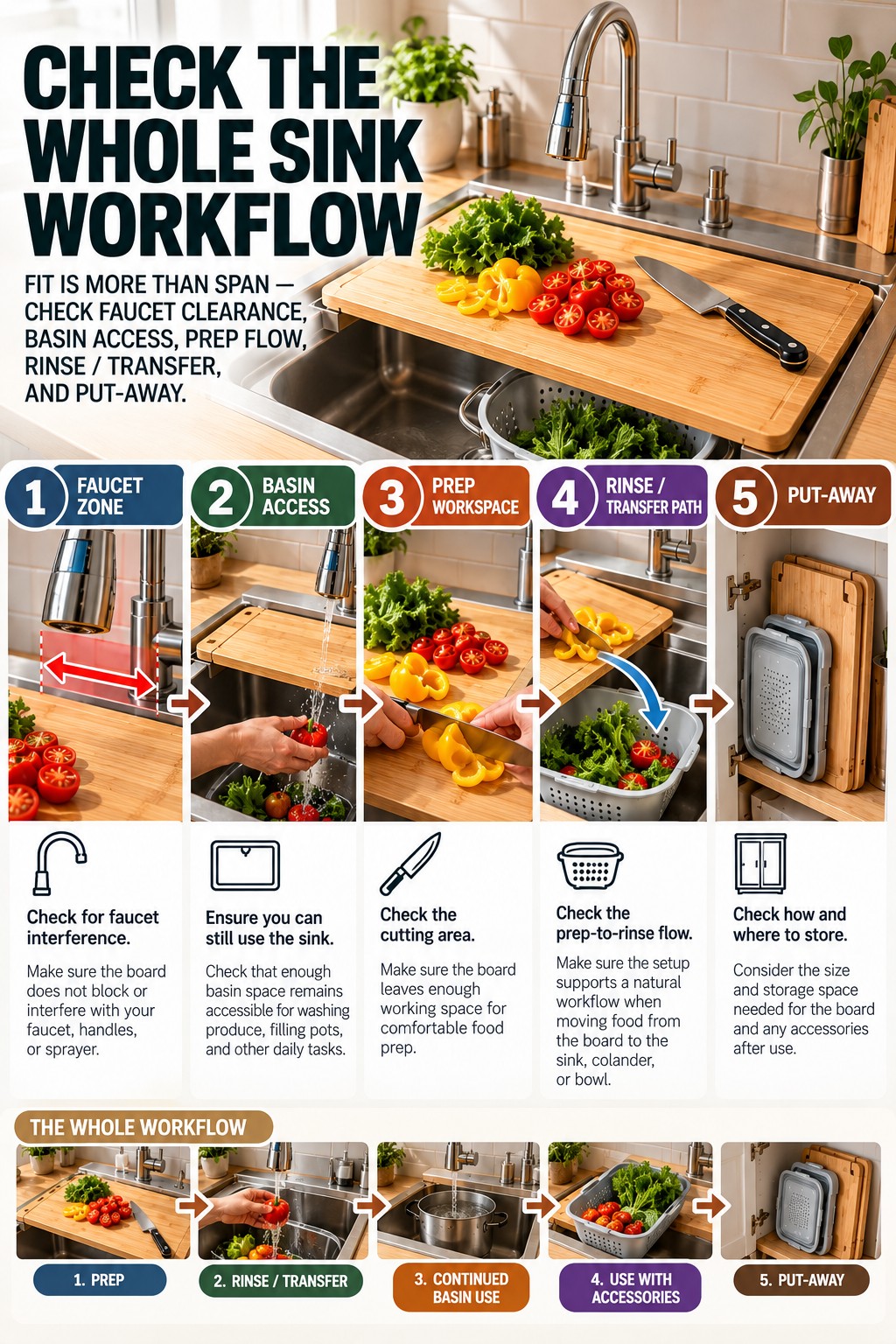
4. Faucet interference
Faucet fit is unknown for all three products.
That matters because the board may occupy the same zone needed by the faucet body, handle, pull-down hose, sprayer, or normal hand movement.
Measure the faucet area before buying.
Check whether the board would sit:
- in front of the faucet
- below a faucet arc
- against the faucet base
- across a handle movement path
- where a sprayer hose needs to move
- where tall ingredients, bowls, or tools would collide with the faucet
Do not treat a product photo as proof of faucet clearance.
5. Basin access
The purpose of putting a prep surface over the sink is often to gain workspace, but the sink may still need to function during prep.
Ask how much basin access you need at the same time.
A fixed board may cover a consistent portion of the sink.
An expandable board may change position or support behavior between closed and extended states.
A board-plus-colander system may intentionally use more of the sink zone as part of the prep workflow.
There is no universal “correct” amount of remaining basin access.
The answer depends on whether you rinse produce, discard scraps, wash knives, drain ingredients, or use the sink for other tasks while the board is in place.
6. Food-prep workflow
The best physical fit can still be a bad workflow fit.
Map the sequence you actually use:
- retrieve ingredients
- rinse or stage them
- place them on the board
- cut or trim
- transfer food to a bowl, pan, or serving container
- discard scraps
- clean the board
- return the sink to normal use
A small kitchen benefits when the board reduces unnecessary movement.
It does not benefit if the board has to be removed repeatedly because it blocks the faucet, basin, or destination container.
7. Storage and put-away fit
An over-the-sink board only solves the workspace problem while it is being used.
Afterward, it still needs a home.
Measure the cabinet, drawer, vertical slot, wall gap, or shelf where the board will actually go.
Use the published product dimensions for that planning, but keep product-specific shapes and accessories in mind.
For Stylish A-907, the included collapsible colander and silicone bowl are part of the system and also need a storage location.
Storage fit is not established by the article; it must be checked against the buyer’s actual kitchen.
Three Product Architectures
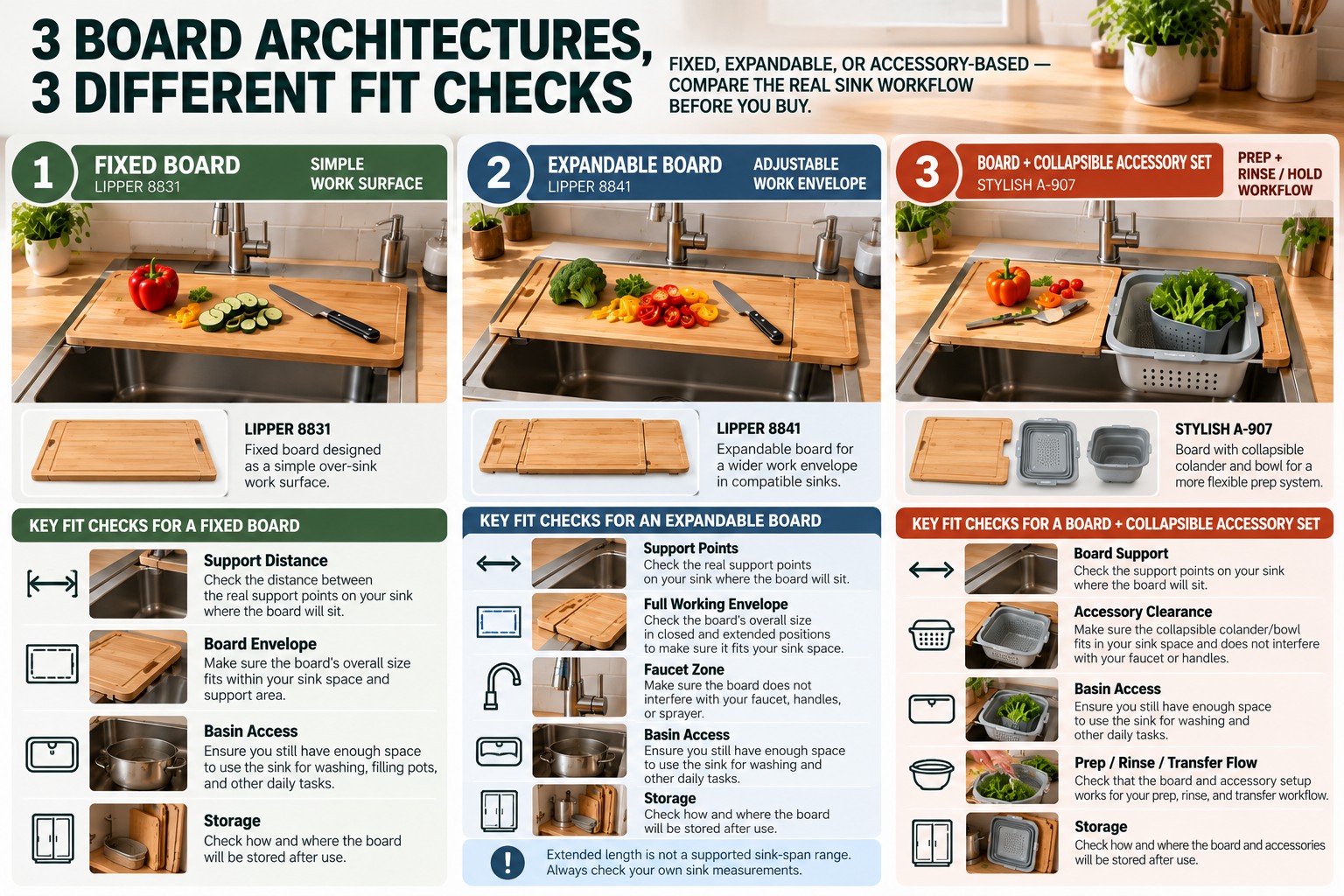
The three locked products solve the same broad small-kitchen problem in different ways.
R1 — Lipper International 8831: Fixed Sink-Spanning Work Surface
The Lipper International item 8831 is the fixed-board role.
Published dimensions are 20.5 × 11.5 × 2 inches.
The material is bamboo.
The manufacturer care boundary adopted here is hand wash and no dishwasher.
The architecture is simple: one fixed work surface with no adopted expandable span mechanism and no included colander system in the locked product role.
That simplicity can be useful when the buyer wants one board that can be positioned as a sink-spanning prep surface without managing an extension mechanism.
But the product’s overall dimensions do not establish the supported sink span.
The following remain unknown:
- supported sink-span range
- exact sink-contact points
- load capacity
- non-slip behavior
- faucet fit
- current U.S. stock
Those unknowns matter because a 20.5-inch overall length is not the same thing as a verified 20.5-inch supported opening.
The buyer should measure the sink and identify where the board would actually rest before treating the published length as useful fit evidence.
Fit-first use case
Consider the fixed-board role when:
- you want a straightforward board without an extension mechanism
- the 20.5 × 11.5-inch overall footprint works in the intended prep zone
- the actual sink provides suitable support points
- faucet and fixture clearance can be verified
- the board can be stored and hand-washed conveniently
The correct question is not, “Is my sink under 20.5 inches?”
It is, “Does this exact board have enough verified support on my sink while preserving the workflow I need?”
R2 — Lipper International 8841: Expandable Prep Surface
The Lipper International item 8841 changes the fit problem by adding an expandable architecture.
Published dimensions are:
- closed: 23.75 × 11.5 × 0.75 inches
- extended: 34 × 11.5 × 0.75 inches
- cutting section: 20.5 × 9.25 × 0.75 inches
The material is bamboo.
The adopted care boundary is hand wash and no dishwasher.
The key advantage of the architecture is not that it fits a specific sink size.
The key advantage is that the product has multiple published length states.
That gives the buyer more geometry to evaluate.
It does not create a supported sink-span range.
The extended 34-inch length must not be treated as proof that the board safely supports a sink opening up to 34 inches.
The exact supported span, contact points, load capacity, non-slip behavior, faucet fit, and current U.S. stock remain unknown.
Closed state and extended state solve different questions
The closed 23.75-inch overall length helps with storage and non-extended placement planning.
The extended 34-inch overall length helps the buyer understand the maximum published product length.
The cutting section, at 20.5 × 9.25 × 0.75 inches, helps separate the actual cutting-area specification from the full extended product envelope.
Those three measurements should not be collapsed into one number.
A buyer should ask:
- Will the closed product fit the intended storage location?
- Will the extended product conflict with faucet hardware, walls, or nearby counter items?
- Where do the extension components make contact with the sink?
- How much of the 34-inch total length is actually available as supported span?
- Does the 20.5 × 9.25-inch cutting section provide enough prep area for the intended task?
The locked research does not answer the contact-point questions.
They must remain buyer verification steps.
Fit-first use case
Consider the expandable role when:
- a variable-length product is useful for the kitchen layout
- the closed and extended envelopes both fit the room
- the buyer is willing to verify real sink contact points instead of assuming span from extended length
- the cutting section is large enough for the intended prep workflow
- hand-wash storage and cleanup work for the household
R3 — Stylish International A-907: Board Plus Included Food-Prep Accessories
The Stylish International A-907 changes the workflow again.
The board dimensions are 15 7/8 × 18 × 1 inch.
The board material is bamboo.
The included accessories are:
- a collapsible silicone colander
- a silicone bowl
The board itself is hand wash only and is not dishwasher safe.
The silicone accessories are dishwasher safe and microwave safe according to the manufacturer.
That distinction matters.
The accessory care instructions should not be generalized to the bamboo board.
The board is the sink-spanning work surface, while the colander and bowl add a prep-system role that the two Lipper products do not have in the locked product set.
The workflow is the feature
A board-plus-accessory system can change how the sink is used.
A buyer may be able to prep on the board while using the included colander or bowl for rinsed ingredients, scraps, or staged food.
But the article should not invent accessory dimensions or claim that the system preserves a specific amount of basin access.
The actual sink layout still controls the fit.
The following remain unknown:
- supported sink-span range
- sink-contact geometry
- load capacity
- slip resistance
- faucet clearance
- exact U.S. stock at a specific location
The product has a U.S.-market listing pass in the locked research.
That is not the same as guaranteed current stock everywhere.
There is also a retailer-dimension conflict in the source set.
Those retailer dimensions are not merged into this article.
The first-party manufacturer dimensions control.
Fit-first use case
Consider the board-plus-accessory role when:
- the buyer wants a prep system rather than only a cutting surface
- the 15 7/8 × 18 × 1-inch board works with the actual sink zone
- the included colander and bowl support the buyer’s normal prep routine
- the remaining basin and faucet access can be verified
- the buyer is comfortable with separate care rules for the bamboo board and silicone accessories
Quick Comparison: Three Sink-Prep Architectures
| Product | Architecture | Locked dimensions | Locked material / care | Important unknowns | Main fit question |
|---|---|---|---|---|---|
| Lipper 8831 | Fixed sink-spanning work surface | 20.5 × 11.5 × 2 in | Bamboo; hand wash; no dishwasher | Supported sink span, load capacity, non-slip, faucet fit, current U.S. stock | Does the board have real support on this sink without interfering with the faucet and workflow? |
| Lipper 8841 | Expandable prep surface | Closed 23.75 × 11.5 × 0.75 in; extended 34 × 11.5 × 0.75 in; cutting section 20.5 × 9.25 × 0.75 in | Bamboo; hand wash; no dishwasher | Supported sink span, contact points, load capacity, non-slip, faucet fit, current U.S. stock | Do both closed and extended states work, and where does the product actually contact the sink? |
| Stylish A-907 | Board plus collapsible colander and bowl | Board 15 7/8 × 18 × 1 in | Bamboo board: hand wash / not dishwasher safe; silicone accessories: dishwasher + microwave safe per manufacturer | Supported sink span, contact geometry, load capacity, slip resistance, faucet clearance, exact location-dependent stock | Does the board-plus-accessory workflow fit the sink while preserving the access the buyer needs? |
This table is a specification reference, not a ranking.
A larger published dimension does not automatically mean better sink fit.
An expandable product does not automatically fit more sinks.
An accessory system does not automatically create a better workflow.
Each architecture has to be tested against the actual sink.
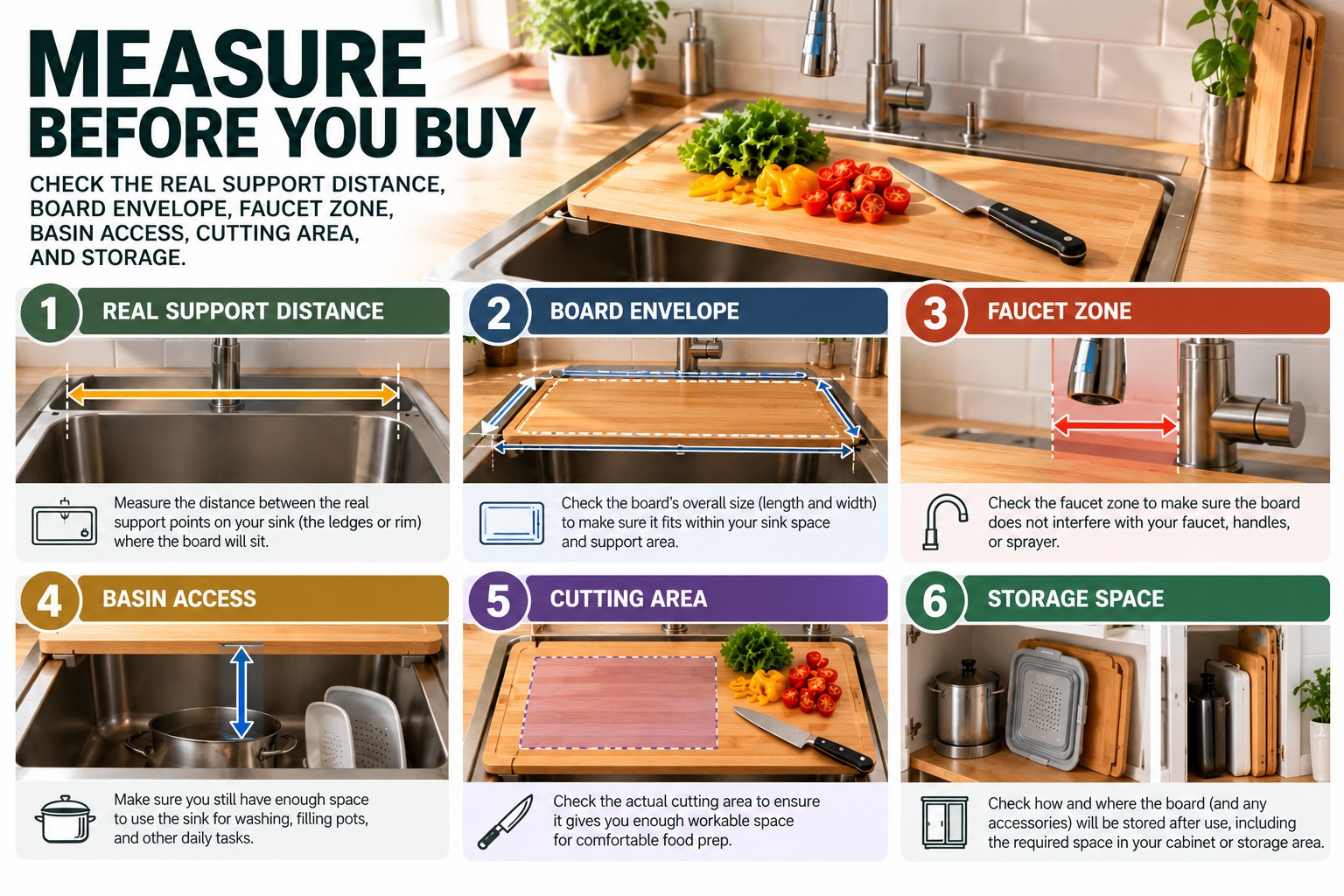
How to Measure an Over-the-Sink Cutting Board Fit
The most useful pre-buy process is physical.
Step 1: map the sink edges
Identify the surfaces where a board could realistically rest.
Do not assume the visible bowl opening is the only relevant measurement.
Check whether the sink has:
- a raised rim
- a flush-mount edge
- surrounding counter support
- faucet hardware inside the board path
- accessories mounted along the sink deck
The article does not establish compatibility with any sink construction type.
The purpose is to identify the buyer’s real geometry.
Step 2: measure the actual support distance
Measure between the support locations that would carry the board.
This is different from simply measuring the bowl.
For the Lipper 8841, do not substitute the 34-inch extended length for the supported span.
For the fixed Lipper 8831 and Stylish A-907, do not substitute overall board length or width for a supported span either.
Step 3: mark the board envelope
Use the locked dimensions to visualize the space each product would occupy.
For a fixed board, mark the overall board envelope.
For the expandable board, mark both the closed and extended envelopes.
For Stylish A-907, mark the board footprint and separately consider where the included accessories will sit during the prep workflow.
Step 4: test faucet movement
Move the faucet through the range you normally use.
Operate handles.
Pull down a sprayer if present.
Place a representative bowl or tall ingredient where it would sit during prep.
Faucet clearance remains buyer-specific.
Step 5: test basin access
Decide whether you need:
- one basin area open for rinsing
- room for scraps
- room for draining
- room for a pot or bowl
- access to the drain
- access to the garbage disposal controls where relevant
There is no universal pass threshold.
A setup is useful only if it preserves enough sink function for the buyer’s own sequence.
Step 6: model hand and knife movement
A board can physically fit and still feel cramped.
Check the motion required to:
- hold ingredients
- use a knife
- transfer chopped food
- move a bowl
- reach the faucet
- clear scraps
- lift the board after use
The article does not assign a universal ergonomic clearance.
The buyer should test the real working zone.
Step 7: verify put-away fit
Use the exact published product dimensions to test the intended storage location.
For Lipper 8841, check the closed dimensions for storage.
For Stylish A-907, remember that the board and two collapsible accessories all need a place after use.
A product that creates counter space during prep should not create a new storage problem afterward.
Fixed vs Expandable vs Accessory-System: Which Role Matches the Kitchen?
The three products are easier to compare when the buyer starts with the job rather than the brand.
Choose a fixed board role when
You want a single board with a straightforward work-surface role.
The main checks are:
- overall board envelope
- support geometry
- faucet clearance
- basin access
- storage fit
Lipper 8831 occupies this role.
Choose an expandable role when
You want a product that has distinct closed and extended states.
The main checks are:
- closed storage fit
- extended room envelope
- true sink contact points
- usable cutting-section size
- faucet and fixture interference
Lipper 8841 occupies this role.
The extended length is a product state, not a guaranteed sink-span rating.
Choose a board-plus-accessory role when
You want the sink area to function as a more integrated prep station.
The main checks are:
- board fit
- colander and bowl workflow
- remaining basin access
- faucet clearance
- separate cleaning requirements
- storage for the complete set
Stylish A-907 occupies this role.
Common Buying Mistakes
Mistake 1: matching board length to sink width
Overall length does not prove supported sink span.
The board still needs appropriate contact points.
Mistake 2: assuming expandable length equals compatibility range
The Lipper 8841 extends to 34 inches.
That is not a verified statement that it supports every sink span up to 34 inches.
Mistake 3: ignoring the faucet
A sink-spanning board can collide with the faucet or its normal movement path even when the board clears the bowl.
Faucet fit remains unknown until the buyer checks the actual sink.
Mistake 4: using the entire product envelope as cutting area
For Lipper 8841, the cutting section is specifically listed as 20.5 × 9.25 × 0.75 inches.
That is not the same as the full 34-inch extended product envelope.
Mistake 5: assuming non-slip performance
Non-slip or slip-resistance performance is not established for the locked products.
Do not convert a visual feature or material assumption into a performance claim.
Mistake 6: assuming load capacity
No adopted product in this article receives an assumed load capacity.
If load capacity matters for the buyer’s use, it requires separate verification.
Mistake 7: treating all care instructions the same
The Lipper bamboo boards are hand wash and no dishwasher.
For Stylish A-907, the bamboo board is hand wash and not dishwasher safe, while the included silicone colander and bowl are dishwasher and microwave safe per the manufacturer.
Do not transfer the accessory care claims to the board.
Mistake 8: assuming U.S. listing means current stock
A U.S.-market listing is not a universal inventory guarantee.
Current stock remains unknown or location dependent where specified.
Mistake 9: merging conflicting retailer dimensions
For Stylish A-907, the first-party manufacturer dimensions control.
Conflicting retailer dimensions are not merged.
Mistake 10: buying for the photo instead of the workflow
Product photography can make an over-the-sink setup look clean and spacious.
The real kitchen includes the faucet, drain, dishes, walls, appliances, hands, knives, ingredients, and storage constraints.
Measure that system.
What Published Specs Do Not Prove
The locked specifications support product identification and dimension planning.
They do not prove:
- universal sink fit
- a supported sink-span range
- universal contact geometry
- load capacity
- non-slip performance
- universal faucet clearance
- universal room fit
- universal food-safety performance
- universal dishwasher safety
- guaranteed current stock
Unknown does not mean zero.
Unknown does not mean pass.
Unknown does not mean fail.
It means the available locked evidence does not answer that question.
A Simple Fit-First Shortlist Process
Before choosing among the three roles, ask these questions in order:
- Where can a board physically rest on the sink or surrounding surface?
- What is the measured support distance between those real contact zones?
- Which locked product envelope fits that zone?
- Does the faucet still operate normally?
- Is enough basin access left for the way I prep food?
- Is the cutting area large enough for the foods and tools I normally use?
- Will ingredients, bowls, scraps, and finished food have a clear destination?
- Does the board need to move repeatedly during one prep session?
- Can the product be cleaned according to its manufacturer care instructions?
- Where will the board and any included accessories be stored afterward?
- Which remaining unknowns matter enough that I need to verify them before buying?
Only after those checks should the buyer decide which architecture is the better match.
Final Fit-First Decision
An over-the-sink cutting board can be a high-value small-kitchen tool because it converts part of the sink zone into prep space.
But the board is only useful if the whole kitchen workflow still works around it.
The three locked roles solve that problem differently:
- Lipper 8831 — fixed sink-spanning work surface
- Lipper 8841 — expandable prep surface
- Stylish A-907 — board plus collapsible colander and bowl
None receives a universal sink-fit claim.
None receives an assumed supported-span claim.
None receives an assumed load-capacity claim.
None receives an assumed non-slip claim.
None receives universal faucet-clearance approval.
The buying sequence is therefore:
measure the real sink support geometry -> compare the locked product envelope -> test faucet interference -> test basin access -> model the food-prep workflow -> confirm cleaning requirements -> confirm storage fit -> verify any unknown that matters before purchase.
That is the Fit-First decision.
A board that merely reaches across the sink is not enough.
The better small-kitchen fit is the board architecture that is supported by the actual sink, leaves the faucet and basin usable for the buyer’s routine, provides enough prep surface, and can be cleaned and stored without creating a second space problem.