Adjustable Drawer Dividers for Small Kitchens: Measure the Usable Interior Before You Buy
A Small Drawer Label Is Not a Fit Measurement
“Small kitchen drawer” sounds like a useful buying category, but it is not a measurement. Two drawers that look similar from the outside can have very different usable interiors once you account for sidewalls, drawer boxes, hardware, liners, rounded corners, handles, and the path the drawer follows when it closes.
That is why adjustable drawer dividers should be treated as a fit problem before they are treated as an organization problem. The relevant question is not whether a divider looks compact or whether a product page calls it adjustable. The relevant question is whether the divider or organizer can occupy the real usable interior without forcing the sidewalls, blocking the closing path, colliding with hardware, or creating a layout that is awkward to remove and reconfigure.
For small kitchens, those details matter because drawers often carry mixed loads: utensils, wraps, clips, measuring tools, gadgets, towels, or narrow pantry items. A divider that works in one drawer may be too short, too tall, too thick, or simply the wrong architecture in another drawer from the same cabinet run.
The fit-first method is simple: measure the usable inside drawer first, then match the architecture to the drawer dimensions, contact surfaces, closing path, and the way you want to reconfigure the compartments. Do not shop from nominal drawer size alone.
Measure the Usable Drawer Interior Before You Shop
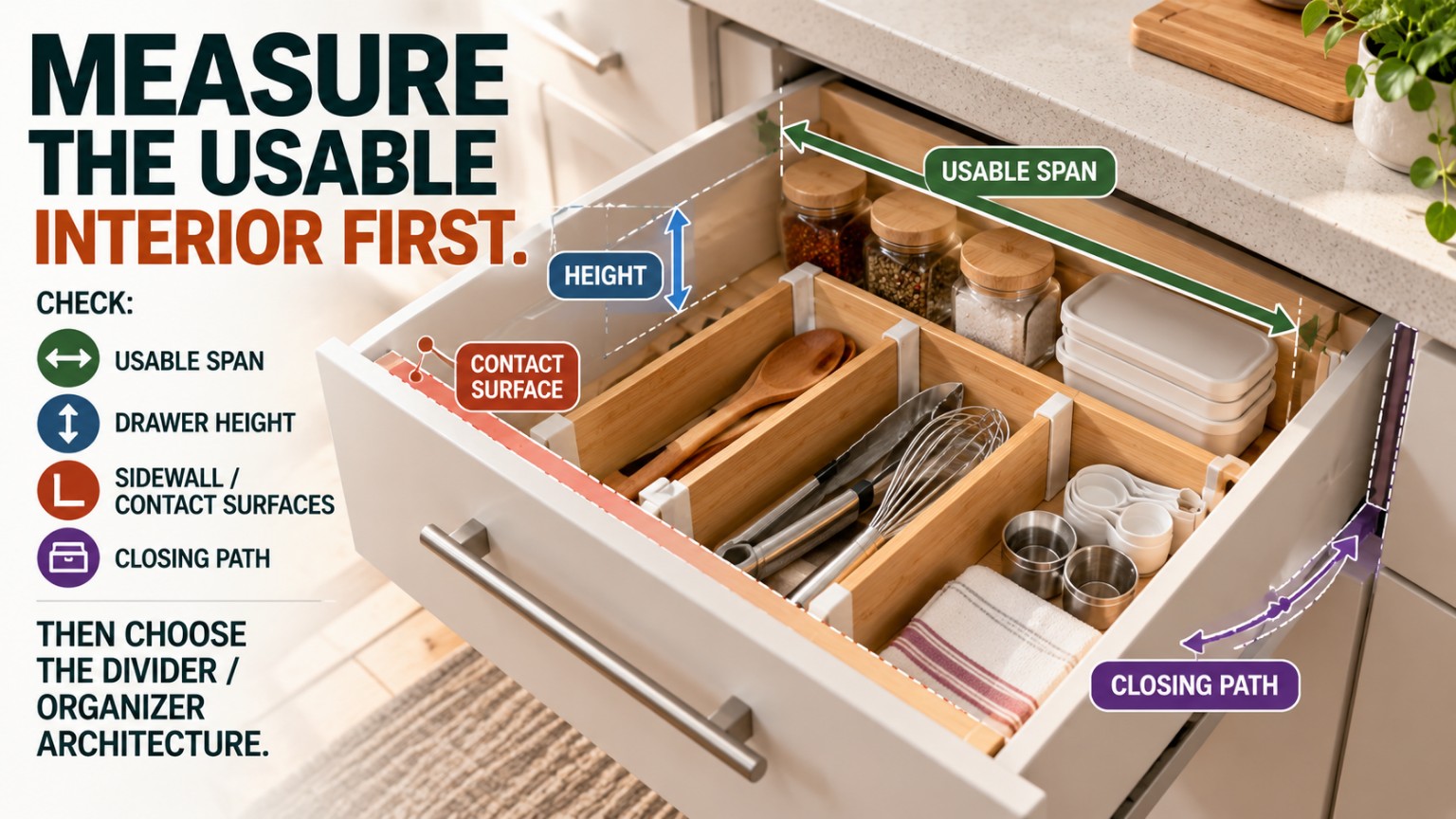
Start with the drawer empty enough to expose the surfaces that will actually contact the divider or organizer. Measure the space the product will occupy, not the exterior cabinet opening.
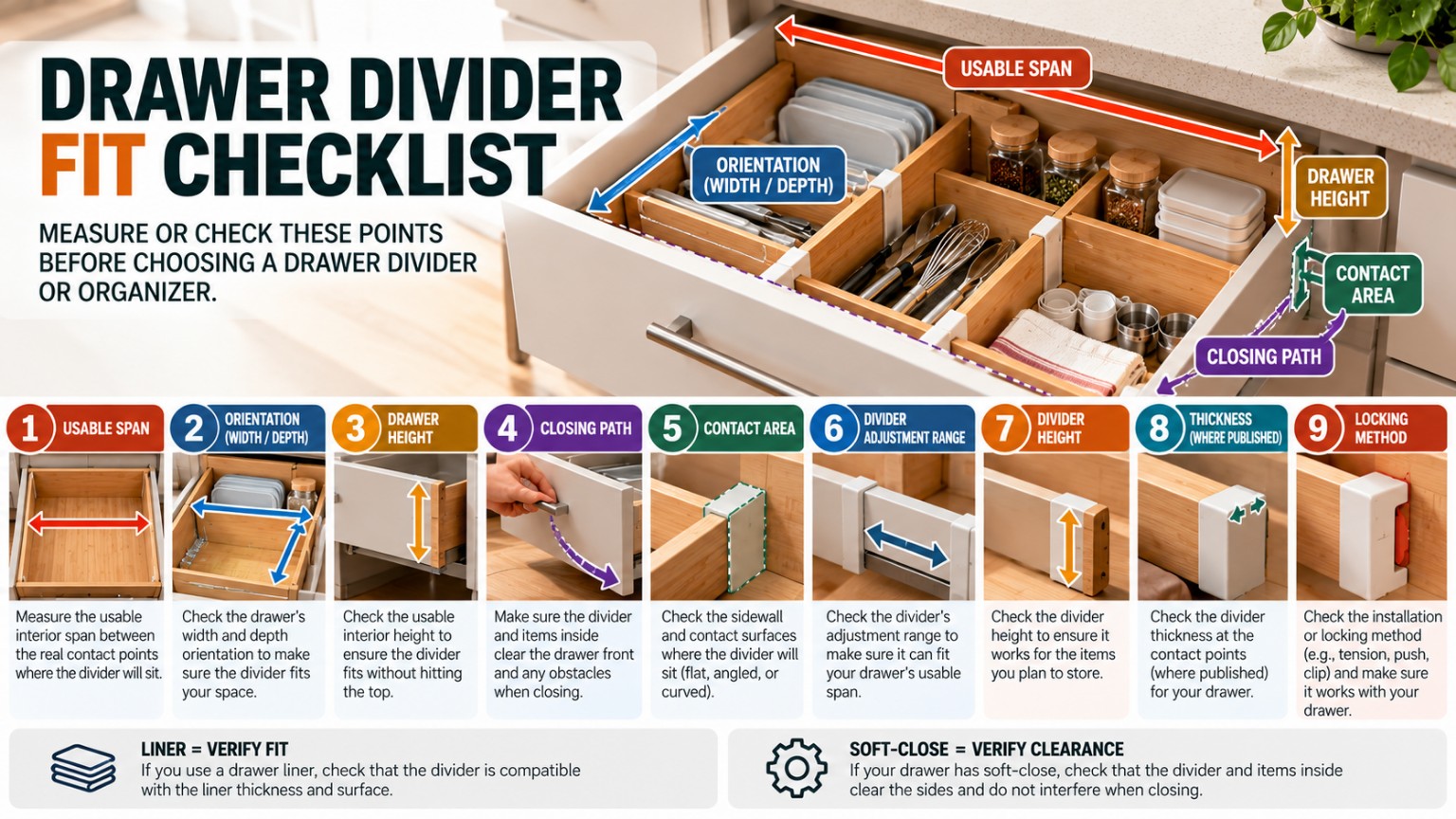
- Usable internal span: Measure the inside dimension the divider will expand across. Depending on orientation, this may be the drawer’s side-to-side width or front-to-back depth. Use the actual clear span between contact surfaces.
- Width and orientation: Decide which way the divider will run before comparing a product’s adjustment range. A divider that fits across the width may not fit front-to-back, and vice versa.
- Drawer height: Measure from the drawer floor to the lowest obstruction in the closing path. Divider height matters because a product can fit the footprint but still interfere with the drawer above, the cabinet frame, or an internal feature.
- Closing path: Close the drawer slowly and observe where handles, rails, soft-close hardware, overhanging countertop structure, or neighboring drawer parts move. A divider must fit the operating drawer, not just the open drawer.
- Sidewall and contact surfaces: Check whether the divider ends will press against flat, stable surfaces. Curved walls, sloped sides, hardware, or narrow contact zones can change how a locking or spring-loaded divider behaves.
- Divider thickness: Thickness consumes compartment space. It also matters when several dividers are used close together. If a product’s thickness is unknown, keep it unknown rather than estimating from photos.
- Liner boundary: A drawer liner can change both the usable dimensions and the contact behavior. Liner compatibility is unknown for all three locked products in this article unless separately stated, so do not assume the same fit on a lined and unlined drawer.
- Soft-close boundary: Soft-close compatibility is also unknown for the locked products. Do not assume a divider will clear every soft-close mechanism just because its height and expansion range look suitable.
- Removal and maintenance path: Consider whether the divider can be released, lifted, or repositioned without emptying the whole drawer. For a custom tray, consider whether the drawer itself must be removed during installation.
When a measurement is close to the edge of a published range, leave room for real-world tolerances and contact geometry. A nominal 17-inch interior is not enough information by itself if trim, corner radius, a liner, or the closing path reduces the usable span.
Three Architectures, Three Different Fit Problems
The three locked products solve drawer organization in materially different ways. They should not be ranked as if they were interchangeable versions of the same mechanism.
The OXO Good Grips Expandable Dresser Drawer Divider Set uses an expandable body with a push-down gray handle that locks the divider in place. Its published adjustment range is 11 to 17 inches, with a 4-inch height. Foam is used at the end contact surfaces. This architecture is useful when the buyer wants a straight divider that can be expanded to a measured span and locked.
The SpaceAid Bamboo Adjustable Drawer Dividers with Labels use a spring-loaded bamboo architecture. The locked white variant includes four main dividers, nine cross-inserts, and 30 label stickers. Its published adjustment range is 17 to 22 inches, with a 2.35-inch face height and 0.6-inch thickness. Rubber pads form the end contact points. This architecture is different because the cross-inserts can create smaller compartments off the main divider lines.
The Custom Inserts AD16 is not a standalone expanding or tension divider. It is a made-to-measure grooved acrylic tray system. The buyer specifies dimensions within the applicable order basis, the tray is fabricated to the order, and removable dividers slide into grooves spaced 5/8 inch center-to-center. It should be considered when the buyer wants a custom-fit tray layout rather than a simple divider that expands against two drawer walls.
The right architecture therefore depends on the measured drawer and the desired workflow. A quick movable boundary, a longer spring-loaded span with cross-compartments, and a custom grooved tray are different buying decisions.
OXO Good Grips Expandable Dresser Drawer Divider Set (SKU 13227200): Push-Down Lock
The OXO Good Grips Expandable Dresser Drawer Divider Set is the shortest-span expandable option in the locked set. The first-party U.S. maker listing supports an adjustment range of 11 to 17 inches and a height of 4 inches. The material boundary is plastic with foam contact surfaces.
Its defining mechanism is the push-down gray handle. The divider is expanded to the intended span and the handle is pushed down to lock it. The manufacturer presents the installation as tool-free. The package contains two dividers.
For a small-kitchen buyer, the first gate is the measured span. If the usable contact-to-contact dimension falls outside 11 to 17 inches, this exact model should not be treated as a fit on the basis of appearance or cabinet size. If the measurement is inside the range, the next checks are the 4-inch divider height, the shape and stability of the sidewall contact surfaces, and the drawer’s closing path.
The published thickness is unknown in the adopted evidence. That means this article does not calculate how much internal storage width two or more OXO dividers will consume. Exact contact size is also unknown, so the foam end pieces should not be translated into a universal claim that the divider will grip every drawer wall or distribute pressure identically on every surface.
Soft-close compatibility is unknown. Drawer-liner compatibility is unknown. A universal damage-free or scratch-free outcome is not supported by the locked evidence. Foam contact is a construction detail, not a guarantee for every finish, liner, paint, veneer, or drawer geometry.
Current U.S. evidence comes from the first-party maker listing. Exact checkout stock is unknown, so this draft does not claim that the set is currently available for immediate shipment.
SpaceAid Bamboo Adjustable Drawer Dividers with Labels: Spring-Loaded + Cross-Inserts
The locked SpaceAid configuration is the white variant with four main bamboo dividers, nine inserts, and 30 label stickers. No numeric SKU is published in the adopted evidence, so no SKU should be invented.
The main dividers adjust from 17 to 22 inches. The published face height is 2.35 inches and the thickness is 0.6 inch. The material is natural bamboo with a white finish. The locking architecture is spring-loaded, with rubber pads at the end contacts.
This is a materially different fit window from the OXO set. The SpaceAid range begins where the OXO range ends, so the buyer should measure the intended span before deciding which architecture belongs in the drawer. The numbers are fit boundaries, not a performance ranking.
The nine cross-inserts change the organization workflow. Instead of creating only long parallel sections, the buyer can create smaller cross-compartments within the larger divider layout. That can be useful for short utensils, clips, measuring tools, packets, or other small items that would move around inside a long uninterrupted lane.
However, the compartment plan must still fit the drawer’s real interior. The 0.6-inch divider thickness consumes usable space. Multiple cross-inserts also create fixed physical boundaries, so the buyer should sketch or measure the intended compartment widths before assuming the system will accommodate specific utensils or containers.
The adopted evidence supports a spring-loaded mechanism and rubber end pads, but this article does not convert that into a universal scratch-free or no-damage guarantee. Surface condition, finish, contact pressure, liner behavior, and drawer geometry can vary.
An explicit universal tool-free claim is not adopted for this product. Soft-close compatibility is unknown. Drawer-liner fit is unknown. Current U.S. evidence comes from the first-party U.S. brand store, while exact checkout stock remains unknown.
Custom Inserts AD16: Made-to-Measure Grooved Acrylic Tray System
The Custom Inserts Adjustable Custom Drawer Organizer, SKU AD16, belongs in this comparison only as a different drawer-organization architecture. It is not a standalone expanding or tension divider and should not be described as one.
The system is a custom-fit clear acrylic tray with grooves that accept removable and repositionable dividers. The locked order basis covers a drawer inside-width category from 12 1/16 to 16 inches. Inside depth is buyer-specified. Height is buyer-selected, with a typical manufacturer recommendation of 2.5 inches.
Because the product is configured to the order, the finished dimensions are unknown until the buyer supplies the required measurements and configuration. This is a critical boundary: the article should not invent a final tray width, depth, or height.
The divider material is 1/4-inch clear acrylic. The tray floor is 1/8 inch. Grooves are spaced 5/8 inch center-to-center. The system includes one custom tray plus four removable dividers. The dividers can be moved between grooves to change the compartment layout.
Polyurethane corner pads are the locked contact detail. The drawer must be removable for installation. The manufacturer deducts 1/8 inch for installation clearance from the submitted fit basis. Buyers should therefore follow the manufacturer’s measuring and ordering process rather than independently converting the published width category into a finished-tray dimension.
This architecture is appropriate to investigate when the buyer wants a made-to-measure tray and repeatable groove positions rather than an expanding divider pressing between two walls. The tradeoff is not a universal “better” or “worse” judgment; it is a different installation and reconfiguration model.
The current U.S. purchase state is configurable add-to-cart and made to order. Ready stock is not claimed. Fabrication is approximately three weeks. Final checkout was not tested in the locked research. The custom order is nonreturnable except under the stated warranty boundary.
Tool requirement is unknown. Soft-close fit is unknown. Drawer-liner fit is unknown. Because the drawer must be removable for installation, the buyer should confirm that the drawer can actually be removed without creating a separate installation problem.
Non-Ranked Comparison: Match Architecture to the Drawer
The table below is intentionally non-ranked. It compares the locked products only on supported, decision-useful fields. Unknown values remain unknown instead of being converted into assumptions.
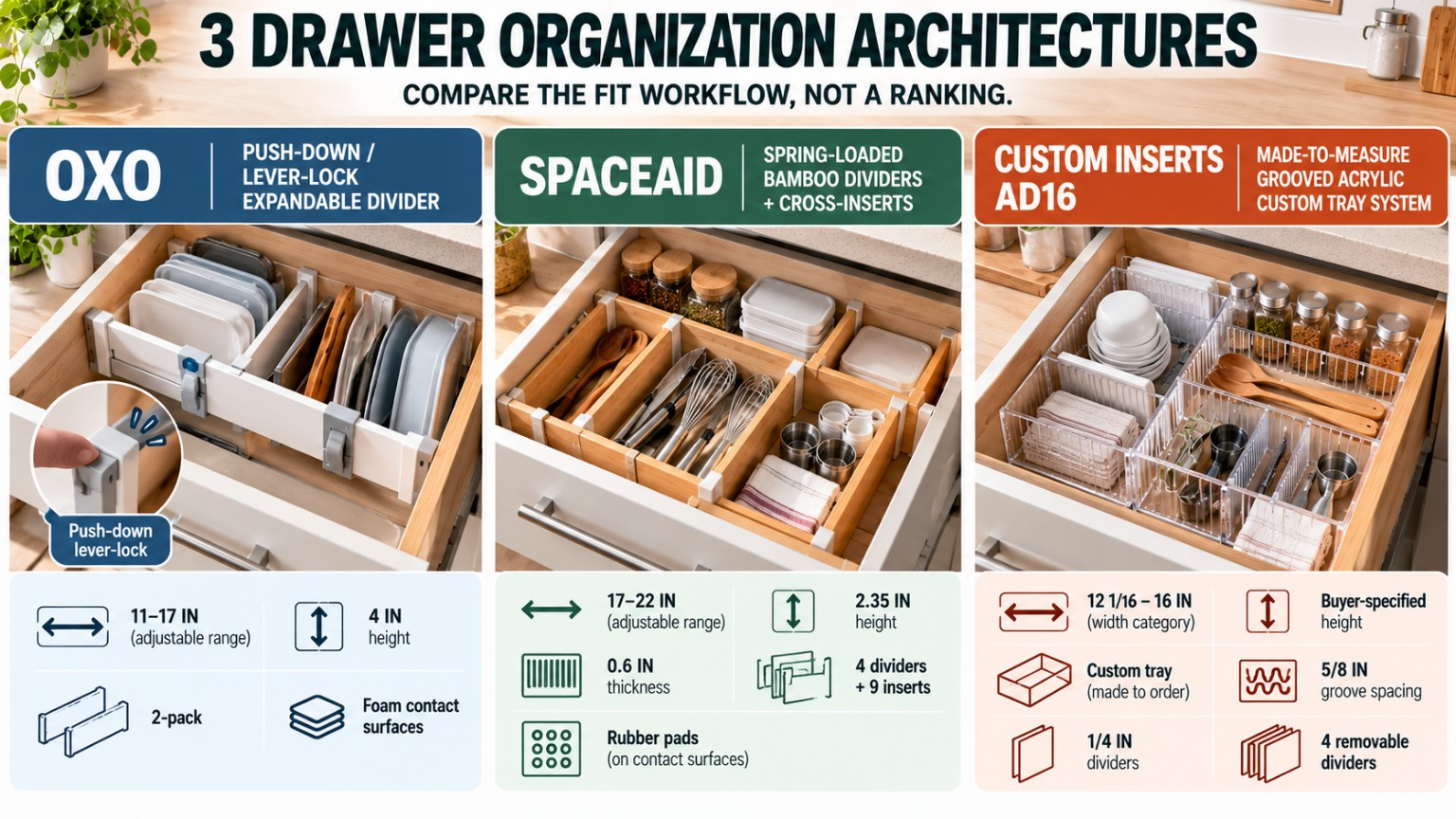
| Field | OXO Good Grips | SpaceAid Bamboo | Custom Inserts AD16 |
|---|---|---|---|
| Product | Expandable Dresser Drawer Divider Set / SKU 13227200 | Adjustable Drawer Dividers with Labels / white 4 dividers + 9 inserts / numeric SKU unknown | Adjustable Custom Drawer Organizer / SKU AD16 |
| Architecture | Expandable divider with push-down handle lock | Spring-loaded bamboo dividers with cross-inserts | Made-to-measure grooved acrylic tray system; not a standalone tension divider |
| Fit range / order basis | 11 to 17 in adjustment range | 17 to 22 in adjustment range | Drawer inside-width category 12 1/16 to 16 in; inside depth buyer-specified; finished dimensions order-specific |
| Height | 4 in | 2.35 in face height | Buyer-selected; typical recommendation 2.5 in |
| Thickness | UNKNOWN | 0.6 in | Divider 1/4 in; tray floor 1/8 in |
| Material | Plastic / foam end contact | Natural bamboo / white finish / rubber pads | Clear acrylic / polyurethane corner pads |
| Lock / attachment method | Push-down gray handle lock; manufacturer tool-free claim | Spring-loaded; universal tool-free claim not adopted | Dividers slide in grooves spaced 5/8 in center-to-center; drawer must be removable for installation |
| Pack / system format | 2 dividers | 4 main dividers + 9 inserts + 30 label stickers | 1 custom tray + 4 removable dividers |
| Repositioning | Release and reset divider position | Move main dividers and cross-inserts within the drawer layout | Move dividers between grooves |
| Key fit check | Measured span, 4 in height, stable contact surfaces, closing path | Measured span, 2.35 in height, 0.6 in thickness, cross-compartment layout, closing path | Follow manufacturer measuring process; removable drawer; buyer-specified depth/height; 1/8 in installation-clearance deduction |
| Important limitation | Thickness, exact contact size, soft-close fit, liner compatibility, and universal damage-free result are UNKNOWN | Numeric SKU, universal scratch-free result, soft-close fit, and liner fit are UNKNOWN | Finished dimensions unknown until configured; tool requirement/soft-close/liner fit unknown; made to order, approx. 3-week fabrication; custom order nonreturnable except warranty |
Choose by Workflow, Not by a Universal Ranking
If the main goal is quick repositioning of one or two straight boundaries, the OXO push-down locking architecture is the most directly relevant architecture to investigate within its 11-to-17-inch fit range. That statement describes the workflow; it is not a universal best-product claim.
If the drawer span is longer and the buyer wants cross-compartments, the SpaceAid spring-loaded bamboo system provides a 17-to-22-inch adjustment range plus nine inserts. The important question is whether the 2.35-inch height, 0.6-inch thickness, contact surfaces, and compartment plan fit the actual drawer and closing path.
If the buyer wants a made-to-measure tray with repeatable groove positions, the AD16 custom acrylic system represents a different path. The buyer specifies the drawer dimensions, selects the height, and receives a fabricated tray with four removable dividers. That can suit a planned layout, but it also introduces a measuring process, drawer-removal requirement, made-to-order lead time, and nonreturnable custom-order boundary.
Quick repositioning and custom fit are not the same job. A divider that can be moved in seconds may be preferable for changing kitchen inventory, while a custom groove system may be preferable when the buyer wants defined compartment positions. The right choice depends on the drawer and the workflow.
Longer span also should not be confused with better fit. A 17-to-22-inch product is not an upgrade over an 11-to-17-inch product if the usable span is 14 inches. Likewise, a custom tray is not automatically a better answer if the buyer does not want to remove the drawer, wait for fabrication, or commit to a made-to-order nonreturnable configuration.
Installation, Removal, and Repositioning Checks
Before installing any divider or organizer, empty enough of the drawer to see the contact surfaces and hardware. Confirm the measurement again at the exact location where the divider will sit.
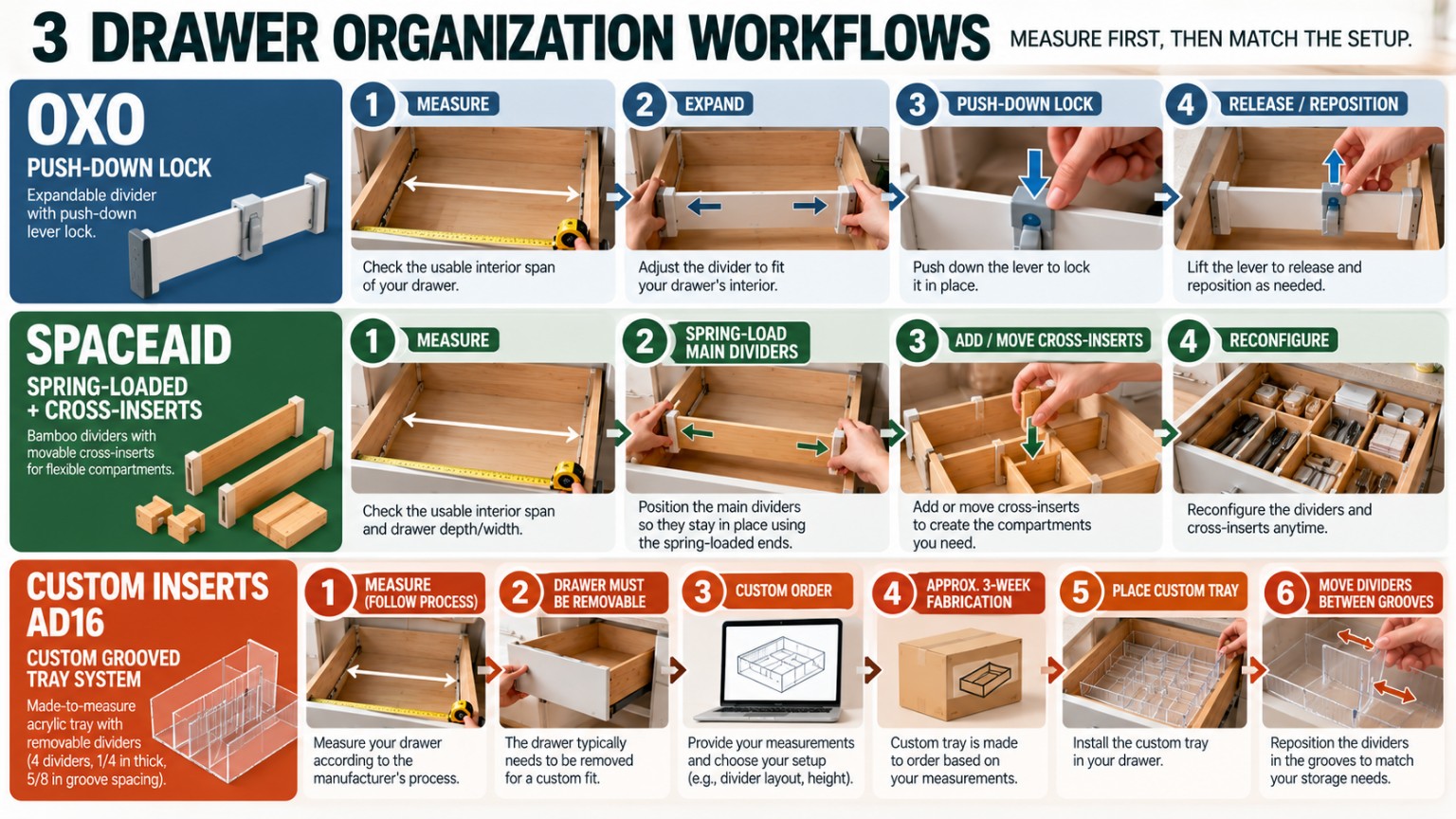
For an expanding locking divider such as the OXO, verify that both end contacts land on stable surfaces. Expand only within the published range and follow the manufacturer’s locking method. Do not compensate for a poor fit by forcing the divider beyond the supported range or by assuming the foam end contacts make excessive pressure harmless.
For a spring-loaded system such as SpaceAid, check both the span and the direction of spring pressure. Confirm that the 0.6-inch thickness and 2.35-inch height do not interfere with the intended contents or closing path. Add cross-inserts only after the main divider positions are established, then check that the resulting compartments are large enough for the items they are meant to hold.
For the AD16 custom tray, follow the manufacturer’s measuring process and remember that the drawer must be removable for installation. The manufacturer applies a 1/8-inch installation-clearance deduction. Do not attempt to reverse-engineer the final dimensions from the order category; finished dimensions remain order-specific until configured.
After installation, close the drawer slowly the first time. Listen and feel for contact rather than assuming that an open-drawer fit proves closing clearance. Reopen the drawer and inspect whether anything shifted, whether the contact points remain where intended, and whether utensils or other contents push against the dividers.
If the drawer uses a liner, test the actual liner condition rather than assuming compatibility. If it uses soft-close hardware, inspect the closing path directly. Those compatibility states remain unknown in the adopted evidence and should be verified in the buyer’s drawer.
Repositioning should also be evaluated as a workflow. A product can be technically adjustable but still inconvenient if the drawer must be emptied every time the layout changes. Decide how often you expect the contents to change and whether you want quick movement, cross-compartment flexibility, or a more deliberate custom layout.
Final Buying Checklist
Use this checklist before choosing adjustable drawer dividers or a custom drawer-organizer system:
- Measure the usable internal span at the exact divider location.
- Confirm whether the divider will run side-to-side or front-to-back.
- Measure usable height and inspect the full closing path.
- Identify the sidewall or contact surfaces the product will press against.
- Compare the measured span with the exact published adjustment range or custom-order basis.
- Check divider height and, where published, thickness.
- Decide whether you want straight boundaries, cross-compartments, or a made-to-measure tray.
- Verify how the system locks, presses, attaches, or sits in the drawer.
- Check how you will remove or reposition the dividers later.
- Keep drawer-liner compatibility unknown unless verified for your setup.
- Keep soft-close compatibility unknown unless verified for your setup.
- Do not assume foam, rubber, or polyurethane contact automatically guarantees a scratch-free or damage-free result.
- For the AD16 custom system, confirm that the drawer can be removed, follow the manufacturer’s measuring process, and account for the made-to-order lead time and return-policy boundary.
- Do not use current-stock assumptions. Exact checkout stock for R1 and R2 is unknown, and R3 is made to order rather than a ready-stock assumption.
The buying decision should come after those checks. The goal is not to find the divider with the biggest adjustment number or the most elaborate accessory set. The goal is to choose an architecture that fits the drawer’s usable interior and the way you actually want to organize and reconfigure it.
Evidence Boundaries and Unknowns
This article uses only the locked product facts adopted for ARTICLE_063. The OXO adjustment range, height, material boundary, push-down lock, foam contacts, tool-free manufacturer claim, and two-divider pack are preserved without extending them into unsupported fit or damage-prevention claims.
The SpaceAid range, 2.35-inch height, 0.6-inch thickness, bamboo material, white finish, spring-loaded mechanism, rubber pads, and four-divider plus nine-insert configuration are preserved. No numeric SKU is invented. A universal tool-free claim is not added.
The AD16 is preserved as a custom-fit grooved acrylic tray system rather than a standalone tension divider. The 12 1/16-to-16-inch inside-width category, buyer-specified depth, buyer-selected height, typical 2.5-inch recommendation, 1/4-inch dividers, 1/8-inch tray floor, 5/8-inch groove spacing, four removable dividers, polyurethane corner pads, drawer-removal requirement, 1/8-inch installation-clearance deduction, made-to-order status, approximately three-week fabrication period, and custom-order return boundary are preserved.
Unknown means unknown. This draft does not infer OXO thickness, exact contact size, soft-close fit, liner compatibility, or universal damage-free performance. It does not invent a SpaceAid SKU or assume universal scratch-free results, soft-close fit, or liner compatibility. It does not invent AD16 finished dimensions, tool requirements, soft-close fit, or liner fit.
No price comparison is made because price refresh was not authorized. No product is ranked as universally best or worst. Current stock is not claimed beyond the locked evidence.
The fit-first conclusion is the same across all three architectures: measure the usable inside drawer first. Then choose the mechanism and layout that match the measured span, height, contact surfaces, closing path, and desired reconfiguration workflow.