
Compact Dehumidifiers for Small Apartments: Check Airflow, Drainage, and Daily Workflow Before You Buy
A Compact Body Is Only the First Fit Check
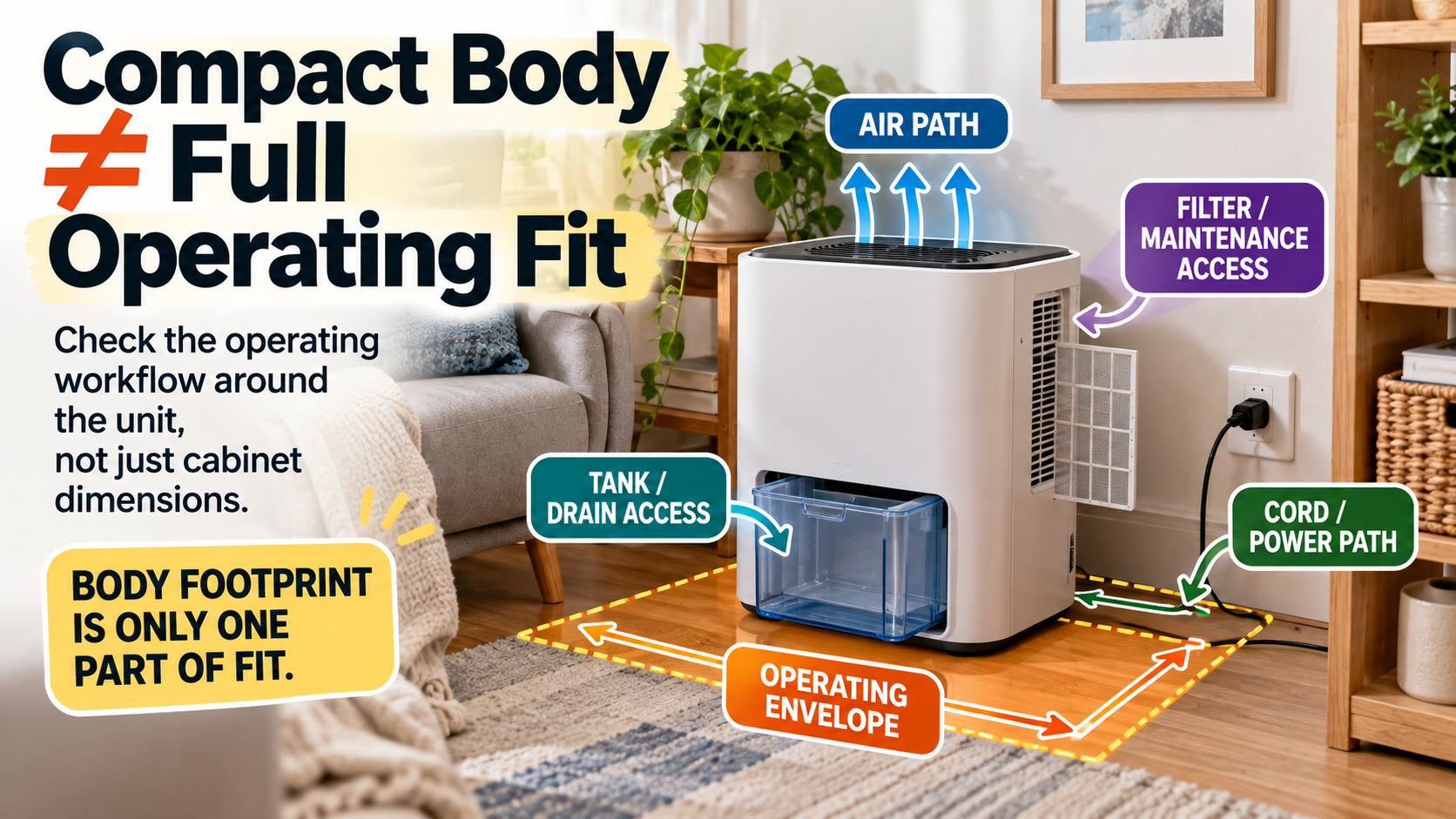
A dehumidifier can look compact on a product page and still be awkward in a small apartment. The cabinet dimensions tell you how much floor space the body occupies, but they do not tell you whether the machine can breathe, whether the tank can be removed, where the water will go, whether the power cord reaches safely, or how much space the unit needs in its real operating state.
That distinction matters more in tight kitchens, bedrooms, laundry corners, hallways, and multipurpose rooms where every few inches can affect circulation. A small body may be easy to park against a wall, yet the installed workflow may require room above, behind, beside, or in front of the cabinet for exhaust, bucket removal, hose routing, or filter cleaning.
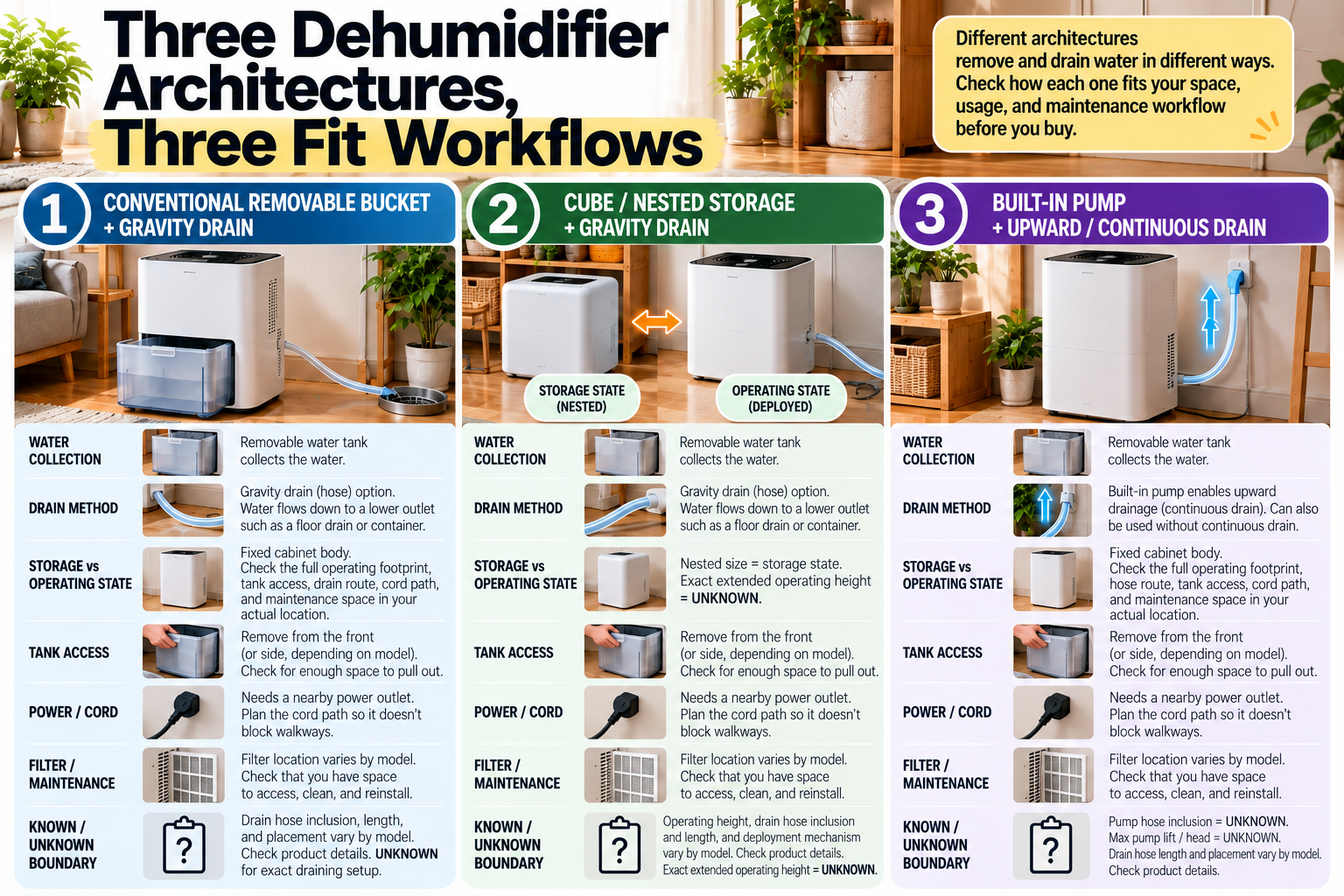
This guide compares three locked product architectures without ranking them: the Midea EasyDry 22 Pint MAD22C1AWS, the Midea Cube 20 Pint MAD20S1QWT, and the Frigidaire 50 Pint Built-In Pump FHDP5033Y1. Their published capacity numbers are manufacturer ratings only. The model-specific test basis is unknown for all three, so the 20-, 22-, and 50-pint figures should not be treated as directly comparable real-world apartment performance data.
The useful question is not “Which number is biggest?” It is “Which operating workflow can actually fit the space I have?”
What to Check Before Buying a Small Apartment Dehumidifier
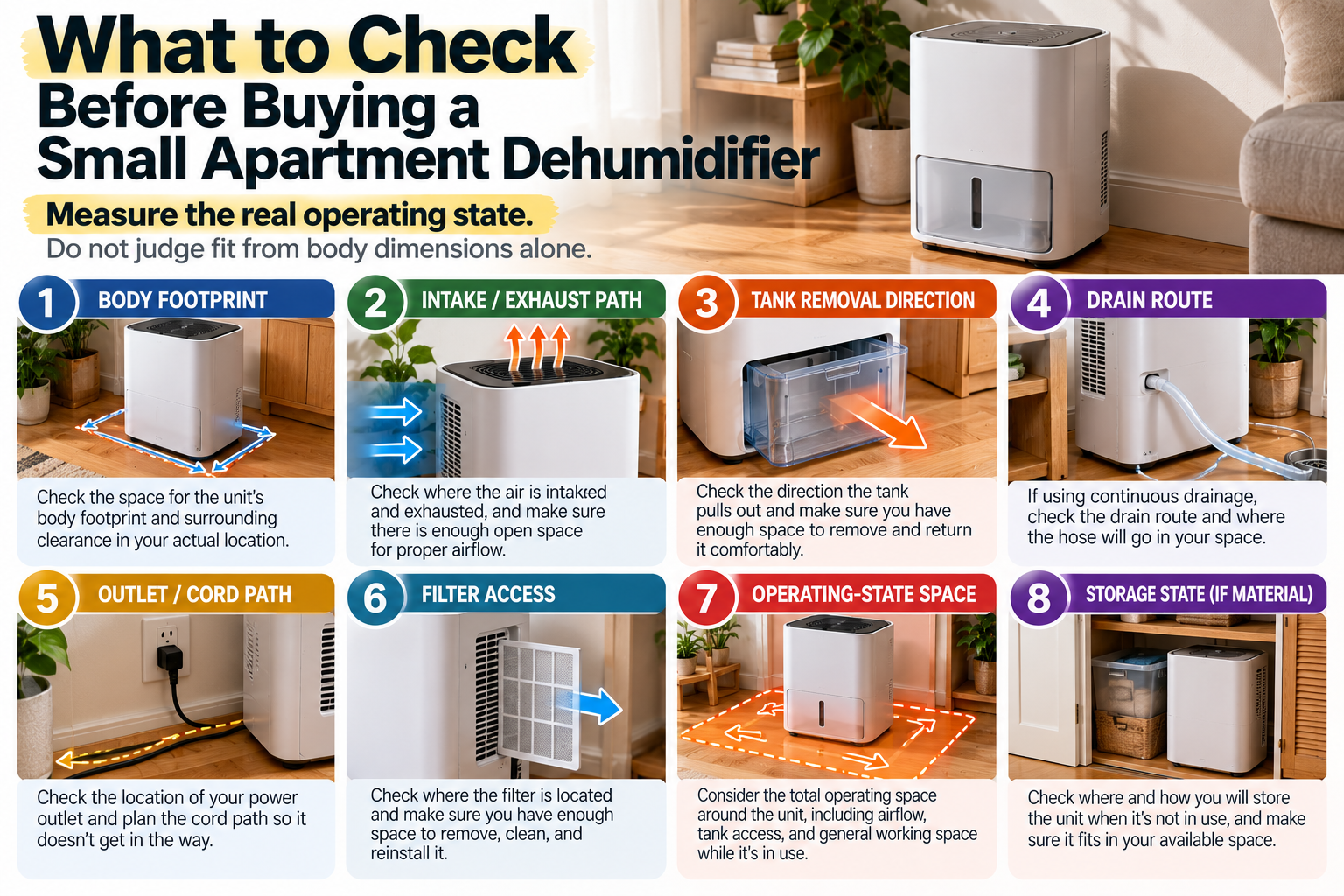
Before comparing models, measure the apartment around the machine. The goal is to understand the full operating system: cabinet, air path, water path, electrical path, access path, and maintenance path.
- Body footprint: where the cabinet will sit without blocking circulation, doors, drawers, or other appliances.
- Operating-state space: the room the unit needs while actually running, including any extended, raised, or service-access state.
- Airflow and placement: where intake and exhaust paths sit, and whether the exact model publishes a required clearance.
- Tank access: the direction the bucket or reservoir comes out and the space your hands need to remove, carry, empty, and reseat it.
- Water-removal workflow: manual emptying, gravity continuous drain, or pumped drainage are different installation problems.
- Drain route: hose path, downward slope where gravity is required, destination point, and whether the exact required hose is actually included.
- Power and cord path: outlet location, cord reach, and whether the cable crosses a walkway or conflicts with furniture.
- Filter and maintenance access: where the filter comes out and whether cleaning it requires moving the machine.
- Daily workflow: how often you may need to interact with the unit, which depends on the room, humidity load, settings, and drainage setup.
Do not turn missing specifications into optimistic assumptions. If an airflow clearance, hose inclusion, pump lift, power draw, tank capacity, or operating humidity boundary is not verified for the exact model and market, the correct state is unknown.
Airflow and Placement: Measure the Operating State, Not Just the Footprint
Dehumidifiers move air through a cabinet, so placement is not just a furniture question. A machine that physically fits between a wall and a shelf may still be a poor installation if the intake or exhaust path is obstructed. The exact airflow-clearance requirement is unknown for the locked evidence on the Midea EasyDry and Midea Cube, so this article does not invent a universal spacing rule.
Instead, treat airflow as a model-specific verification step. Identify the intake and exhaust locations from the exact manual or product documentation, then measure the actual operating position. Check what happens when doors open, curtains move, laundry is hung nearby, or the unit is pushed back after cleaning. A clearance that is comfortable in an empty room can disappear once the apartment returns to normal use.
Operating temperature is another bounded specification. For the Midea EasyDry MAD22C1AWS, the locked OEM manual boundary supports an approximate operating-temperature range of 41–95°F. For the Frigidaire FHDP5033Y1, the locked evidence supports low-temperature operation down to 41°F. The Midea Cube MAD20S1QWT does not have a verified operating temperature or operating-relative-humidity boundary in the adopted evidence.
Do not confuse a humidity control setting with an operating-environment specification. For the Frigidaire, the 35–85% figure is a control-setting range, not a verified environmental RH operating boundary.
Tank Access and Condensate Removal Are Part of the Fit
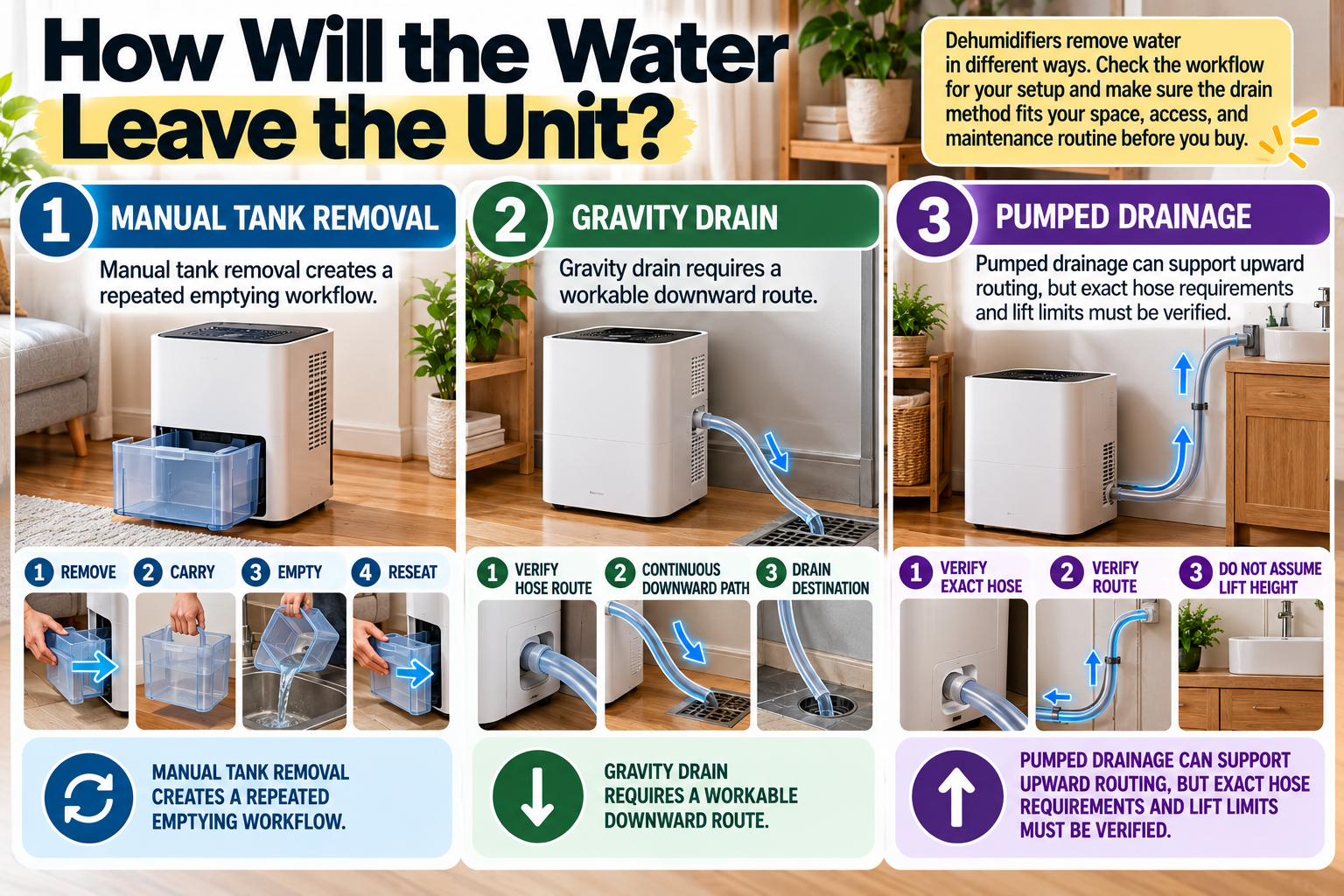
Water removal is often the difference between a dehumidifier that fits your floor plan and one that fits your daily life. A removable bucket creates a repeated carrying task. Gravity drainage creates a hose-routing task. Pumped drainage creates a different route and installation task. None of these should be treated as automatically better.
For a bucket workflow, measure the removal direction and the space needed to pull the tank free. Then think about the carry path to a sink, tub, or drain. A small unit in a tight corner may become annoying if a chair, laundry basket, or cabinet has to move every time the tank is emptied.
For gravity continuous drain, the route must work as a gravity route. Verify the drain connection and hose requirement for the exact model, then check whether the hose can travel continuously toward an appropriate lower destination without being pinched, sharply bent, or forced across a walkway. The presence of a continuous-drain feature does not by itself prove that your apartment has a workable drain path.
For pumped drainage, verify the exact pump instructions before planning an upward route. The Frigidaire FHDP5033Y1 has a built-in pump and supports upward drainage, but the adopted evidence does not establish a separate maximum pump-lift or head figure. The manual’s approximate 5 m drainage wording must not be converted into a vertical pump-lift claim.
Midea EasyDry 22 Pint (MAD22C1AWS): Conventional Bucket + Gravity Drain
The Midea EasyDry MAD22C1AWS represents the conventional removable-bucket architecture in this comparison. The manufacturer rating is 22 pints per day, with the test basis unknown. Its published body dimensions are 15.2 inches wide by 10.24 inches deep by 19.69 inches high, and the published weight is 32.41 pounds.
The water-collection workflow is a removable pull-out bucket: remove it, empty it, and reseat it. The adopted evidence does not verify the tank capacity, so that value remains unknown. Continuous drainage is supported as a gravity-drain workflow, but drain-hose inclusion is not verified. That means a buyer should not assume a hose arrives in the box without checking the current exact-model documentation.
For power, the verified boundary is 115 V and 60 Hz. Watts and amps are unknown in the adopted evidence. The filter is removable and washable. The approximate OEM-manual operating-temperature boundary is 41–95°F. Exact airflow clearance and operating RH are unknown.
In a small apartment, the practical fit questions are therefore straightforward: can the pull-out bucket clear the surrounding furniture, can the gravity hose reach a lower drain if you intend to use continuous drainage, can the removable filter be accessed without relocating the unit, and can the machine sit where its air path remains unobstructed? The 22-pint manufacturer rating does not answer any of those questions.
Midea Cube 20 Pint (MAD20S1QWT): Nested Storage + Gravity Drain
The Midea Cube MAD20S1QWT uses a different physical concept: a cube-style body with a nested storage architecture. Its manufacturer rating is 20 pints per day, with the model-specific test basis unknown.
The most important dimensional control is that the U.S.-published 13.5 by 13.5 by 13.39 inch dimensions are nested or storage dimensions. They must not be presented as the operating dimensions of the unit. The exact extended operating height is unknown in the adopted evidence. For a small apartment, that means you should measure the intended operating location independently rather than treating the nested height as the height needed while running.
Continuous drainage is supported, and the adopted evidence preserves that a drain hose is included. That makes hose availability different from the EasyDry boundary, where hose inclusion is not verified. It does not, however, prove that a gravity drain route will work in a particular apartment.
Some exact-model evidence comes from Midea Canada for MAD20S1QWT. That regional evidence reports a 12 L tank capacity, 115 V, a washable filter, and 45 dBA noise. Those values are useful only when the regional boundary is made explicit. They are not independently verified as U.S.-revision specifications in the adopted evidence, so this guide does not silently normalize them into U.S. data.
Frequency, watts, amps, operating temperature, operating RH, and exact airflow clearance remain unknown in the adopted evidence. The central fit issue is therefore the difference between storage state and operating state: a product that nests into a compact cube can still require a larger working envelope when deployed.
Frigidaire 50 Pint Built-In Pump (FHDP5033Y1): Pumped Drainage Architecture
The Frigidaire FHDP5033Y1 represents the built-in pumped-drainage architecture. Its manufacturer rating is 50 pints per day, again with the test basis unknown. That rating should not be used to claim that the model will remove more moisture in a particular apartment than the 20- or 22-pint models.
The published body dimensions are 18.9 inches wide by 9.9 inches deep by 19.1 inches high, and the published weight is 41.89 pounds. The front removable tank has a published capacity of 1.9 U.S. gallons.
The built-in pump is the architectural difference that matters most for workflow. The model supports upward drainage and also supports continuous drainage. Pump-hose inclusion is unknown in the adopted evidence, and the maximum pump lift or head is also unknown. Do not translate the manual’s approximate 5 m drainage wording into a vertical-lift promise.
The verified electrical specifications are 115 V, 470 W, and 8.8 A. The power cord is 72 inches long. The filter is accessed from the rear, while exhaust is from the top. Those access directions matter when the unit is placed against a wall, under shelving, or beside furniture.
Noise is published at 49 dBA on low and 51.5 dBA on high. Those are verified model values, but they should not be generalized into a claim that the unit is “quiet” for every sleeper, room, or apartment. The low-temperature boundary is down to 41°F. The model is ENERGY STAR qualified in the adopted evidence.
For apartment fit, the question is whether the front tank, rear filter, top exhaust, 72-inch cord, and chosen water-removal route can all work in the same location. A pumped drain can change where water may be routed, but it does not eliminate the need to verify the exact hose setup and real path.
Non-Ranked Comparison: Three Different Apartment Workflows
The table below is intentionally non-ranked. It compares only verified fields and makes unknown states explicit instead of leaving blanks that could look like “not applicable.”
| Field | Midea EasyDry MAD22C1AWS | Midea Cube MAD20S1QWT | Frigidaire FHDP5033Y1 |
|---|---|---|---|
| Body dimensions | 15.2 W × 10.24 D × 19.69 H in | U.S.-published nested dimensions: 13.5 × 13.5 × 13.39 in | 18.9 W × 9.9 D × 19.1 H in |
| Storage / operating state | Published fixed-body dimensions | Nested/storage dimensions only; exact extended operating height unknown | Published fixed-body dimensions |
| Water collection | Removable pull-out bucket; remove, empty, reseat | Midea Canada exact-model evidence reports 12 L tank; U.S.-revision equivalence not independently verified | Front removable tank |
| Continuous drain | Yes; gravity | Yes; gravity; drain hose included | Yes |
| Pump | Pump capability not verified in adopted evidence | Pump capability not verified in adopted evidence | Built-in pump; upward drainage |
| Tank capacity | Unknown | 12 L — Midea Canada exact-model evidence; not independently verified as U.S.-revision spec | 1.9 U.S. gallons |
| Power | 115 V / 60 Hz; watts and amps unknown | 115 V reported by Midea Canada; frequency, watts, and amps unknown | 115 V / 470 W / 8.8 A; 72 in power cord |
| Filter / maintenance | Removable / washable filter | Washable filter — Midea Canada exact-model evidence | Rear-access filter; top exhaust |
| Noise | Unknown | 45 dBA — Midea Canada exact-model evidence; not independently verified as U.S.-revision spec | 49 dBA low / 51.5 dBA high |
| Low-temp boundary | Approx. 41–95°F operating-temperature boundary from OEM manual | Unknown | Down to 41°F |
| Key unknown | Tank capacity; drain-hose inclusion; watts/amps; airflow clearance; operating RH | Exact extended operating height; U.S.-revision status of regional values; frequency; watts/amps; operating temp/RH; airflow clearance | Pump-hose inclusion; maximum pump lift/head; operating RH |
Power, Cord Path, Filter Access, and Maintenance
Power and maintenance are easy to overlook because they are not part of the cabinet footprint, but they affect whether the machine can stay in its intended location.
For the EasyDry MAD22C1AWS, 115 V and 60 Hz are verified, while watts and amps are unknown. For the Cube MAD20S1QWT, Midea Canada reports 115 V for the exact model, but that regional value is not treated here as an independently verified U.S.-revision specification; frequency, watts, and amps remain unknown. For the Frigidaire FHDP5033Y1, 115 V, 470 W, and 8.8 A are verified, along with a 72-inch power cord.
Cord length is not the same as permission to route a cord anywhere. Before buying, locate the actual outlet and check the path the cord would take when the machine is in its operating position. Avoid planning around a cord crossing a doorway, walkway, or other area where it could be pulled or pinched.
Filter access deserves the same physical check. The EasyDry has a removable washable filter. The Cube has a washable filter in the Midea Canada exact-model evidence, with the regional boundary preserved. The Frigidaire uses rear filter access. If the unit has to be pulled out every time the filter is cleaned, that movement becomes part of the maintenance footprint.
Decision Checklist Before You Buy
Use this checklist as a fit gate before treating any compact dehumidifier as apartment-ready:
- Where will the dehumidifier sit while operating, not merely while stored?
- Does that location preserve the intake and exhaust path required by the exact model? If the clearance is unpublished, keep it unknown rather than guessing.
- Can the tank be removed in the direction required without moving furniture or the machine every time?
- If using gravity drain, is there a continuous downward route to a suitable drain point?
- If using a pump, have you verified the exact hose requirement and the real route instead of assuming a lift height?
- Does the power cord reach an appropriate outlet without becoming a trip or door-clearance problem?
- Can you remove and clean the filter in the installed position?
- If a model has a nested or storage state, have you measured the operating state separately?
- Are regional specifications clearly labeled instead of being treated as interchangeable U.S. data?
- Are manufacturer capacity ratings being treated as ratings rather than as proof that one model will remove more moisture in your apartment?
If several of those answers are still unknown, that is a signal to verify the exact model documentation or measure the space again. It is not a reason to fill the gap with a generic assumption from another dehumidifier.
Evidence Boundaries and Unknowns
This article uses a bounded evidence method. Published dimensions, electrical values, tank information, drainage features, filter details, noise values, and temperature boundaries are included only where they were adopted as verified for the locked product set.
Capacity numbers are manufacturer ratings. Because the model-specific test basis is unknown for all three products, the ratings are not normalized into an apples-to-apples performance hierarchy. A 50-pint label is not used here to claim better real-world moisture removal than a 22-pint or 20-pint label.
For the Midea Cube MAD20S1QWT, some exact-model details come from Midea Canada. The article keeps those values visibly regional rather than presenting them as independently verified U.S.-revision specifications. That includes the 12 L tank capacity, 115 V, washable filter, and 45 dBA noise figure.
Unknown values remain unknown. The article does not assume airflow clearance, operating RH, hose inclusion where it is unverified, pump lift, missing power values, current stock, universal bathroom suitability, health effects, mold-prevention outcomes, or universal quietness.
The fit-first conclusion is simple: choose the operating workflow before you choose the cabinet. Measure where the machine will breathe, how you will remove water, where the cord will run, how the tank and filter will be accessed, and how the unit will behave in its full operating state. In a small apartment, those workflow dimensions can matter as much as the body dimensions.