Portable Induction Cooktops for Small Kitchens: Check the Full Cooking Fit Before You Buy
A portable induction cooktop looks simple: put a small appliance on the counter, set a pan on top, plug it in, and cook.
In a small kitchen, that picture is incomplete.
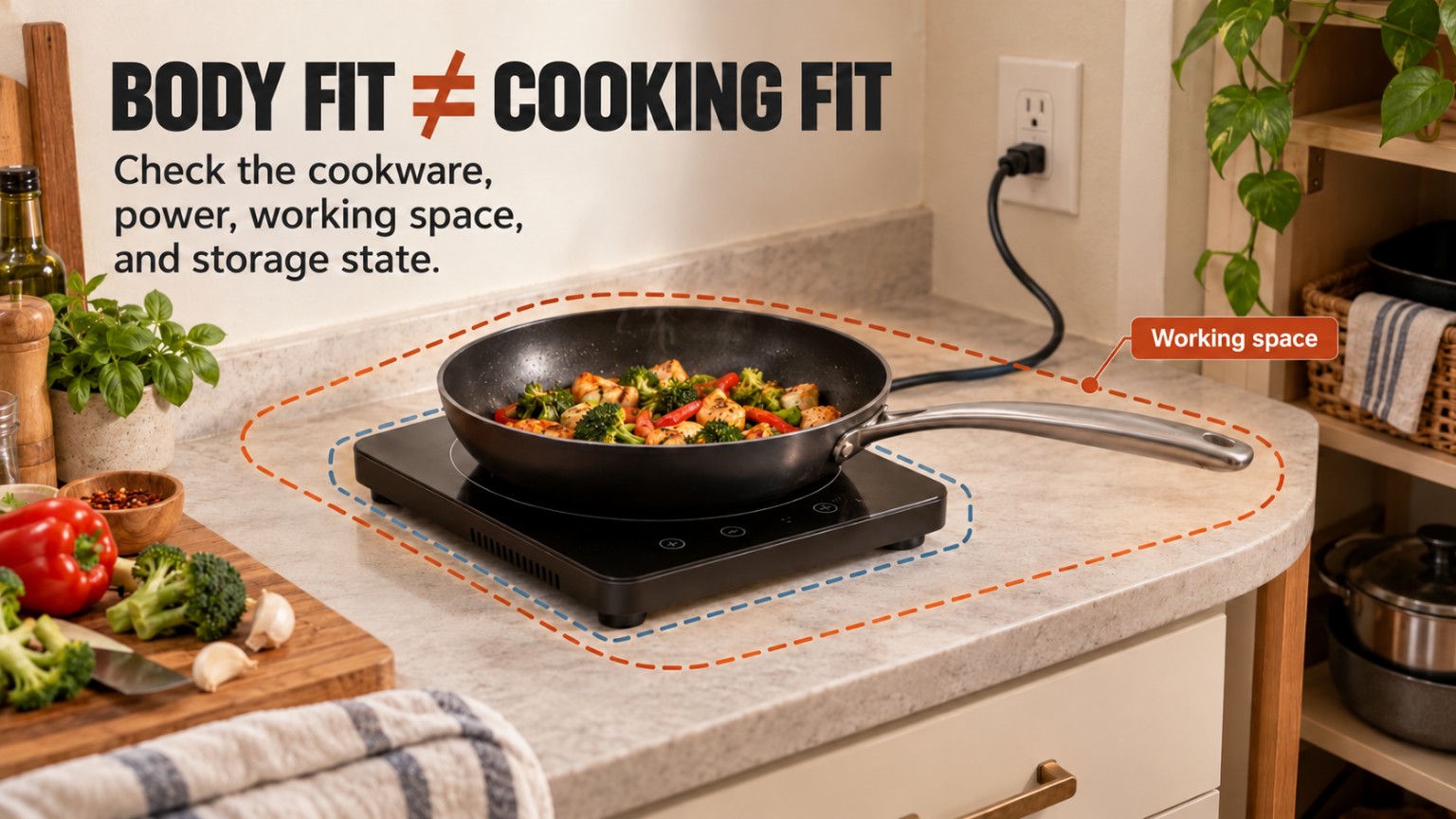
The cooktop body can fit while the cookware does not. A pan can be
induction-compatible and still be the wrong size for the exact model. A
120V rating does not prove that every outlet or circuit in a home is
suitable for the product. A cooktop can fit between two appliances when
it is cold and empty, then become awkward once a real pan and its handle
extend beyond the body. A counter can be large enough for the unit but
wrong for the product’s published surface or ventilation requirements.
And a portable cooktop still needs a defined cool-down and storage
workflow after cooking.
That is the Fit-First rule for this category:
Body fit ≠ cookware-interface fit ≠ power-supply fit ≠ active
pan / handle fit ≠ counter / working fit ≠ storage fit.
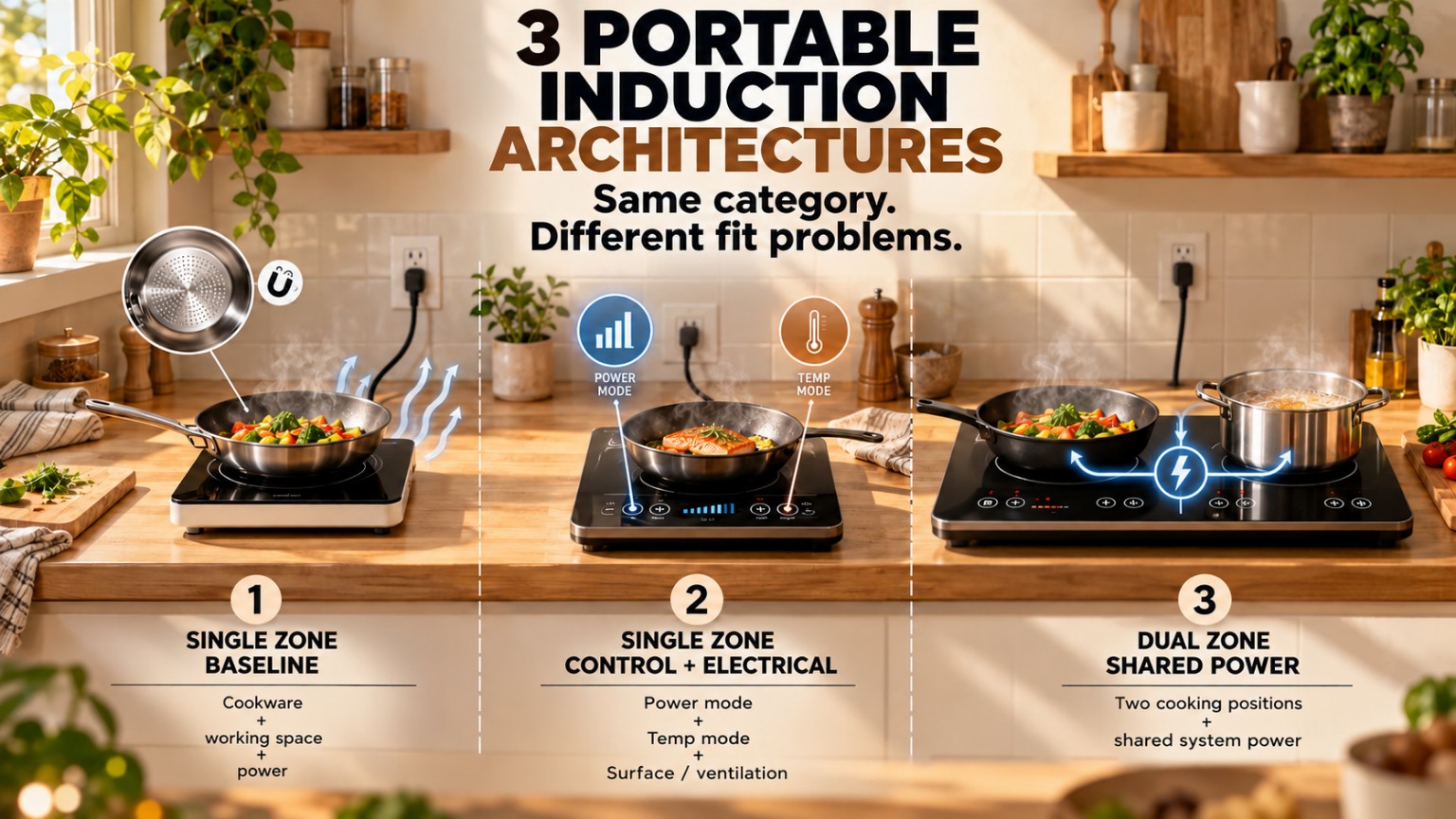
This guide compares three non-ranked US portable induction cooktop
architectures:
- IKEA TILLREDA 104.935.20 — a compact single-zone
baseline with published body dimensions, one heating zone whose current
US page and exact US manual use different size wording, 120V / 15A /
1800W ratings, a recommended 120–200 mm cookware diameter range, and a
qualitative requirement for good surrounding ventilation. - Duxtop 9600LS / BT-200DZ — a single-zone model with
Power and Temperature modes, 20 power levels, 120V / 15A operation, a
5-inch minimum cookware base, a 5-foot cord, a 4-inch ventilation
boundary, and a more explicit electrical and countertop workflow. - Duxtop 9620LS — a dual-zone model with independent
zone controls, 120V / 15A operation, up to 1800W system power, Power and
Temperature modes, and a power-sharing architecture.
The purpose is not to rank the products. It is to show why three
products that can all be called portable induction cooktops create three
different small-kitchen fit problems.
Start
With the Cooking System, Not Just the Cooktop Body
The first measurement should not be the product width by itself.
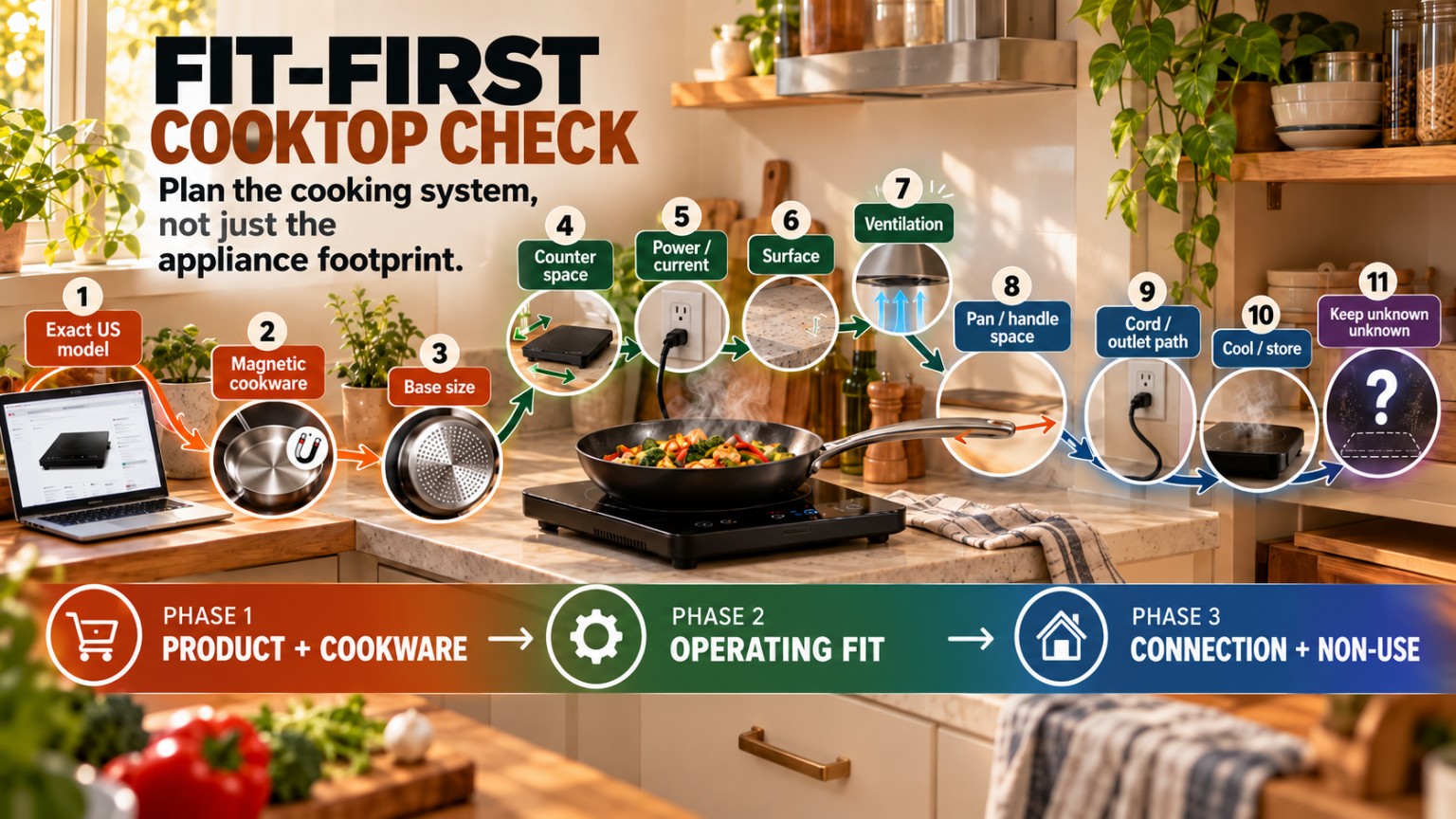
Start with the complete cooking system:
- Confirm the exact model and US-region identity.
- Check the cooktop body dimensions where published.
- Check the number of heating zones and the zone size where
established. - Confirm that the cookware has a magnetic base compatible with
induction. - Check the cookware base-size requirement where the exact model
publishes one. - Check the exact model’s voltage, wattage, and current rating.
- Check the counter or work-surface requirement.
- Check the published ventilation or airflow boundary.
- Map the active pan and handle envelope, not just the empty cooktop
body. - Trace the cord and outlet path without assuming that every 120V
outlet is suitable. - Plan the cool-down and storage state.
- Preserve every unsupported field as unknown.
This sequence matters because a portable induction cooktop is an
interface between appliance, cookware, electrical supply,
countertop, user movement, and storage.
The body is only one component.
A useful buying decision therefore begins with the question:
Can this exact model operate with my actual pan, my actual
counter, my actual electrical setup, and my actual cooking
workflow?
That is more useful than asking for one universal choice.
Three Non-Ranked Portable Induction Cooktop Architectures
| Product / model | Architecture | Body dimensions | Weight | Zone count | Zone size | Voltage | Current | Max power | Power / control mode | Cord length | Cookware requirement | Min cookware if established | Surface requirement | Ventilation | Cool / store state | Material unknowns |
|---|---|---|---|---|---|---|---|---|---|---|---|---|---|---|---|---|
| IKEA TILLREDA 104.935.20 | Single-zone baseline | 10 5/8 in W × 12 3/4 in D × 2 1/2 in H | 6 lb | 1 | US page: 7 in; exact US manual: 158 mm — not normalized | 120V | 15A | 1800W | Single-zone touch control; manual power levels 200–1800W | 55 1/8 in | Magnetic / ferromagnetic-base cookware | Recommended 120–200 mm diameter; 200 mm is not treated as a hard maximum |
Flat, stable / solid surface | Good surrounding ventilation required; numeric clearance not established |
Let unit cool before disconnecting; keep connected until fan / heat-indicator sequence is finished |
Hard maximum cookware size; numeric ventilation clearance; exact active pan / handle envelope |
| Duxtop 9600LS / BT-200DZ | Single-zone control / electrical variant | 11.4 × 14 × 2.5 in | 5 lb 12 oz | 1 | Not established | 120V / 60Hz | 15A | 1800W | Current first-party power range 100–1800W; Power mode + Temperature mode; 20 preset power levels |
5 ft | Magnetic / ferrous-base cookware | 5 in base | Dry, stable, level, non-combustible, non-metallic surface | At least 4 in around unit | Cooling fan continues until cool; do not store while hot | Physical zone diameter; maximum cookware size; exact active pan / handle envelope |
| Duxtop 9620LS | Dual-zone / shared-power architecture | Not established | Not established | 2 | Not established | 120V | 15A | Up to 1800W system power | Independent zone controls; Power mode + Temperature mode; power sharing |
Not established | Magnetic-compatible cookware | Not established | Not established | Exact clearance not established | Exact cool-down / storage boundary not established | Body dimensions, weight, cord length, physical zone size, min / max cookware size, exact ventilation clearance, exact active pan / handle envelope |
The table is intentionally non-ranked.
It also keeps unknowns visible instead of deleting columns that are
inconvenient for comparison.
That matters because the absence of a published field is not evidence
that the field is zero, irrelevant, compatible, or something that can be
ignored.
Unknown ≠ zero. Unknown ≠ pass. Unknown ≠ fail. Unknown ≠
compatible.
1. IKEA
TILLREDA 104.935.20: Compact Single-Zone Baseline
The US IKEA TILLREDA 104.935.20 gives this comparison a clean
single-zone baseline.
Its published body dimensions are 10 5/8 inches wide × 12 3/4
inches deep × 2 1/2 inches high, and the published weight is
6 lb. IKEA’s current US product page describes one
7-inch induction zone, while the exact US manual lists
a 158 mm cooking zone. Those two first-party values are
preserved as source-labeled wording rather than silently normalized into
one canonical zone diameter. The product is rated 120V, 15A, and
1800W, and the manual publishes power levels from
200–1800W. The published cord length is 55 1/8
inches.
Those numbers are useful, but they do not by themselves answer
whether the product will work in a small kitchen.
Cookware
fit: magnetic is necessary, but size still matters
The TILLREDA requires cookware with a magnetic / ferromagnetic base.
Its exact-model manual recommends cookware with a 120–200 mm
diameter. For this guide, 120 mm can be used
as the published lower boundary, while 200 mm is
treated as the recommended upper boundary rather than a universal hard
maximum.
That creates two separate gates:
- Is the base magnetically compatible with induction?
- Is the base dimensionally suitable for this exact cooktop?
Passing the first test does not prove the second.
A magnet test can be a useful compatibility indicator for the
cookware base, but it is not complete pan-fit proof. It does not
establish the pan’s base diameter, the handle envelope, the pan’s
stability, or whether the whole cooking setup fits the user’s
counter.
A hard maximum cookware size is not established in the locked
evidence, so this guide does not turn the recommended 200 mm upper
boundary into a universal hard maximum.
Counter
fit: the empty body is smaller than the working system
The TILLREDA body is compact, but the operating setup includes more
than a 10 5/8-by-12 3/4-inch rectangle.
The exact-model evidence calls for a flat, stable / solid
operating surface and requires good surrounding
ventilation. The current exact US evidence used for this
article does not establish a numeric ventilation
clearance for TILLREDA.
For a small kitchen, plan the operating area around the product body,
the intended cookware, and the model’s qualitative ventilation
requirement rather than inventing a clearance number, then place the
intended pan on top of that plan.
The pan may extend beyond the cooktop body. Its handle may point into
a walkway, toward another appliance, over a sink, or toward a wall. The
exact active pan / handle envelope is not published, so it must be
checked with the buyer’s real cookware and layout.
Electrical
fit: 120V is a product rating, not universal outlet approval
The TILLREDA is a US 120V / 15A / 1800W product.
Do not translate that into “works with any standard outlet.”
The product rating tells you what the appliance requires. It does not
prove that a particular outlet, branch circuit, extension arrangement,
shared load, or building condition is appropriate.
This guide therefore keeps the electrical claim bounded to the exact
product rating and leaves building-level suitability to the actual
installation and applicable electrical guidance.
Cool-down and storage fit
Portable products are often bought with a storage plan: use the
cooktop, let it cool, unplug it, then move it into a cabinet or another
location.
The TILLREDA evidence specifically supports a cool-before-disconnect
workflow and keeping the unit connected until the fan / heat-indicator
sequence is complete.
That means the storage state begins after the
operating and cooling state, not the instant cooking stops.
If the only available storage space is directly beside the cooking
position, that may be simple. If the unit must be unplugged and carried
across the room after every meal, that transition is part of the buying
decision.
2.
Duxtop 9600LS / BT-200DZ: Single Zone With a More Explicit Control and
Electrical Workflow
The Duxtop 9600LS / BT-200DZ stays within the single-zone category,
but it creates a different operating interface.
The exact-model evidence establishes body dimensions of 11.4
× 14 × 2.5 inches and a published weight of 5 lb 12
oz. It is rated 120V / 60Hz, 15A, with a
maximum output of 1800W and a 5-foot
cord.
It also provides Power mode and Temperature
mode, with 20 preset power levels.
Those control features are not a reason to rank it above the
TILLREDA. They simply make it a useful second architecture for comparing
how product controls and electrical instructions affect small-kitchen
fit.
Cookware
fit: 5-inch minimum base is a model-specific boundary
The 9600LS requires magnetic / ferrous-base cookware and publishes a
5-inch minimum cookware base.
That is not a universal induction rule. It belongs to this exact
model.
A pan that passes a magnetic-base check can still fail the model’s
dimensional requirement. Conversely, the evidence used here does not
establish a maximum cookware size, so this guide does not invent
one.
The physical induction-zone diameter is also not established in the
locked evidence. That remains unknown even though the product publishes
a minimum cookware-base size.
Surface
fit: the counter material and condition are part of the system
The 9600LS evidence is unusually useful for surface planning because
it specifies a dry, stable, level, non-combustible, non-metallic
surface.
Those words matter more than a generic statement such as “put it on a
counter.”
A small kitchen might offer several possible surfaces: a narrow
counter section, a rolling cart, a metal-topped work table, an appliance
cover, or another temporary platform. The exact-model surface
requirement means those options should not be treated as equivalent.
This guide does not convert the published surface requirement into a
universal rule for every portable induction cooktop. It applies it to
this model only.
Ventilation fit:
published 4-inch boundary
The exact-model evidence publishes 4 inches of ventilation
space around the unit.
For a tight kitchen, that can change the practical footprint
significantly.
The product body might appear to fit between a wall and another
appliance, but the usable operating position has to respect the
published ventilation boundary. The pan and handle also need room within
that larger operating zone.
Again, the exact pan / handle envelope is not published. The buyer
has to map it using the cookware they actually intend to use.
Electrical
fit: preserve the exact-model workflow
The 9600LS manual provides a more explicit electrical workflow,
including guidance for a dedicated 120V / 15A outlet
for this product.
That instruction belongs to the 9600LS evidence boundary.
Do not generalize it to the TILLREDA or 9620LS unless their exact
sources establish the same requirement.
It also reinforces the larger Fit-First point: a 120V label is not
complete proof of circuit compatibility.
Current first-party
power range: 100–1800W
The current Secura / Duxtop product page and the newer first-party
manual support a 100–1800W power range for the 9600LS,
with 20 preset power levels.
An older 2016 manual listed 200W at
the low end. That older value is retained only as document-version
history; the current evidence state is 100–1800W.
For this article, the current locked minimum output is
100W.
Cool-down and storage fit
The 9600LS cooling fan continues operating until the unit has cooled,
and the evidence does not support storing the unit while it is still
hot.
That creates a simple but important workflow boundary:
finish cooking → allow the cooling process to complete → move
to storage only after the product is ready for that
transition.
A small kitchen that depends on immediately reclaiming every inch of
counter space should account for that interval rather than treating
“portable” as “instant storage.”
3.
Duxtop 9620LS: Dual-Zone Cooking Creates a Different Working-Fit
Problem
The Duxtop 9620LS is included for architecture, not because it is
dimensionally better or more compact.
The locked first-party evidence establishes two heating zones
with independent controls, 120V / 15A
operation, Power and Temperature modes, and a system
architecture of up to 1800W with power sharing.
That is enough to make it materially different from the two
single-zone products.
It is not enough to fill every comparison field.
The locked evidence does not establish the body
dimensions, weight, cord length, physical zone sizes, minimum or maximum
cookware size, exact ventilation clearance, or exact active pan / handle
envelope. Those fields remain not established.
Dual
zone does not mean two unrestricted 1800W burners
The 9620LS uses a power-sharing architecture.
That distinction matters because a reader could otherwise see “two
zones” and “1800W” and assume that each zone can independently draw the
full maximum at the same time.
This guide does not make that assumption.
The bounded comparison is:
- two heating zones;
- independent controls;
- up to 1800W system power;
- power sharing between the cooking zones.
The exact behavior at every possible two-zone setting should follow
the exact model instructions rather than inference.
Working
fit: two pans create a larger real-world envelope than two empty
circles
The biggest small-kitchen difference is not just zone count.
It is the two-pan working state.
With one zone, the cooktop has one pan, one handle direction, and one
primary access point. With two active zones, the user may need room for
two pan bodies, two handles, utensil access, stirring, lifting, and the
space to move between them.
That does not justify inventing a universal clearance number. It does
justify treating active pan / handle fit as a separate measurement
problem.
For this model, the exact active envelope is unknown.
So if a dual-zone setup is the reason for buying it, simulate the
intended cooking state before purchase using the actual cookware
dimensions. Mark where both pans and handles would sit, and confirm that
the counter, wall, sink, backsplash, neighboring appliances, and walking
path still work.
Unknown
dimensions are not permission to borrow a retailer specification
The locked evidence does not establish the 9620LS body dimensions
from an approved current first-party source.
This article therefore does not fill the table using a retailer
listing, another Duxtop model, a search snippet, or a non-US
variant.
That is not a defect in the article. It is evidence discipline.
The 9620LS remains useful because its architecture
is established: dual zone, independent controls, magnetic cookware
requirement, 120V / 15A rating, and shared-power behavior.
Those are enough to explain the decision problem without pretending
that every specification is known.
Cookware-Interface
Fit: Magnetic Compatibility Is Only Gate One
Induction depends on compatible cookware, but “magnetic” should not
be treated as the entire cookware decision.
For a Fit-First check, separate at least four questions:
1. Is the
cookware base magnetically compatible?
Where the exact product requires a magnetic / ferrous base, the
cookware has to meet that requirement.
A magnet test can help indicate whether the base is likely to
interact with induction.
It is still only an indicator, not a complete product-fit test.
2.
Is the base size within the exact model’s published requirement?
For TILLREDA, the locked evidence establishes a 120 mm
minimum base.
For the 9600LS, it establishes a 5-inch minimum
base.
For the 9620LS, the locked evidence does not establish a minimum
cookware size.
Do not copy the single-zone minimums onto the dual-zone model.
3.
Does the pan remain stable and usable on the real counter?
A pan can be compatible with induction and still create a poor
working fit because of body size, handle length, handle direction, wall
conflicts, or nearby objects.
4.
Does the active cooking state still leave working space?
The pan is not just a circle centered over a zone. Cooking also
requires access for hands, utensils, lids, ingredients, and
movement.
That is why cookware-interface fit and counter fit should stay
separate.
Power-Supply
Fit: Product Ratings Do Not Certify the Building
All three locked products are normalized to the US
market.
This article does not mix in 220–240V specifications from Thailand,
Europe, or other regional versions.
The product-level evidence establishes:
- TILLREDA: 120V / 15A / 1800W.
- Duxtop 9600LS: 120V / 60Hz / 15A / 1800W max.
- Duxtop 9620LS: 120V / 15A / up to 1800W system power with
power sharing.
Those ratings are buying inputs.
They are not universal statements about a reader’s outlet, circuit,
wiring condition, shared loads, extension setup, adapter, or local code
compliance.
Do not reduce the electrical decision to “it has a normal-looking
plug.”
For the 9600LS specifically, preserve its exact-model
dedicated-outlet workflow. Do not silently turn that into a rule for R1
or R3.
The correct Fit-First question is:
Can the actual electrical location support the exact product
according to its instructions and the applicable electrical
requirements?
Counter
/ Working Fit: Measure the Cooking State, Not the Product Photo
Portable cooktops are often photographed empty.
The working state is larger.
It includes:
- the appliance body;
- required ventilation space where published;
- the pan base;
- the pan body;
- one or more handles;
- access for hands and utensils;
- the cord route;
- clearance from neighboring objects;
- the space needed to lift, rotate, stir, or remove cookware.
For TILLREDA, follow the exact-model requirement for good
surrounding ventilation; the current exact US evidence used
here does not establish a numeric clearance.
For the 9600LS, include the exact-model 4-inch ventilation
boundary.
For the 9620LS, exact ventilation clearance is not established in the
locked evidence, so do not invent one.
The absence of a locked clearance number for R3 does not mean zero
clearance is acceptable. It means the article cannot supply a number
from this evidence set.
That distinction is central to the unknown-control rule.
Cord /
Outlet Path: The Cable Is Part of the Footprint
Small kitchens often have few conveniently located outlets.
That makes cord length and routing part of the physical layout.
For TILLREDA, the published cord length is 55 1/8
inches.
For the 9600LS, it is 5 feet.
For the 9620LS, the cord length is not established in the locked
first-party evidence.
Do not solve an inconvenient outlet location by assuming an extension
arrangement is acceptable. This guide does not authorize one.
Instead, map the intended product location to the actual outlet and
then check the exact product instructions and applicable electrical
guidance.
A useful counter position can fail the buying test if the only
available power path is incompatible with the product’s
requirements.
Cool-Down
and Storage: Portable Does Not Mean Immediately Stowable
Storage is a real advantage only if the transition works.
A portable cooktop may spend part of the day on the counter and part
of the day in a cabinet, drawer, shelf, or pantry.
But the non-use state begins after the product has completed the
required cool-down process.
For TILLREDA, the evidence supports cooling before disconnecting and
waiting for the fan / heat-indicator sequence to finish.
For the 9600LS, the cooling fan continues until the unit is cool, and
the product should not be stored while hot.
For the 9620LS, the exact cool-down / storage boundary is not
established in the locked evidence used here.
Do not treat that unknown as permission for immediate storage.
Before buying, identify:
- where the cooktop will cool;
- whether that position blocks needed counter space;
- where the cord will sit during cool-down;
- whether the storage location can accept the unit only after it is
ready to move; - whether the product has to be carried through a busy cooking path
while still warm.
That is the difference between a theoretical storage location and a
working storage workflow.
Fit-First Pre-Buy Checklist
Use this checklist before choosing any of the three
architectures.
- Confirm the exact product and US region. Do not
merge specifications from a similar model or a 220–240V version. - Check magnetic cookware compatibility. Use the
exact product requirement rather than assuming all stainless steel or
all cookware marketed for induction will fit. - Check cookware-base size where published. TILLREDA
recommends a 120–200 mm cookware diameter range, with 120 mm used as the
published lower boundary and 200 mm not treated as a hard maximum; the
9600LS publishes a 5-inch minimum; preserve the 9620LS value as unknown
here. - Measure the product body where dimensions are
established. Do not invent R3 dimensions from a retailer. - Record the exact voltage, current, and maximum power
rating. Treat these as product requirements, not universal
building compatibility. - Check the counter or surface requirement. For the
9600LS, the exact-model requirement includes a dry, stable, level,
non-combustible, non-metallic surface. - Check the exact model’s published ventilation
requirement. TILLREDA requires good surrounding ventilation but
no numeric clearance is established in the current exact US evidence
used here; the 9600LS requires at least 4 inches around the unit; do not
invent a clearance for the 9620LS. - Map the active pan and handle envelope. Use the
cookware you actually plan to use. - For a dual-zone model, map the two-pan state.
Include both handles, utensil access, and the space to lift
cookware. - Trace the cord and outlet path. Do not assume any
120V outlet or any extension arrangement is automatically suitable. - Plan the cool-down state. The counter may remain
occupied after cooking ends. - Plan the storage state. Confirm how and where the
cooktop moves after it is cool and ready to store. - Preserve unknowns. If the exact model does not
establish a material field, keep it unknown rather than borrowing a
number.
What the Specs Do Not Prove
Specifications are useful when they answer the exact question being
asked.
They become misleading when they are stretched beyond their evidence
boundary.
A compact
body does not prove complete counter fit
The operating state can be larger than the appliance body because
cookware, handles, ventilation, cord routing, and user access also
occupy space.
Magnetic
cookware does not prove dimensional pan fit
A magnetic base can satisfy one induction requirement while the pan
still fails a minimum-base requirement or creates a poor working
envelope.
A
120V rating does not prove every outlet or circuit is suitable
Voltage, amperage, and wattage are product ratings. They do not
certify an unknown building electrical system.
One
product’s clearance does not establish another product’s clearance
TILLREDA’s qualitative good-surrounding-ventilation requirement and
the 9600LS’s 4-inch boundary belong to those exact models.
TILLREDA’s current exact US evidence used here does not establish a
numeric clearance, and neither product’s evidence fills the unknown
ventilation field for the 9620LS.
Two
zones do not prove two unrestricted full-power zones
The 9620LS uses a shared-power architecture. Do not interpret two
zones as two independent 1800W outputs operating simultaneously without
limitation.
Portable does not prove
instant storage
Cooling and shutdown behavior remain part of the workflow.
A missing field
does not prove compatibility
Unknown is not a positive answer.
It is a signal to verify the exact model before making the purchase
decision.
Product Profiles:
Why Each Role Is in the Set
IKEA TILLREDA 104.935.20
TILLREDA represents the compact single-zone baseline. It has enough
exact-model evidence to show how body dimensions, the recommended
cookware-diameter range, electrical rating, ventilation, cord length,
and cool-down interact in one relatively simple architecture.
Its role is not a ranking claim. Its role is to make the basic
Fit-First system visible.
Duxtop 9600LS / BT-200DZ
The 9600LS represents a single-zone product with a more explicit
control, surface, ventilation, and electrical workflow.
Its inclusion also shows why document version matters: current
first-party evidence supports a 100–1800W power range,
while an older 2016 manual listed 200W at the low end.
The older value is historical context; the current evidence state is
100–1800W.
Duxtop 9620LS
The 9620LS represents the dual-zone / shared-power architecture.
It is included because two active cooking positions create a
different working-fit problem and because power sharing changes how the
two-zone system should be interpreted.
Its many unknown specification fields are intentionally preserved
rather than filled from third-party retailer data.
Methodology and Source
Transparency
Renternook did not physically test these three
cooktops for this article.
The comparison is based on the locked US first-party evidence for the
exact product identities:
- IKEA TILLREDA portable induction cooktop — Article / SKU
104.935.20, using the current IKEA US product
information and exact-product user guidance. - Duxtop 9600LS / BT-200DZ — using the current Secura / Duxtop US
product information and exact-model manual evidence. - Duxtop 9620LS — using current Secura / Duxtop US first-party product
information for the dual-zone model.
The article uses only fields established within those evidence
boundaries.
It does not borrow dimensions, clearances, cord lengths, cookware
limits, or other specifications from a different model, retailer
listing, non-US regional version, or search snippet.
For the 9600LS, the current product page and newer first-party manual
support a 100–1800W power range; the older 2016
manual’s 200W low-end value is retained only as document-version
history. The 9620LS unknown fields remain unknown rather than beingcompleted from third-party specifications.
The article also excludes current commercial-offer data from the
product comparison.
Conclusion
A portable induction cooktop is not just a small rectangle that needs
an empty patch of counter.
It is a cooking system.
The real fit includes the exact US model, magnetic cookware, cookware
base size where published, product electrical requirements, counter and
surface requirements, ventilation, pan and handle space, cord routing,
cooling, and storage.
TILLREDA shows the baseline single-zone problem with a compact body,
a published cookware-size recommendation, and a documented qualitative
ventilation requirement. The Duxtop 9600LS adds a different control and
electrical workflow plus a model-specific surface and ventilation
requirement. The Duxtop 9620LS changes the working state again by adding
a second independently controlled zone within a shared-power
architecture.
None of those roles is universally better.
The useful question is:
Which architecture can complete the entire cooking workflow
in your actual small kitchen without requiring you to assume away anunverified constraint?
Measure the body, but keep going. Check the cookware interface. Check
the product rating against the real electrical location. Add the
published ventilation boundary. Put the real pans and handles into the
plan. Trace the cord. Plan the cool-down. Plan the storage state.
And when the exact product evidence does not establish a material
field, keep it unknown.
That is what turns a portable induction cooktop from a product-page
rectangle into a cooking setup that can actually fit the kitchen.
FAQ
Will any magnetic pan work on these portable induction cooktops?
Do not assume that. Magnetic compatibility is only one gate. TILLREDA
recommends a 120–200 mm cookware diameter range, with 120 mm used as the
published lower boundary and 200 mm not treated as a hard maximum. The
Duxtop 9600LS publishes a 5-inch minimum base. The locked evidence used
here does not establish the 9620LS minimum cookware size. Pan body,
handle position, stability, and the active working envelope also
matter.
Does 120V mean I can plug the cooktop into any household outlet?
No universal outlet-fit claim is established here. The products
publish 120V / 15A ratings, but those ratings do not certify every
outlet, branch circuit, shared load, wiring condition, or extension
arrangement. Follow the exact product instructions and applicable
electrical requirements for the actual location.
Can I use the ventilation clearance from one model for another model?
No. TILLREDA requires good surrounding ventilation, but the current
exact US evidence used here does not establish a numeric clearance. The
9600LS publishes at least 4 inches around the unit. The exact 9620LS
ventilation clearance is not established in the evidence used here, so
it stays unknown.
Does the Duxtop 9620LS provide 1800W to each burner at the same time?
This guide does not make that claim. The exact product is treated as
an up-to-1800W system with power sharing between two independently
controlled zones. Do not interpret the architecture as two unrestricted
1800W outputs.
Is the Duxtop 9600LS minimum power 100W or 200W?
For the current evidence lock, use 100W. The current
product page and newer first-party manual support a
100–1800W range. An older 2016 manual
listed 200W at the low end; that value is retained only
as document-version history; the current evidence state is
100–1800W.
Can I assume a portable induction cooktop is suitable for a dorm, RV, rental, or every countertop material?
This article does not make those universal claims. Product fit
depends on the exact model, the actual surface, the electrical
environment, the manufacturer’s instructions, and any rules that apply
to the location.