Drop-Leaf Dining Tables for Small Apartments: Measure Folded Fit, Deployed Fit, and Chair Clearance Before You Buy
A drop-leaf table can look compact in its folded state and still fail in the room where you actually plan to eat.
That is the central problem with shopping for a drop-leaf dining table for a small apartment: the parked footprint is only one state. A real buying decision also has to account for the fully deployed table, the chairs, the space needed to sit down and stand up, the movement of each leaf, the position of gatelegs or support legs, and the circulation path around the dining area.
This article compares four locked models with different folding architectures and storage roles. The goal is not to rank them. It is to show how to measure the room and match a table format to the way you actually expect to use it.
The four models are:
- IKEA NORDEN gateleg table, white, article 104.238.86
- Winsome Wood Taylor drop leaf table, walnut, item 94145
- IKEA RESARÖ mobile drop-leaf table with storage, pine, article 205.333.37
- Linon Torino black square drop leaf table, SKU 826520BLK01U
The product facts below come from the locked manufacturer research. Buyer-specific fit is kept separate from published dimensions, and unknown values remain unknown.
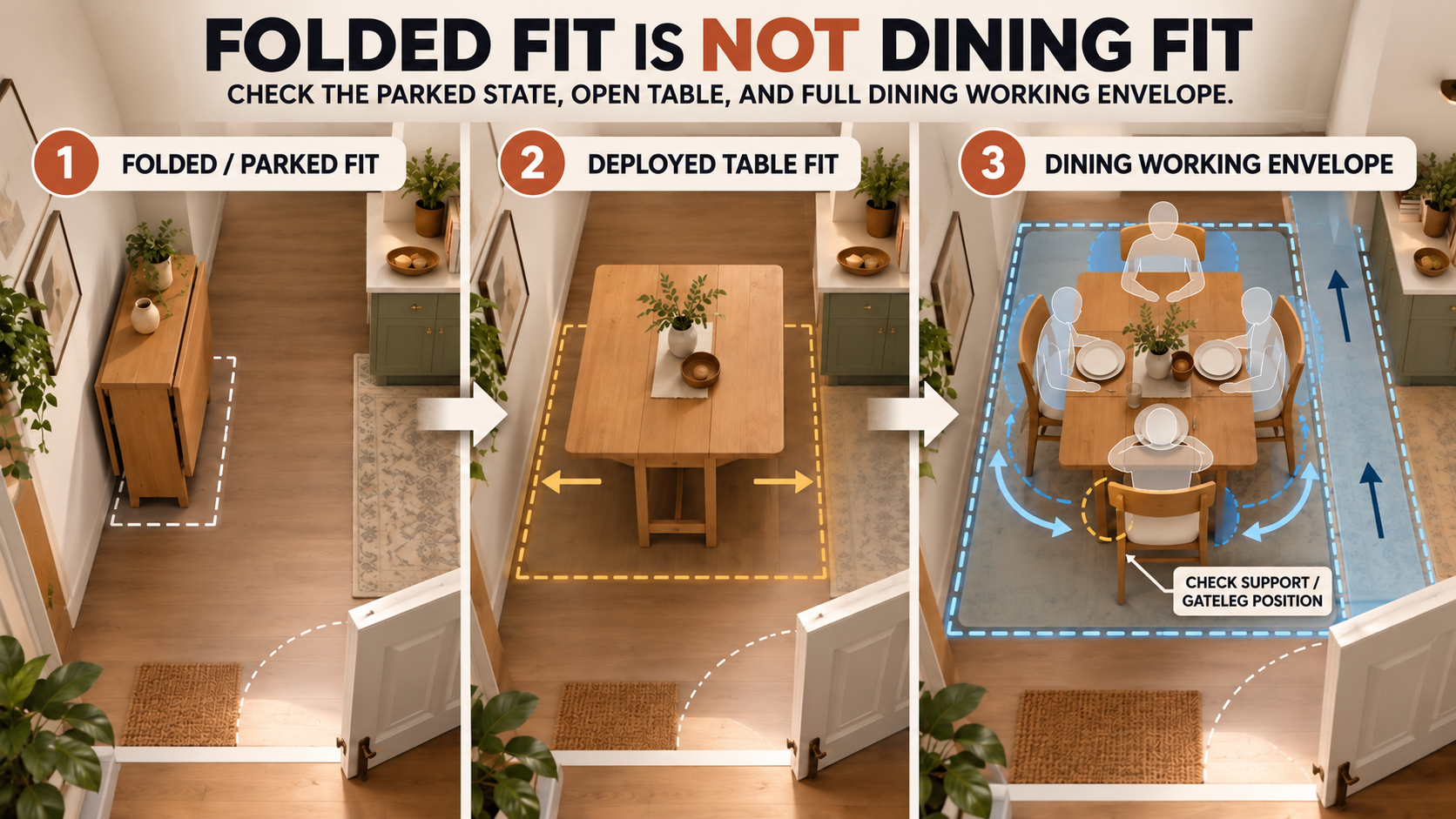
The first decision: separate three different footprints
Before comparing models, separate the dining setup into three states.
1. Folded or parked footprint
This is the amount of floor area the table body occupies when it is stored in its smallest published state, or in the folded state the manufacturer explicitly identifies.
This state matters if the table will spend most of the day against a wall, beside a cabinet, near a kitchen boundary, or in another compact parking zone.
But a small parked footprint does not prove that the table works as a dining table.
2. Deployed table footprint
This is the actual table body when opened for use.
For some models, the manufacturer publishes minimum, length, and maximum values rather than mapping every value to a specific leaf position. Those numbers should be kept exactly in that form unless the manufacturer explicitly identifies the state.
This matters because an apartment may easily accommodate the folded table while the fully deployed top reaches into a doorway, cabinet path, circulation lane, or nearby furniture.
3. Dining working envelope
The dining working envelope is larger than the tabletop.
It can include:
- chair depth
- chair pull-back
- seated body space
- leaf swing
- gateleg or support-leg position
- the route used to approach and leave the table
- passage space around the setup
The dimensions required for those items depend on the actual chairs, users, room, floor, and table position. They are not universal values.
A table therefore has to pass more than a simple “does it fit here?” test. It needs to fit in the parked state, fit in the deployed state, and work as a dining setup when people and chairs are added.
Model-specific comparison
| Model | Published dimensions and features | What is published | What the buyer still has to verify |
|---|---|---|---|
| IKEA NORDEN gateleg table | Min length 10 1/4 in; length 35 in; max length 59 7/8 in; width 31 1/2 in; height 29 1/8 in; seats 2 to 4; 2 drop leaves; 6 drawers; assembly required | Manufacturer-listed min / length / max values, seating guidance, drawers, two leaves | Exact room fit, chair pull-back, seated legroom, support-leg interference, passage requirement, floor condition, table load |
| Winsome Wood Taylor drop leaf table | 41.8 W x 30.6 D x 29.2 H in; tabletop folds in half; full-width drawer; floor protectors; solid wood; seats up to 4 when extended; assembly required | Published overall size and listed features | Exact folded dimensions, partial-state dimensions, room fit, chair pull-back, seated legroom, passage requirement, load limit |
| IKEA RESARÖ mobile drop-leaf table with storage | Min length 16 1/8 in; length 24 3/4 in; max length 48 3/8 in; width 25 1/4 in; height 35 7/8 in; seats 2; casters; side handles; storage shelves; drop leaves; max load per shelf 33 lb | Manufacturer-listed min / length / max values, height, seating guidance, casters, handles, shelves, shelf load | Chair-height compatibility, tabletop load, caster performance, room fit, chair pull-back, seated legroom, passage requirement, floor condition |
| Linon Torino black square drop leaf table | Fully open length 48 in; both leaves folded length 30 in; width 30 in; height 30 in; solid rubberwood with metal supports; seats up to 4; published load capacity 100 lb; assembly required | Fully open and both-leaves-folded lengths, width, height, materials, seating guidance, load capacity | Single-leaf dimension, room fit, chair pull-back, seated legroom, support position, passage requirement, floor condition |
IKEA NORDEN: compact minimum state, large maximum state, and a gateleg system
The IKEA NORDEN is useful to analyze because its manufacturer-listed dimensions span a wide range.
Published dimensions:
- minimum length: 10 1/4 inches
- length: 35 inches
- maximum length: 59 7/8 inches
- width: 31 1/2 inches
- height: 29 1/8 inches
IKEA also lists seating for 2 to 4, two drop leaves, six drawers, and required assembly.
The important control is the middle length value. The manufacturer lists 35 inches as “length,” but the locked research does not establish that 35 inches is an exact one-leaf or partial-state dimension. It should therefore remain a manufacturer-listed length value rather than being relabeled as a specific deployment state.
For a buyer, the NORDEN decision is less about asking whether the minimum footprint is small enough and more about testing the whole range of use.
A useful room check is:
- mark the minimum parked zone
- mark the maximum published table length
- place the intended chairs in their real positions
- test whether the leaf and gateleg system can move without hitting walls or nearby furniture
- check whether the support-leg position conflicts with chair placement
- test the circulation path around the dining setup
The six drawers add storage utility, but they do not reduce the need to test the deployed dining envelope.
The table load is not established in the locked research and should not be assumed.
Winsome Wood Taylor: a dining-to-console format with an unknown exact folded footprint
The Winsome Wood Taylor takes a different approach.
Published size:
- 41.8 inches wide
- 30.6 inches deep
- 29.2 inches high
Manufacturer-listed features include:
- tabletop folds in half
- full-width drawer
- floor protectors
- solid wood construction
- seats up to 4 when extended
- assembly required
The exact folded dimensions are not established in the locked research. Partial or intermediate dimensions are also unknown.
That makes this model a good example of why a buyer should not infer a storage footprint from a product photo or from the phrase “folds in half.”
The useful check is to treat the published 41.8 x 30.6 x 29.2-inch size as the verified product dimension set and then verify the folded state separately before purchase if that state is critical to the room plan.
The buyer should also test:
- where the folded table will park
- whether the open table reaches into a door or cabinet path
- where chairs sit relative to the table frame
- whether the chair can pull back in the actual room
- whether the dining setup leaves the required circulation path
The load limit is unknown in the locked research and should remain unknown.
IKEA RESARÖ: mobile storage utility with a higher published table height
The IKEA RESARÖ combines drop leaves, storage shelves, casters, and side handles.
Published dimensions:
- minimum length: 16 1/8 inches
- length: 24 3/4 inches
- maximum length: 48 3/8 inches
- width: 25 1/4 inches
- height: 35 7/8 inches
Manufacturer guidance lists dining for two.
Other published features include:
- casters
- side handles
- storage shelves
- drop leaves
- maximum load per shelf: 33 lb
The 33 lb figure applies to a shelf. It is not a tabletop load rating.
The tabletop load limit is unknown.
The 24 3/4-inch value also needs the same dimension discipline as the NORDEN: it is a manufacturer-listed “length” value, not an exact one-leaf or partial-state dimension unless the manufacturer explicitly maps it to that state.
The published height is 35 7/8 inches. That makes chair-height compatibility a specific verification point. Manufacturer dining-for-two guidance can be reported, but it does not prove that a buyer’s existing dining chairs will work with the table.
A buyer considering RESARÖ should verify:
- the intended chair height against the actual table
- seated legroom with the chosen chairs
- whether support structures or storage elements interfere with knees or chair placement
- the route used when moving the unit
- floor condition along that route
- threshold or surface changes
- the parked location for the table
- the maximum deployed table footprint
Caster performance is not established in the locked research. Floor levelness and actual room conditions are also unknown until the buyer checks the space.
Linon Torino: explicit folded and fully open lengths
The Linon Torino gives a clearer two-state dimension set than the other models in this comparison.
Published dimensions:
- both leaves folded length: 30 inches
- fully open length: 48 inches
- width: 30 inches
- height: 30 inches
Manufacturer-listed details also include:
- solid rubberwood
- metal supports
- seats up to 4
- published load capacity: 100 lb
- assembly required
The single-leaf dimension is unknown.
That means a buyer can work with verified fully folded and fully open lengths, but should not invent the footprint of a one-leaf setup.
The practical room test is to mark both the 30-inch folded length and the 48-inch fully open length, then add the actual chair positions and movement path.
The table may pass the 30-inch parked test and still fail when:
- both leaves are opened
- chairs are placed around it
- a chair is pulled back
- a support element lands where a chair or seated user needs space
- the dining setup narrows the main circulation path
Those are buyer-specific checks, not manufacturer claims.
A practical pre-buy measurement sequence
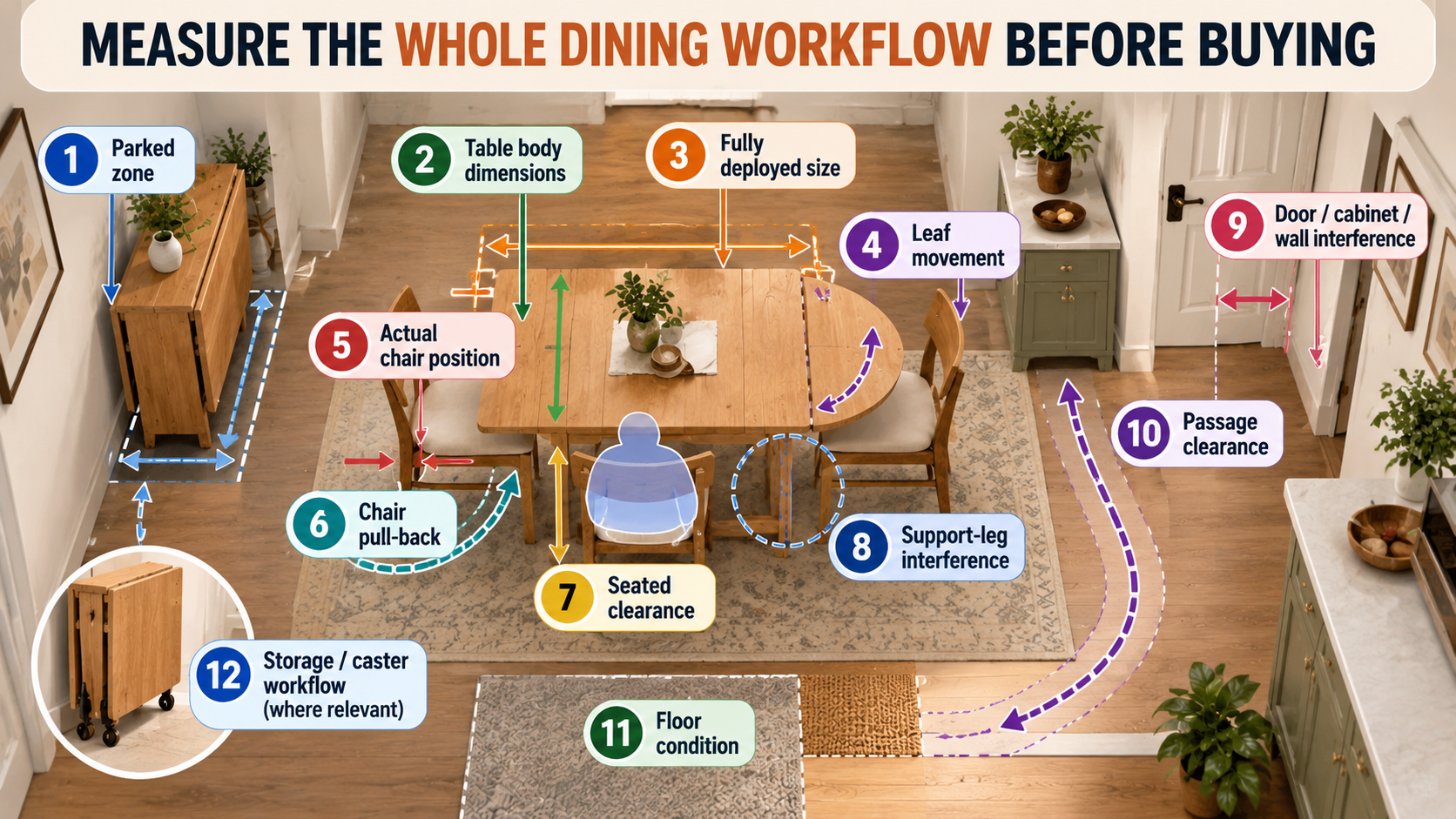
The most reliable way to compare drop-leaf tables is to measure the room in the order the setup will actually be used.
Step 1: mark the parked zone
Start with the location where the table will live when folded or stored.
Measure the available floor area and note nearby walls, cabinets, doors, shelving, baseboards, and other furniture.
Do not assume that a published minimum length automatically proves parked fit. The room still has to match the product’s width, height, orientation, and local obstructions.
Step 2: record the verified table body dimensions
Use the manufacturer-published dimensions exactly as stated.
If the manufacturer provides minimum, length, and maximum values without mapping the middle number to a specific leaf state, keep those labels intact.
Do not create an intermediate dimension from inference.
Step 3: mark the fully deployed table size
Use tape, cardboard, furniture placement, or another room-planning method to mark the full deployed tabletop footprint.
This is where a table that looks compact online can become too large for the actual dining zone.
Step 4: test leaf movement
A leaf needs room to move between folded and deployed states.
Check nearby:
- walls
- cabinets
- doors
- shelving
- counters
- adjacent furniture
The required movement space depends on the table design and room layout.
Step 5: place the actual chairs
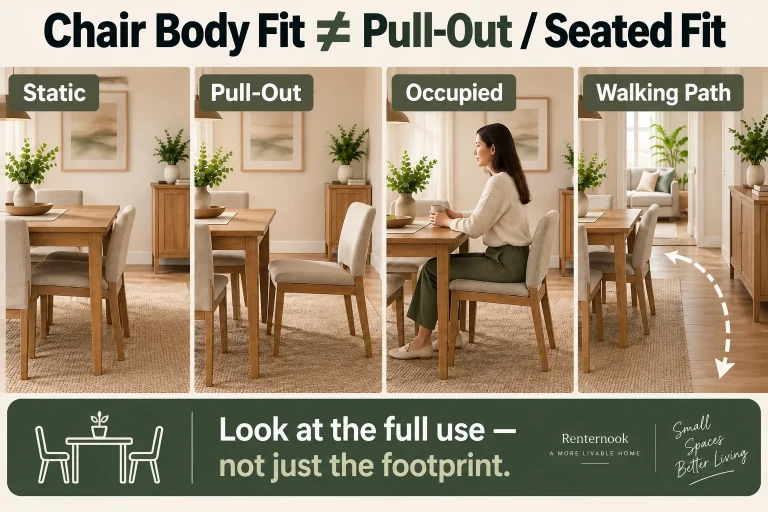
Do not evaluate the table alone.
Use the real chairs you plan to pair with it, or use their verified dimensions.
Chair fit is not proven by the table’s seating-count guidance.
Step 6: test chair pull-back
Pull each chair out as it would be used.
The required distance is buyer-specific. It depends on chair depth, user movement, room geometry, and the path behind the chair.
Do not substitute a universal clearance rule for an actual room test.
Step 7: test seated clearance
Sit at the table or model the actual seating position.
Check:
- knee space
- legroom
- support-leg location
- storage-body interference
- table height relative to the intended chair
This is particularly important for a gateleg structure, a storage-integrated table, or any model with supports that move as leaves deploy.
Step 8: inspect support-leg interference
A tabletop can fit while a gateleg or support lands in the wrong place for a chair.
The exact conflict depends on:
- product support geometry
- chair width
- chair position
- user position
If the manufacturer does not publish the necessary support geometry, that part of the fit remains buyer-specific or unknown until physically verified.
Step 9: check doors, cabinets, and walls
Open the nearby doors and cabinets.
A dining setup should be tested in the same room state in which it will actually be used.
A deployed leaf or pulled-back chair may block access even when the tabletop itself clears the obstruction.
Step 10: test passage clearance
Walk through the remaining circulation path with the table deployed and chairs in use.
Passage requirements are buyer-specific. The appropriate path depends on the apartment layout and the way people move through the room.
Step 11: check floor condition
The floor can affect how a table sits, how supports contact the floor, and how a mobile product moves.
Floor levelness is unknown until the buyer checks the actual space.
Step 12: test storage and caster workflow where relevant
This matters most for storage-integrated or mobile models.
For a mobile table such as RESARÖ, verify the real route between the parked position and the use position.
Check:
- doorway width
- turns
- threshold changes
- floor surfaces
- nearby furniture
- handle access
- storage load and placement
The presence of casters does not by itself prove easy movement in every apartment.
How the four models differ as room-fit problems
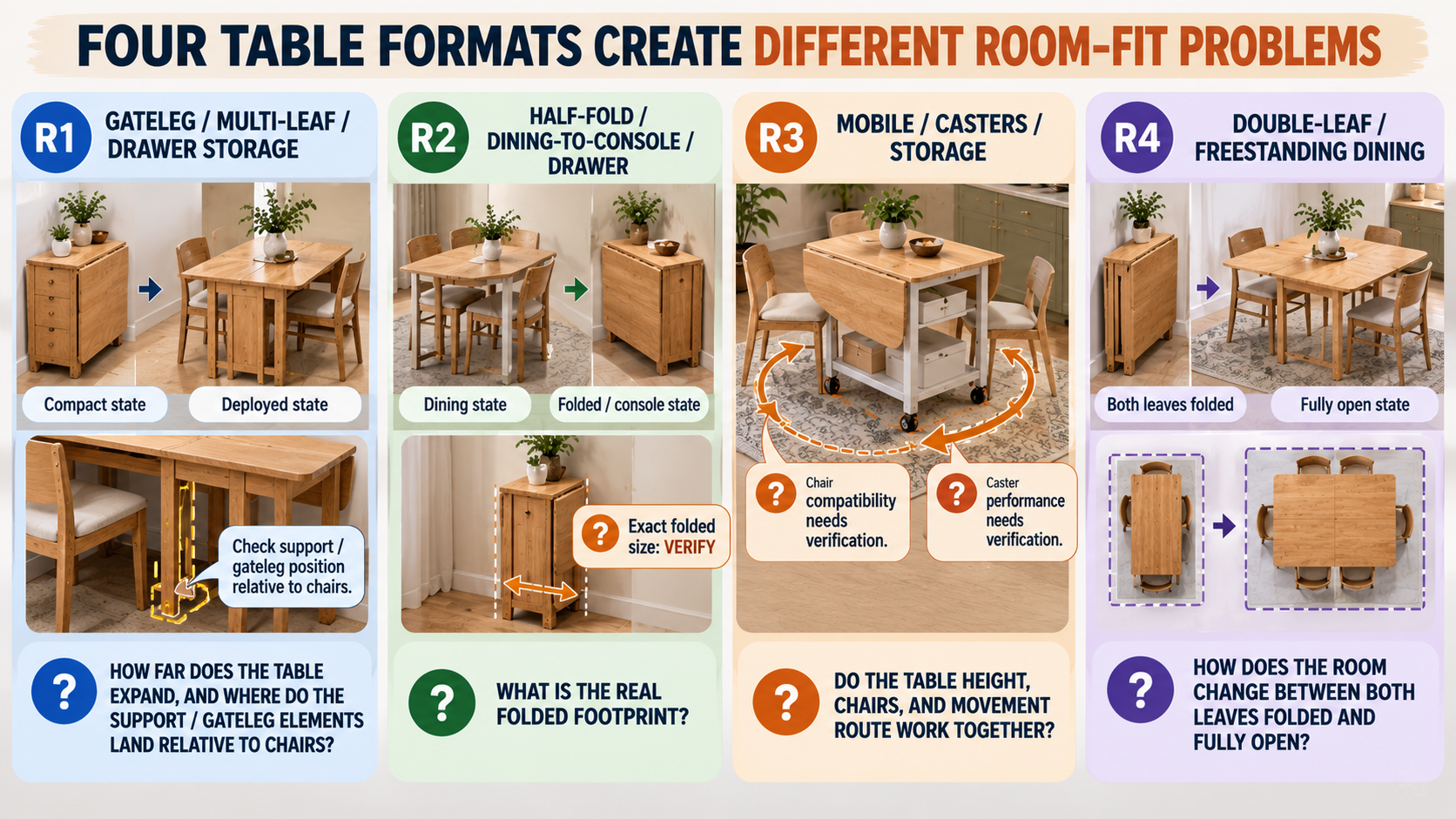
These products should not be reduced to a single “small-space table” category.
They solve different planning problems.
NORDEN
The NORDEN combines a very compact manufacturer-listed minimum length with a much larger maximum length, two leaves, gateleg structure, and six drawers.
The critical room-fit questions are expansion range, gateleg placement, chair interaction, and the full dining envelope.
Taylor
The Taylor uses a tabletop that folds in half and adds a full-width drawer.
Because the exact folded dimensions are unknown in the locked research, the buyer should verify that state rather than assume its footprint.
RESARÖ
The RESARÖ combines a mobile format, storage shelves, side handles, casters, and drop leaves.
Its 35 7/8-inch published height makes chair compatibility a specific verification task rather than an assumption.
Its 33 lb published load figure applies to each shelf, not the tabletop.
Torino
The Torino provides explicit both-leaves-folded and fully open lengths, which makes two-state floor planning more direct.
The single-leaf state remains unknown.
Its published 100 lb load capacity is the one verified load-capacity figure in this locked product set.
What the comparison table cannot decide for you
Manufacturer dimensions can tell you the physical size of the table in published states.
They do not tell you whether your room works.
The following remain buyer-specific or unknown unless directly verified:
- chair pull-back
- seated legroom
- support-leg interference
- passage requirement
- room fit
- floor levelness
- caster performance
- chair compatibility where not explicitly established
- partial-state dimensions where the manufacturer does not publish them
- load limits that are not published
Unknown does not mean zero.
Unknown does not mean pass.
Unknown does not mean fail.
It means the decision still requires verification.
A simple way to shortlist a drop-leaf table
A useful shortlist can be built around the way the table will actually be used.
Ask these questions in order:
- Where will the table park when folded?
- What is the verified folded or minimum product footprint?
- What is the verified fully deployed footprint?
- Can the leaves move freely in the intended location?
- Where do the actual chairs sit?
- Can those chairs pull back?
- Is seated legroom acceptable for the intended users?
- Do gatelegs, supports, drawers, shelves, or other structures interfere with seating?
- Do nearby doors and cabinets still work?
- Is there enough circulation for the apartment’s real traffic pattern?
- Does the floor condition work for the product?
- If the table moves, does the full caster and storage workflow work in the actual route?
Only after those checks should the buyer compare secondary features such as drawers, shelves, mobility, or material preferences.
Final takeaway
The key advantage of a drop-leaf table is that its footprint can change.
That same feature is also why it requires more careful room planning than a fixed table.
A product can fit perfectly in its parked state and still fail as a dining setup once the leaves are open, chairs are added, people are seated, and the room still needs to function around them.
For a small apartment, the better decision is therefore not “Which table folds the smallest?”
It is:
- Which table fits the parked zone?
- Which table fits when fully deployed?
- Which table works with the actual chairs?
- Which table leaves usable room for seated bodies, support structures, doors, cabinets, and circulation?
- Which table matches the storage or mobility workflow you actually need?
Measure those states separately before buying. That is the difference between a table that merely stores compactly and a table that actually works in the room.