Small Bookcases for Small Spaces: 5 Fit-First Options to Check Before You Buy
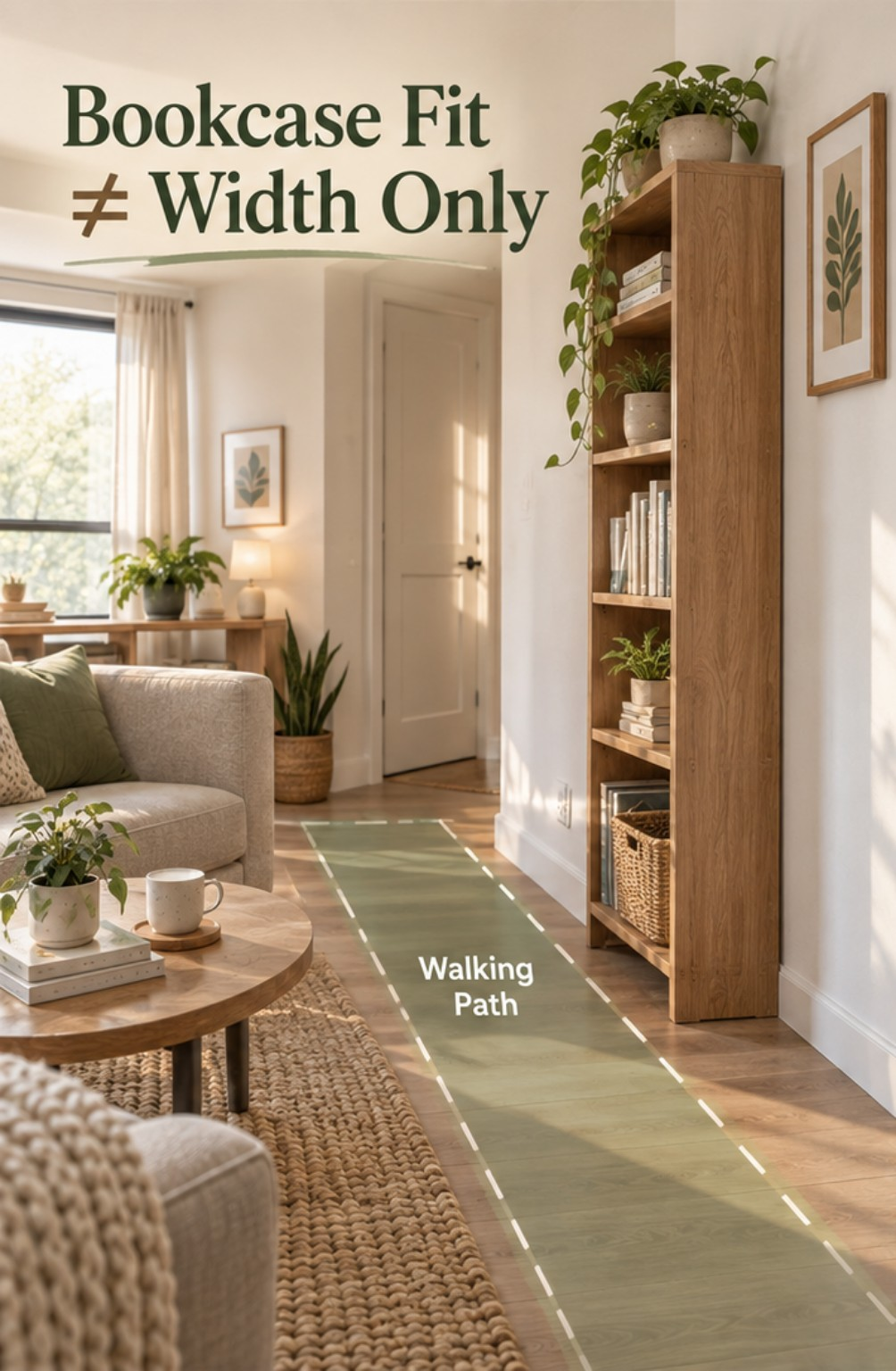
A bookcase can be narrow and still be the wrong fit for a small room.
That is because bookcase fit is not only about width.
A unit also projects into the room. Its shelves may be shallower than the overall frame. A tall design can create installation and anchoring questions. A cube tower may use very little wall width but still be relatively deep. And even a compact bookcase can become a problem if it narrows the walking path between a bed, sofa, desk, or doorway.
For a small apartment, studio, bedroom, or rental, the better sequence is:
wall / floor width → overall bookcase depth → book or object depth → height and trim interference → shelf height / adjustability → shelf load → anchoring / installation → working state → walking clearance
The five bookcases below fill different roles. They are not ranked from best to worst.
The useful question is:
Which role fits your wall, your objects, and the way the room actually needs to work?
Start with the object, not the furniture label
“Small bookcase” is a useful search term, but it is not a dimension.
Before comparing products, measure what you plan to store.
For books or binders, check the front-to-back depth of your largest items. For baskets, boxes, speakers, decor, or record sleeves, measure the real object instead of relying on a category name.
Then measure the room:
- available wall width;
- maximum depth you can give up without hurting the walking path;
- usable height below windows, switches, wall art, shelves, sloped ceilings, or trim;
- baseboards that may keep the furniture from sitting where you expect;
- any outlet, vent, thermostat, or door swing that shares the same wall zone.
This matters because overall furniture depth and usable shelf depth are not automatically the same measurement.
If a product page gives only the outside depth, do not assume every inch of that depth is usable shelf space.
Quick comparison: 5 small-space bookcase roles
| Product | Role | Overall size | Shelf detail surfaced | Surfaced shelf load | Main installation / fit guard |
|---|---|---|---|---|---|
| IKEA BILLY 105.220.37 | Ultra-narrow low / shallow | 15 3/4″W × 11″D × 41 3/4″H | 2 adjustable shelves; usable shelf depth not separately surfaced | 31 lb per shelf | IKEA requires secure anchoring |
| Threshold Carson Narrow 5-Shelf | Tall narrow | 18″W × 13.6″D × 72″H | Shelf width 16.3″; shelf depth 12.2″; 11.3″ between shelves | 65 lb per shelf | Tall profile; verify wall zone and current installation instructions |
| Nathan James Theo 65501 | Wall-attached ladder | 24″W × 12″D × 73″H | 5 fixed open shelves | UNKNOWN / not surfaced in exact evidence used here | Designed to mount along a wall; wall suitability matters |
| IKEA KALLAX 406.316.38 | Slim-width cube-storage tower | 16 3/8″W × 15 3/8″D × 57 5/8″H | Open cube format; usable cubby dimensions not separately locked here | 29 lb per shelf only for the surfaced vertical-floor-standing + correctly anchored condition | Narrow width does not mean shallow depth; IKEA requires secure anchoring |
| Sauder Beginnings 3-Shelf | Compact low 3-shelf | 24.57″W × 11.5″D × 35″H | 3 shelves; 2 adjustable | UNKNOWN / not surfaced on exact TCIN used here | Can be secured to wall but is not a wall-mounted bookcase |
Important: a published shelf-load value does not tell you whether your actual books, storage bins, or equipment will fit the shelf dimensions. Load and physical fit are separate checks.
1. IKEA BILLY 105.220.37 — the ultra-narrow low / shallow role
This BILLY is the narrowest overall product in the five-product set.
Its published measurements are:
- Width: 15 3/4 inches
- Overall depth: 11 inches
- Height: 41 3/4 inches
- Maximum load per shelf: 31 lb
IKEA also states that two adjustable shelves are included.
That combination creates a useful role for a small room: limited wall width, relatively low height, and a comparatively shallow overall cabinet.
But there are two fit guards.
First, the 11-inch figure is overall product depth. The exact usable shelf depth is not separately surfaced in the evidence used for this guide. If you have deep books, baskets, or equipment, measure the actual shelf before treating the overall depth as usable storage depth.
Second, IKEA gives a tipping-hazard warning and says the product must be securely anchored.
For renters, that means the anchoring requirement belongs in the buying decision. Do not treat “small” as a reason to ignore the manufacturer’s installation instructions.
Check before buying
Choose this role if your main constraint is wall width and you prefer a lower, relatively shallow bookcase.
Verify:
- the 15 3/4-inch width against the real wall opening;
- the 11-inch overall depth against your walking path;
- your largest book or object depth against the real shelf depth;
- the 31 lb per-shelf limit against what you plan to store;
- whether the required anchoring can be completed correctly in your home.
2. Threshold Carson Narrow 5-Shelf — the tall narrow role
The Carson uses height to create storage while keeping the overall width to 18 inches.
Target lists:
- Overall width: 18 inches
- Overall depth: 13.6 inches
- Overall height: 72 inches
- Shelf width: 16.3 inches
- Shelf depth: 12.2 inches
- Distance between shelves: 11.3 inches
- Maximum shelf weight: 65 lb
- Number of shelves: 5
Target describes the shelves as a mix of adjustable and non-adjustable.
This is an important contrast with the BILLY.
The Carson needs only a little more wall width, but it rises to six feet and projects 13.6 inches overall into the room. That makes it a vertical-storage decision, not simply a narrow-width decision.
Check before buying
Measure the whole 72-inch height against:
- ceiling shape;
- wall art or shelves;
- switches;
- vents;
- trim;
- sloped walls;
- any other feature that could interfere with the upper part of the bookcase.
Then compare the 12.2-inch shelf depth with the depth of your actual books or storage pieces.
The product page gives usable shelf depth here, so this is a case where you can compare the object directly with a surfaced shelf dimension instead of relying on overall cabinet depth.
Also review the current assembly / securement instructions before installation. A tall, narrow piece should not be treated as universally renter-safe simply because the footprint is compact.
3. Nathan James Theo 65501 — the wall-attached ladder role
The Theo solves a different layout problem.
Home Depot lists Model 65501 at:
- Width: 24 inches
- Depth: 12 inches
- Height: 73 inches
- Shelves: 5 fixed open shelves
The product page describes it as a ladder bookcase and says it can be mounted along a wall with screws.
That makes this a wall-attached storage role, not a conventional freestanding case.
The benefit for a small room is the open, vertical format. The constraint is installation.
The exact shelf-load limit for Model 65501 is not surfaced in the exact-product evidence used for this guide, so this article does not invent one or borrow a figure from another Theo configuration.
Check before buying
Before choosing a ladder bookcase, verify:
- whether your wall can accept the intended mounting method;
- whether your lease allows the required wall attachment;
- whether the 73-inch height clears everything on the wall;
- whether the 12-inch overall depth preserves the walking path;
- whether your books or objects physically fit the shelves;
- the current exact-product load limits from the manufacturer or current instructions before placing heavy items.
Do not treat “wall mounted” as a universal renter recommendation.
It is an installation fact that still needs to work with the actual wall and lease.
4. IKEA KALLAX 406.316.38 — the slim-width cube-storage tower
The vertical KALLAX in this set is narrow in width, but it is not the shallowest product.
IKEA lists:
- Width: 16 3/8 inches
- Depth: 15 3/8 inches
- Height: 57 5/8 inches
- Maximum load per shelf: 29 lb
The depth is the important part.
At 15 3/8 inches, the KALLAX projects farther into the room than the BILLY, Theo, or Sauder options in this set.
So the right description is slim-width cube-storage tower, not shallow bookcase.
IKEA also gives a specific condition for the published 29 lb shelf-load figure: it applies when the product is used vertically, standing on the floor, and anchored correctly to the wall.
That condition must stay attached to the load claim.
IKEA also warns that the product must be securely anchored.
Check before buying
This role makes sense when you want a narrow strip of wall width and prefer cube-style storage.
Measure:
- the 16 3/8-inch wall width;
- the 15 3/8-inch room projection;
- the remaining walkway;
- the dimensions of any boxes or inserts you plan to use;
- your intended orientation;
- the current anchoring requirements.
Do not carry the 29 lb shelf-load figure into another configuration unless the manufacturer supports that configuration.
5. Sauder Beginnings 3-Shelf — the compact low role
The Sauder Beginnings option is wider than the BILLY but remains low and relatively shallow overall.
The exact Target listing used here gives:
- Width: 24.57 inches
- Overall depth: 11.5 inches
- Height: 35 inches
- Number of shelves: 3
- Adjustable shelves: 2
A Sauder brand-expert response on the same listing says this bookcase can be secured to the wall but cannot be wall-mounted.
That distinction matters.
“Can be secured to the wall” and “wall-mounted furniture” are different installation roles.
The exact current listing used for this guide does not surface a maximum shelf-load figure, so the table keeps that field UNKNOWN.
Check before buying
Choose this role if you want a low case that can sit below a window, under wall decor, or in a space where a six-foot bookcase would be too tall.
Verify:
- the 24.57-inch wall width;
- the 11.5-inch overall depth;
- the height of the objects you want to store;
- the usable shelf depth;
- the current exact-product load guidance before placing heavy books;
- wall securement instructions if you plan to use them.
A lower bookcase can solve a height constraint, but it does not remove the need to check the walking path or installation guidance.
Overall depth vs usable shelf depth: do not merge the two
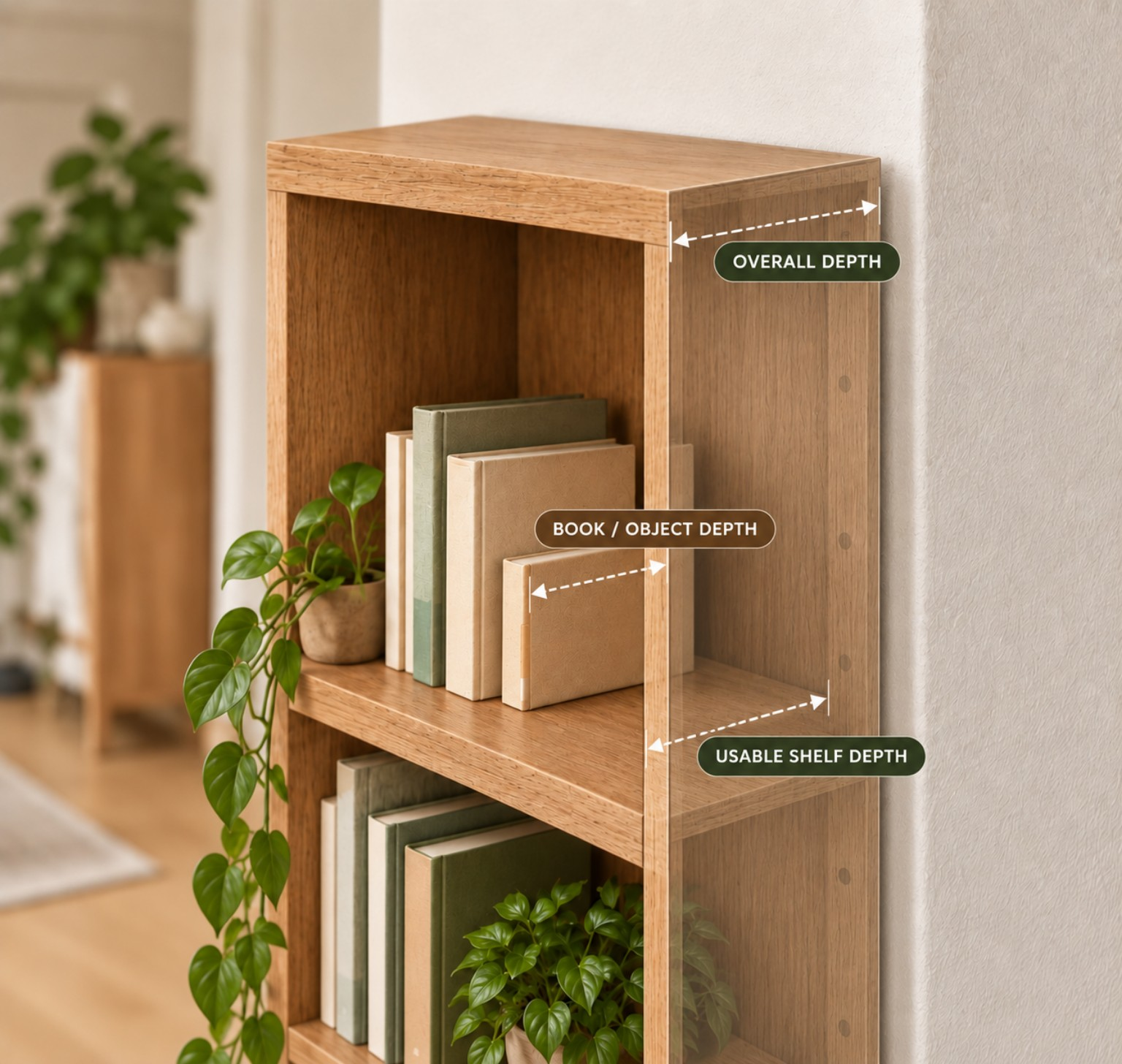
This is one of the easiest measurements to get wrong.
A product can be 13.6 inches deep overall while the shelf itself is 12.2 inches deep. The Carson listing shows exactly why those fields should stay separate.
The difference can come from:
- frame geometry;
- trim;
- a back panel;
- legs;
- a projecting top;
- shelf setback.
So when object depth matters, compare the object with usable shelf depth, not automatically with the overall cabinet depth.
If usable shelf depth is not published, keep it unknown until you can verify it.
Height creates a second fit problem
Narrow furniture often solves a width problem by becoming taller.
That can be useful, but height introduces new constraints:
- switches;
- wall lights;
- thermostats;
- picture rails;
- shelves;
- sloped ceilings;
- vents;
- window trim;
- mounting points.
A bookcase that fits the floor rectangle can still fail the wall zone.
For tall or wall-attached options, mark both the footprint and the full vertical envelope before buying.
Shelf load and object fit are different checks
A 65 lb shelf does not mean every 65 lb group of books is a good fit.
You still need to check:
- whether the books physically fit the shelf depth;
- whether the shelf height works;
- whether the weight is distributed as the manufacturer intends;
- whether the product is installed in the configuration tied to that load rating.
For products where the exact current source does not surface a shelf-load value, this guide keeps the field unknown.
That is more useful than importing a number from a similar model.
Which role should you shortlist?
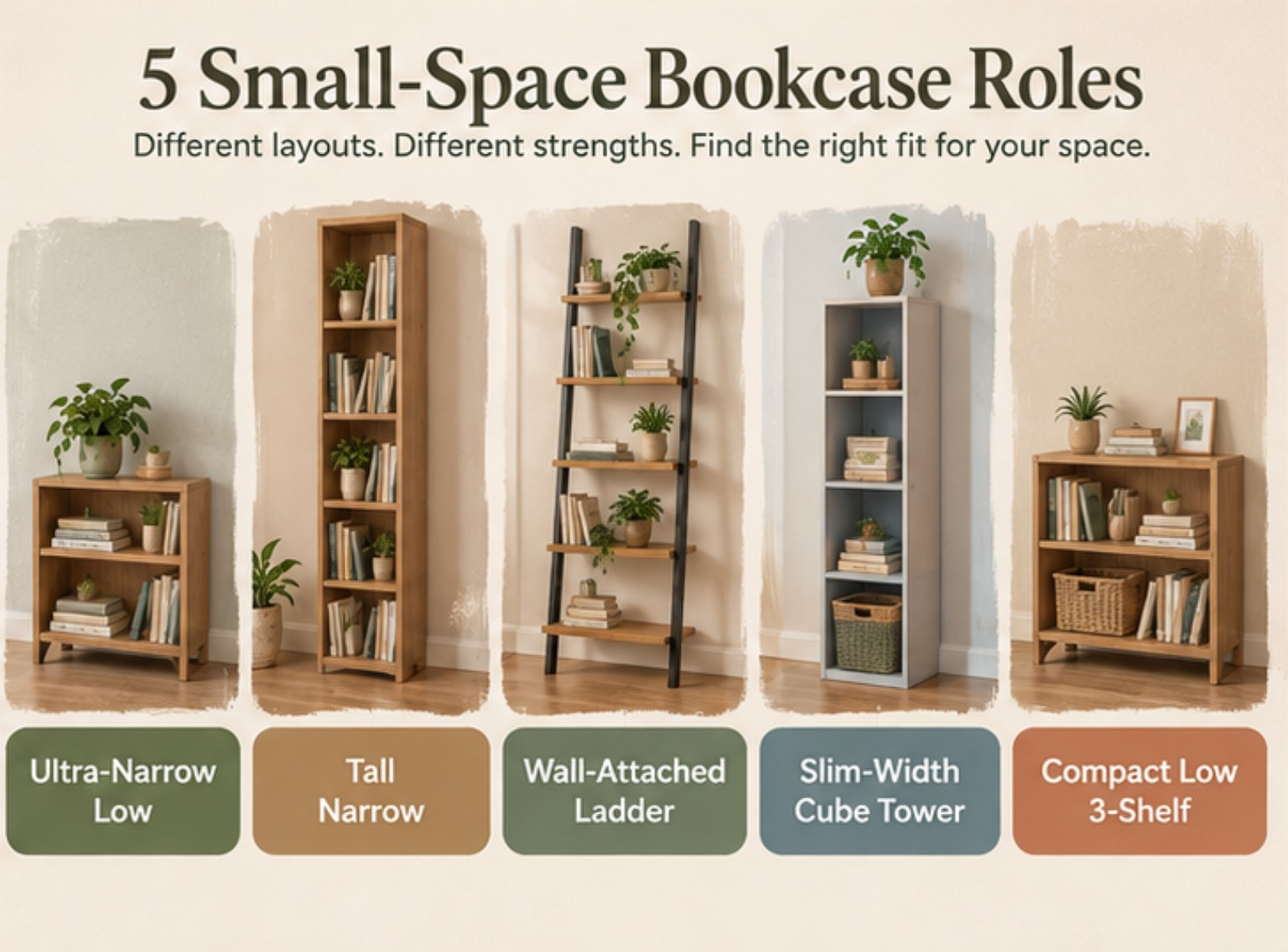
Use the five products as role examples rather than a universal ranking.
Choose the BILLY role if you have very little wall width and want a relatively shallow, lower bookcase.
Choose the Carson role if wall width is limited but you can use more vertical height and you value a separately published 12.2-inch shelf depth.
Choose the Theo role if a wall-attached ladder format works with your lease and your wall construction.
Choose the KALLAX role if narrow wall width and cube-style storage matter more than minimizing depth.
Choose the Sauder role if a low 3-shelf case fits the wall zone better than a tall bookcase.
The best option is the one that passes your measurements, installation constraints, and walking-path test.
Fit-first checklist before you buy
Before ordering a small bookcase, confirm:
- ☐ available wall width measured
- ☐ overall furniture depth marked on the floor
- ☐ largest book / binder / storage-bin depth measured
- ☐ usable shelf depth verified where available
- ☐ total height checked against the full wall zone
- ☐ shelf spacing checked for your tallest objects
- ☐ adjustable vs fixed shelves understood
- ☐ exact shelf-load limit checked where surfaced
- ☐ load-rating configuration preserved
- ☐ current anchoring / securement instructions reviewed
- ☐ lease / wall constraints checked
- ☐ baseboard / trim interference checked
- ☐ walking path remains usable
- ☐ delivery / assembly path reviewed if relevant
If one of those fields is still unknown, keep it unknown until you can verify it.
Methodology and source transparency
We did not physically test these five bookcases.
This guide compares currently surfaced manufacturer and retailer information for the exact product identities listed in the research set.
We used:
- exact overall dimensions where surfaced;
- usable shelf dimensions where separately surfaced;
- shelf-load values only when the exact product / configuration supported them;
- shelf count and adjustability where surfaced;
- anchoring or wall-attachment information only when supported by the exact product evidence.
Where a field was not surfaced — including some usable shelf dimensions, shelf-load values, or installation details — it remains UNKNOWN / NOT SURFACED.
We did not infer missing values from a neighboring model or a similar product family.
We also did not treat retailer language such as “narrow,” “small profile,” or “small spaces” as proof that a product will fit a particular room.
Product specifications and installation guidance can change, so verify the current product page and assembly instructions before purchase.
Product sources used
- IKEA U.S. — BILLY Bookcase 105.220.37
- Target U.S. — 72″ Carson Narrow Bookcase — Threshold
- Home Depot U.S. — Nathan James Theo 5-Shelf Ladder Bookcase, Model 65501
- IKEA U.S. — KALLAX Shelf Unit 406.316.38
- Target U.S. — Sauder Beginnings 3-Shelf Bookcase / TCIN 79474015
Final takeaway
For a small room, the right bookcase is not automatically the narrowest one.
The useful question is:
Does the bookcase fit the wall, do my objects fit the shelves, and does the room still work after it is installed?
Check width, depth, usable shelf space, height, load, anchoring, and the walking path as separate variables.
That is the difference between furniture that fits on a product page and storage that actually fits your space.