Small Dining Table Buying Guide: Measure the Full Dining Footprint Before You Buy
A small dining table can fit on the floor and still be too large for the way the room actually works.
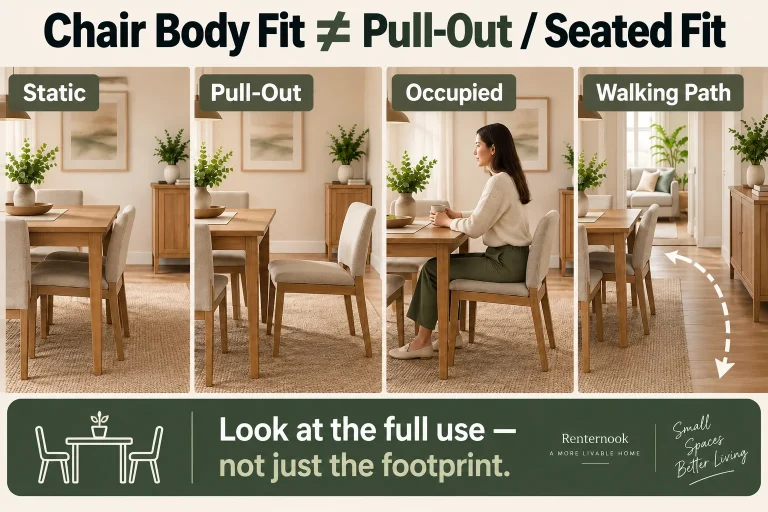
The tabletop is only one part of the footprint. Once you add chairs, people, nearby doors or cabinets, and the path someone needs to walk through the room, the usable dining area becomes larger.
Before choosing a table, check it in three states:
- the table by itself,
- the table while people are actually using it,
- the surrounding room while someone needs to walk past.
Table fit is not the same as dining-setup fit.
Step 1: Measure the Table-Only Footprint
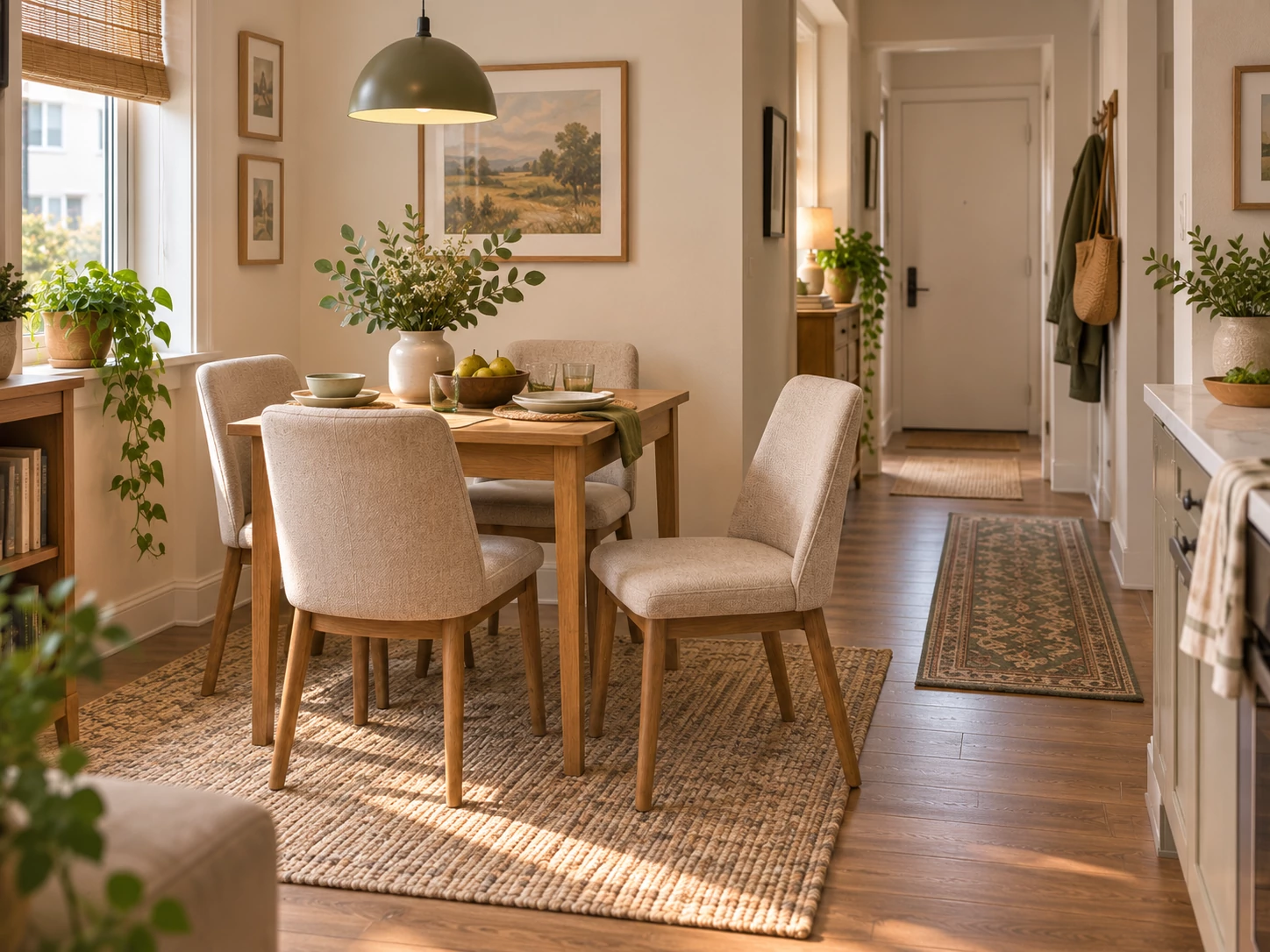
Start with the space the table physically occupies.
Measure the actual dining zone and compare it with the table’s verified width, length, depth, or diameter. Do not rely only on the overall size of the room.
Also check what surrounds the dining zone:
- walls,
- doors,
- kitchen cabinets,
- drawers,
- fixed furniture,
- and any route that needs to stay accessible.
A table may technically fit between two points while still interfering with something nearby.
Step 2: Add the Chairs Before You Decide It Fits
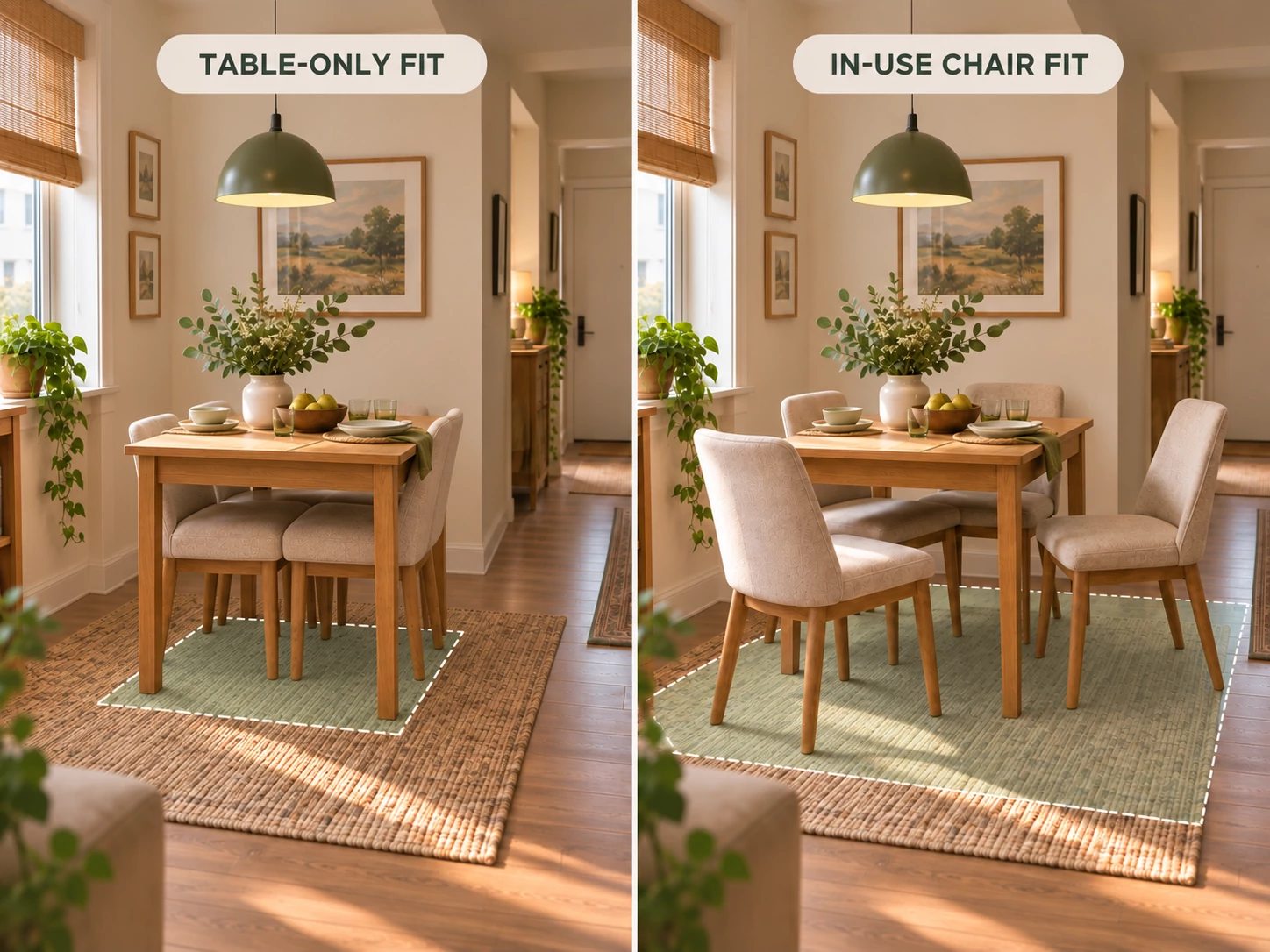
The table footprint is only the first layer.
Once chairs are added, the space required during a meal becomes larger. Check where each chair sits when tucked in and where it moves when someone gets in or out.
Also look underneath the tabletop.
A four-leg table and a pedestal table do not create identical seating geometry. Rather than assuming one base type is automatically better, check whether the actual legs or base work with the chair positions you need.
Tabletop width is not the same as verified usable chair space.
Step 3: Check the Walking Path While the Table Is in Use
Now test the room in its real in-use state.
Imagine someone is already seated. Can another person still move through the route the room actually needs?
This matters especially when the dining area sits:
- between the kitchen and living room,
- near an entry,
- beside cabinetry,
- close to a balcony or patio door,
- or inside a multipurpose room.
Instead of relying on one universal clearance number, check the actual chair and circulation conditions in your layout.
The goal is not simply to make the table fit.
The goal is to make the dining setup usable while it is occupied.
Folding and Expandable Tables Need More Than One Measurement
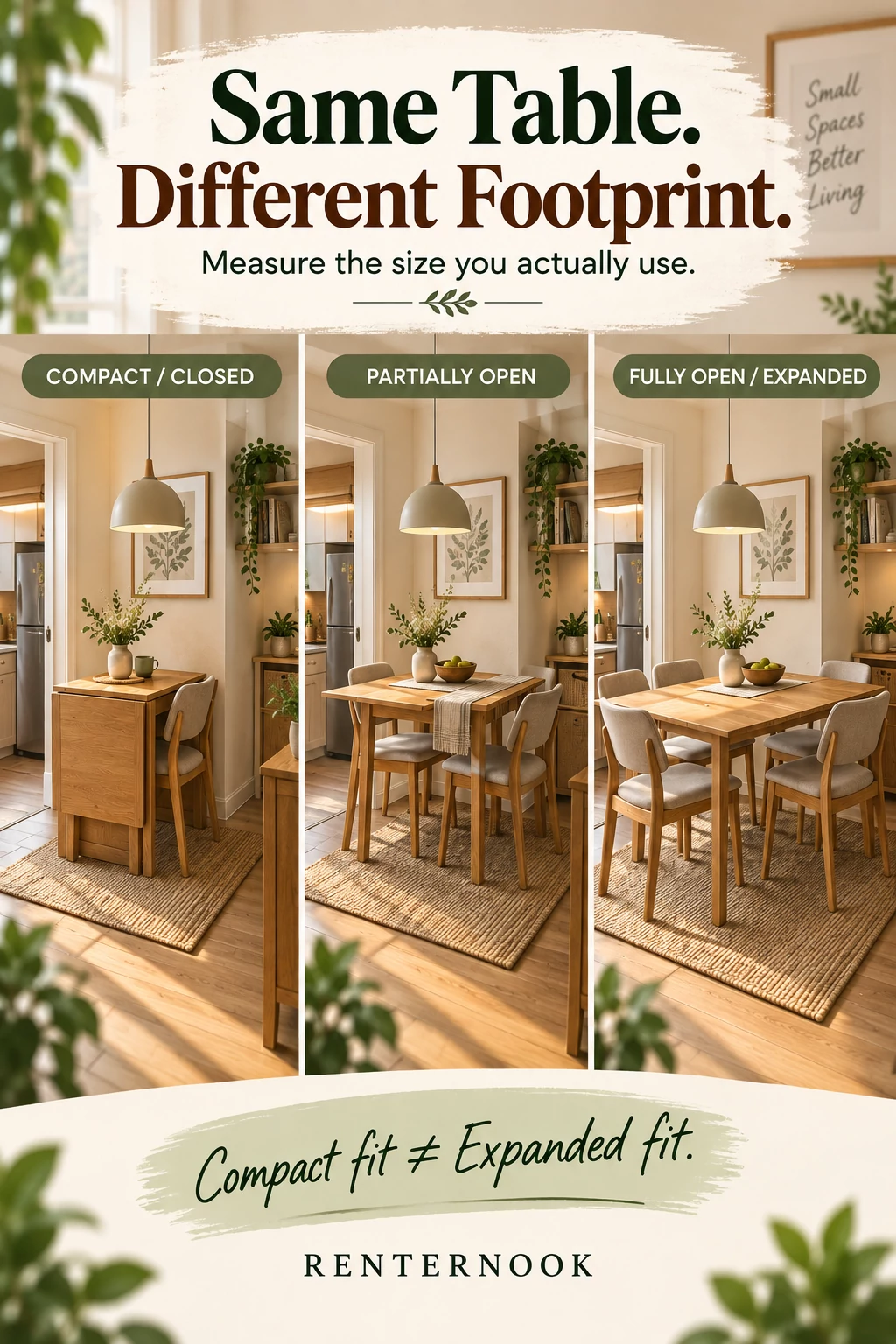
A folding or expandable dining table can change its footprint substantially.
Do not record only one size.
Depending on the design, check:
Compact / Closed State
How much floor space does it occupy in its smallest configuration?
Partially Open State
If the table supports an intermediate configuration, measure that state separately.
Fully Open / Expanded State
How large does it become when you open the leaves or extensions you expect to use?
A table that fits easily in its compact state may require a very different room layout when fully opened.
5 Dining Table Fit Roles for Small Spaces
1. Winsome Wood Groveland Square Dining Table — Item #34130
Verified dimensions:
29.6" W × 29.6" D × 29.2" H
Fit role:
Fixed compact footprint
This is the simplest fit role in the set because its tabletop size does not change between configurations.
That makes it useful when you want a footprint that is straightforward to measure before buying.
Check before buying:
Do not stop at the 29.6-inch tabletop footprint. Check where your chairs sit and whether their in-use position leaves the walking route your room needs.
2. East West Furniture ANT-LWH-TP
Verified footprint:
36" round
Base:
Central pedestal
Fit role:
Round tabletop + pedestal geometry
This product represents a different fit question: the relationship between the tabletop and the table base.
A central pedestal creates a different chair-positioning problem from four corner legs, but that does not automatically mean it will fit every chair arrangement better.
Check before buying:
Verify your chair positions against the actual pedestal footprint.
3. East West Furniture MZT-BCH-T Monza Drop-Leaf Table
Leaf-down / compact state:
36" L × 36" W
Fully open state:
54" L × 36" W
Mechanism:
Two 9-inch drop leaves
Fit role:
Two-state drop-leaf footprint
The important point here is not simply that the table is small. Its footprint changes when the leaves are opened.
Check before buying:
Measure both the 36-inch compact state and the 54-inch fully open state against your chairs, nearby furniture, and walking path.
4. HOMCOM Folding Dining Table — 83A-150V80BK
Fully folded:
33.9" W × 31.1" D × 31.1" H
Partially folded:
38.6" W × 31.1" D × 31.1" H
Fully expanded:
47.2" W × 31.1" D × 31.1" H
Fit role:
Three-state / partial-fold fit
This product is a useful example of why one table may need more than two measurements.
Its footprint changes across three manufacturer-listed states.
Check before buying:
Measure the specific state you plan to use most often, plus the fully expanded configuration if you expect to use it.
5. Mobili Fiver First Extendable Table — Pearled Elm
SKU:
TAVFITOLM
Closed:
47.2" × 31.5"
One extension:
63" × 31.5"
Fully extended:
78.7" × 31.5"
Fit role:
Normal dining footprint → guest expansion
This table represents a different small-space tradeoff. Its normal state remains a conventional dining-table footprint, while additional extensions create substantially more length when needed.
Check before buying:
Do not measure only the 47.2-inch closed state. If you expect to use one or both extensions, test those larger configurations against your room before buying.
Quick Comparison
| Product | Type | Compact / Closed State | Largest Verified State | Fit Role | Check Before Buying |
|---|---|---|---|---|---|
| Winsome Groveland #34130 | Fixed square | 29.6 × 29.6" | Same | Fixed footprint | Chair + circulation footprint |
| East West Furniture ANT-LWH-TP | Round pedestal | 36" round | Same | Base geometry | Chair position vs pedestal |
| East West Furniture MZT-BCH-T | Drop-leaf | 36 × 36" | 54 × 36" | Two-state fit | Measure both states |
| HOMCOM 83A-150V80BK | Folding | 33.9 × 31.1" | 47.2 × 31.1" | Three-state fit | Compact / partial / full state |
| Mobili Fiver First TAVFITOLM | Extendable | 47.2 × 31.5" | 78.7 × 31.5" | Guest expansion | Maximum-use footprint |
Before You Buy a Small Dining Table
- Measure the actual dining zone.
- Verify the current product dimensions.
- Add your chairs to the footprint.
- Check where the table legs or base sit.
- Test the room while the chairs are in use.
- Check nearby doors, cabinets, and drawers.
- Measure folding tables in every configuration you expect to use.
- Measure extendable tables at the largest configuration you realistically expect to use.
- Treat manufacturer-listed seating capacity separately from whether that seating arrangement actually works in your room.
The best small dining table is not automatically the one with the smallest tabletop.
A better choice starts with the way the dining area actually works: where the table sits, where the chairs move, and where people still need to walk.
Measure those conditions first, then choose the table geometry that fits them.