Wall-Mounted Folding Desks for Small Spaces: Check the Wall Before You Buy
A wall mounted folding desk can look like a simple way to add a workspace without keeping a full desk on the floor all day.
But there are two separate questions to answer before you buy one.
First, can that specific desk be mounted under the conditions required by its manufacturer?
Then, once it is installed, does the desk work through the states you will actually use: folded, opening, fully open, and folded back again?
That order matters.
A thin cabinet on a product page does not tell you whether your wall matches the mounting requirements. An open desktop dimension does not tell you how the desk deploys. And a published load number is only useful when you know exactly what part of the product that number describes.
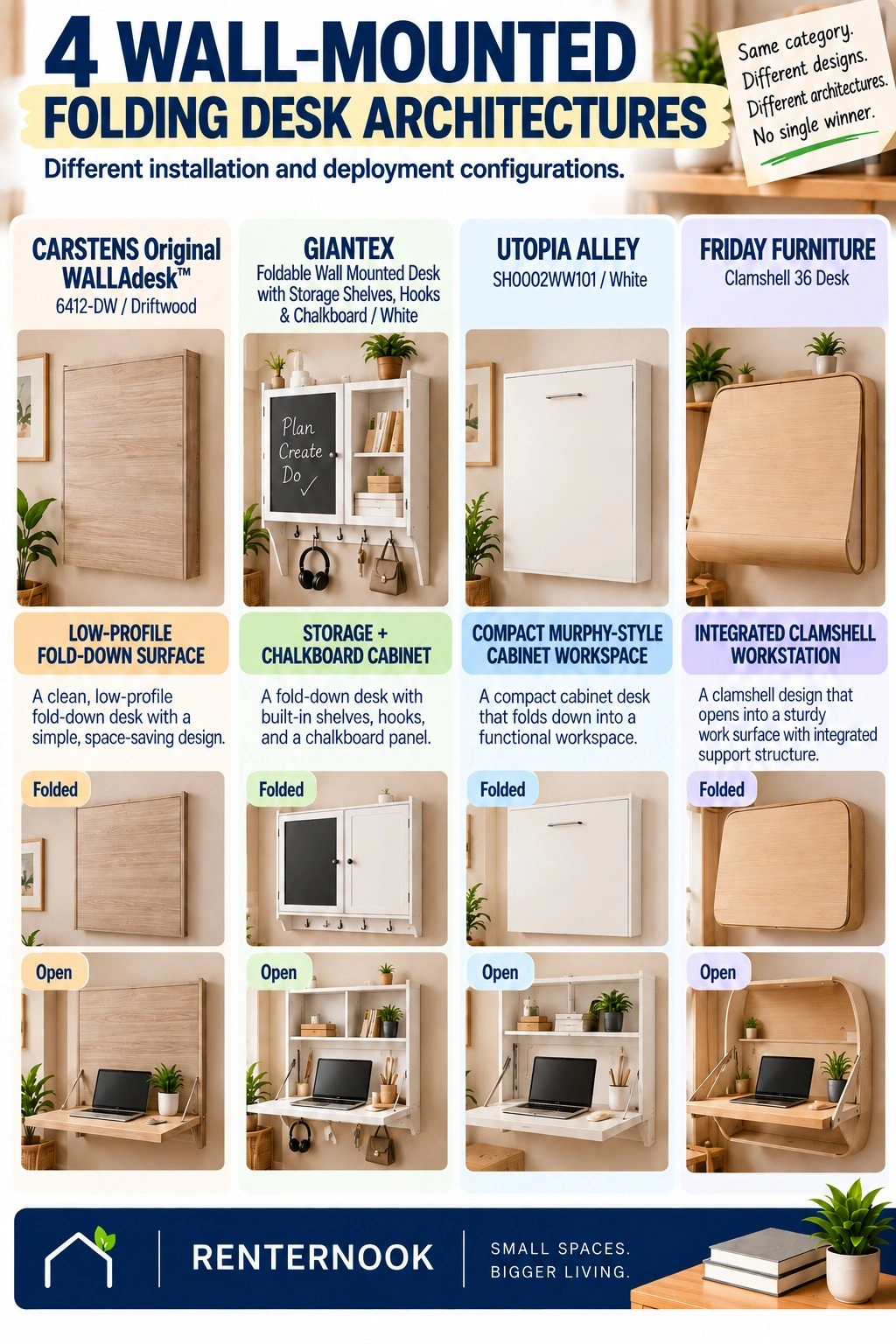
This guide compares four different wall-mounted folding-desk architectures:
Carstens Original WALLAdesk™ 6412-DW
Giantex Foldable Wall Mounted Desk with Storage Shelves, Hooks & Chalkboard
Utopia Alley SH0002WW101 Fold Down Desk Table Wall Cabinet with Chalkboard
Friday Furniture Clamshell 36 Desk
They are not ranked.
Instead, they show why the useful buying question is not simply, “Which desk is smallest?”
The better sequence is:
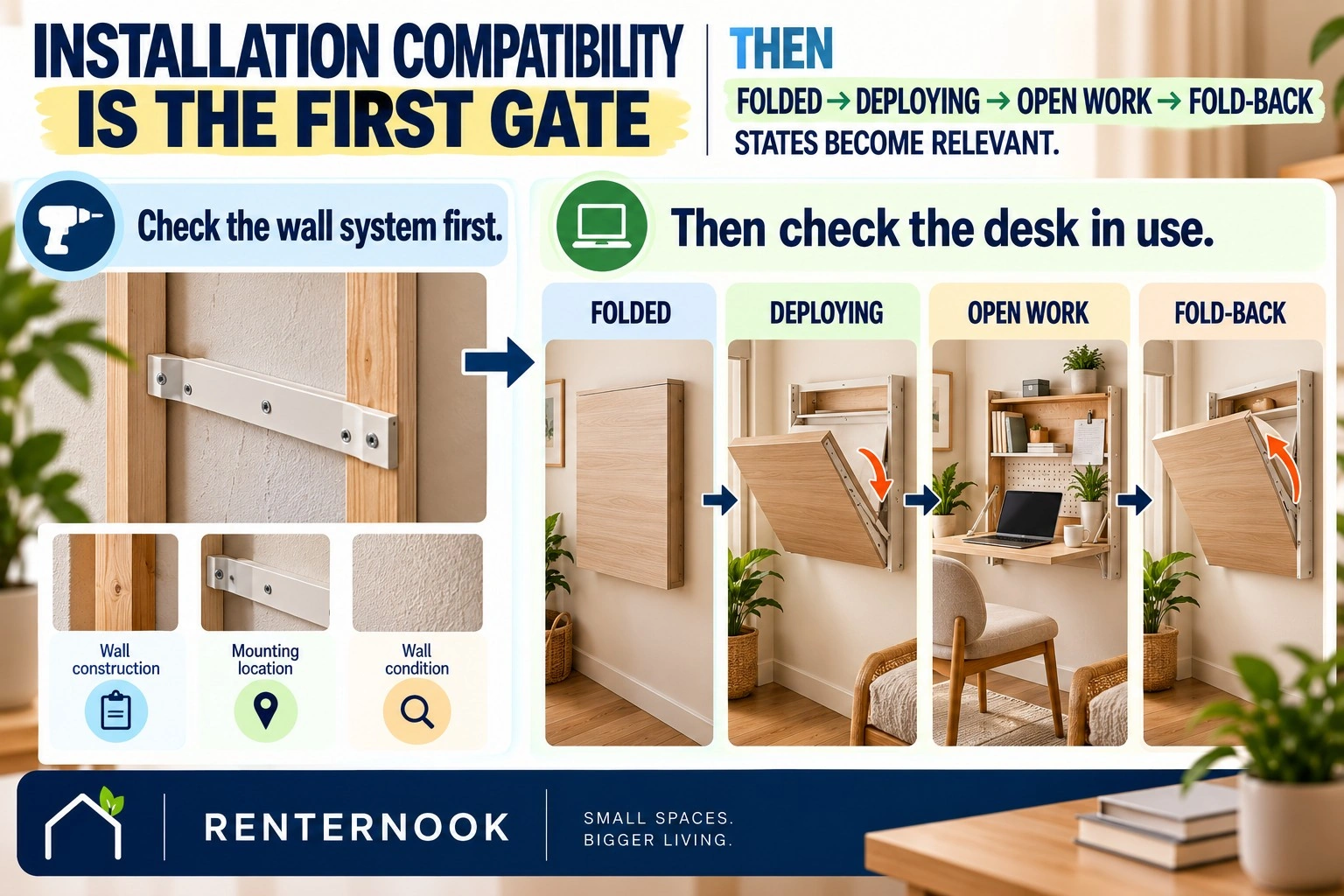
Check the wall and installation system first. Then check how the desk works through each physical state.
The Two-Part Buying Decision
A wall-mounted folding desk is different from a freestanding small desk because the wall is part of the system.
That creates two decision gates.
Part 1: Can the product be installed under your actual conditions?
Depending on the product, the documentation may specify or discuss:
- wall construction
- anchors or fasteners
- brackets
- included or excluded mounting hardware
- installation templates
- mounting instructions
- other product-specific installation conditions
There is no single installation rule that can safely be transferred across every wall-mounted desk.
For example, Carstens says mounting hardware is not included with the Original WALLAdesk because wall construction varies. Giantex publishes a solid-wall installation context for its chalkboard model and identifies anchors for brick or concrete. Friday Furniture uses its own aluminum mounting-bracket system and publishes installation documentation for the Clamshell 36.
Those are different installation conditions, not interchangeable versions of one rule.
If you are still deciding whether a wall-mounted model is the right desk type for your space, start with Renternook’s general guide to desks for small spaces before moving into the installation-specific checks below.
Part 2: What happens after installation?
Once the installation question is resolved, the desk still needs to work through its physical states.
You need to understand:
- what remains on the wall when the desk is folded;
- what moves when it is deployed;
- what work surface and support system exist when it is open; and
- what has to happen before it can be folded back.
This is why a wall-mounted folding desk should not be judged from its closed cabinet or open desktop alone.
Quick Comparison: Four Different Wall-Mounted Folding Desk Systems
| Product | Product role | Folded state | Open state | Work surface | Installation condition | Published load information | Important unknowns |
|---|---|---|---|---|---|---|---|
| Carstens Original WALLAdesk™ 6412-DW, Driftwood | Low-profile steel fold-down surface | 24.19″W × 16.44″H × 2.78″D | 24.19″W × 16.44″H × 15.90″D | 23.5″W × 14.29″D | Wall-mounted; full-size mounting template included; mounting hardware not included because wall construction varies | 40 lb product-specific capacity | No material unknown required for this decision method |
| Giantex Foldable Wall Mounted Desk with Storage Shelves, Hooks & Chalkboard, White | Storage/chalkboard fold-down cabinet | Published closed cabinet: 24″ × 6″ × 30″ | Published overall open size: 34.5″ × 22″ × 60″ | Published tabletop: 28″ × 22″; published tabletop height 29″ | Solid-wall context; brick/concrete anchors identified in the qualified product evidence | 110 lb tabletop; 45 lb cabinet | Public model/SKU not published |
| Utopia Alley SH0002WW101, White | Compact Murphy-style wall cabinet workspace | 19.7″ × 7″ × 31.5″ | 19.7″ × 37″ × 60″ | Clean desktop W × D not established from the source used | Wall-mounted; exact first-party fastener and wall-type requirements not established from the source used | Not published in the qualified first-party evidence | Product weight, load capacity, fastener detail, wall-type limit, clean desktop W × D |
| Friday Furniture Clamshell 36 | Integrated clamshell workstation | 36″ wide; approximately 7″ closed depth in the qualified product evidence | See current first-party technical drawing for exact technical dimensions | Integrated work surface | Aluminum mounting bracket; current first-party documentation includes mounting hardware and installation guidance | 100 lb desktop surface; 300 lb aluminum wall-bracket rating | Exact technical dimension values should be checked against the current first-party drawing |
The table is deliberately not a scorecard.
The four products use different installation and deployment architectures, so the useful comparison is whether the published conditions match your wall and intended use.
Why Installation Comes First
It is tempting to start with the desktop.
That is how most people think about a normal desk: measure the space, check the desktop, and decide whether the furniture fits.
A wall-mounted desk adds another dependency.
The desk has to become part of the wall system before its folded depth or desktop size matters in practice.
Carstens: a thin folded body does not eliminate the mounting question
The Driftwood Original WALLAdesk, SKU 6412-DW, has a published folded depth of 2.78 inches and opens to 15.90 inches deep.
That makes the difference between stored and open states easy to see.
Carstens recommends getting approval of the mounting hardware and installation method from a construction professional because wall construction varies.
The lesson is straightforward:
A compact folded profile does not make the installation condition disappear.
Giantex: the wall condition and load labels both matter
The locked Giantex model combines a fold-down work surface with storage cubes, hooks, and a chalkboard front.
Its qualified product evidence identifies a solid-wall installation context and references anchors for brick or concrete.
It also publishes two different capacity numbers:
- 110 lb for the tabletop
- 45 lb for the cabinet
Those numbers should stay attached to their objects.
“110 lb capacity” without saying that the figure describes the tabletop would remove an important part of the specification.
Utopia Alley: dimensions can be known while installation details remain unknown
The Utopia Alley SH0002WW101 has useful folded and open envelope dimensions in its first-party product evidence.
Its folded dimensions are listed as 19.7 × 7 × 31.5 inches, while the fully open dimensions are listed as 19.7 × 37 × 60 inches.
But the qualified first-party evidence used for this guide does not establish several other decision-relevant fields, including exact fastener requirements, a wall-type limitation, product weight, or load capacity.
Those gaps should remain gaps.
Good dimension evidence does not give us permission to invent missing installation evidence.
Friday Furniture: separate the desk from the support-system rating
Friday Furniture’s Clamshell 36 uses an integrated wall-mounted workstation architecture with an aluminum mounting bracket.
Its first-party documentation separates two numbers that are easy to confuse:
- 100 lb for the desktop surface
- 300 lb for the aluminum wall bracket
They do not describe the same object.
The bracket rating should not be rewritten as a 300 lb desktop capacity.
This distinction is exactly why installation and support information need to remain product-specific.
Folded, Deploying, and Open Are Different States
Once the installation condition is understood, the next mistake is treating the desk as if it has only one useful size.
A folding desk changes state.
Folded state
The folded state tells you what stays on the wall while the desk is stored.
That may be a very shallow body, as with the WALLAdesk, or a deeper cabinet containing shelves or storage.
Folded dimensions are useful, but they describe only the stored state.
Deployment state
Deployment is the transition between stored and working positions.
Depending on the product, that can involve:
- a worktop folding down;
- a cabinet front moving;
- hinges changing position;
- a support structure engaging;
- a clamshell opening; or
- another product-specific mechanism.
Do not estimate an opening arc or movement envelope from photographs if the manufacturer does not publish it.
If a dimension is not established, treat it as something to verify rather than a number to invent.
Open work state
When fully open, the product becomes a workstation.
Now the relevant questions change.
What is the published work-surface size?
How is that surface supported?
What load number applies to the desktop?
Does another published capacity apply to a cabinet, shelf, or bracket instead?
The open state is where object labels on specifications become especially important.
Fold-back state
The final state is easy to overlook.
A folding desk is useful partly because it can return to its stored position.
Before buying, think through what your normal setup would require before closing it.
Do not assume a laptop, monitor, accessories, or other equipment can remain in place when the desk is folded unless the product documentation actually supports that use.
The Wall-to-Work 6-Step Check
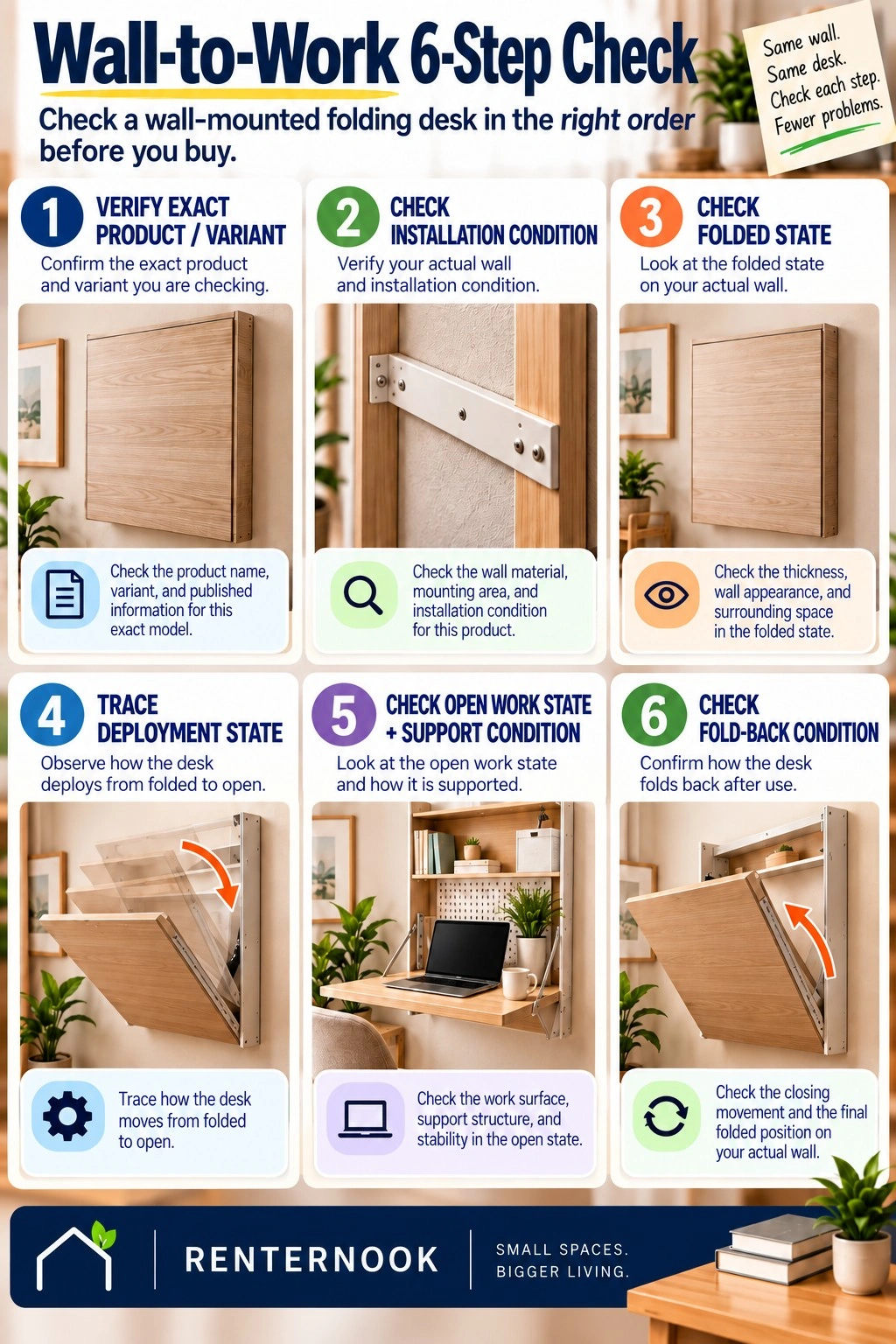
Use this sequence before buying a wall mounted folding desk.
Step 1 — Verify the exact product and variant
Start with identity.
Record the exact:
- product name;
- variant;
- model or SKU when published; and
- current first-party source.
This matters because two desks that look similar can have different dimensions, mounting systems, load ratings, or installation instructions.
Do not transfer a specification from a similar model.
For example, the locked Giantex product in this guide does not have a public model/SKU established in the qualified source. That field stays unknown rather than being replaced with a retailer identifier from another listing.
Step 2 — Check the installation condition
Next, check the product-specific installation evidence.
Look for:
- wall type;
- stud requirements where stated;
- anchors;
- fasteners;
- brackets;
- mounting hardware;
- whether hardware is included;
- mounting-height instructions where relevant; and
- an installation manual or guide.
This is the first real compatibility gate.
Do not start with a generic assumption such as “wall-mounted desks use drywall anchors” or “you need studs.”
The correct installation condition is the one supported for the exact product and your actual wall.
Step 3 — Check the folded state
Now record what the desk becomes when stored.
Check published:
- width;
- height;
- depth;
- cabinet or storage body; and
- fixed projection from the wall.
This tells you how much physical body remains when the desk is not being used.
But do not stop here.
A folded depth is not a complete description of a folding workstation.
Step 4 — Trace the deployment state
Identify what physically changes when the desk opens.
Depending on the product, inspect the documented:
- hinge action;
- fold-down action;
- worktop movement;
- cabinet-front movement;
- support movement; and
- bracket, lift, or clamshell architecture.
If the manufacturer does not publish a complete movement envelope, do not create one from the product photography.
The purpose of this step is not to calculate an imaginary universal clearance.
It is to identify what moves and what still needs verification.
Step 5 — Check the open work state and support condition
Once open, check the desk as a working system.
Use published evidence for:
- open dimensions;
- work-surface dimensions;
- support architecture;
- desktop load;
- cabinet or shelf loads; and
- bracket ratings.
Keep each load number attached to the object it describes.
For the Giantex product in this guide, the tabletop and cabinet have separate published capacities.
For the Friday Clamshell 36, the desktop surface rating and aluminum bracket rating are also separate.
A larger number is not automatically the usable desktop capacity.
Step 6 — Check the fold-back condition
Finally, work backward.
What needs to happen before the desk can return to its stored state?
Consider:
- equipment that may need to be removed;
- objects stored inside the cabinet;
- support release;
- closure or latch operation where documented; and
- the return to the published folded envelope.
Only claim that equipment can remain in place when the manufacturer establishes that capability.
If the documentation does not answer the question, verify it before treating it as part of your normal setup.
Four Product Decision Examples
These products are included to show four different ways a wall-mounted folding desk can be built and documented.
They are not a ranking.
Carstens Original WALLAdesk™ 6412-DW
The Driftwood Original WALLAdesk demonstrates a low-profile fold-down architecture.
Published dimensions:
- folded: 24.19″W × 16.44″H × 2.78″D
- open: 24.19″W × 16.44″H × 15.90″D
- work surface: 23.5″W × 14.29″D
The published product-specific capacity is 40 lb.
Carstens recommends getting approval of the mounting hardware and installation method from a construction professional because wall construction varies.
That makes the product a useful example of why folded depth and installability are separate questions.
You can know exactly how shallow the desk is when closed and still need to resolve the correct mounting method for the actual wall.
Giantex Foldable Wall Mounted Desk with Storage Shelves, Hooks & Chalkboard
The white Giantex product represents a storage-integrated cabinet architecture.
Its published closed cabinet size is:
24″ × 6″ × 30″
The published overall open size is:
34.5″ × 22″ × 60″
The tabletop is published as:
28″ × 22″
with a published tabletop height of 29″
Unlike the low-profile WALLAdesk, this product combines the work surface with six storage cubes, three hooks, and a chalkboard-front cabinet architecture.
The qualified evidence places installation in a solid-wall context and identifies brick/concrete anchors.
It also publishes separate load figures:
- tabletop: 110 lb
- cabinet: 45 lb
Those should remain separate in any comparison.
The public model/SKU was not established in the qualified first-party source, so this guide does not invent one.
Utopia Alley SH0002WW101 Fold Down Desk Table Wall Cabinet with Chalkboard
The white Utopia Alley SH0002WW101 is another wall-cabinet workspace, but it is useful for a different reason: it demonstrates how known and unknown evidence can coexist.
The first-party product evidence publishes:
- folded: 19.7″ × 7″ × 31.5″
- fully open: 19.7″ × 37″ × 60″
That gives the buyer a meaningful stored/open envelope comparison.
But the qualified first-party evidence used here does not establish:
- product weight;
- load capacity;
- exact fastener details;
- a specific wall-type limitation; or
- a clean desktop width × depth measurement.
Those fields should not be reverse-engineered from photographs or borrowed from another Murphy-style desk.
For this product, the missing fields become part of the buying checklist: verify them if they matter to your installation.
Friday Furniture Clamshell 36 Desk
The Friday Furniture Clamshell 36 represents an integrated clamshell workstation rather than a simple fold-down panel.
The selected product is the 36-inch Clamshell.
The qualified first-party evidence establishes a 36-inch width and an approximately 7-inch closed depth. For exact technical dimensions, use the current first-party technical drawing rather than copying unverified values from an image.
Friday’s documentation also distinguishes between:
- 100 lb desktop-surface capacity; and
- 300 lb aluminum wall-bracket rating.
Those are different specifications.
The current first-party documentation used during qualification also provides an aluminum mounting-bracket architecture, included mounting hardware, and installation guidance.
That makes the Clamshell useful for showing why the support system itself deserves a separate check from the desktop.
What the Specs Do Not Tell You
A product page can contain a lot of numbers and still leave an important buying question unanswered.
That is normal.
The correct response is not to fill the gap yourself.
“Not published” is different from zero
If a manufacturer does not publish a load capacity, that does not mean the capacity is zero.
It means the value was not established from the source used.
A photograph is not a technical drawing
Product photography can help you understand the general architecture.
It should not be used to calculate:
- an opening arc;
- an exact deployment envelope;
- an unpublished work-surface dimension;
- fastener size;
- load capacity; or
- another missing technical specification.
Similar products are not interchangeable sources
Do not borrow a mounting instruction from a similar wall desk because the cabinets look alike.
The exact product or variant is the source boundary.
Unknown installation information deserves extra attention
An unknown field is not automatically a reason to reject a product.
It is a signal that the buyer needs more information before relying on that field.
For example, the Utopia Alley model has useful first-party folded and open dimensions, but several installation and load fields remain unestablished in the qualified first-party evidence.
That distinction should remain visible rather than being hidden by assumptions.
Common Mistakes When Buying a Wall-Mounted Folding Desk
Mistake 1: Choosing by folded depth alone
A shallow closed profile tells you how far the stored body projects.
It does not prove the desk can be installed on your wall or that its open state works for your intended setup.
Mistake 2: Assuming every wall-mounted desk uses the same hardware
The four products in this guide already show different documentation and mounting approaches.
Use the exact product’s instructions.
Mistake 3: Comparing load numbers without reading the label
A desktop load, cabinet load, shelf load, and wall-bracket rating can describe four different things.
Do not place them in one “capacity” column unless the object label remains attached.
Mistake 4: Jumping directly from closed to open dimensions
The product has to move between those states.
Check the deployment architecture and identify anything that moves or still needs verification.
Mistake 5: Assuming your equipment can stay on the desk when it closes
That may be possible with a particular system, but it is not a category-wide feature.
Use product-specific evidence.
Mistake 6: Treating missing information as compatibility
If the wall requirement or fastener specification is not established, “unknown” does not mean “works with my wall.”
It means you still have a question to resolve.
Final Wall-Mounted Folding Desk Buying Checklist
Before buying, use this order:
- Verify the exact product and variant. Make sure every dimension, load figure, and installation instruction belongs to the product you are actually considering.
- Check the installation condition. Compare your actual wall with the manufacturer’s published wall, fastener, bracket, hardware, and installation information.
- Record the folded state. Check the stored width, height, depth, and fixed cabinet body.
- Trace what moves during deployment. Identify the worktop, cabinet front, hinge, support, bracket, or clamshell movement without inventing unpublished clearances.
- Check the open work state and support condition. Compare the work surface and published loads, keeping desktop, cabinet, shelf, and bracket ratings separate.
- Check the fold-back condition. Determine what needs to move or be removed before the desk can return to its stored state.
The key is the order.
Do not start by asking which wall mounted folding desk has the smallest closed body.
Start by asking whether the exact product can be installed under the conditions you actually have.
Then follow the desk from the wall to the work state—and back again.
Sources and Methodology
Renternook did not physically install or load-test the four wall-mounted folding desks in this guide.
Product identity, dimensions, materials, published capacities, mounting information, and installation conditions were checked against product-specific sources during the Article #037 research and qualification process.
Where first-party evidence established a specification, the draft keeps that specification attached to the product and object it describes.
Where a decision-relevant field was not established from the qualified source, it remains not published or not established from the source used rather than being estimated from photographs, transferred from a similar model, or converted into zero.
Installation requirements vary by product and wall condition. This article therefore does not treat one product’s anchor, fastener, bracket, wall-type statement, or load rating as a category-wide rule.
Primary product-source set used for the draft:
- Carstens — Original WALLAdesk™, Driftwood, SKU/MPN 6412-DW
- Giantex — Foldable Wall Mounted Desk with Storage Shelves, Hooks & Chalkboard, White
- Utopia Alley — SH0002WW101 Fold Down Desk Table Wall Cabinet with Chalkboard, White
- Friday Furniture — Clamshell 36 Desk
Product availability, documentation, and specifications can change. Recheck the current product page and installation documentation before purchasing or installing.