
How to Read Furniture Dimensions Before Buying: Verify the Specs Before You Decide
Furniture listings can look precise and still leave you without enough evidence to make the next decision.
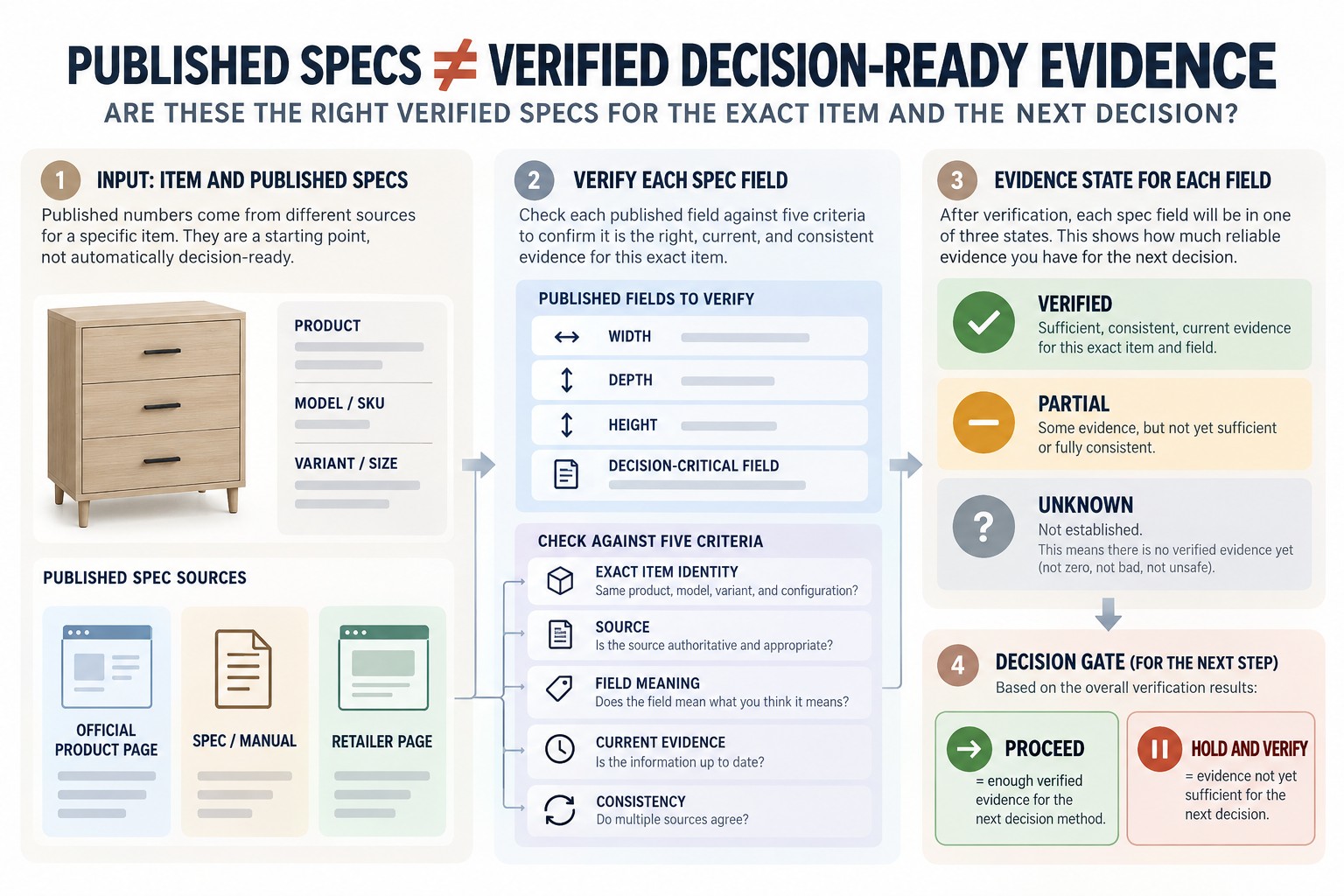
A product page may show width, depth and height. A retailer may repeat the same numbers. A second source may show a different depth. A manual may refer to another configuration. One page may list the assembled size while another is showing the packaged size.
All of those numbers can be “published specs.”
That does not automatically make them verified, decision-ready evidence.
The useful question is not simply:
“Did I find dimensions?”
It is:
“Do I have the right dimensions, for the exact item I am considering, from evidence strong enough to continue to the next fit or buying decision?”
That is the role of this guide.
This is an upstream evidence-quality gate. It comes before room-fit, delivery-fit, layout-fit or product-specific comparison methods.
The end of this method has only two outcomes:
- PROCEED — there is enough verified evidence to continue to the next decision method.
- HOLD AND VERIFY — a material field is missing, the product identity is uncertain, or a material conflict remains unresolved.
PROCEED does not mean buy.
It does not mean the furniture fits your room.
It does not mean it will fit through the delivery route.
It does not mean the product is safe, durable, comfortable or the best choice.
It means only this:
You have enough verified evidence to continue.
Why published furniture specs are not automatically decision-ready
Furniture dimensions are useful only when you know what the numbers actually describe.
A number can be correct and still be the wrong number for your decision.
For example:
- an overall width does not tell you the usable width inside a cabinet;
- a closed depth does not tell you how far a drawer, leaf or moving part extends in use;
- an assembled dimension is not the same thing as a package dimension;
- dimensions for one size or configuration do not automatically apply to another;
- a retailer summary may not be as specific as the current manufacturer page or manual;
- two sources can both look authoritative while referring to different revisions, variants or measurement states.
The problem is therefore not just measurement.
It is evidence identity.
Before you use any published dimension in a later fit check, first verify what the evidence belongs to and whether it answers the decision you actually need to make.
The evidence-quality method
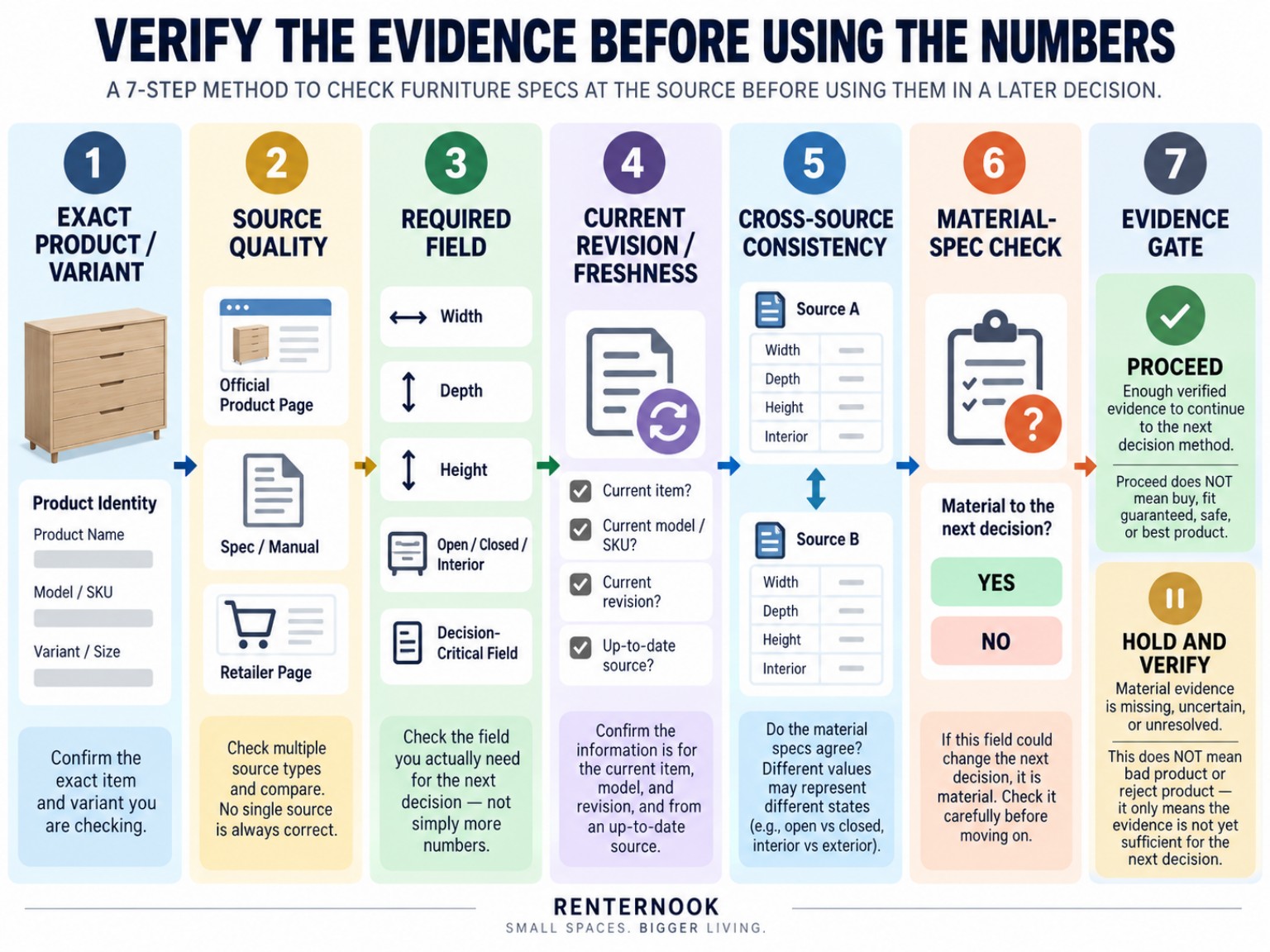
Use the checks in this order:
- Exact product / variant identity
- Source quality
- Required field specificity
- Current revision / freshness
- Cross-source consistency
- Material-spec check
- Evidence gate: PROCEED or HOLD AND VERIFY
Do not skip directly to a number because it is convenient.
A clean-looking product page is not a substitute for matching the evidence to the exact item and exact decision.
Step 1 — Confirm the exact product and variant
Before reading dimensions, confirm what product the dimensions belong to.
Record the identifying information that matters for the item you are considering, such as:
- brand;
- product name;
- model number;
- SKU, article number or product code where available;
- size;
- configuration;
- number of pieces;
- mechanism or version where relevant;
- any other variant attribute that can change the dimensions or structure.
Do not assume that two products with nearly identical names use the same specifications.
Do not assume that every size in the same product family shares the same depth, height, package count or operating dimensions.
Do not assume that a retailer’s generic family page applies to the exact configuration in your cart.
Identity gate
Ask:
Can I tie these dimensions to the exact product and variant I am considering?
If the answer is no, the dimensions are not yet decision-ready.
Result: HOLD AND VERIFY.
Step 2 — Check the quality of the source
Next, identify where each specification came from.
A practical evidence preference is to start with the source closest to the product identity, for example:
- the current official manufacturer product page for the exact item;
- an official specification sheet, technical document, assembly instruction or manual for that exact model;
- an official retailer page that clearly identifies the exact variant;
- another retailer or reseller page that can be matched to the same exact product;
- secondary summaries, aggregators, search snippets or copied specifications.
This is not a rule that every manufacturer page is automatically complete or every retailer page is automatically wrong.
The point is to know what kind of evidence you are relying on.
If a lower-quality source is the only place where a critical dimension appears, treat that field as needing stronger verification rather than silently upgrading it to a verified fact.
Source-quality gate
Ask:
Is the source specific enough and close enough to the exact product to support this field?
If the answer is uncertain, mark the field as UNKNOWN or NEEDS VERIFICATION.
Do not convert weak evidence into a confident number.
Step 3 — Verify the exact field your next decision needs
“Dimensions” is not one field.
The next method may require a very specific dimension or state.
Depending on the furniture and the next decision, you may need fields such as:
- overall width;
- overall depth;
- overall height;
- usable interior width, depth or height;
- shelf dimensions;
- drawer dimensions;
- seat dimensions;
- closed dimensions;
- open or extended dimensions;
- folded dimensions;
- deployed dimensions;
- package or box dimensions;
- number of packages;
- clearance or installation requirements explicitly published for the product;
- other product-specific operating states.
Do not substitute a nearby field just because it is available.
If you need an open-state depth, a closed depth is not a replacement.
If you need the usable interior width, the outside cabinet width is not a replacement.
If you need package dimensions for a later delivery check, the assembled size is not a replacement.
And if the manufacturer does not publish the field you need, the correct result is not to estimate it from a photo.
The correct result is:
UNKNOWN — HOLD AND VERIFY if the field is material.
Step 4 — Read dimension labels instead of assuming the order
Different pages can present dimensions differently.
One page may clearly label:
- Width
- Depth
- Height
Another may use a compact string.
Another may list a tabletop size, seat size, interior size or package size separately.
Do not assume that every three-number sequence uses the same order.
Preserve the labels attached to the original source.
Also preserve the source unit.
If you convert units for your own planning, keep the original published figure in your evidence notes so you can trace the conversion back to the source.
Good evidence note
Width: [published value] Depth: [published value] Height: [published value] Source: exact product page Variant: exact size / configuration Original unit preserved
Weak evidence note
Size: about X × Y × Z Source: search result / image Variant: unclear
The second note may still be useful as a research lead.
It is not decision-ready evidence.
Step 5 — Check the current revision and freshness
Product specifications can change.
A product family may receive:
- a revised model;
- a new size;
- a new configuration;
- a new article or SKU;
- a packaging change;
- an updated manual;
- a retailer listing that has not caught up with the current manufacturer information.
Freshness matters most when the field can materially change the next decision.
You do not need to reject every undated page.
You do need to ask whether you can establish that the evidence still belongs to the current item.
Useful checks include:
- exact SKU or model match;
- current product-page identity;
- current downloadable manual or specification sheet;
- current retailer variant;
- whether the source clearly refers to a discontinued or different revision.
If you cannot determine whether a conflicting specification belongs to the current product, do not resolve the conflict by preference.
Keep it unresolved.
Step 6 — Reconcile cross-source consistency
Once you have the exact identity and the required fields, compare the relevant sources.
There are three useful outcomes.
Outcome A — The material fields agree
The exact item matches.
The source labels match.
The required dimensions are consistent.
There is no unresolved material conflict.
That field can move toward VERIFIED.
Outcome B — The numbers differ because the sources describe different things
This is not necessarily a contradiction.
Examples include:
- assembled dimensions vs package dimensions;
- overall dimensions vs usable interior dimensions;
- closed state vs open state;
- one size vs another size;
- one configuration vs another.
Separate the fields instead of choosing one number.
Outcome C — The material fields genuinely conflict
If two sources appear to describe the same exact item, same state and same field but give materially different values, do not:
- average the numbers;
- choose the smaller number;
- choose the number that makes the product fit;
- choose whichever source appears first;
- quietly ignore the conflict.
The field remains unresolved until you can identify the stronger current evidence.
If the field is material to the next decision:
HOLD AND VERIFY.
What makes a specification “material”?
Not every missing detail needs to stop the process.
A material specification is a field that can change the result of the next decision method.
For example, if your next method needs to determine whether a cabinet body fits a planned position, its verified outside dimensions may be material.
If the product has a moving part and the next method depends on that moving state, the relevant open or deployed dimension may be material.
If the next method is delivery-route verification, package dimensions may become material — but that is a separate downstream method and belongs to the delivery-fit process, not this article.
A missing decorative detail may not affect the next decision at all.
The key question is:
If this field turned out to be different, could it change the next decision?
If yes, treat it as material.
If a material field is missing:
HOLD AND VERIFY.
If a material conflict is unresolved:
HOLD AND VERIFY.
If a field is simply unknown but not required by the next decision, keep it marked as unknown and continue without pretending it has been verified.
Use an evidence table before you use the numbers
A small evidence table is often enough to prevent specifications from getting mixed together.
| Field | Exact item / variant | Source | Published value | Evidence state | Material to next decision? |
|---|---|---|---|---|---|
| Overall width | Confirmed / Unknown | Source | Value / Unknown | Verified / Partial / Unknown | Yes / No |
| Overall depth | Confirmed / Unknown | Source | Value / Unknown | Verified / Partial / Unknown | Yes / No |
| Overall height | Confirmed / Unknown | Source | Value / Unknown | Verified / Partial / Unknown | Yes / No |
| Open / extended state | Confirmed / Unknown | Source | Value / Unknown | Verified / Partial / Unknown | Yes / No |
| Interior / usable size | Confirmed / Unknown | Source | Value / Unknown | Verified / Partial / Unknown | Yes / No |
| Package dimensions | Confirmed / Unknown | Source | Value / Unknown | Verified / Partial / Unknown | Yes / No |
| Other decision-critical field | Confirmed / Unknown | Source | Value / Unknown | Verified / Partial / Unknown | Yes / No |
The point is not to fill every box.
The point is to make the unknowns visible.
A blank field should not disappear just because the rest of the table looks complete.
VERIFIED, PARTIAL and UNKNOWN are different states
A simple evidence state can keep the process honest.
VERIFIED
Use this when:
- the exact product / variant is established;
- the source is specific enough;
- the required field is explicitly published;
- the field is current enough for the decision;
- no unresolved material conflict remains.
PARTIAL
Use this when some evidence exists but an important part is still unresolved.
Examples:
- product identity is clear but the exact operating-state dimension is not;
- a retailer publishes the value but the manufacturer source cannot be matched yet;
- two sources appear close but the variant relationship is unclear.
PARTIAL is not failure.
It is also not VERIFIED.
UNKNOWN
Use this when the field has not been established.
UNKNOWN does not mean:
- zero;
- absent;
- bad;
- unsafe;
- incompatible;
- too large;
- too small.
It means only:
The evidence currently available does not establish the answer.
That distinction matters.
The final evidence gate
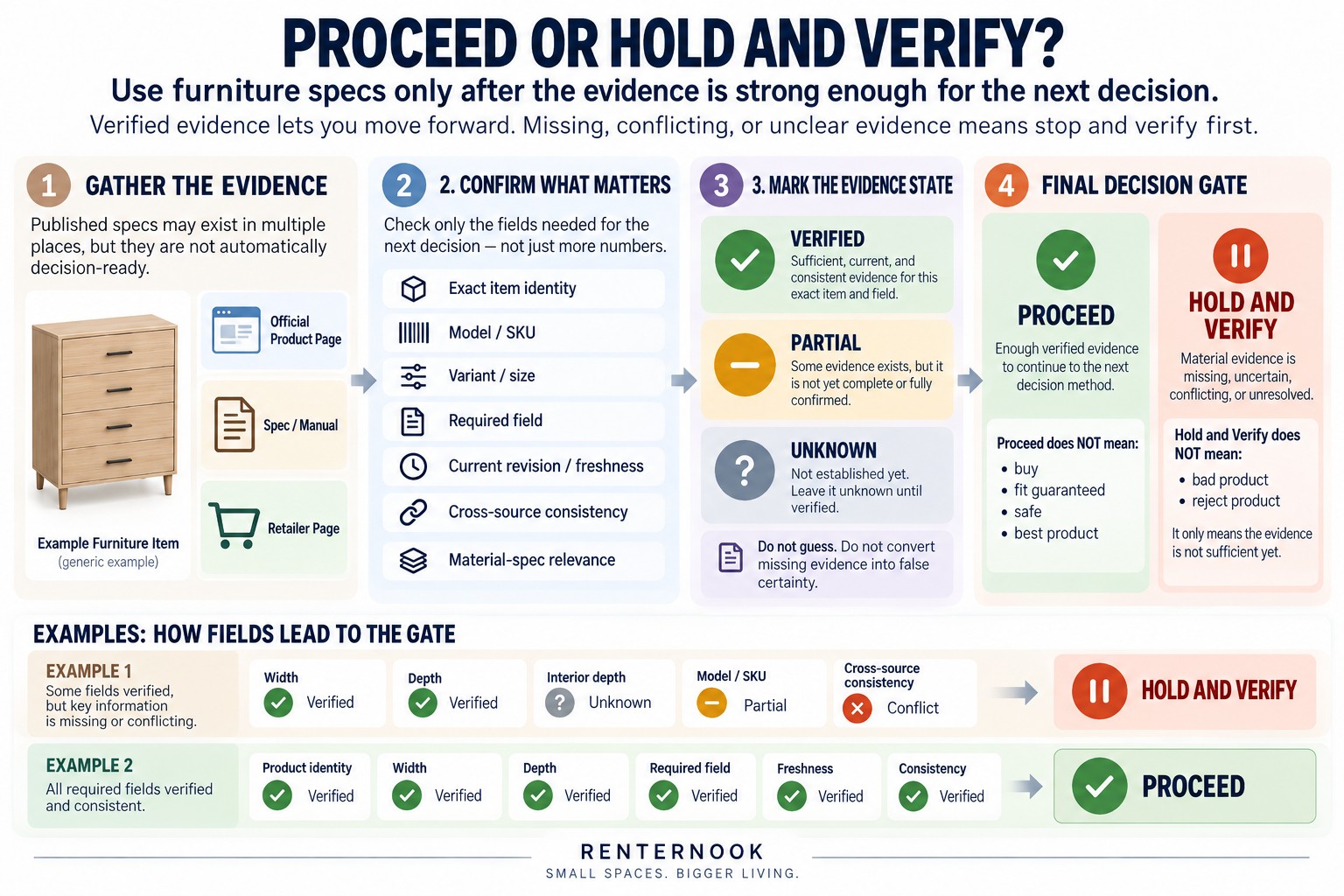
After working through the evidence chain, stop and make one of two decisions.
PROCEED
Use PROCEED only when:
- the exact product and variant are established;
- the source quality is sufficient for the material fields;
- the fields required by the next method are explicit;
- current revision / freshness is adequate;
- material cross-source conflicts are resolved;
- no material field required by the next method remains unknown.
PROCEED means:
The evidence is sufficient to continue to the next decision method.
It does not mean:
- buy the product;
- the product fits;
- the product will fit through your door;
- the product is safe;
- the product is comfortable;
- the product is the best choice;
- the product will work in every room.
Those are separate decisions.
HOLD AND VERIFY
Use HOLD AND VERIFY when any of the following is true:
- exact product identity is uncertain;
- exact variant identity is uncertain;
- a material field is missing;
- a material field comes only from evidence that is too weak to support the decision;
- current revision cannot be reconciled where it matters;
- two sources have an unresolved material conflict;
- the field needed by the next method remains unknown.
HOLD is not a rejection of the product.
It is a rejection of pretending that incomplete evidence is complete.
Example: a listing has dimensions, but the evidence gate still fails
Imagine a furniture listing shows:
- width;
- depth;
- height.
At first glance, that looks complete.
Then you check the evidence:
- the retailer title matches the product family;
- the exact SKU in your cart is not shown in the dimension section;
- the manufacturer lists two sizes;
- the retailer does not say which size its dimensions describe;
- the next decision depends on depth.
The correct result is not:
“The retailer probably means the smaller size.”
It is:
Exact variant identity is unresolved. Depth is material. HOLD AND VERIFY.
Now imagine the SKU is confirmed and the manufacturer page explicitly lists the same depth for that exact variant.
The evidence gate can move to:
PROCEED to the next decision method.
That still does not tell you whether the product fits your room.
It tells you that the dimension evidence is now strong enough to use in the room-fit method.
Example: two depths do not always mean two sources disagree
Suppose one page shows one depth and another shows a larger number.
Before calling it a conflict, ask what each number describes.
One may be:
- closed body depth;
while the other is:
- open or extended depth.
If the labels establish that these are different states, preserve both.
Do not “correct” one number to match the other.
The evidence becomes more useful because you now know the product has more than one decision-relevant state.
If the sources both claim to describe the same exact state and same exact item, then the conflict is real and must be resolved before using that field.
Example: package dimensions belong to a different downstream decision
Package dimensions can be important.
But they answer a different question from final assembled dimensions.
This article does not decide whether the package can pass through:
- the building entrance;
- a doorway;
- a hallway turn;
- stairs;
- an elevator;
- the final room entry.
That belongs to the delivery and assembly-fit method.
The role of this evidence-quality gate is narrower:
- confirm whether package dimensions are published for the exact item;
- verify the source and variant;
- preserve the package dimensions as a separate field;
- pass that verified evidence into the delivery method.
Do not turn an evidence-quality check into a delivery-fit guarantee.
A practical pre-decision checklist
Before using furniture dimensions in any later fit method, confirm:
- ☐ I have the exact product identity.
- ☐ I have the exact size / configuration / variant that can affect the specs.
- ☐ I know what source each material specification came from.
- ☐ I know what each number describes.
- ☐ I have not mixed assembled, package, interior, closed or open-state dimensions.
- ☐ I have preserved the source labels and units.
- ☐ I have checked whether the evidence still belongs to the current item.
- ☐ I have compared material fields across relevant sources.
- ☐ I have not averaged or guessed through a real conflict.
- ☐ Every field required by the next decision is verified strongly enough to use.
- ☐ Any unresolved field is still marked PARTIAL or UNKNOWN.
- ☐ If a material field is missing or conflicted, I stop at HOLD AND VERIFY.
If all material fields pass, the result is:
PROCEED TO THE NEXT DECISION METHOD.
Not “buy.”
Not “fits.”
Not “safe.”
Not “best.”
Just:
The evidence is ready for the next question.
Final rule
Furniture specifications should reduce uncertainty.
They should not hide it.
A dimension is useful only when you can answer:
- Which exact product does this belong to?
- Which variant?
- Which source?
- Which measurement field?
- Which product state?
- Is it current enough?
- Do the material sources agree?
- Is anything required by the next decision still unknown?
If a material answer is missing, HOLD AND VERIFY.
If the evidence is complete enough, PROCEED — and then use the correct downstream method to decide what comes next.
Published specs are inputs. Verified, decision-ready evidence is the gate.