
Collapsible Storage Crates for Move-Ins: Check the Open Footprint, Folded Size, and Carry Path Before You Buy
Moving into a small rental often means carrying the same things more than once: from the old room to the car, from the car through the building, and finally into a closet or under a shelf. Collapsible storage crates can help organize that process. But the fact that a crate folds does not tell you whether it will fit through your move-in route, stack safely with your actual load, or have a practical home once empty.
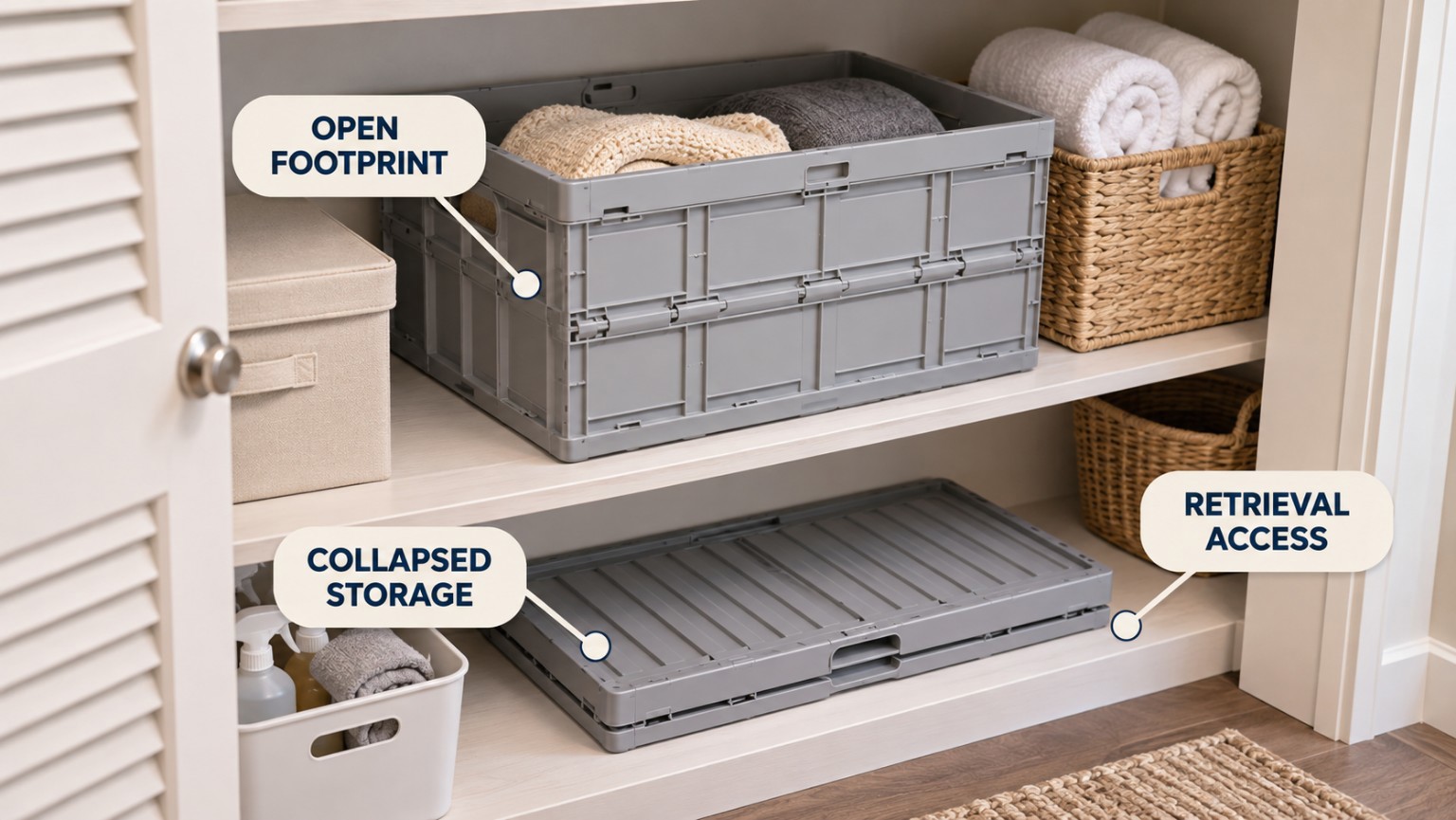
Before buying, think about two footprints: the crate when it is open and filled, and the crate when it is collapsed and waiting for the next move. Then trace the entire route between them.
Quick answer: measure the route, not just the crate
Start with the crate’s open outside dimensions, not its advertised liter capacity. Measure the narrowest doorway, hallway turn, stair landing, elevator opening, car trunk access and final storage shelf. Check the space needed for your hands to reach the handles, not only the width of the plastic body. Then decide where empty folded crates will live.
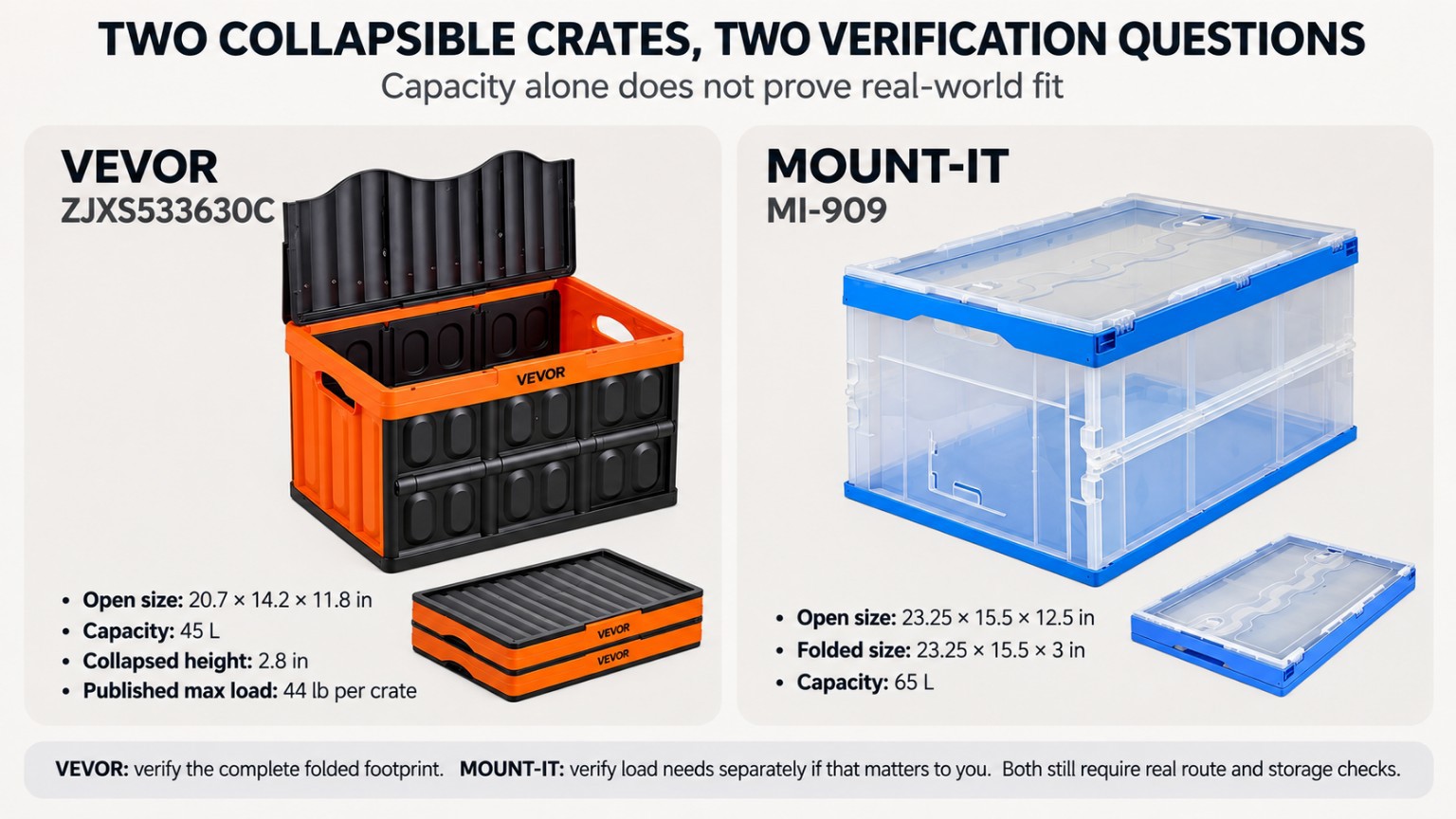
Two examples illustrate different fit questions. The VEVOR ZJXS533630C is a 45 L orange three-pack with published open dimensions of 20.7 L × 14.2 W × 11.8 H inches, collapsed height of 2.8 inches, and a stated maximum load of 44 lb per crate. The MOUNT-IT MI-909 is a clear/blue 65 L crate with published open dimensions of 23.25 × 15.5 × 12.5 inches and folded dimensions of 23.25 × 15.5 × 3 inches. Neither capacity number proves how much of your particular belongings will pack efficiently.
1. Start with the open footprint
Place tape on the floor to mark each crate’s published length and width. Include the height when checking shelving, vehicle loading or the space beneath a table. A larger advertised capacity can come with a larger outside envelope, and the most important constraint may be the narrowest point in the move rather than the space in the destination room.
VEVOR’s open envelope is 20.7 × 14.2 × 11.8 inches. MOUNT-IT’s is 23.25 × 15.5 × 12.5 inches. These are published product dimensions, not a guarantee of fit through every opening.
2. Check doorway and hallway clearance
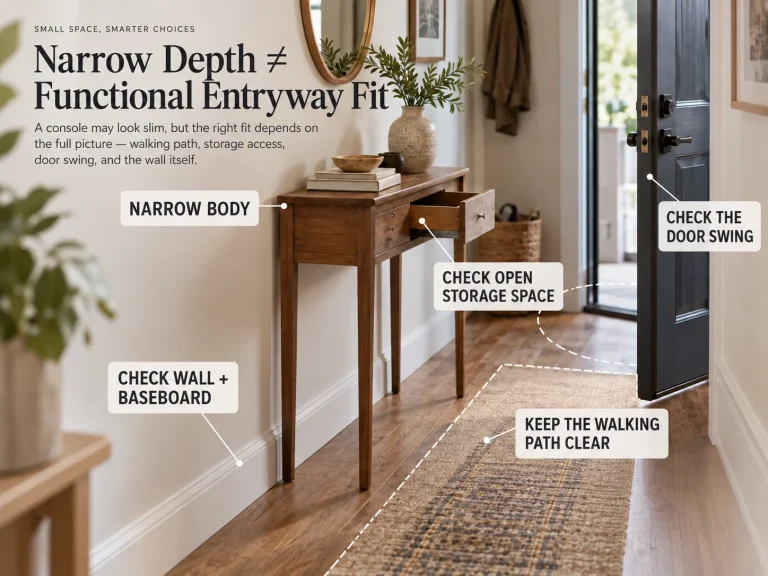
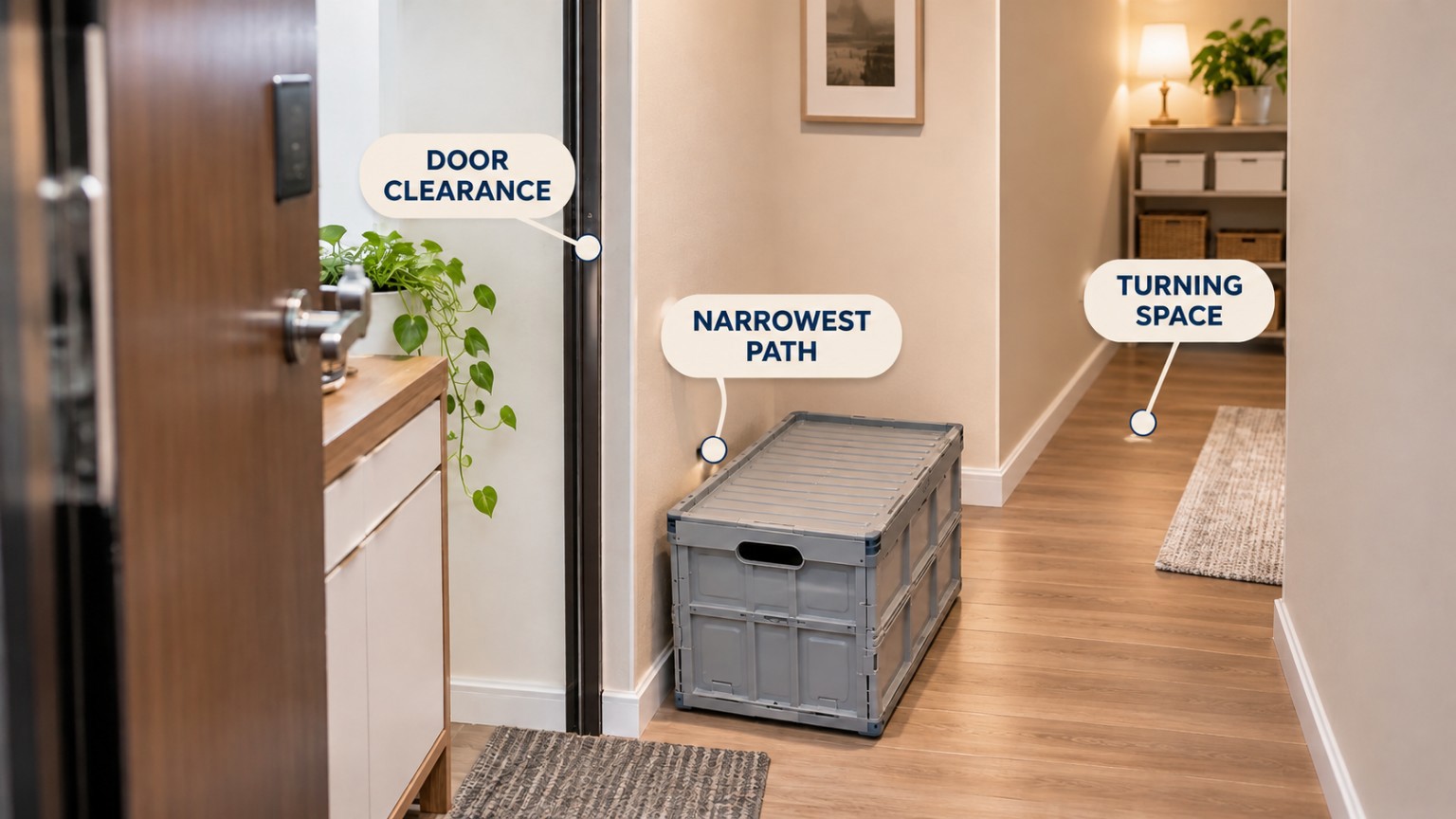
A crate that fits straight through a doorway may be awkward around a hallway corner. Check the turn as well as the opening. Include your hands at the handles and any objects protruding from the top. If a crate must be rotated or carried sideways, test the available turning space before assuming the route works.
Do not use nominal door width as the only measurement. Measure the clear opening with the door in its actual operating position, and note knobs, trim, thresholds and tight turns.
3. Map the car-to-room load path
The move-in path may include a trunk lip, a narrow elevator, a flight of stairs and a long walk. The crate’s outside footprint is only one part of that job. The load must also be manageable to lift and carry, and the handles must remain accessible.
For VEVOR, the locked published maximum load is 44 lb per crate. That is an upper published rating, not a promise of comfortable carrying, durability in every situation or performance on stairs. No comparable load rating is established in this locked brief for MOUNT-IT; do not invent one.
Measure the vehicle opening and available loading space. Do not infer that either crate fits a specific car merely because its outside dimensions look compact.
4. Check the lid and opening workflow
A lid can help keep items together, but it can also change the daily routine. Ask whether the crate must be opened repeatedly during unpacking, whether the lid can move with a wall or shelf close behind it, and whether you can access contents when another crate is nearby.
The VEVOR brief identifies a lid, handles, stacking design and PP material. The MOUNT-IT brief identifies handles, a flip cover, locks and stacking design. These are product features, not proof that all configurations can be stacked or opened in every location.
5. Understand stacking as a relationship, not a universal promise
Stacking depends on the exact crate model, orientation, condition, load, lid position and the stability of the surface underneath. A product described as stackable is not automatically compatible with a different brand, a different size, or every height and weight combination.
Check manufacturer guidance for the precise configuration you intend to use. Avoid assuming the published carrying load also defines a safe stacking load.
6. Compare the two locked products by verification task
VEVOR ZJXS533630C — orange, 45 L, three-pack:
Open size: 20.7 L × 14.2 W × 11.8 H inches.
Collapsed height: 2.8 inches.
Published maximum load: 44 lb per crate.
Documented features: handles, lid, stackable design, PP material.
Verify the actual folded length and width, route clearance, lid access and stable stacking configuration. The locked brief provides collapsed height but does not establish a complete collapsed footprint.
MOUNT-IT MI-909 — clear/blue, ODP 8082435:
Open size: 23.25 × 15.5 × 12.5 inches.
Folded size: 23.25 × 15.5 × 3 inches.
Capacity: 65 L.
Documented features: handles, flip cover, locks and stackable design.
Verify vehicle and doorway clearance, flip-cover operating room, carrying comfort and manufacturer stacking guidance. A maximum load rating is not established in the locked brief.
Neither product wins by default. The useful comparison is which outside envelope, folding format and opening workflow can be verified against your actual move-in route.
7. Plan the empty-crate storage location
A collapsible crate still takes up floor or shelf space after the move. For MOUNT-IT, the locked folded dimensions are 23.25 × 15.5 × 3 inches. For VEVOR, the locked collapsed height is 2.8 inches; do not infer its folded length and width from the open dimensions without verification.
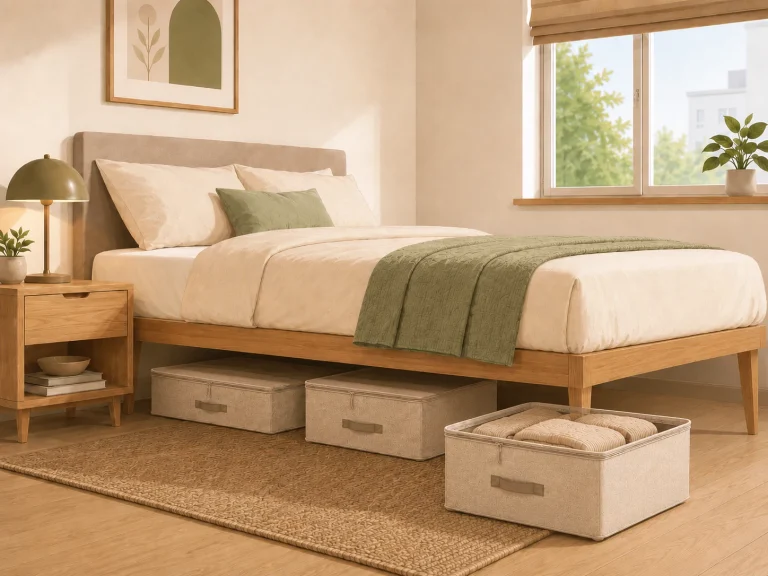
Measure the exact place where empty crates will be stored. Include the number of crates, access to retrieve them and any clearance needed to slide them out. A crate that folds low may still be too wide for the shelf you hoped to use.
8. Fit-first checklist before ordering
- OPEN: Measure the full outside length, width and height.
- FOLDED: Confirm all three folded dimensions; preserve unknowns.
- ROUTE: Measure door clear openings, hallway turns, stairs and elevators.
- VEHICLE: Check the real trunk or loading opening and the route into it.
- CARRY: Check handles, grip clearance and manageable loaded weight.
- LID: Verify opening space during packing and unpacking.
- STACK: Confirm same-model stacking guidance and load conditions.
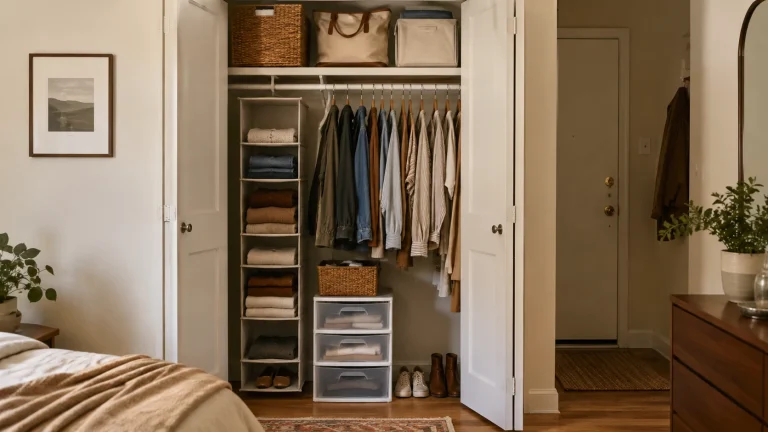
- EMPTY STORAGE: Mark a shelf, closet or under-bed location.
- REUSE: Check whether the folding and setup steps fit your actual routine.
9. A simple move-in test
Before ordering a large quantity, mark the candidate crate footprint on the floor and walk the move-in route. Simulate turning through the tightest corner while keeping your hands clear. Check the final storage space twice: once for a filled crate and once for a folded one. If a critical dimension is unavailable, request or verify it instead of guessing.
Bottom line
Collapsible storage crates solve a repeat-use problem only when both their open and folded forms fit the space. Compare VEVOR ZJXS533630C and MOUNT-IT MI-909 by published outside dimensions, the real carry path, handle and lid access, stacking constraints, and empty-crate storage. Capacity in liters is not the same as usable packing volume, and a stackable label is not a universal stacking guarantee. Measure the complete move-in workflow before choosing.