Vacuum Cleaners for Small Apartments: Check Cleaning, Storage, and Charging Fit Before You Buy
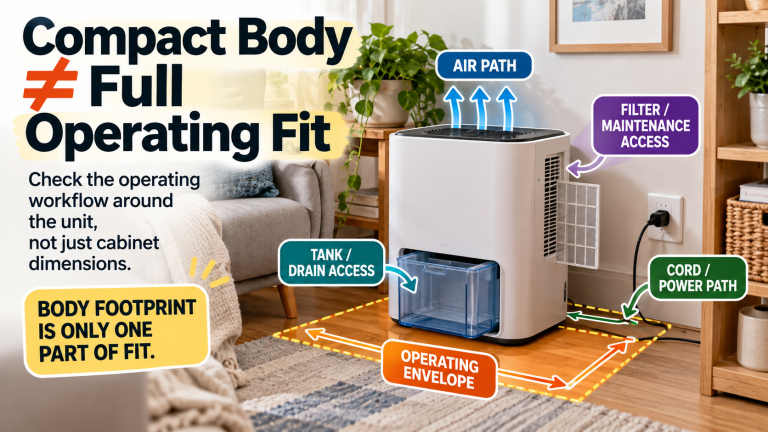
A vacuum cleaner can look compact enough for a small apartment and still be the wrong fit once you use, charge, empty, and store it.
That is because the vacuum body is only one part of the system.
A cordless stick vacuum still needs a charging plan. A folding stick vacuum may reduce its stored height, but that does not tell you its exact folded footprint or where its charger and accessories will go. A canister vacuum may have a relatively compact body while the hose, wand, floorhead, cord, and parked storage state use a much larger real-world envelope.
So the useful question is not only:
“Will this vacuum fit in my apartment?”
It is:
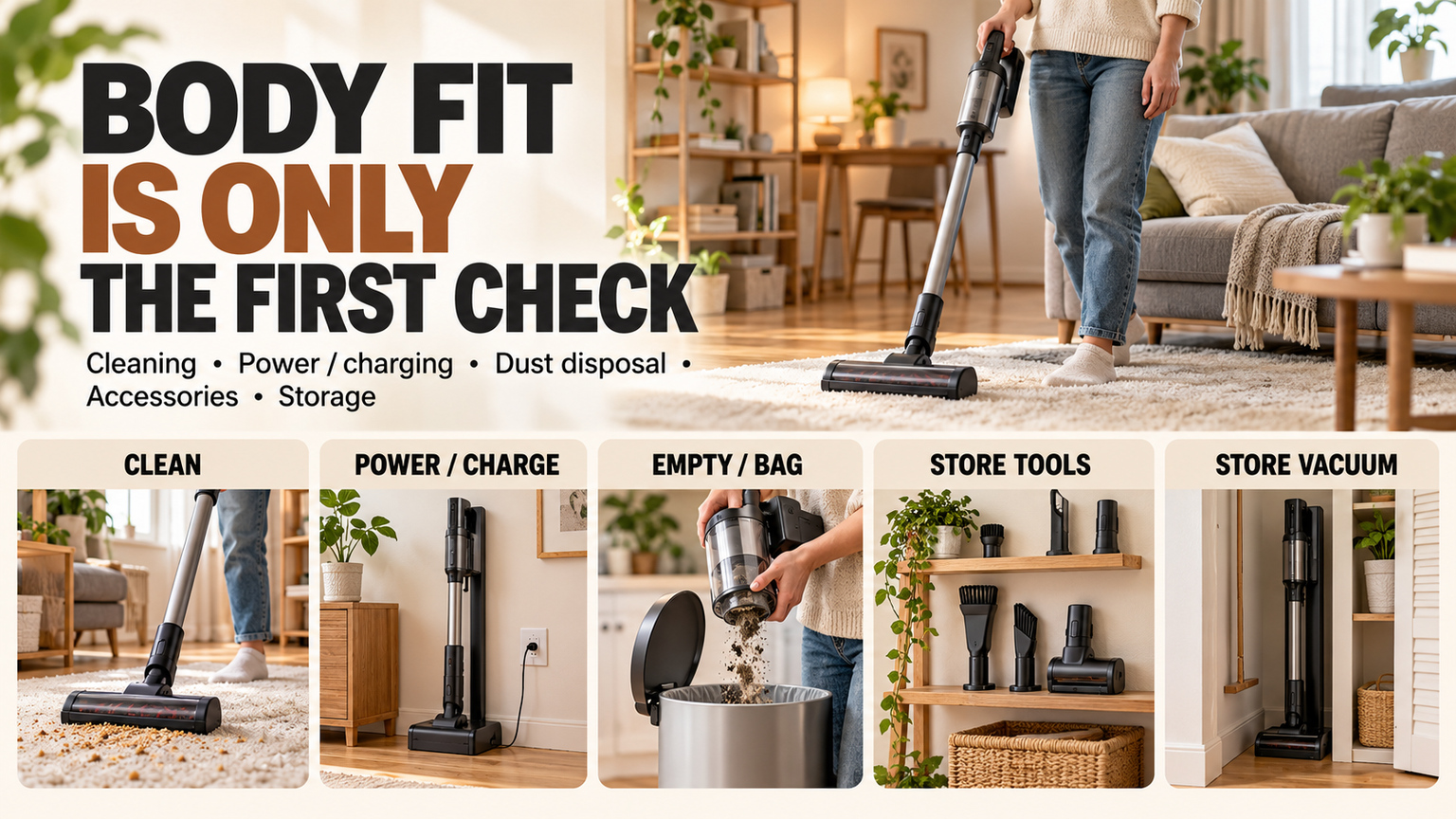
“Can I clean the surfaces I actually have, reach the places I need to reach, power or charge the vacuum, empty or replace the dust system, store the accessories, put the complete vacuum away, and have it ready for the next clean?”
That is the fit-first rule for this guide:
BODY FIT ≠ CLEANING FIT ≠ POWER / CHARGING FIT ≠ DUST-DISPOSAL FIT ≠ ACCESSORY-STORAGE FIT ≠ STORAGE FIT
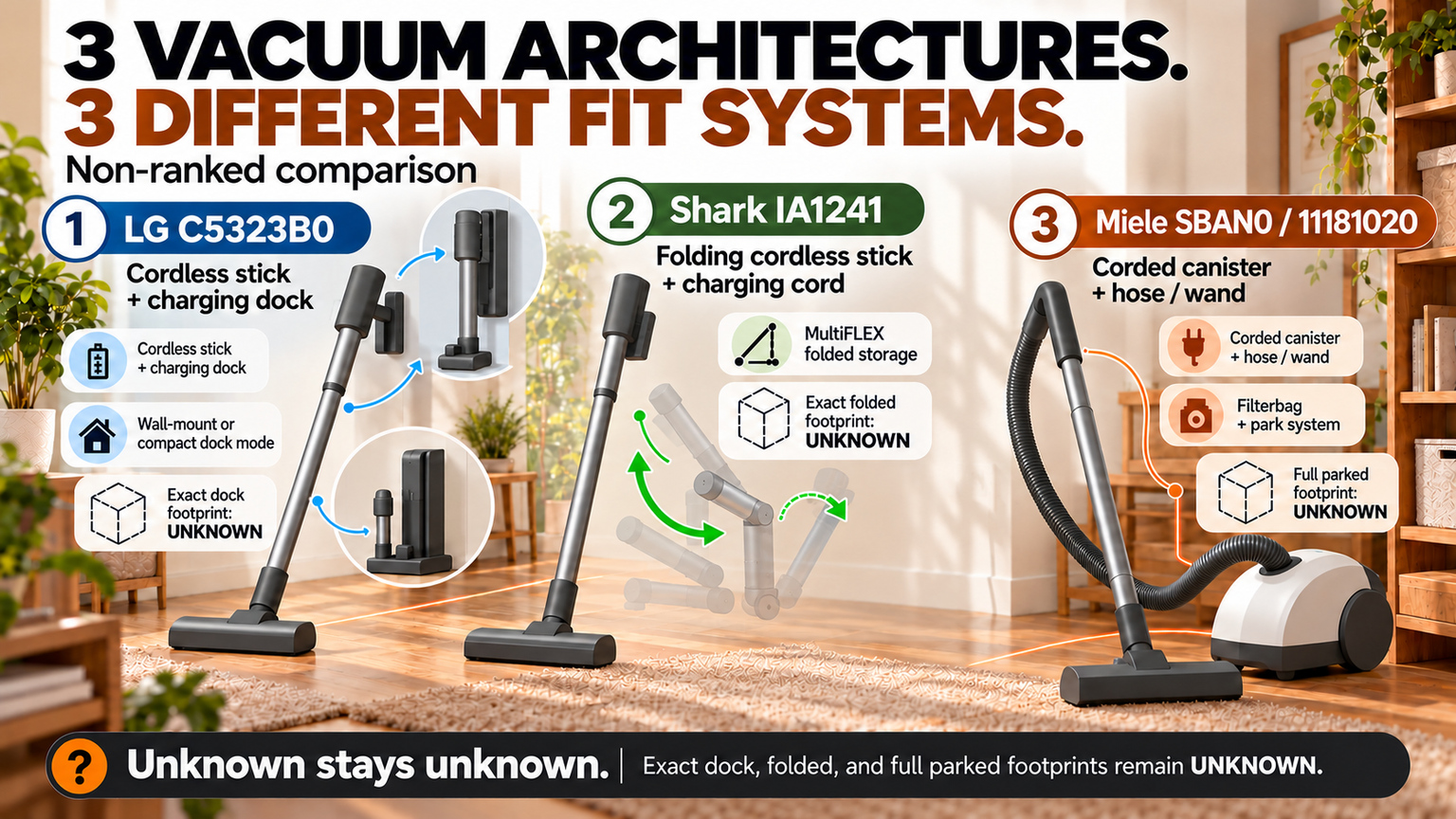
This article uses three exact models as non-ranked examples of three different small-apartment vacuum architectures:
- LG CordZero Q3 C5323B0 — conventional cordless stick with a charging dock.
- Shark PowerDetect Speed IA1241 — folding cordless stick with MultiFLEX storage.
- Miele Classic C1 Pure Suction PowerLine SBAN0 / material no. 11181020 — corded canister with a filterbag, hose, telescopic wand, and park system.
These products are here because they change the fit problem in different ways. They are not presented as first, second, or third place.
Start With the Cleaning Job, Not the Vacuum Body
Before comparing dimensions, define what the vacuum has to do in your apartment.
Ask:
- What floor surfaces will you clean?
- Do you need to reach under beds, sofas, or low cabinets?
- Do you need a handheld configuration for upholstery, corners, or shelves?
- Where will a cordless model charge?
- Where will a corded model plug in, and how will the cord cross the cleaning route?
- Where will you empty a dust cup or change a bag?
- Where will the accessories live?
- What is the actual stored configuration?
- What has to happen before the vacuum is ready for the next clean?
This sequence matters because small-apartment fit is a workflow problem.
A vacuum that looks slim in a product photo can still create friction if its charger has no practical location, its dust cup is awkward to empty in your available trash area, its cord does not work with the room layout, or its complete storage state is larger than the body dimensions suggest.
Three Vacuum Architectures Compared
The three locked models expose different decision mechanics.
Two boundaries in this table are important.
First, the LG dimensions and weight above are exact-model first-party specifications from LG Canada for model C5323B0. They should not be silently relabeled as US-specific physical specifications.
Second, the published body size of any of these vacuums is not the complete cleaning or storage envelope.
1. Cleaning Fit Starts With the Full Assembly
A vacuum cleaner does not work as a body sitting still.
It works as a body plus a floorhead, wand or hose, handle position, cleaning path, user movement, and sometimes a different configuration for furniture, upholstery, or tight spaces.
LG CordZero Q3 C5323B0
The LG is a cordless stick architecture with handheld conversion.
LG describes the Dual Floor Max Lite nozzle as detecting carpet or hard floor and adjusting suction accordingly. That is a manufacturer performance claim, not an independently tested conclusion in this article.
For fit purposes, the more important point is that the vacuum has multiple use states. Floor cleaning is one state. Handheld use is another. The full upright body dimensions do not tell you the reach, angle, or access envelope for every cleaning job.
If you need to clean under furniture, around bed frames, on stairs, or above the floor, test the actual assembly and attachment path rather than assuming the upright body measurement answers the question.
Shark PowerDetect Speed IA1241
The Shark adds a different geometry through MultiFLEX.
The verified architecture lets the wand bend for under-furniture cleaning and fold for compact storage.
That creates two separate fit questions:
- Can the wand and floorhead reach the places you need to clean?
- Does the folded storage state actually fit the location where you want to keep the vacuum?
The second question cannot be answered from a generic “foldable” label. The exact folded dimensions and folded footprint are not established in the locked evidence.
Miele Classic C1 Pure Suction PowerLine SBAN0
The Miele changes the cleaning geometry completely.
Instead of a single stick body, the system includes the canister, hose, telescopic wand, and floorhead.
The exact-model manual covers carpet, rugs, and durable hard flooring with the included SBD 365-3 floorhead. The floorhead uses different brush states for carpet/rugs and hard floors.
That is a verified workflow, but it is not a claim that performance is equal on every carpet pile or floor material.
For small-apartment planning, the main difference is physical: the canister follows the user while the hose and wand extend away from it. The canister body dimensions alone therefore do not describe the cleaning envelope.
2. Cordless Fit Still Needs a Charging Location
Cordless does not mean infrastructure-free.
A cordless vacuum needs a place where the battery can be charged without creating a permanent obstacle or awkward daily routine.
LG: charging dock becomes part of the storage decision
The LG uses a rechargeable quick-release battery and includes one battery.
The exact-model first-party material supports two charging / storage modes:
- wall mount;
- compact installation.
For compact installation, the charging dock is placed on a stable, level surface and the wand and nozzle are removed for charging.
This is a useful small-apartment architecture because it gives more than one storage path.
But it does not prove that either path works in your apartment.
A wall-mount option is not automatically renter-safe, damage-free, or approved by a landlord. A compact dock mode is not the same thing as a known compact-storage footprint. The exact dock footprint is not established in the locked evidence.
The exact-model first-party charge time is 240 minutes. Treat that as a charging-workflow fact, not as a reason to assume that any convenient-looking location is suitable.
Shark: charging cord is separate from the folding benefit
The Shark uses a lithium-ion battery and an included charging cord. The published charge time is 6 hours.
No wall dock or charging stand is established in the locked evidence.
That distinction matters.
The vacuum can fold for storage, but the charging path still has to work. You need a practical place for the folded vacuum, the charging cord, the nearby outlet, and any accessories.
Folding solves one geometry problem. It does not remove the charging problem.
3. “Up to 60 Minutes” Is Not an All-Mode Runtime
Both cordless examples have a manufacturer-published “up to 60 minutes” runtime claim in the locked research.
That number needs a boundary.
For the LG, the published test basis is the lowest or Eco-type setting without a powered tool.
For the Shark, the published test basis is Eco mode with a non-motorized tool.
So this guide does not convert “up to 60 minutes” into:
- 60 minutes with the powered floorhead;
- 60 minutes at maximum power;
- 60 minutes on every floor type;
- 60 minutes in every apartment.
Runtime matters to cleaning fit only when you connect it to your actual cleaning job and the manufacturer’s stated test conditions.
4. A Corded Vacuum Replaces Charging Fit With Cord and Outlet Fit
The Miele does not need a charging location.
Instead, it introduces an outlet and cord-routing problem.
The exact-model data gives:
- 18-ft power cord;
- 29-ft operating radius in the product data;
- automatic cord rewind.
The operating instructions also require the cord to be fully unwound when vacuuming for longer than 30 minutes. After use, the vacuum is unplugged before the cord is rewound.
In a small apartment, that means the decision is not simply “corded versus cordless.”
Map the actual cleaning route:
- Which outlet will you start from?
- Can the canister and hose move through the room without repeatedly snagging on furniture?
- Will the cord cross a high-traffic path?
- Will you have to move between outlets?
- Can the cord be fully unwound when required without creating an impractical route?
A corded vacuum removes battery charging from the workflow but adds a live cord and outlet relationship during cleaning.
5. Dust Disposal Needs Its Own Working Space
Dust collection is another place where body fit can hide the real workflow.
LG: removable bagless bin with Kompressor
The LG uses a removable, washable bagless dust bin.
LG’s first-party material says the Kompressor system compresses collected dirt and dust to increase bin capacity and can help with emptying with less scattered dust.
That is a manufacturer claim. It should not be rewritten as “dust-free emptying.”
The guidance says to empty the bin after use. The exact trash-can / emptying clearance is not established.
For fit planning, identify where the bin will be removed, emptied, cleaned, dried if needed, and returned to the vacuum.
Shark: 0.5-qt dust cup with one-touch emptying
The Shark uses a 0.5-qt dust cup and a one-touch emptying workflow.
Again, “one-touch” describes the mechanism. It does not prove dust-free or zero-contact emptying.
The exact emptying clearance is unknown.
If you plan to keep the vacuum in a narrow closet, ask whether you will have to move it elsewhere every time you empty the cup.
Miele: filterbag changes the disposal workflow
The Miele uses a HyClean GN filterbag with a published 4.8-qt / 4.5-L volume and a bag-change indicator.
The replacement workflow is established in the operating instructions. When the dust compartment is opened, the bag flap closes automatically to limit dust escape.
That is not the same as zero dust exposure.
A bagged system changes the small-apartment question from “Where do I empty and wash a dust cup?” to “Where do I open the compartment, remove the bag, install a replacement, and store spare bags?”
The exact bag-change opening clearance is not established.
6. Included Accessories Still Need a Storage Plan
A small apartment can make accessory storage surprisingly important.
LG
The LG includes a combination tool and crevice tool.
LG markets the flexible charging dock as a way to keep accessories organized, but the exact accessory positions and the complete accessory-storage footprint are not established in the locked evidence.
So the safe conclusion is:
Accessory organization is supported, but the exact geometry is unknown.
Shark
The Shark includes a crevice tool and upholstery tool.
Built-in onboard accessory storage is not established.
An accessory bag may be available separately, but that is not evidence that the vacuum itself has integrated storage for the included tools.
Miele
The Miele has the clearest verified accessory-storage architecture in this set.
It includes an upholstery nozzle, crevice nozzle, and dust brush. The manual identifies a holder for three accessories at the hose / vacuum connection area.
That does not make the full parked footprint known, but it does establish where the three included tools are intended to live.
7. Storage Fit Is a Separate State
Storage is where the three architectures become most different.
LG: dock, wall, or separated compact configuration
The LG can use a wall-mount or compact installation.
In compact installation, the wand and nozzle are removed.
That means the stored system is not always one tall assembled stick. But the exact wall-mount footprint and compact-dock footprint remain unknown.
Do not turn “compact installation” into a made-up width, depth, or clearance number.
Shark: folding is verified; folded size is not
The Shark’s MultiFLEX wand can fold for compact storage.
That is verified.
The exact folded dimensions and folded footprint are not.
Self-standing is also not established.
So avoid a common shortcut:
Foldable ≠ known folded size ≠ self-standing.
If you want to store it under a shelf, beside a cabinet, or inside a closet, measure the real folded unit or verify exact-model dimensions before treating the location as a pass.
Miele: body storage is not complete-system storage
The Miele can be stood upright after use. The telescopic wand can be fully retracted to save space, and the floorhead can slot into the storage parking attachment.
Those are verified storage actions.
But the full vertically parked assembly dimensions, hose-storage envelope, and complete assembled storage volume are unknown.
This is one of the clearest fit-first examples in the article:
CANISTER BODY SIZE ≠ CANISTER + HOSE + WAND + FLOORHEAD STORAGE SIZE
A closet may fit the canister body and still be awkward for the full parked system.
8. Ready State Matters More Than “Can I Put It Away?”
Storage is not the end of the workflow.
The useful final question is whether the vacuum is ready for the next clean.
For a cordless stick, “ready” may mean:
- battery charged;
- charger and outlet accessible;
- dust bin emptied if needed;
- tools returned to their storage location;
- vacuum stored without blocking circulation;
- no extra setup friction before the next use.
For the Miele, “ready” may mean:
- vacuum unplugged;
- cord rewound;
- bag not due for replacement;
- tools returned to the holder;
- wand retracted;
- floorhead parked;
- hose and canister stored in a workable arrangement.
This is why the smallest-looking vacuum is not automatically the easiest one to live with.
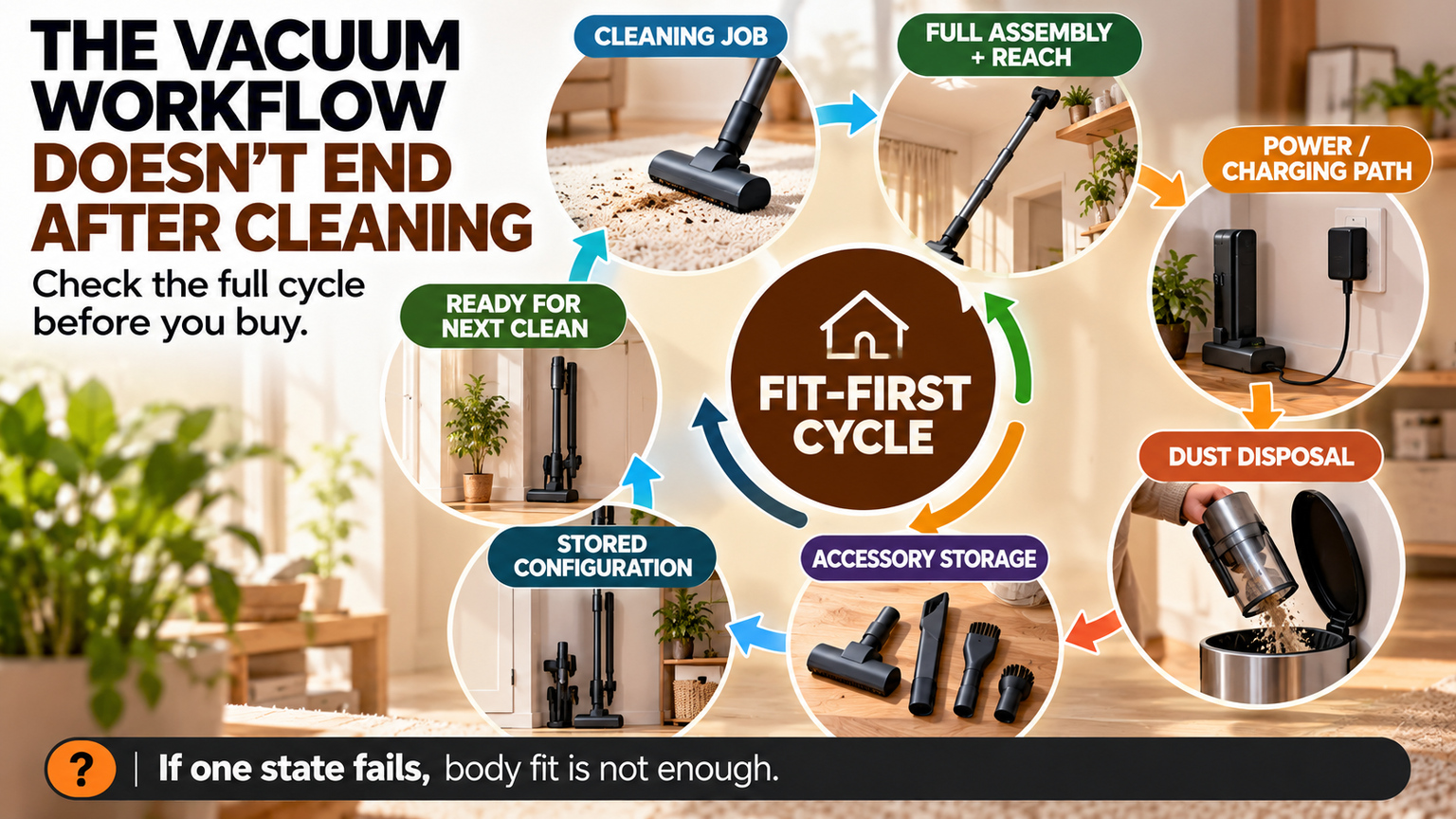
The right architecture is the one whose complete cycle works in your apartment:
clean -> dispose -> recharge or reset cord -> store accessories -> store vacuum -> ready for next clean
Product Profiles: Three Different Small-Apartment Fit Systems
LG CordZero Q3 C5323B0: Cordless Stick + Charging Dock
The LG CordZero Q3 C5323B0 represents a conventional cordless-stick system whose storage decision is closely tied to its charging dock.
For physical size, the exact-model LG Canada specification lists 10 3/8 inches wide x 44 1/8 inches high x 12 inches deep and 6.28 pounds. This article keeps the region label explicit: those are exact-model first-party Canada specifications, not silently normalized US physical specs.
The vacuum converts to handheld use and uses the Dual Floor Max Lite nozzle. LG says the nozzle detects carpet or hard floor and adjusts suction accordingly; that remains a manufacturer performance claim.
The exact-model first-party charging workflow supports wall-mount and compact installation modes. Compact installation places the charging dock on a stable, level surface with the wand and nozzle removed. The exact-model first-party charge time is 240 minutes.
The model uses a removable, washable bagless bin and LG’s Kompressor system. LG says Kompressor compacts collected dirt and can help reduce scattered dust during emptying. This guide does not convert that into a dust-free claim.
Its main fit-first questions are:
- Where will the dock go?
- Is wall mounting actually permitted and appropriate in the apartment?
- If you use compact installation, where will the removed wand and nozzle go?
- Is there enough space to empty and maintain the dust bin?
- Where will the included tools live?
The exact wall-mount footprint, compact-dock footprint, emptying clearance, and complete accessory-storage geometry remain unknown.
Shark PowerDetect Speed IA1241: Folding Cordless Stick + Separate Charging-Cord Workflow
The Shark PowerDetect Speed IA1241 represents a folding cordless-stick architecture.
Its published dimensions are 13.78 inches long x 10.24 inches wide x 44.09 inches high and its weight is 7.1 pounds. The hand-vac portion is listed at 3.5 pounds.
MultiFLEX is the key architecture difference. The wand can bend for under-furniture cleaning and fold for compact storage.
Shark says PowerDetect detects carpets and floors and adjusts power. That is a manufacturer performance claim, not an independent performance ranking.
The dust system uses a 0.5-qt cup with one-touch emptying. The battery charge time is 6 hours, and the included charging hardware is a battery plus charging cord. A wall dock and charging stand are not established in the locked evidence.
The manufacturer publishes up to 60 minutes of runtime under an Eco-mode, non-motorized-tool test condition. Do not generalize that number to every mode or powered-floorhead use.
The included tools are a crevice tool and upholstery tool. Onboard accessory storage is not established.
Its main fit-first questions are:
- Does the MultiFLEX cleaning geometry help with the furniture you actually own?
- Where will the vacuum sit when folded?
- Where will it charge?
- Where will the two included tools live?
- Can the dust cup be emptied comfortably in your available disposal area?
The exact folded dimensions, folded footprint, charging-placement footprint, and emptying clearance are unknown. Self-standing is not established.
Miele Classic C1 Pure Suction PowerLine SBAN0 / 11181020: Corded Canister + Filterbag + Park System
The Miele Classic C1 Pure Suction PowerLine changes nearly every workflow in the comparison.
The canister body is published at 18 1/4 inches wide x 11 inches high x 8 3/4 inches deep. The vacuum itself is listed at 12 pounds, while the marketing weight with vacuuming accessories is 13 pounds. Those two weight bases should not be conflated.
The power system uses an 18-ft cord with rewind and a 29-ft operating radius in the product data. The operating instructions require the cord to be fully unwound for vacuuming longer than 30 minutes.
The included SBD 365-3 floorhead is used with different brush states for carpets / rugs and hard floors. That is a verified exact-model workflow, not proof of equal performance across every surface.
The dust system uses a HyClean GN filterbag with 4.8 qt / 4.5 L published volume and a change indicator. The operating instructions establish the bag replacement process and an automatically closing bag flap when the dust compartment opens to limit dust escape.
The model includes an upholstery nozzle, crevice nozzle, and dust brush, with a verified three-tool accessory holder.
For storage, the vacuum can stand upright after use, the telescopic wand can be fully retracted, and the floorhead can be placed in the storage parking attachment.
But the complete parked system remains larger and less defined than the body dimensions alone. The full vertical storage height / footprint and hose-storage envelope are unknown.
Its main fit-first questions are:
- Does the cord / outlet path work across the rooms you clean?
- Can the canister and hose move around furniture without creating friction?
- Where will the full parked system live?
- Where will spare filterbags be stored?
- Is there enough room to change the bag and handle the hose, wand, and floorhead?
Fit-First Checklist Before You Buy
Use this checklist with the exact vacuum model you are considering.
- Confirm the exact model. Similar names can hide different batteries, tools, storage systems, and dimensions.
- Define the cleaning surfaces and jobs. Floors, rugs, upholstery, under-furniture reach, stairs, and handheld tasks can change the required architecture.
- Map the full cleaning assembly. Include floorhead, wand, hose, handle position, and user movement rather than body dimensions alone.
- Check the power path. For cordless models, map charger, outlet, charge time, and charging location. For corded models, map outlet position, cord route, and operating radius.
- Check dust disposal. Identify where a dust cup will be emptied or a filterbag will be replaced.
- Check accessory storage. Included tools still need a known home.
- Check the exact stored configuration. Folded, docked, wall-mounted, upright parked, or partially disassembled are different states.
- Keep unknown dimensions unknown. Do not invent folded dimensions, dock footprints, emptying clearances, or hose envelopes.
- Check renter constraints separately. A wall-mount option is not automatic permission to drill or mount hardware.
- Test the ready-for-next-clean state. Make sure charging, cord reset, dust disposal, accessories, and storage can all be completed without creating a new obstacle.
Claim and Unknown Boundary
A fit-first comparison is useful only if it stops where the evidence stops.
For ARTICLE_051, preserve these boundaries:
- Cordless ≠ storage-ready without a charging path.
- Folding ≠ known folded dimensions.
- Wall mount ≠ renter-safe.
- Wall mount ≠ damage-free.
- Body dimensions ≠ full cleaning envelope.
- Body dimensions ≠ full storage footprint.
- Canister body size ≠ canister + hose + wand + floorhead storage size.
- Up to 60 minutes ≠ 60 minutes in every cleaning mode.
- Multi-surface or all-floor manufacturer language ≠ equal performance on every floor type.
- One-touch emptying ≠ dust-free emptying.
- Kompressor ≠ dust-free emptying.
- Automatically closing filterbag flap ≠ zero dust exposure.
- Accessory included ≠ onboard accessory storage.
- Current product page ≠ guaranteed current stock.
- Current product identity ≠ affiliate eligibility.
- Unknown ≠ zero.
- Unknown ≠ pass.
- Unknown ≠ fail.
The point is not to penalize a product for an unpublished field.
The point is to avoid turning a missing measurement or unverified workflow into a confident purchase conclusion.
Conclusion
For a small apartment, the most useful vacuum comparison is not simply stick versus canister, cordless versus corded, or the smallest body on a specification sheet.
The real comparison is the full ownership workflow.
The LG CordZero Q3 C5323B0 shows how a conventional cordless stick turns charging-dock placement into part of the storage decision. The Shark PowerDetect Speed IA1241 shows how a folding wand can change cleaning reach and storage state without making folded dimensions, self-standing behavior, charging placement, or accessory storage automatically known. The Miele Classic C1 Pure Suction PowerLine SBAN0 shows a different system entirely: no battery charging, but a cord / outlet route, canister movement, filterbag workflow, hose and wand storage, and a parked assembly whose full footprint is not captured by the canister body dimensions.
None of those architectures is the automatic winner.
The better question is:
Can this exact vacuum complete the entire cycle in my apartment — clean, power or charge, empty or change the bag, store the tools, store the complete vacuum, and be ready for the next clean?
If the answer is yes, then the body dimensions finally become useful.
FAQ
Are cordless vacuums automatically better for small apartments?
No. Cordless removes a live power cord during cleaning, but it adds battery charging, charger placement, and stored-state questions. A corded canister removes charging but introduces outlet, cord-route, hose, and parked-storage questions. The better architecture depends on the complete workflow.
Does a folding stick vacuum take up less space?
The Shark IA1241 has a verified MultiFLEX folding-storage function, but its exact folded dimensions and folded footprint are not established in the locked evidence. “Foldable” should not be converted into a made-up storage size.
Can I assume a wall-mounted charging dock is renter-safe?
No. The LG supports wall mounting, but a wall-mount feature does not prove landlord approval, damage-free installation, or suitability for every wall. Treat rental permission and mounting conditions as separate checks.
Do the LG and Shark run for 60 minutes in every mode?
No. “Up to 60 minutes” is a manufacturer claim with test boundaries. The LG figure is tied to its lowest / Eco-type condition without a powered tool, and the Shark figure is tied to Eco mode with a non-motorized tool. Do not generalize those claims to maximum-power or powered-floorhead use.
Are the Miele canister dimensions the full storage dimensions?
No. The canister body dimensions are known, and the manual supports upright storage with the telescopic wand retracted and floorhead in the storage parking attachment. But the full vertically parked assembly footprint and hose-storage envelope remain unknown.