Shower Caddies for Small Bathrooms: Check the Shower Interface Before You Buy
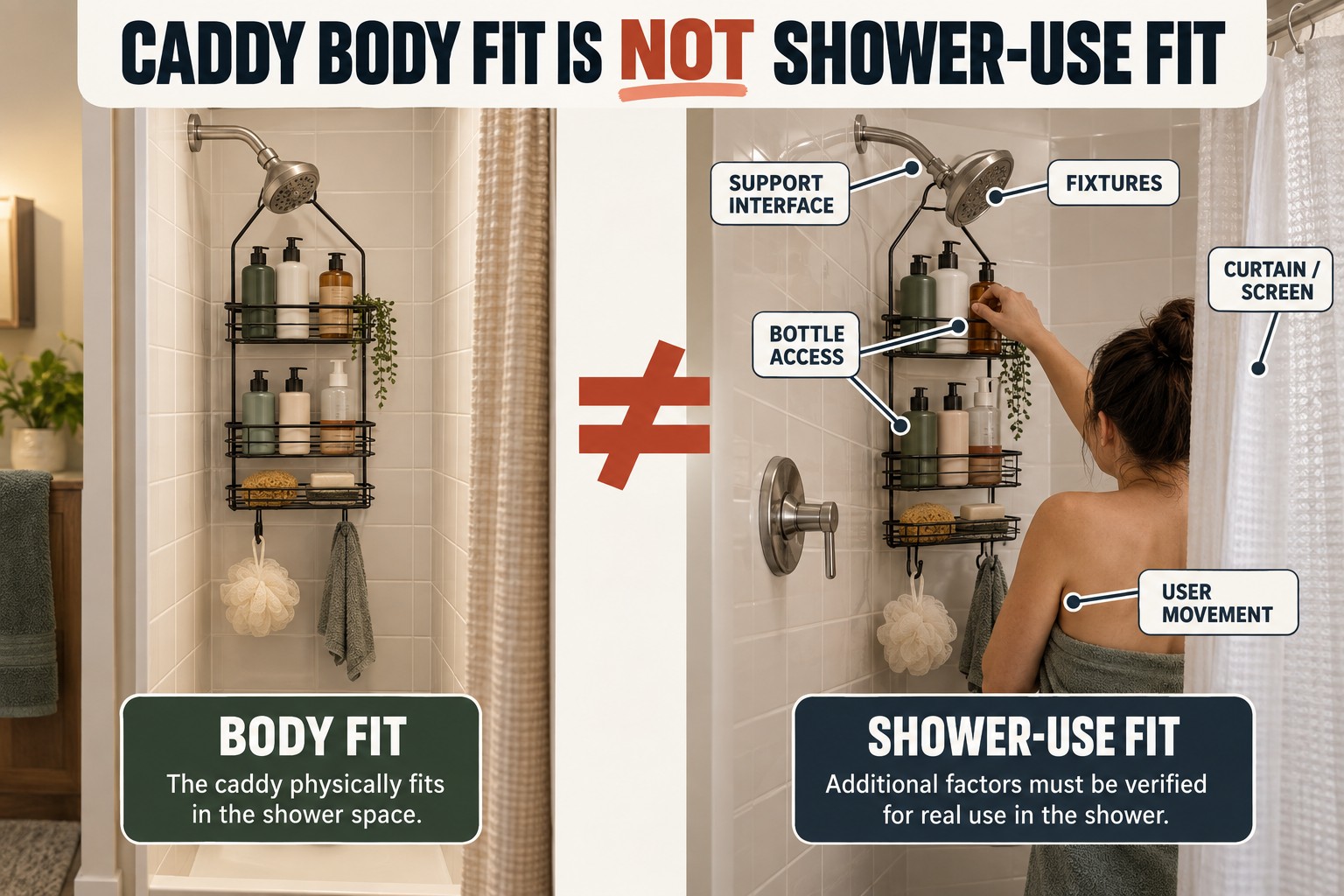
A shower caddy can fit inside a small bathroom and still be the wrong fit for the shower.
That is the part product dimensions alone do not tell you. A caddy has to work with a real shower interface: the floor and ceiling, the shower arm, a corner, or the shower rod that actually supports it. Then it still has to leave bottles accessible and avoid creating a new conflict with the showerhead, fixtures, curtain, screen, or the way you move inside the shower.
Caddy body fit does not automatically mean shower-use fit.
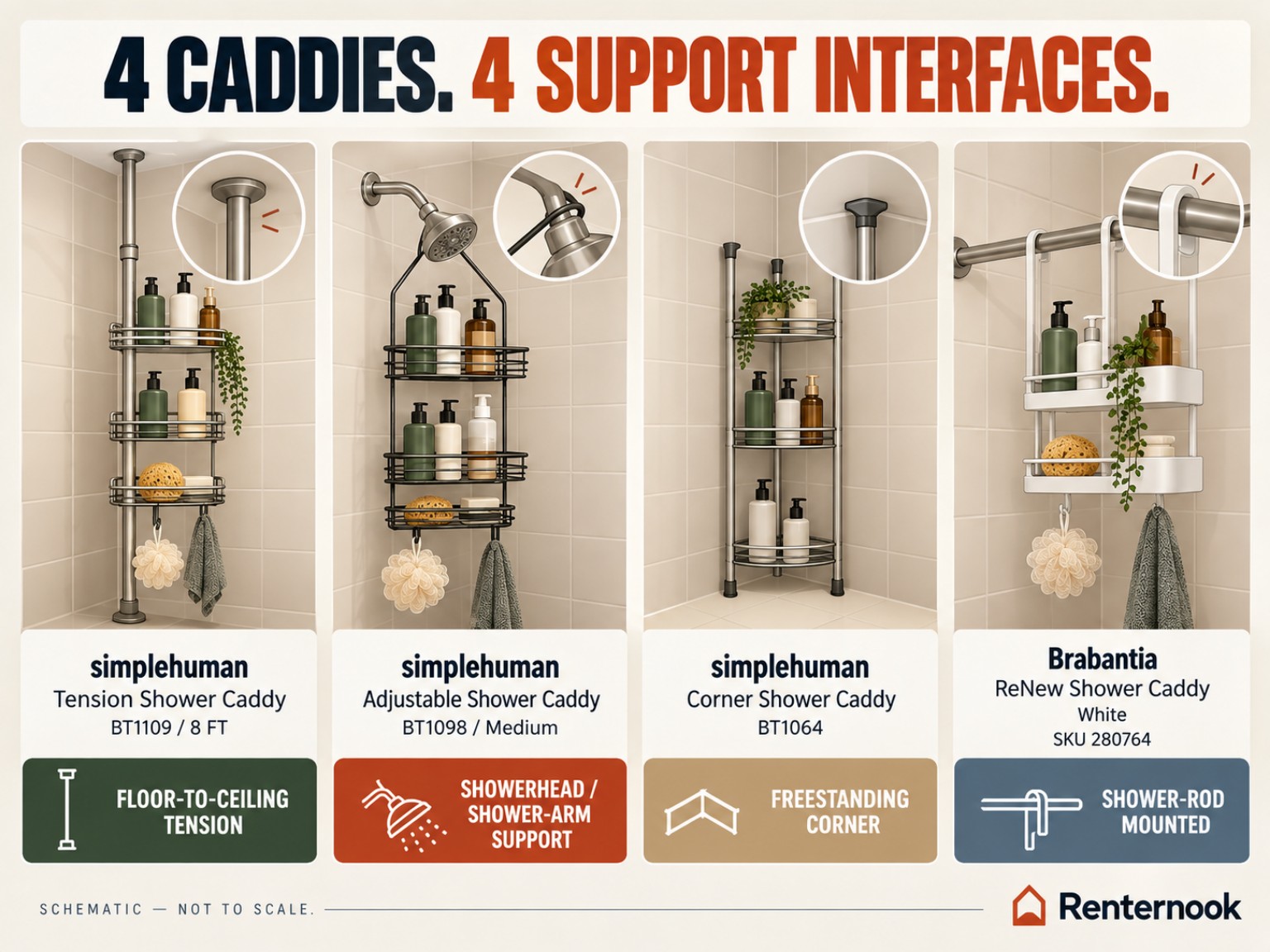
This guide compares four different support architectures and shows what to verify before choosing a shower caddy for a small bathroom. It does not rank the products from best to worst; the first question is whether the support interface matches your actual shower.
If you are working through storage elsewhere in the same room, see our fit-first guides to over-the-toilet storage for small bathrooms and narrow bathroom storage cabinets. Those are different storage interfaces; this article stays focused on the shower itself.
Quick comparison: four caddies, four support interfaces
| Product | Support type | Recorded body size | Key support condition | Published load |
|---|---|---|---|---|
| simplehuman Tension Shower Caddy BT1109 / 8 FT |
Floor-to-ceiling tension pole | 12.7 in W × 8.7 in D × 96.1 in H | 5-to-8-ft operating range; high-compression spring and rubber feet | Unknown in the locked evidence |
| simplehuman Adjustable Shower Caddy BT1098 / Medium |
Showerhead / shower-arm support with lower stabilization | 13.3 in W × 4.3 in D × 26.5 in H | Recorded shower-arm range approx. 0.75–1.0 in / 1.9–2.5 cm | Unknown in the locked evidence |
| simplehuman Corner Shower Caddy BT1064 |
Freestanding corner system | 13.2 in W × 8.5 in D × 30.5 in H | Corner placement with adjustable feet | Unknown in the locked evidence |
| Brabantia ReNew Shower Caddy White / SKU 280764 |
Shower-rod mounted | 24.4 cm × 13.3 cm × 7.5 cm | Rod diameter 16–28 mm; at least 15 mm between rod and wall | Up to 2 kg / 4.4 lb |
Why these four are not interchangeable
The biggest difference between these products is not simply how many bottles they can hold. It is what part of the shower has to support them.
The simplehuman BT1109 depends on a floor-to-ceiling tension interface. The BT1098 depends on the showerhead or shower-arm area plus lower stabilization. The BT1064 is a freestanding corner system. The Brabantia ReNew 280764 mounts to a compatible shower rod.
That means the first question should not be, “Which caddy is smallest?” It should be, “Which support interface does my shower actually provide?” Only after that question is answered does body size become useful.
The 6-step shower-interface fit check
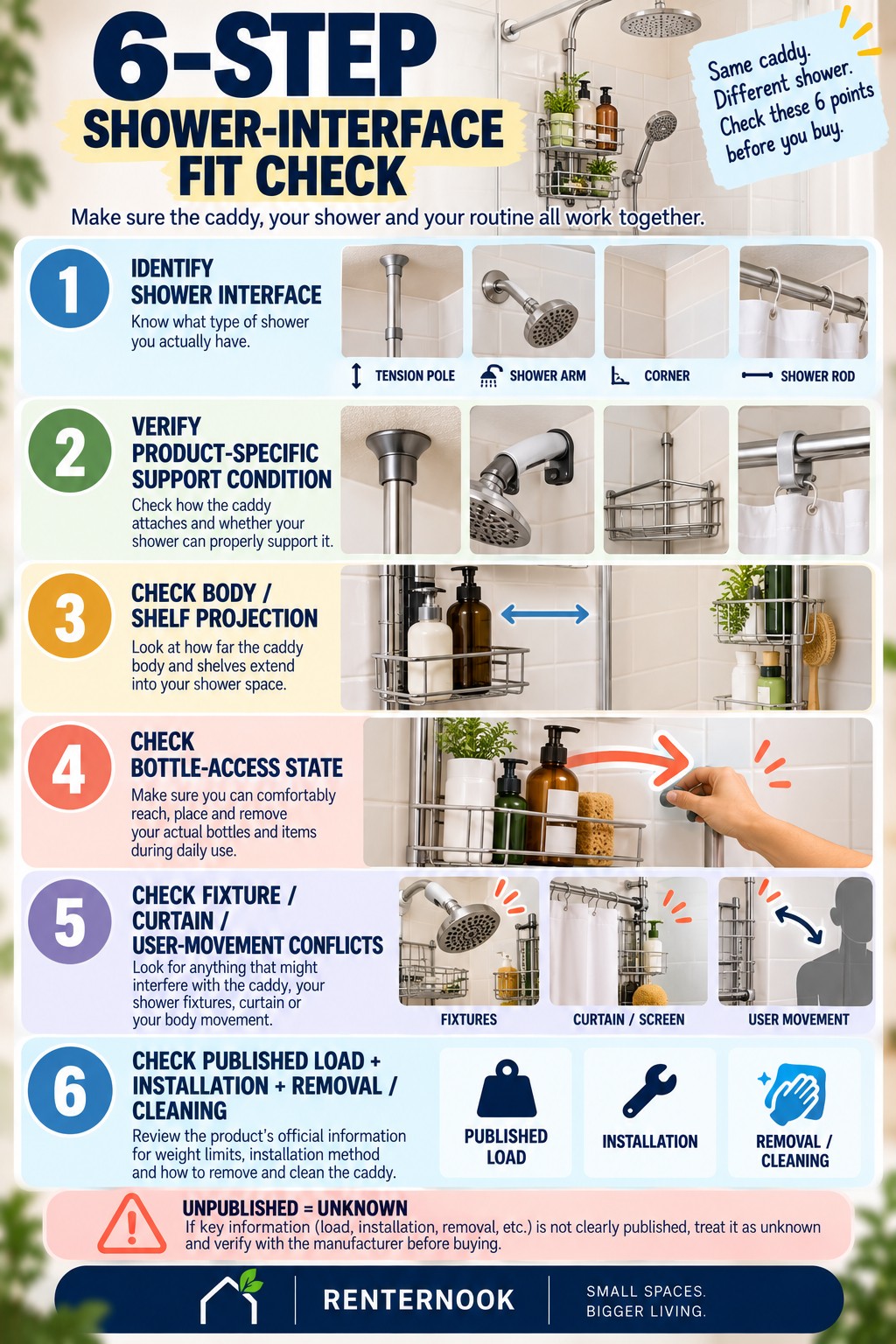
1. Identify the shower interface
Start with the shower itself, not the product photo. Look at the physical support point the caddy would need to use.
- Floor-to-ceiling tension path
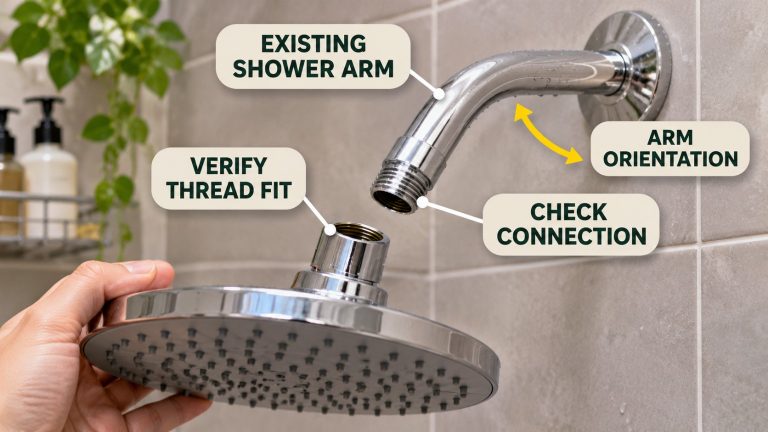
- Showerhead or shower arm
- Freestanding corner
- Shower rod
Do not assume that two caddies sold for the same bathroom use the same support condition.
2. Verify the product-specific support condition
Once you identify the interface, check the exact requirement for that product.
- BT1109: 5-to-8-ft tension range.
- BT1098: shower-arm / showerhead support system with lower stabilization.
- BT1064: freestanding corner placement.
- Brabantia 280764: 16-to-28-mm shower rod plus at least 15 mm rod-to-wall distance.
A product can physically fit inside the shower and still fail here if its support interface does not match the shower.
3. Check body and shelf projection
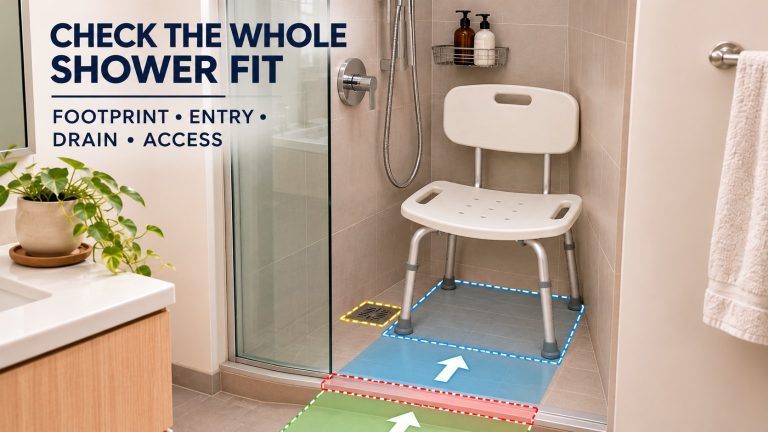
Do not measure only the wall or floor footprint. Look at how far the caddy, basket, or shelf projects into the usable shower area.
Published body dimensions tell you the product body. They do not automatically prove how the installed product will interact with your fixtures, curtain, screen, or body movement. If a required projection or clearance is not published, keep it unknown.
4. Check the bottle-access state
An empty caddy is not the final working state. Think about the actual bottles you plan to store.
Can the shelves be positioned for taller containers? Can you reach, place, and remove bottles without another shelf, fixture, or shower component blocking access?
The simplehuman models in this guide provide adjustable shelf arrangements, but that does not create a universal bottle-clearance number. The exact bottle set still has to be checked against the selected configuration.
Unpublished bottle clearance = unknown.
5. Check fixture, curtain, and user-movement conflicts
This is where a caddy that “fits” can still become inconvenient in real use. Check the installed position against:
- showerhead and shower arm
- faucet or controls
- handheld hose
- curtain or screen
- other shower accessories
- the space you actually use while showering
Do not convert product dimensions into a universal user-clearance rule. There is no single clearance number in this guide that works for every shower; the check has to be made against the actual shower.
6. Check published load, installation, removal, and cleaning
Load limits deserve their own check. For the Brabantia ReNew 280764, a load of up to 2 kg is published. For the three locked simplehuman products in this guide, a product-specific load limit has not been established in the locked evidence.
That does not mean the load limit is zero. It means unknown.
The same rule applies to installation, removal, and cleaning. Use the exact procedure published for the product. Do not turn terms such as “no drilling,” “adjustable,” “suction-supported,” “tension-mounted,” or “freestanding” into broader claims such as renter safe, no damage, works on tile, or universal compatibility.
Product notes
1. simplehuman Tension Shower Caddy — BT1109 / 8 FT
This is the floor-to-ceiling option in the locked set. The key evidence is the tension architecture: a reinforced pole uses a high-compression spring and rubber feet, with an operating range of 5 to 8 feet.
The caddy has three adjustable wire-frame shelves. That gives you flexibility to change shelf positions, but it does not prove that every bottle combination will work.
For a small shower, check the complete installed state: pole position, shelf projection, fixture location, curtain or screen movement, and actual bottle access.
Published product-specific load, shelf dimensions, bottle capacity or clearance, and required user clearance remain unknown.
2. simplehuman Adjustable Shower Caddy — BT1098 / Medium
BT1098 moves the support point away from the floor and ceiling and toward the showerhead area. Its adjustable shelves can move up, down, and sideways.
That can help organize different bottle heights, but the adjustable state itself does not prove working fit. This model needs a compatible shower-arm / showerhead interface and lower stabilization, so nearby hardware matters.
Before choosing it, check the relationship between the shower arm, showerhead, lower support position, faucet or controls, any handheld hose, and the caddy body.
The locked evidence does not establish a universal suction-surface rule, load limit, bottle-clearance number, or fixture-clearance number. Those remain unknown.
3. simplehuman Corner Shower Caddy — BT1064
The BT1064 takes a different route: it does not depend on a ceiling, shower arm, or shower rod. It is a freestanding corner caddy with adjustable feet and adjustable shelves.
For a small bathroom, that changes the fit problem rather than removing it. Check how much of the shower corner the body occupies, what the recorded 8.5-inch depth interacts with, whether the base sits correctly in the actual corner, and whether you can access the shelves without creating a conflict with the shower area.
Published product-specific load, shelf dimensions, loaded stability limits, and user-clearance requirements remain unknown.
4. Brabantia ReNew Shower Caddy — White / SKU 280764
The Brabantia uses a more specific shower-rod interface. The published fit condition is a rod diameter of 16 to 28 mm and at least 15 mm between the rod and wall.
Its published dimensions are 24.4 × 13.3 × 7.5 cm, and the published load is up to 2 kg. It can be positioned at a chosen height during mounting, and the published product information says it can be removed for cleaning. The bottom includes drainage holes.
Those are useful product-specific facts, but they still do not answer every working-fit question. The locked evidence does not establish an exact bottle-height limit, loaded bottle projection, shower-curtain clearance, or user-movement clearance. Those remain unknown.
How to make the final decision
- Find the support interface your shower actually has.
- Eliminate any product whose required support condition does not match.
- Check the installed body and shelf projection.
- Configure the caddy around your real bottles.
- Check the installed and loaded state against fixtures, curtain or screen, and shower movement.
- Verify published load, installation, removal, and cleaning information.
Anything still unpublished at the end of that process should stay unknown. Do not turn missing information into an assumption just because the product looks small enough.
Final takeaway
The useful question is not simply, “Will this shower caddy fit in my bathroom?”
The better question is: Will this exact caddy, using its required support interface, still work once it is installed, loaded with my bottles, and used inside my actual shower?
That is the difference between caddy body fit and shower-use fit. For a small bathroom, that difference matters more than another inch saved on a product listing.