
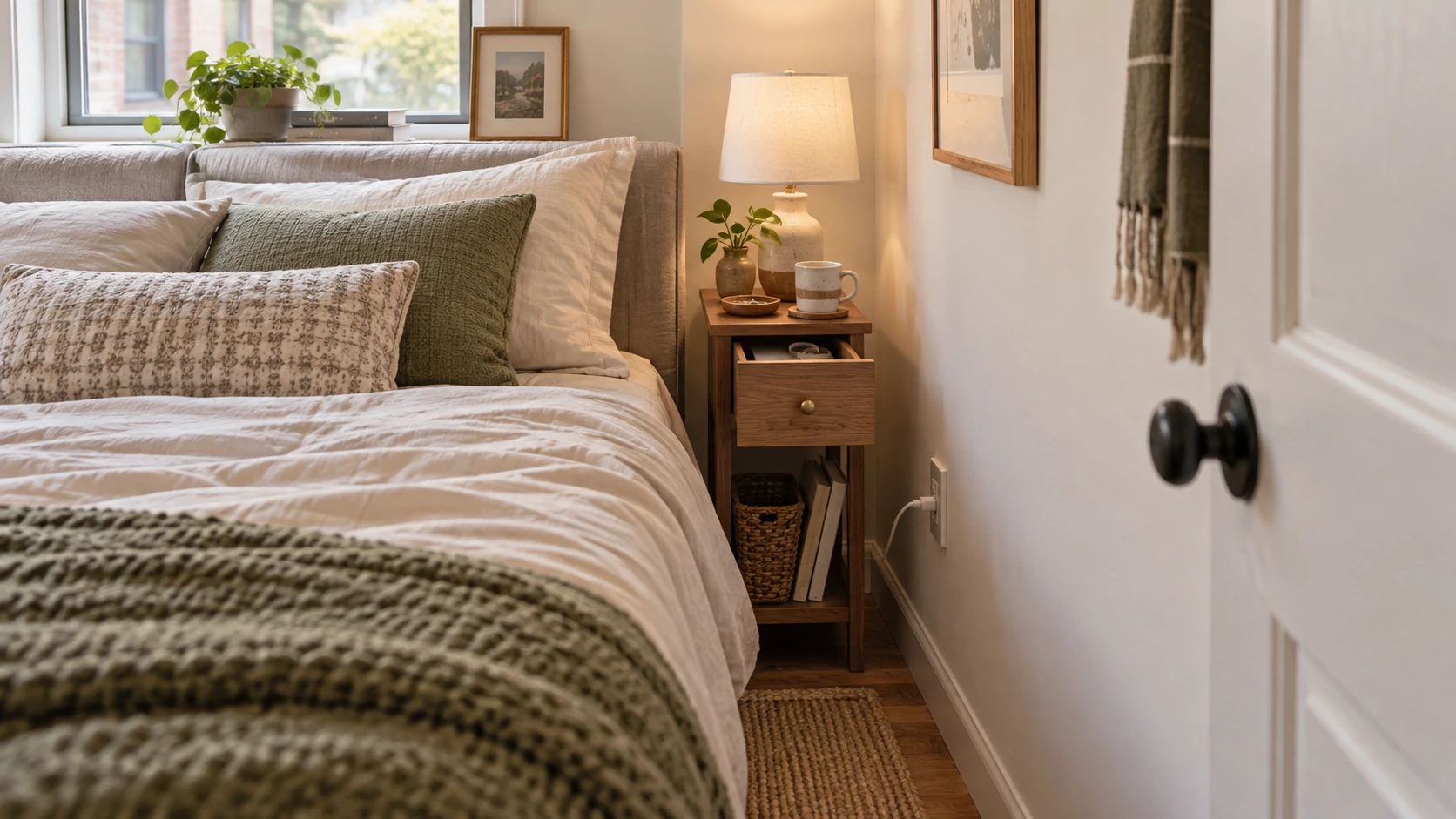
Narrow Nightstands for Small Bedrooms: Check Bedside Gap, Front-Access Clearance, and Outlet Access Before You Buy
A narrow nightstand can fit beside your bed and still be the wrong choice for the space.
The reason is simple: width is only one part of the fit.
A nightstand may be narrow enough to slide into the gap beside your bed but still project too far into the room, leave too little space to open a drawer, or block an outlet you use every day.
So before comparing styles, finishes, drawers, or charging features, check three things:
- Bedside gap and overall footprint
- Front-access clearance
- Existing outlet and cable access
Think of these as a three-point fit check before you buy.
Start With Your Actual Bedside Gap
Do not start with the product photo.
Start with the space beside your bed.
Measure the actual available gap between the bed and whatever sits next to it, such as:
- a wall
- a closet
- another piece of furniture
- a doorway
- a circulation path
Also look at the bed frame itself.
A bed frame, headboard, or base may project beyond the mattress and reduce the space that is actually usable.
Once you know your available space, compare it with the verified external width of the nightstand.
But do not stop there.
You also need to check depth.
A very narrow nightstand can still extend surprisingly far into the room.
Fit Point 1: Check Width and Depth Separately
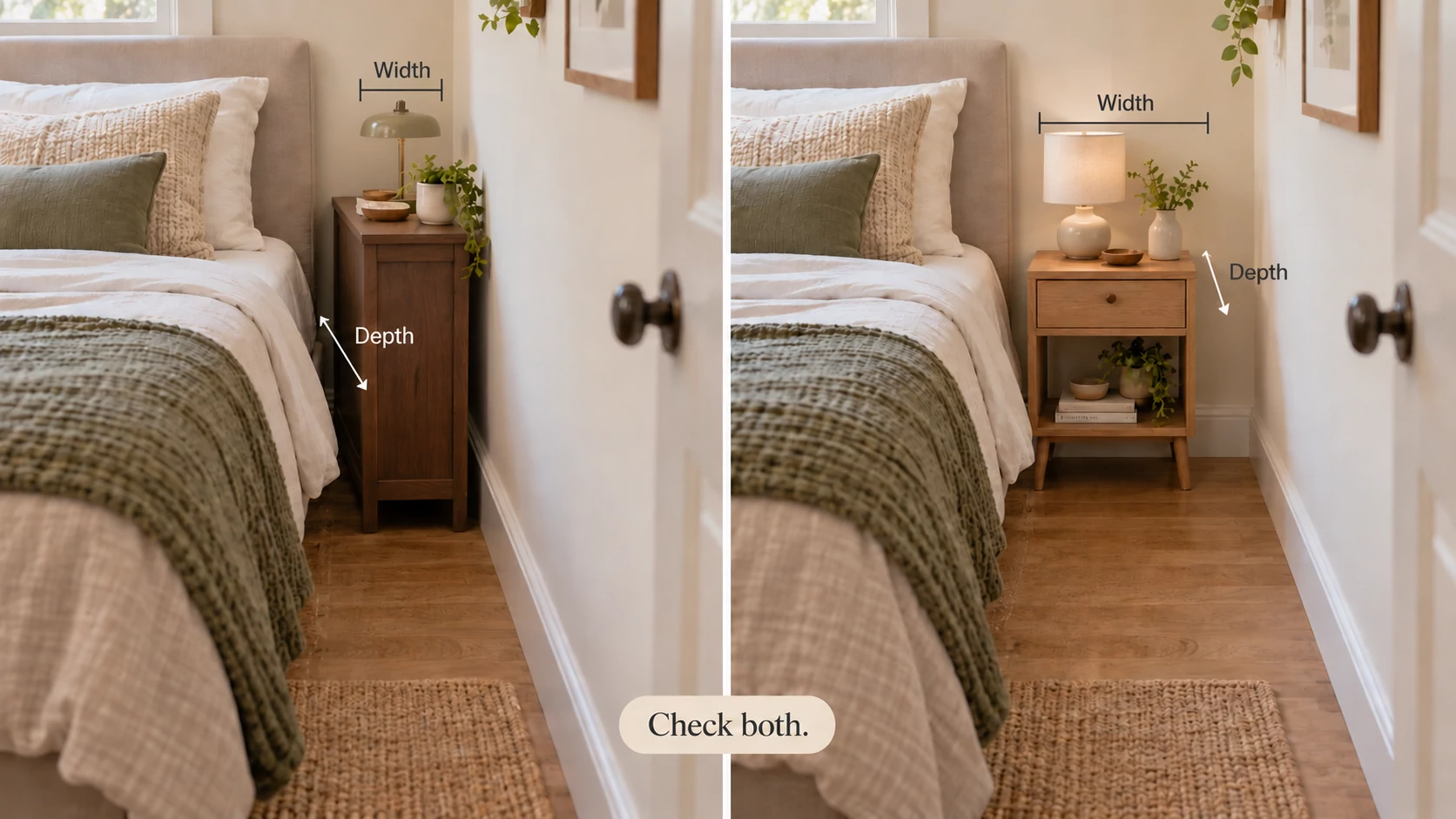
“Narrow” does not automatically mean “small footprint.”
For example, the GiraTree Fluted Small Nightstand is listed at approximately:
11.02 in. W × 23.62 in. D × 22.83 in. H
Its width is extremely narrow, but its depth is much larger.
The HOMCOM 839-948V80BK follows a similar pattern:
14 in. W × 23.6 in. D × 23.6 in. H
Compare those with the IKEA KNARREVIK:
16.5 in. W × 13.25 in. D × 20.5 in. H
The KNARREVIK takes more bedside width, but it is substantially shallower.
That difference matters in a small bedroom.
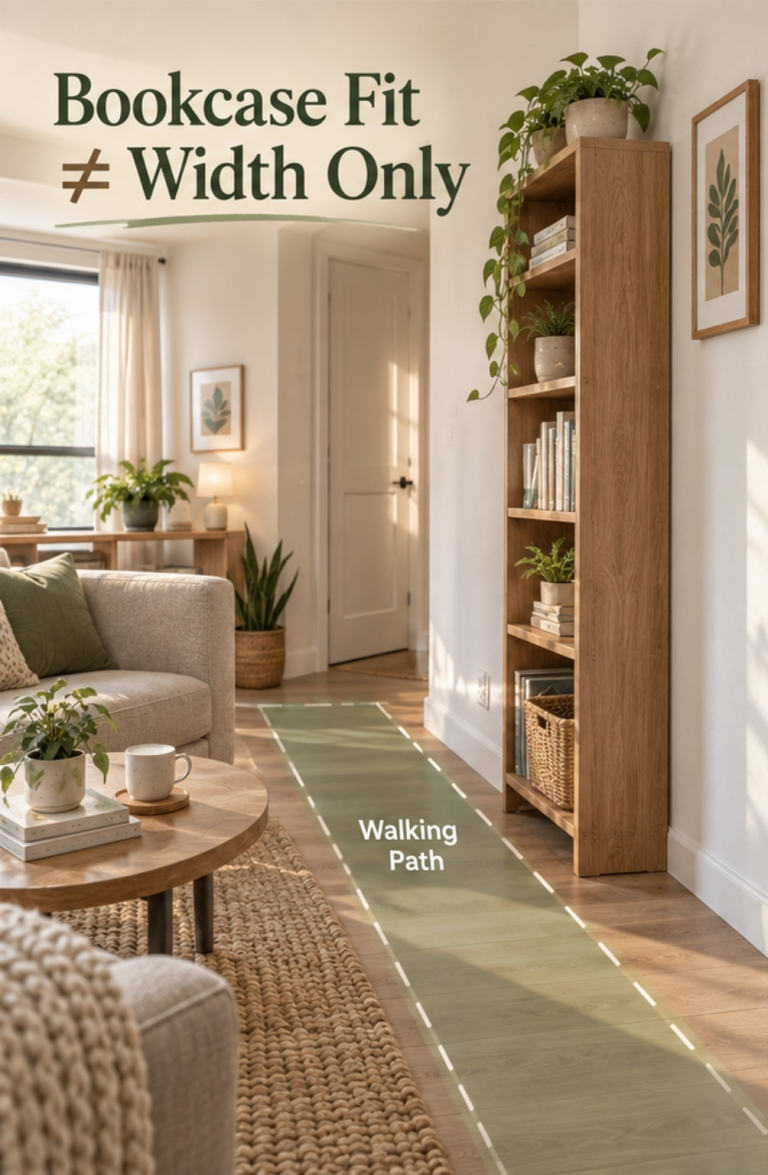
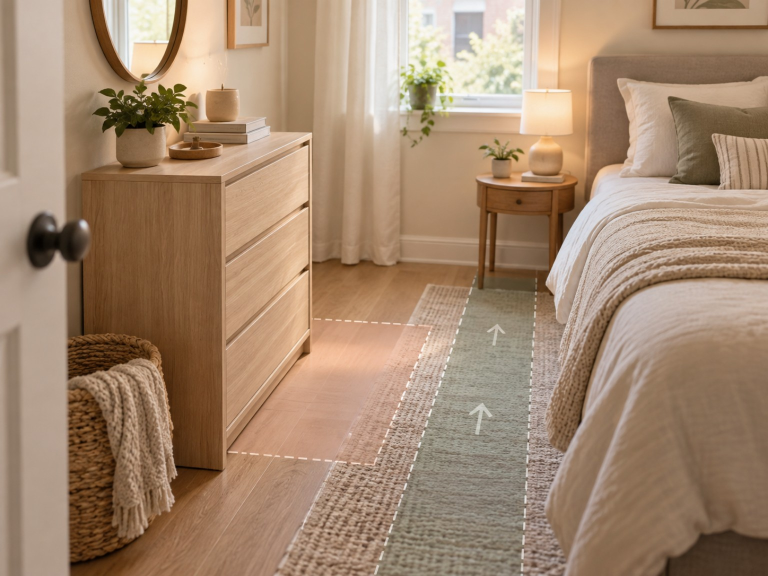
A nightstand may fit between the bed and wall but still project too far into the walking area.
Fit Rule
Do not ask only:
“Is this nightstand narrow enough?”
Also ask:
“How far will it project into the room?”
Width fit and depth fit are two separate checks.
Fit Point 2: Make Sure You Can Actually Use the Storage

A nightstand can physically fit in the space and still be difficult to use.
Before buying, check what parts of the nightstand move.
That may include:
- drawers
- cabinet doors
- pull-out trays
- handles
- other front-access storage
Then look at what sits directly in front of the nightstand.
A bed frame, nearby furniture, closet door, or wall projection may interfere with the way the storage opens.
For example, the IKEA STORKLINTA includes one drawer and an open shelf.
Its external dimensions are approximately:
15.75 in. W × 18.875 in. D × 20.875 in. H
The drawer itself is verified, but the exact drawer-extension distance was not located in the available product information.
That means you should not treat the drawer’s internal depth as the amount of space required to open it.
Instead, check the actual room layout and confirm that the drawer has enough unobstructed space in front of it.
A Simpler Access Option
The IKEA KNARREVIK uses open storage rather than a drawer or cabinet door.
That removes one moving front-access mechanism.
It does not guarantee that the nightstand will work in every space, but it may simplify the fit decision where front clearance is tight.
A Different Access Design: IKEA NORDKISA
The IKEA NORDKISA has a different operating pattern.
Its dimensions are approximately:
15.75 in. W × 15.75 in. D × 26.375 in. H
Its drawer can be accessed from both sides.
That is useful because access is not limited to one conventional front-facing drawer position.
IKEA also states that a charger cable can be routed through the drawer handle on either side.
That makes the NORDKISA an interesting example of how storage access and cable routing can affect fit, not just width.
However, it is still about 15.75 inches wide.
If your available bedside gap is narrower than the product’s verified 15.75-inch width, its flexible access design does not solve the basic static-fit problem.
Fit Point 3: Check Your Existing Outlet
Before placing any nightstand against the wall, look at your outlet.
Ask:
- Is the outlet directly behind the nightstand?
- Will the nightstand body cover it?
- Will there still be room to reach the plug?
- Where will the cable travel?
- Does the product have a verified cable-management opening?
This is a physical access question, not an electrical-safety assessment.
Built-In Charging Does Not Automatically Solve the Problem
Some nightstands include charging features.
The GiraTree model, for example, has a built-in charging station with outlets and USB ports.
The HOMCOM 839-948V80BK also includes built-in charging, with two AC outlets, two USB ports, and a published power cord.
Those features may be useful.
But the nightstand still needs access to your existing wall power source.
You should still check:
- where the wall outlet sits
- whether the furniture blocks it
- whether the power cord has a practical route
A charging station is a product feature.
It is not proof that the nightstand will work with your particular outlet location.
Compare the Nightstands by Fit Role
Instead of ranking these products from “best” to “worst,” it is more useful to compare the different fit problems they solve.
| Product | Width | Depth | Storage / Access | Cable / Charging | Fit Role | Main Fit Watch-Out |
|---|---|---|---|---|---|---|
| GiraTree Fluted Small Nightstand | 11.02" | 23.62" | Drawer + door | Built-in charging | Ultra-narrow width | Very deep footprint |
| IKEA KNARREVIK | 16.5" | 13.25" | Open shelf | None verified | Shallow open storage | Requires more bedside width |
| IKEA STORKLINTA | 15.75" | 18.875" | Drawer + open shelf | None verified | Conventional drawer storage | Drawer travel not published |
| IKEA NORDKISA | 15.75" | 15.75" | Two-sided drawer + shelf | Verified cable path | Flexible storage access | Not ultra-narrow |
| HOMCOM 839-948V80BK | 14" | 23.6" | Shelf + cabinet door | Built-in charging | Narrow cabinet + charging | Deep footprint + door access |
The goal is not to find the smallest number in the width column.
The goal is to identify which fit role matches your room.
Product specifications and availability can change, so verify current product information before purchasing.
Installation-Dependent Option: Floating Nightstand
There is one additional category worth separating from the freestanding options.
The Ebern Designs Leda Floating Nightstand is approximately:
15.71 in. W × 12.52 in. D × 9.02 in. H
It includes:
- one drawer
- an open shelf
- a cable-management hole
But it is wall mounted.
That makes it a materially different decision from the five freestanding nightstands above.
Before considering a floating nightstand, verify:
- the required installation method
- whether the wall is suitable
- whether installation is permitted in your situation
Do not assume that a floating design is automatically appropriate for a rental.
It is better treated as an installation-dependent option, not a default renter choice.
Which Fit Role Makes Sense for Your Bedroom?
If the Bedside Gap Is Extremely Narrow
Start with verified product width.
But immediately check depth too.
A very narrow but deep nightstand may solve one problem while creating another.
If the Walking Area Is Tight
Pay more attention to depth.
A slightly wider but shallower nightstand may use the room more efficiently than an ultra-narrow model that projects far into the walkway.
If Front Access Is Limited
Open-storage designs may remove the drawer or cabinet-door clearance problem.
You still need to check the overall footprint.
If Cable Routing Matters
Look for a verified cable-management feature rather than assuming that the product has one.
The NORDKISA, for example, has a published cable-routing path through its drawer handles.
If You Are Considering a Floating Nightstand
Treat installation as part of the buying decision from the beginning.
Do not evaluate it only by dimensions.
Before You Buy: Three-Point Fit Checklist
Static Fit
- Measure the actual bedside gap
- Check bed-frame projection
- Compare the product’s verified external width
- Check the product’s verified depth
- Look for interference with nearby furniture or walking space
Operational Fit
- Identify drawers, doors, or pull-out parts
- Check the space in front of the nightstand
- Look for bed-frame or furniture interference
- Do not invent an opening-clearance number when the manufacturer does not publish one
Utility Access
- Locate the existing wall outlet
- Check whether the nightstand body may cover it
- Check physical plug access
- Think through the cable route
- Verify cable-management or charging features from the product information
And finally:
- Verify the installation type
- Recheck current product availability and specifications before purchasing
The Bottom Line
The right narrow nightstand is not necessarily the one with the smallest width.
A better fit is the one whose:
width and depth
front-access requirements
outlet and cable access
all work with your actual bedside setup.
Measure first.
Then compare the products by the type of fit your room actually needs.


One Comment