Folding Step Stools for Small Spaces: Check the Open-to-Storage Fit Before You Buy
A folding step stool can look compact in a product photo and still be a poor fit for a small home.
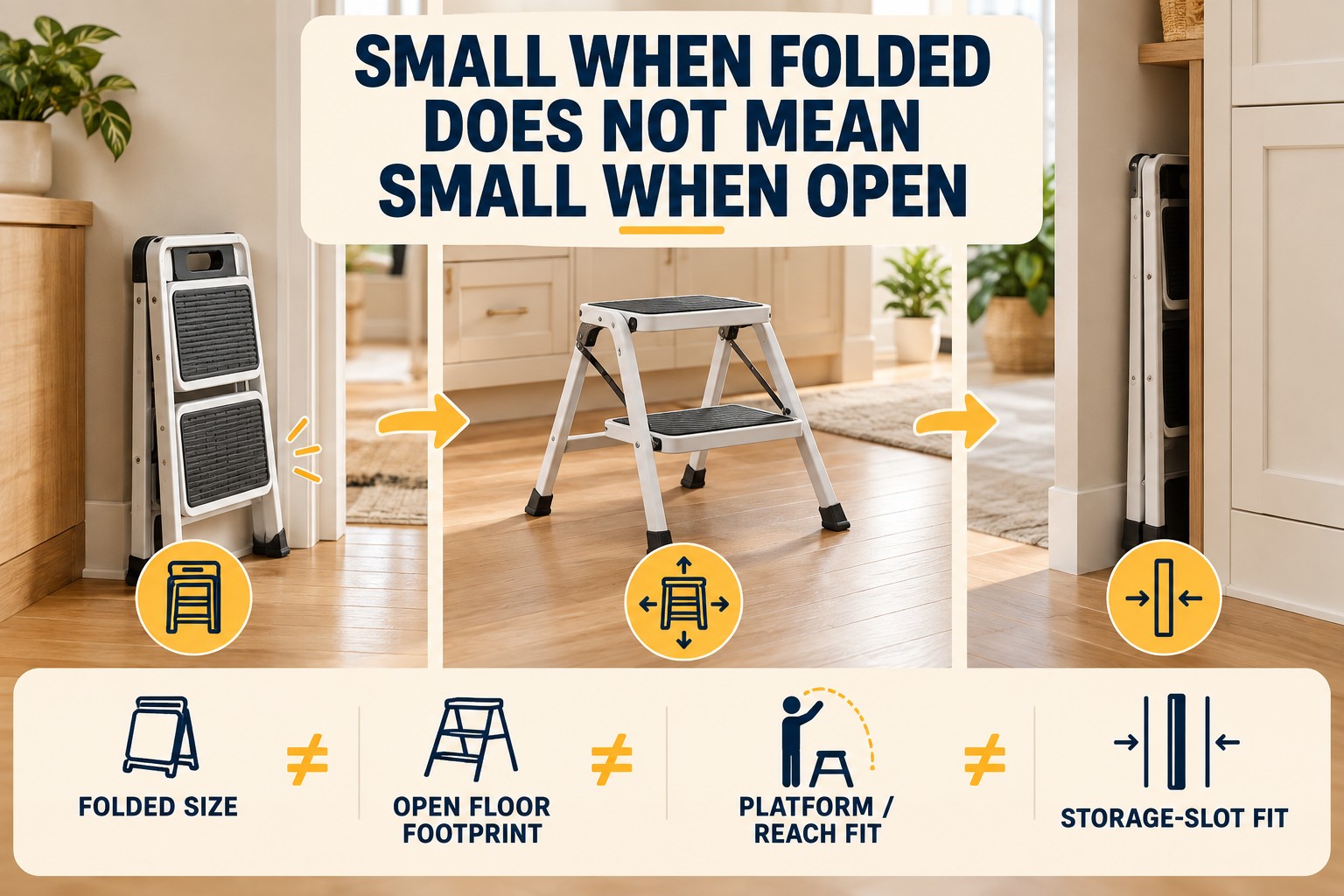
The problem is that a folding step stool does not occupy one fixed amount of space. It changes shape as you carry it out of storage, deploy it, stand on it, fold it again, and return it to its storage slot. A model that stores in a very thin envelope may need much more floor area when open. A taller model may provide a higher standing platform but also create a longer folded body. A low one-step stool may have a simple storage shape while still leaving an unanswered question about its open floor footprint.
That is why this guide uses a fit-first rule:
FOLDED SIZE ≠ OPEN FLOOR FOOTPRINT ≠ PLATFORM / REACH FIT ≠ SUPPORT / STANDING FIT ≠ STORAGE-SLOT FIT
Those are separate checks.
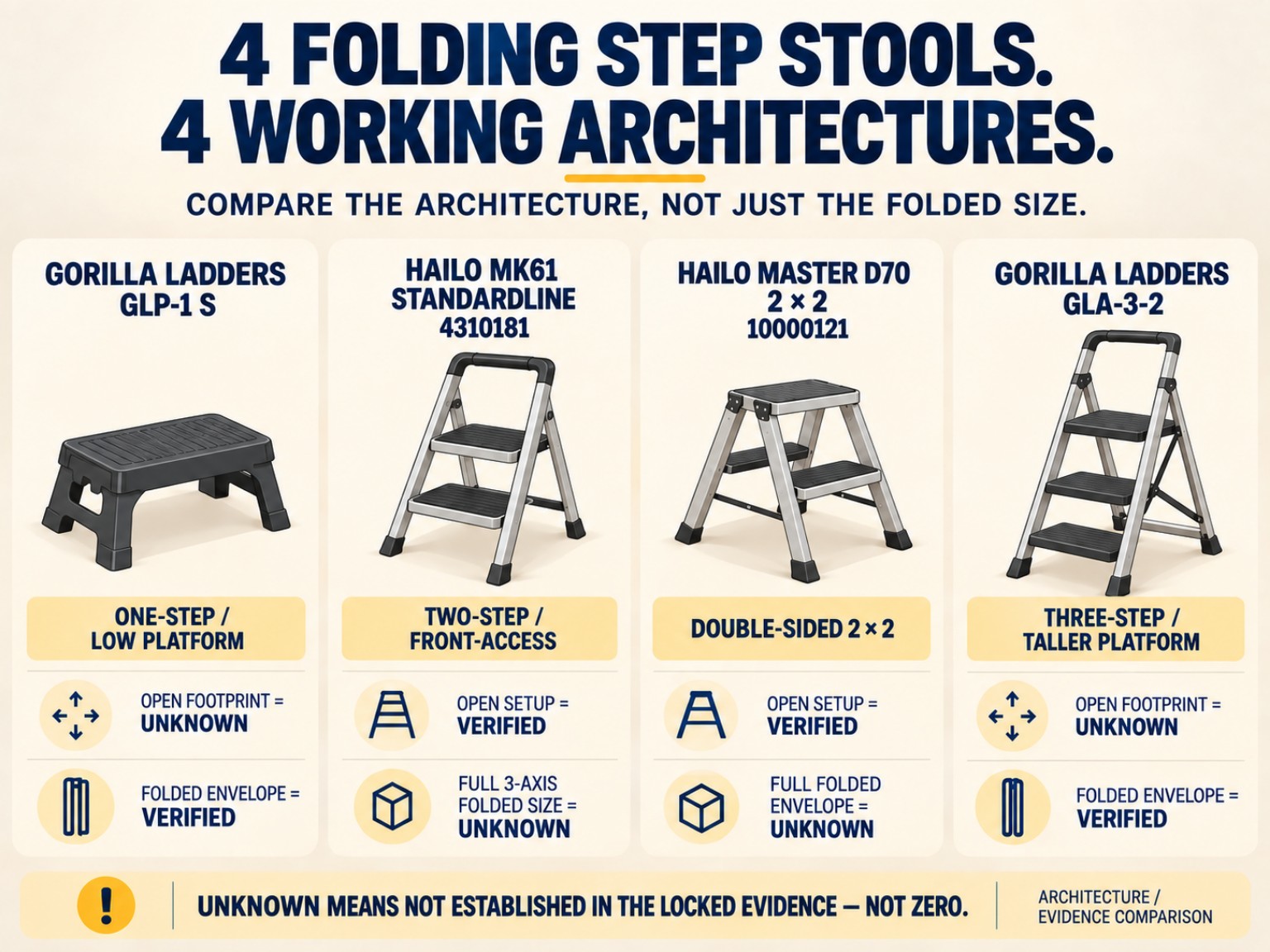
This article compares four locked products without ranking them:
- Gorilla Ladders GLP-1 S
- HAILO MK61 StandardLine 4310181
- HAILO Master D70 2 × 2 10000121
- Gorilla Ladders GLA-3-2
The goal is not to name a winner. It is to show how each product changes from stored state to working state and back again, so you can decide whether the full sequence fits your room and your intended household use.
Quick Comparison: 4 Folding Step Stools
| Product | Step / platform evidence | Open floor evidence | Folded / storage evidence | Load rating | Lock / contact evidence |
|---|---|---|---|---|---|
| Gorilla Ladders GLP-1 S | 1 step; 8.5 in platform height; top platform 11.8 × 8.75 in | UNKNOWN | 17 × 13.25 × 1 in folded; 3 lb product weight | 300 lb | Soft-touch tread; solid platform; non-marring feet; exact deployment / lock mechanism not established in the locked evidence |
| HAILO MK61 StandardLine 4310181 | 2 steps; 44 cm platform height; 45 cm total height | 49 × 49 cm setup width / depth | Manufacturer states 4 cm narrow when folded; full three-axis folded envelope UNKNOWN; package size must not be used as folded size | 150 kg | Hinge lock with release button; anti-slip mats; non-slip plastic feet; carry handle |
| HAILO Master D70 2 × 2 10000121 | 2 × 2 steps; 40 cm platform height; 12 cm step depth | 41 × 48 cm setup width / depth | Full folded envelope UNKNOWN; 47 × 41 × 19 cm is package size, not folded size | 150 kg | Galvanized-steel safety catch; rubber-coated plastic feet; exact step width UNKNOWN |
| Gorilla Ladders GLA-3-2 | 3 steps; 2 ft 6 in platform height; top platform 14 × 12 in | UNKNOWN | 53.6 × 18.4 × 3.2 in folded; 8 lb product weight | Type I, 250 lb | Non-marring feet; tool organizer; exact open footprint not established in the locked evidence |
Important: A published load rating is not a quality score, a universal stability rating, or proof that a product is suitable for a particular user. A published platform height is also not a promise of how high you can safely reach.
If a required value is not established in the locked evidence, this guide keeps it UNKNOWN.
Why “Compact” Is a Multi-State Question
A folding step stool moves through several physical states.
First, it has to fit wherever you store it. Then it has to come out of that slot without colliding with nearby furniture. It has to open fully. Its feet or support points need enough floor area. The standing surface has to be at a useful height for the task. The user still needs room to approach, step up, work, and step down. After the task, the stool has to unlock or fold, move back through the room, and return to storage.
Those states are related, but they are not interchangeable.
A one-inch folded depth tells you something useful about storage. It does not tell you the floor footprint when the stool is open.
A 44 cm platform height tells you the standing level. It does not tell you whether a particular person can safely reach a particular shelf.
A 150 kg load rating tells you the published load capacity. It does not tell you that the stool is automatically suitable for every user, floor surface, task, or working posture.
For a small space, the right question is therefore not:
“Which stool is smallest?”
The better question is:
“What does this exact stool require through the entire stored → open → standing → fold-back → stored sequence?”
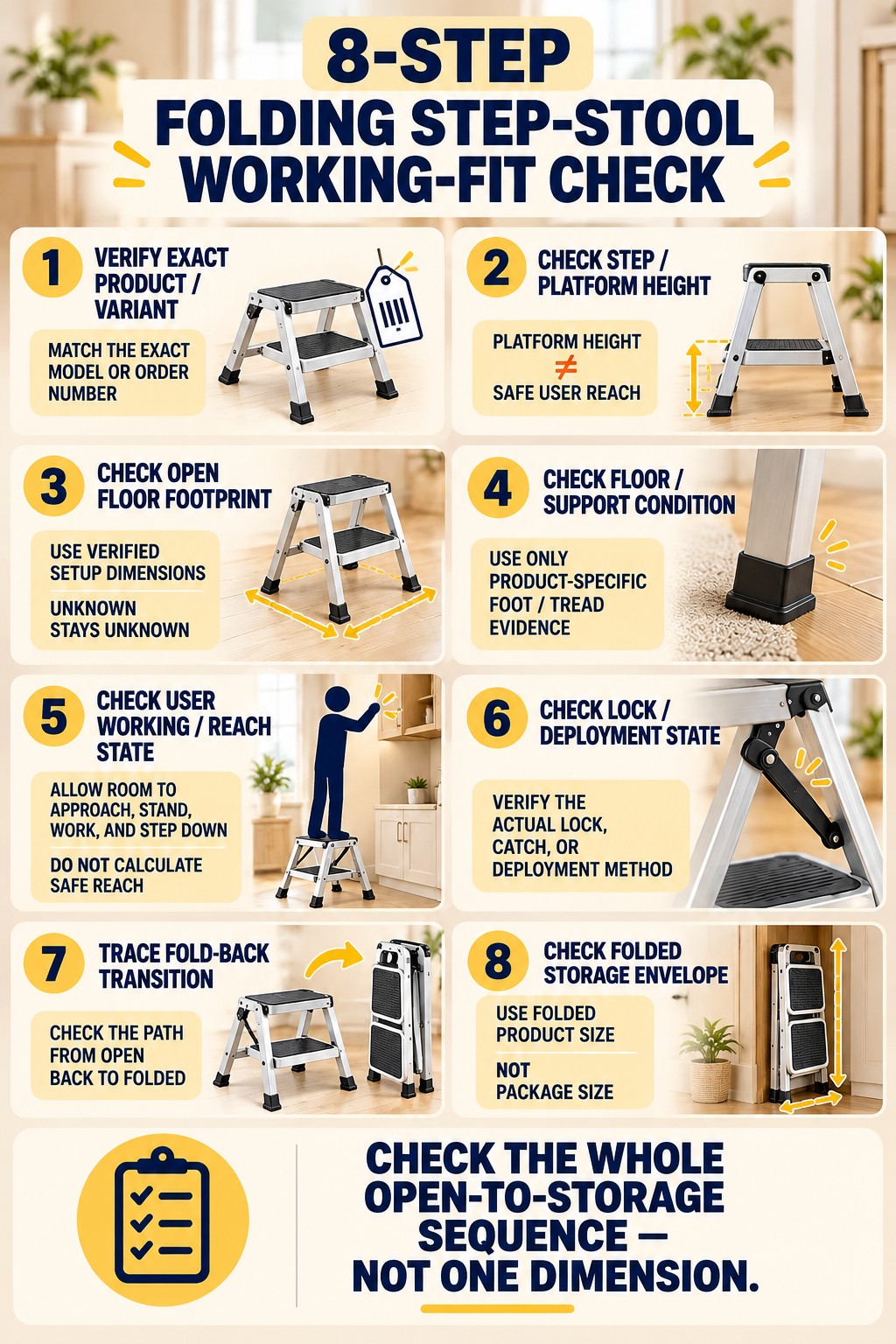
The 8-Step Working-Fit Method
Use the same sequence for every folding step stool you are considering.
1. Verify the exact product and variant
Start with the model number, order number, or exact variant.
Do not assume two products with similar names share the same dimensions, duty rating, step geometry, or folding mechanism. The four products in this guide are treated as four exact identities, not as generic brand families.
2. Check the step or platform height
Record the manufacturer-published standing or platform height for the exact product.
This tells you where the standing surface is located. It does not tell you your personal safe reach.
Do not turn a platform height into a reach calculation. Do not add a user’s height, arm length, or a generic reach allowance and call the result a safe working height.
3. Check the open floor footprint
This is one of the most important small-space measurements.
When a manufacturer publishes setup width and depth, use those values as the open setup evidence.
When the open footprint is not established, keep it UNKNOWN.
Do not reverse-engineer an open footprint from folded dimensions, product photos, platform size, leg angles, or a package box.
4. Check the floor and support condition
Look at what the manufacturer actually states about feet, treads, or floor contact.
A non-marring foot, rubber-coated foot, or anti-slip surface is useful product-specific information. It is not proof of universal compatibility with every floor material, slope, surface condition, rug, mat, or wet area.
The actual household floor condition remains part of the user’s own fit check.
5. Check the user working and reach state
Now look beyond the stool body.
Ask where your body will be while stepping up, standing, turning, handling an object, and stepping down. Check nearby cabinet doors, counters, furniture edges, appliances, and circulation paths.
Do not use a manufacturer’s reach-height figure as a universal promise. Platform height and safe user reach are different questions.
6. Check the lock and deployment state
A folding product has to reach its intended open state before use.
If the locked evidence identifies a hinge lock, release button, or safety catch, include that mechanism in the deployment sequence.
If the exact mechanism is not established in the evidence, do not invent one from a photo or from another product in the same brand.
7. Trace the fold-back transition
The job is not finished when you step down.
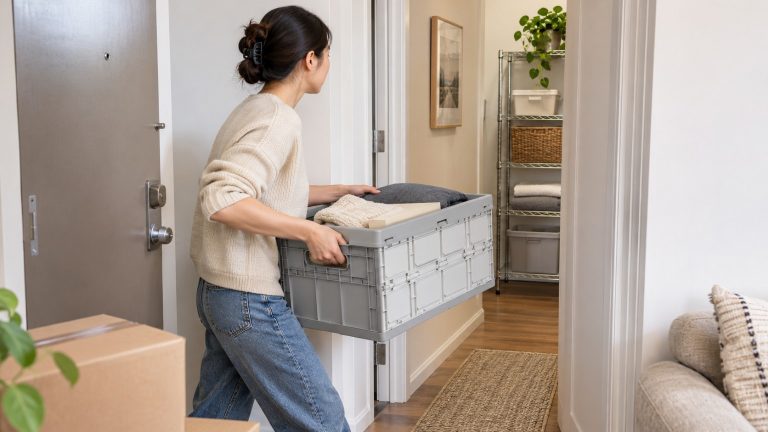
Think through what happens next: release, fold, rotate, carry, and clear nearby objects. A product can fit when fully open and fit when fully folded while still being awkward during the transition between those two states.
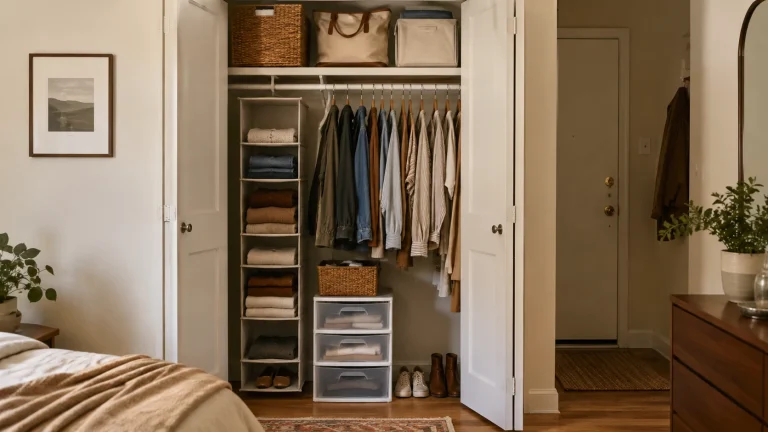
That transition is especially important in narrow kitchens, utility rooms, closets, and small apartments where there may be little spare turning room.
8. Check the folded storage envelope
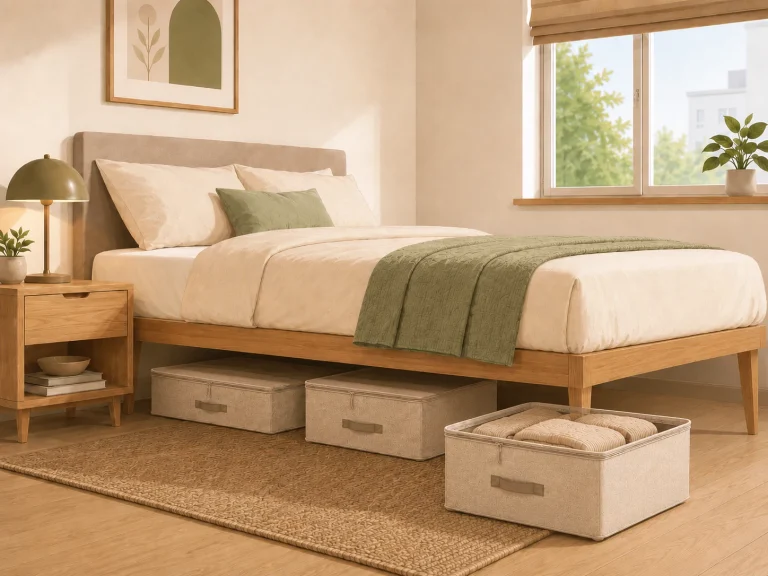
Finally, compare the verified folded dimensions with the actual storage slot.
Use complete folded dimensions only when they are published for the product itself.
Do not substitute package dimensions. A shipping carton may include packaging material, a different orientation, or other space that does not describe the folded product.
If only one folded dimension is verified, then only that dimension is known.
Product 1: Gorilla Ladders GLP-1 S
The Gorilla Ladders GLP-1 S is the one-step plastic model in the locked set.
Its published platform height is 8.5 inches, and the top platform measures 11.8 × 8.75 inches. The product weight is 3 lb, and the published maximum load is 300 lb.
For storage, the folded dimensions are:
- 17 in
- 13.25 in
- 1 in
That gives the GLP-1 S a clearly defined thin folded state.
The locked evidence also establishes a soft-touch tread, a solid platform, non-marring feet, and plastic construction.
What the numbers do tell you
The 1-inch folded dimension is useful if you are evaluating a narrow storage gap.
The 8.5-inch platform height is useful if you are comparing standing levels among exact products.
The 11.8 × 8.75-inch platform dimensions describe the top standing surface.
These are three different types of fit evidence.
What remains UNKNOWN
The open floor footprint is UNKNOWN in the locked evidence.
That matters because the folded envelope cannot be used as a stand-in for the open state. The stool has to spread or deploy into its usable configuration, and this draft does not invent the resulting floor dimensions.
The exact deployment or locking mechanism is also not established in the locked evidence used here.
So for a small-space decision, the GLP-1 S gives you strong folded-storage evidence but incomplete open-floor evidence.
That is not a defect finding. It is an evidence boundary.
Product 2: HAILO MK61 StandardLine — 4310181
The HAILO MK61 StandardLine is a two-step steel-and-plastic folding step.
The locked evidence establishes:
- 2 steps
- 49 × 49 cm setup width / depth
- 45 cm total height
- 44 cm platform height
- 3.6 kg product weight
- 150 kg load capacity
Unlike the GLP-1 S, this model has a published setup width and depth, so its open floor state is more directly described.
The product also has two large steps with anti-slip mats, non-slip plastic feet, a practical carry handle, and a hinge lock with a release button.
The useful small-space distinction
For this product, the open setup evidence is relatively clear: 49 × 49 cm.
The folded state is less complete.
The manufacturer states that it is 4 cm narrow when folded down. That is useful as one folded-state dimension.
But the full three-axis folded envelope is UNKNOWN in the locked evidence.
A package size exists in the manufacturer information, but package size is not folded product size. This guide therefore does not use the package dimensions to complete the missing folded envelope.
Why that matters
Imagine you have a 5 cm-wide storage gap.
The verified 4 cm folded dimension may be relevant to that one constraint, but a storage slot is three-dimensional. You still need the other two product dimensions in the folded orientation to confirm full slot fit.
One verified dimension does not become three dimensions just because the product is described as compact.
Product 3: HAILO Master D70 2 × 2 — 10000121
The HAILO Master D70 in the locked 2 × 2 configuration is a double-sided aluminum folding step.
Its verified setup width and depth are:
- 41 cm
- 48 cm
Its total height and platform height are both 40 cm.
The locked evidence also establishes:
- 2 × 2 steps
- 12 cm step depth
- 2.8 kg product weight
- 150 kg load capacity
- galvanized-steel safety catch
- plastic feet with a rubber-coated surface
Because it is accessible from both sides, its working pattern differs from a one-direction step stool. That does not automatically make it a better fit; it changes what you need to check around it.
Open state: known
The 41 × 48 cm setup dimensions provide an actual open-state footprint reference.
That is useful for checking whether the stool body itself can deploy in the intended floor area.
You still need to consider the user’s approach and working space separately. The footprint is not the same thing as complete user clearance.
Folded state: incomplete
The full folded envelope is UNKNOWN in the locked evidence.
The published 47 × 41 × 19 cm figure is a package size.
It is not used here as folded product dimensions.
That distinction is critical. If you are checking a closet gap, cabinet side space, or behind-door storage slot, package dimensions cannot close the evidence gap.
The exact step width is also UNKNOWN in the locked evidence; only the 12 cm step depth is established.
Product 4: Gorilla Ladders GLA-3-2
The Gorilla Ladders GLA-3-2 is the three-step aluminum model in the locked set.
Its published platform height is 2 ft 6 in, and the top platform measures 14 × 12 inches.
The folded dimensions are:
- 53.6 in
- 18.4 in
- 3.2 in
The product weight is 8 lb, and the published duty rating is Type I, 250 lb.
The locked evidence also establishes non-marring feet and a tool organizer.
The storage tradeoff is visible
Compared with a low one-step stool, this model has a much taller folded body.
That is not a ranking statement. It is a geometry difference.
A 3.2-inch folded depth may work in a relatively narrow gap, while the 53.6-inch folded length or height may rule out a short cabinet or low storage area.
All three folded dimensions matter.
The open footprint remains UNKNOWN
For this draft, the open floor footprint is UNKNOWN.
Do not infer it from the 14 × 12-inch top platform. Do not infer it from the folded dimensions. Do not estimate it from the visible leg angle.
The platform height also must not be turned into a promise that a user will reach a particular cabinet, shelf, ceiling, or fixture.
For small-space planning, the GLA-3-2 therefore gives you a well-defined folded envelope and standing-platform evidence, but the locked draft still lacks the open floor footprint required for a complete room-fit check.
Cross-Product Comparison: What Is Actually Comparable?
The four products do not provide the same evidence fields.
That means a clean comparison should not force them into a fake spreadsheet where every cell looks equally complete.
Open floor state
- GLP-1 S: UNKNOWN
- HAILO MK61: 49 × 49 cm
- HAILO Master D70 2 × 2: 41 × 48 cm
- GLA-3-2: UNKNOWN
The two HAILO products have verified setup width/depth evidence in the locked set. The two Gorilla products do not.
That does not prove the HAILO products use less floor area. It only means the evidence is more complete for this particular field.
Folded state
- GLP-1 S: 17 × 13.25 × 1 in
- HAILO MK61: one verified folded dimension of 4 cm; full three-axis folded envelope UNKNOWN
- HAILO Master D70 2 × 2: full folded envelope UNKNOWN
- GLA-3-2: 53.6 × 18.4 × 3.2 in
The GLP-1 S and GLA-3-2 have complete folded dimensions in the locked evidence.
The HAILO products do not have complete folded envelopes established here.
For the Master D70, the package dimensions are not used as a substitute.
Standing level
- GLP-1 S: 8.5 in platform height
- HAILO MK61: 44 cm platform height
- HAILO Master D70 2 × 2: 40 cm platform height
- GLA-3-2: 2 ft 6 in platform height
These values can help you compare standing-surface heights.
They cannot tell you your safe reach.
Load rating
The published ratings are:
- GLP-1 S: 300 lb
- HAILO MK61: 150 kg
- HAILO Master D70 2 × 2: 150 kg
- GLA-3-2: Type I, 250 lb
Do not rank the products by these numbers.
A load rating is not a universal stability score, a quality grade, or a personal suitability determination.
The Evidence Boundary Is Part of the Buying Decision
It is tempting to treat an unknown dimension as a research inconvenience.
For a small-space product, it is more useful to treat it as a decision variable.
If your storage slot is generous, a missing folded dimension may not matter much.
If you are trying to fit a stool into a precise 5 cm gap, under a fixed shelf, or beside an appliance, a missing dimension can be the difference between a confident purchase and a guess.
The same logic applies to the open state.
If the stool will be used in an open utility room, an unknown floor footprint may be manageable.
If it must open between a kitchen island and a cabinet run, the footprint may be a hard constraint.
The correct response to a missing field is not to manufacture a number.
It is to decide whether that unknown field is material to your room.
Small-Space Decision Guidance
A useful folding step stool for a small home is not simply the one with the smallest folded number.
Start with your actual constraint.
If the storage slot is the hard limit
Measure the slot in three dimensions.
Then compare it only with verified three-axis folded dimensions.
If a product has only one verified folded dimension, do not assume the other two fit.
If the only available number is a package size, do not use it as a product-size substitute.
If open floor area is the hard limit
Prioritize products with verified setup width and depth.
For products where the open footprint is UNKNOWN, either obtain the missing exact evidence before purchase or treat the fit as unresolved.
Do not estimate from photos.
If standing height is the hard limit
Compare verified platform heights.
Then separately evaluate your own task and working position.
Do not convert the platform height into a universal reach promise.
If deployment space is tight
Look at how the stool opens and locks.
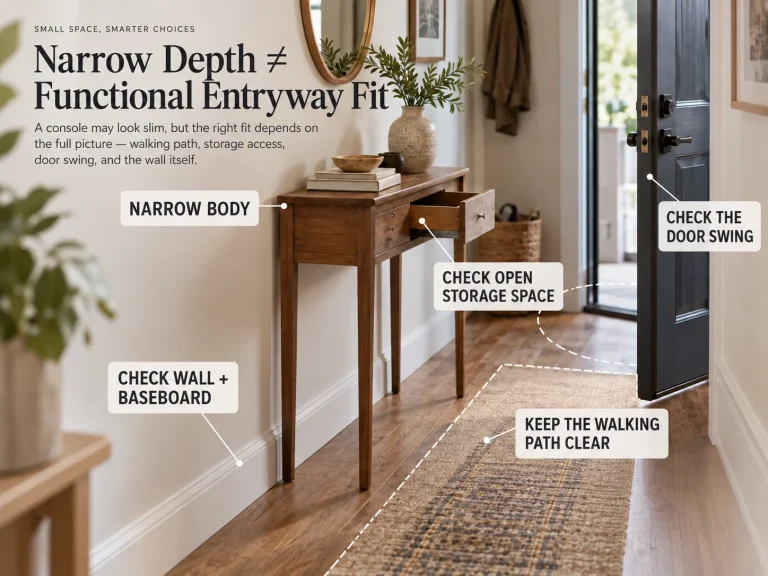
A hinge lock, release button, or safety catch is part of the transition. The stool needs enough room not only to exist when fully open, but to get there.
If the floor surface is a concern
Use manufacturer statements about feet and tread only as product-specific evidence.
Then inspect the real floor condition yourself.
“Non-marring,” “non-slip,” or rubber-coated feet do not establish universal compatibility with every floor and every condition.
Final Pre-Buy Checklist
Before buying a folding step stool for a small space, run this checklist on the exact model.
- Exact identity: Do I have the exact model or order number?
- Platform height: Is the standing height published for this exact variant?
- No reach conversion: Am I avoiding any assumption that platform height equals my safe reach?
- Open footprint: Do I have verified setup width and depth, or is the field still UNKNOWN?
- Floor condition: What does the manufacturer actually state about feet, tread, and support contact?
- Working clearance: Is there room for me to approach, stand, work, turn, and step down?
- Deployment mechanism: Do I understand the verified lock, catch, or release state for this model?
- Fold-back path: Can the stool close and rotate without hitting nearby furniture or fixtures?
- Folded envelope: Do I have actual folded product dimensions in all three axes?
- Package check: Have I avoided using package dimensions as folded dimensions?
- Storage slot: Does the verified folded envelope fit the real slot, including access into and out of it?
- Unknown fields: Is any remaining UNKNOWN value material enough that I should resolve it before buying?
Conclusion
A folding step stool is not one shape.
It is a sequence of shapes.
It starts in storage, moves through deployment, occupies an open floor state, creates a standing platform, supports a working position, folds back down, and returns to storage.
That is why one compact-looking dimension cannot answer the whole buying question.
For the four products in this guide, some states are well documented and others remain incomplete. The GLP-1 S and GLA-3-2 have clearly defined folded envelopes but an UNKNOWN open footprint in the locked evidence. The HAILO MK61 and Master D70 2 × 2 have verified open setup dimensions, while their complete folded envelopes are not established here.
That uneven evidence is not something to smooth over.
It is exactly what a fit-first buying process should preserve.
Measure the space you actually have. Match each measurement to the correct product state. Keep package size separate from folded size. Keep platform height separate from safe reach. Keep load rating separate from user suitability.
Then buy only when the states that matter to your room are supported by evidence rather than assumption.