Over-the-Door Organizers for Small Apartments: Check Door Thickness, Top Gap, and Closure Before You Buy
An over the door organizer looks simple.
You hang it over the top of a door, use the hooks or pockets, and turn unused vertical space into storage.
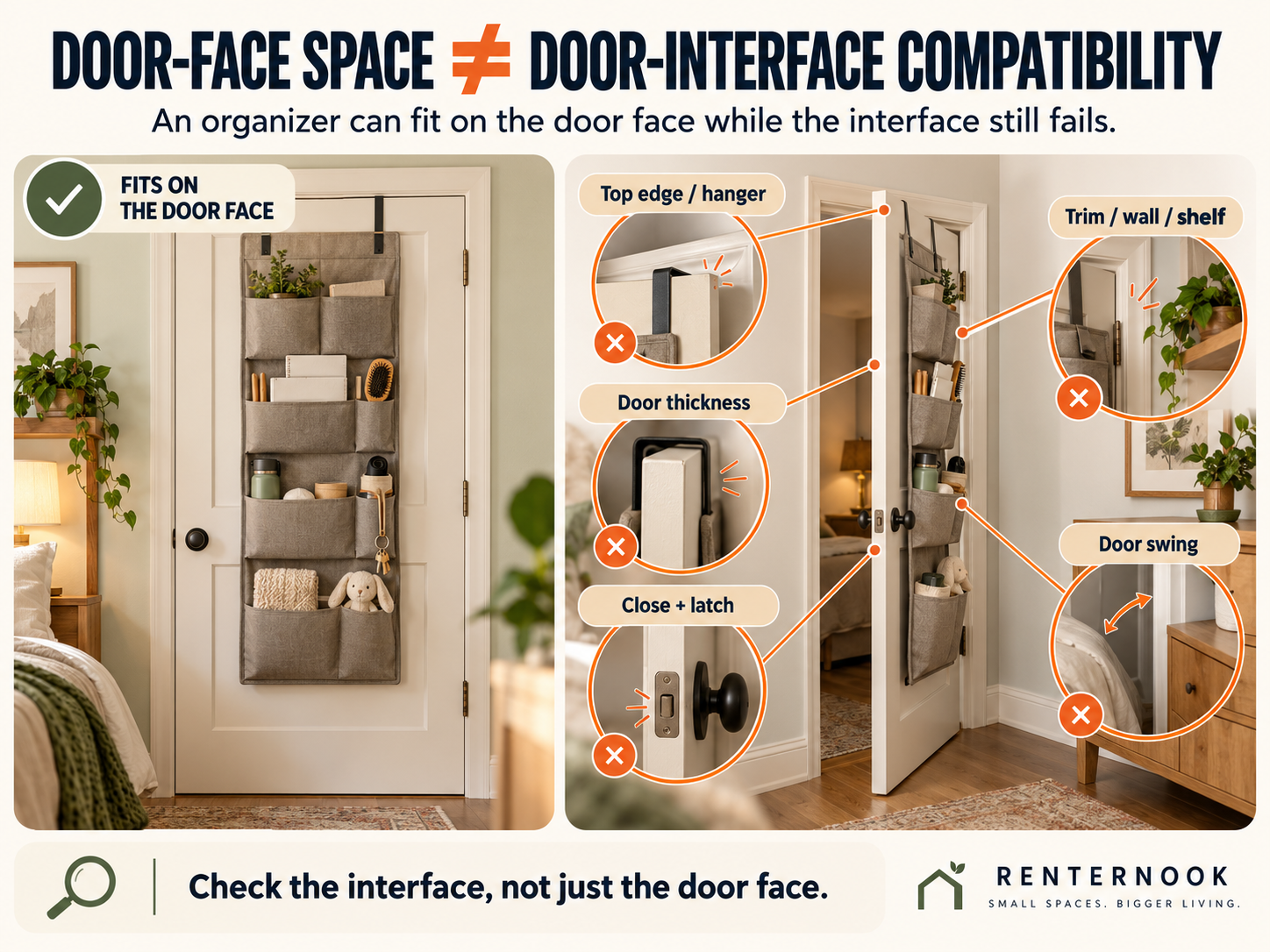
But the visible door face is only one part of the installation.
The organizer also has to interface with a moving architectural element: the door itself.
That means the real buying question is not just:
“Will this organizer fit on the door?”
It is:
“Is this specific over-the-door organizer compatible with my specific door before I buy it?”
That difference matters because door thickness, available top gap, hook or hanger geometry, installation method, trim, nearby walls or shelves, and the door’s close-and-latch state can all affect the result.
The core idea in this guide is:
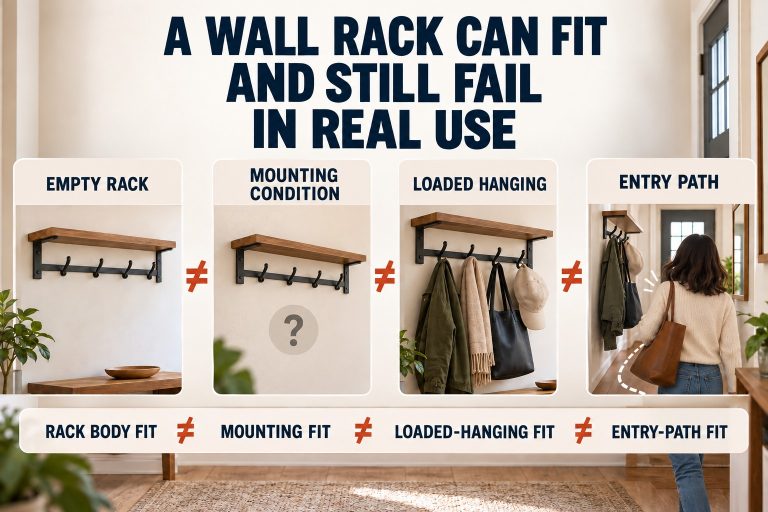
Door-face space does not automatically mean door-interface compatibility.
This is not a ranking of four organizers. The products below represent four different installation roles so you can see what should be verified—and what should stay unknown—before you buy.
The Door-Interface Decision Chain
Use this sequence for an over the door organizer:
Door thickness → Published top-gap requirement where available → Hook / hanger interface → Installation method → Close / latch state → Trim / wall / shelf / swing interaction → Published or unknown projecting depth → Loaded state where actually published → Actual door function
Each step answers a different question.
A product can have dimensions that look suitable and still leave an unresolved installation question.
1. Door thickness
Start with the actual thickness of the door you plan to use.
Then compare that number with the exact product’s published door-thickness limit.
Do not replace the product-specific limit with a generic rule for all over-door organizers.
The four products in this guide publish different door-thickness information, and one of them uses two different figures on the same current first-party product page.
That is exactly why the source wording matters.
2. Published top-gap requirement—when the source gives one
The hanger has to occupy space at the top edge of the door.
But that does not mean you should invent a universal top-gap number.
Some products publish a requirement. Others do not.
If the manufacturer does not publish a top-gap requirement, keep that field unknown unless you have exact-product evidence from another clearly identified source.
Do not derive top gap from hook metal thickness alone.
3. Hook or hanger interface
Look at how the organizer actually attaches.
A low-profile steel rack, a removable hook system, a fabric organizer hanging from metal hooks, and a tall rigid basket frame do not create the same interface.
Check the exact architecture:
- what sits over the top edge of the door;
- whether the hook or hanger is included;
- whether the product can also be wall mounted;
- whether assembly or support panels are part of the installation;
- and whether the published design changes the door-side projection.
The product name alone does not answer these questions.
4. Installation method
“Over the door” can describe more than one installation path.
The locked product set includes products that hang over the door only, products that can also be wall mounted, and a fabric organizer that uses metal hooks plus support panels.
Evaluate the exact installation method you intend to use.
Do not treat an alternate wall-mount option as proof that the over-door setup will work on your door.
5. Close and latch state
Door thickness is an input.
It is not a closure guarantee.
Even if the organizer’s published door-thickness limit matches your door, the real installation can still depend on the available top gap, trim, door stop, hinge geometry, latch geometry, and nearby surfaces.
Do not conclude:
“The door is within the thickness limit, therefore it will definitely close and latch.”
Thickness alone does not support that conclusion.
6. Trim, wall, shelf, and swing interaction
A door does not move in empty space.
It may swing toward a wall, shelf, cabinet, closet interior, trim, door stop, or another nearby surface.
The organizer may also project from one or both sides of the door.
Check your actual installation location rather than relying on a universal wall or trim clearance number.
This guide does not provide one because the locked evidence does not support one.
7. Projecting depth and loaded state
Published product depth is useful.
But published product depth is not automatically the same as loaded real-world projection.
A fabric organizer listed as 6.6 inches deep, for example, does not automatically have a verified 6.6-inch loaded depth in every use state.
The same rule applies to rigid racks and hook organizers.
If the source does not publish loaded projection, keep loaded projection unknown.
8. Actual door function
The final decision is practical:
Can the specific organizer be installed on the specific door while preserving the door function you need?
That may include opening, closing, latching, accessing the stored items, and avoiding conflicts with nearby trim, walls, shelves, or fixtures.
If a material compatibility field is still unknown, keep the decision open.
How to Check Your Door Before You Buy
You do not need a universal “over-door clearance rule.”
You need a product-specific comparison.
Step 1: Identify the exact door
Choose the exact door where the organizer will be installed.
Record the conditions that can affect the interface:
- door thickness;
- the available space at the top edge;
- trim and door-stop profile;
- hinge side and swing direction;
- latch geometry;
- adjacent wall, shelf, cabinet, or closet condition.
Step 2: Measure the actual door thickness
Compare your door thickness with the exact product’s published limit.
If the product publishes “up to” a certain thickness, treat that as the product-specific published limit—not as a guarantee that every door at or below that number will close normally.
Step 3: Check top-gap evidence separately
If the product publishes a top-gap requirement, compare it with your actual door condition.
If the product does not publish one, mark the top-gap requirement as unknown.
Do not calculate it from the hook thickness.
Do not borrow a top-gap requirement from another organizer.
Step 4: Identify what sits over the top edge
Look at the exact hook or hanger architecture.
Ask whether the installation uses detachable hooks, a horizontal steel hanger, a tall steel frame, metal hooks holding a fabric organizer, support panels, or an alternate wall-mount path.
Step 5: Check the close-and-latch condition
The product may meet its published door-thickness requirement and still need a separate closure check.
That check is specific to your door.
Do not assume universal latch compatibility.
Step 6: Check the surfaces around the door
Look at where the organizer and its stored items could project when the door moves.
Check the actual wall, trim, shelving, cabinet, closet, or other nearby surface.
There is no universal clearance number in this guide.
Step 7: Separate published product depth from loaded projection
Use published depth as published.
If loaded depth is not published, do not convert the empty product depth into a loaded-depth claim.
Step 8: Decide whether the door still performs its job
A compatible installation is not just an organizer hanging successfully.
The door still has to perform the function you need.
If closure, latching, swing, or adjacent-clearance behavior is material and remains unverified, keep that part of the decision unresolved.
Four Over-the-Door Organizer Roles to Compare
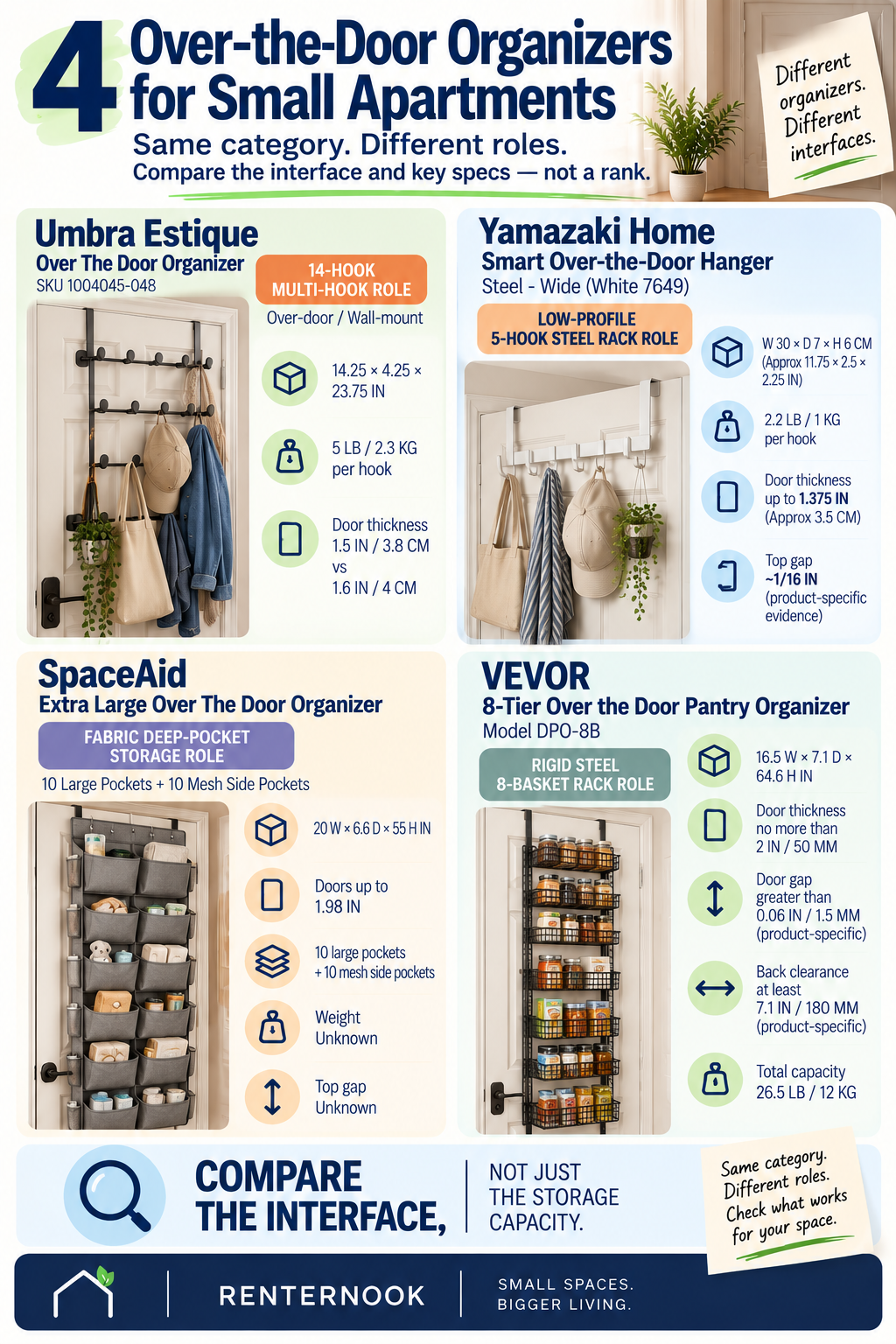
These products are not ranked.
They represent four different door-interface and installation roles.
| Product | Role | Verified dimensions | Door-thickness evidence | Installation / hanger evidence | Published capacity | Top-gap / clearance evidence | Important unknowns |
|---|---|---|---|---|---|---|---|
| Umbra Estique Over The Door Organizer — SKU 1004045-048 | 14-hook multi-hook organizer; over-door / wall-mount dual-installation role | 14.25 × 4.25 × 23.75 in | First-party page uses two phrasings: designed for doors up to 1.5 in / 3.8 cm; feature copy says up to 1.6 in / 4 cm with attachable over-the-door hooks | Attachable over-the-door hooks; 14 front storage hooks; over-door or wall mount | 5 lb / 2.3 kg per hook | Top-gap requirement unknown | Loaded depth; close / latch fit; trim / wall clearance |
| Yamazaki Home Smart Over-the-Door Hanger, Steel – Wide — White 7649 | Low-profile 5-hook steel door rack | First-party global: W 30 × D 7 × H 6 cm; US first-party approx. 11.75 × 2.5 × 2.25 in | Up to 1.375 in / approx. 3.5 cm | Horizontal over-door steel rack with 5 storage hooks; hangs over top of door; no assembly | 2.2 lb / 1 kg per hook | Primary-source top-gap requirement unknown; exact-product secondary retail copy states roughly 1/16 in for the door to close | Loaded depth; close / latch guarantee; trim clearance |
| SpaceAid Extra Large Over The Door Organizer — 10 Large Pockets + 10 Mesh Side Pockets | Large fabric pocket organizer / deep-storage role | 20 W × 6.6 D × 55 H in | Included hooks designed for doors up to 1.98 in thick | Included metal over-door hooks; attach hooks → hang organizer → insert support panels | Unknown | Top-gap requirement unknown | Model / SKU; weight capacity; loaded depth; close / latch fit; trim / wall clearance |
| VEVOR 8-Tier Over the Door Pantry Organizer — Black, DPO-8B | Rigid steel multi-basket rack with explicit door-gap / back-clearance requirements | 16.5 W × 7.1 D × 64.6 H in / 420 × 180 × 1640 mm | No more than 2 in / 50 mm | Door-hanging steel frame; alternate wall mount with included screws; 8 baskets, 6 small + 2 large, adjustable spacing | 26.5 lb / 12 kg total; 3.31 lb / 1.5 kg per basket | Door gap greater than 0.06 in / 1.5 mm; at least 7.1 in / 180 mm between door and pantry shelf | Loaded depth; trim / wall clearance; actual close / latch result on a specific door |
The useful comparison is not “which one is best?”
It is:
Which product publishes the interface information you need for the door you actually have?
Product Role 1: Umbra Estique Over The Door Organizer — SKU 1004045-048
The Umbra Estique is a 14-hook organizer with a verified overall size of 14.25 × 4.25 × 23.75 inches.
It uses attachable over-the-door hooks and can also be wall mounted.
The locked first-party evidence publishes a capacity of 5 lb / 2.3 kg per hook.
The most important evidence issue is the door-thickness wording.
The current Umbra page uses two different figures:
- one location states that the organizer is designed for doors up to 1.5 inches / 3.8 cm;
- feature copy states up to 1.6 inches / 4 cm when using the attachable over-the-door hooks.
This guide does not silently convert those into one number.
If your door is near that limit, the source wording itself is part of the decision.
Unknown in the locked evidence:
- exact top-gap requirement;
- loaded depth;
- close / latch compatibility on a specific door;
- trim or wall clearance.
Role logic: a multi-hook accessory with both over-door and wall-mount installation paths, where door-thickness information is published but the current manufacturer wording is not perfectly uniform.
Product Role 2: Yamazaki Home Smart Over-the-Door Hanger, Steel – Wide — White 7649
The locked variant is White, product number 7649. The black variant is product number 7650, but it is not the selected variant for this comparison.
First-party dimensions are published as:
- global specification: W 30 × D 7 × H 6 cm;
- US first-party approximate dimensions: 11.75 × 2.5 × 2.25 inches.
The hanger is a horizontal steel rack with five storage hooks.
The published door-thickness limit is up to 1.375 inches / approximately 3.5 cm.
The published capacity is 2.2 lb / 1 kg per hook.
The product hangs over the top of the door and requires no assembly.
The top-gap evidence needs a narrower treatment.
The locked primary Yamazaki evidence does not establish a primary-source top-gap requirement.
A current exact-product secondary retail source states that roughly 1/16 inch of clearance is needed for the door to close.
That figure may be useful as secondary exact-product evidence, but it should not be presented as a first-party Yamazaki specification.
Loaded depth, trim clearance, and a guaranteed close-or-latch result remain unknown.
Role logic: a low-profile five-hook steel rack with a clearly published door-thickness limit and hook capacity, while its top-gap figure remains secondary exact-product evidence rather than a primary-source specification.
Product Role 3: SpaceAid Extra Large Over The Door Organizer
The locked SpaceAid product is the Extra Large Over The Door Organizer with 10 Large Pockets + 10 Mesh Side Pockets.
The exact model or SKU is unknown in the locked evidence.
Its verified overall dimensions are 20 inches wide × 6.6 inches deep × 55 inches high.
The main storage system includes:
- 10 large clear-front pockets;
- 10 mesh side pockets.
Each large pocket is published at 9.7 inches wide × 6.5 inches deep × 6.5 inches high.
The included metal hooks are designed for doors up to 1.98 inches thick.
The published installation sequence is:
attach hooks → hang organizer → insert support panels
The important boundary is the depth field.
The product has a published depth of 6.6 inches.
That does not make 6.6 inches a verified loaded depth.
Loaded depth is unknown.
The locked evidence also does not establish an exact current first-party weight capacity, a top-gap requirement, close / latch compatibility, or trim / wall clearance.
First-party marketing includes no-damage language, but this guide does not turn that into a universal no-damage conclusion.
Role logic: a large fabric pocket organizer with deep storage geometry and a published door-thickness limit, but with important loaded-state and closure fields still unknown.
Product Role 4: VEVOR 8-Tier Over the Door Pantry Organizer — DPO-8B
The VEVOR DPO-8B publishes several explicit door-interface prerequisites.
Its verified dimensions are 16.5 inches wide × 7.1 inches deep × 64.6 inches high, or 420 × 180 × 1640 mm.
The published door-thickness limit is no more than 2 inches / 50 mm.
VEVOR also publishes two additional product-specific requirements:
- door gap greater than 0.06 inch / 1.5 mm;
- at least 7.1 inches / 180 mm between the door and pantry shelf.
Those figures belong to this specific product.
They are not universal requirements for over-door organizers.
The organizer uses a door-hanging steel frame and can alternatively be wall mounted with included screws.
Its basket system includes 8 baskets total: 6 small and 2 large, with adjustable spacing.
Published capacity is 26.5 lb / 12 kg total and 3.31 lb / 1.5 kg per basket.
The source uses the thickness, gap, and back-clearance checks in support of smooth closure.
That still does not justify a Renternook guarantee that the organizer will close smoothly on every door meeting those numbers.
Loaded depth, trim or wall clearance, and the actual close-and-latch result on the buyer’s specific door remain unresolved until checked against that installation.
Role logic: a rigid multi-basket organizer with unusually explicit product-specific door-gap and back-clearance requirements, making it a useful example of why door-interface buying decisions cannot rely on door-face dimensions alone.
Why Unknown Specs Should Stay Unknown
The easiest way to make an over-door buying guide unreliable is to turn an unpublished field into an assumed number.
Examples include:
- assuming a top-gap requirement from the thickness of the hook;
- treating product depth as loaded depth;
- assuming that a compatible door-thickness range proves closure;
- assuming a universal trim or wall clearance;
- assuming a universal door load limit;
- assuming “fits most doors” means your exact door will work.
This guide does not do that.
Verified inputs can include:
- exact product identity;
- published overall dimensions;
- published door-thickness limit;
- published top-gap requirement;
- published back-clearance requirement;
- hook or hanger architecture;
- installation method;
- published weight capacity;
- published basket, pocket, or hook configuration.
Unknowns can include:
- your actual available top gap;
- trim profile;
- door-stop profile;
- hinge geometry;
- latch geometry;
- adjacent wall or shelf condition;
- loaded real-world projection;
- door strength or load suitability;
- unpublished closure envelope.
An unknown field is not automatically a failure.
It means you do not yet have enough evidence to turn that field into a pass.
A Practical Pre-Buy Decision Method
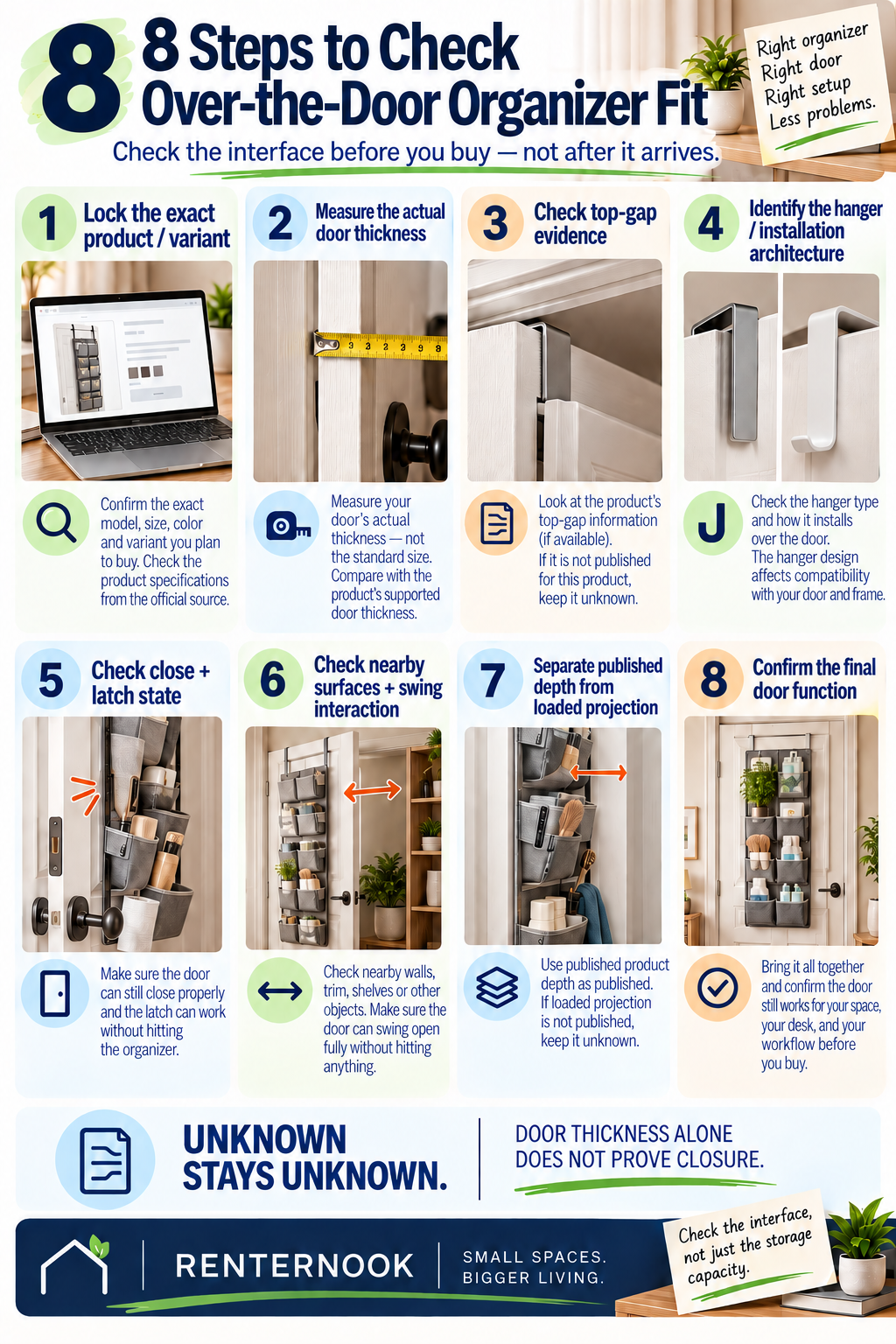
Step 1: Lock the exact product and variant
Do not compare a measurement from one size or variant with another product page.
Confirm the exact product name, model, SKU, color, or variant where those identifiers are published.
Step 2: Measure the exact door thickness
Compare your actual door with the product’s exact published thickness limit.
If the source wording itself is inconsistent—as with the current Umbra 1.5-inch versus 1.6-inch wording—keep that discrepancy visible.
Step 3: Check top-gap evidence without inventing it
If the exact product publishes a top-gap requirement, use that requirement.
If it does not, mark the field unknown.
If you use secondary exact-product evidence, label it as secondary rather than upgrading it into a manufacturer specification.
Step 4: Identify the hanger and installation architecture
Confirm what physically sits over the top edge of the door and how the rest of the organizer is supported.
Step 5: Check the door’s close-and-latch state
Do not stop at door thickness.
Consider the actual top edge, trim, stop, hinge, and latch condition.
If closure is important and not established by the published evidence, keep that result unresolved until you can verify the real installation.
Step 6: Check nearby surfaces and swing interaction
Look at what the organizer faces as the door moves.
A wall, shelf, cabinet, closet interior, or other surface can matter.
Do not use a universal clearance number.
Step 7: Separate product depth from loaded projection
Use the published product depth as a product dimension.
Do not call it loaded depth unless the source actually publishes loaded depth.
Step 8: Confirm the final door function
The final question is not whether the organizer hangs.
It is whether the door still performs the function you need with that organizer installed.
If a material compatibility question is still unresolved, do not convert it into a confident pass.
Final Checklist Before You Buy
- ☐ I verified the exact product and variant.
- ☐ I measured the actual thickness of the exact door I plan to use.
- ☐ I compared that thickness only with the exact product’s published limit.
- ☐ I checked whether the product publishes a top-gap requirement.
- ☐ If top-gap information is unpublished, I kept it unknown.
- ☐ I did not derive top gap from hook metal thickness.
- ☐ I identified the exact hook or hanger architecture.
- ☐ I identified the installation method I actually plan to use.
- ☐ I checked whether nearby trim, a door stop, wall, shelf, cabinet, or closet surface could interact with the organizer.
- ☐ I did not treat door-thickness compatibility as a guaranteed close-or-latch result.
- ☐ I separated published product depth from loaded real-world projection.
- ☐ If loaded depth is unpublished, I kept loaded depth unknown.
- ☐ I used only published weight-capacity numbers for the exact product.
- ☐ I did not generalize “renter-safe,” “no-damage,” or “fits most doors” language beyond an exact sourced product claim.
- ☐ I checked whether the installed organizer preserves the actual door function I need.
- ☐ Any unresolved compatibility field is still marked unknown.
A number published for one organizer is not a universal rule for another.
Conclusion
An over the door organizer can look like one of the easiest storage products to buy.
But the real interface is more demanding than the visible door face.
The organizer has to match the actual door thickness, any published top-gap requirement, the hook or hanger architecture, the installation method, the close-and-latch state, the surrounding trim or surfaces, and the projection created by the organizer and its contents.
The decision chain is:
Door thickness → Published top gap where available → Hook / hanger interface → Installation method → Close / latch state → Trim / wall / shelf / swing interaction → Published or unknown projection → Loaded state where published → Actual door function
That is why the central rule is simple:
Door-face space is not door-interface compatibility.
The goal is not to find a universal “best” organizer.
It is to verify whether a specific organizer can work with a specific door before you buy it.