Small Filing Cabinets for Home Offices: Check Drawer, File-Access, and Desk-Chair Fit Before You Buy
A small filing cabinet looks easy to shop for.
You measure the empty space beside your desk, find a cabinet with a narrow body, and check whether the height seems low enough for the place you want to put it.
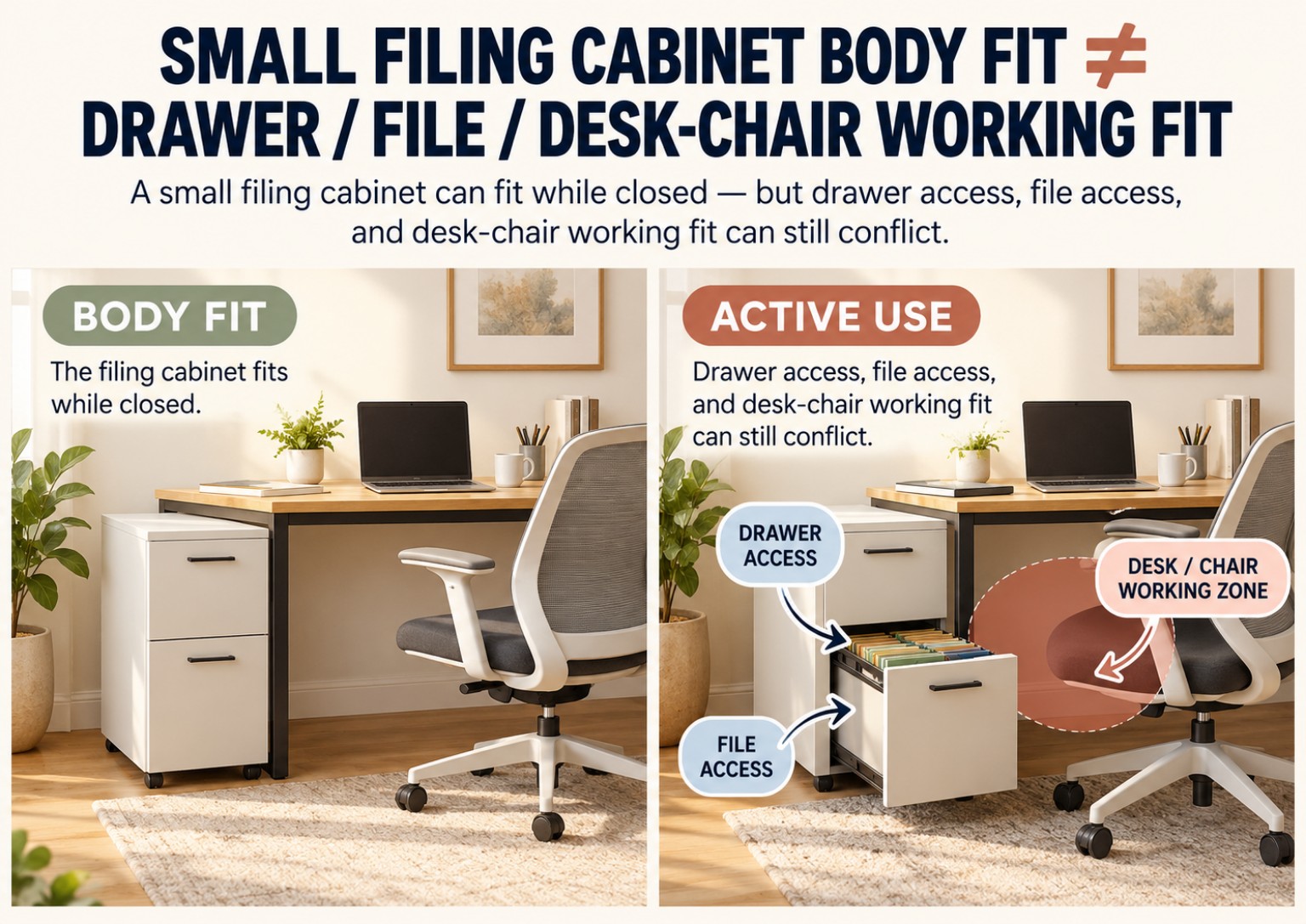
But that only tells you whether the cabinet can occupy the space while closed.
It does not tell you whether you can open the drawers, reach the files, move the cabinet if it is designed to roll, or keep using your desk chair without creating a conflict.
That is the small-space problem this guide focuses on:
Cabinet body fit does not automatically mean drawer-open, file-access, or desk-chair working fit.
Instead of ranking products from best to worst, this guide compares four different filing-cabinet roles and shows you how to check the part that matters in a real home office: whether the cabinet still works after you start using it.
The Fit-First Decision Chain
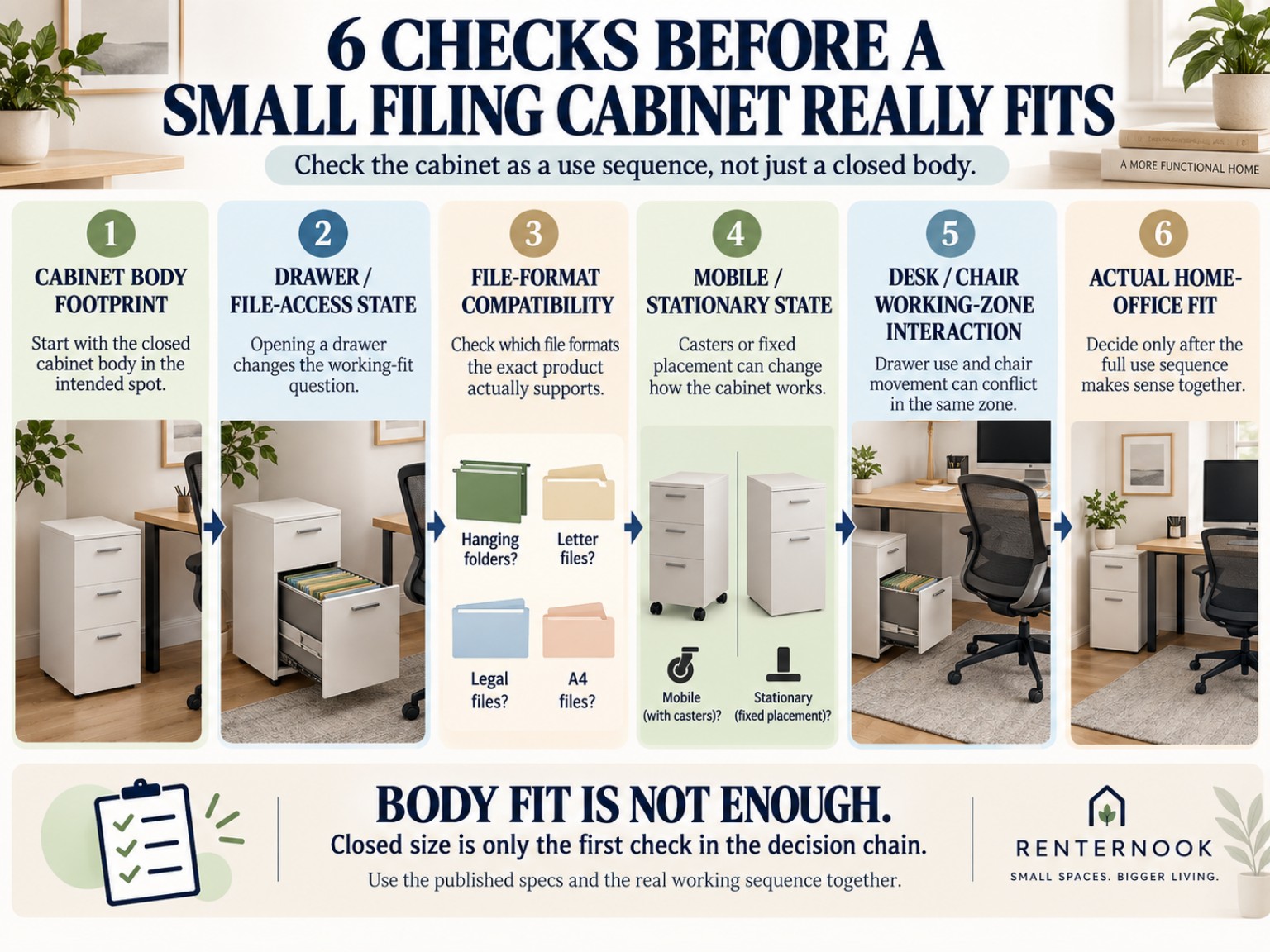
For a small filing cabinet, check the decision in this order:
Cabinet body footprint → Drawer / file-access state → File-format compatibility → Mobile / stationary state → Desk / chair working-zone interaction → Actual home-office fit
Each step answers a different question.
A cabinet can pass the first step and still fail later.
1. Cabinet body footprint
Start with the published cabinet dimensions.
Check the actual width, depth, and height of the location where you want the cabinet to sit. Do not stop at a product label such as “small,” “slim,” “mobile,” or “under desk.” Those labels describe a product category or marketing position. They do not prove fit in your room.
The body dimensions are the first verified input.
They are not the whole decision.
2. Drawer and file-access state
Next, ask what must happen when you actually use the cabinet.
A closed drawer is part of the cabinet body. An open drawer creates a different working state.
That means:
Closed cabinet depth ≠ drawer-open working depth.
However, do not calculate an open-drawer depth unless the manufacturer publishes the drawer extension or another exact dimension that supports that calculation.
For most of the products in this guide, numeric drawer extension is not published in the evidence set. That number therefore stays unknown.
The correct question is not “How many extra inches should I add?”
It is:
Does the location leave enough real space for the drawer and your file-access movement once you test the cabinet against your own desk, chair, wall, and circulation constraints?
3. File-format compatibility
A filing cabinet can fit physically and still be the wrong cabinet for the documents you need to store.
Check the exact file format supported by the exact product.
Do not treat “standard hanging folders” as proof of letter, legal, or A4 compatibility unless the source says so.
For this four-product set:
- Branch verifies standard hanging-folder storage, but letter, legal, and A4 compatibility remain unverified in the locked evidence.
- Vari verifies letter and legal compatibility.
- Mount-It! verifies letter, legal, and A4 compatibility.
- HON verifies letter and legal compatibility; A4 remains unverified in the locked evidence.
This is a good example of why fit-first buying is not only about exterior dimensions.
The cabinet has to fit the room and the job you are buying it to do.
4. Mobile or stationary state
Some filing cabinets are designed to roll. Others may simply have hard wheels or a mobile-pedestal form.
Mobility changes the decision because the cabinet may be used in more than one position: parked beside a desk, pulled out for file access, or moved when the workstation needs to change.
But the presence of casters does not justify claims about rolling ease, floor performance, or caster quality unless those claims are explicitly supported.
Use only the published mechanism:
- Branch: smooth locking wheels are published.
- Vari: roll-and-lock casters are published.
- Mount-It!: four casters, two locking, plus one anti-tipping wheel are published; 360-degree swivel is also published.
- HON: hard wheels are published; locking-caster state is not verified in the locked evidence.
Treat those as product features, not performance guarantees.
5. Desk and chair working-zone interaction
This is where a cabinet that looks compact can become a poor workstation fit.
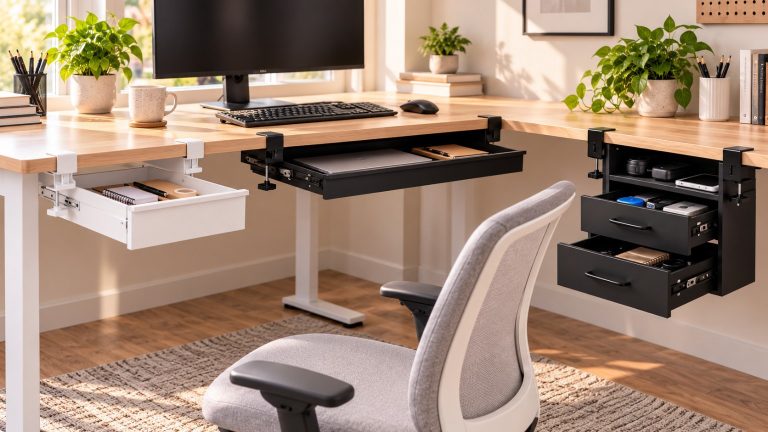
A small filing cabinet may sit beside a desk, near the chair path, or under part of the desk structure. The cabinet body can fit in one of those places while the real working states conflict.
Examples include:
- the file drawer opening into the chair zone;
- the chair needing to move into the same space used for file access;
- a cabinet fitting under the desktop but conflicting with a rail, apron, leg, crossbar, cable tray, or other structure;
- a mobile cabinet needing to be moved before a drawer can be used comfortably.
There is no universal cabinet-to-chair gap in this guide.
There is no universal aisle width in this guide.
And there is no automatic “under-desk fit” because a cabinet height is lower than the desktop height.
The actual desk structure matters.
Important: “Under Desk” Does Not Mean Guaranteed Under-Desk Fit
Marketing language such as under desk, tucks under desk, or fits under most desks is not a measurement of your desk.
If you want to place a filing cabinet under a desk, compare the cabinet against the actual usable underside clearance at the exact position where the cabinet will sit.
That can include more than desktop height.
Check for:
- desk aprons;
- crossbars;
- drawer units;
- cable trays;
- support frames;
- desk legs;
- any other structure below the work surface.
The correct comparison is:
actual cabinet height vs. actual usable underside / structural clearance
—not cabinet height vs. desktop-top height.
And even if the cabinet body fits under the desk, you still have to check whether the drawers and files can be accessed in that position.
Four Small Filing Cabinet Roles to Compare
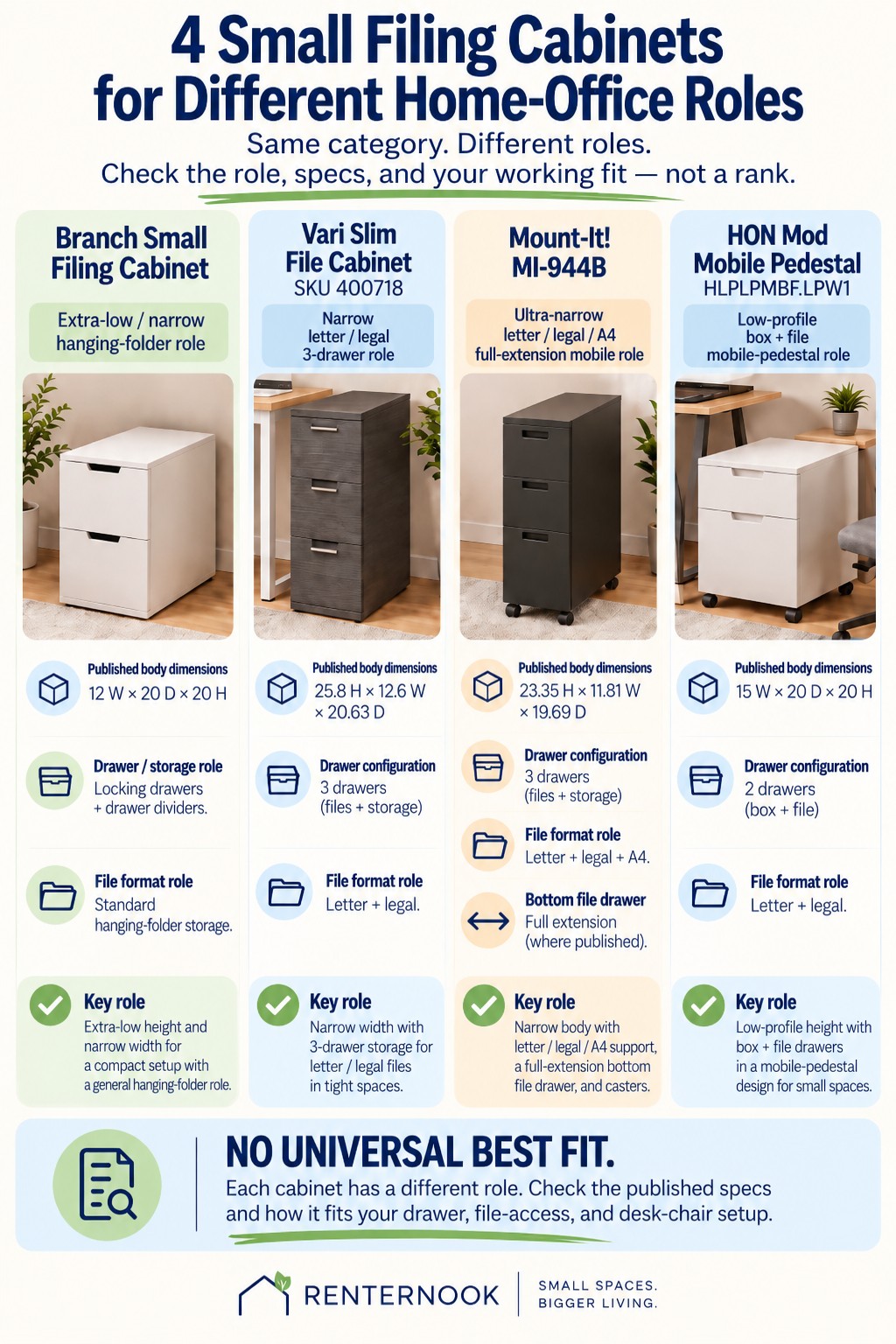
These four products are not ranked. They represent different combinations of body size, file compatibility, drawer configuration, and mobility evidence.
| Product | Verified body dimensions | Verified drawer / file evidence | Verified file formats | Verified mobility / assembly evidence | Important unknowns |
|---|---|---|---|---|---|
| Branch Small Filing Cabinet | 12 W × 20 D × 20 H in | Locking drawers; drawer dividers; standard hanging-folder storage | Standard hanging folders only; letter / legal / A4 not verified | Smooth locking wheels; minimal assembly; package 22 × 15 × 23 in / 35 lb | SKU; numeric drawer extension; letter / legal / A4 |
| Vari Slim File Cabinet — SKU 400718, Slate | 25.8 H × 12.6 W × 20.63 D in | 3 soft-close lockable drawers; lower hanging-file drawer; drawer interior 15 3/4 D × 9 3/4 W in | Letter; legal | Roll-and-lock casters; ships fully assembled | Numeric drawer extension; A4 |
| Mount-It! Slim Rolling File Cabinet — MI-944B | 23.35 H × 11.81 W × 19.69 D in | 3 drawers; bottom file drawer is full extension | Letter; legal; A4 | 4 casters; 2 locking; 1 anti-tipping wheel; 360-degree swivel; cabinet fully assembled; casters require installation | Numeric full-extension distance |
| HON Mod Mobile Pedestal — HLPLPMBF.LPW1 | 15 W × 20 D × 20 H in | 1 box drawer + 1 file drawer; steel ball-bearing drawer suspensions; standard hangrails | Letter; legal | Hard wheels | Numeric drawer extension; A4; locking-caster state; assembly |
The table is a starting point, not a winner list.
The next step is to match the role to the way your office actually works.
Product Role 1: Branch Small Filing Cabinet
The Branch Small Filing Cabinet has a verified body size of 12 inches wide × 20 inches deep × 20 inches high.
The locked evidence also verifies locking drawers, drawer dividers, standard hanging-folder storage, smooth locking wheels, and minimal assembly. Package dimensions are 22 × 15 × 23 inches, with a published package weight of 35 lb.
The important boundary is file-format specificity.
The source supports standard hanging-folder storage. It does not, in the locked evidence, establish letter, legal, or A4 compatibility.
That means this cabinet can be evaluated for body fit, mobility mechanism, and general hanging-folder use without converting “standard” into a more specific file-format claim.
Its numeric drawer extension is also unknown, so do not calculate a full open working depth from the 20-inch closed depth.
Role logic: a compact mobile filing cabinet where standard hanging-folder storage is enough for the decision, but exact file-format compatibility must be verified separately if it matters to you.
Product Role 2: Vari Slim File Cabinet — SKU 400718
The locked Vari variant is Slate, SKU 400718.
Its verified body dimensions are 25.8 inches high × 12.6 inches wide × 20.63 inches deep.
The cabinet has three soft-close, lockable drawers, with a lower hanging-file drawer. The published drawer interior is 15 3/4 inches deep × 9 3/4 inches wide.
Letter and legal file compatibility are verified. A4 compatibility is not verified in the locked evidence.
The cabinet also has roll-and-lock casters and ships fully assembled.
Again, the numeric drawer extension remains unknown.
That means the published 20.63-inch body depth cannot be converted into a drawer-open working depth without additional source evidence.
Role logic: a slim three-drawer cabinet with verified letter/legal file support and a published rolling/locking caster system, where the buyer still needs to test the actual drawer-access zone against the desk and chair.
Product Role 3: Mount-It! Slim Rolling File Cabinet — MI-944B
The Mount-It! MI-944B has a verified body size of 23.35 inches high × 11.81 inches wide × 19.69 inches deep.
It has three drawers, and the bottom file drawer is published as full extension.
That is useful evidence because it identifies the drawer state. But it still does not provide a numeric extension distance.
So the correct statement is:
Full extension is verified; numeric full-extension distance is unknown.
The locked evidence also verifies letter, legal, and A4 file compatibility.
For mobility, it has four casters, two locking casters, one anti-tipping wheel, and published 360-degree swivel. The cabinet arrives fully assembled, while the casters require installation.
Those facts make the operating state clearer, but they do not establish a universal rolling-performance claim or a numeric open-drawer footprint.
Role logic: a slim rolling cabinet with the broadest explicitly verified file-format compatibility in this four-product evidence set and a verified full-extension bottom drawer, while the exact extension distance remains unknown.
Product Role 4: HON Mod Mobile Pedestal — HLPLPMBF.LPW1
The HON Mod Mobile Pedestal has a verified body size of 15 inches wide × 20 inches deep × 20 inches high.
Its published configuration includes one box drawer and one file drawer, steel ball-bearing drawer suspensions, and standard hangrails.
Letter and legal compatibility are verified.
A4 compatibility is not verified in the locked evidence.
The product also has hard wheels, but the locked evidence does not establish whether those wheels lock. Assembly state is also not verified here.
Numeric drawer extension is unknown.
This means the cabinet can be compared by body size, drawer configuration, verified letter/legal support, and published wheel type—but not by an invented open-drawer dimension or locking-caster claim.
Role logic: a low-profile mobile-pedestal format with a simpler box-drawer + file-drawer configuration and verified letter/legal support, where wheel-locking state, assembly, and exact drawer extension should remain open questions unless separately verified.
Verified vs. Unknown: Why the Boundary Matters
Small-space buying guides become unreliable when an unknown measurement quietly turns into an assumed number.
For filing cabinets, that often happens with drawer access.
A buyer sees a 20-inch-deep cabinet and mentally adds an estimated drawer length. That estimate then becomes a fake “required clearance.”
This guide does not do that.
Verified inputs can include:
- cabinet width, depth, and height;
- published drawer count;
- published drawer type;
- published file-format compatibility;
- published caster or wheel mechanism;
- published full-extension language;
- published assembly state;
- published package dimensions where relevant.
Unknowns must remain unknown when not published:
- numeric drawer extension;
- derived drawer-open working depth;
- universal chair clearance;
- universal cabinet-to-chair gap;
- universal aisle width;
- universal under-desk fit;
- user standing zone;
- lock quality;
- caster performance;
- rolling ease;
- load capacity unless an exact source provides it;
- tip resistance beyond the published mechanism.
An unknown field does not make a product unusable.
It simply means the final fit decision has to be completed with your actual room and, where necessary, additional verified product information.
A Practical Buying Decision Method
Use this sequence before buying a small filing cabinet for a home office.
Step 1: Measure the closed-body location
Measure the actual usable width, depth, and height where the cabinet will sit.
Compare those numbers with the exact product dimensions.
Do not rely on “slim” or “small” as a substitute for measurement.
Step 2: Check the exact desk structure if the cabinet goes under or beside it
If the cabinet will sit under the desk, measure the usable underside clearance at that exact position.
If it will sit beside the desk, identify any desk leg, support, drawer, frame, wall, or baseboard condition that affects the cabinet body.
Step 3: Identify the drawer / file-access direction
Ask which drawer you will use most often and what has to occupy the space in front of it.
Do not invent an extension distance.
Instead, preserve the extension as unknown unless the manufacturer publishes it, then test the real access state against the room before finalizing the purchase.
Step 4: Verify the file format you actually use
Do you need letter files, legal files, A4 files, or only a general hanging-folder system?
Match that need only to formats the source explicitly verifies.
If the exact format is not published, treat compatibility as unverified.
Step 5: Map the chair state
Put the chair where it sits when you work.
Then consider where it moves when you sit down, stand up, turn, or access the cabinet.
The question is not whether there is a generic “recommended gap.”
The question is whether the cabinet-access state and the chair-use state can coexist in your workstation.
Step 6: Check mobile vs. stationary use
If the cabinet has wheels or casters, decide whether your intended use depends on moving it.
Then verify only the published wheel or caster features.
Do not assume rolling ease, floor suitability, or locking performance where the source does not establish it.
Step 7: Make the final working-fit decision
A product is ready for your shortlist only when the evidence and your own measurements support the complete use sequence:
closed body → drawer / file access → file compatibility → mobility state → chair / desk interaction
If one material part of that sequence is still unresolved, keep the decision open.
Final Checklist Before You Buy
Use this checklist for any small filing cabinet:
- I verified the exact product and variant.
- I measured the actual width, depth, and height available for the cabinet body.
- If I plan to place it under a desk, I measured the actual underside / structural clearance at that exact position.
- I did not treat “under desk” marketing language as a fit guarantee.
- I know which drawers and file areas I will actually use.
- I did not invent a numeric drawer extension when the source does not publish one.
- I did not calculate a fake open-drawer working depth from an unknown extension.
- I verified the file format I need: letter, legal, A4, or another explicitly supported format.
- I did not convert “standard hanging folders” into letter / legal / A4 without evidence.
- I checked whether my desk chair and file-access state compete for the same space.
- I checked the published mobility mechanism if I plan to move the cabinet during use.
- I did not assume caster quality, rolling ease, or locking performance beyond the published information.
- Any unverified field is still marked unknown in my decision.
If those checks work in your actual office, the cabinet has a much stronger case than one chosen only because its closed body looks small.
Conclusion
The most important measurement on a small filing cabinet is not always the smallest number in the spec table.
A cabinet can fit beside or under a desk while closed and still create a problem when the drawer opens, the files are accessed, or the chair needs the same working zone.
So use the body dimensions as the starting point, then keep going:
Cabinet body footprint → Drawer / file access → File-format compatibility → Mobile / stationary state → Desk / chair working-zone interaction → Actual home-office fit
That sequence keeps the decision grounded in what the cabinet has to do—not just where the cabinet can sit.
Small cabinet body fit is only the first check. Working fit is the real decision.