Small Bedroom Storage Solutions: Use the Closet, Add a Dresser, Buy a Wardrobe, or Change the Bed?
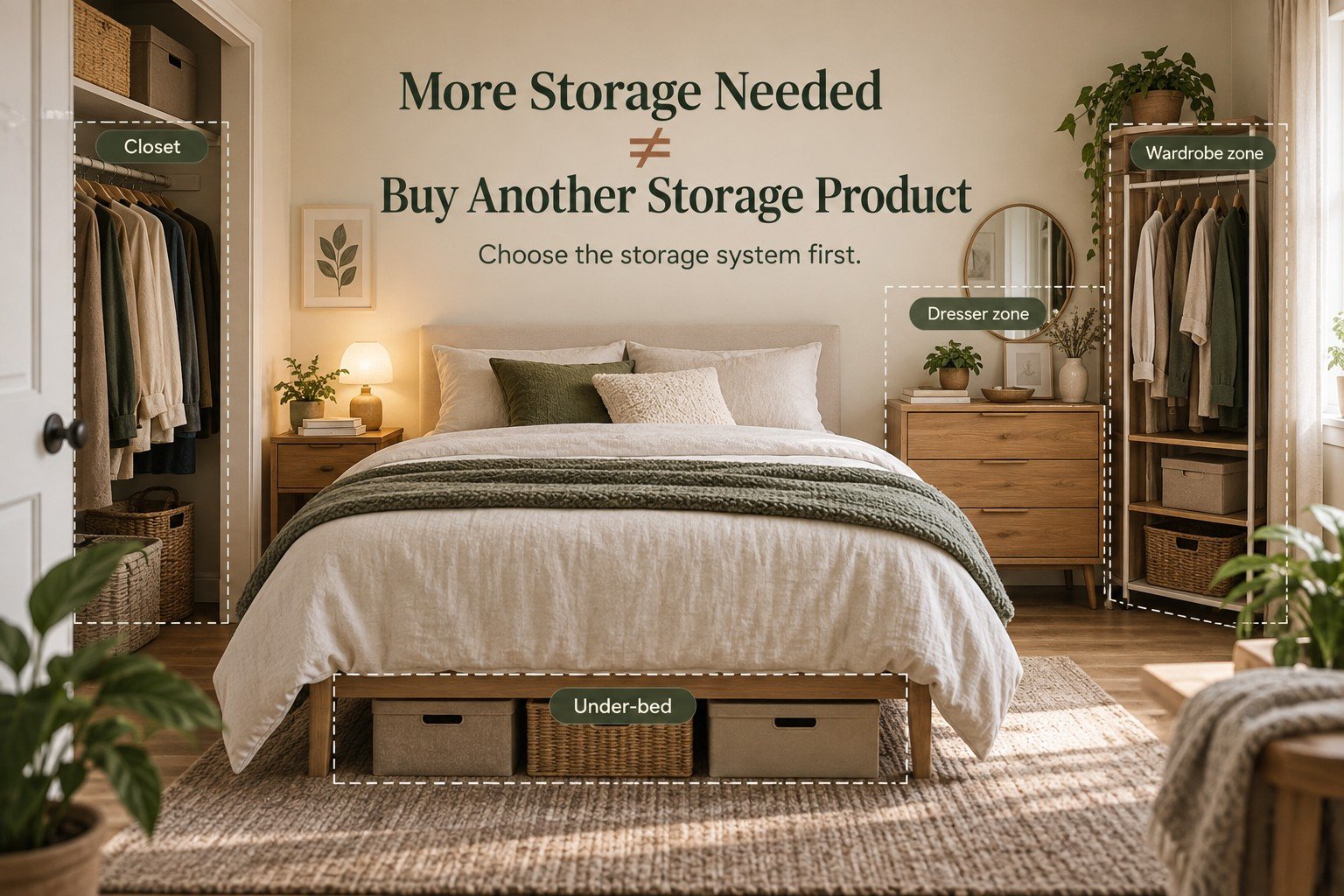
Needing more bedroom storage does not automatically mean you need another storage product.
In a small bedroom, the bigger decision comes first:
Which storage system should change?
You might be able to use the closet you already have more effectively. You might have usable space under the current bed. You might need drawer storage, hanging storage, or a different bed that turns the bed footprint itself into storage.
Those are different problems.
That is why the useful rule for small bedroom storage solutions is:
Storage capacity need ≠ storage product choice.
Choose the storage system first. Then compare products inside that system.
This guide helps you make that first decision.
Diagnose the storage problem before you shop
Before adding furniture, identify what is actually missing.
Is the problem poor use of the storage you already have?
Look at the current closet first.
You may already have usable rod, shelf, floor, or vertical space, but the layout may not match the way you store clothes and other items.
The key question is not simply whether there is empty space. It is whether that space can support an organizer that fits, installs correctly, and remains accessible.
If the closet itself can absorb the storage problem, you may not need another large furniture piece.
Is there usable space under the current bed?
If you want to keep your bed, the area underneath it can become a separate storage zone.
But “space under the bed” is not one measurement.
You need to check the lowest usable clearance, the footprint underneath the bed, which side you can actually reach, and how the storage needs to pull out or open.
If that zone works, under-bed storage may solve the problem without taking another wall.
Do you specifically need drawer storage?
A dresser creates a different storage system.
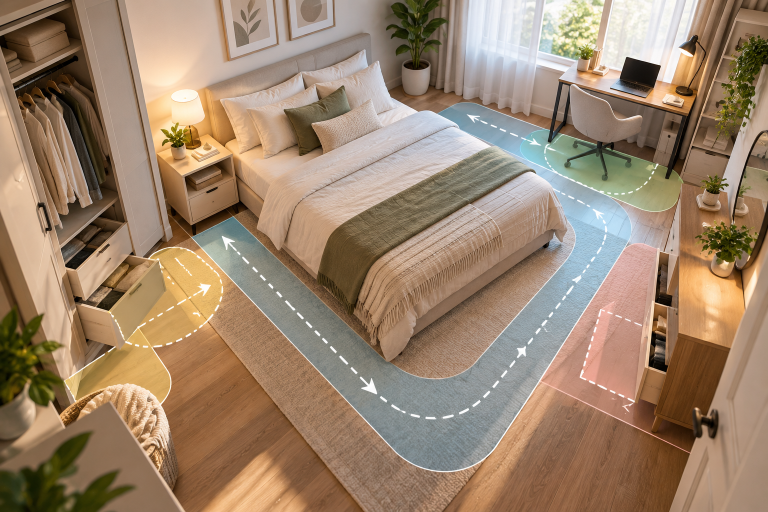
It uses wall width and floor depth, then creates another working state when the drawers open.
That means the right question is not only whether the dresser body fits against the wall. The bedroom also has to work when you stand in front of it and use the drawers.
Do you need more hanging or enclosed storage?
A wardrobe may be more relevant when the missing function is hanging space, enclosed clothing storage, or a combination of rails and shelves.
But a wardrobe has its own working states.
The cabinet body needs to fit. The doors need to work. You need access to the rail and shelves. You need somewhere to stand. The rest of the bedroom still needs to function around it.
Are you willing to replace the bed itself?
A storage bed changes a major furniture object instead of adding another separate storage piece.
That can make sense when the bed footprint is the storage zone you want to use.
But replacing the bed also changes more than capacity. You need to check how the storage opens, the mattress and foundation setup, delivery packages, assembly space, and any installation requirements for the exact bed.
Small bedroom storage decision tree
Use this as a routing sequence, not a ranking.
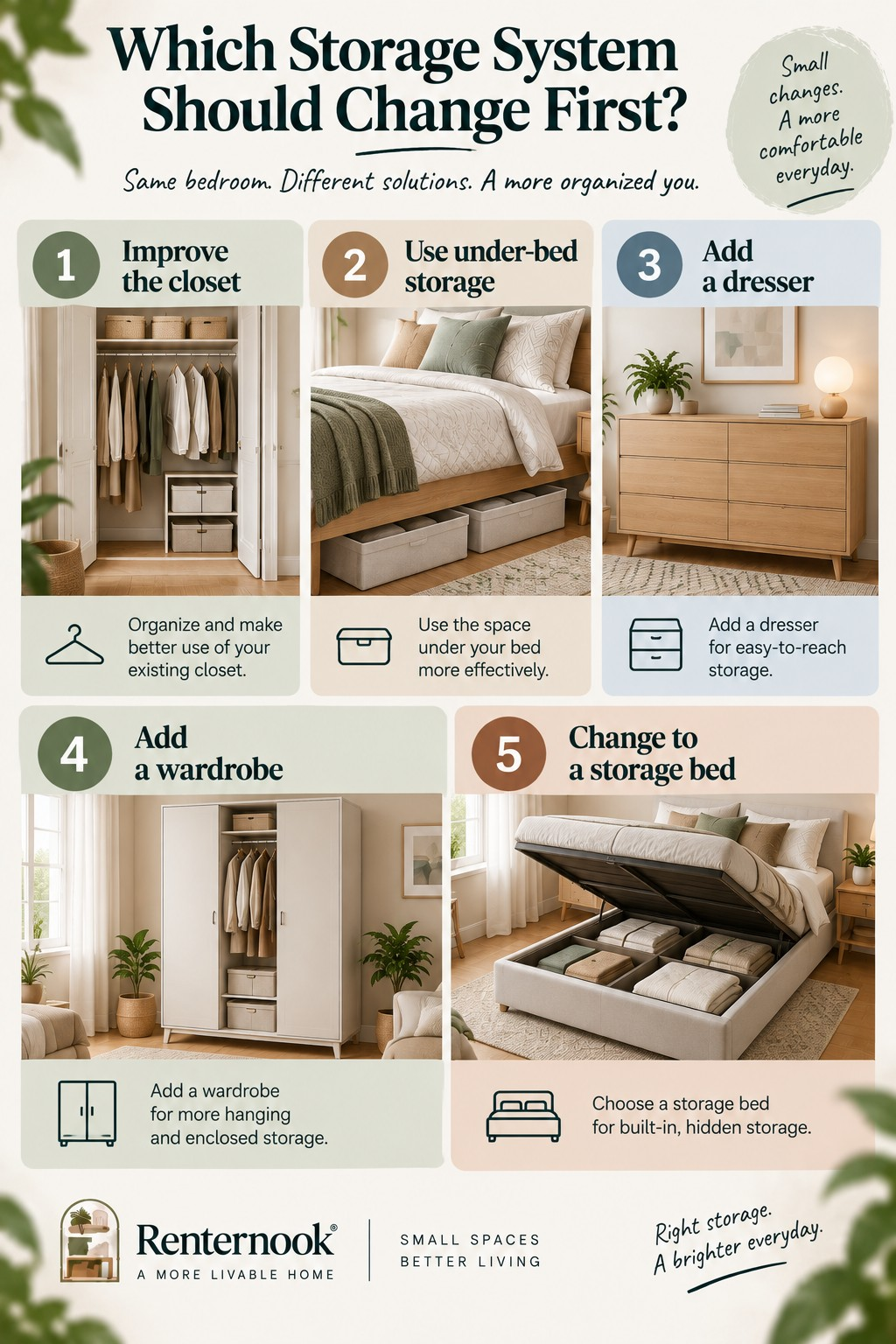
1. Can the existing closet solve the problem?
Ask:
- Is there usable rod, shelf, floor, or vertical space that is poorly organized?
- Can an organizer fit without blocking garments, drawers, doors, or another storage zone?
- Does the installation method work with the actual closet and housing constraints?
If yes, investigate the existing closet before adding another large piece of furniture.
If no, move to the next branch.
2. Can you keep the current bed and use the space underneath it?
Ask:
- Is there usable clearance below the bed?
- Is there enough usable length and width?
- Which side of the bed can you realistically access?
- Can the storage pull out or open in the direction the room allows?
If yes, under-bed storage may create capacity without consuming another wall.
If no, move to the next branch.
3. Is drawer storage the missing function?
Ask:
- Do you need front-access drawers for folded clothing or other items?
- Is there a wall zone available for the dresser body?
- Will the room still work when drawers are open?
- Can the product-specific installation or anchoring requirements be followed?
If yes, investigate a dresser.
If no, move to the next branch.
4. Do you need more hanging or enclosed storage?
Ask:
- Is hanging storage the main missing function?
- Do you have enough wall space for a wardrobe body?
- Will the door or access mechanism work beside the bed and other furniture?
- Can you stand in front of the wardrobe and reach the storage?
- Can the required anchoring, delivery, and assembly conditions be handled?
If yes, investigate a wardrobe.
If no, move to the final branch.
5. Does the bed itself need to become the storage system?
Ask:
- Are you willing to replace the current bed?
- Would under-mattress or built-in drawer storage solve a problem that the current furniture cannot?
- Can the storage mechanism work in the real bedroom?
- Do the mattress/foundation, delivery, assembly, and installation requirements work for the exact bed?
If yes, investigate a storage bed.
If no, recheck the storage problem and the zones already in the room before adding furniture by default.
Compare the five storage-system paths
| Storage-system path | Use this branch when | Main fit question before product shopping | Next Renternook guide |
|---|---|---|---|
| Improve the existing closet | The closet has usable space, but the current organization does not match what you need to store | Can an organizer install, fit, and remain accessible inside the actual closet zones? | Small Closet Organizers for Renters |
| Use under-bed storage | You want to keep the current bed and have a potentially usable storage zone beneath it | Does the container fit the lowest usable clearance and can you retrieve it from the side the room gives you? | Under-Bed Storage for Small Apartments |
| Add a dresser | Drawer storage is the missing function and you have a wall/floor zone for it | Does the dresser work in both its closed-body state and drawer-open working state? | Small Dressers for Small Bedrooms |
| Add a wardrobe | Hanging or enclosed storage is the missing function | Does the wardrobe body fit while the doors/access state, standing zone, hanging access, and circulation still work? | Small Wardrobe Closets for Small Bedrooms |
| Replace the bed with a storage bed | You are willing to change a major furniture object so the bed footprint also becomes storage | Does the bed work in its assembled, storage-access, delivery, and setup states? | Storage Beds for Small Bedrooms |
This table is a router. It does not rank one storage system above another.
Branch 1: Keep the closet and improve what is already there
Start here when the bedroom already has a closet and the problem may be how that space is being used.
The existing closet guide separates the closet into usable zones such as the rod zone, shelf zone, floor zone, and vertical zone. It also treats installation and access as part of the fit decision.
That matters because adding an organizer is not the same as adding free capacity.
A hanging organizer uses rod width and vertical drop. A drawer unit uses floor or shelf space and needs front access. An under-shelf organizer depends on the shelf itself. A freestanding floor unit competes with hanging clothes and other storage in the same vertical column.
So before adding furniture to the bedroom, ask whether the current closet can solve the problem without creating a new conflict inside the closet.
If the answer is yes, continue with the Renternook guide to Small Closet Organizers for Renters.
Branch 2: Keep the current bed and use the under-bed zone
Under-bed storage is a different architecture because it uses space that is already occupied by the bed footprint.
That can be useful when you do not want another cabinet or chest in the room.
But the source guide makes an important distinction:
Clearance is only the first check.
The storage also needs to fit the usable length and width under the bed, line up with a side you can actually reach, and use an access mechanism that works with the room.
A top-lid bin, drawer, handled case, and wheeled container can all create different retrieval problems even when their heights are similar.
So this branch is most relevant when you are keeping the current bed and the under-bed zone is physically usable and retrievable.
If that describes your room, continue with Under-Bed Storage for Small Apartments.
Branch 3: Add a dresser when drawer storage is the missing function
A dresser makes sense only after you decide that drawer storage is the system you need.
The dresser guide treats the furniture in two separate states:
- the closed body;
- the drawer-open working state.
The closed body tells you whether the dresser can occupy the wall zone.
The operating state tells you whether the drawers can open, whether you can stand in front of them, and whether the bed, door, closet, chair, or walking path creates a conflict.
Height and wall use matter too. So do the exact product’s installation and anchoring instructions.
This means “I have enough wall width” is not yet a dresser decision.
The bedroom needs to work while the dresser is being used.
If drawer storage is the missing function and that working state is feasible, continue with Small Dressers for Small Bedrooms.
Branch 4: Add a wardrobe when hanging or enclosed storage is the missing function
A wardrobe solves a different problem from a dresser.
The wardrobe guide centers on this distinction:
Wardrobe body fit ≠ door-open / hanging-access fit.
A wardrobe can fit against the wall and still be difficult to use.
Hinged doors need an opening state. Sliding doors change the access problem but do not make the cabinet body disappear. You still need room to stand in front of the wardrobe and reach the rail or shelves.
The bedroom also needs to keep functioning around the wardrobe, especially beside the bed, room door, and normal circulation route.
Anchoring, delivery, and assembly are also part of the exact-product decision.
If your real storage gap is hanging or enclosed storage rather than drawers, continue with Small Wardrobe Closets for Small Bedrooms.
Branch 5: Replace the current bed with a storage bed
This is the most structural change in the decision tree because you are replacing a major furniture object instead of adding storage around it.
The storage-bed guide separates five fit states:
- assembled bed body;
- storage-access mechanism;
- mattress and foundation setup;
- delivery path;
- assembly and installation.
A drawer bed and a lift-up bed can use the same general room zone in very different ways.
The closed footprint does not prove the storage can be used comfortably, and published drawer dimensions do not automatically establish drawer-open projection. A lift-up image does not establish an exact lift arc or open height unless the source publishes it.
This branch is relevant when you are already willing to replace the current bed and want the bed itself to become part of the storage architecture.
If that is the decision you are making, continue with Storage Beds for Small Bedrooms.
What if more than one branch could work?
That is normal.
A bedroom might have both usable under-bed space and enough wall area for a dresser. A closet might be improvable while a wardrobe could also add hanging capacity.
Do not solve that by asking which product has the most storage.
Instead, compare the storage systems:
- Which existing zone would each option use?
- What working state would it add?
- Would it compete with the bed, doors, closet, or circulation?
- Does it require adding furniture, or can you reuse something already in the room?
- Are you willing to replace a major object such as the bed?
- Which branch matches the type of storage you actually need?
Once one storage system makes sense, move into that system’s dedicated guide and compare products there.
Common mistakes when choosing a small bedroom storage solution
Buying another storage product before defining the missing function
“More storage” is too broad.
Drawer storage, hanging storage, closet organization, under-bed storage, and storage built into a bed solve different problems.
Treating every empty zone as usable storage
An empty area may still be needed for access, drawer opening, wardrobe doors, standing space, or circulation.
A storage zone has to work in use, not only look empty.
Choosing by capacity before access
Capacity does not help if the storage cannot be opened, pulled out, reached, or installed correctly.
Adding furniture when an existing storage system could be reorganized
If the closet can absorb the problem, another dresser or wardrobe may create a second space problem instead of solving the first one.
Replacing the bed only because storage beds exist
A storage bed changes the bed, storage mechanism, delivery state, mattress/foundation setup, and assembly conditions.
Treat it as a system change, not a simple storage add-on.
Final takeaway
The first decision in a small bedroom is not:
Which storage product should I buy?
It is:
Which storage system should change first?
Start with the storage you already have.
Check whether the closet can work better.
Check whether the existing bed has a usable under-bed zone.
If you still need another system, decide whether the missing function is drawer storage or hanging/enclosed storage.
Only then consider whether replacing the bed itself is the more appropriate storage architecture.
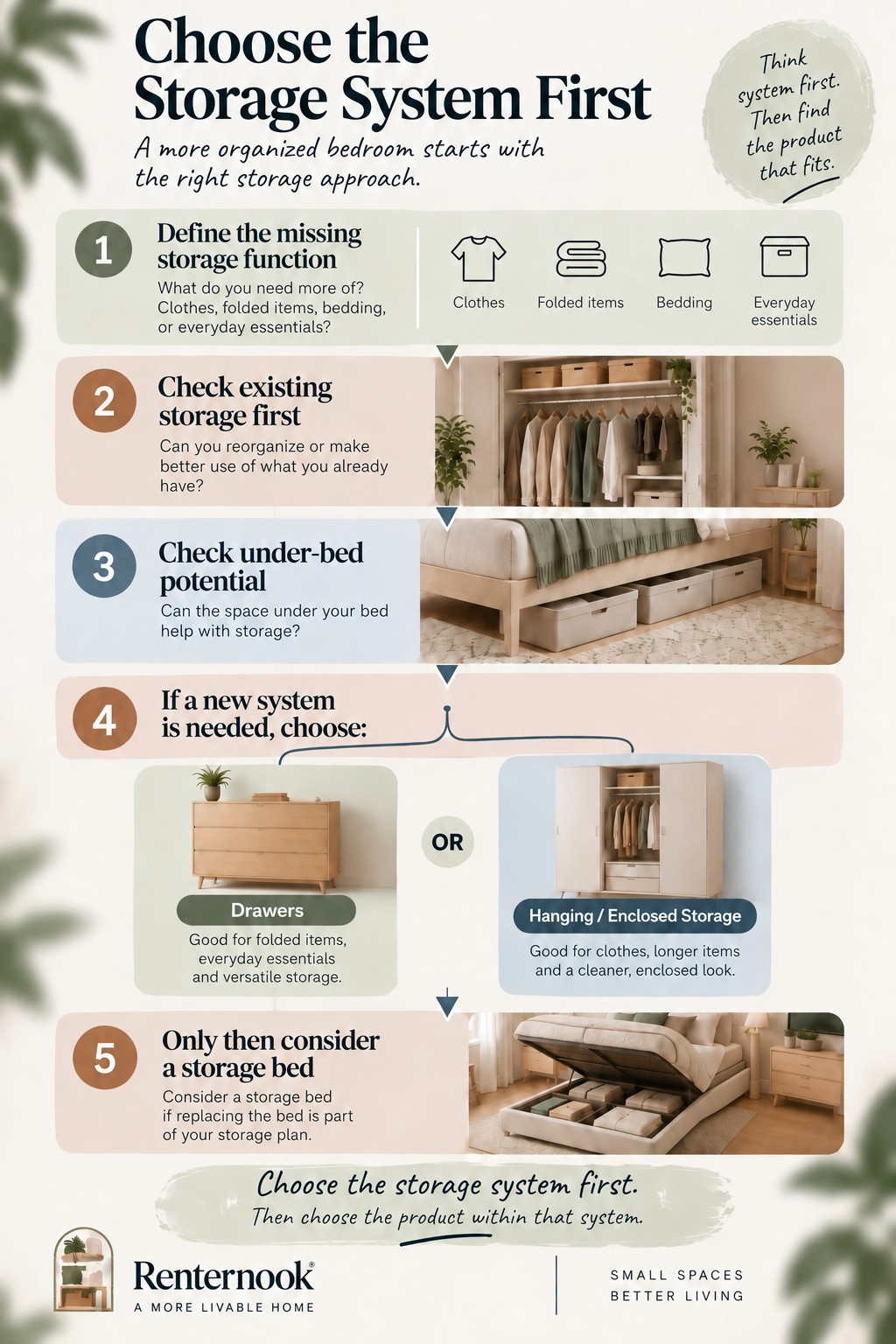
The sequence is simple:
Choose the storage system first → then choose the product within that system.
That keeps the decision focused on how the bedroom actually works, instead of turning “I need more storage” into another furniture purchase by default.