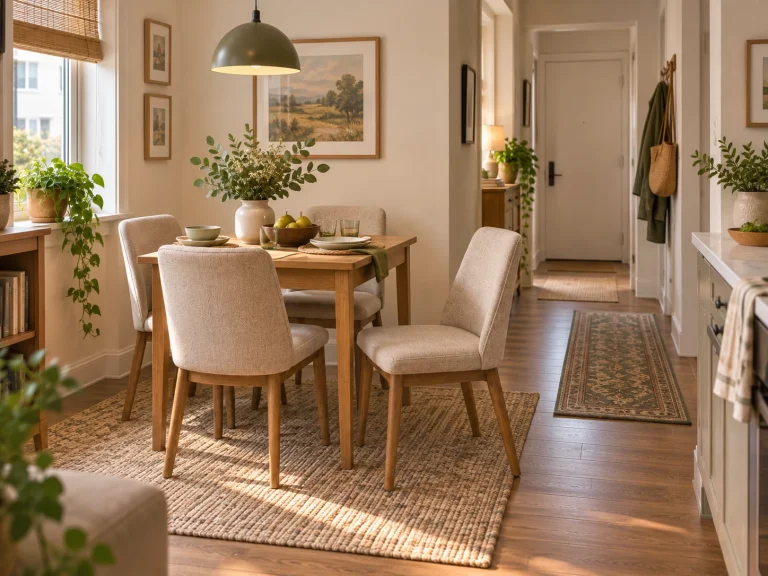
Small Dining Chairs for Small Dining Spaces: 5 Fit-First Options to Check Before You Buy
A dining chair can look compact on a product page and still fail in a small dining space.
The chair itself may fit beside the table.
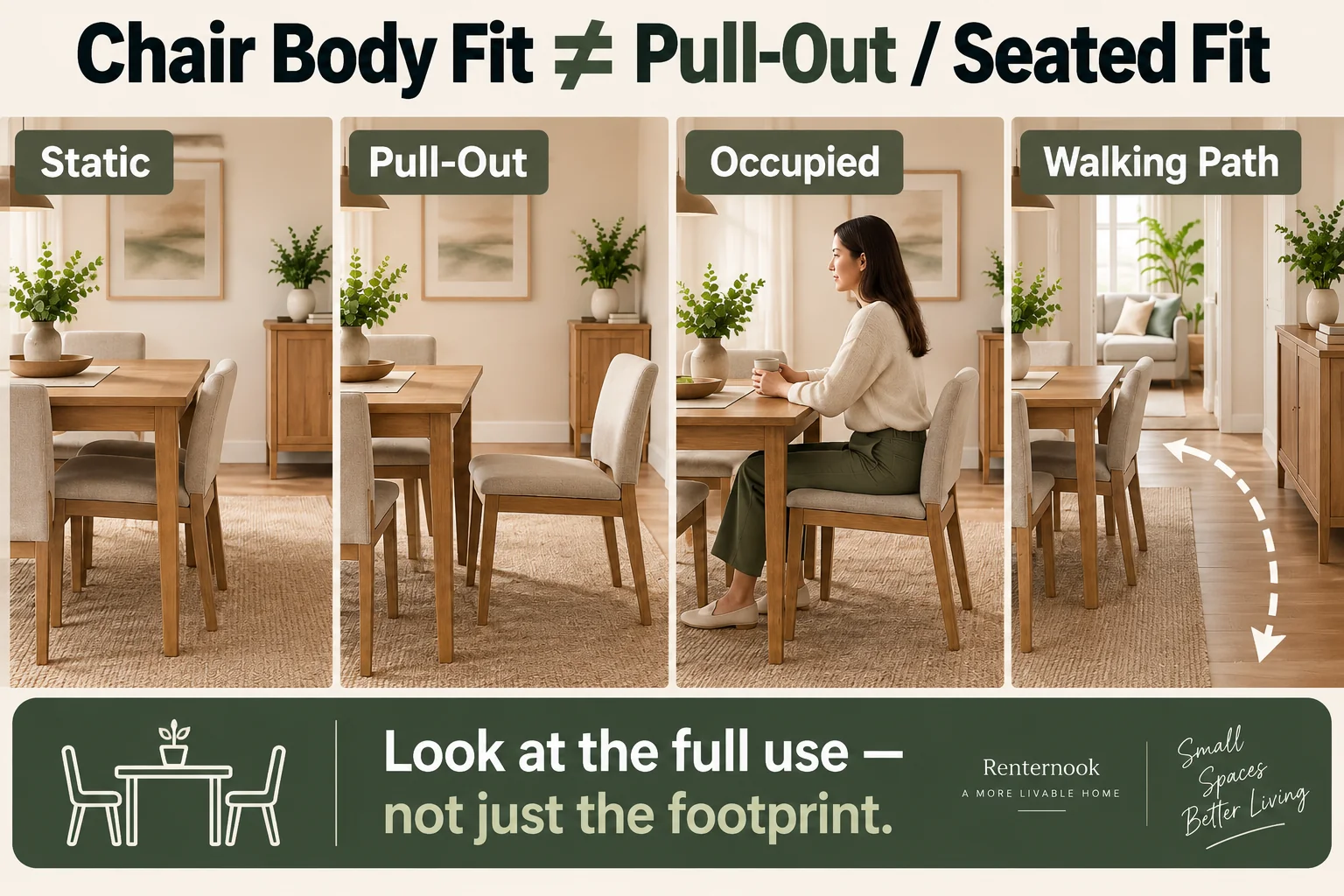
But dining does not happen with the chair frozen in its catalog position.
You pull it out.
You sit down.
Your body moves behind the table edge.
The chair interacts with table legs, an apron, a pedestal, another chair, and the path people use to walk through the room.
That is why the useful question is not only:
“Is this a small chair?”
It is:
“Does this chair still work once I pull it out, sit in it, and use the dining area?”
The core rule is:
CHAIR BODY FIT ≠ PULL-OUT / SEATED FIT
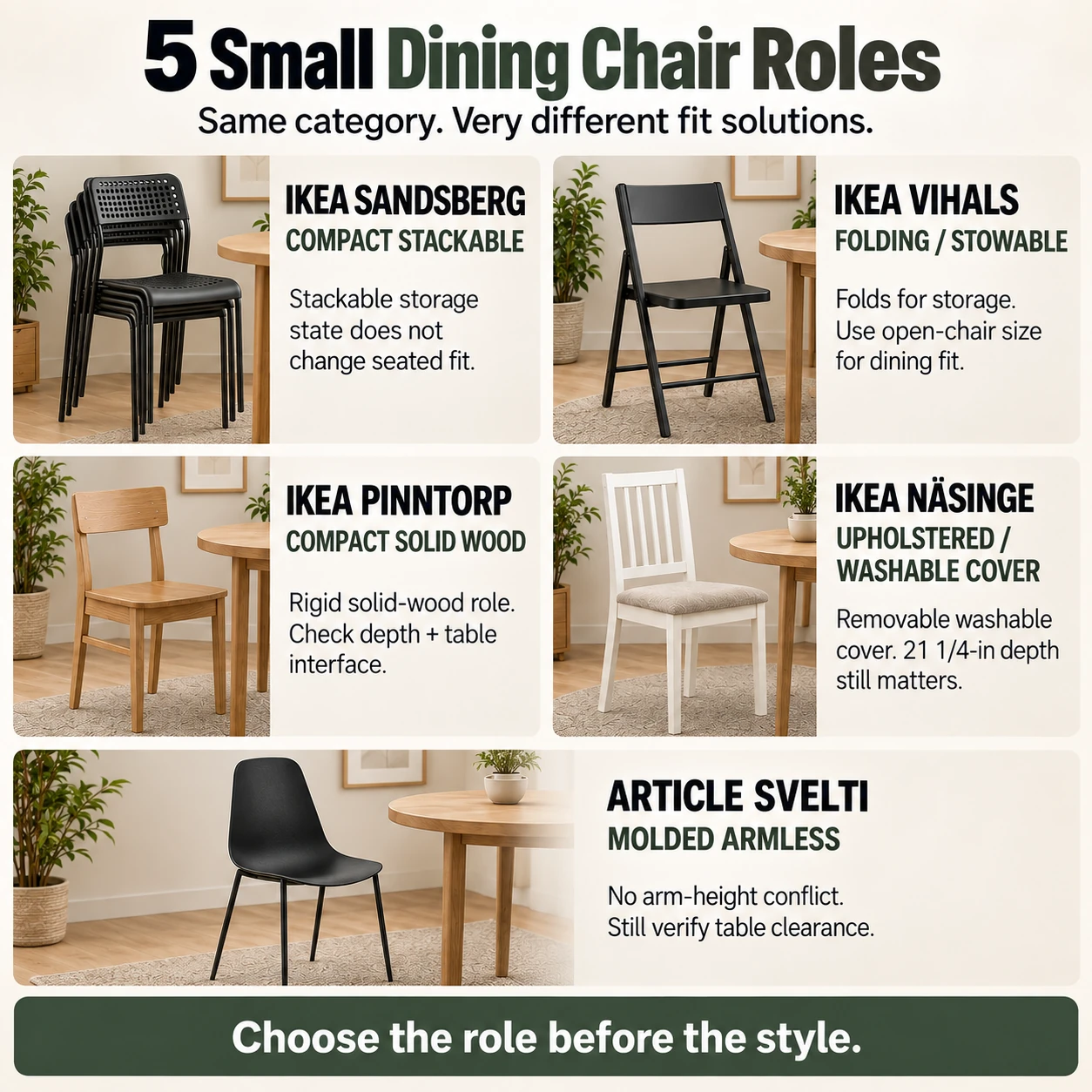
This guide compares five different chair roles:
- IKEA SANDSBERG — compact stackable;
- IKEA VIHALS — folding / stowable;
- IKEA PINNTORP — compact solid wood;
- IKEA NÄSINGE — upholstered with a washable cover;
- Article Svelti — molded armless.
They are not ranked from best to worst.
Instead, the goal is to show how different chair geometries and states change the fit decision.
Start With the Static Chair — Then Measure the States the Catalog Does Not Show
Published chair dimensions are useful.
They tell you the chair’s static body size.
But the available product information for these five chairs does not establish a product-specific pull-out distance or occupied rear projection for any of them.
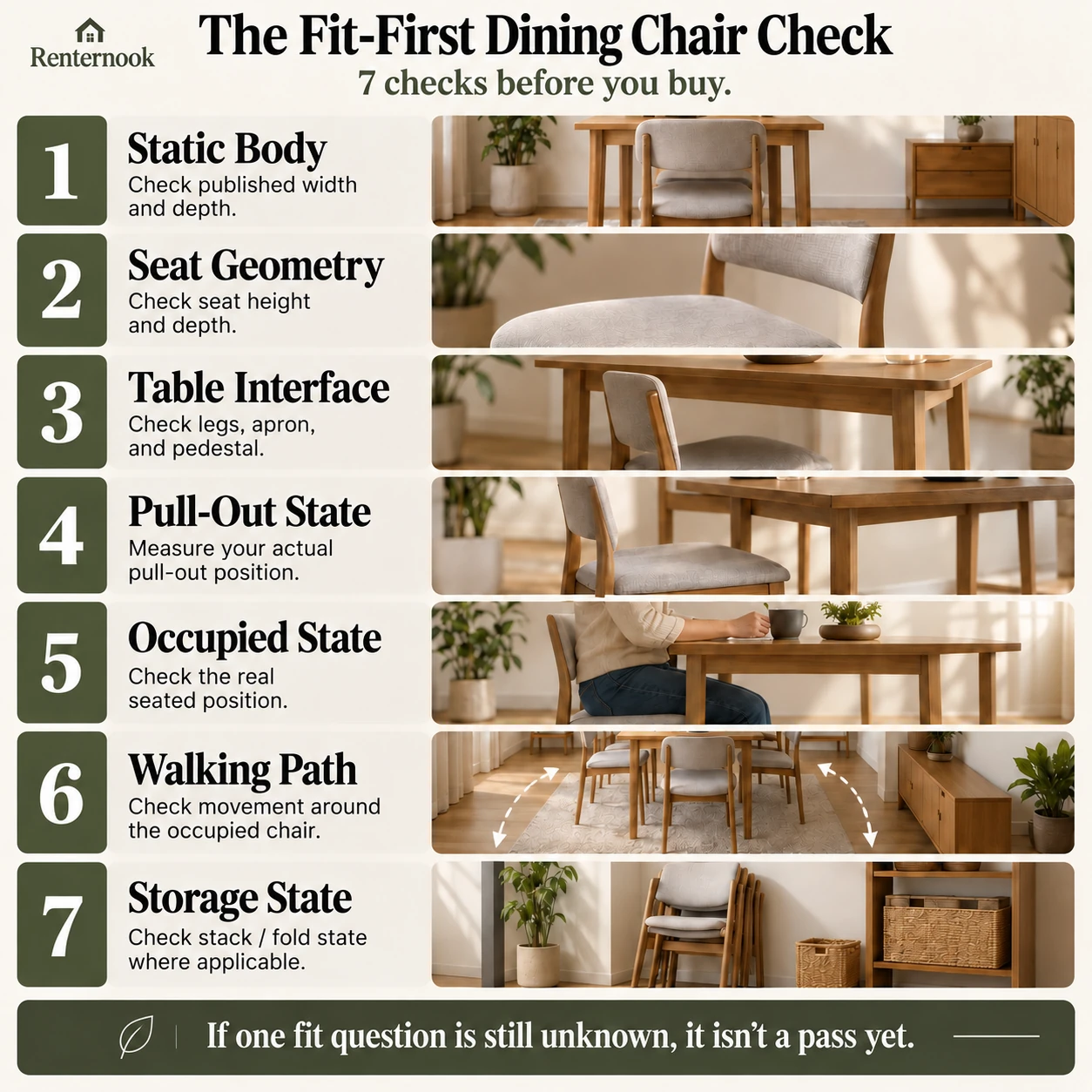
So the buying sequence should be:
- static chair width and depth;
- seat height and seat depth where published;
- arm state where relevant;
- table apron / leg / pedestal interface;
- pull-out state;
- occupied state;
- walking path;
- storage state if the chair folds or stacks.
The first four steps can often be checked from product and table dimensions.
The later steps may require you to measure your actual room and your own use pattern.
There is no universal pull-out number in this guide.
There is no universal walking-clearance number.
And there is no universal dining-chair height rule that can guarantee compatibility with every table.
Why Chair Width Alone Is Not Enough
It is tempting to sort small dining chairs by width.
That can be useful, but it is incomplete.
Among the five products in this guide:
- SANDSBERG is 15 3/8 in wide;
- PINNTORP is 15 3/4 in wide;
- NÄSINGE is 16 1/2 in wide;
- VIHALS is 16 7/8 in wide;
- Svelti is 18 in wide.
Those numbers describe the chair body.
They do not tell you how much room a seated person needs behind the table.
They also do not prove how far a chair must be pulled back before someone can sit down.
That working envelope is UNKNOWN for all five products based on the available source information.
So use static width as a screening variable—not as the final answer.
Depth Can Change the Decision
Chair depth matters because a narrow chair can still project farther into the room.
For example:
- SANDSBERG: 18 1/2 in deep;
- VIHALS: 18 1/2 in deep;
- PINNTORP: 19 1/4 in deep;
- Svelti: 20.5 in deep;
- NÄSINGE: 21 1/4 in deep.
NÄSINGE shows the issue clearly.
Its 16 1/2-in width is relatively narrow within this set, but the chair is 21 1/4 in deep.
That does not make it a bad choice.
It means the width cannot be used as proof that it creates the smallest working footprint.
Narrow body width does not erase chair depth.
Check the Chair Against the Actual Table
A chair can be compact and still interact badly with the table.
Important table-side variables include:
- the underside of the tabletop;
- an apron below the tabletop;
- table legs;
- pedestal bases;
- stretchers or crossbars;
- and the available opening between structural parts.
For these chairs, table-apron compatibility is not established as a universal fact.
It is product- and table-specific.
That means you should not assume that two chairs with the same seat height will tuck under the same table.
You should also not assume that an armless chair automatically fits under every table.
Armless construction removes one possible arm-height conflict.
It does not prove that the seat, back, legs, or frame will clear the table structure.
Quick Comparison: 5 Small Dining Chair Roles
| Product | Role | Published body | Seat height | What changes the fit decision? |
|---|---|---|---|---|
| IKEA SANDSBERG 306.054.23 | Compact stackable | 15 3/8 W × 18 1/2 D × 30 3/8 H in | 17 3/4 in | Very compact static body, but stackability only changes storage state—not seated fit |
| IKEA VIHALS 906.517.42 | Folding / stowable | 16 7/8 W × 18 1/2 D × 31 1/2 H in | 17 3/4 in | Fold-away state can reduce storage burden between uses, but dining fit must use the open chair |
| IKEA PINNTORP 005.294.78 | Compact solid wood | 15 3/4 W × 19 1/4 D × 32 5/8 H in | 17 3/4 in | Narrow rigid body, with table interface and pull-out state still requiring a room-specific check |
| IKEA NÄSINGE 805.875.82 | Upholstered / washable cover | 16 1/2 W × 21 1/4 D × 35 3/8 H in | 18 7/8 in | Narrow width plus noticeably deeper body; table interface remains specific to the actual table |
| Article Svelti SKU3055 | Molded armless | 18 W × 20.5 D × 34.5 H in | 18 in | Armless form removes arm-height conflict, but does not guarantee tuck, leg, or apron compatibility |
This table compares roles and published body dimensions.
It does not establish the full working envelope around a seated diner.
1. IKEA SANDSBERG 306.054.23 — Compact Stackable Role
The IKEA SANDSBERG has the smallest published width among these five chairs.
Published dimensions are:
- width: 15 3/8 in;
- depth: 18 1/2 in;
- height: 30 3/8 in;
- seat width: 15 3/8 in;
- seat depth: 13 3/8 in;
- seat height: 17 3/4 in.
The chair uses a steel frame with a polypropylene seat and back.
It is also stackable, with the source supporting stacking up to six chairs.
That gives it two distinct states:
- in-use state at the dining table;
- stacked storage state when chairs are put away.
The storage benefit is real.
But it should not be confused with a smaller working footprint while someone is seated.
Check before buying
- Does the 15 3/8 × 18 1/2-in static body fit the intended chair position?
- Does the 17 3/4-in seat height work with the actual table structure?
- Do the table legs or apron interfere with where the chair needs to sit?
- Is stackability useful in your routine, or will the chair stay at the table most of the time?
- Where will a stack of chairs actually be stored?
Good role match
SANDSBERG is the clearest fit for buyers who prioritize a very compact published static body and want the option to stack extra chairs between uses.
Important limitation
The exact pull-out distance and occupied envelope are UNKNOWN.
Do not convert stackability into a claim about in-use dining clearance.
2. IKEA VIHALS 906.517.42 — Folding / Stowable Role
The IKEA VIHALS takes a different approach to space.
Instead of stacking, the chair folds.
Published open dimensions are:
- width: 16 7/8 in;
- depth: 18 1/2 in;
- height: 31 1/2 in;
- seat width: 15 3/8 in;
- seat depth: 16 1/8 in;
- seat height: 17 3/4 in.
The chair uses a steel frame with a polypropylene seat and back and is listed as pre-assembled.
The main advantage of this role is not that the dining footprint disappears.
It is that the storage state can change when the chair is not being used.
Check before buying
- Use the open-chair dimensions for dining fit.
- Check the actual table opening and structural parts against the chair.
- Decide whether folding the chair between meals is realistic in your routine.
- Identify where the folded chair would be stored.
- Do not assume a folded envelope unless you have the exact source data you need.
Good role match
VIHALS makes the most sense when the dining area is flexible and you genuinely plan to remove or stow seating between uses.
Important limitation
The exact folded thickness / storage envelope was not established in the product information used for this guide.
The pull-out and occupied envelopes also remain UNKNOWN.
3. IKEA PINNTORP 005.294.78 — Compact Solid-Wood Role
The IKEA PINNTORP is the rigid solid-wood option in this five-chair set.
Published dimensions are:
- width: 15 3/4 in;
- depth: 19 1/4 in;
- height: 32 5/8 in;
- seat width: 15 3/4 in;
- seat depth: 14 1/8 in;
- seat height: 17 3/4 in.
The chair is solid pine.
No folding or stacking claim is used in this article.
That makes the decision simpler in one sense: there is no separate storage state to model.
But the normal dining-use questions still remain.
Check before buying
- Does the 15 3/4-in width work with the number of chairs you want around the table?
- Does the 19 1/4-in depth work before you even account for pull-out and occupied states?
- Does the chair line up with the actual leg / apron / pedestal geometry of your table?
- Is the 17 3/4-in seat height appropriate for this specific table setup?
Good role match
PINNTORP is a clean fit-first comparison point for buyers who want a compact rigid wood chair rather than a folding, stacking, or upholstered role.
Important limitation
Static body size does not establish tuck depth or seated working clearance.
Those remain table- and room-specific.
4. IKEA NÄSINGE 805.875.82 — Upholstered / Washable-Cover Role
The IKEA NÄSINGE adds an upholstered seat and removable machine-washable cover.
Published dimensions are:
- width: 16 1/2 in;
- depth: 21 1/4 in;
- height: 35 3/8 in;
- seat width: 16 1/2 in;
- seat depth: 15 3/4 in;
- seat height: 18 7/8 in.
The frame is solid wood.
This chair is useful for showing why width should not be evaluated alone.
At 16 1/2 in wide, it is still relatively narrow within the set.
But the 21 1/4-in depth is the deepest published chair body among these five.
The seat height is also higher than the 17 3/4-in seats on SANDSBERG, VIHALS, and PINNTORP.
Neither difference is automatically good or bad.
They simply create a different fit problem.
Check before buying
- Do not treat the 16 1/2-in width as proof of a smaller overall working footprint.
- Check the 21 1/4-in depth against the actual dining area.
- Compare the 18 7/8-in seat height with the specific table.
- Check table-apron / leg / pedestal geometry rather than assuming the chair will tuck.
- Decide whether the upholstered seat and removable washable cover matter enough to justify the geometry trade-off in your room.
Good role match
NÄSINGE is the strongest role match here for buyers prioritizing an upholstered seat and washable cover while still wanting a relatively narrow published chair width.
Important limitation
Pull-out envelope, occupied envelope, and table-apron clearance are UNKNOWN.
No universal table-height match claim is supported.
5. Article Svelti SKU3055 — Molded Armless Role
The Article Svelti is the only non-IKEA chair among these five chairs.
Published dimensions are:
- width: 18 in;
- depth: 20.5 in;
- height: 34.5 in;
- seat height: 18 in.
The product page lists an armless molded chair with:
- a polypropylene / fiberglass seat;
- powder-coated metal legs.
The armless state matters because it removes one possible arm-height conflict with a table.
But that is a narrow claim.
It does not prove:
- that the chair tucks fully under a given table;
- that the chair legs clear the table legs;
- that the seat clears the apron;
- or that the occupied chair fits the walking path.
Check before buying
- Does the 18-in width work with your table length and chair spacing?
- Does the 20.5-in depth work in the room before pull-out?
- Does the 18-in seat height work with the specific table?
- Are the table legs or pedestal positioned where the chair needs to move?
- Is an armless chair useful for your table geometry, without treating it as a compatibility guarantee?
Good role match
Svelti is the clearest role match when you specifically want an armless molded-chair form and want to avoid arm-height interference as one variable.
Important limitation
Seat width and seat depth were not established in the available product information.
Pull-out distance, occupied rear projection, table-specific tuck depth, and apron clearance are also UNKNOWN.
How to Measure a Small Dining Area Before You Buy Chairs
The useful measurement is not just the empty gap around the table.
You need to think in states.
1. Map the table’s fixed geometry
Record:
- tabletop width and length;
- table height;
- underside / apron position if present;
- leg positions;
- pedestal footprint if applicable;
- stretchers or crossbars.
A chair has to interact with this geometry.
2. Map each chair’s static body
Use the published:
- width;
- depth;
- height;
- seat height;
- seat depth where available;
- arm state where relevant.
Do not substitute a missing dimension with a visual estimate.
3. Check the tuck / resting position
Place the chair footprint where it would normally sit when not occupied.
Ask:
- Do the chair legs conflict with the table legs?
- Does the seat or frame reach the apron?
- Can the chair sit where you expect it to?
If the table-specific interface is unknown, keep it unknown until you measure the actual table.
4. Check pull-out state
A person needs to move the chair away from the table to sit down and stand up.
The available product information does not establish a universal pull-out distance for these chairs.
So use your own dining area.
Mark the chair’s resting position.
Then physically determine the pull-out position your household needs.
5. Check occupied state
The chair body is not the entire occupied envelope.
Once a person is seated, the real rear projection can change.
That projection is not published for these five chairs.
Do not pretend the catalog depth equals occupied depth.
6. Check the walking path
Finally, ask whether another person can still move through the room when a chair is:
- tucked in;
- pulled out;
- occupied.
There is no universal walking-clearance number in this guide.
The usable path depends on your room, table, chair, doorway, and traffic pattern.
7. Check storage state where relevant
For SANDSBERG, decide whether stacking is actually useful and where stacked chairs will go.
For VIHALS, decide whether folding and stowing the chair is part of your real routine.
A storage state only helps if you have a practical place and reason to use it.
Fit-First Checklist
Before ordering, confirm:
If a required field is not published and you cannot verify it in your own room:
UNKNOWN stays UNKNOWN.
Common Small Dining Chair Buying Mistakes
Mistake 1: Buying by the word “small”
“Small” does not define a complete working envelope.
Read the actual dimensions.
Mistake 2: Looking only at width
A narrow chair can still be deep.
NÄSINGE is a clear example: 16 1/2 in wide and 21 1/4 in deep.
Mistake 3: Treating catalog depth as seated depth
Static chair depth is a product dimension.
Occupied rear projection is a different state and is not established for these five chairs.
Mistake 4: Assuming a standard pull-out distance
This guide does not establish one.
Measure the way people actually sit down and stand up in your room.
Mistake 5: Ignoring table legs and aprons
Chair fit is a chair-and-table problem.
The chair dimensions alone cannot prove compatibility.
Mistake 6: Treating “armless” as “will tuck under the table”
Armless removes one possible interface.
It does not prove that the seat, legs, or frame clear the table.
Mistake 7: Treating stackable or foldable as a smaller dining footprint
Stacking and folding are storage-state features.
Use the open / in-use chair dimensions for the dining fit decision.
Which Chair Role Fits Your Dining Space?
Choose the compact stackable role if:
- you want one of the smallest published static bodies in this set;
- storing extra chairs in a stack is useful;
- you understand that stacked size and seated fit are separate questions.
Role: IKEA SANDSBERG.
Choose the folding / stowable role if:
- the dining area changes function during the day;
- you genuinely plan to remove chairs between uses;
- the open chair works at your specific table.
Role: IKEA VIHALS.
Choose the compact solid-wood role if:
- you want a rigid wood chair;
- you do not need a fold or stack state;
- the narrow static body works with your table layout.
Role: IKEA PINNTORP.
Choose the upholstered / washable-cover role if:
- upholstery and easier cover care are important;
- the 21 1/4-in depth fits the room;
- the 18 7/8-in seat height works with the actual table.
Role: IKEA NÄSINGE.
Choose the molded armless role if:
- arm-height conflict is one variable you want to remove;
- the 18 × 20.5-in static footprint works;
- your specific table geometry still passes the tuck / leg / apron check.
Role: Article Svelti.
Final Takeaway
A dining chair can have a compact published body and still be the wrong fit for a small dining space.
The fit-first sequence is:
STATIC BODY → SEAT GEOMETRY → TABLE INTERFACE → PULL-OUT → OCCUPIED STATE → WALKING PATH → STORAGE STATE
The first dimensions help you shortlist.
The later states decide whether the chair actually works.
That is the distinction to keep:
CHAIR BODY FIT ≠ PULL-OUT / SEATED FIT
How We Researched This Guide
Renternook reviewed the exact products listed in this guide using current manufacturer and official-brand product information.
The product dimensions and feature details in this guide come from current manufacturer / official-brand product pages.
We did not physically test these chairs.
We did not establish:
- a universal pull-out clearance;
- a universal walking clearance;
- a universal dining-chair height rule;
- a universal seat-to-table height rule;
- universal table-apron compatibility;
- product-specific occupied envelopes for the five chairs;
- or universal small-space suitability.
Where the available source information did not establish a field—such as pull-out distance, occupied rear projection, table-specific apron clearance, or Svelti seat width / depth—the field remains UNKNOWN.
Current local stock, delivery availability, prices, seller conditions, demand growth, and search-volume growth are not used as durable article facts.