Small Entryway Shoe Storage for Renters: Measure Depth, Door Swing, and Walking Space Before You Buy
A shoe cabinet can look impressively slim on a product page and still
be the wrong choice for your entryway.
Why?
Because the product depth is only one part of the space it actually
needs.
In a small rental entryway, your shoe storage has to coexist
with:
- the front door
- nearby closet doors
- the walking path
- baseboards and trim
- wall anchoring requirements
- the way the storage actually opens
- and the shoes you need to store
A 7-inch-deep cabinet may protect floor space, but if it has to be
fastened to the wall, that becomes part of the buying decision.
A 9.5-inch-deep flip-drawer cabinet may look compact when closed, but
you still need enough room in front of it to open the drawers.
And a shoe bench may be useful for sitting down while putting on
shoes, but its larger footprint can take more space out of a narrow
entry path.
So instead of asking:
“Which shoe organizer is the slimmest?”
Start with a better question:
“Which storage role actually fits my entryway, my walking path, and
my installation limits?”
This guide walks through that decision step by step.
Before You Buy:
Measure the Entryway as a Whole
Do not start by measuring only the empty wall.
Your entryway is a moving space.
Doors open through it.
People walk through it.
Shoes project beyond shelves.
Some storage units open toward you.
Some products need anti-tip hardware or wall securement.
The useful measurement is therefore not just the size of the empty
rectangle on the floor.
Think of it as an entry envelope.
Before comparing products, record these measurements and
conditions.
1. Clear Wall Width
Measure the section of wall you can actually use.
Do not automatically count the full distance from one corner to
another.
Check whether that wall section includes:
- door trim
- baseboards
- electrical outlets
- switches
- vents
- adjacent doors
- or other fixed obstacles
A product may technically fit the wall width while still interfering
with something beside it.
2. Usable Floor Depth
Measure how far storage can project into the room without making the
space impractical.
This is where many “slim” products become misleading.
The product’s published depth tells you how much floor space the unit
itself occupies when closed.
It does not automatically tell you how much usable
walking space will remain after installation.
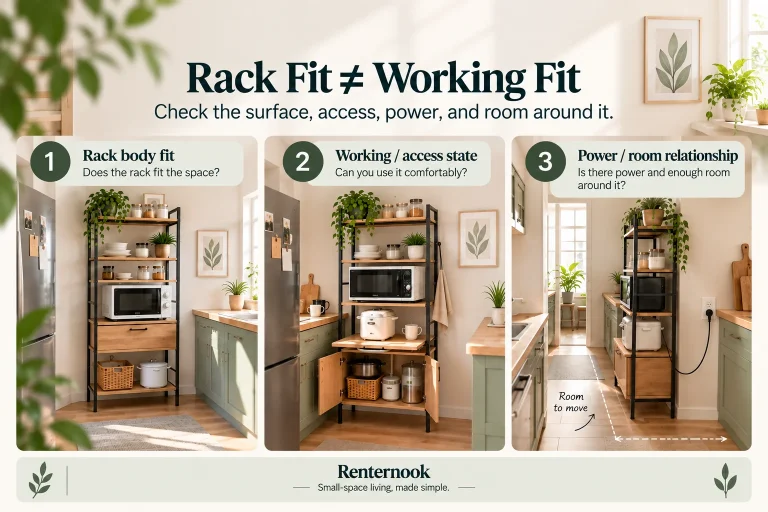
Product depth pass ≠ walking-path pass.
Place a piece of painter’s tape on the floor at the product depth you
are considering.
Then walk through the entryway normally.
Open the front door.
Carry a bag through the space.
Stand where you normally put your shoes on.
That simple test can tell you more about real fit than the word
“slim” on a product listing.
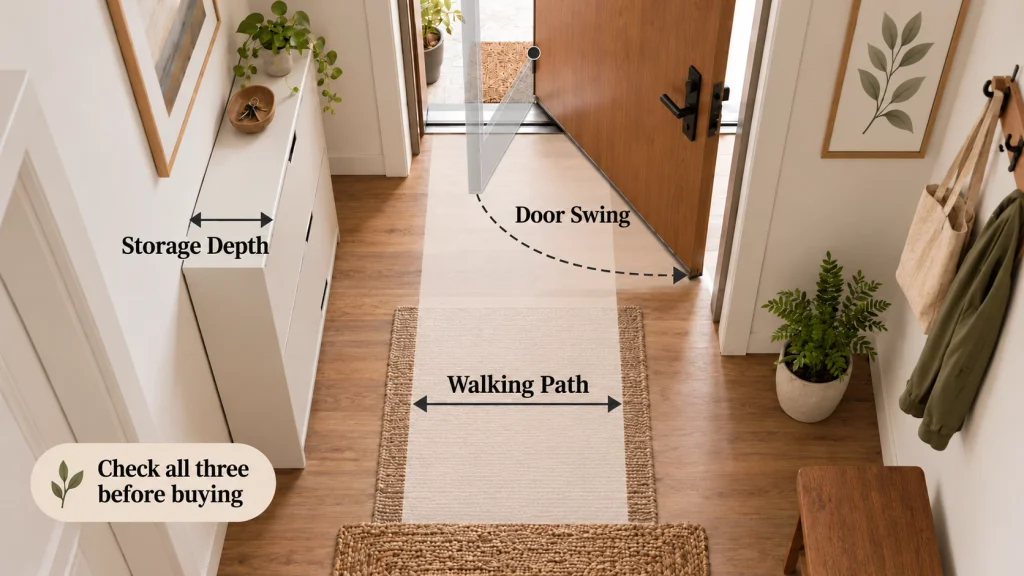
3. Map the Door Swings
Check every door that moves through the entry area.
That may include:
- the front door
- a coat-closet door
- a utility door
- a nearby bedroom or bathroom door
- the doors or drawers on the shoe-storage product itself
Mark the door swing on the floor if the space is tight.
A storage unit can fit perfectly against the wall and still sit
directly inside a door’s travel path.
4. Check Baseboards and Trim
Baseboards can prevent cabinets from sitting completely flush against
a wall.
This matters especially with taller or wall-secured shoe
cabinets.
Do not assume the published product depth will translate perfectly
into the installed footprint.
Check:
- baseboard thickness
- trim height
- rear-leg position
- wall-fastening location
- and whether the product is designed to sit over or in front of
trim
5. Check Whether Wall
Anchoring Is Allowed
For renters, this can completely change which storage role makes
sense.
Some very shallow cabinets achieve their small footprint partly
because they are designed to be secured to the wall.
If the manufacturer requires wall fastening, do not treat that
instruction as optional simply because you are renting.
Before buying, check:
- whether your rental agreement allows wall anchoring
- what type of wall you have
- what fasteners are appropriate for that wall
- whether the product includes or requires anti-tip hardware
- and whether you can follow the manufacturer’s installation
instructions correctly
Slim product ≠ renter-safe.
And:
Freestanding format ≠ anti-tip requirement
absent.
Choose the
Storage Role Before Choosing the Product
The biggest mistake is comparing every shoe organizer as if they
solve the same problem.
They do not.
A shallow wall cabinet, a vertical rack, a flip-drawer cabinet, a
bench, and a small floor rack all use the entryway differently.
The right starting point is to decide which storage role fits your
space.
Here are five materially different options.
Quick Comparison
| Product | Storage Role | Published Size | Main Fit Question |
|---|---|---|---|
| IKEA TRONES | Ultra-shallow wall-secured modular cabinet | 20 1/2″ W × 7 1/8″ D × 15 3/8″ H | Can you secure it to the wall? |
| Costway 7-Tier Vertical Shoe Rack | Narrow vertical open rack | 18.5″ × 10″ × 43.5″ (L × W × H) | Does the floor footprint and shelf spacing work for your shoes? |
| Costway Narrow Shoe Cabinet | Flip-drawer / tilt-out cabinet | 31.5″ × 9.5″ × 35.5″ | Is there enough room to open the flip drawers? |
| IKEA TJUSIG Bench | Bench + open shoe storage | 42 1/2″ W × 13 3/8″ D × 19 5/8″ H | Is the larger footprint worth the seated function? |
| IKEA GREJIG | Minimal floor / daily-pair rack | 22 7/8″ W × 10 5/8″ D × 6 3/4″ H | Do you really need more than a small daily-pair drop zone? |
The dimensions above should be treated as product specifications, not
guarantees that the product will fit your home.
Your door swing, walking path, wall conditions, and footwear still
need to be checked separately.
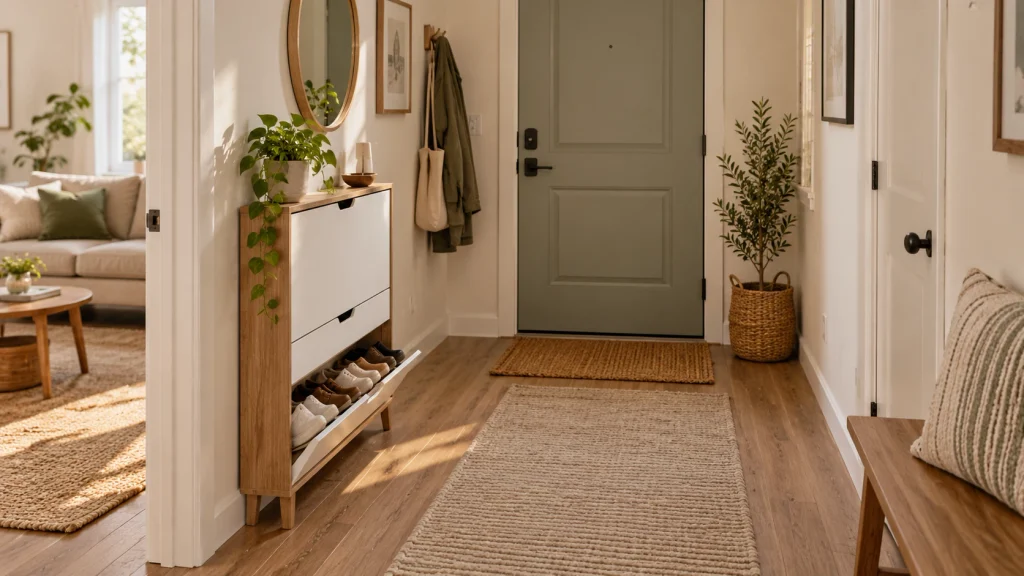
1. IKEA
TRONES — When Floor Depth Is the Main Constraint
The IKEA TRONES is the shallowest option in this group.
Published dimensions are:
- Width: 20 1/2″
- Depth: 7 1/8″
- Height: 15 3/8″
IKEA describes it as a shallow shoe/storage cabinet intended to take
up relatively little space, and the product page states an approximate
capacity of four pairs of shoes per cabinet.
It is also modular.
The cabinets can be used together in different arrangements, which
can be useful if you have limited floor depth but more vertical wall
space.
However, there is one major renter-specific condition:
IKEA states that these cabinets must be secured to the
wall.
Different wall materials may require different fasteners.
That means the 7 1/8-inch depth should not be considered in
isolation.
The real decision is:
“Does the shallow footprint help enough to justify a wall-secured
installation in my rental?”
Check before buying
- Do you have at least 20 1/2 inches of usable wall width?
- Will the 7 1/8-inch depth leave enough walking space?
- Does your lease allow wall anchoring?
- What wall material are you fastening into?
- Will baseboards affect how the cabinet sits?
- Will the cabinet fronts remain easy to access?
Good role match
This role makes the most sense when floor depth is one of your
biggest constraints and wall securement is acceptable.
Important limitation
Do not describe TRONES as “damage-free” or universally
“renter-friendly.”
Its shallow dimensions are verified.
Its wall-securement requirement is also verified.
Those two facts need to stay together.
2.
Costway 7-Tier Vertical Shoe Rack — When You Have More Height Than Floor
Space
A narrow vertical open rack uses a different strategy.
Instead of trying to hide shoes inside a shallow cabinet, it builds
storage upward.
The Costway 7-Tier Vertical Shoe Rack has published overall
dimensions of:
18.5″ × 10″ × 43.5″ (L × W × H)
Because Costway labels the two horizontal axes as length and width
rather than width and depth, keep those source labels intact when
comparing dimensions.
Before buying, check how the rack will actually be oriented in your
entryway and verify which horizontal dimension will project into your
walking path.
The manufacturer describes the unit as freestanding.
It has seven tiers, removable shelves, and published shelf spacing
of:
- 5 inches for the top five shelf levels
- 7.5 inches for the bottom shelf space
That published spacing can be useful if you own shoes with different
heights.
But this product also includes an anti-tipping device.
So the word “freestanding” should not be interpreted as:
“No wall-safety consideration required.”
Check before buying
- Does the 18.5″ × 10″ horizontal footprint work in the place where
you plan to put it? - Which horizontal side will project into your walking path?
- Will the 43.5-inch height interfere with switches or wall
fixtures? - Does the 5-inch shelf spacing fit the shoes you actually own?
- Do taller shoes need the 7.5-inch lower section?
- Can you handle the anti-tip requirement correctly?
Good role match
This role may work well when you have limited floor area but enough
vertical space.
It can also make footwear easier to see and access than enclosed
storage.
Important limitation
Do not assume every pair of shoes will fit simply because the rack
has adjustable or removable components.
Use the published shelf spacing as a starting point and compare it
with your actual footwear.
3.
Costway Narrow Shoe Cabinet — Check the Open Position, Not Just the
Closed Depth
This is where product dimensions can become especially
misleading.
The Costway Narrow Shoe Cabinet has published dimensions of:
31.5″ × 9.5″ × 35.5″
It includes:
- two flip drawers
- adjustable and removable shelves
- a 29.5-inch inner shelf width
- approximately 3.5 inches between shelves
- approximately 4 inches of ground clearance
A closed depth of 9.5 inches may look attractive in a small
entryway.
But that number only tells you how deep the cabinet is while
closed.
The flip drawers still need space in front of the cabinet to
open.
The current source evidence does not provide a verified minimum
open-drawer projection.
So there is no responsible universal number to give you here.
What to do instead
Before buying:
- mark the 9.5-inch closed depth on your floor
- identify the area directly in front of the cabinet
- check whether the front door or closet door moves through that
area - make sure you can stand in front of the cabinet while opening a
drawer - verify the actual drawer-opening envelope before final
installation
Anti-tip consideration
The product includes an anti-toppling device, and the product
information indicates that wall-secured placement improves stability and
tip protection.
Again:
Freestanding product format does not mean anti-tip
considerations disappear.
Good role match
A flip-drawer cabinet can make sense when you want concealed storage
and a relatively shallow closed profile.
But this role only works if both states fit:
- closed
- open
Important limitation
Never write:
“This cabinet only needs 9.5 inches of space.”
That would ignore the front-opening path.
The verified statement is only that the published closed dimension
includes a 9.5-inch dimension in the manufacturer’s product sizing.
4.
IKEA TJUSIG Bench — When Sitting Space Is Worth the Larger
Footprint
Not every small entryway needs the shallowest possible storage.
Sometimes function matters more than maximum compactness.
The IKEA TJUSIG Bench with shoe storage combines a seating surface
with open shoe storage underneath.
Published dimensions are:
- Width: 42 1/2″
- Depth: 13 3/8″
- Height: 19 5/8″
IKEA states that it holds approximately eight pairs of shoes.
This is a much larger footprint than the shallow cabinets in this
guide.
But it also gives you something those cabinets do not:
a place to sit while putting shoes on or taking them off.
The question is therefore not:
“Is 13 3/8 inches too deep?”
The better question is:
“Is the seated function useful enough to justify giving this much
entryway space to the bench?”
Check before buying
- Can your walking path handle a 13 3/8-inch-deep piece of
furniture? - Does the 42 1/2-inch width fit the wall?
- Can the front door open fully?
- Can people still pass through the entry comfortably?
- Is sitting down to change shoes actually useful in your
routine?
Good role match
This role works best when the entryway has enough width and depth to
support a larger footprint and you value the seating function.
Important limitation
Do not claim the bench is universally safer, stronger, or more stable
than other options.
This guide does not include a hands-on durability or stability
test.
5.
IKEA GREJIG — When You Only Need a Daily Shoe Drop Zone
A small apartment does not always need a shoe cabinet.
Sometimes the simplest storage role is enough.
The IKEA GREJIG Shoe Rack has published dimensions of:
- Width: 22 7/8″
- Depth: 10 5/8″
- Height: 6 3/4″
IKEA states that it holds three pairs of shoes.
The rack is foldable, and the manufacturer says up to three racks can
be stacked.
This makes it materially different from the other options in this
guide.
Instead of trying to store a larger shoe collection at the entry, it
can function as a small daily-pair zone.
Check before buying
- Are three pairs enough for your normal entryway routine?
- Does the 10 5/8-inch depth work in the walking path?
- Do your shoes fit comfortably on the rack?
- If you plan to stack racks, will the footwear height still
work? - Do you actually need a cabinet, or would a simple drop zone solve
the problem?
Good role match
This role is useful when you want to keep only the shoes you wear
most often near the door.
It may also be a better fit for renters who want to avoid buying a
much larger storage piece than they actually need.
Important limitation
Do not assume boots or high-top shoes will fit stacked configurations
unless you verify the available vertical space yourself.
The current source evidence does not establish a universal boot-fit
rule.
Which Storage Role Fits
Your Entryway?
Instead of ranking these products from “best” to “worst,” match the
storage role to the problem you actually have.
Choose an ultra-shallow
wall cabinet if:
- floor depth is extremely limited
- you have suitable wall space
- wall anchoring is allowed
- you are comfortable following the manufacturer’s fastening
requirements
Choose a narrow vertical rack
if:
- you have more vertical space than floor space
- open storage works for you
- your shoes fit the published shelf spacing
- anti-tip requirements can be handled correctly
Choose a flip-drawer cabinet
if:
- you want concealed shoe storage
- the closed depth fits
- there is enough space in front for the drawers to open
- anchoring or anti-tip requirements are acceptable
Choose a bench with shoe
storage if:
- you have more entryway floor space
- sitting to put on shoes is useful
- the larger width and depth do not restrict circulation
Choose a minimal floor rack
if:
- you only need a few daily pairs near the door
- a simple open solution is enough
- you do not need cabinet-style storage
Renter Installation Check
Before buying any entryway storage, check the installation
instructions for the exact product.
Pay particular attention to:
- mandatory wall fastening
- anti-tip hardware
- assembly requirements
- wall-material requirements
- baseboard interference
- floor contact
- required opening space
Do not bypass a manufacturer’s wall-securement or anti-tip
instructions just to avoid putting holes in a rental wall.
If an installation requirement conflicts with your lease or your
space, choose a different storage role.
That is a product-fit problem, not something to solve by ignoring the
safety instructions.
Final Fit Checklist
Before ordering, check every item below.
If one of those items is still unknown, treat it as a measurement you
still need to make—not as something the product listing has already
solved for you.
Bottom Line
The slimmest shoe organizer is not automatically the right one for a
small rental entryway.
A successful fit depends on four things working together:
- the product footprint
- the way the storage opens and is accessed
- the installation or anti-tip requirements
- the space that remains for doors and people to
move
An ultra-shallow cabinet may save floor depth but require wall
anchoring.
A vertical rack may use space efficiently but still need anti-tip
planning.
A flip-drawer cabinet may look compact when closed but need more room
when opened.
A bench may use more space but provide a function you genuinely
value.
And sometimes a simple three-pair floor rack is enough.
Measure the entire entryway first.
Then choose the storage role.
Then verify the exact product.
That order is much more reliable than buying the slimmest-looking
organizer and hoping the rest of the space works around it.