Shower Chairs for Small Walk-In Showers: Check the Real Fit Before You Buy
A shower chair can look compact in a product photo and still be too awkward for the shower where you actually need to use it.
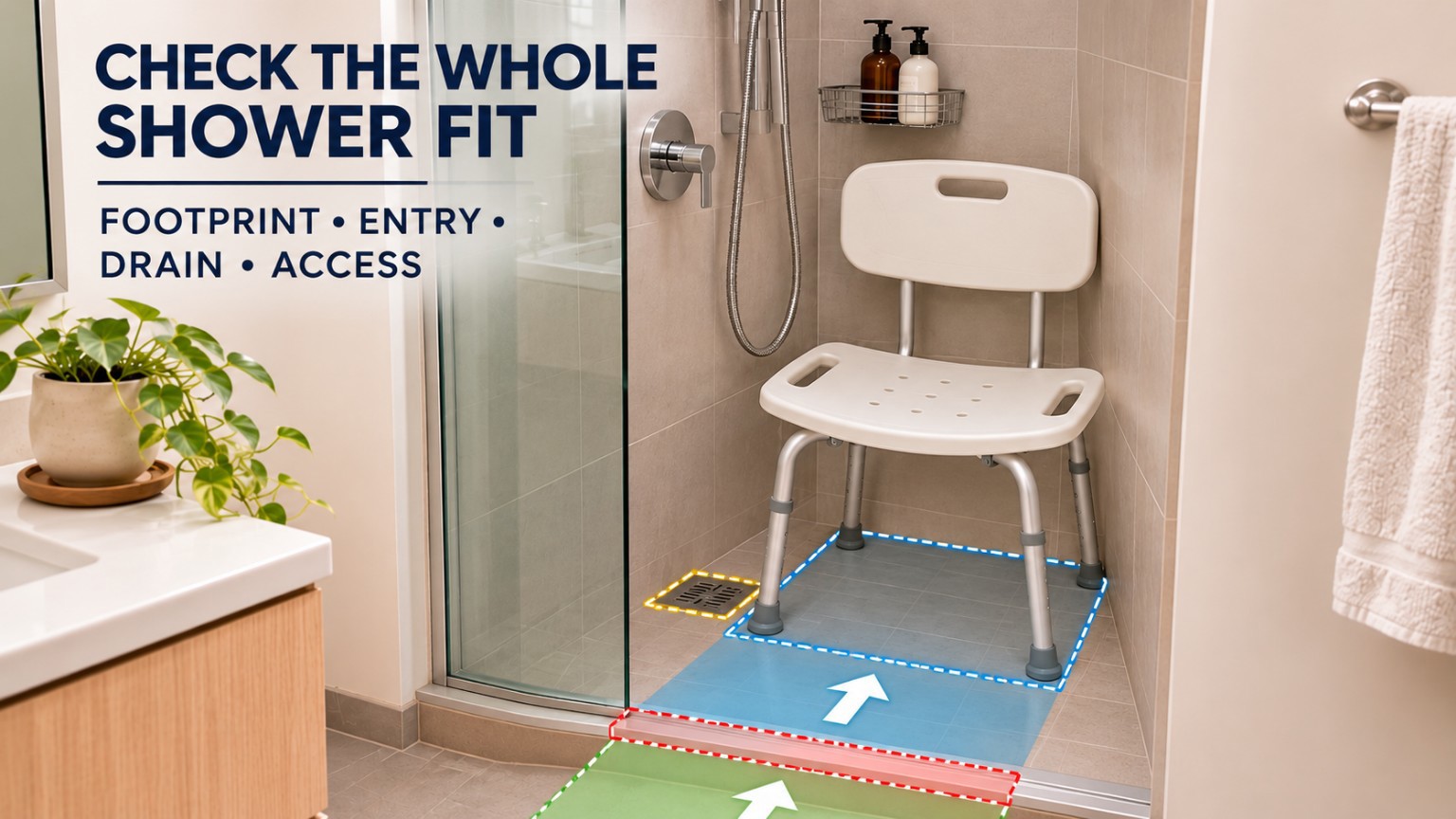
For a small walk-in shower, the important question is not simply whether the seat itself looks narrow enough. You need to consider the chair’s full base or leg footprint, the selected seat height, the shower door, threshold, drain location, room for the user to approach and use the seat, and—if the chair swivels—the additional operating space required while it turns.
This guide compares two locked examples: the NOVA 9131-R, a fixed-orientation bath seat with back, and the VIVE LVA2088, a swivel shower chair. They represent two different approaches to the same fit problem. Neither is a universal winner.
The goal is to help you check the real shower before you buy.
Quick answer: measure the usable shower, not just the seat
Start with the shower itself.
Measure and observe the usable floor area where the chair would actually stand. Then identify the door path, threshold, drain, walls, fixtures, and the space a person needs to approach and use the chair.
Only after you understand that space should you compare chair dimensions.
A 16- or 17-inch-wide seat does not mean the entire chair uses only 16 or 17 inches of floor space. Legs or a base extend beyond the seat, and a swivel chair may require additional operating clearance that cannot be understood from its base dimensions alone.
Think in terms of the complete working envelope.
1. Map the shower floor before comparing chairs
Stand outside the product pages for a moment and look at the shower you actually have.
Identify the area where all four chair legs—or the full chair base—could sit on the shower floor. Check whether that area is level enough for the product to be positioned according to its instructions.
Then mark the obstacles around it.
Look for the drain, raised threshold, shower-door track, fixed glass panel, wall, mixer controls, handheld-shower hose, shelves, and anything else that reduces the usable floor area.
Do not treat the full wall-to-wall shower dimensions as usable chair space automatically. A shower may look wide on paper while having much less practical floor area once the threshold, drain and door movement are considered.
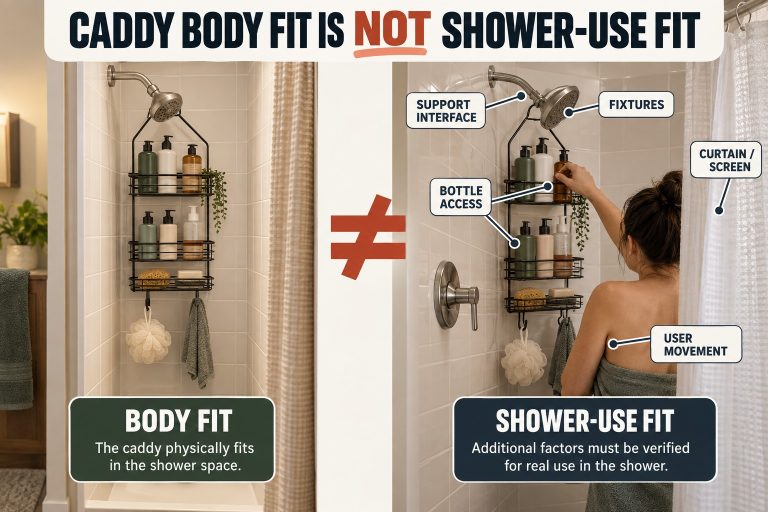
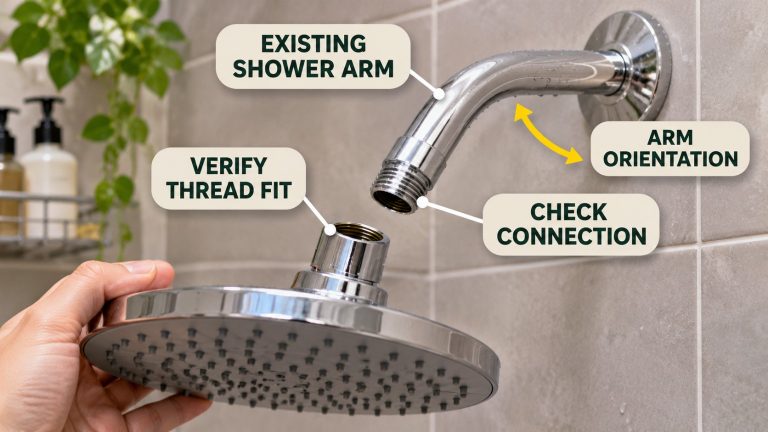
This is the same fit-first logic used when you check the real shower interface for other bathroom products.
The first useful measurement is therefore not “How wide is my shower?” It is: Where can the complete chair actually stand without conflicting with the shower’s fixed features?
2. Seat dimensions and chair footprint are different measurements
This distinction matters throughout the buying process.
The NOVA 9131-R has a maker-listed seat measuring 17 inches wide by 14.75 inches deep. Its actual leg footprint is larger.
At the lower height setting, the locked manufacturer specifications list an approximately 18.5 × 16-inch footprint. At the higher setting, that footprint becomes approximately 19.25 × 16.5 inches.
That change illustrates an important fit-first principle: adjusting a chair vertically can also change the space its legs occupy on the floor.
The VIVE LVA2088 has a maker-listed 16 × 13-inch seat and a 17 × 19-inch base.
Again, the seat dimensions and the floor-space requirement are not the same thing.
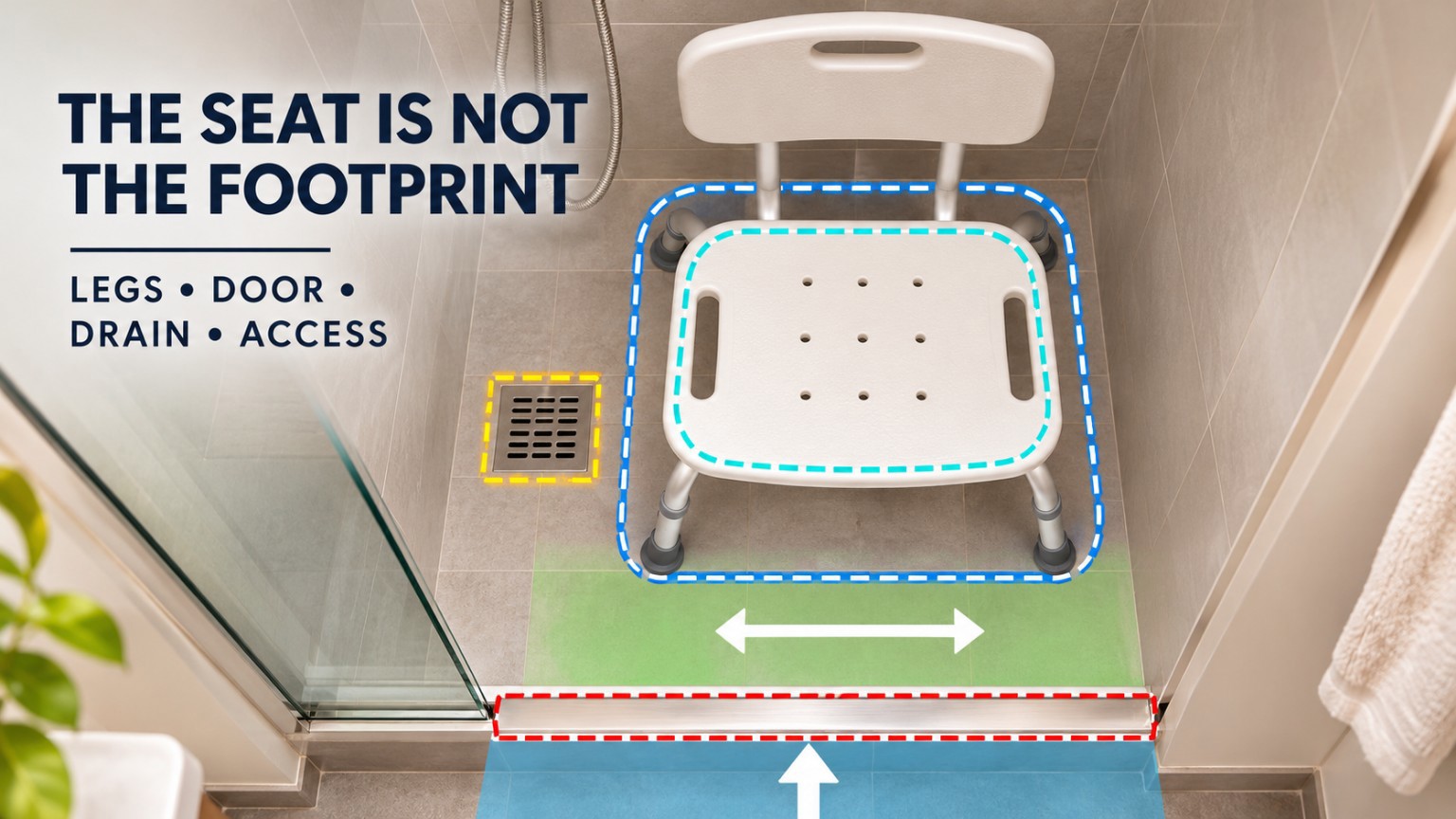
When comparing either chair with your shower, use the complete base or leg footprint as the starting point—not the seat width alone.
3. Check the height setting before locking the footprint
Both examples provide adjustable seat height.
The NOVA 9131-R has a maker-listed height range of 16.5 to 20.5 inches.
The VIVE LVA2088 has a maker-listed height range of 16 to 19 inches.
Those numbers should not be treated as a recommendation for a particular user. They are product specifications that need to be checked against the intended setup and the product instructions.
For fit planning, the key point is simpler: decide which height setting is realistically relevant before assuming the chair’s floor relationship is settled.
This is especially visible with the NOVA because the locked specifications provide different footprints at different height settings.
Do not measure the shower against one configuration and then assume every adjustment produces exactly the same floor geometry.
4. Check the shower door before you buy
A chair can fit on the floor and still interfere with the shower door.
Open the door through its normal path and look at the space the door actually consumes. If the shower uses a hinged door, check its swing. If it uses a sliding system, check the clear opening available for entry and the position of the track.
Then imagine the complete chair already in place.
Ask whether the door can still move as intended and whether there is enough room to enter the shower without having to drag the chair around every time.
Do not check only the chair’s parked position.
You are buying for the whole routine: entering, positioning yourself, using the chair, leaving the shower, and moving the chair when cleaning is required.
A dimension that looks acceptable on a product page may feel very different once a door occupies part of the same small space.
5. Keep the drain and threshold in the fit map
Small showers often have geometry that product photos do not show.
A drain may sit directly where one chair leg would naturally land. A raised threshold may reduce the practical entry width. A floor transition may also affect where the chair can be positioned according to its instructions.
Before buying, locate the drain relative to the proposed footprint.
Do not assume that covering or straddling the drain is automatically acceptable. The correct setup depends on the shower and the specific product instructions.
Check the threshold separately.
Ask whether the chair can be brought into the shower without an awkward route and whether its final position leaves the entry usable.
The goal is not simply to prove that the chair can physically be placed somewhere inside the enclosure. The goal is to find a practical location that works with the rest of the shower.
6. NOVA 9131-R: check the fixed footprint at the intended height
The NOVA 9131-R represents the more straightforward of the two movement patterns in this comparison.
It uses a fixed-orientation seat rather than a swivel mechanism. The locked product data lists a 17 × 14.75-inch seat, an adjustable height range of 16.5 to 20.5 inches, and four adjustable legs with rubber tips.
The listed floor footprint changes with height:
- approximately 18.5 × 16 inches at the lower setting
- approximately 19.25 × 16.5 inches at the higher setting
This makes the primary fit job relatively clear.
Choose the relevant configuration, map the complete leg footprint, then check that footprint against the door, threshold, drain, shower walls and user-access area.
The back is removable according to the locked product specifications, but that does not turn the product into a universal solution for small showers. The surrounding shower geometry still determines whether the chair can be positioned practically.
The manufacturer-stated weight limit is 500 lb. That number is a product rating, not a determination that the chair is appropriate or safe for every person below that weight.
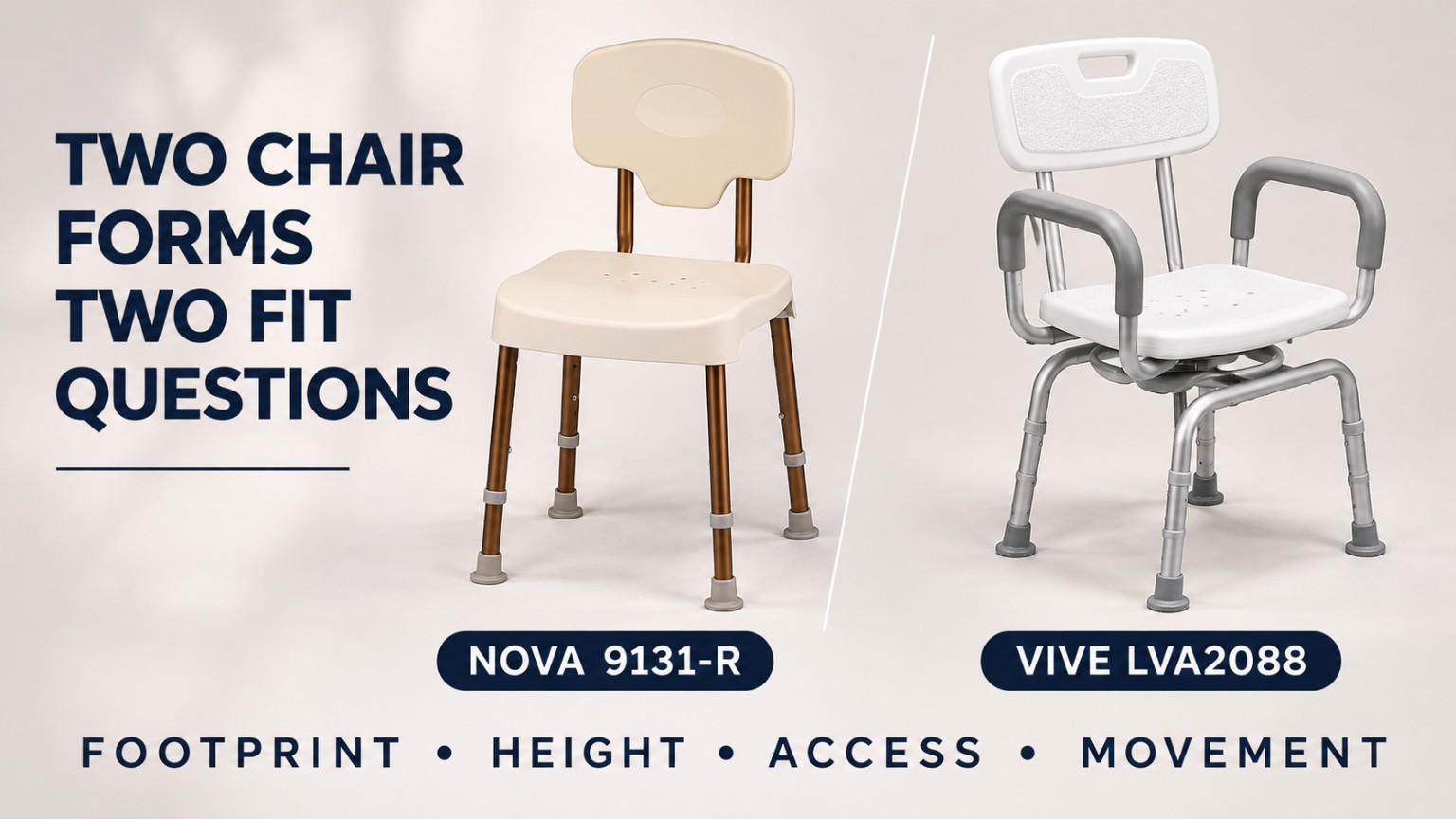
7. VIVE LVA2088: the base measurement is only the beginning
The VIVE LVA2088 creates a different fit problem because the chair swivels.
The locked product data lists a 16 × 13-inch seat, a 16–19-inch height range and a 17 × 19-inch base. The chair can rotate 360 degrees with locking positions at 90-degree intervals.
Those specifications describe important parts of the product, but the 17 × 19-inch base should not be mistaken for the chair’s complete operating envelope.
When a seat rotates, parts of the chair and user position can occupy different areas relative to the base.
For this reason, the full real-world rotated envelope remains an unknown that must be checked in the buyer’s actual shower.
Do not invent a rotation diameter from the listed base dimensions.
Do not assume that because the base clears a shower door when the seat faces one direction, the complete setup will also clear the door through every useful rotation.
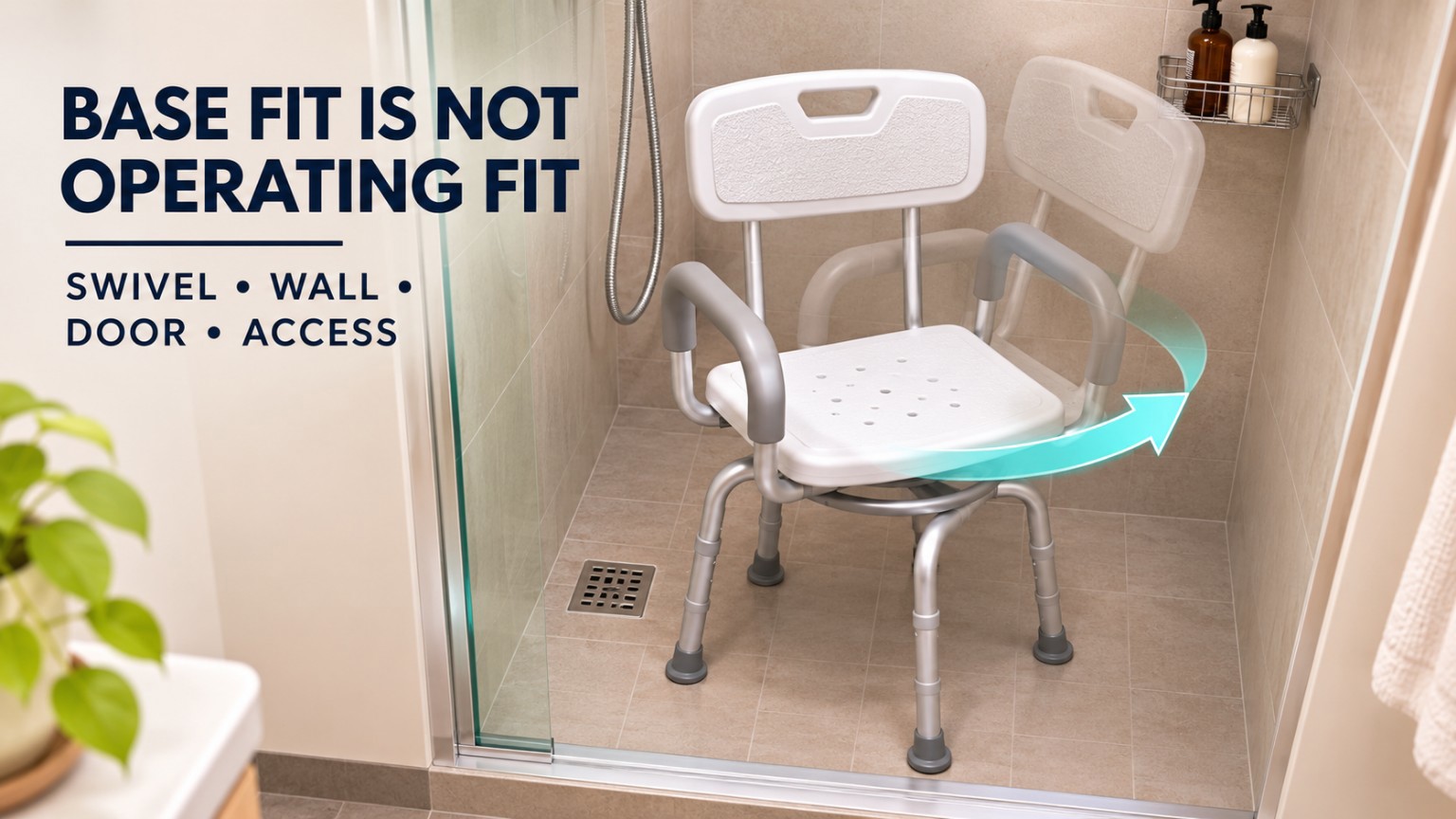
For this product, fit planning needs two separate questions:
Does the base fit?
and
Is there enough room to operate the swivel function without conflicting with the shower enclosure and entry path?
Those are not the same test.
The manufacturer-stated weight limit is 300 lb. As with the NOVA rating, this does not establish individual user suitability, stability or safety.
8. Fixed versus swivel: compare the movement problem, not the winner
The NOVA and VIVE examples are useful because they illustrate different space-planning jobs.
With the NOVA 9131-R, the main geometry is the chair’s fixed leg footprint at the selected height, plus the surrounding access space.
With the VIVE LVA2088, you need to consider the base footprint and an additional operating question created by the swivel mechanism.
That does not make one architecture inherently better.
A fixed chair may still be too large for a particular shower. A swivel chair may work well in one layout and interfere with a door or wall in another.
Compare the chair architecture against the shower rather than comparing the products in isolation.
9. Check user access as part of the physical layout
A chair that technically fits between two walls may still leave too little usable space around it.
Look at how the person will approach the seat, where legs and feet need to go, and whether nearby fixtures or the shower enclosure reduce practical access.
For the VIVE chair, also consider the space needed for the intended swivel movement.
This guide cannot determine medical suitability or whether a particular chair is appropriate for an individual user. Those questions are separate from dimensional fit and should follow the relevant product instructions and appropriate professional guidance where needed.
The fit-first job here is limited to physical space planning: Can the chair, the shower and the intended use occupy the same space without relying on assumptions that were never measured?
10. Fit-first checklist before ordering
Before choosing a shower chair, record these items from the actual shower:
- Usable floor area: measure the area where the complete legs or base can stand.
- Seat dimensions: understand the sitting surface, but do not confuse it with the floor footprint.
- Leg or base footprint: use the product’s full supporting footprint when comparing against the shower floor.
- Height setting: identify the relevant setup and check whether changing height affects footprint.
- Door clearance: test the complete door path against the proposed chair location.
- Drain position: map the drain relative to the legs or base.
- Threshold: check the real entry opening and the route used to place or remove the chair.
- Nearby fixtures: note controls, hoses, shelves, glass panels and other obstacles.
- User-access space: leave room for the person to approach and use the chair.
- Swivel operating space: for the VIVE LVA2088, verify the actual movement envelope in the shower rather than estimating it from the base dimensions.
If one of those items is unknown, keep it unknown until it can be verified.
Do not replace a missing measurement with confidence.
11. What the published weight limit does—and does not—tell you
Product weight ratings matter, but they answer only one part of the purchase decision.
The NOVA 9131-R carries a maker-stated 500-lb limit. The VIVE LVA2088 carries a maker-stated 300-lb limit.
Those figures should be reported as manufacturer specifications.
They should not be converted into claims such as “safe for anyone under this weight,” “guaranteed stable,” or “appropriate for every user below the limit.”
Real-world suitability involves more than a single number.
For this fit-first comparison, use the ratings as product specifications while keeping the dimensional and operating-space checks separate.
12. When neither chair is a good fit
A shower chair category may not be a good fit when the usable floor footprint is too small, the door cannot operate around the chair, the drain or threshold conflicts with the supporting footprint, or the remaining access space becomes impractical.
For a swivel chair, insufficient room for the intended rotation is another reason to reconsider the setup.
Do not force a product into a shower simply because one published dimension fits.
If the shower requires the chair to be constantly shifted into awkward positions, blocks the entry, or depends on unverified operating clearance, the dimensional plan is not finished.
13. Make the purchase decision in the right order
Start with the shower.
- Map the usable floor area and fixed obstacles.
- Check the chair’s complete leg or base footprint rather than the seat alone.
- Choose the relevant height configuration and recheck the footprint.
- Check door, threshold, drain and user-access space.
- If considering the VIVE swivel chair, verify the actual operating space required for the intended rotation.
Only then compare the two product approaches.
Do not begin with the weight limit, brand name or product photo and work backward toward the room.
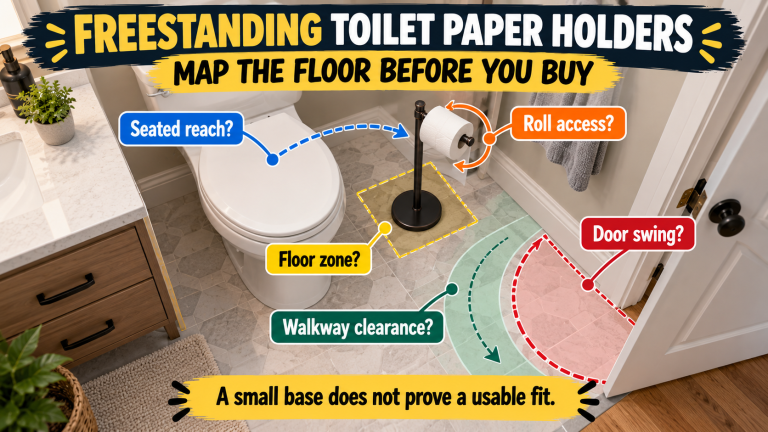
The same principle applies across small bathrooms: measure usable bathroom floor space before assuming a freestanding product will fit simply because its headline dimensions look compact.
Bottom line
For a small walk-in shower, the best buying question is not “Which shower chair is better?”
It is: Which chair geometry actually works in this shower?
The NOVA 9131-R provides a fixed-orientation example whose leg footprint changes with height. The VIVE LVA2088 provides a swivel example whose base dimensions do not establish its complete rotated operating envelope.
Measure the full supporting footprint, door, threshold, drain and access space. Treat swivel clearance as an additional real-world check. Preserve unknowns until they can actually be verified.
A shower chair should be evaluated as part of the whole shower layout—not as a seat floating in a product photograph.