Freestanding Toilet Paper Holders for Small Bathrooms: Measure the Floor Before You Buy
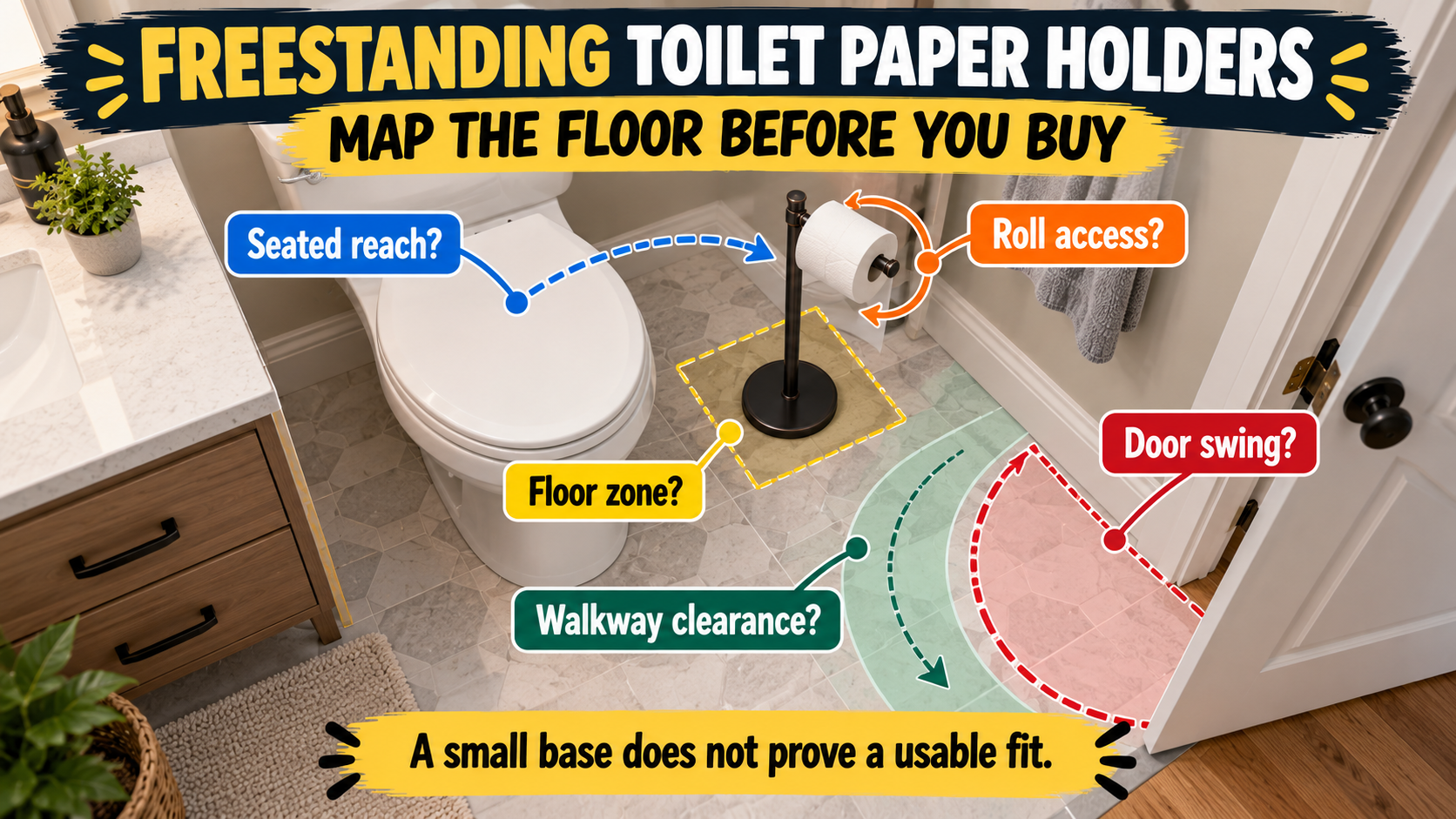
A freestanding toilet paper holder looks like a simple solution for a rental bathroom: put it beside the toilet, load a roll, and avoid drilling into the wall. But in a small bathroom, a stand that fits on paper can still block a cabinet door, sit too far from a seated hand, wobble when a roll is pulled, or occupy the only comfortable spot for walking and cleaning.
That makes this a fit problem before it is a style problem. The stand’s published dimensions tell you how much room its body takes up, not whether the roll is convenient to reach, whether the floor is suitable for the base, or whether a full-size household roll will slide on and turn freely. The floor plan, usable reach, paper-loading path, and daily cleaning routine all matter.
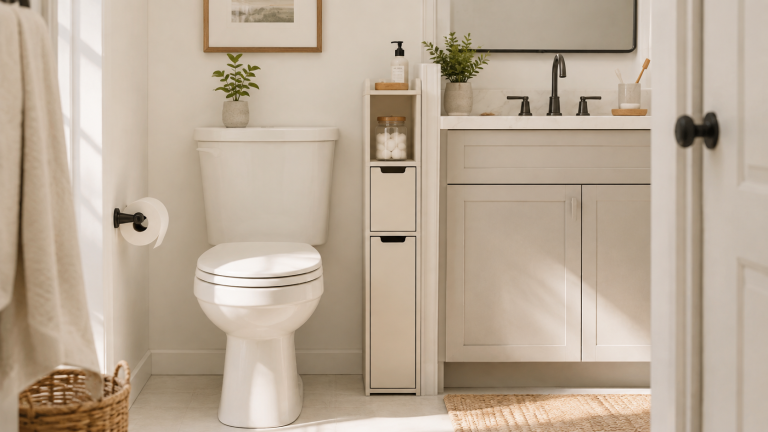
This guide compares two specific, non-ranked floor-standing designs. The Room & Board Slim Toilet Paper Stand in graphite, item 654181, is a slim dispensing-focused stand. The IKEA KROKFJORDEN Toilet Roll Stand, article 604.540.26, combines a dispenser with manufacturer-stated storage for four toilet paper rolls in total. They do different jobs; neither is universally the better product. [1] [2]
If you do not know an important dimension, your bathroom’s real clearance, or whether your roll fits the selected holder, leave that fact unknown until you check it. An unknown measurement is not a pass, a failure, or permission to guess.
The Quick Decision: Dispenser Only or Dispenser Plus Reserve?
Start with what you actually need beside the toilet. If spare rolls already live in a nearby cabinet, vanity, or accessible shelf, a stand devoted mainly to dispensing may be the more appropriate architecture to assess. If the bathroom lacks convenient built-in storage, consider whether keeping several rolls with the holder would solve a real restocking problem. That second function adds a different question: where will the spare rolls sit, and can you still clean around them?
Room & Board’s Slim Toilet Paper Stand is listed at 6 inches wide, 7 inches deep, and 21.5 inches high. The locked graphite variant is a freestanding dispenser; the adopted manufacturer evidence does not establish integrated spare-roll capacity. Do not read that as a guarantee that every roll diameter or width fits the arm. [1]
IKEA’s KROKFJORDEN measures 6.75 inches wide, 6.75 inches deep, and 22 inches high. The maker states a total capacity of four toilet paper rolls. That is four rolls total as published—not four spare rolls plus an additional active roll. It is a dispenser-and-reserve system rather than a direct substitute for a dispenser-only stand. [2]
Both avoid a normal wall-mounted holder’s drilling step because they stand on the floor. Neither is a promise of scratch-free flooring, universal resistance to tipping, approval under every lease, or compatibility with every paper-roll format. The decision begins with room measurements and the actual everyday task, not with a winner badge.
Measure the Usable Floor Zone, Not Just the Base
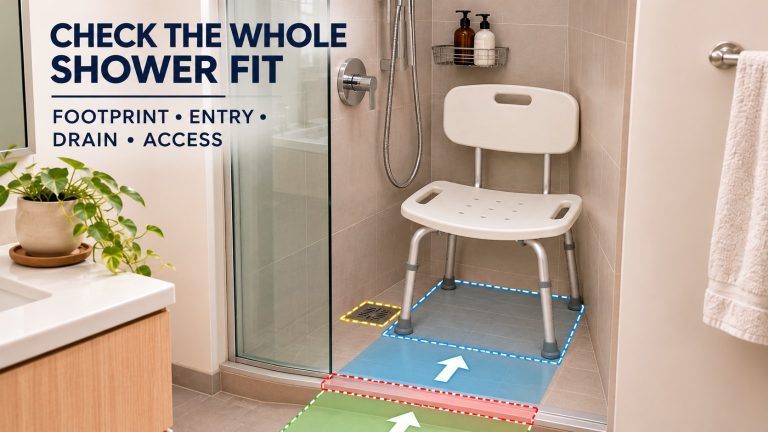
Imagine an invisible rectangle around the place where the stand will actually sit. Its width and depth are only the starting dimensions. You also need room for your foot, the sweep of the bathroom door, movement of vanity drawers or cabinet doors, roll-loading clearance, and the path a hand uses to pull paper. A tiny measured footprint can still be in the wrong location.
Make a temporary floor template from scrap paper or painter’s tape used only where the flooring allows it. Outline a 6-by-7-inch rectangle for the Room & Board body and a 6.75-by-6.75-inch rectangle for IKEA. Label them R1 and R2. These rectangles represent published product footprints—not a certified safe operating envelope. Do not attach tape to a sensitive finish without checking the finish’s care guidance.
Set each template on the likely toilet-side spot. Open the bathroom door as far as it needs to open, operate the vanity or cabinet, stand at the sink, approach the toilet, and reach naturally from a seated position. Repeat with a hypothetical full roll and with the need to replace it. If something must be moved each time, the nominal base fit is not enough.
The stated body heights—21.5 inches for Room & Board and 22 inches for IKEA—help you visualize the general vertical envelope, but they do not establish the exact position of the dispensing arm or the seated user’s comfortable reach. Test the height with a physical reference or a comparable object if possible; do not infer ergonomics from overall height alone. [1] [2]
Ten Fit Checks Before You Buy
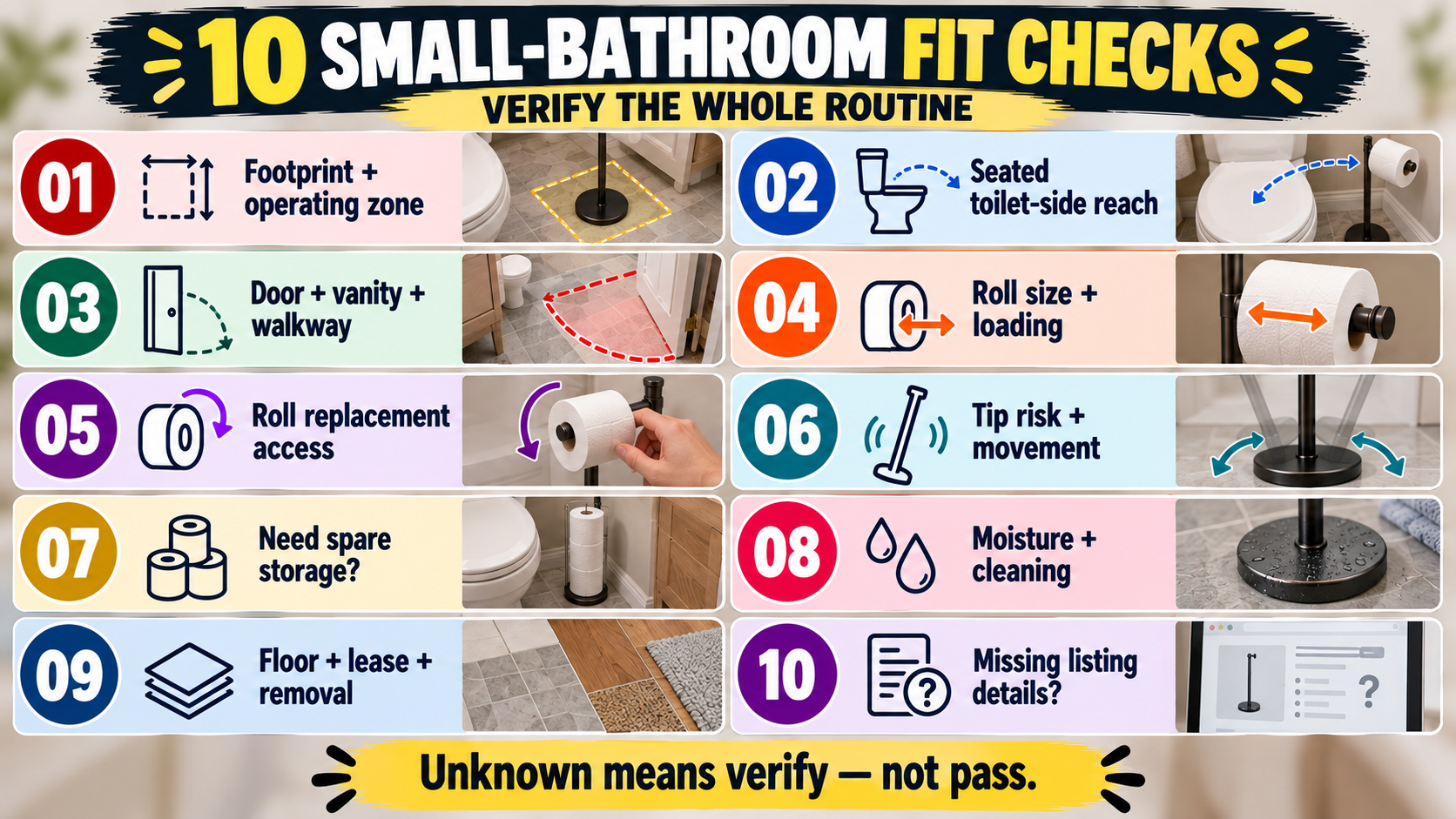
1. Record the stand’s real footprint and its operating zone
Measure the clear floor between the toilet, wall, vanity, bath or shower, and entry path. Note both the total available rectangle and the smaller zone where the stand could remain without being bumped. Compare that with the two published bases. Mark space beyond the base for handling, turning, cleaning, and a possible small movement or tilt. Neither manufacturer supplies a universal extra-clearance value in the locked evidence, so do not invent one.
If the stand fits only when pressed directly against a door’s travel line or the edge of a cabinet drawer, treat the location as unresolved. A good installation is one you can leave in place through an ordinary day, not one that works only when nobody moves.
2. Test toilet-side reach while seated
Sit where you normally sit and reach toward the proposed stand location without twisting sharply, leaning excessively, or grabbing the toilet tank for support. Identify whether the roll would be easiest to approach from the front or side and whether your arm would meet a toilet lid, cabinet corner, towel rack, or wall edge. Other household members may need a different reach zone.
Try the hand motion that dispenses paper, not just the hand motion that touches the stand. A lightweight object can be easy to reach yet inconvenient to pull from if the entire holder moves. The published overall height cannot prove ergonomic reach, and no tested reach distance for these exact bathroom placements is included in the adopted evidence.
3. Trace the bathroom door, vanity doors, and walking path
Open and close the bathroom entry door, vanity doors, and drawers. A freestanding holder can be narrow and still interfere with a hinge arc, a lower cabinet pull, the space beside the toilet, or the walking route to the sink. Remember that a person may approach sideways while carrying laundry or cleaning supplies.
Keep essential access routes and bathroom fixtures usable. In a very narrow bathroom, do not treat the device’s body width as proof that the remaining walkway is acceptable. Any applicable access, lease, or building requirements depend on the actual property and are not established by the two product listings.
4. Check roll width, diameter, and how the roll loads
Bring the exact brand and size of paper you normally use into the decision. Measure the roll’s width and outside diameter if necessary. Determine how the selected stand receives a roll: is there space to slip it onto the arm, lift it off, and keep it turning without contacting nearby fixtures? Compare the exact maker’s product geometry and installation instructions with your roll, rather than assuming all regular, double, mega, or jumbo rolls are interchangeable.
Neither locked product record establishes universal roll compatibility, a tested maximum roll diameter, or a specific roll-width limit. If your household buys unusually bulky rolls, ask the maker or seller for exact compatible dimensions. Do not use IKEA’s four-roll total storage claim as evidence that four oversized rolls will fit.
5. Practice the roll-replacement path
A roll may dispense from a corner but require more room to replace. Picture the user’s hands removing an empty core, loading a new roll, and putting the holder back in position. Do you have to pull the stand into the walkway, raise it, or pass the roll between the toilet and wall?
For a reserve stand, account for accessing the stored rolls as well as the active roll. Reserve capacity is only useful when you can retrieve a roll without dragging the whole unit across a wet floor or lifting it around obstacles. If this step looks awkward from your floor template, investigate the actual product’s loading approach before purchase.
6. Evaluate tip risk and side-to-side movement
A freestanding item can tip or shift if a person pulls paper at an angle, catches the stand with a leg, or uses it for balance. Test the likely pull direction and the flooring conditions: a smooth tile floor, sloped surface, raised grout line, or thick bath mat may change how a base contacts the ground. Do not position the holder where someone is likely to lean on it as a support.
Room & Board lists an approximate weight of four pounds for its Slim Toilet Paper Stand. That number may help identify the item, but mass alone is not evidence of tip resistance. IKEA’s published measurements and total roll capacity likewise do not guarantee stability while loaded. The locked research notes some consumer comments about wobble or tipping for the IKEA stand; those reports are signals to evaluate, not a controlled test or a prediction of every buyer’s experience. [1] [2]
If the manufacturer does not disclose a tested tipping threshold for the exact model, do not invent one. For either item, treat lateral stability on your actual bathroom floor as a buyer-specific check.
7. Decide whether spare storage truly belongs beside the toilet
A reserve holder is not automatically an upgrade. In a small bathroom, spare-roll storage can reduce trips to another cabinet but place paper closer to splashes, cleaning sprays, floor moisture, or the area around the toilet. Ask how often the supply runs out, where rolls are currently stored, and whether the new position will keep them clean and convenient.
The Room & Board Slim Stand is not established as a spare-roll rack in the locked record; do not assign storage capacity to it. IKEA KROKFJORDEN has a maker-stated four-roll total capacity, without proof that every household roll size will fit. Choose the architecture based on the actual reserve requirement rather than on the larger number of visible rolls in a product photo. [1] [2]
8. Account for water, humidity, and cleaning
Look for shower overspray, a nearby sink, a tub edge, damp towels, cleaning products, and the route of the mop or vacuum. The stand itself may be made from finished metal, but the paper rolls are absorbent and should not be treated as protected from moisture just because they are off the floor.
Room & Board identifies stainless steel with a graphite powder-coat finish and directs users to wipe with a damp cloth and dry immediately. IKEA lists galvanized steel with a polyester powder coating and instructs wiping with a damp cloth and water or window cleaner, followed by drying. These are model-specific care instructions, not a blanket promise of waterproof performance under continuous spray or pooled water. [1] [2]
Plan how to wipe beneath and around the base without scuffing the floor. Avoid assuming cleaning chemicals or abrasive tools are safe for either finish when the current manufacturer instructions do not authorize them.
9. Check flooring, rental restrictions, and removal
A freestanding design avoids installing a conventional wall bracket, which can be useful when you are not permitted to drill. But a no-drill setup can still be inconvenient or cause wear through movement, grit under a base, prolonged moisture contact, or repeated scraping across a sensitive floor.
Read any relevant rental or building rules and inspect the floor condition. If protection is needed, choose only a manufacturer-compatible approach for that flooring and holder; do not invent an adhesive pad, permanent fastener, or leveling hardware as part of the product. Nothing in the locked evidence guarantees damage-free floors or universal landlord approval.
10. Check what the listing does not tell you
Write down every unresolved purchase-critical fact: maximum compatible roll size, actual mounted arm orientation, expected stability on your flooring, assembly steps, current stock in your ZIP code, shipping eligibility, and current return terms. The correct outcome for a missing fact is ‘unknown; verify before ordering,’ not an assumed zero or an assumed pass.
For Room & Board, a graphite product listing was available and an add-to-cart control was visible at research time, but no completed checkout was tested. For IKEA, the U.S. catalog page existed while ZIP-level inventory and fulfillment remained unknown. Current prices, tax, delivery, lead times, and seller policies can change. Confirm the exact item before placing an order. [1] [2]
Product 1: Room & Board Slim Toilet Paper Stand, Graphite (Item 654181)
The job: a slim dispensing station without established reserve storage
The locked Room & Board Slim Toilet Paper Stand in graphite is a freestanding toilet-roll dispenser rather than a documented spare-roll storage tower. Its maker lists an overall width of 6 inches, depth of 7 inches, and height of 21.5 inches. The listing describes stainless steel with a graphite powder-coat finish, an approximate weight of four pounds, and manufacture by Bell Manufacturing in Minnesota. [1]
That 6-by-7-inch footprint gives a buyer a concrete starting shape to trace on the floor. The more important test is whether the stand can remain within that zone while someone pulls paper, changes the roll, opens the door, and cleans the bathroom. Its slim styling cannot demonstrate a stable pull on every floor or convenient reach for every toilet.
Where it may suit the buyer’s task
Evaluate R1 first when your toilet-side location is physically narrow, you already have satisfactory spare-roll storage elsewhere, and the job is simply to keep one dispensable roll within reach without drilling. This is a use-case test, not a price or quality ranking. A bathroom with limited side clearance may still reject R1 if the 7-inch depth crosses a door or cleaning path.
What remains unverified
The adopted manufacturer evidence does not confirm specific roll-diameter or roll-width limits, universal paper-roll compatibility, an exact measured arm reach from a seated position, tip-resistance performance, lateral stability under a sudden pull, or a guarantee of floor protection. Assembly requirements and buyer-specific delivery or checkout are also not established. Hold those details as questions, not promises.
For cleaning, follow the maker’s damp-cloth instruction and dry the stand immediately. Do not infer from stainless steel and powder coating that the stand can be immersed, left in pooled water, or exposed to every bathroom cleaner. [1]
R1 purchase decision
Consider this architecture only after confirming (a) the 6-by-7-inch base can occupy a usable location, (b) the height and actual dispensing orientation make sense for your seated reach, (c) the roll format fits and can be changed, (d) the floor and pull direction are workable, and (e) spare-roll storage is not a requirement the product must fulfill. Otherwise pause and verify rather than assigning it capabilities not documented by its maker.
Product 2: IKEA KROKFJORDEN Toilet Roll Stand (Article 604.540.26)
The job: dispensing plus reserve rolls in one freestanding unit
The locked KROKFJORDEN is a zinc-plated freestanding toilet-roll stand whose maker describes a combined dispenser and spare-storage function. Its dimensions are 6.75 inches wide by 6.75 inches deep by 22 inches high. IKEA states that the holder fits four toilet paper rolls in total. Do not convert this into a claim that it holds four spares plus a fifth active roll. [2]
The maker lists galvanized steel and a polyester powder coating. Care instructions permit wiping with a cloth dampened with water or window cleaner and wiping dry. IKEA describes this model as requiring no drilling, but that fact does not verify the stability, roll compatibility, or floor suitability of an untested setup. [2]
Where it may suit the buyer’s task
Evaluate R2 first when spare rolls need an accessible home near the toilet and you can give the full stand a clean, dry location that stays outside the entry and cabinet paths. If you regularly find yourself opening a vanity cabinet to replace an empty roll, reserve storage might solve a real daily friction point. If the bathroom has frequent water spray, a tight toilet-side gap, or little floor space for cleaning, that extra role may be a liability rather than a benefit.
What remains unverified
The locked evidence does not establish maximum compatible roll size, whether the buyer’s exact rolls can be stored and dispensed without interference, a tested tip-resistance threshold, specific assembly requirements, or ZIP-level stock and delivery. Research noted customer comments about wobble or tipping, but reviews do not establish a uniform defect rate or prove performance on your floor. Never label the stand universally stable, scratch-free, or renter-safe. [2]
R2 purchase decision
Consider this architecture when (a) the 6.75-by-6.75-inch base works without blocking movement, (b) you have a genuine need for near-toilet reserve storage, (c) the household rolls and loading path are confirmed, (d) the stand is positioned away from problematic moisture, and (e) normal pulling and cleaning will be practical. IKEA stock must be checked for the actual delivery ZIP code or store; do not infer location-specific availability from the existence of a U.S. product page.
Two Architectures Compared — Different Jobs, Not Ranks
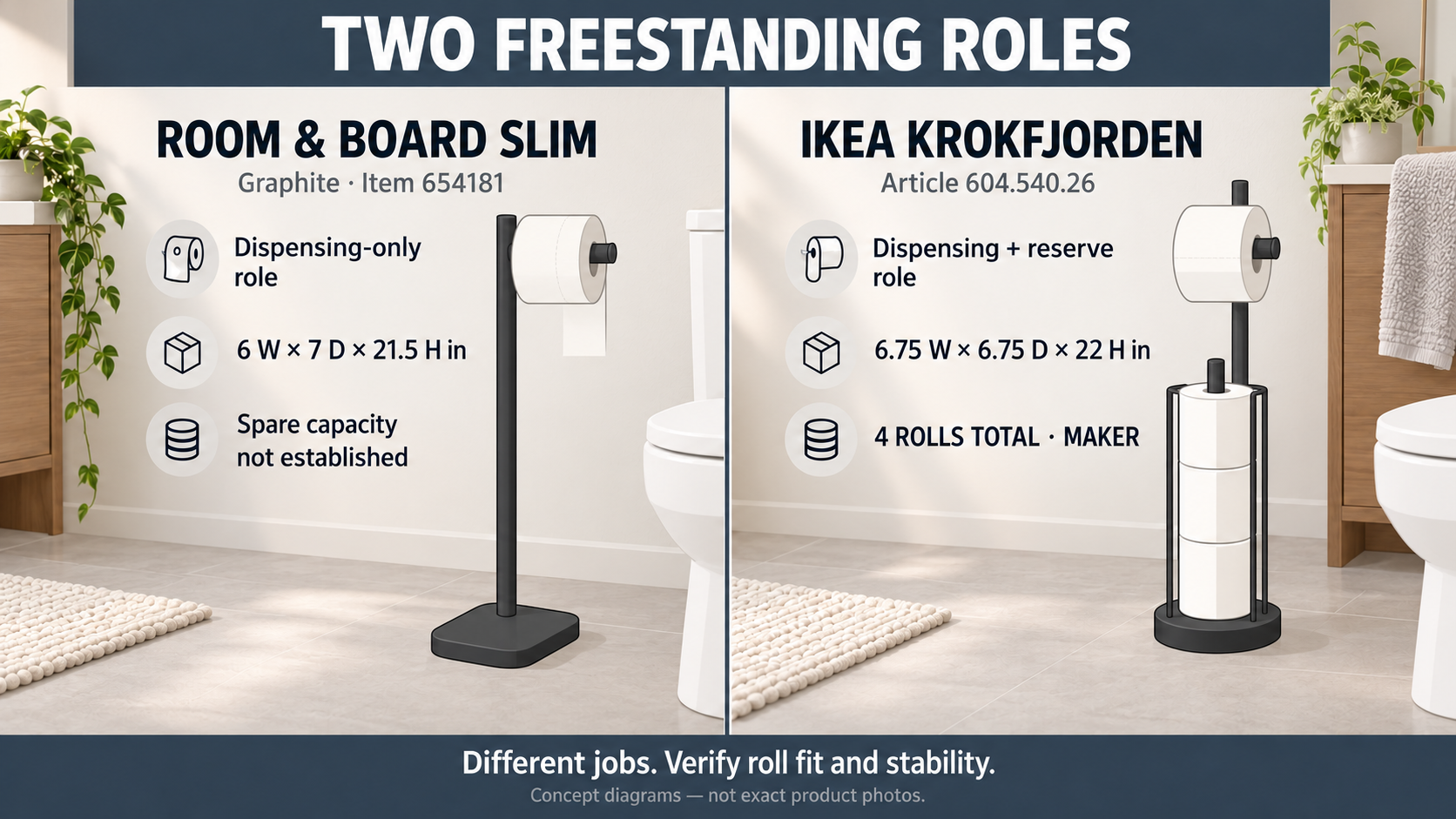
System R1: Room & Board Slim Toilet Paper Stand, graphite, maker item 654181. Published envelope: 6 W × 7 D × 21.5 H inches. Main job: floor-standing dispenser only; integrated extra-roll storage has not been established. Materials: stainless steel with graphite powder-coat finish. Approximate maker-listed weight: four pounds. Care: damp wipe, dry immediately. Unknowns include the buyer’s roll compatibility and tested resistance to tipping. [1]
System R2: IKEA KROKFJORDEN, maker article 604.540.26. Published envelope: 6.75 W × 6.75 D × 22 H inches. Main job: floor-standing dispenser with reserve storage. Published capacity: four toilet paper rolls total. Materials: galvanized steel with polyester powder coating. Care: damp wipe with water or window cleaner, dry. Unknowns include oversize-roll fit, stability under pulling, and local inventory. [2]
The numerical footprints are close but not interchangeable. R1’s listed base is narrower in width while deeper front-to-back; R2’s listed base is square. Whether one footprint helps is determined by the orientation of the toilet, door swing, vanity and remaining walkway. Both heights are similar, yet neither published overall height substitutes for a seated-reach test.
Neither product should be labeled best overall. There is no locked evidence supporting a comparative stability rating, certified universal fit, controlled tip-risk score, verified household-roll compatibility, or guaranteed damage-free placement. Reserve capacity is a functional difference, not a quality score.
Common Small-Bathroom Scenarios
Scenario A: The entry door nearly touches the toilet
Start with a floor sketch and the door’s actual swing arc. If either base overlaps that travel space or the user’s footpath, neither passes simply because its listed footprint looks narrow. The right outcome may be ‘no freestanding holder here’ until a suitable location is identified.
Scenario B: The vanity stores plenty of spare paper
A dispensing-focused system may match the job better because reserve storage beside the toilet adds little value. Compare R1’s 6-by-7-inch base with the usable floor opening and test roll-loading access; do not conclude that it is automatically easier to clean or more stable.
Scenario C: There is no spare-roll cabinet
R2’s published four-roll total capacity may serve a real purpose. But check the paper-loading route and whether a full reserve stack would be too close to splashes, mopping, or people walking past. Manufacturer capacity is not proof of hygienic placement.
Scenario D: Your household buys bulky paper rolls
Neither locked record establishes the exact maximum roll diameter. If you use jumbo or unusually wide paper, verify both dispensing and storage compatibility directly with the maker. R2’s four-roll capacity cannot be extrapolated to four jumbo rolls; R1’s dispensing-only role does not prove that a jumbo roll fits its arm.
Scenario E: The floor is slippery, uneven, or frequently wet
Do not assume either design has been validated for your floor. A stand placed partly on a bath mat, near raised grout or close to shower spray may behave differently from one displayed on a level, dry showroom surface. Test the setup cautiously according to product instructions; prioritize a location that does not encourage users to brace themselves on the holder.
A Practical Buying Workflow — From Bathroom Map to Checkout
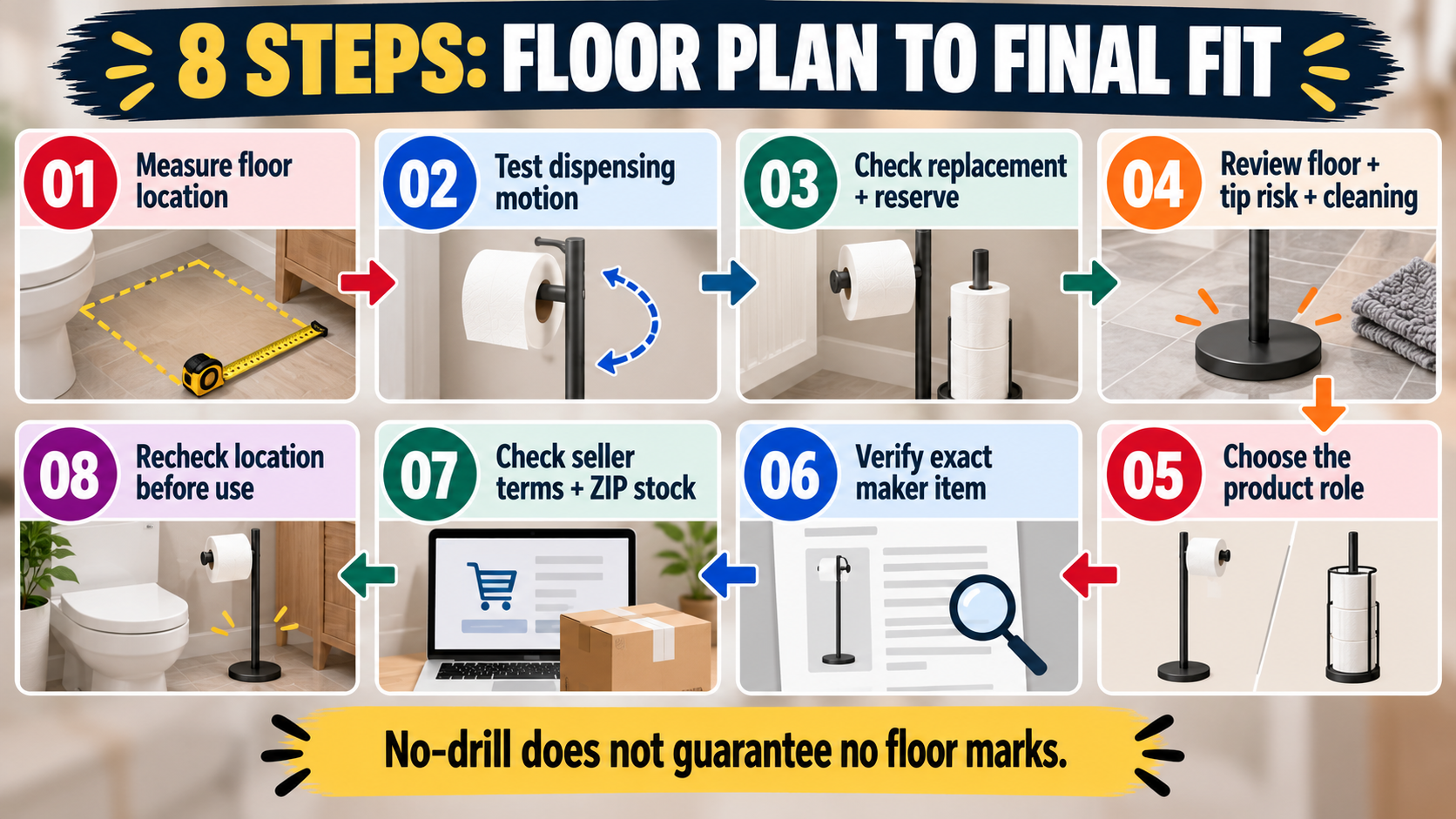
Step 1 — Measure the available location
Write down the clear width and depth beside the toilet, the intended position relative to the user’s seated reach, and any nearby door or drawer travel. Trace each exact listed base on paper. Do not add a made-up manufacturer clearance number.
Step 2 — Confirm the daily dispensing motion
Decide which hand will pull the paper and in which direction. Confirm that the likely location allows a comfortable reach and that the base will not sit in a place where someone must lean on it. Overall stand height alone does not resolve this.
Step 3 — Test the replacement and reserve workflow
Picture removing the empty roll and fitting a new one. For R2, include retrieving a spare. If access needs a temporary move into the walkway, decide whether that is acceptable and whether water or floor protection creates another constraint.
Step 4 — Review floor, stability, and cleaning exposure
Look at slope, grout, mats, grit, splashes, cleaning chemicals, and the path of mop or vacuum. Compare your care routine with each manufacturer’s instructions. Do not promise a scratch-free floor or a tip-proof stand.
Step 5 — Choose the required product role
If dispensing is the only job, assess R1 against the floor geometry. If near-toilet reserve storage is genuinely valuable, assess R2. These are two different architectures, not ranked upgrades. If both have unresolved fit problems, purchase neither until you have the missing facts.
Step 6 — Verify exact identity and manufacturer facts
For Room & Board, match the graphite Slim Toilet Paper Stand to item 654181. For IKEA, match KROKFJORDEN to article 604.540.26. Recheck the published dimensions, materials, care guidance, roll-loading arrangement and any maker instructions before checkout. Do not transfer one product’s capacity or dimensions to the other.
Step 7 — Verify current seller terms, local stock, and returns
Use the current maker or authorized seller pages for delivery eligibility, ZIP code or store availability, price, taxes, assembly notes and return terms. Research-time visibility of a listing is not a completed checkout. IKEA’s local stock and fulfillment were not verified in the locked evidence.
Step 8 — Recheck the real floor position before use
Once an item is obtained, follow its exact maker instructions for any assembly, use and care. Place it so the door, vanity, toilet access and cleaning path remain usable. Check whether pulling paper causes unwanted movement and reassess if the location is unsuitable. This is an owner observation step, not a claim that the article has tested the products.
Questions Renters Commonly Ask
Is a freestanding toilet paper holder always rental-friendly?
It avoids ordinary drilling into the bathroom wall, which may be useful where the lease restricts wall hardware. It does not automatically guarantee lease approval, zero floor marks, or acceptable placement. Read the rules that apply to the property.
Which one has the smaller footprint?
R1 is published at 6 inches wide by 7 inches deep; R2 at 6.75 inches wide by 6.75 inches deep. The shapes differ. The better fit depends on the exact available floor rectangle and how the stand is oriented. Neither published footprint includes all the space required to reach, pull and replace paper. [1] [2]
Can the Room & Board stand hold spare rolls?
Its locked role is dispenser-only, and integrated extra-roll capacity is not established in the adopted manufacturer evidence. Do not purchase it on the assumption that it functions as reserve storage. [1]
Does IKEA KROKFJORDEN hold four spare rolls plus the one in use?
No such five-roll capacity is supported. IKEA states four toilet paper rolls total. How your household’s exact roll format fits still needs confirmation. [2]
Will both fit mega or jumbo toilet paper?
Universal roll-size compatibility has not been verified for either product. Ask the manufacturer about your roll’s actual width and diameter and the intended loading method before buying.
Is one stand more stable than the other?
The available locked evidence does not provide a controlled head-to-head tipping test or a universal stability rating. Room & Board’s approximate four-pound listed weight is not a tip-resistance certificate, and IKEA’s capacity is not a balance score. Evaluate the floor, pull direction and actual use. [1] [2]
Will these stands damage tile or vinyl flooring?
There is no verified universal no-damage guarantee. Movement, grit, water, finish condition and cleaning habits can matter. Follow the maker’s care directions and floor-care requirements, and avoid improvised adhesives or protective hardware not approved for the surface.
Are these products in stock at my ZIP code?
That is unknown from the adopted record. The Room & Board listing was purchasable-looking at research time without a tested checkout; IKEA’s U.S. page did not establish ZIP-level stock or delivery. Confirm the exact current listing and fulfillment before paying. [1] [2]
What if my bathroom is too narrow for both?
Do not force either stand into the walkway or door swing. Keep the purchase unresolved until a location meets both the body’s footprint and the normal operating and cleaning needs. A non-fitting product is not a bargain even when it needs no drilling.
Final Pre-Purchase Checklist
□ I measured the actual floor area beside the toilet and outlined both published base shapes.
□ I checked the bathroom entry door, vanity drawers, walking route, and cleaning access.
□ I tested the seated reach and natural direction of pulling paper.
□ I know how a roll is loaded and replaced; I have verified my household’s roll format if necessary.
□ I considered unwanted movement, tipping risk, the floor finish, water exposure, and cleaning.
□ I decided whether reserve rolls truly need to live beside the toilet.
□ I understand that IKEA’s stated capacity is four rolls total, not four spares plus an active roll.
□ I have not assumed any reserve storage capacity for the Room & Board dispenser.
□ I checked the applicable rental restrictions and did not assume a no-damage guarantee.
□ I verified the exact maker item, current product instructions, local availability, delivery and returns.
If any of these steps remains unresolved, mark the question as unknown and verify it before purchasing. A fit-first buying decision should prevent a bad purchase, even if that means waiting.
Bottom Line: Give the Floor and the Routine the Final Vote
Room & Board’s Slim Toilet Paper Stand (graphite, item 654181) is a dispensing-focused freestanding option whose published 6-by-7-inch footprint makes it straightforward to evaluate against a marked floor zone. IKEA’s KROKFJORDEN (article 604.540.26) combines dispensing with maker-defined storage for four toilet paper rolls total in a 6.75-by-6.75-inch footprint. These are distinct jobs, not a first-place and second-place ranking. [1] [2]
Measure the actual bathroom, practice reach and roll replacement, trace the door and cleaning paths, and preserve any unknown stability or compatibility fact as unknown. When the real floor and the daily routine both work, choose the architecture that serves the task—not the one that merely looks slimmer in a photo.
Product Sources and Claim Boundaries
[1] Room & Board — Slim Toilet Paper Stand, manufacturer U.S. direct listing. Identity, graphite item 654181, published dimensions, materials, approximate weight, care, and dispensing-focused role: https://www.roomandboard.com/catalog/bath/bath-organization/slim-toilet-paper-stand
[2] IKEA U.S. — KROKFJORDEN Toilet Roll Stand, zinc plated, article 604.540.26. Identity, dimensions, four-roll total capacity, materials, no-drill claim, and care: https://www.ikea.com/us/en/p/krokfjorden-toilet-roll-stand-zinc-plated-60454026/
These sources were adopted from the locked RL9 qualification record; this draft does not claim a fresh stock, price, checkout, or third-party laboratory verification. Products, availability, finishes and terms may change. This guide does not certify universal roll compatibility, resistance to tipping, damage-free placement, lease approval, or buyer-specific fit.