Magnetic Spice Racks for Refrigerator Sides: Measure the Mounting Space Before You Buy
Your Refrigerator Side Is Storage Space—But Only If the Fit Works
A magnetic spice rack for refrigerator storage can reclaim a narrow patch of kitchen space without taking up another cabinet shelf. For renters, that sounds especially useful: the outside of a refrigerator may sit next to a prep area, and keeping frequently used seasonings within reach can reduce counter clutter.
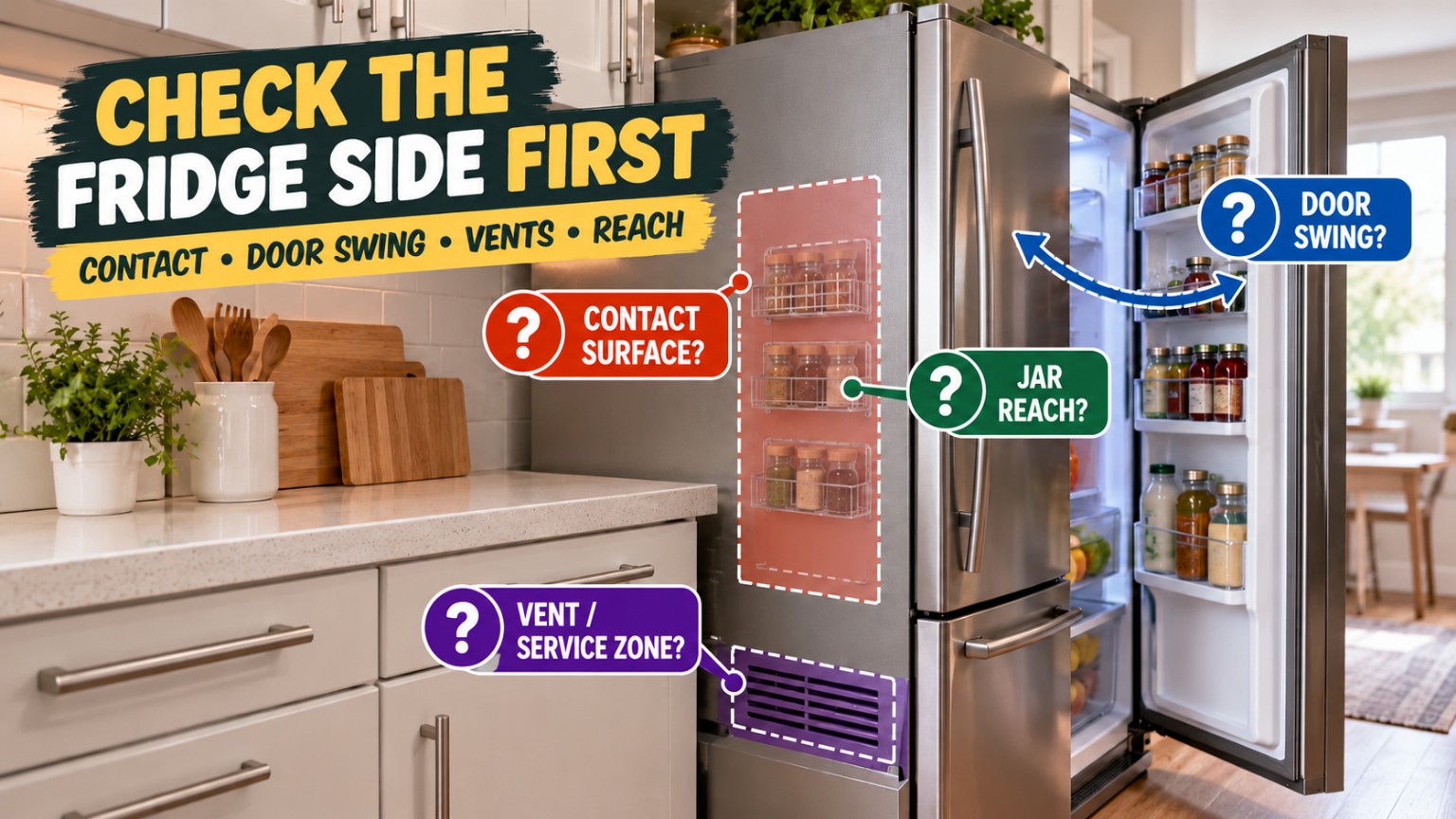
The catch is that a refrigerator side is not a universal mounting surface. Its finish and construction determine whether a magnet makes meaningful contact. The available side area, door swing, ventilation openings, neighboring cabinets, and the weight and shape of what you intend to store can all change the outcome. A magnet attaching to one small spot does not prove that a loaded rack will hold safely on the whole surface.
This guide uses a fit-first approach. Check the real refrigerator, the movement around it, and your cooking routine before choosing among three different products: a compact Yamazaki caddy, a modular four-shelf Songmics set, and a larger Yamazaki organizer with hooks and a paper-towel arm. These are different storage architectures, not interchangeable versions of a single rack and not a ranked list.
Manufacturer dimensions and capacity figures below are product-specific published claims, not a guarantee for your refrigerator or your intended loading. Where the exact U.S. product’s measurements or load rating are unavailable, that information remains unknown rather than being estimated from another market or a similar-looking model.
The Quick Decision: Match the Storage Job to the Rack Role
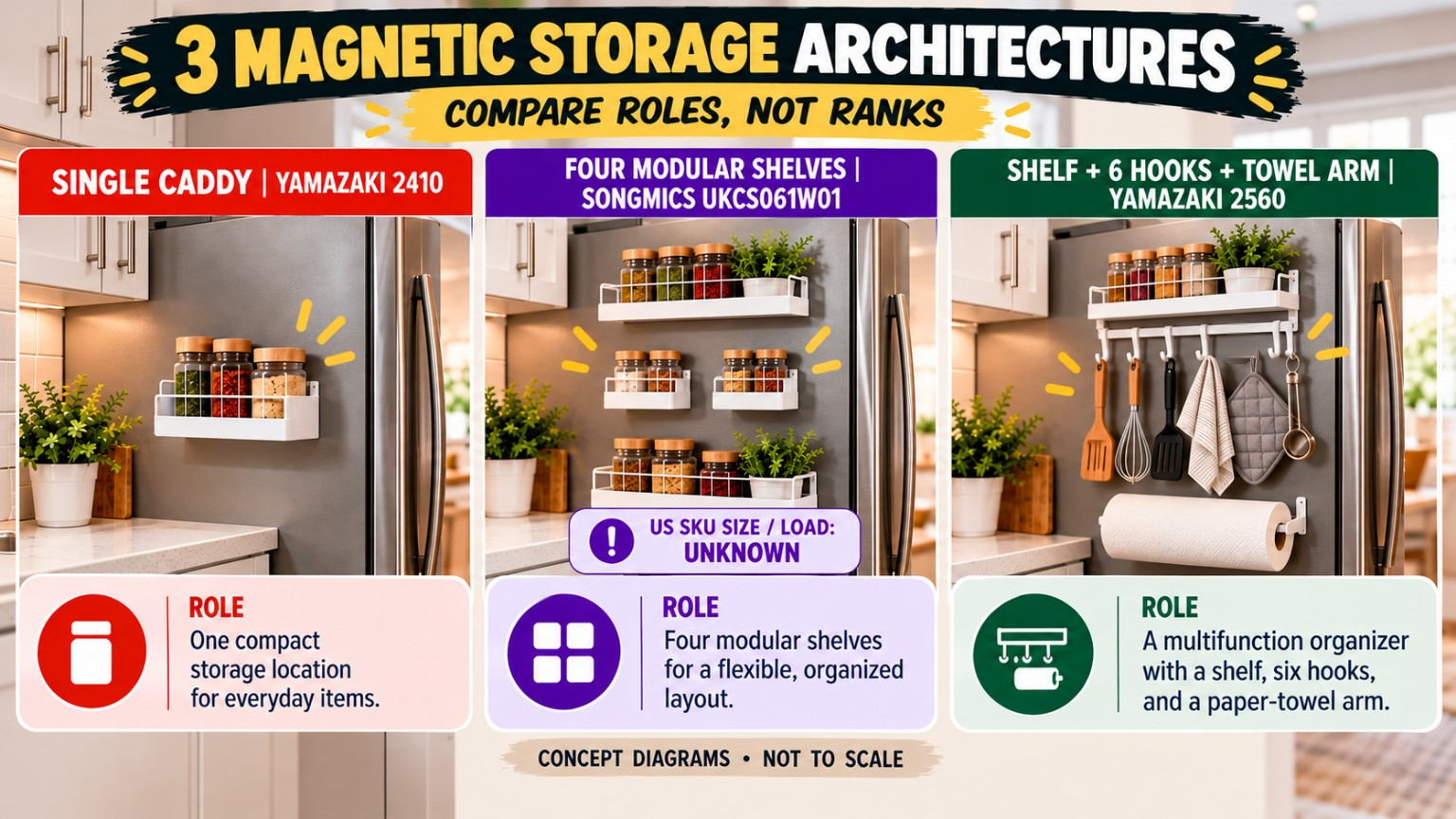
A compact single caddy makes sense to investigate when you want one accessible spot for a small collection of seasonings and have a defined, unobstructed area. The Yamazaki Home PLATE Magnetic Storage Caddy (model 2410) fills that role. Its maker publishes dimensions and a capacity figure, but surface compatibility and stable holding on your refrigerator still require a real-world check. [1]
A four-shelf modular arrangement is a different project. The Songmics Magnetic Spice Rack Set of 4 (U.S. SKU UKCS061W01, cream white) provides two large and two small shelves that can be arranged around the available area. The exact U.S. SKU’s individual shelf dimensions and load capacities are not certified in the adopted evidence. You cannot responsibly finish a close-clearance or capacity-based buying decision until those SKU-specific facts are obtained. [2]
The Yamazaki Home PLATE Magnetic Kitchen Organizer (model 2560) is a multifunction unit with a shelf, six hooks, and a paper-towel arm. It introduces a taller vertical footprint and more ways for stored items to project or swing into nearby space. Manufacturer dimensions and load information are available, along with an assembly requirement, but the actual location still needs clearance and loading checks. [3]
Choose a role first—single caddy, distributed shelves, or one multifunction organizer—then measure the usable location. There is no universal winner; a product that answers the right storage need can still fail the fit test.
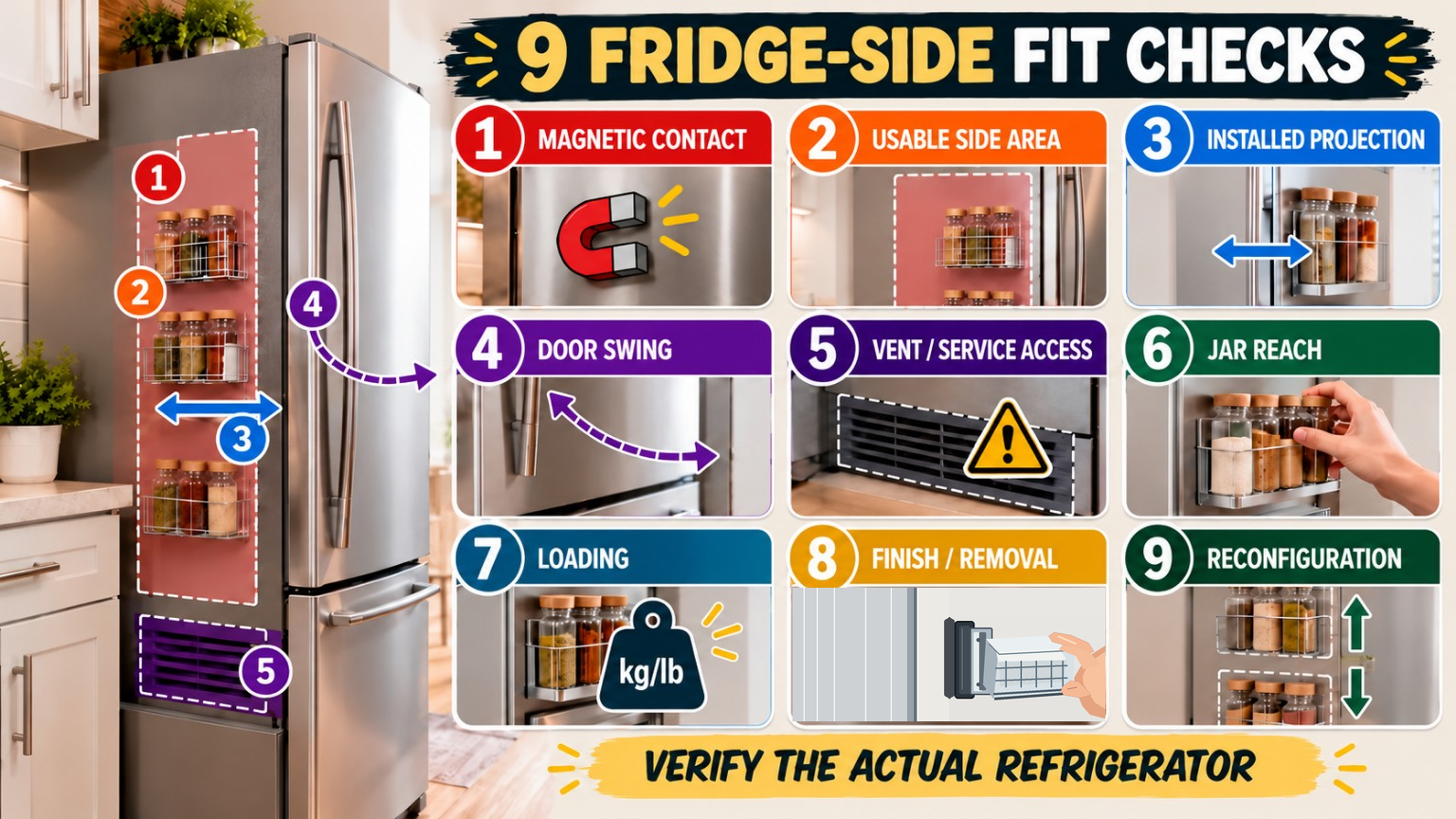
Nine Fit Checks to Make Before Buying
1. Verify the actual magnetic contact surface
Test the specific area where the rack would attach using a small, ordinary household magnet, following the appliance and finish guidance. A steel-looking panel may have a nonmagnetic section, covering, trim, or attached panel. Test more than one relevant spot, including where the rack’s magnets would contact. Treat a positive test as a starting condition, not proof of loaded holding strength. If the appliance manufacturer restricts accessories or a surface cannot be verified as suitable, stop before mounting.
2. Measure usable side-panel area, not the outside refrigerator size
Measure the uninterrupted panel region that is genuinely available. Exclude handles, protruding edges, seams, hinges, cables, controls, recessed sections, and any spots that must remain accessible for servicing. Record the width and height of that usable rectangle and note where the magnetic contact points would land. Refrigerator body width is not the same as the usable area on one side.
3. Check depth and projection into the room
A rack can fit within the side-panel width and height yet project too far into a walkway, cabinet-opening path, or work zone. Account for the rack itself plus jar rims, utensils, hooks, or a paper-towel roll extending beyond it. A manufacturer’s L × W × H list does not necessarily tell you which dimension becomes outward projection in your installation; compare the product illustration and mounted orientation before interpreting it. For the exact Songmics U.S. SKU, rack-specific projection measurements remain unknown in the adopted evidence.
4. Observe the full door swing
Open and close the refrigerator door through the range you normally use. Watch the path of the door edge and handle, nearby cabinetry, and any stored object that might be bumped as you open the door. Test the actual intended mounting position, not an abstract clearance around an empty refrigerator. A rack that fits while the door is shut might become an obstruction when it is open.
5. Preserve ventilation and service access
Locate ventilation openings, heat-rejection areas, appliance clearances, access panels, cords, and anything called out by the refrigerator manual. Do not cover or crowd them to make storage fit. This article cannot assign a universal safe clearance, because requirements depend on the particular appliance and location. If you cannot confirm the required space from the refrigerator’s guidance, do not assume the magnet rack has enough clearance.
6. Test spice-jar access and comfortable reach
Imagine removing the tallest and widest jar you actually use. Can you grasp it without tilting the rack, scraping a cabinet, or reaching across a hot or crowded work area? Are the labels visible, and can you return the jar without disturbing the others? Accessible storage is about the hand movement around the shelf, not only the shelf’s outside measurements.
7. Plan the load, not just the jar count
Weigh or otherwise establish the realistic combined weight of the rack’s contents—including glass containers, refills, lids, and anything hanging from hooks. Use the exact manufacturer’s applicable rating as a ceiling for evaluation, not as an independent prediction of magnet performance on your appliance. Distribution and leverage matter: a heavy object at an outer edge can behave differently from the same weight close to the mounting surface. An unknown capacity is a purchase hold for any load-sensitive use.
8. Consider finish care and safe removal
Magnets and contact surfaces do not automatically guarantee scratch-free or damage-free use. Dust, grit, movement, forceful removal, and painted or coated appliance finishes can change the risk. Inspect the appliance instructions, keep contact areas clean, and consider whether you can remove or reposition the organizer without dragging it across the finish. Do not treat a renter-friendly layout as proof that no marks will be left.
9. Match the system to future reconfiguration
One caddy is adjusted as a single location; four shelves create several possible positions; a multifunction unit concentrates hooks, a shelf, and paper-towel access in one vertical layout. Consider whether you will move the rack for cleaning, seasonal changes, or a new refrigerator. Reconfiguration should not force you to ignore the same contact, clearance, and loading checks that applied at installation.
How to Map Your Refrigerator Side Before Choosing a Product
Start with a quick site sketch. Mark the usable magnetic-contact region you can verify, the door-swing envelope, any vents or service zones, a nearby cabinet edge, and the place where your hand naturally reaches for spices. Write down usable width and height in the actual region rather than the refrigerator’s overall dimensions.
Next, make a simple paper-size mockup of the candidate rack’s face or the cluster of shelves you want to use. Hold it in the proposed location while opening the refrigerator and adjacent storage. A mockup shows the intended footprint; you still need the item’s true installed projection and space for jars. Do not use tape or adhesive on a delicate finish unless your appliance guidance permits it.
For Yamazaki model 2410, the published dimensions give you a product-specific starting point. For model 2560, check both the unit’s tall overall geometry and the paper-towel/hook paths. For Songmics UKCS061W01, do not convert measurements from a regional model family into exact U.S. SKU dimensions. Request or verify the precise dimensions for the shelves you plan to place, then repeat the mockup.
Finally, plan contents. List your actual jars and tools, their combined weight, the height needed to remove each item, and whether you will frequently lift or move them. A rack is usable only when its mounted position, storage contents, and surrounding kitchen all work together.
Product 1: Yamazaki Home PLATE Magnetic Storage Caddy (Model 2410)
Role: compact single caddy. Model 2410 is the one-place storage option in this comparison. Yamazaki Home identifies the material as steel and lists dimensions of L 4.33 × W 9.65 × H 3.35 inches. The manufacturer’s specification lists a 3.3 lb capacity. [1]
One important source discrepancy should not be smoothed over: another manufacturer description refers to 3.5 lb, while the adopted maker specification states 3.3 lb. This guide uses the 3.3 lb specification as the stated reference and does not present 3.5 lb as an interchangeable or upgraded rating. Even 3.3 lb does not mean the caddy will reliably remain attached to every refrigerator surface under that load.
Measure the intended side-panel rectangle against the actual mounting orientation. The L × W × H notation is a published set of product dimensions, not permission to assume that one particular value is the outward projection without inspecting the mounted arrangement. Also check that the jar lids and your fingers clear the cabinet or doorway next to the fridge.
A single caddy can simplify access when your goal is one concentrated storage point rather than organizing an entire spice collection into several tiers. That is a workflow distinction, not a guarantee that it fits a small kitchen. If your refrigerator side is interrupted by a trim strip, poor magnetic contact, a door-swing obstacle, or a narrow reach zone, the product may not be suitable for that spot.
Identity and links: Yamazaki Home PLATE Magnetic Storage Caddy, model 2410; U.S. Target product identity TCIN 1010912314, UPC 4903208024105. The manufacturer is the source for product-spec claims [1]; Target is an exact U.S. retail product page [4], not evidence of your specific refrigerator fit or a promise of current checkout stock.
Product 2: Songmics Magnetic Spice Rack Set of 4 (U.S. SKU UKCS061W01)
Role: modular four-shelf system. This exact U.S. product identity is the cream-white Songmics set with two large and two small magnetic shelves. That lets a buyer consider spacing individual shelves rather than relying on one large continuous organizer. The first-party U.S. product page identifies SKU UKCS061W01. [2]
The distinction between a product family’s marketing and this exact SKU matters. For UKCS061W01, the adopted evidence does not certify numerical dimensions or load capacities for each U.S. shelf. Regional-family listings contain measurements and weight ratings, but those figures have not been established for the exact U.S. SKU. They are intentionally excluded here. Do not use a similar-looking cream-white set, a regional specification card, or a photo scale as a replacement for exact SKU facts.
That uncertainty changes the buying workflow. If shelf depth is critical because a cabinet or hallway is close to the refrigerator, you need the exact U.S. shelf projection before ordering. If you need to store a known combined weight of glass spice jars, obtain the exact SKU’s applicable load rating and evaluate it against your refrigerator’s real magnetic contact. If neither can be verified, keep the purchase on hold rather than guessing.
Four separate shelves also create a clearance puzzle: the whole set need not occupy one block, but every intended shelf position needs its own magnetic-contact patch, unobstructed door path, and comfortable reach. Planning two large and two small locations can be useful for grouping frequently used spices, yet it increases the number of places that must pass the fit test.
Identity and links: Songmics Magnetic Spice Rack Set of 4, cream white, U.S. SKU UKCS061W01. The first-party product page is the source for the locked product identity and configuration [2]. The supplied Newegg link [6] is a retail search-results page, not a verified exact-product detail page or a direct purchase link. Manufacturer direct-stock status is ambiguous; no current-stock assertion is made.
Product 3: Yamazaki Home PLATE Magnetic Kitchen Organizer (Model 2560)
Role: multifunction shelf, six hooks, and paper-towel arm. Unlike a single caddy or separate small shelves, Yamazaki model 2560 brings several storage actions into one organizer. The maker lists dimensions of L 3.5 × W 11.4 × H 14.2 inches and a capacity figure of 8.8 lb. Its paper-towel arm accommodates a roll of about 6 inches maximum diameter. Assembly is required; optional wall-mounting screws are not included. [3]
The H 14.2-inch manufacturer dimension signals a taller arrangement that deserves a full-height side-panel check. Test access to the shelf, hanging items, and paper-towel roll without obstructing the fridge door, another cabinet, or the route through the kitchen. A paper-towel roll or hanging utensil may move during use, so evaluate more than a static, empty outline.
The maker’s 8.8 lb figure is a product-level capacity statement. Do not treat it as a separate guarantee for each hook, the paper-towel arm, or any refrigerator side. The suitability of the magnet interface, surface, weight distribution, and the particular items stored still needs evaluation. Avoid hanging objects that could fall into a path where they present a hazard.
Use the manufacturer’s dimensional specification as primary. The supplied Target listing carries a conflicting dimensional presentation, so this guide does not combine the two into a fabricated average or silently substitute retailer dimensions. Check the maker’s current diagrams for intended mounting orientation and verify on-site projection before treating the unit as a fit.
Identity and links: Yamazaki Home PLATE Magnetic Kitchen Organizer, model 2560; Target TCIN 1010685130 and UPC 4903208025607. Product specifications come from Yamazaki Home [3]. Target is an exact U.S. retail product page [5], not independent evidence of universal magnetic compatibility or a guarantee of present stock.
Three Architectures Compared Without Ranking Them
Compact caddy: one defined storage point
R1 concentrates the task in a single caddy. The main questions are whether a verified magnetic patch is available, whether the caddy and jars can be reached and removed, and whether the intended contents remain within a safe load evaluation. Its published product dimensions and 3.3 lb specification allow a more concrete fit check than a listing with unknown size, but the refrigerator-side hold is still unverified.
Modular shelves: multiple independent mounting zones
R2 trades a single unit for four shelf positions: two large and two small. That may suit grouped seasonings or a side panel with usable patches at different heights. The limiting uncertainty is exact U.S. SKU shelf size and capacity. These remain unknown; modularity does not eliminate the need to certify each position and load.
Multifunction organizer: one taller equipment zone
R3 combines storage functions. The higher and broader equipment zone can make sense when shelves, hooks, and a paper-towel roll are all part of the same cooking routine. That also means checking vertical space, object swing, changing loads, roll access, and assembly. Its 8.8 lb manufacturer rating is not a substitute for attachment-surface verification.
None of these systems is a universal winner. What matters is the intersection of a verified surface, adequate clearance, stable loading, and the way you actually cook. If an essential measurement is unknown for the exact model, pause the purchase rather than substituting a neighboring product’s specification.
Loading and Magnetic Hold: What a Published Capacity Does—and Doesn’t—Tell You
Capacity numbers are useful only when read with their scope. Yamazaki lists 3.3 lb for model 2410 and 8.8 lb for model 2560 in the adopted maker specifications. Those are manufacturer product figures; this article cannot establish the force holding either unit to a particular refrigerator finish, the effect of uneven loading, or the separate limits of hooks and other appendages. [1] [3]
For Songmics UKCS061W01, no exact U.S. SKU shelf load figure is certified here. Do not borrow a kilogram rating from another region and treat it as U.S. SKU evidence. A buyer who needs a load threshold should obtain exact SKU-specific documentation before using the shelves with heavier items. [2]
Load each unit conservatively after confirming that the appliance surface is appropriate, and follow the product’s actual instructions. Consider the weight of full jars, not empty jars, and the effort applied when lifting, pulling, or unrolling items. Keep anything vulnerable to falling away from a location where breakage or personal injury would be especially consequential.
A magnet sticking to a refrigerator while the rack is empty is not a stress test for safe long-term use. Conversely, a numerical rating on a product page cannot tell you how the refrigerator’s paint, curvature, surface preparation, magnet contact, or repeated removal will behave.
Vent Clearance, Door Movement, and the Hidden Costs of Projection
The side of a refrigerator may face a wall, pantry door, walkway, dining chair, or a narrow counter return. In a floor plan, a slim-looking rack can occupy little area. In day-to-day use, opening the fridge, reaching for jars, or pulling paper towels adds a moving space requirement.
Watch both closed and fully usable door-open positions. Include the handle and any interference created by an object stored in the rack. Leave the refrigerator’s required service and airflow openings clear according to the appliance manufacturer—not an invented universal distance. Nothing in these three product specifications proves refrigerator door-swing or vent compatibility for all models.
If a shelf’s exact outward depth is unavailable, as with the locked Songmics U.S. SKU, do not design around a guessed clearance. Either secure exact-model dimensions or change the storage plan until there is a confirmed fit. The same principle applies when a maker’s L × W × H dimensions cannot be confidently mapped to the way an organizer projects from its installed surface.
A Practical Setup and Removal Routine for Renters
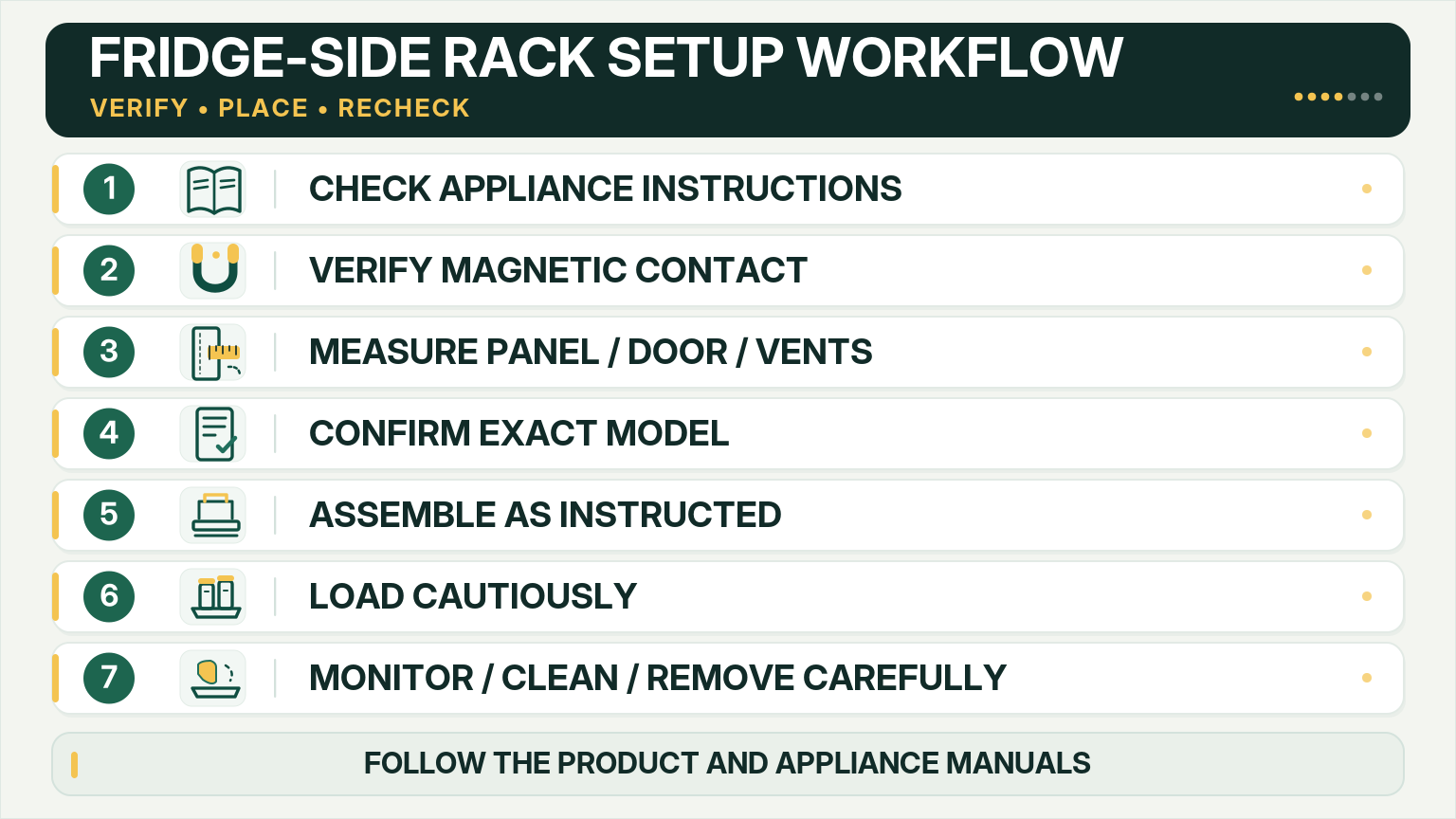
Step 1 — Inspect first. Read the refrigerator’s surface and ventilation guidance along with the rack’s manufacturer instructions. Identify whether the selected side location is an appropriate magnetic contact surface, without assuming that every visible metal panel is suitable.
Step 2 — Measure and simulate. Map the planned position, door swing, adjacent cabinet movement, and the real hand motion needed to access the jars. For a unit with hooks or a paper-towel arm, check the movement of those attachments as well.
Step 3 — Confirm the exact model. Use the matching manufacturer product identity, not a look-alike. R1 is Yamazaki 2410, R2 is Songmics UKCS061W01, and R3 is Yamazaki 2560. Keep dimensions or capacity unknown when the exact SKU has no certified figure in the adopted evidence.
Step 4 — Assemble only as instructed. Model 2560 requires assembly; its optional wall screws are not included. That does not authorize assuming screws are needed for the intended magnetic refrigerator placement, nor does it authorize a universal no-tool claim. Follow the instructions for the mounting method you will actually use.
Step 5 — Place and load cautiously. Avoid trapping grit between magnet/contact surfaces and the appliance finish. Establish stable attachment before putting breakable or heavy contents into use. Published product capacities are not a substitute for checking actual mounting performance and keeping a margin against disturbance.
Step 6 — Recheck after use. Confirm that normal door operation, routine grabbing of jars, cleaning, and the pull from a paper-towel roll do not move or destabilize the organizer. If the rack shifts, the finish shows distress, or contact is uncertain, unload and stop using that position.
Step 7 — Remove with care. Do not slide a loaded rack over a painted finish or assume that a magnetic mount is scratch-free. Unload it, follow removal instructions, inspect contact points, and reassess the location if the rack must be moved.
Common Buying Mistakes
Mistake: choosing by the word “magnetic.” A product name does not establish that your refrigerator’s side panel has a suitable magnetic contact area—or that it can carry the intended contents.
Mistake: measuring only width. Door movement, installed depth, vents, hooks, roll access, and jar removal can all make an otherwise narrow rack inconvenient or unsuitable.
Mistake: treating every product image as a dimensioned drawing. Marketing photos can show an arrangement but cannot supply unknown exact-SKU measurements or a guaranteed load rating.
Mistake: applying Songmics regional-model dimensions or ratings to U.S. SKU UKCS061W01. The figures are not certified as interchangeable in this product set.
Mistake: mistaking a retail search page for a direct buy link. The supplied Newegg page may help locate listings, but it is not an exact U.S. product-detail page with a verified checkout for UKCS061W01.
Mistake: using a published capacity as a promise of damage-free, scratch-free, or permanent attachment. Manufacturer figures and the actual refrigerator-side contact problem are different questions.
Frequently Asked Questions
Will a magnetic spice rack work on every refrigerator?
No. The rack’s magnet and the specific refrigerator-side material and finish both matter. Verify the actual intended contact area and consult appliance instructions. Even if a small test magnet attaches, that does not establish how a fully loaded product will perform.
Can I mount a spice rack on a refrigerator door instead?
This guide evaluates refrigerator sides. A moving door introduces extra motion, clearance, and loading variables, so do not transfer side-panel assumptions to the door. Check the appliance and product instructions and the entire sweep before considering any alternative location.
Is it okay to place a rack near a refrigerator vent?
Do not block vents or required service and airflow clearances. The correct requirement comes from your appliance manual and the real installation, not a single universal spacing number.
What dimensions does the Songmics four-pack have?
For the exact U.S. SKU UKCS061W01, individual shelf dimensions are unknown in the adopted product evidence. Measurements on regional-family pages are not treated as certified U.S. SKU dimensions. Obtain model-specific specifications before purchasing for a constrained space.
How much weight can the three products hold?
The manufacturer specifications adopted here list 3.3 lb for Yamazaki 2410 and 8.8 lb for Yamazaki 2560. The exact U.S. Songmics UKCS061W01 load capacity is unknown. None of these facts guarantees secure holding on your refrigerator, or establishes how much each hook or tray section can independently carry. [1] [2] [3]
Do magnetic racks guarantee a scratch-free rental refrigerator?
No. Contact materials, dust, shifting loads, appliance coatings, and removal methods create finish risks. Do not assume damage-free use based on a magnet or a generic renter-friendly description.
Can the Yamazaki model 2560 carry paper towels as well as spices?
The model includes a paper-towel arm and six hooks in addition to the shelf. The maker notes a paper-towel roll diameter of about 6 inches maximum. The total practical arrangement still depends on assembly, reach, clearance, load distribution, and the intended location. [3]
Does the model 2560 require drilling?
The maker states that assembly is required and that optional wall screws are not included. Do not confuse optional wall mounting with every use of the organizer or assume that any selected surface requires no preparation. Follow the manufacturer’s instructions for the mounting method you choose. [3]
Your Final Pre-Purchase Check
Before ordering, be able to answer all of the following for the actual refrigerator and exact product:
- The intended attachment surface has been checked for magnetic suitability, and the appliance permits the location.
- The usable contact area is known—not just the refrigerator’s overall dimensions.
- The installed footprint and projection are understood for the exact product and arrangement.
- The refrigerator door, nearby cabinets, and normal walking path can operate without interference.
- No vent, service zone, or required appliance clearance will be obstructed.
- Spice jars, hanging tools, and paper towels can be accessed without unstable pulling or awkward reach.
- The intended load is known and evaluated against applicable exact-model information and the real mounting surface.
- The appliance finish, cleaning, removal, and renter-specific risks have been considered.
- Any essential unknown, especially Songmics exact U.S. shelf dimensions or capacity, has been resolved before purchase.
If one of those checks fails, reconsider the mounting location or storage job rather than forcing a rack into an unsuitable spot. If a critical model-specific fact remains unknown, keep the buying decision open.
Bottom Line: Measure the Refrigerator Side, Then Choose the Storage Architecture
A refrigerator-side magnetic spice rack can be useful in a small kitchen, but its value depends on a verified place to mount it, the space it consumes while loaded, and how the kitchen works around it. The right order is surface first, usable panel space second, door and vent clearance third, then access, loading, and reconfiguration.
The Yamazaki 2410 is a compact single caddy, the Songmics UKCS061W01 is a modular four-shelf set with important exact-U.S.-SKU specification unknowns, and the Yamazaki 2560 is a taller multifunction organizer with hooks and a paper-towel arm. None should be described as universally compatible or the best choice for every refrigerator.
Treat manufacturer specifications as product evidence, not a substitute for checking your own appliance. Measure the surface you actually have and choose only after the system, contents, and movement around it make sense together.
Product Sources and Retail-Link Boundaries
[1] Yamazaki Home — PLATE Magnetic Storage Caddy, model 2410. First-party product-spec source (dimensions, steel material, 3.3 lb specification; 3.5 lb descriptive discrepancy not merged): https://theyamazakihome.com/products/plate-magnetic-storage-caddy
[2] SONGMICS — Magnetic Spice Rack for Refrigerator, Set of 4, U.S. SKU UKCS061W01, cream white. First-party identity/configuration source; exact U.S. shelf sizes and load capacity remain unknown: https://www.songmics.com/products/songmics-songmics-magnetic-spice-rack-for-refrigerator-set-of-4-ukcs061
[3] Yamazaki Home — PLATE Magnetic Kitchen Organizer, model 2560. First-party product-spec source (dimensions, 8.8 lb capacity, six hooks, paper-towel arm, approximately 6 in maximum roll diameter, assembly, optional wall screws): https://theyamazakihome.com/collections/kitchen-organization/products/plate-magnetic-organizer
[4] U.S. retail identity — Target exact product page for Yamazaki model 2410, TCIN 1010912314, UPC 4903208024105. Availability requires a fresh checkout check; not the primary spec source: https://www.target.com/p/-/A-1010912314
[5] U.S. retail identity — Target exact product page for Yamazaki model 2560, TCIN 1010685130, UPC 4903208025607. Its dimensional presentation conflicts with the maker’s; the maker is primary for this guide: https://www.target.com/p/-/A-1010685130
[6] Newegg search-results page for Songmics marketplace discovery. This is NOT a verified exact-product detail page or a confirmed direct-buy URL for UKCS061W01: https://www.newegg.com/p/pl?N=101709774&d=magnets&isdeptsrh=1
Product listing and availability data can change. The guide does not promise current stock, price, completed checkout, surface compatibility, or damage-free use.