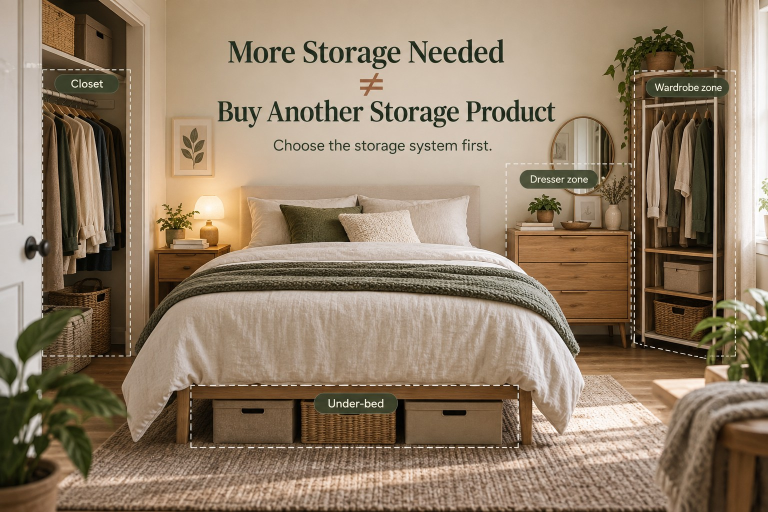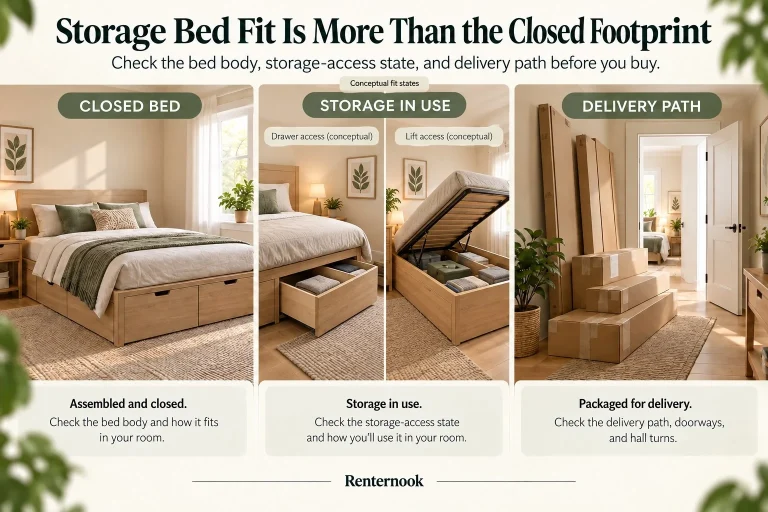
Under-Bed Storage Bins for Low-Clearance Beds: Measure the Real Fit Before You Buy
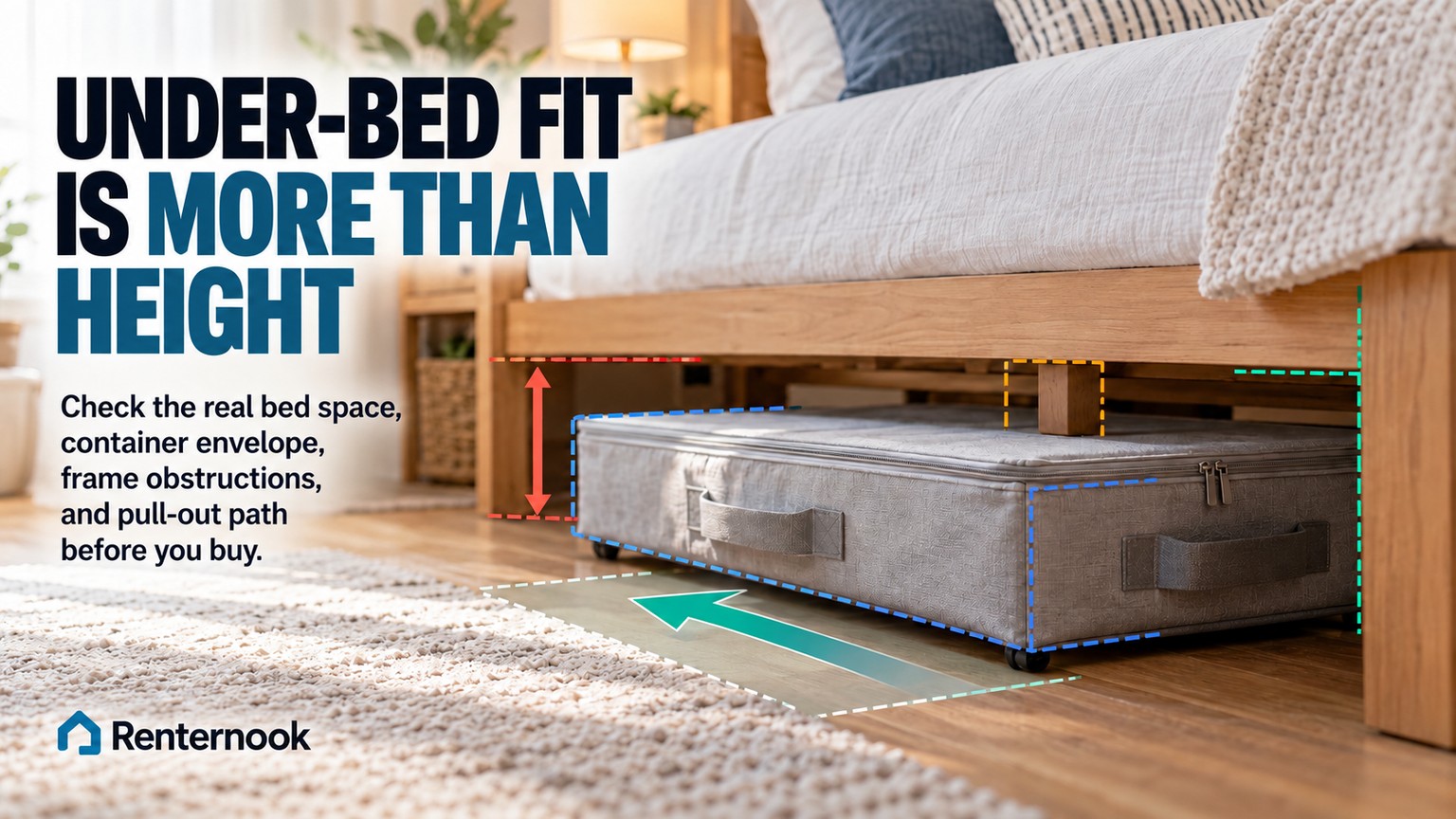
Under-bed storage looks simple until a container that seems short
enough will not slide under the bed, catches on a side rail, collides
with a center support, becomes difficult to pull out, or cannot be
opened once it is in place.
That is why published product height is only one part of the fit
decision. A low-profile bin may still fail in the real room if its
wheels, handles, lid, fabric cover, pull-out path, or the bed frame
itself reduce usable clearance.
For low-clearance beds, the useful question is not just, “How tall is
the bin?” It is, “Will this exact storage format fit under this exact
bed, and can I actually access and remove it when it is loaded?”
This guide compares four locked under-bed storage formats without
ranking them:
- IKEA VARDO 202.382.23 — rigid wheeled box with textile cover
- IKEA SKUBB 805.910.51 — soft-sided zippered storage case with
handles - IKEA SOCKERBIT 204.115.24 — rigid lidded non-wheeled storage
box - Sterilite 60 Qt Wheeled Underbed Latch Box, model 2761 / item
2761B804T — clear wheeled latched storage
The goal is to match the container format to your actual bed
clearance, access pattern, floor, and storage job—not to name one
universal winner.
Why Bed Clearance Alone
Is Not Enough
A published storage-bin height does not prove the required bed
clearance.
That distinction matters. If a product is listed at 7 inches high, it
is not valid to conclude that a 7-inch opening under the bed is
automatically enough. Real fit can be affected by parts and conditions
that are not fully captured by a single height figure.
These can include:
- side rails that sit lower than the mattress platform
- center supports or legs under the bed
- the true external envelope of the container
- wheels or castors
- handles or latches that protrude
- the angle needed to insert or remove the container
- the lid or zipper access you need after the container is parked
- carpet or floor transitions
- how the container behaves when loaded
Some of those details are model-specific. Others remain unknown until
you measure the actual bed and room.
For that reason, treat published height as a product
specification—not as proof of required bed clearance.
What to Measure Before
Shopping
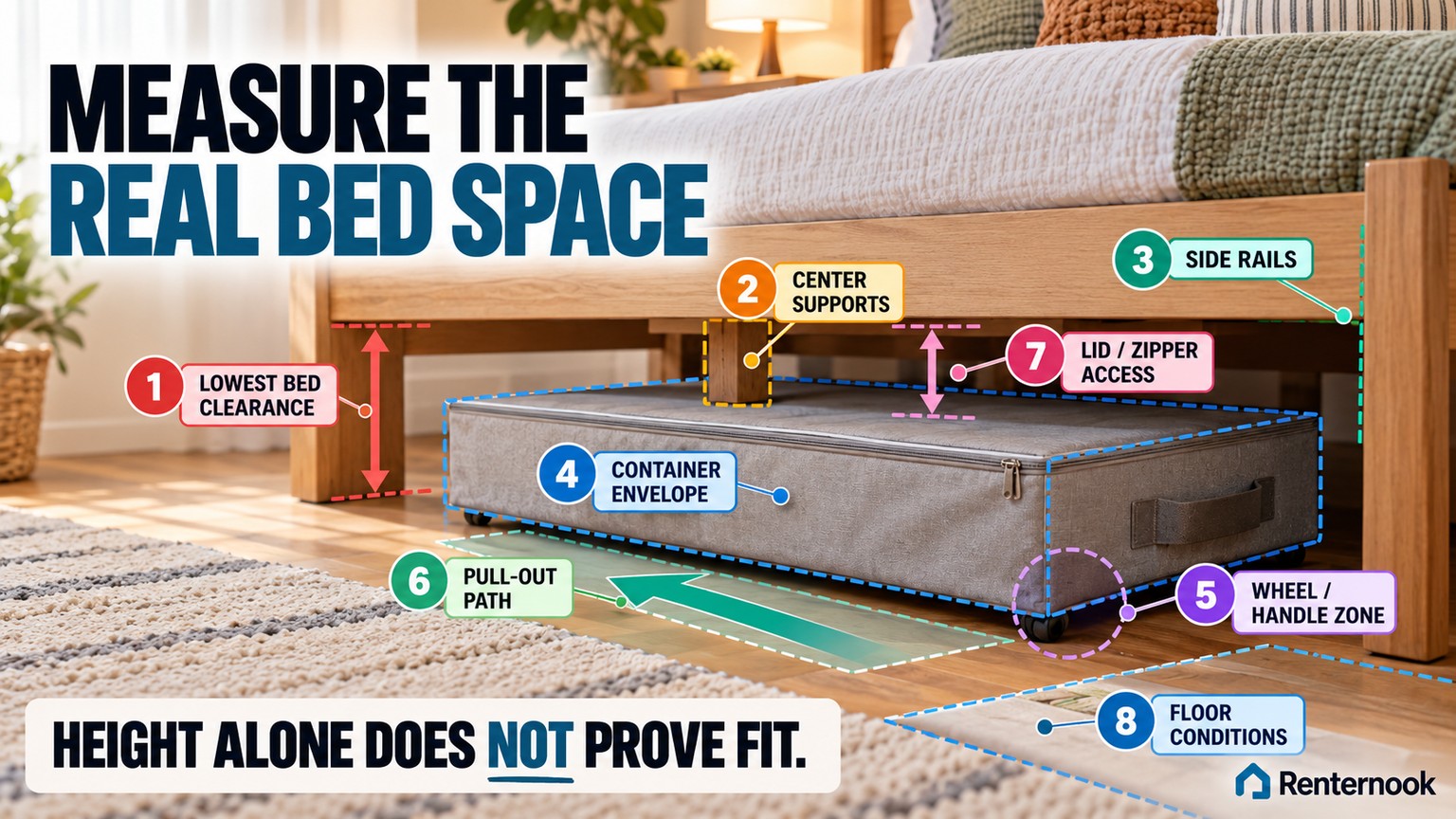
Before comparing products, measure the real space under the bed.
1. Lowest usable bed
clearance
Measure from the floor to the lowest obstruction along the path the
container must travel. Do not assume the visible side opening represents
the full usable clearance.
Check the side rail, brackets, center beam, center legs, and any
hardware under the bed.
2. Available width and depth
Measure the horizontal space the container can actually occupy. A
long box may fit the room under the mattress but still collide with a
bed leg, center support, wall, nightstand, or another stored item.
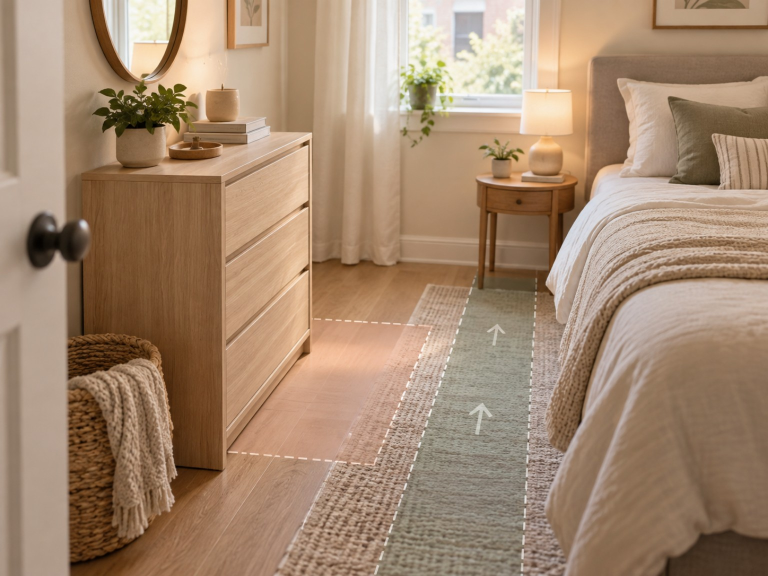
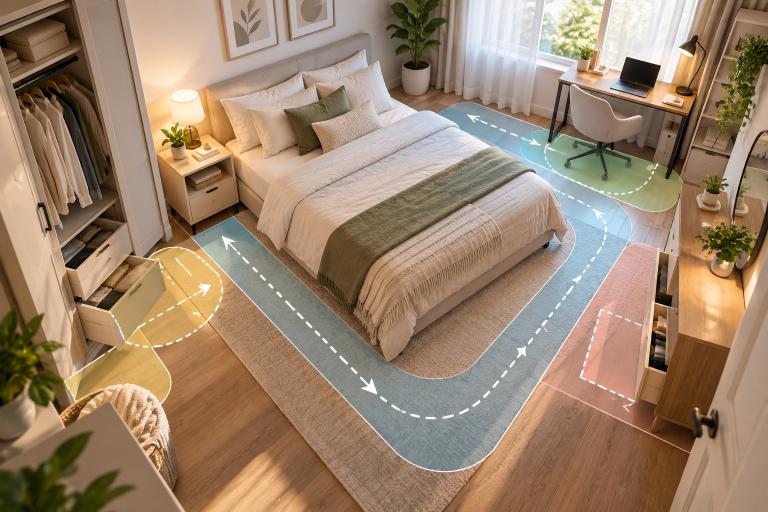
3. Pull-out path
A container that fits while parked may still be awkward or impossible
to remove. Measure the path in front of the bed and account for nearby
furniture.
Extra movement clearance is buyer-specific and remains unknown until
you test the real setup.
4. Access method
Ask how you expect to reach the contents.
A zippered soft case may need enough room to pull it out and unzip
it. A rigid box with a lid may need space to lift or remove the lid. A
wheeled container may be easier to reposition on some floors, but
published wheel presence does not prove universal rolling ease.
5. Floor conditions
Hard flooring, rugs, carpet, thresholds, and uneven surfaces can
change how easy a container is to move.
Do not assume that wheels automatically solve the access problem.
Carpet rollability, threshold compatibility, and loaded movement are not
established here for these products.
6. What you plan to store
The contents affect how useful the format is. Bulky bedding, folded
clothes, shoes, seasonal items, or mixed household storage may favor
different interior layouts and access styles.
Published external dimensions also do not prove how much usable
interior volume you will get for a specific item.
Four Under-Bed Storage
Archetypes
The four locked products represent different storage architectures
rather than a ranked list.
R1 — IKEA VARDO 202.382.23
VARDO is a rigid under-bed box with castors and a textile cover
secured with poppers.
Published dimensions are 25 5/8 inches wide, 27 1/2 inches deep, and
7 1/8 inches high. The published interior width is 24 3/8 inches,
interior depth is 26 3/8 inches, and interior drawer height is 5 1/8
inches.
Its construction combines particleboard and fiberboard with a
polyester cover.
The buyer decision here is whether a rigid wheeled box with a textile
top matches the available footprint and access pattern. The wheels may
help with movement in some setups, but the true maximum external
footprint, wheel protrusion, extra movement clearance, carpet
rollability, and loaded movement remain unknown.
A pull handle is not verified, and the load limit is unknown.
R2 — IKEA SKUBB Storage
Case 805.910.51
The locked SKUBB variant is the white 35 1/2-inch size.
Published dimensions are 35 1/2 inches wide, 20 3/4 inches deep, and
7 1/2 inches high.
It uses polyester fabric with a polypropylene insert. Handles are
present, and the case uses a zipper. Corner nets provide
ventilation.
This is the soft-sided format in the group. That changes the storage
and access decision compared with rigid boxes. The case may be useful
when you want handles and zippered access, but the published dimensions
still do not prove bed-specific fit or required clearance.
Wheels are not listed. The load limit is unknown.
Because the case is soft-sided, do not assume that its body will
always deform enough to overcome a tight clearance problem. The actual
fit still depends on the bed, contents, and removal path.
R3 — IKEA SOCKERBIT 204.115.24
The locked SOCKERBIT variant is the white low under-bed size.
Published dimensions are 30 1/4 inches long, 19 3/4 inches wide, and
7 1/2 inches high.
It is made from polypropylene and uses a lid with a built-in locking
function. Small ridges create a ventilation gap at the lid.
This is the rigid, lidded, non-wheeled format in the set.
That means the buyer should pay particular attention to how the box
will be pulled across the actual floor and whether there is enough room
to access the lid after it is stored.
Wheels are not listed. A handle is not verified. The load limit is
unknown.
The product is not claimed here to be airtight, moistureproof,
dustproof, or pest-proof.
R4 —
Sterilite 60 Qt Wheeled Underbed Latch Box, Model 2761
The locked Sterilite product is model 2761, item 2761B804T, in the
Pewter Aqua variant.
Published exterior dimensions are 35 1/2 inches long, 18 7/8 inches
wide, and 7 inches high.
Published interior bottom dimensions are 31 3/4 inches long, 16 3/4
inches wide, and 6 1/8 inches high.
It is a clear plastic box with wheels and a latching lid. The latches
also provide a carrying grip.
This format gives buyers both exterior and interior-bottom
measurements, which can help separate “will the box fit under the bed?”
from “will the stored item fit inside the box?”
However, the true maximum external footprint, wheel protrusion, extra
movement clearance, exact resin, load limit, carpet rollability, and
loaded movement remain unknown.
A source-text reference to 66 Qt / 110 Qt lid compatibility is not
adopted for this model and should not be used to infer cross-model lid
compatibility.
Model-Specific Comparison
| Product | Storage format | Published exterior size | Interior dimensions supported here | Wheels | Access / closure | Handles / grip | Load limit |
|---|---|---|---|---|---|---|---|
| IKEA VARDO 202.382.23 | Rigid wheeled box with textile cover | 25 5/8 W × 27 1/2 D × 7 1/8 H in | 24 3/8 W × 26 3/8 D × 5 1/8 interior drawer height in | Yes / castors | Textile lid / poppers | Unknown / not verified | Unknown |
| IKEA SKUBB 805.910.51 | Soft-sided zippered storage case | 35 1/2 W × 20 3/4 D × 7 1/2 H in | Unknown | No / not listed | Zipper | Yes | Unknown |
| IKEA SOCKERBIT 204.115.24 | Rigid lidded non-wheeled box | 30 1/4 L × 19 3/4 W × 7 1/2 H in | Unknown | No / not listed | Lid with built-in locking function | Unknown / not verified | Unknown |
| Sterilite 60 Qt Wheeled Underbed Latch Box 2761 / 2761B804T | Clear wheeled latched storage | 35 1/2 L × 18 7/8 W × 7 H in | 31 3/4 L × 16 3/4 W × 6 1/8 H in at interior bottom | Yes | Latching lid | Latches provide carrying grip | Unknown |
The table is a specification reference, not a ranking. It also should
not be read as proof that any product fits a particular low-clearance
bed.
Access, Pull-Out,
and Lid or Zipper Decisions
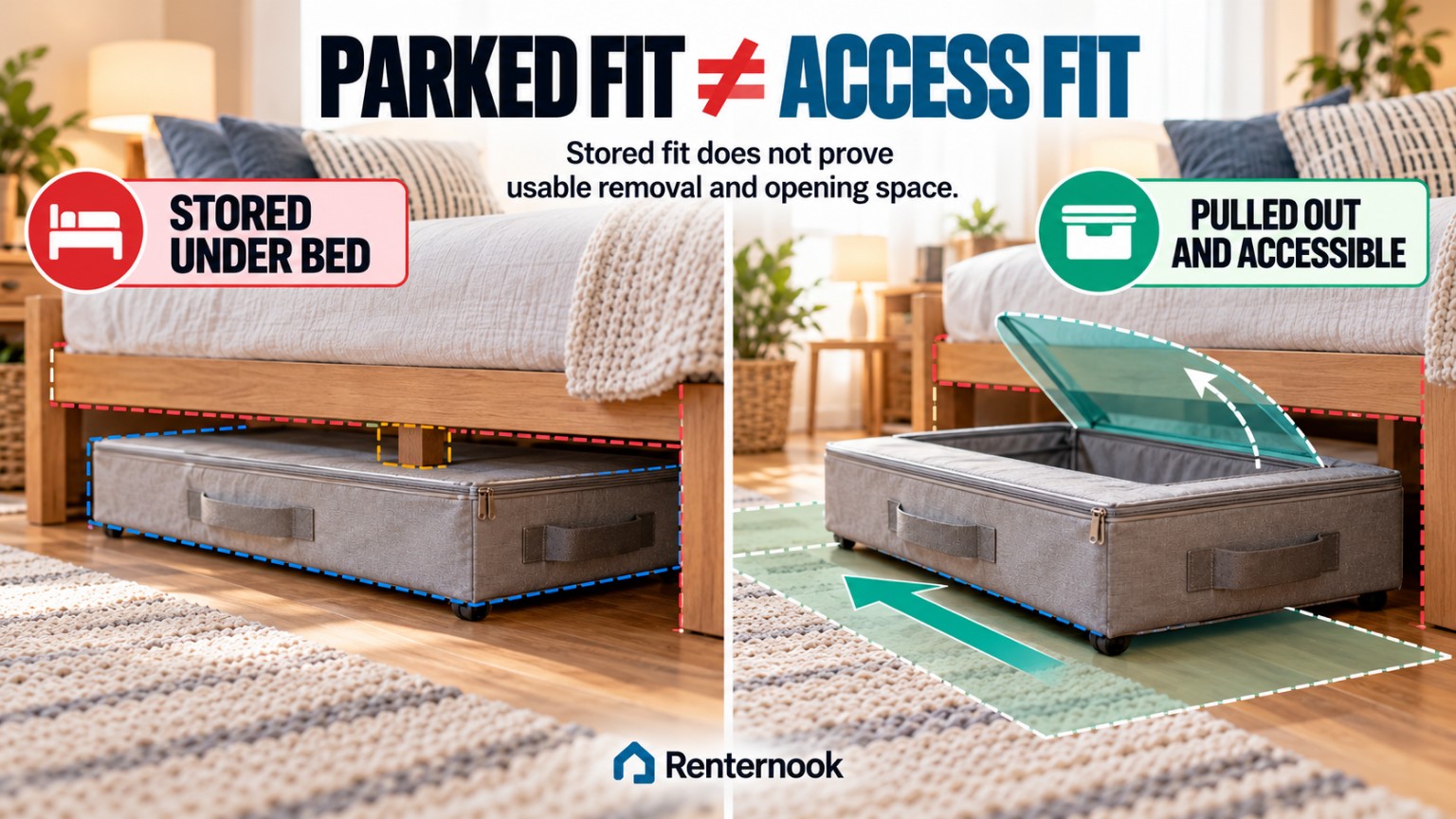
The access method can matter as much as the storage footprint.
If you expect frequent
access
Think about how far the container needs to move before you can reach
the contents. A container that needs to be fully removed may require
more open floor area than one you can partially access.
The required pull-out distance is not established here. Measure your
own room.
If the container has a lid
Check whether the lid can be opened where the box will actually be
used. A low bed may leave too little vertical room to open a rigid lid
while the container is still underneath.
For SOCKERBIT and the Sterilite latch box, lid-opening access is
buyer-specific and should remain an explicit fit check.
If the container uses a
zipper
SKUBB uses a zipper, but zipper presence does not prove easy access
under every bed. You still need enough room to reach the zipper path and
manipulate the case.
If the container uses a
textile cover
VARDO uses a textile lid with poppers. The access question is not
only whether the box fits under the bed, but also whether the cover can
be reached and opened in the intended position.
Wheels vs Non-Wheeled
Storage
Wheels change the movement interface, but they do not settle the fit
decision.
VARDO and the Sterilite 60 Qt box have wheels. SKUBB and SOCKERBIT do
not list wheels.
That does not justify a universal conclusion that wheeled storage is
easier, better, or more suitable for every floor.
For a wheeled container, check:
- whether the wheels add to the true external envelope
- whether the floor lets the container roll as expected
- whether rugs or thresholds interrupt the path
- whether the container remains manageable when loaded
For a non-wheeled container, check:
- whether you can grip and pull it comfortably
- whether the floor surface creates too much resistance
- whether the container must be fully removed for access
Those conditions depend on the room and user. They are not resolved
by the published product dimensions alone.
What Published Specs Do Not
Prove
The model-specific facts above are useful, but several buyer-critical
questions remain outside the supported evidence.
The published specifications do not establish:
- the true maximum external footprint including every wheel, edge,
handle, or protrusion - wheel protrusion
- handle protrusion
- minimum extra movement clearance
- fit under your specific bed
- compatibility with your bed’s center supports
- compatibility with your side rails
- the pull-out path in your room
- lid-opening access under your bed
- carpet rollability
- threshold compatibility
- loaded movement
- load limits for any of the four products
- buyer-specific accessibility
Unknown does not mean no. It does not mean zero. It also does not
mean pass or fail.
It means the published evidence does not answer that question
yet.
Final Pre-Buy Fit Check
Before buying under-bed storage for a low-clearance bed, run the
exact setup through this checklist.
Measure the bed
- Find the lowest usable clearance, not just the most visible
opening. - Check side rails, brackets, center beams, legs, and other
obstructions. - Measure available width and depth.
Measure the route
- Check the path used to insert and remove the container.
- Check nearby walls, nightstands, dressers, and other furniture.
- Check rugs, carpet edges, or thresholds.
Match the format
- Rigid wheeled box with textile cover: verify wheel path and cover
access. - Soft zippered case with handles: verify zipper access and handling
space. - Rigid lidded non-wheeled box: verify pull-out effort and lid
access. - Clear wheeled latch box: verify wheel path, latch access, and both
exterior fit and interior storage dimensions.
Verify the stored item
External fit and interior fit are separate questions. If you are
storing bulky bedding, shoes, folded clothes, or seasonal items, confirm
that the interior dimensions and access method work for the actual
contents.
Keep unknowns visible
Do not convert missing evidence into assumptions. If wheel
protrusion, handle protrusion, required movement clearance, loaded
movement, or load limit matters to your setup, verify it before
purchase.
The Fit-First Rule
For low-clearance beds, a short published height is not enough to
prove fit.
The practical decision is the full system:
bed clearance + frame obstructions + container envelope + wheels or handles + pull-out path + lid or zipper access + floor conditions + stored contents.
Choose the storage architecture that matches that system, then verify the remaining unknowns against your actual bed and room before you buy.