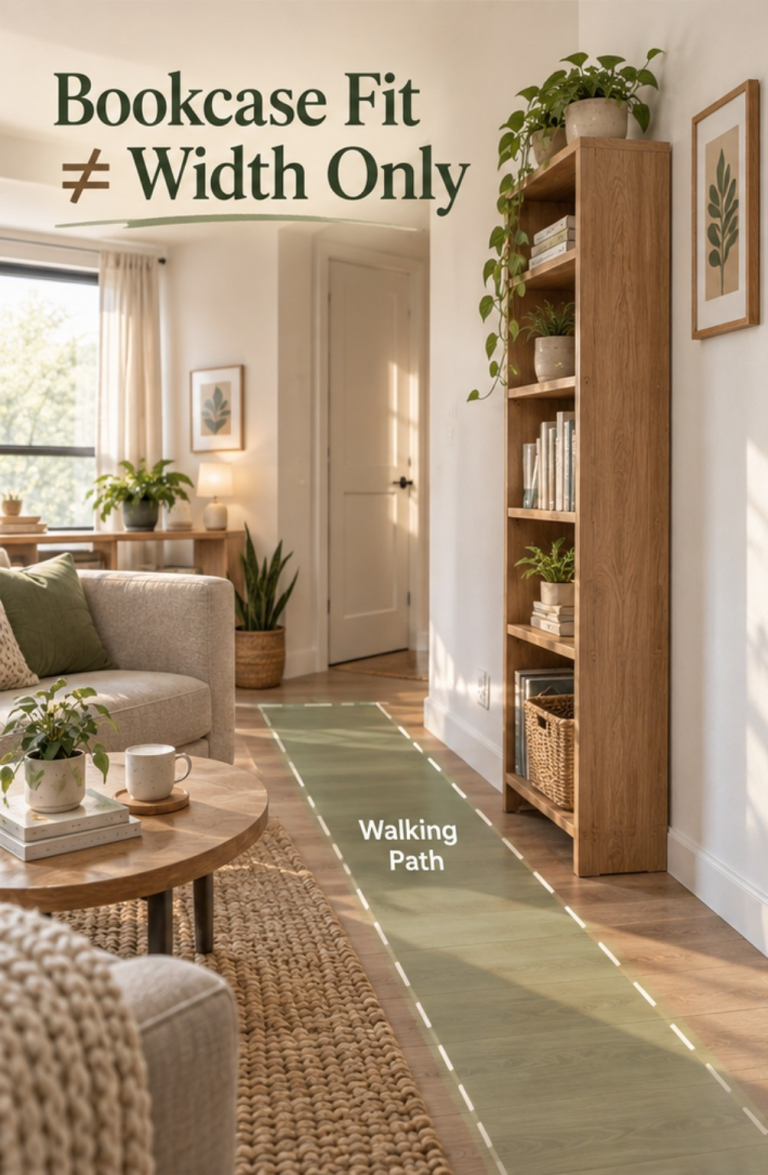
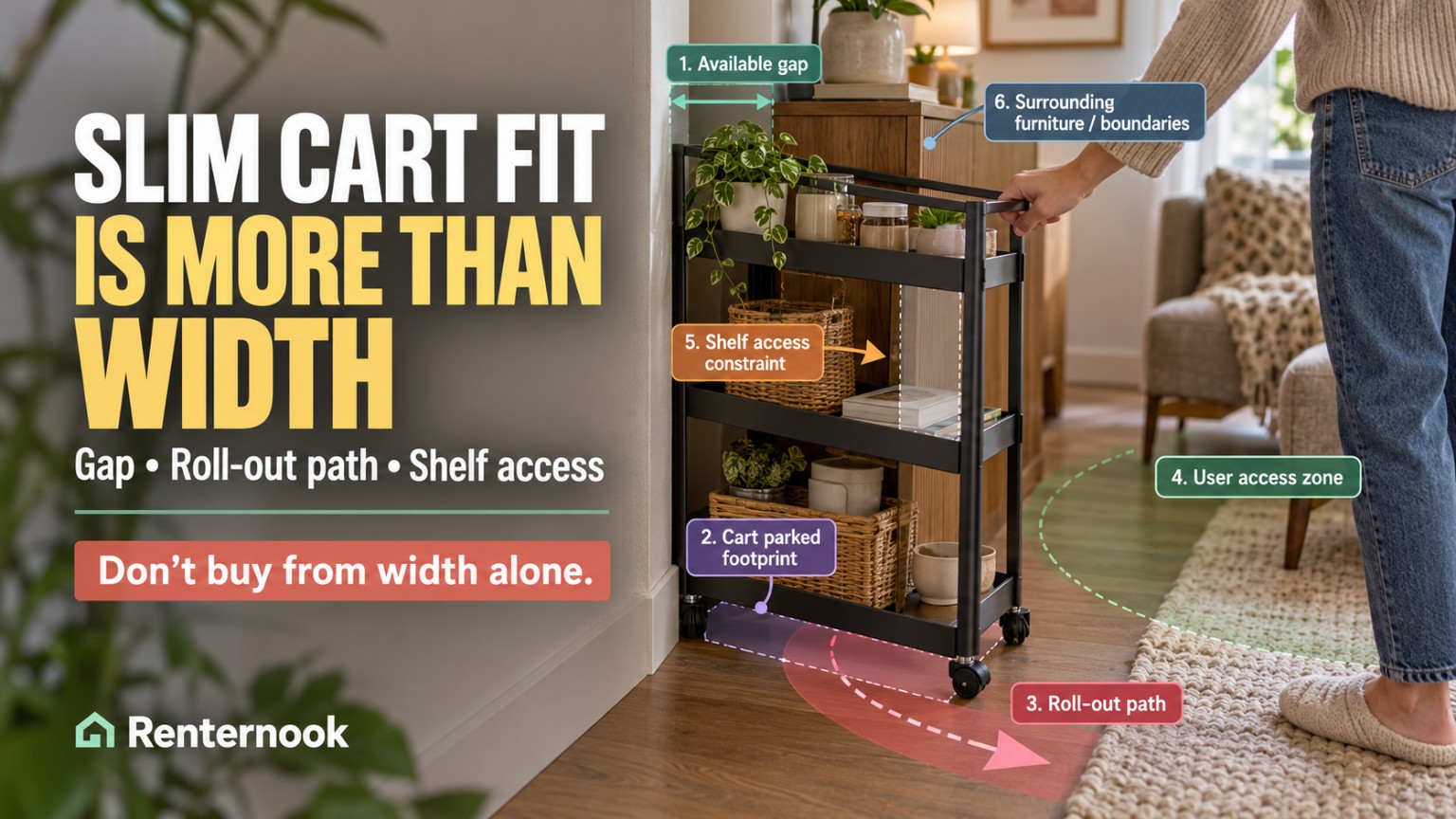
Slim Rolling Storage Carts for Narrow Spaces: Measure the Gap, Roll-Out Path, and Shelf Access Before You Buy
A slim rolling storage cart can look like an easy answer for an
awkward gap beside a cabinet, refrigerator, vanity, shelf, or other
fixed piece of furniture. The product page may show a narrow body, a few
shelves, and wheels. That can make the buying decision look simple:
measure the gap, compare one published width or depth, and choose the
cart that seems to fit.
That is not enough.
A cart can fit the nominal gap and still fail in daily use. The
wheels may extend beyond the visible body. A handle or frame may need
more room than expected. The cart may slide into the gap but have no
usable roll-out path. It may clear the opening while empty but become
difficult to maneuver when loaded. The shelves may become hard to reach
when the cart is parked. A cross-traffic path, threshold, rug edge, or
uneven floor can change how practical the cart feels.
The better buying question is not simply, “Is this cart slim
enough?” It is:
Will the complete cart, in both its parked and moving states,
work in the real space where I plan to use it?
This guide uses four non-ranked product archetypes to show how to
make that decision:
- IKEA NISSAFORS 106.029.82 — ultra-slim metal gap
cart - IKEA VESKEN 004.712.22 — narrow-depth plastic
cart - IKEA RASKOG 905.917.67 — compact mobile storage
with lockable casters - Yamazaki Home Tower Slim Rolling Storage Cart / Open
3627 — extra-narrow pull-out storage with a handle
The goal is not to name one universal winner. Each product solves a
different kind of fit problem, and the right choice depends on your
actual gap, movement path, access needs, floor conditions, and load.
Why a Slim Cart
Can Still Fail a Narrow Space
A published width or depth describes only part of the fit
problem.
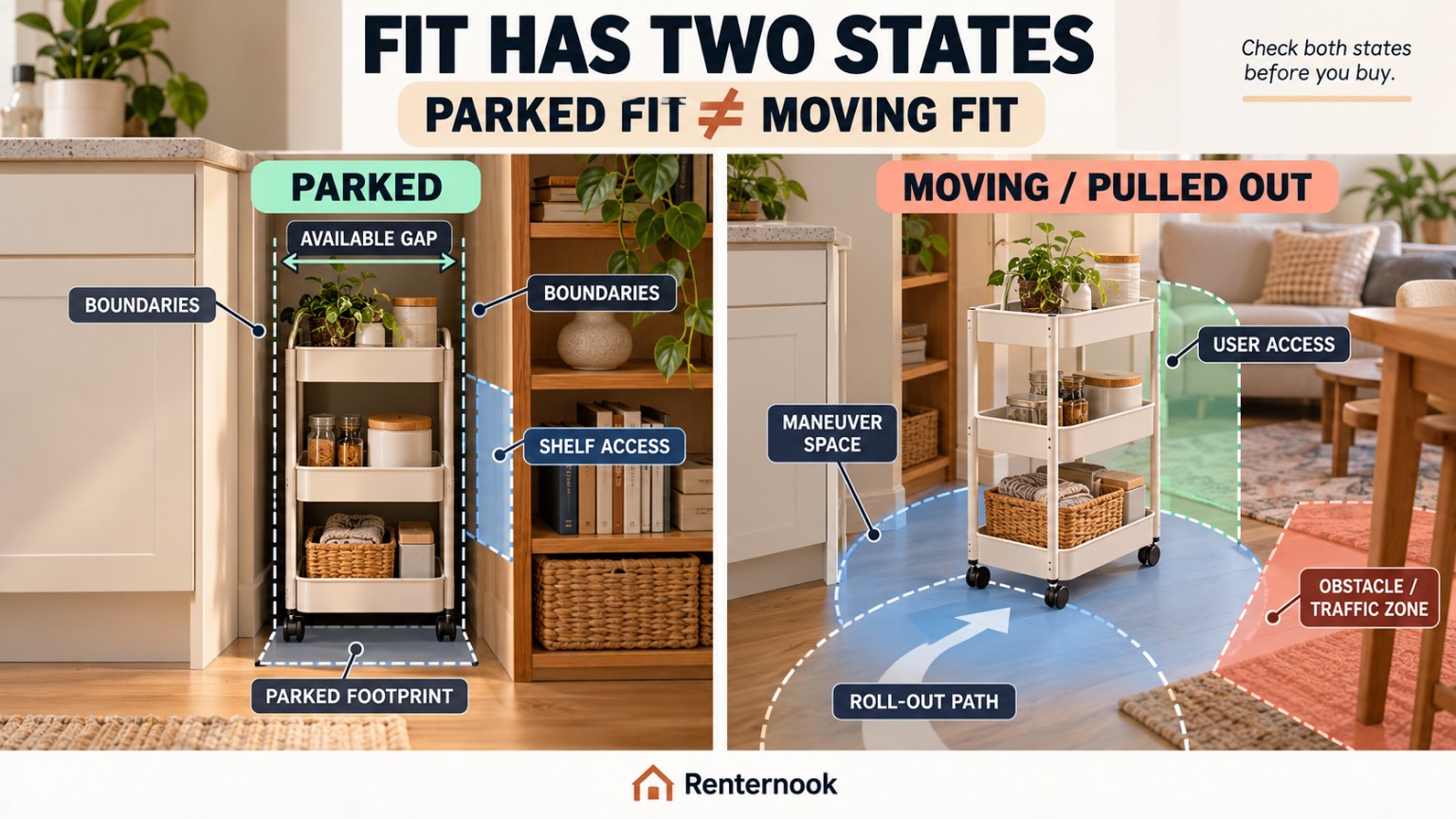
For a rolling cart, there are at least two states to evaluate:
- Parked state — where the cart sits when
stored. - Moving state — the space the cart uses while you
pull it out, steer it, turn it, reach the shelves, and push it
back.
A cart may pass the parked-state test and still fail the moving-state
test.
For example, a very narrow cart may fit beside a cabinet, but you may
not have enough room in front of it to pull it out far enough to reach
all three tiers. A wider cart may technically fit between two objects,
but wheel or frame protrusions could reduce your real clearance. A cart
with lockable casters may stay more controlled once parked, but that
does not prove that it will be stable on every surface or easy to move
when loaded.
The important distinction is this:
Nominal dimensions describe the product. Functional fit
describes the product interacting with your room.
That interaction is what you need to measure before buying.
What to Measure Before
Shopping
Before comparing carts, measure the real space instead of relying on
a single gap number.
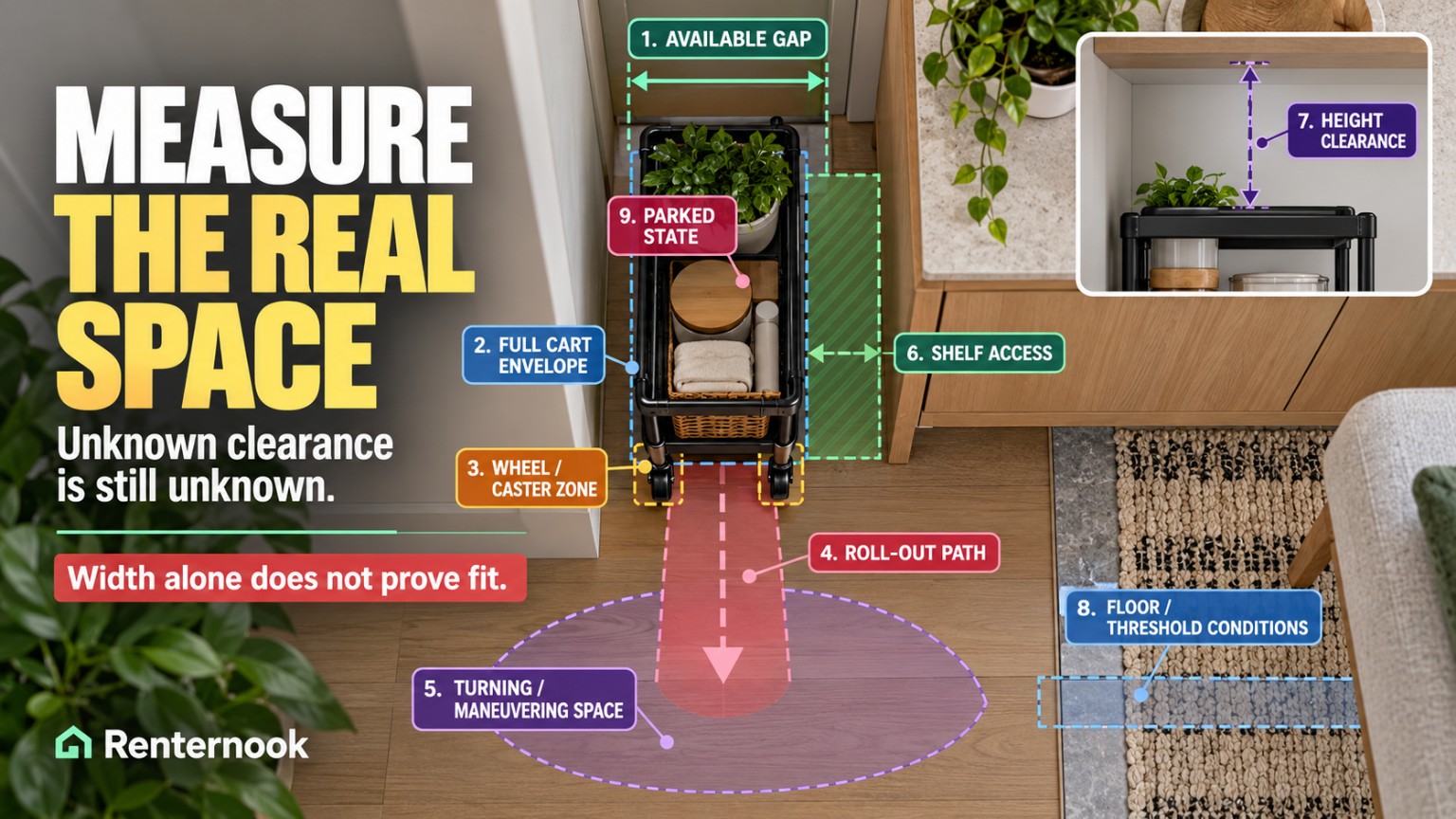
1. Available gap
Measure the narrowest usable opening where the cart will park. Check
the gap at several heights if nearby furniture, trim, handles,
baseboards, pipes, or other protrusions could narrow the opening.
Do not assume the gap is perfectly rectangular.
2. Full cart envelope
Compare the available gap with the complete published cart
dimensions, not only the number that looks most favorable.
Also remember that the true maximum external footprint including
wheels, casters, or small protrusions is not verified for every product
in this comparison. If your tolerance is tight, treat that missing
information as unknown, not as zero clearance.
3. Wheel or caster footprint
Wheels determine more than mobility. Their position can affect the
effective footprint and how the cart tracks through a narrow
opening.
For all four products in this guide, the true maximum external
footprint including wheel or caster protrusion is not fully established
from the reviewed first-party sources. If the fit is close, verify the current
product information or measure the assembled cart before relying on
millimeter-level clearance.
4. Roll-out path
Measure the clear distance in front of the storage gap.
Ask:
- How far must the cart come out before the shelves are usable?
- Is a door, appliance, cabinet, toilet, bed, desk, or other furniture
in the path? - Will people need to walk through the same space?
- Can the cart be returned to its parked position without an awkward
steering maneuver?
The minimum roll-out clearance is product- and room-specific and is
not established by the published dimensions alone.
5. Turning and maneuvering
space
A cart that moves only forward and backward needs less maneuvering
room than one you expect to rotate or steer around furniture.
The turning radius for the products in this guide is not published in
the reviewed first-party evidence. If your intended route includes a corner, doorway,
offset opening, or direction change, treat turning space as a separate
measurement.
6. Shelf access
A cart can physically occupy a narrow gap while still being
inconvenient to use.
Ask whether you can reach the top, middle, and bottom storage areas
in the parked position. If not, determine how far the cart must move
before the contents become accessible.
Actual shelf access while parked is buyer-specific and should be
tested against the surrounding furniture and stored items.
7. Height clearance
Check the full vertical zone, especially under counters, shelves,
rails, wall-mounted fixtures, or sloped surfaces.
Published height is useful, but your available overhead clearance
must include any obstruction above the cart and any object you plan to
store on the top tier.
8. Load
Use the manufacturer’s published load limits rather than estimating
from appearance.
A narrow steel cart may look more robust than a plastic cart, but the
useful question is not how strong it looks. The useful question is what
load the manufacturer actually publishes and whether that limit suits
what you plan to store.
9. Floor conditions
Hard flooring, rugs, carpet, grout lines, thresholds, and uneven
transitions can change how a cart rolls.
Carpet rollability and threshold clearance are not verified for the
four products compared in this guide. If your route crosses a threshold or soft surface,
that remains an open fit question.
10. Parked state
Finally, evaluate how the cart behaves when you are not moving
it.
Ask:
- Does it protrude into a walkway?
- Can the shelves be accessed without pulling it out?
- Will the cart be frequently bumped?
- Do you need locking casters?
- Is the cart’s parked orientation compatible with the way you load
and unload it?
A product that fits only when perfectly aligned may still be
frustrating in everyday use.
Four Slim
Rolling Storage Cart Archetypes Compared
This comparison is intentionally non-ranked. The products represent
different approaches to narrow-space storage rather than a best-to-worst
list.
| Product | Fit role | Published size | Material | Mobility / caster facts | Published load information |
|---|---|---|---|---|---|
| IKEA NISSAFORS 106.029.82 | Ultra-slim metal gap cart | 19 7/8 in L × 7 1/2 in W × 26 3/8 in H | Steel with powder coating | Manufacturer description states 2 casters; locking casters not stated |
26 lb total; 9 lb per tier |
| IKEA VESKEN 004.712.22 | Narrow-depth plastic cart | 21 1/4 in W × 7 1/8 in D × 28 in H | Polypropylene plastic | 4 casters; locking casters not stated | 13 lb total; per-tier limit unknown |
| IKEA RASKOG 905.917.67 | Compact mobile storage with lockable casters | 11 in L × 15 in W × 24 in H | Steel with epoxy powder coating | 4 lockable casters | 26 lb total; 9 lb per tier |
| Yamazaki Home Tower Slim Rolling Storage Cart / Open 3627 |
Extra-narrow pull-out storage with handle | 5.12 in published width; 31.69 in published height; first-party length figures conflict |
Steel | Wheels and handle stated; caster lock not verified | Top shelf 4.4 lb; top board 2.2 lb; middle 6.6 lb; bottom 13.2 lb; do not assume a total |
Important note on the
Yamazaki length
The current first-party source set presents two different length
figures for Product 3627:
- The product page publishes 18.7 in.
- A dimension image shows 17.63 in.
This guide does not choose one value, average them, or infer which is
correct. If the cart’s length is material to your installation, verify
the current first-party product page and dimension information before
purchase.
R1: IKEA
NISSAFORS 106.029.82 — Ultra-Slim Metal Gap Cart
The NISSAFORS slim version is the clearest fit archetype when your
primary constraint is a narrow lateral gap and you want a metal
three-tier cart.
Manufacturer-published facts
- Variant: black, slim version
- Material: steel with powder coating
- Published dimensions: 19 7/8 in length × 7 1/2 in width × 26
3/8 in height - Tiers: 3
- Casters: 2 according to the manufacturer description
- Maximum load: 26 lb total
- Load per tier: 9 lb
- Locking casters: not stated in the reviewed first-party sources
Fit questions to answer
before buying
Is 7 1/2 inches really enough clearance?
Do not use 7 1/2 inches as a guaranteed minimum gap. The published
width is useful, but the true maximum external footprint including any
wheel or frame protrusion is not verified here. If your opening is only
slightly wider, verify the current assembled footprint.
Can the cart come out far enough to use all three
tiers?
A narrow body does not prove easy shelf access. Measure the path in
front of the cart and decide whether you expect to access it while
parked or only after pulling it out.
Does the load match what you plan to store?
The published 26 lb total and 9 lb per tier are more useful than
guessing from the steel construction. If you need to store dense or
heavy items, compare your expected load with those published limits.
Will it stay where you want it?
Locking casters are not stated in the reviewed first-party evidence. If a wheel
lock is essential to your parked-state workflow, verify that feature
before purchase rather than assuming it is present.
Best use-case role
Choose this archetype when the main decision is how to use a
very narrow gap with a metal cart while staying within published load
limits. It is not automatically the best cart for carpet,
thresholds, tight turns, or every narrow opening.
R2: IKEA
VESKEN 004.712.22 — Narrow-Depth Plastic Cart
VESKEN represents a different narrow-space strategy: a shallow
plastic cart with three tiers and four casters.
Manufacturer-published facts
- Variant: white
- Material: polypropylene plastic
- Published dimensions: 21 1/4 in width × 7 1/8 in depth × 28
in height - Tiers: 3
- Casters: 4
- Maximum load: 13 lb total
- Per-tier load: unknown in the reviewed first-party sources
- Assembly: clicks together without tools
- Shelf features: high edges and drainage holes
- Locking casters: not stated
Fit questions to answer
before buying
Is your narrow dimension aligned with the cart’s 7 1/8-inch
depth?
This matters because buyers often compare the smallest published
number with the wrong room dimension. Your gap geometry needs to match
the cart’s actual orientation.
Do you need a lighter-duty storage role?
The only supported reason to describe VESKEN as lighter-duty in this
comparison is its published 13 lb total load limit,
which is lower than the published 26 lb total limits for NISSAFORS and
RASKOG. That does not mean it is lower quality or unsuitable in
general.
Will high shelf edges help or hinder access?
High edges can help contain items, but they may affect how easily you
reach objects from the side, especially when the cart is parked in a
tight gap. Test your intended access direction.
Do your floor conditions suit the cart?
Four casters confirm mobility hardware, but they do not prove easy
rolling on carpet, over thresholds, or across uneven flooring. Those
conditions remain unverified.
Best use-case role
Choose this archetype when you want narrow-depth plastic
storage and the published 13 lb total load is sufficient for your
intended contents. Do not infer universal floor compatibility
or parked stability from the caster count.
R3:
IKEA RASKOG 905.917.67 — Compact Mobile Storage With Lockable
Casters
The smaller RASKOG is less about an ultra-thin gap and more about
compact mobile storage where lockable casters are part of the published
feature set.
Manufacturer-published facts
- Variant: beige-yellow, small size
- Material: steel with epoxy powder coating
- Published dimensions: 11 in length × 15 in width × 24 in
height - Tiers: 3
- Casters: 4, lockable
- Maximum load: 26 lb total
- Load per tier: 9 lb
Fit questions to answer
before buying
Is your space narrow in the correct direction?
At 11 by 15 inches, RASKOG has a different footprint geometry from
the ultra-slim NISSAFORS and extra-narrow Yamazaki cart. Do not compare
only one dimension. Sketch the whole footprint inside your real
space.
Do the lockable casters solve your parked-state
need?
They may be useful if you want to limit rolling after positioning the
cart, but a caster lock does not prove universal stability, resistance
to tipping, or suitability for every floor.
Can you steer the cart where you need it to go?
The turning radius and loaded maneuverability are unknown. If the
route includes a tight turn or narrow doorway, measure the path rather
than assuming four casters guarantee easy steering.
Does the load match your intended use?
The published limits are 26 lb total and 9 lb per tier. Stay within
the manufacturer’s published limits and distribute your own stored items
accordingly.
Best use-case role
Choose this archetype when your priority is compact mobile
storage with a published lockable-caster feature, and your
space can accommodate its full 11-by-15-inch footprint. Do not treat the
locks as proof of universal safety or stability.
R4:
Yamazaki Home Tower Slim Rolling Storage Cart / Open 3627 — Extra-Narrow
Pull-Out Storage With a Handle
The Yamazaki cart is the extra-narrow archetype in this set. Its
published width is 5.12 inches, and it includes wheels
and a handle, which makes it especially relevant to pull-out storage in
a tight gap.
Manufacturer-published facts
- Product number: 3627
- Variant: white
- Material: steel
- Published width: 5.12 in
- Published height: 31.69 in
- Wheels: yes
- Handle: yes
- Caster lock: not verified
- Published load capacities:
- Top shelf: 4.4 lb
- Top board: 2.2 lb
- Middle: 6.6 lb
- Bottom: 13.2 lb
- Total load: do not assume
The length figure is
unresolved
The first-party evidence is internally inconsistent:
- Product page: 18.7 in
- Dimension image: 17.63 in
Because those values conflict, this article does not present either
one as definitive.
If your space depends on the cart’s length, verify the current
product page, current dimension image, or assembled product before
purchase. A one-inch discrepancy can matter in a tight pull-out
path.
Fit questions to answer
before buying
Is 5.12 inches enough information?
No. It describes the published width, but not the true maximum
envelope including every wheel or protrusion. If your gap is close to
that figure, maintain a margin and verify the current product
dimensions.
Will the handle help your actual pull-out
motion?
A handle supports the pull-out use case, but you still need a clear
path in front of the cart. Check where your hand will go, how far the
cart must move, and whether another object blocks the extraction
path.
Can you reach the stored items after pulling the cart
out?
The extra-narrow body may suit a gap that other carts cannot use, but
shelf access still depends on the surrounding furniture and how far the
cart can travel.
How should you interpret the load limits?
Use the published section-by-section limits above. Do not add them
together and present the result as a manufacturer-published total unless
the manufacturer explicitly does so.
Best use-case role
Choose this archetype when your main problem is an
extra-narrow pull-out gap and you value a handle for
extraction. It is not a universal solution for tight turns,
carpet, uneven flooring, or every heavy-storage need.
Common Buying Mistakes
Mistake
1: Comparing only the smallest published number
A product may advertise or prominently display a narrow width or
depth, but your room must fit the whole cart in the intended
orientation.
Mistake 2:
Treating the gap as the only space requirement
The parked gap is only one part of the system. Rolling carts also
need a movement path and, sometimes, turning space.
Mistake 3: Ignoring
wheels and protrusions
If the published body size leaves only a tiny amount of clearance,
unverified wheel or frame protrusion becomes material. Unknown external
footprint should remain unknown until verified.
Mistake
4: Assuming four casters means easy maneuverability
Caster count does not establish turning radius, threshold
performance, carpet performance, or loaded maneuverability.
Mistake
5: Assuming locking casters guarantee stability
Locking casters are a useful feature on RASKOG, but they do not prove
that the cart cannot tip, shift, or behave differently on another
floor.
Mistake 6: Ignoring shelf
access
A cart that must be pulled fully into a walkway every time you need
an item may be technically compatible but operationally
inconvenient.
Mistake 7:
Estimating load capacity from material
Steel does not automatically mean unlimited load. Plastic does not
automatically mean inadequate load. Use the manufacturer’s published
limits.
Mistake
8: Adding separate Yamazaki shelf limits into an assumed total
The reviewed first-party sources provides section-specific limits for Product
3627. It does not establish a manufacturer-published total load. Keep
those facts separate.
Mistake
9: Resolving conflicting measurements yourself
When first-party information conflicts, as it does for the Yamazaki
cart’s length, do not average the numbers or choose whichever one fits
your space. Verify the current source before purchase.
How to Measure the Real
Space
A simple measurement worksheet is more useful than a single gap
number.
Step 1: Draw the parked
footprint
On paper, sketch the narrow space from above. Record:
- opening width
- usable depth
- wall or furniture projections
- baseboards
- handles
- pipes or trim
- nearby doors or drawers
Step 2: Mark the full cart
envelope
Use the published dimensions in the orientation you actually intend
to use. Do not rotate dimensions mentally without sketching them.
If wheel or protrusion envelope is unknown, mark that uncertainty
rather than treating the body dimensions as the absolute maximum.
Step 3: Draw the roll-out
path
Extend the cart footprint outward from the parked position.
Mark anything the cart or your body could encounter:
- opposite furniture
- appliance doors
- room doors
- cabinet doors
- toilets or vanities
- beds
- chairs
- wall corners
- traffic paths
Step 4: Add the access zone
Ask how you will remove items from each tier.
Do you need to stand beside the cart? In front of it? Can you reach
the bottom tier while it is partially extended? Does the top tier remain
usable under a counter or shelf?
Step 5: Add floor transitions
Mark rugs, threshold strips, tile edges, floor transitions, or uneven
surfaces on the route. These are not automatically disqualifying, but
their effect on rollability is not established by the reviewed first-party
product data.
Step 6: Add the load plan
Write down what you expect to store and compare that plan with the
published load limits.
Do not rely on visual impressions of strength.
Step 7: Keep unknowns visible
If you cannot verify turning radius, wheel protrusion, loaded
maneuverability, or threshold clearance, label those items
unknown.
Unknown does not mean the cart will fail. It means the decision needs
another measurement, a current manufacturer check, or a real-world test
before you can treat the fit as confirmed.
Which
Product Role Matches Which Type of Uncertainty?
This is a better way to use the four products than ranking them.
If
your main uncertainty is an extremely narrow lateral gap
Start by comparing the Yamazaki Tower Slim Rolling Storage
Cart / Open and IKEA NISSAFORS slim version
with your actual opening.
The Yamazaki has the narrower published width at 5.12 inches, while
NISSAFORS publishes a 7 1/2-inch width. But neither figure alone proves
real-world clearance because the maximum wheel or protrusion envelope is
not established here.
If
your main uncertainty is shallow depth and lower published load
needs
The IKEA VESKEN archetype is relevant because its
published depth is 7 1/8 inches and its total published load is 13
lb.
Use that role only if the load and orientation match your use
case.
If
your main uncertainty is controlling movement after parking
The IKEA RASKOG is the only product in this comparison
with lockable casters explicitly stated.
That feature may matter for your workflow, but it does not replace a
stability assessment or prove compatibility with every floor.
If
your main uncertainty is pulling a cart out of a very tight gap
The Yamazaki cart’s handle supports a pull-out role.
The important test is whether the complete cart can travel through the
available path and whether you have enough room to access its storage
areas once extended.
If
your main uncertainty is load within a narrow metal format
The IKEA NISSAFORS combines a 7 1/2-inch published
width with a published 26 lb total load and 9 lb per tier.
That makes it a useful comparison point when both narrow storage and
published load limits matter.
A Fit-First Decision Rule
Before buying any slim rolling storage cart, confirm four things in
order:
1. It fits while parked
The full cart envelope must fit the real gap, not just the most
attractive published dimension.
2. It can move through the
real path
You need enough roll-out and maneuvering space for the way you will
actually use it.
3. You can access the storage
A cart that cannot be reached comfortably in either the parked or
extended state may solve the wrong problem.
4.
Its published load and mobility features match your use
Use manufacturer-stated limits and features. Do not infer wheel
performance, stability, or load capacity from appearance.
If any fit-critical point remains unknown, keep it unknown until you
verify it.
That is the core rule for buying a slim rolling storage cart for a
narrow space:
Do not buy from the width alone. Buy from the complete
parked-and-moving system.
Sources and Methodology
This guide uses first-party product information from:
- IKEA US — NISSAFORS, article 106.029.82
- IKEA US — VESKEN, article 004.712.22
- IKEA US — RASKOG, article 905.917.67
- Yamazaki Home US — Tower Slim Rolling Storage Cart / Open, product
3627
The four products are used as non-ranked fit archetypes. Product details are limited to the first-party sources reviewed for this guide. Where those sources do not establish a fact, this guide keeps it unknown rather than inferring an answer.
Evidence boundaries
The following remain unknown or buyer-specific for all four products
unless explicitly stated otherwise:
- true maximum external footprint including wheels or protrusions
- caster protrusion
- turning radius
- minimum roll-out clearance
- carpet rollability
- threshold clearance
- loaded maneuverability
- tip resistance
- actual shelf access while parked
For Yamazaki product 3627, the conflicting first-party length figures
of 18.7 inches and 17.63 inches remain unresolved. Neither figure is
used as a definitive fit guarantee.
This article does not claim universal narrow-gap fit, universal floor
compatibility, guaranteed tip resistance, universal maneuverability,
universal shelf access, automatic renter safety, or a universally best
product.