Room Dividers for Small Apartments: Check the Full Deployed Fit Before You Buy
A room divider can look like one of the simplest ways to change a small apartment. Put a screen between the bed and living area, hang a curtain to separate a work zone, or use shelving to create a visual boundary.
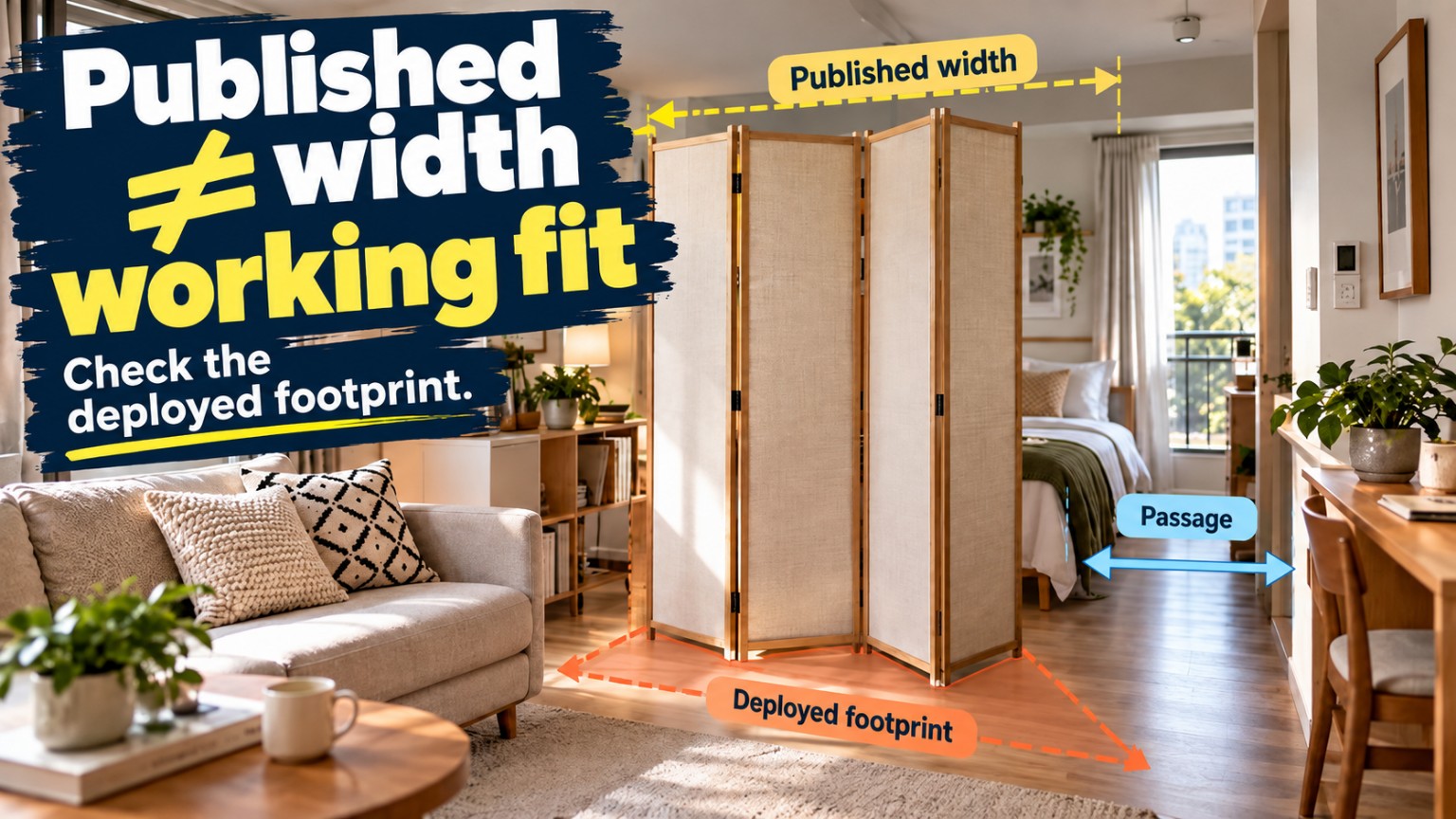
The difficult part is that published width is not the same thing as working fit.
A folding screen may need to stand at an angle instead of forming a perfectly flat line. A floor-to-ceiling tension rod depends on the ceiling and floor surfaces where the vertical poles will press. A ceiling-track system needs an installation route above the space. A shelving divider adds real body depth, storage access, and an anchoring requirement.
That is the central Fit-First rule for this category:
Published width != stable deployed footprint != passage fit != installation fit != folded / stored fit.
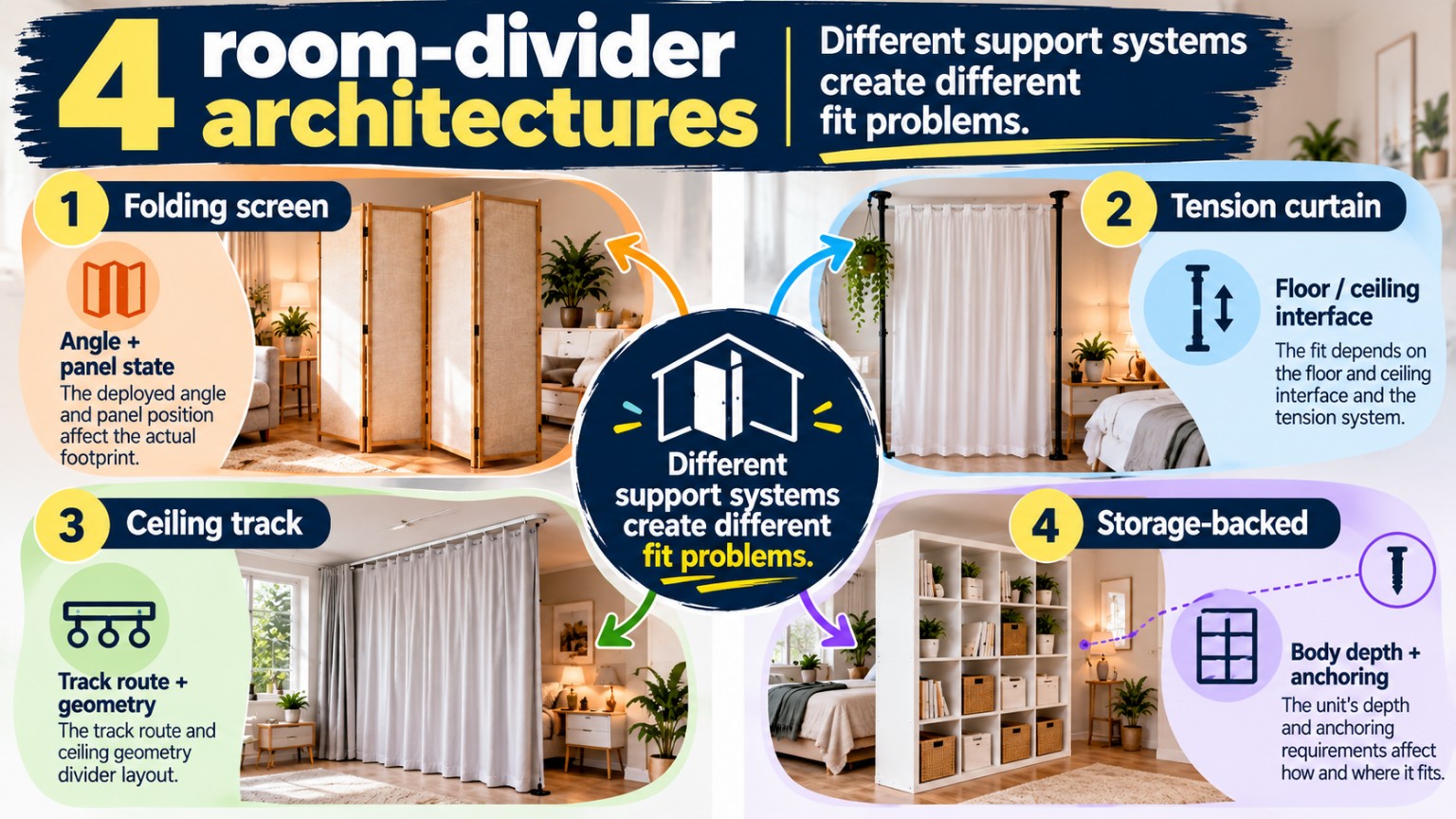
This guide compares four non-ranked room-divider architectures:
- IKEA GLAMBERGET 805.647.45 — folding freestanding screen.
- Costway room divider curtain rod, black, 28–72 in wide and 4–10 ft high — floor-to-ceiling tension curtain divider.
- IKEA VIDGA 194.282.43 — ceiling-track curtain divider for a corner.
- IKEA KALLAX 603.518.82, white, 147 × 147 cm — storage-backed divider.
The purpose is not to name a winner. It is to show why four products that can all divide a room create four different fit and installation problems.
Start With the Divider Architecture, Not Just the Width
Before choosing a room divider for a small apartment, decide what kind of boundary you are actually creating.
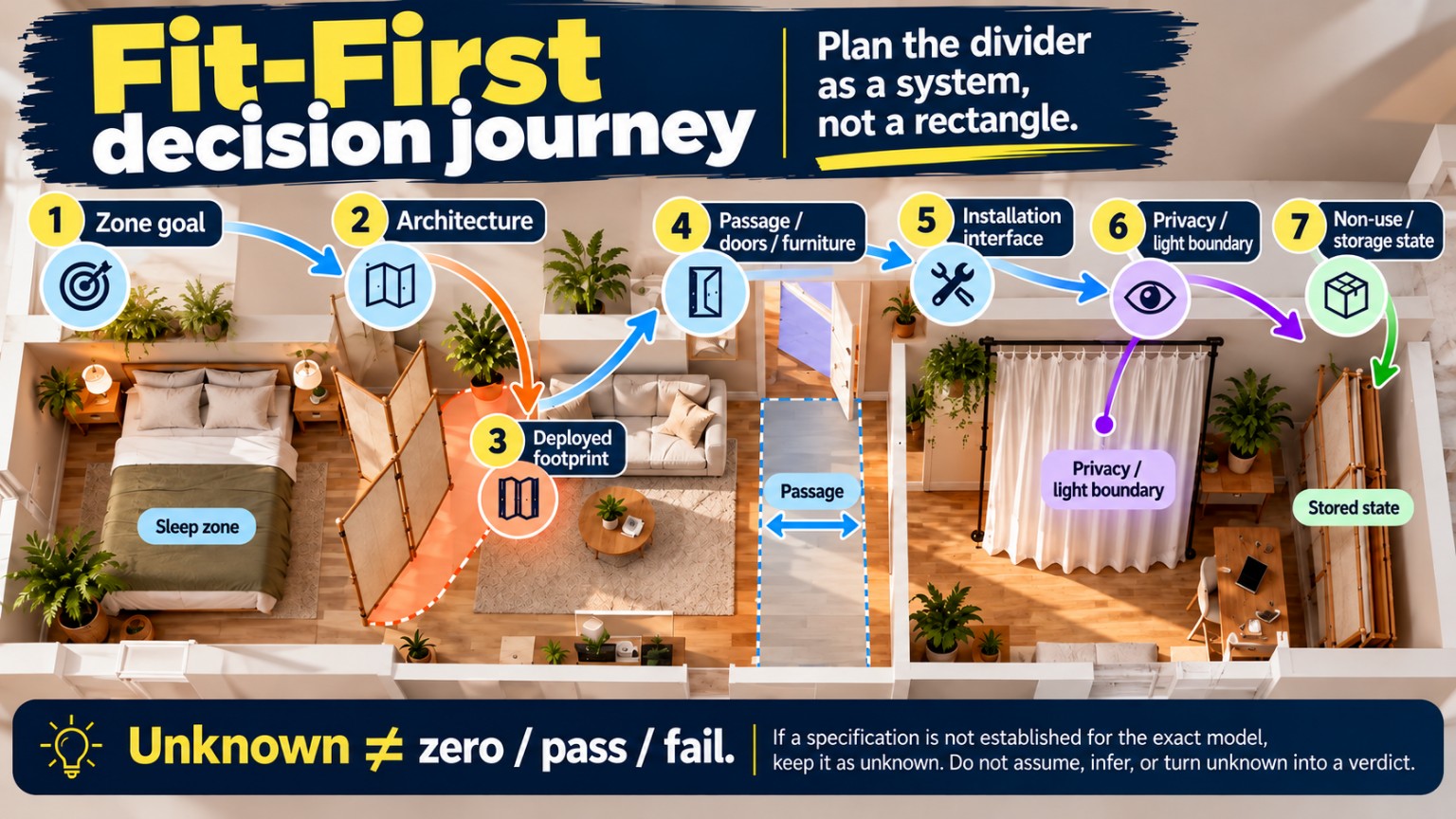
A useful sequence is:
- Define the zone you want to separate.
- Choose the divider architecture.
- Check the published body or adjustment range.
- Check the real deployed state: angle, base, tension points, track route, or shelf depth.
- Check the remaining passage and nearby furniture.
- Check the installation interface.
- Check what provides the visual/privacy layer.
- Check the folded, removed, or stored state where applicable.
- Preserve every unsupported field as unknown.
The four locked products below are useful because each one exposes a different failure mode.
Four Room-Divider Architectures Compared
| Product | Role | Published size / range | Installation or support state | Working-fit issue | Material unknowns |
|---|---|---|---|---|---|
| IKEA GLAMBERGET 805.647.45 | Folding freestanding screen | 150 cm W × 150 cm H | Freestanding; 3 panels, 4 poles, adjustable feet, variable panel angles | The screen’s published width does not establish the floor depth or stable footprint at the angle you use | Exact deployed depth, minimum stable angle, exact folded size, product net weight, quantified privacy/light performance |
| Costway tension divider, black, 28–72 in | Floor-to-ceiling tension curtain divider | 28–72 in W × 4–10 ft H | Concealed spring-lock tension system with non-slip pads; no drilling required for this exact product | Floor/ceiling contact points and curtain choice become part of the working system | Pad footprint, passage clearance, stored/disassembled size, quantified privacy/light performance |
| IKEA VIDGA 194.282.43 | Ceiling-track curtain divider for corner | 3 × 140 cm single track rails plus corner piece | Ceiling fittings and screw fixing; track can be cut or extended | Track length is not the same thing as the final usable divider width or curtain envelope | Final deployed span, complete-system load, curtain stack depth, privacy/light performance |
| IKEA KALLAX 603.518.82 | Storage-backed divider | 147 cm W × 39 cm D × 146.5 cm H | Shelving body; secure anchoring required | The 39 cm body depth, shelf use, circulation, and anchoring all remain part of the room plan | Exact center-room anchoring solution, net product weight, renter permission, full privacy/light blocking |
Several boundaries should stay visible from the beginning.
Visual division is not soundproofing. None of these products should be treated as a verified acoustic isolation system.
Published width is not automatically the stable footprint. That is especially important for folding screens and any divider whose working geometry changes when deployed.
Curtain systems do not create a fixed privacy or light-blocking result by themselves. The fabric or curtain choice materially affects what the finished divider does.
And unknown is not zero. If the source does not establish a required dimension or performance field, this guide leaves it unknown.
1. IKEA GLAMBERGET: Folding Freestanding Screen
The IKEA GLAMBERGET room divider, Article 805.647.45, is published at 150 cm wide by 150 cm high.
IKEA describes the divider as three panels with four poles that can be positioned in different ways. Adjustable feet support use at different angles, and the screen can be folded and put away.
That makes GLAMBERGET the clearest example of why a single width number is not enough.
The width is not the floor plan
A folding screen normally creates its support geometry by changing the angle between panels. When those panels are no longer in one perfectly straight line, the real floor footprint changes.
The evidence used here does not establish:
- the exact deployed depth at a given angle;
- a minimum stable angle;
- one universal stable footprint;
- the exact folded dimensions;
- the product’s net weight.
So the safe decision is not to convert 150 cm of published width into a guaranteed 150 cm straight divider line with zero depth.
Instead, treat the room as a floor-plan problem.
Mark the zone you want to separate. Then allow for the screen to create some depth as the panels change angle. Keep the door swing, bed edge, sofa, desk chair, and main walking path visible in that plan.
The freestanding role reduces one installation interface, not every constraint
GLAMBERGET does not depend on a ceiling track or a floor-to-ceiling tension rod. That makes its installation architecture different from the two curtain systems in this guide.
But freestanding does not mean universally stable in every configuration.
The product evidence supports adjustable feet and different panel angles. It does not establish a universal stable angle or a universal floor condition that guarantees the same behavior everywhere.
Privacy and light remain bounded claims
The fabric panels create visual separation, but this guide does not assign a quantified privacy level, light-blocking level, or soundproofing performance to the screen.
If visual separation is the main goal, the product role is relevant. If the real goal is acoustic isolation, this evidence does not establish that outcome.
2. Costway: Floor-to-Ceiling Tension Curtain Divider
The locked Costway product is the black 28–72-inch-wide, 4–10-foot-high room divider curtain rod with an adjustable floor-to-ceiling tension system.
The exact first-party product page describes:
- adjustable width from 28 to 72 inches;
- adjustable height from 4 to 10 feet;
- a concealed spring-lock tension system;
- non-slip rubber pads;
- locking buckles;
- no drilling required for this exact product;
- a published 45 lb load capacity per rod;
- a published 6.5 lb net weight;
- compatibility statements covering plaster or wood ceilings and wood, marble, tile, or concrete floors;
- tool-free assembly;
- disassembly for reuse;
- curtains not included.
This is a different architecture from a freestanding screen because the divider depends on the floor-to-ceiling interface.
No-drill is an exact-product claim, not a lease guarantee
The Costway product is explicitly marketed as a no-drill tension system.
That claim belongs only to this exact product architecture.
It does not establish:
- zero chance of marks or surface effects;
- compatibility with every ceiling or floor finish;
- universal approval under a lease;
- universal renter-safe status.
A no-drill installation method and a lease-safe installation outcome are not the same claim.
The adjustment range is not the whole installation test
The 28–72-inch width and 4–10-foot height ranges help answer whether the rod system can physically span the intended zone.
They do not answer every working-fit question.
The evidence used here does not establish the exact footprint of the top or bottom pads, a universal side-clearance requirement, or the exact stored size after disassembly.
So the Fit-First check should include:
- the floor-to-ceiling height where each vertical pole will stand;
- the surface materials at those contact points;
- the width you want the horizontal rod to cover;
- the curtain weight relative to the product’s documented limit;
- the remaining walking path;
- the curtain’s own sweep, stack, or overlap behavior.
The curtain determines much of the finished visual result
The curtain is not included.
That matters because the rod system alone does not establish the final privacy or light-blocking behavior. A sheer curtain, blackout curtain, or another fabric can create very different visual and light conditions.
So the product can be compared as a support architecture, while privacy and light performance remain curtain-dependent.
3. IKEA VIDGA: Ceiling-Track Curtain Divider for a Corner
IKEA VIDGA Article 194.282.43 is a different kind of divider again.
The package includes:
- three 140 cm single track rails;
- ceiling fittings;
- a corner piece;
- gliders and hooks.
IKEA states that the track can be cut to the desired length and extended with connectors. The system is designed so a ceiling-mounted route can navigate around a corner.
Track length is not the final divider width
Three 140 cm rails do not automatically equal one verified final divider width.
The final geometry depends on:
- where the rails run;
- how much is cut;
- how the corner is configured;
- whether the system is extended;
- the curtain arrangement.
So this guide does not add the rail lengths together and present the result as a guaranteed usable divider span.
Track length != final divider width.
This is an installation-route decision
Unlike GLAMBERGET, VIDGA depends on the ceiling route.
The exact product evidence establishes ceiling fittings and screw fixing. It should therefore not be described as drill-free.
Before choosing this architecture, check the full route above the room:
- Where will the rails run?
- Is the intended ceiling interface suitable for the required fixing method?
- Does the route conflict with lights, vents, beams, or other ceiling elements?
- Does the corner geometry create the separation you actually want?
- Where will the curtain stack when open?
The exact curtain-stack depth and final deployed curtain envelope remain unknown in this evidence set.
Curtain choice still controls privacy and light
VIDGA provides the track, corner hardware, gliders, and hooks. The curtain or fabric is separate.
That means the track architecture should not be assigned one universal privacy or light-blocking performance.
The rail controls the route. The selected curtain materially affects the visual boundary.
4. IKEA KALLAX: Storage-Backed Divider
The white IKEA KALLAX shelving unit, Article 603.518.82, measures:
- 147 cm wide;
- 39 cm deep;
- 146.5 cm high;
- 13 kg maximum load per shelf.
IKEA explicitly presents the shelving unit as something that can also be used as a room divider.
This architecture is very different from the first three because the divider is also storage furniture.
Body depth becomes permanent floor-plan depth
The KALLAX body has a published depth of 39 cm.
Unlike a curtain line, that depth occupies floor space continuously. It also creates two faces that may be accessed, styled, or fitted with inserts depending on the configuration.
For a small apartment, that means the divider decision should include:
- the 39 cm body depth;
- the room left for circulation on each side;
- shelf access;
- nearby furniture;
- the visual effect of open or filled cubbies;
- the anchoring plan.
Anchoring is not optional in the product evidence
IKEA’s safety guidance states that this product must be securely anchored.
That means KALLAX should not be presented in this guide as an unqualified freestanding divider that can simply be placed anywhere without an anchoring decision.
The exact center-room anchoring solution is not established by the evidence used here. Renter permission is also not established.
So if the user cannot make the required anchoring work in the intended location, that is not a minor afterthought. It is part of the product’s installation fit.
Storage-backed does not mean full privacy
KALLAX can create a substantial visual boundary, especially when shelves or inserts are used, but the product evidence does not establish complete visual privacy or quantified light blocking.
An open shelving divider and a fabric curtain divider solve different problems.
Published Width vs Stable Deployed Footprint
One of the easiest mistakes in this category is treating the product’s headline width as the complete space claim.
The four architectures show why that fails.
Folding screen
The panel angle changes the actual footprint. Published width does not prove the floor depth at the angle you will use.
Tension curtain rod
The span can be adjusted, but the installation depends on floor-to-ceiling contact points and the curtain itself.
Ceiling track
The rail route can be cut, extended, and turned around a corner. Track length is not one finished divider width.
Storage-backed shelving
The width matters, but the 39 cm body depth and anchoring requirement are equally real parts of the layout.
A better rule is:
Measure the deployed system, not just the headline dimension.
Passage Fit: The Divider Must Leave the Apartment Usable
A divider only works if the rest of the room still works.
Do not use one universal passage-clearance number for every apartment. The evidence set does not support one.
Instead, mark the real route people use.
Check:
- the main path from the entrance to the living area;
- access to the bed or sofa;
- desk-chair movement;
- cabinet and drawer opening;
- balcony or window access;
- door swing;
- the route to the bathroom or kitchen;
- any emergency or required egress that must remain unobstructed.
The useful question is not “Does the divider fit between these two walls?”
It is:
Can the divider create the zone I want without breaking the paths and furniture states I still need?
Installation Fit: Four Architectures, Four Interfaces
The products in this guide should not be treated as equivalent installation choices.
GLAMBERGET
Primary interface: floor placement and panel-angle geometry.
No wall or ceiling fixing is part of the locked role. But exact stability geometry remains unknown.
Costway tension rod
Primary interface: pressure between floor and ceiling surfaces.
No drilling is an exact-product claim. Surface compatibility and the real contact conditions still matter.
VIDGA
Primary interface: ceiling-mounted track route with screw fixing.
This is not a drill-free architecture.
KALLAX
Primary interface: furniture placement plus required secure anchoring.
The anchoring requirement belongs in the buying decision before the shelving unit is used as a divider.
This is why “room divider” is too broad to act as an installation category by itself.
Privacy, Light, and Sound: Keep the Claims Separate
A room divider can be useful without being a wall.
Three boundaries matter.
Visual separation
All four roles can create some kind of visual zone boundary, but the amount and direction of coverage depend on the product and configuration.
Light
Fabric choice, openness, panel material, shelf fill, and room placement can change how much light passes through or around the divider.
This guide does not assign one universal light-blocking score.
Sound
Visual divider != soundproofing.
None of these four products is treated here as a verified acoustic wall or sound-isolation system.
If sound control is the primary problem, that requires separate evidence and should not be inferred from the word “divider.”
Folded, Removed, or Stored State
Small-apartment products should be checked in both use and non-use states where those states exist.
GLAMBERGET is foldable, but the exact folded size is not established in the evidence used here.
The Costway tension system can be disassembled for reuse, but its exact stored dimensions are not established.
VIDGA is a fixed ceiling-track architecture once installed; its useful “open” state depends more on where the curtain stacks than on storing the track itself.
KALLAX is furniture rather than a temporary folding divider, so its body remains part of the room even when you are not actively using it as a visual separator.
Those are different storage states, and they should not be collapsed into a generic “easy to store” claim.
Which Architecture Matches the Problem?
Use the products as role examples rather than as a ranking.
Choose the folding-screen role when:
You want a divider that does not depend on a ceiling track or floor-to-ceiling tension setup, and you are willing to plan around panel-angle geometry and a variable deployed footprint.
Choose the tension-curtain role when:
You want a curtain-based boundary and the exact floor/ceiling surfaces and height work with the tension system. Treat the no-drill claim as exact-product evidence, not a universal lease guarantee.
Choose the ceiling-track role when:
You want the divider line to follow a ceiling route, including a corner, and you can support the required ceiling installation. Curtain selection remains a separate decision.
Choose the storage-backed role when:
You want the divider to perform a real storage function as well, and the 39 cm body depth, shelf access, circulation, and required anchoring all work in the room.
None of these roles is universally better. They solve different room-separation problems.
Fit-First Checklist Before You Buy
- Define the zone. Decide what is being separated and why.
- Choose the architecture. Folding screen, tension curtain, ceiling track, or storage-backed divider.
- Confirm the exact product. Do not merge specifications across similar listings or variants.
- Record published width, height, and depth where established.
- Map the real deployed footprint. Include angle, body depth, contact points, track route, or anchoring state.
- Keep the walking path visible. Do not use one universal clearance number.
- Check furniture states. Include doors, drawers, chairs, bed access, and other moving parts.
- Verify installation. Floor/ceiling surfaces, screw fixing, or anchoring requirements belong in the decision.
- Separate support hardware from privacy material. Curtain systems do not include one universal privacy result.
- Check the non-use state. Folded, disassembled, curtain-open, or permanent furniture state.
- Preserve unknowns. Do not back-calculate missing dimensions or assume renter-safe status.
- Recheck the complete room. The divider should improve zoning without making the apartment harder to use.
Claim and Unknown Boundary
Preserve these rules throughout the decision:
- Visual divider != soundproofing.
- Published width != stable deployed footprint.
- Foldable != known folded size.
- No-drill applies only to the exact Costway product in this set.
- No-drill != universally lease-safe.
- No-drill != guaranteed zero damage in every real installation.
- Freestanding != universally stable.
- Room divider != universal privacy.
- Curtain system != fixed privacy or light performance.
- Track length != final divider width.
- KALLAX must not be described as unqualified freestanding use when the product requires secure anchoring.
- No universal passage clearance is established here.
- Unknown != zero.
- Unknown != pass.
- Unknown != fail.
The purpose of these boundaries is not to penalize a product for an unpublished field. It is to stop the conclusion where the evidence stops.
Product Profiles: Why Each Role Is in the Set
IKEA GLAMBERGET 805.647.45
GLAMBERGET represents the folding freestanding architecture. Its 150 × 150 cm published size is useful, but the more important Fit-First question is how the three-panel screen stands when the panels are angled in the real room.
Its inclusion keeps the comparison honest about the difference between a published width and a stable deployed footprint.
Costway 28–72 in Floor-to-Ceiling Tension Divider
The Costway product represents the no-drill tension architecture. Its 28–72-inch width and 4–10-foot height ranges create a different measurement problem: the buyer must validate the floor-to-ceiling installation interface, the curtain load, the surfaces, and the final walking path.
Its inclusion also creates a useful claim boundary: a manufacturer no-drill claim should not be expanded into universal renter-safe or zero-damage language.
IKEA VIDGA 194.282.43
VIDGA represents the ceiling-track architecture. Its three 140 cm rails, corner piece, ceiling fittings, and cut/extend behavior make the track route itself part of the room plan.
Its inclusion demonstrates that hardware length and final divider geometry are different variables.
IKEA KALLAX 603.518.82
KALLAX represents the storage-backed architecture. Its 147 cm width, 39 cm depth, 146.5 cm height, and 13 kg maximum shelf load make the divider a piece of storage furniture rather than a thin visual line.
Its required anchoring makes installation fit impossible to ignore.
Methodology and Source Transparency
Renternook did not physically test these four products.
This comparison is based on first-party product information for the exact locked identities:
- IKEA GLAMBERGET room divider — Article 805.647.45.
- Costway Room Divider Curtain Rod with Adjustable Floor-to-Ceiling Tension Rod — black, 28–72 in width, 4–10 ft height.
- IKEA VIDGA room divider for corner — Article 194.282.43.
- IKEA KALLAX shelving unit, white, 147 × 147 cm — Article 603.518.82.
The article uses published dimensions, configuration, installation/support details, load information where specifically surfaced, and product-specific warnings. It does not import current price, stock, seller, delivery, or availability as article claims.
Where the evidence does not establish a material field — such as GLAMBERGET’s exact deployed depth, the Costway system’s exact stored size, VIDGA’s final installed divider span, or KALLAX’s exact center-room anchoring solution — that field remains unknown.
No specification is borrowed from a similar product listing.
Conclusion
The useful question is not simply, “How wide is the room divider?”
For a small apartment, the real question is:
What shape does this divider create when it is actually deployed, installed, used, passed around, and eventually folded, opened, removed, or stored?
GLAMBERGET shows why panel angle can matter more than headline width. The Costway tension system makes the floor-to-ceiling interface part of the fit. VIDGA turns the ceiling route and track geometry into the installation problem. KALLAX adds permanent body depth, storage access, and required anchoring.
Those are four different architectures, not four interchangeable products.
Check the exact product, map its real deployed state, protect the passage, verify the installation interface, keep privacy and sound claims bounded, and preserve every unsupported field as unknown.
That is what turns a room divider from a rectangle in a product photo into a divider that actually works in a small apartment.
FAQ
Is the published width of a folding room divider the same as its real floor footprint?
Not necessarily. A folding screen can change footprint as its panels change angle. For GLAMBERGET, exact deployed depth and minimum stable angle are not established in the evidence used here.
Does a no-drill tension divider mean it cannot affect a rental surface?
Do not make that universal claim. The exact Costway product uses a no-drill tension installation, but no-drill is not the same thing as a guaranteed zero-damage or universally lease-safe outcome.
Does the IKEA VIDGA track width equal the final room-divider width?
No. The locked VIDGA set contains three 140 cm rails and a corner piece, but the rails can be cut or extended and routed around a corner. Final installed divider geometry depends on the actual layout.
Can KALLAX be used as an unanchored freestanding room divider?
This guide does not make that claim. IKEA’s product safety guidance requires KALLAX to be securely anchored, so anchoring must remain part of the installation decision.
Will any of these room dividers soundproof a small apartment?
No soundproofing claim is established here. Visual separation and acoustic isolation are different performance questions.