Wall-Mounted Coat Racks for Small Entryways: Check the Loaded Hanging Fit Before You Buy
A wall mounted coat rack can look small enough for an entryway and still be the wrong fit once you actually use it.
That is because the rack body is only the first layer of the decision.
The rack still has to work with the wall and the product’s own mounting requirements. Its hook layout has to make sense for what you actually hang. Then coats, bags, jackets, or other items create a loaded shape that can extend farther into the room than the empty rack itself.
In a tight entryway, that last part matters.
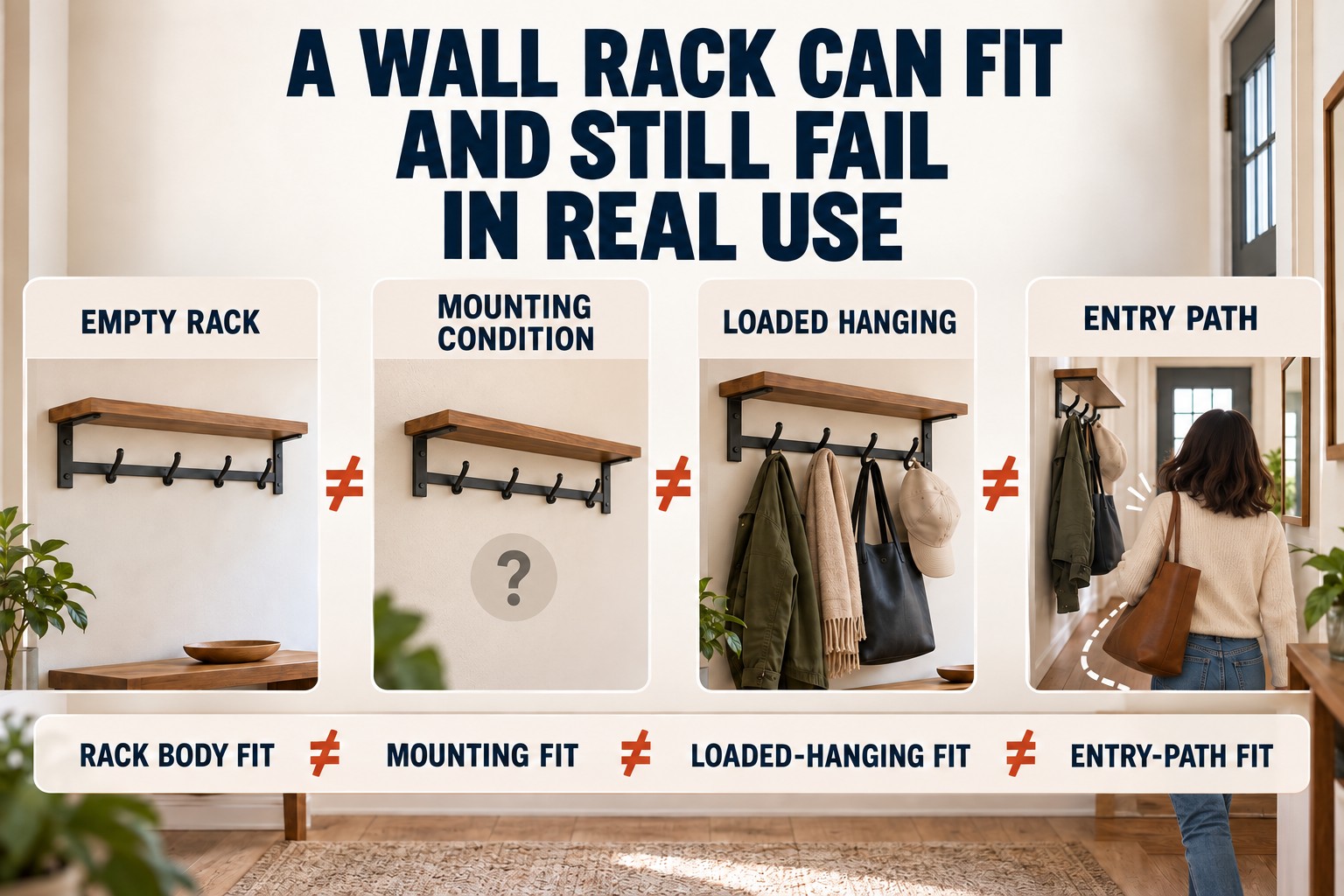
A rack may fit neatly on the wall while empty, but once it is loaded, the hanging items may move into the path people use to enter, leave, open a nearby door, or pass through the space.
That is why this guide uses a fit-first rule:
RACK BODY FIT ≠ MOUNTING FIT ≠ LOADED-HANGING FIT ≠ ENTRY-PATH FIT
The goal is not to find the smallest-looking rack.
The goal is to find a wall-mounted coat rack whose complete working state makes sense in your actual entryway.
Quick Comparison: 4 Wall-Mounted Coat Racks
| Product | Rack architecture | Published load | Main fit question |
|---|---|---|---|
| UMBRA FLIP 5 — SKU 318850-048 | Wall-mounted flip-hook rail | 5 lb per hook / 25 lb total | Does the rack, required mounting condition, loaded hanging state, and entry path all work together? |
| IKEA KUBBIS — 302.895.75 | Wall-mounted coat-rack / hook-rail format | UNKNOWN | Does its mounting condition and real loaded hanging job work in the available entryway? |
| Rejuvenation Brendon Farrell 6-Fin Hook Rack | Wall-mounted multi-hook rack | UNKNOWN | Does the hook architecture work for the items you plan to hang without creating an entry-path conflict? |
| Article Williams 24-in Shelf + Coat Rack — SKU25487 | Shelf + coat-rack combination | UNKNOWN | Can both the rack body and its hanging / shelf working state fit the wall and the entry path? |
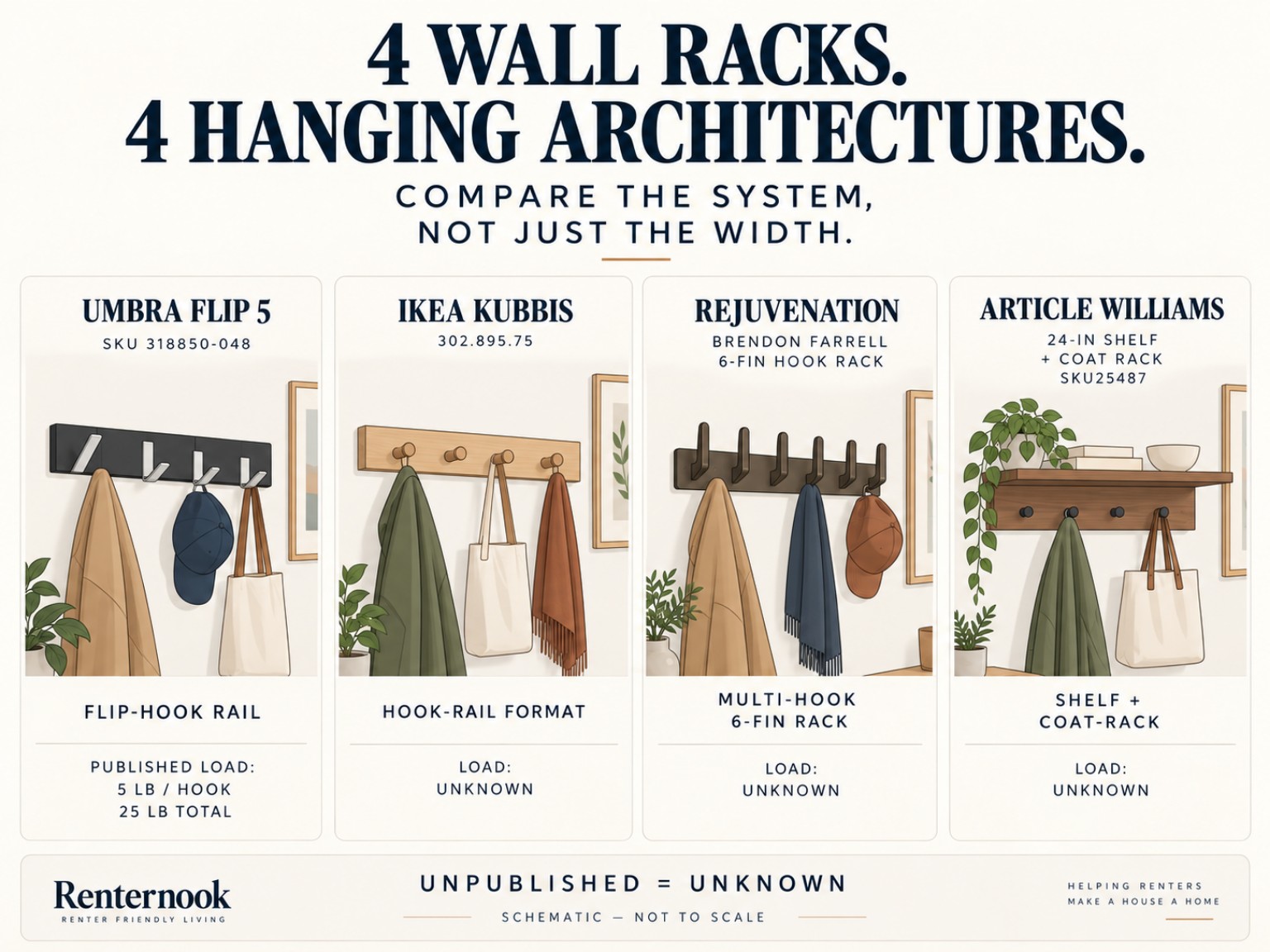
Important: A published rack depth is not the same thing as the real projection of a coat or bag hanging from that rack.
If loaded projection is not published, keep it UNKNOWN and measure or test it against your actual hanging job.
The Main Problem: The Empty Rack Is Not the Working State
Product photos usually make a wall-mounted rack easy to understand while it is empty.
You see the rail. You see the hooks. You see the shelf, if there is one. You see the published body dimensions.
But that is not necessarily the state that matters most in a small entryway.
The working state begins when the rack is installed and loaded.
A winter coat can create a very different wall profile from an empty hook.
A shoulder bag can hang farther into a path than the rack body itself.
Several items placed next to one another can also create a wider or deeper hanging zone than the empty product suggests.
That does not mean there is one universal clearance number every entryway should follow.
There isn’t one in this guide.
The actual loaded projection depends on the rack, the hook position, what you hang, and how those items sit when used.
If that projection is not published, it stays UNKNOWN until you measure or test the real hanging job.
Product 1: UMBRA FLIP 5 — SKU 318850-048
The UMBRA FLIP 5 is the only product in this locked comparison for which a product-specific load figure is established here.
Published load:
- 5 lb per hook
- 25 lb total
Those numbers are useful, but they answer only one part of the buying decision.
They do not tell you whether the mounting condition works on your particular wall.
They do not tell you how far your coat or bag will extend into the room after it is hung.
They do not establish a universal entryway clearance.
And they do not mean that every item under the published weight will automatically work in every entryway.
For a small space, the stronger use of the load figure is to separate two questions:
- Is the intended hanging job within the published product load?
- Does that same hanging job physically work in the entryway after the rack is installed?
Those are different checks.
UMBRA FLIP 5 may make sense for
Someone comparing a rail-style wall rack who wants a product in this set with a clearly established published load figure.
It still needs to pass the product-specific mounting check, the real loaded-hanging check, and the entry-path check.
Keep UNKNOWN
- wall type unless specifically published for the exact installation
- anchor requirement unless specifically published
- fastener requirement unless specifically published
- real coat or bag projection
- universal entry clearance
- renter-safe status
- no-damage status
- no-drill status unless exact product evidence supports it
Product 2: IKEA KUBBIS — 302.895.75
IKEA KUBBIS represents another wall-mounted rack option in the locked set.
For this comparison, its load capacity is not established.
LOAD = UNKNOWN
That means the absence of a verified load figure cannot be converted into an assumed capacity.
It also cannot be treated as zero.
It is simply information that still needs verification if load matters to the buyer’s decision.
The same rule applies to the mounting system.
Do not choose a mounting method from generic advice and then assume it applies to this product.
Use the exact product-specific mounting information available for the exact item and compare that with the wall where you intend to place it.
Then move to the more important small-entryway question:
What happens after your real coats or bags are hanging there?
If the loaded projection is not published, the rack’s body depth cannot answer that question.
IKEA KUBBIS may make sense for
Someone considering a straightforward wall-mounted rack format and willing to verify the product-specific mounting and loading requirements before deciding.
Keep UNKNOWN
- load
- unsupported wall-type claims
- anchor specification not established by exact evidence
- fastener specification not established by exact evidence
- loaded coat / bag projection
- universal clearance
- renter-safe status
- no-damage status
- no-drill status
Product 3: Rejuvenation Brendon Farrell 6-Fin Hook Rack
The Brendon Farrell 6-Fin Hook Rack brings a different hanging architecture into the comparison.
The reason to consider this type of rack is not simply the rack body’s footprint.
The hook arrangement itself becomes part of the working fit.
Think about what you expect those hanging positions to do.
Are you hanging lightweight everyday items?
Bulky outerwear?
Bags?
A mixture of different items?
The article does not assign a universal capacity to this rack because a verified product-specific load figure is not established in the locked evidence.
LOAD = UNKNOWN
And even if you know the body dimensions, that still does not tell you the real space occupied by the items hanging from it.
A row of empty hooks and a row of loaded hooks are two different physical states.
For a narrow entryway, evaluate the second one.
Brendon Farrell 6-Fin Hook Rack may make sense for
Someone whose decision depends on having multiple hanging positions in a wall-mounted rack format, provided the exact mounting requirements and real loaded state work in the intended entryway.
Keep UNKNOWN
- load
- wall compatibility beyond exact published evidence
- anchor / fastener requirement beyond exact published evidence
- loaded projection
- universal user clearance
- universal door clearance
- renter-safe status
- no-damage status
- no-drill status
Product 4: Article Williams 24-in Shelf + Coat Rack — SKU25487
The Article Williams adds another variable because it combines a shelf with a coat-rack function.
That changes the decision from simply:
“Will the hook rail fit?”
to:
“Will the complete shelf-and-rack body fit, and will the loaded hanging state still work below it?”
The 24-inch reference is part of the locked product identity, but that number alone does not establish the product’s complete working fit in an entryway.
A shelf can affect the body-fit question.
The hanging area affects the loaded-hanging question.
The items placed on or below the unit can also affect how the installation functions as a whole.
But this article does not invent capacities or clearance rules for those states.
The product-specific load is not established here.
LOAD = UNKNOWN
Loaded coat / bag projection is also not established.
UNKNOWN
Article Williams may make sense for
Someone who specifically wants a wall-mounted shelf + coat-rack architecture rather than a hook rail alone, and whose wall and entryway can accommodate the complete working state.
Keep UNKNOWN
- load
- unsupported wall-type requirements
- anchors
- fasteners
- real loaded hanging projection
- universal clearance
- renter-safe status
- no-damage status
- no-drill status
The 5-Step Wall-Rack Working-Fit Check
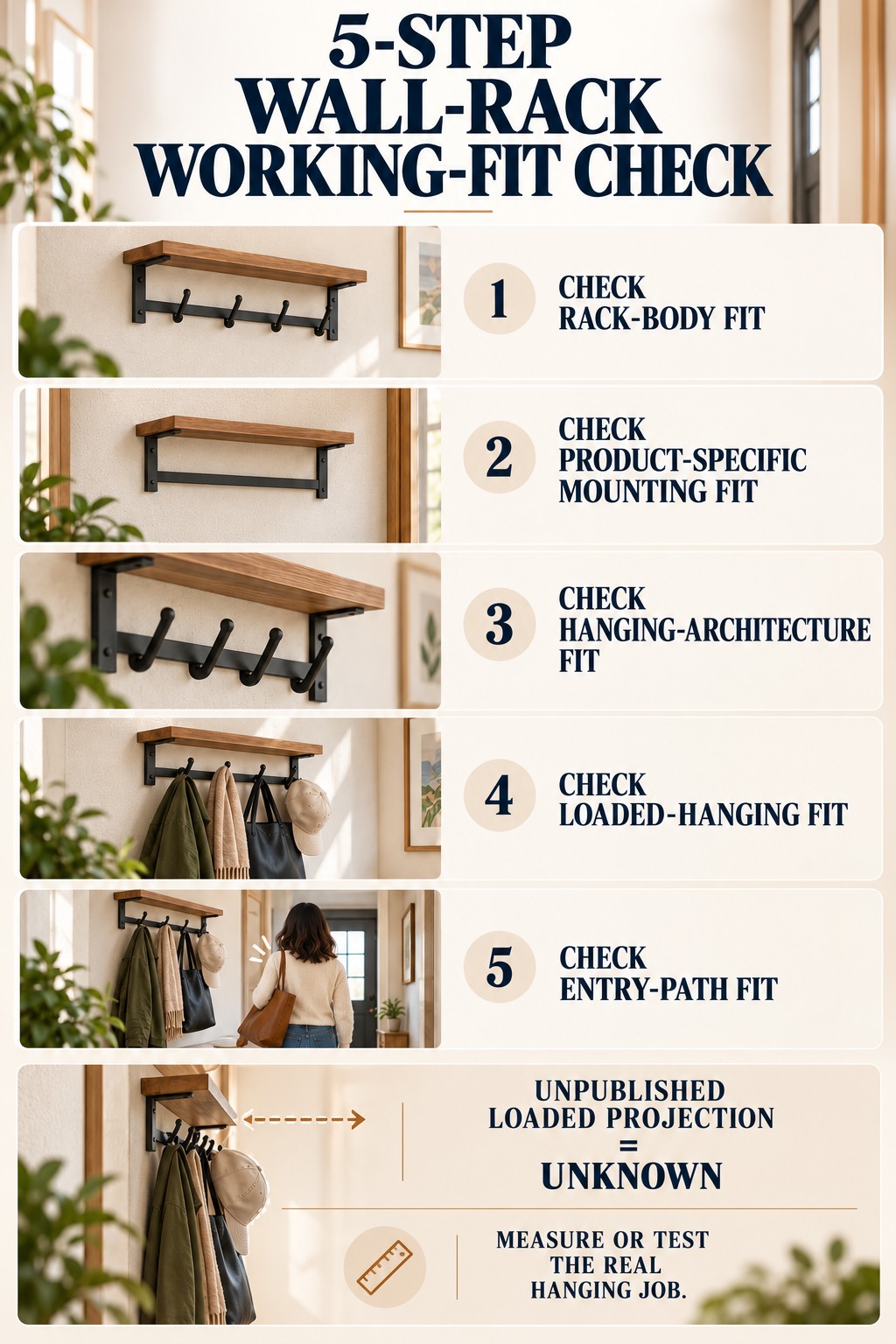
Step 1: Check rack-body fit
Start with the physical product body.
Identify the wall area you intend to use and compare it with the rack itself.
This is the simplest part of the process, but it is only the first gate.
A product passing rack-body fit does not mean it has passed the rest of the decision.
Do not stop at:
“It fits between these two points on the wall.”
You still need to check how it mounts, how it holds items, and what happens to the entryway after it is loaded.
Step 2: Check product-specific mounting fit
Next, check the mounting conditions for the exact product.
The important word here is:
PRODUCT-SPECIFIC.
Do not replace missing product information with generic wall-mounting advice.
This guide does not infer:
- wall type
- anchor type
- fastener type
- drilling requirement
- renter-safe installation
- no-damage installation
If the exact product evidence does not establish one of those things, keep it UNKNOWN.
The buying question is simply:
Does the exact rack’s published mounting condition match the place where you want to use it?
If you cannot establish that yet, the product has not passed this step.
Step 3: Check hanging-architecture fit
Now look at the rack as a hanging system rather than as an empty object.
Different rack architectures organize hanging items differently.
In this set, you are comparing:
- a flip-hook rail
- another wall-mounted rack / hook-rail format
- a multi-hook 6-fin rack
- a shelf + coat-rack combination
Ask what you actually need to hang.
A rack that works well for one hanging job may be awkward for another even when both products physically fit the same wall.
Do not reduce this step to hook count alone.
The relevant question is whether the architecture matches the actual items and usage pattern you expect from the entryway.
Step 4: Check loaded-hanging fit
This is the most important step people can miss.
The rack is not finished when it is mounted.
Load it mentally — and where necessary, physically test the real hanging job.
A published rack depth describes the rack body.
It does not automatically describe:
- a coat hanging from it
- a backpack
- a shoulder bag
- several jackets together
- mixed hanging items
Those items can project farther into the room than the rack itself.
If the manufacturer does not publish real loaded projection, do not create a number.
UNPUBLISHED = UNKNOWN
Instead, use the items you actually plan to hang.
Measure or test the working state against your real entryway.
That gives you a more useful answer than trying to invent a universal clearance from the empty rack dimensions.
Step 5: Check entry-path fit
Finally, look at the entryway as a path.
Where do people actually walk?
What route do they take when entering or leaving?
What nearby doors or moving elements use the same area?
Where do bags, sleeves, or coats sit when the rack is loaded?
The rack can pass every earlier step and still be inconvenient if the loaded items occupy the path you need to use.
There is no universal entry-path clearance in this guide.
The right check is specific to your space.
Look at the real wall.
The real hanging items.
And the real path people use.
If those three states work together, you have a much stronger basis for choosing the rack.
Who Each Architecture May Suit
This is not a ranking.
There is no “best overall” product in this comparison.
The useful question is which architecture matches your actual job.
UMBRA FLIP 5
May suit a buyer who wants a wall-mounted rail-style rack and values having a published product-specific load figure available in the comparison.
Still requires mounting-fit, loaded-hanging-fit, and entry-path checks.
IKEA KUBBIS
May suit a buyer looking for a straightforward wall-mounted rack format and who is prepared to verify product-specific mounting and load information that is not established in this comparison.
Its UNKNOWN fields should stay UNKNOWN until verified.
Rejuvenation Brendon Farrell 6-Fin Hook Rack
May suit a buyer whose hanging job benefits from a multi-position hook-rack architecture.
The decision should still be based on the exact mounting condition and the physical space created by the actual items being hung.
Article Williams 24-in Shelf + Coat Rack
May suit a buyer who wants a shelf + coat-rack combination rather than hooks alone.
Because the architecture adds another functional element to the wall, check the complete body and loaded state rather than judging the rack only by its nominal width.
Claim and Unknown Boundaries
For this comparison, one rule matters throughout:
UNPUBLISHED ≠ PASS
and
UNPUBLISHED ≠ FAIL
It means:
UNKNOWN.
Published load established in this article
UMBRA FLIP 5:
- 5 lb per hook
- 25 lb total
Load not established in the locked evidence
IKEA KUBBIS: UNKNOWN Rejuvenation Brendon Farrell 6-Fin Hook Rack: UNKNOWN Article Williams 24-in Shelf + Coat Rack: UNKNOWN
Also keep UNKNOWN unless exact product evidence establishes it
- wall type
- anchor type
- fastener type
- loaded coat projection
- loaded bag projection
- universal entry clearance
- universal user clearance
- renter-safe status
- no-damage status
- no-drill status
Do not convert a product photo, rack-body dimension, or generic wall-mounting convention into one of those claims.
Final Buying Check
Before buying any wall mounted coat rack for a small entryway, run the decision in this order:
1. Rack-body fit
Does the physical rack body fit the intended wall area?
2. Product-specific mounting fit
Does the exact product’s published mounting condition work for the intended installation?
3. Hanging-architecture fit
Does the rack’s hook / rail / shelf-and-rack architecture match what you actually need to hang?
4. Loaded-hanging fit
What happens after your real coats and bags are on the rack?
If loaded projection is unpublished, keep it UNKNOWN and measure or test the real hanging job.
5. Entry-path fit
Does the loaded rack stay compatible with the path people actually use through the entryway?
If any required information is still unknown, do not silently convert it into a pass.
Either verify it before buying or treat it as an unresolved decision point.
Final Takeaway
A small wall-mounted coat rack is not automatically a good small-entryway rack.
The rack body may fit while the mounting condition does not.
The mounting condition may work while the hanging architecture does not suit the job.
And all of those can work while loaded coats or bags still interfere with the entry path.
That is why the better buying question is not:
“Will this rack fit on my wall?”
It is:
“Will this exact rack, mounted as required and loaded with the things I actually use, still work in my real entryway?”
For a small entryway, that is the difference between buying a rack that fits as an object and choosing one that works as part of the space.