Slim Trash Cans for Small Kitchens: Check the Working Fit, Not Just the Body
A slim trash can can fit beside a cabinet, refrigerator, island, or wall and still be awkward to use.
That is the main problem with shopping by width alone.
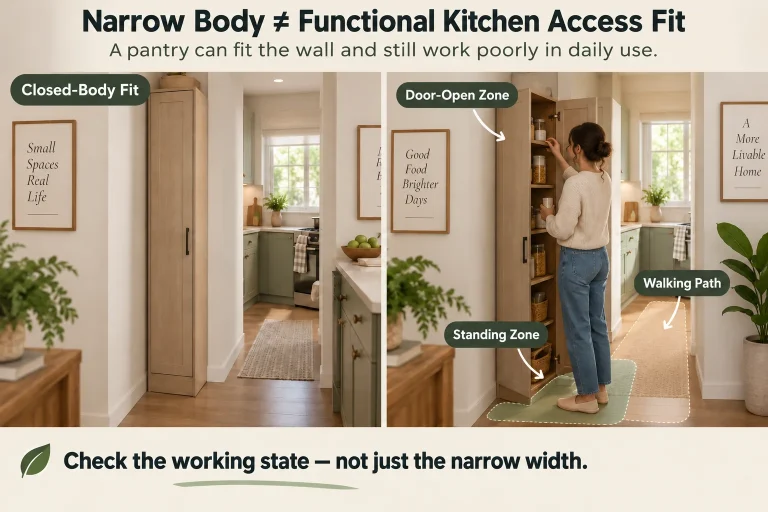
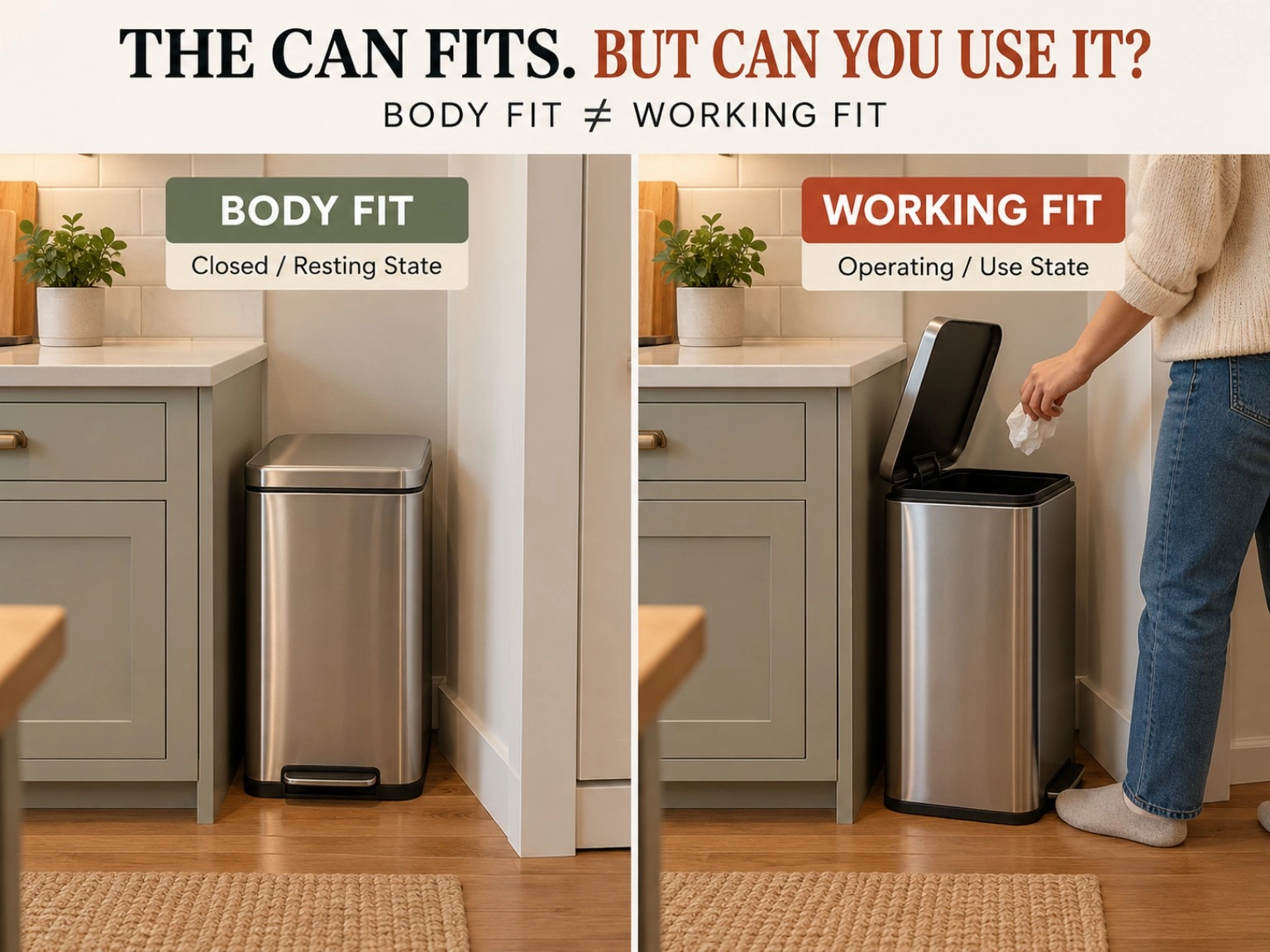
The body may fit the spot when the can is closed, but a kitchen trash can is not used only in that state. You may need room for a lid to open, a pedal to be reached, a sensor zone to work, or a liner or inner bucket to come out during a bag change. Those are different operating states, and the published body dimensions do not automatically prove that every one of them works in your kitchen.
For a small kitchen, the better question is not:
“Is this trash can slim enough?”
It is:
“Can this exact trash can work in this exact spot through the states I actually need?”
That is the fit-first method used in this guide.
TRASH-CAN BODY FIT ≠ LID / PEDAL / BAG-REMOVAL WORKING FIT
Capacity matters, but capacity is not working-fit proof. A 45L or 50L can may hold more waste, yet the practical fit still depends on how the exact product opens, how you access it, and what must happen when you replace the bag.
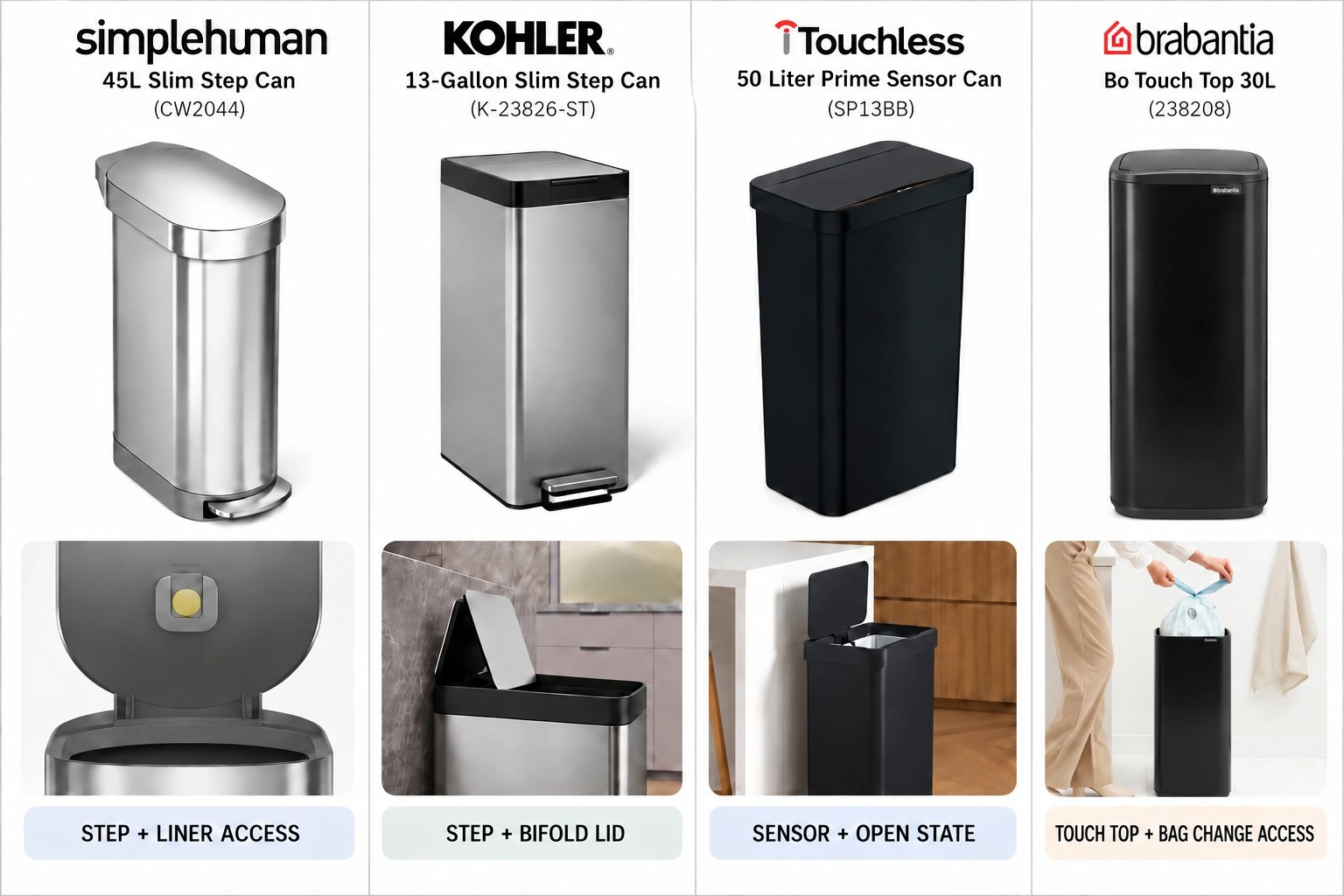
Quick comparison: four different working-fit roles
| Product | Capacity | Opening / operating method | Verified working-state evidence | Fit-first role |
|---|---|---|---|---|
| simplehuman 45L Slim Step Can — CW2044 | 45 L | Foot pedal; liner rim lifts for liner access; slow-close lid | Manufacturer verifies pedal operation, liner-rim access, and lid motion. Numeric open-lid height / pedal projection were not established in the evidence used for this draft. | Slim step-can option where body footprint is only the first check; bag-change and lid/pedal states remain separate fit questions. |
| KOHLER 13-Gallon Slim Step Can with Bifold Lid — K-23826-ST | 13 gal / 49 L class | Foot pedal; bifold lid folds into a tented state at the back | Manufacturer spec sheet verifies the bifold-lid mechanism, pedal operation, wall-protecting hinge design, and nominal body drawing. | Distinct option when reducing the lid’s operating envelope is the design idea, but exact lid arc / pedal projection must not be inferred. |
| iTouchless Prime 13.2-Gallon / 50L Sensor Trash Can — SP13BB | 13.2 gal / 50 L | Motion-sensor lid | Manufacturer gives body dimensions of 10.7 × 15.8 × 24.7 in and 32.5 in height with lid open. | Sensor-operated option where open-state height is directly published, so vertical working fit can be checked more explicitly than on products without a published open-state dimension. |
| Brabantia Bo Touch Top 30L — 238208 | 30 L | Soft-touch top opening; removable inner bucket | Manufacturer verifies 31.2 × 28.7 × 65.4 cm article dimensions, soft-touch opening, and removable inner bucket. Numeric open-lid envelope and bag-removal clearance were not established in the evidence used for this draft. | Lower-capacity touch-top option where body fit, touch access, lid state, and inner-bucket removal should be treated as separate checks. |
Important: this table is non-ranked. The products are here because they create different working-fit questions, not because one is universally better than another.
The fit-first method for a slim kitchen trash can
Before comparing products, define the placement and the states that matter.
1. Check the closed-body fit
Start with the published body size for the exact model and finish you are considering.
You need enough verified evidence to answer:
- Does the body fit the intended location?
- Is the published size for the exact product variant?
- Is the source current and manufacturer-level where available?
Do not treat a generic “slim” label as a measurement.
Also do not assume that capacity tells you the footprint. Two cans with similar gallon or liter ratings can use very different shapes and opening systems.
2. Identify the operating state
Next, ask how the can is actually opened.
The four locked products show four different operating patterns:
- simplehuman CW2044: step-pedal operation with a moving lid and a liner rim that lifts for liner access.
- KOHLER K-23826: step-pedal operation with a bifold lid that folds into a tented state at the back.
- iTouchless SP13BB: motion-sensor lid; the manufacturer publishes both closed height and lid-open height.
- Brabantia 238208: soft-touch opening with a removable inner bucket.
These are not interchangeable details. They determine what must move, what must be reachable, and which extra state needs to be checked.
3. Separate verified dimensions from unverified clearance
This is where small-kitchen buying guides often overreach.
A manufacturer may publish body width, depth, and height without publishing:
- the lid’s forward or rearward arc,
- pedal projection,
- required toe position,
- required standing space,
- bag-removal clearance,
- walkway clearance.
If a number is not published and cannot be verified from a primary source, leave it unknown.
Do not convert a product photo into an exact clearance number.
Do not assume a lid needs a universal gap.
Do not assume every pedal can be comfortably operated from the same standing position.
4. Check the bag-change state separately
A trash can that works every day can still be frustrating when the bag is full.
Bag changes may require the liner rim, lid, inner bucket, or bag itself to move differently from the normal disposal state.
For example:
- simplehuman states that the liner rim lifts for liner access.
- KOHLER states that the liner can be raised and uses a rotating, locking rim for bag changes.
- Brabantia specifies a removable plastic inner bucket.
- iTouchless specifies a bag retainer ring.
Those are verified mechanisms.
What is not verified here is a universal amount of space needed around each product to perform the bag change. That remains placement-specific and, where unpublished, unknown.
Product notes
1. simplehuman 45L Slim Step Can — CW2044
Role in this guide: narrow-body step can with a dedicated liner-rim bag-change state.
The manufacturer identifies this as the 45L Slim Step Can, SKU CW2044. It uses a foot pedal, a slow-close lid, and a stainless-steel liner rim that lifts for access to the liner before closing over it again.
For a small kitchen, the useful distinction is not simply “45L in a slim body.”
There are at least three states to think about:
- Closed body
- Pedal / lid operating state
- Liner-access state
The manufacturer source used for this draft verifies the capacity, SKU, pedal/lid behavior, and liner-rim function. It did not provide text-readable numeric body dimensions in the evidence captured for this draft, so this draft does not invent them.
It also does not infer numeric pedal projection, lid arc, standing space, or bag-removal clearance.
Fit-first takeaway: if this is the product you want, verify the exact published dimensions before purchase and then test the operating and liner-access states against the intended location.
2. KOHLER 13-Gallon Slim Step Can with Bifold Lid — K-23826-ST
Role in this guide: step can with a bifold lid designed to change the lid’s opening behavior.
KOHLER’s current specification sheet identifies the K-23826 family as a 13-gallon slim step trash can with a bifold lid. The mechanism folds the lid into a tented state at the back of the can, and the product uses a metal foot pedal.
The spec drawing publishes nominal dimensions including approximately:
- 11-1/16 in (281 mm) across the narrow face,
- 17 in (431 mm) body depth in the side view,
- 26-7/16 in (672 mm) height,
- with additional drawing dimensions for the product profile.
That gives you verified body evidence.
It does not give permission to calculate a lid arc or pedal projection that the manufacturer did not publish.
KOHLER also describes a hinge design intended to protect the wall from scuffs and a raised liner / rotating locking rim for bag changes. Those features are relevant because they describe how the can behaves in use, not just how large the closed body is.
Fit-first takeaway: the bifold lid makes this product’s operating state different from a conventional single-panel lid, but you still need to verify that the exact placement works for the pedal, lid state, and bag-change state.
3. iTouchless Prime 13.2-Gallon / 50L Sensor Trash Can — SP13BB
Role in this guide: sensor can with a manufacturer-published open-state height.
This product gives unusually useful working-fit evidence because iTouchless publishes both the body dimensions and the height with the lid open.
Manufacturer dimensions for SP13BB are:
- 10.7 in L
- 15.8 in W
- 24.7 in H
- 32.5 in H with lid open
The product uses a motion-activated lid and a trash-bag retainer ring.
For a small kitchen, that means you can check at least one operating-state requirement directly: vertical clearance when the lid is open.
That still does not prove every other type of fit.
The manufacturer does not, in the evidence used here, give a universal sensor standing distance, walkway requirement, bag-removal clearance, or side clearance. Those remain unknown unless separately verified.
Fit-first takeaway: this is the strongest of the four locked products for a directly published open-state vertical check, but the published open height is only one part of working fit.
4. Brabantia Bo Touch Top 30L — 238208
Role in this guide: lower-capacity touch-top can with a removable inner bucket.
Brabantia identifies SKU 238208 as the 30L Bo Touch Bin / Bo Touch Top Trash Can. The manufacturer lists article dimensions of:
- 31.2 cm length
- 28.7 cm width
- 65.4 cm height
The product uses a soft-touch opening system and has a removable plastic inner bucket.
This creates a different working-fit pattern from the pedal and sensor cans.
You need to distinguish:
- Closed-body placement
- Touch access
- Open-lid state
- Inner-bucket removal state
The manufacturer evidence verifies the body dimensions, touch-opening system, and removable inner bucket. It does not establish a numeric lid arc or a numeric amount of clearance required to remove the bucket.
Fit-first takeaway: the 30L capacity and slim rectangular form may suit a smaller placement, but that does not automatically prove the touch/open/removal states work in the intended spot.
How to choose among these four without ranking them
There is no universal “best slim trash can” in this guide.
Instead, match the product’s operating system to the constraint you actually have.
If the problem is narrow floor space
Start with verified body width and depth.
Then continue to the operating-state check. A body that fits is only the first gate.
If overhead clearance is tight
Prioritize products where open-state height is explicitly published.
Among these four, SP13BB has a manufacturer-published 32.5-inch lid-open height. For the others, do not invent an open-state number if it is not published in the evidence you have.
If you prefer foot-pedal operation
CW2044 and K-23826 use pedal operation, but their lid systems are different.
The KOHLER bifold lid is specifically designed around a folding/tented opening state. The simplehuman uses its own step-lid system and a liner rim that lifts for bag access.
Do not assume the same pedal or lid clearance applies to both.
If you want touch rather than pedal or sensor activation
The Brabantia 238208 uses a soft-touch top.
That changes the access question: you need to be able to reach and use the top, then handle the inner bucket when required.
If bag changing is the hidden problem
Look at the actual liner system, not just the capacity.
The four products use different bag-management structures:
- simplehuman: liftable liner rim
- KOHLER: raised liner / rotating locking rim
- iTouchless: bag retainer ring
- Brabantia: removable inner bucket
Those mechanisms are verified. The exact free space required to use them in your kitchen is not universal and should not be guessed.
A small-kitchen trash-can fit checklist
Before buying, answer these in order:
Closed body
- Exact product identity verified?
- Width, depth, and height verified from an appropriate source?
- Body fits the intended placement?
Opening state
- Pedal, sensor, or touch?
- Does the lid move?
- Is a manufacturer-published open-state dimension available?
- If not, is the needed clearance still unknown?
Access state
- Can you comfortably reach the pedal, sensor zone, or touch surface?
- Do not convert this into a universal numeric standing-space rule.
Bag-change state
- Liner rim, retainer ring, or removable inner bucket?
- What must lift or come out?
- Is the required removal clearance actually published?
- If not, preserve it as unknown and verify physically before relying on the placement.
Circulation
- Do not infer a universal walkway clearance from the trash-can dimensions.
- Evaluate circulation as a separate room-specific decision if it matters.
The mistake to avoid
The common mistake is:
“The can is only X inches wide, so it fits.”
That checks one state.
A better sequence is:
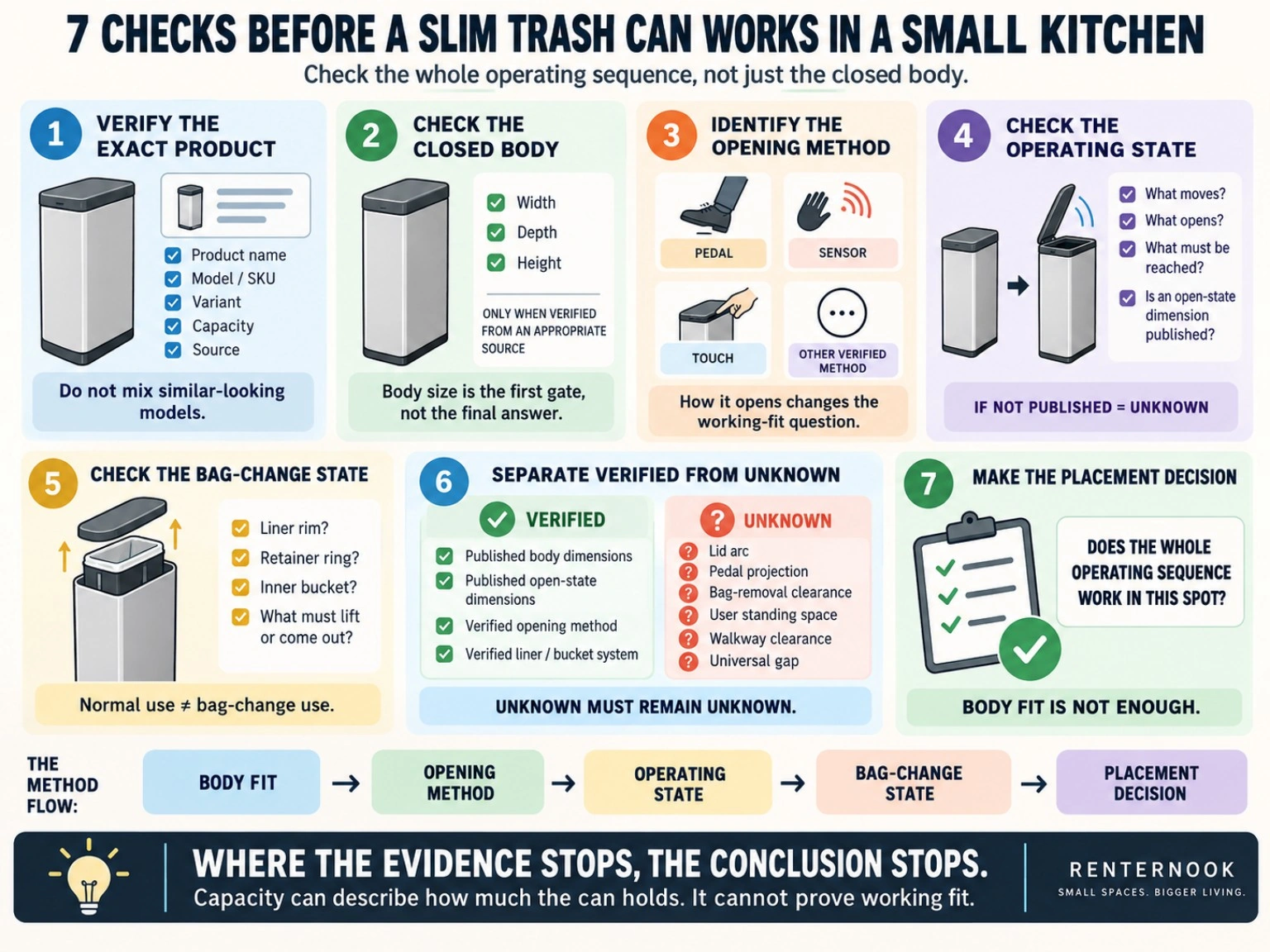
BODY FIT → OPENING METHOD → OPERATING STATE → BAG-CHANGE STATE → PLACEMENT DECISION
The exact numbers available will differ by product. Some manufacturers publish more operating-state evidence than others.
Where the evidence stops, the conclusion should stop too.
Bottom line
Slim trash cans for small kitchens should not be judged by body size or capacity alone.
The closed body may fit while the working state does not.
A step can needs pedal and lid access. A sensor can needs its lid-open state checked. A touch-top can needs top access. Every can eventually needs a bag-change state.
That is why:
TRASH-CAN BODY FIT ≠ LID / PEDAL / BAG-REMOVAL WORKING FIT
Use verified specifications for the exact product. Keep unpublished states unknown. Then decide whether the whole operating sequence works in the actual kitchen spot.
Capacity can help you compare how much a can holds.
It cannot prove working fit.