Balcony Railing Planters for Apartment Renters: Check Railing Fit, Retention, Load, and Permission Before You Buy
Balcony railing planters can add planting space without taking up as much floor area as a freestanding pot, but they move part of the planting load onto or around the railing. For renters, that changes the buying question. The first question is not which planter looks best. It is whether the planter actually matches the railing geometry, stays retained in the installed position, remains acceptable when the soil is wet, and is allowed by the landlord or building.
Start with the balcony and railing, not the planter listing. Identify the railing type, measure the relevant width or baluster gap, inspect where the planter would sit, and check what would happen if the planter shifted, tilted, or detached. A no-drill design can reduce permanent modification, but no-drill does not mean fall-safe.
Quick answer: verify railing fit, retention, wet load, and permission before buying
Railing planters use different attachment concepts. One product may sit over the top rail, while another may install between vertical balusters. Those forms are not interchangeable. A dimension that matters for one design may be irrelevant for the other.
For this guide, two examples show that difference. The EMSCO Group Bloomers Railing Planter, model 2441-1 in terracotta, is an over-rail planter with a published railing-width range of 1.25 to 3.875 inches. The Sprout Railing Planter blue 3-pack is documented as installing between vertical balusters with a stated gap of 3.5 to 4 inches. Model, SKU, and UPC for the Sprout variant reviewed for this guide remain unknown and should not be guessed.
Neither published fit range proves universal compatibility, installed retention, safe wet load, or wind resistance on a specific balcony. Those are separate verification tasks.
1. Identify the railing type before comparing planter dimensions
Do not start by measuring only the top rail. First identify the railing configuration. A balcony may use a flat top rail, rounded rail, metal guard, glass system, decorative profile, closely spaced balusters, or another form that changes how a planter can sit and how it can move.
If the planter is an over-rail design, the relevant questions include the top-rail width, shape, and the surfaces that actually contact the planter. If the planter installs between balusters, the spacing and geometry of those vertical members become more important.
A published width range is only useful when the railing shape also allows the planter to seat as intended. A rounded, angled, tapered, or irregular rail may behave differently from a flat rail even when one measured dimension falls inside the product’s stated range.
2. Measure the installed geometry, not just one dimension
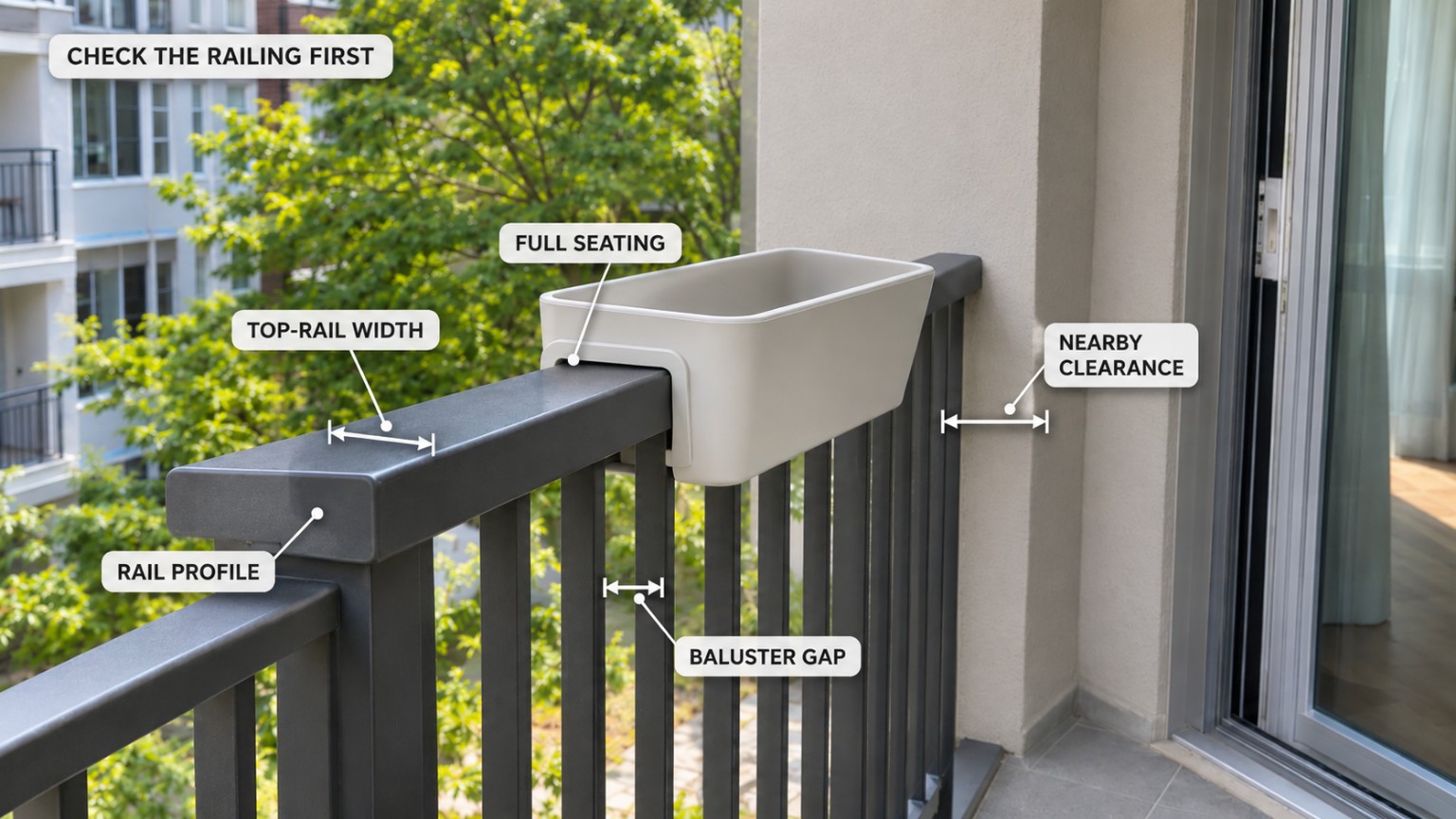
Measure the actual placement zone from the side and from above. Record the rail or baluster dimensions that matter to the attachment method, then check nearby walls, glass panels, posts, trim, door movement, and any surface that could prevent the planter from seating fully.
For an over-rail planter, verify:
- the top-rail width at the exact placement point;
- the rail profile and whether the planter can sit squarely;
- clearance on both sides of the railing;
- whether the planter body contacts another structural or decorative element;
- whether the installed position interferes with access, drainage, or routine balcony use.
For a between-baluster planter, verify:
- the clear gap between the relevant vertical members;
- the baluster shape and thickness;
- whether the planter seats at the intended height and orientation;
- whether adjacent panels or rails prevent full installation;
- whether removal remains practical for maintenance or move-out.
The usable fit is the installed fit, not the dimension that happens to look closest on a product page.
3. Understand what the EMSCO 2441-1 fit range does — and does not — establish
The EMSCO Group Bloomers Railing Planter, model 2441-1, is documented as the terracotta variant with UPC 072358024410. Published dimensions are 9.5 × 23.75 × 10.5 inches. The product is documented as an over-rail design intended for railing widths from 1.25 to 3.875 inches. The documented material is HDPE resin, and drainage holes are documented.
Those facts help with a first fit screen. They do not establish that every railing inside the width range has the correct shape, stiffness, edge geometry, or surrounding clearance. They also do not establish a safe installed load, certified retention strength, or wind rating.
Before buying, compare the exact balcony railing to the planter’s installed shape. If the railing geometry is unusual, the fit remains unverified even when the width number appears to match.
4. Treat the Sprout planter as a different attachment problem
The Sprout Railing Planter reviewed for this guide is the blue 3-pack. Available product documentation describes installation between vertical balusters with a stated gap of 3.5 to 4 inches. UV-protected polypropylene, drainage, and a liner are documented.
The available product documentation does not establish the exact model, SKU, UPC, overall dimensions, capacity, product weight, secondary-retention method, load rating, or wind-resistance rating. Treat those values as unknown rather than borrowing details from another variant or estimating from product photos.
Because the Sprout form installs between vertical balusters, do not compare its 3.5-to-4-inch gap requirement directly with the EMSCO top-rail width range as if both numbers describe the same fit dimension. They refer to different railing geometries and different installation concepts.
5. Check retention after installation — not just whether the planter can be placed
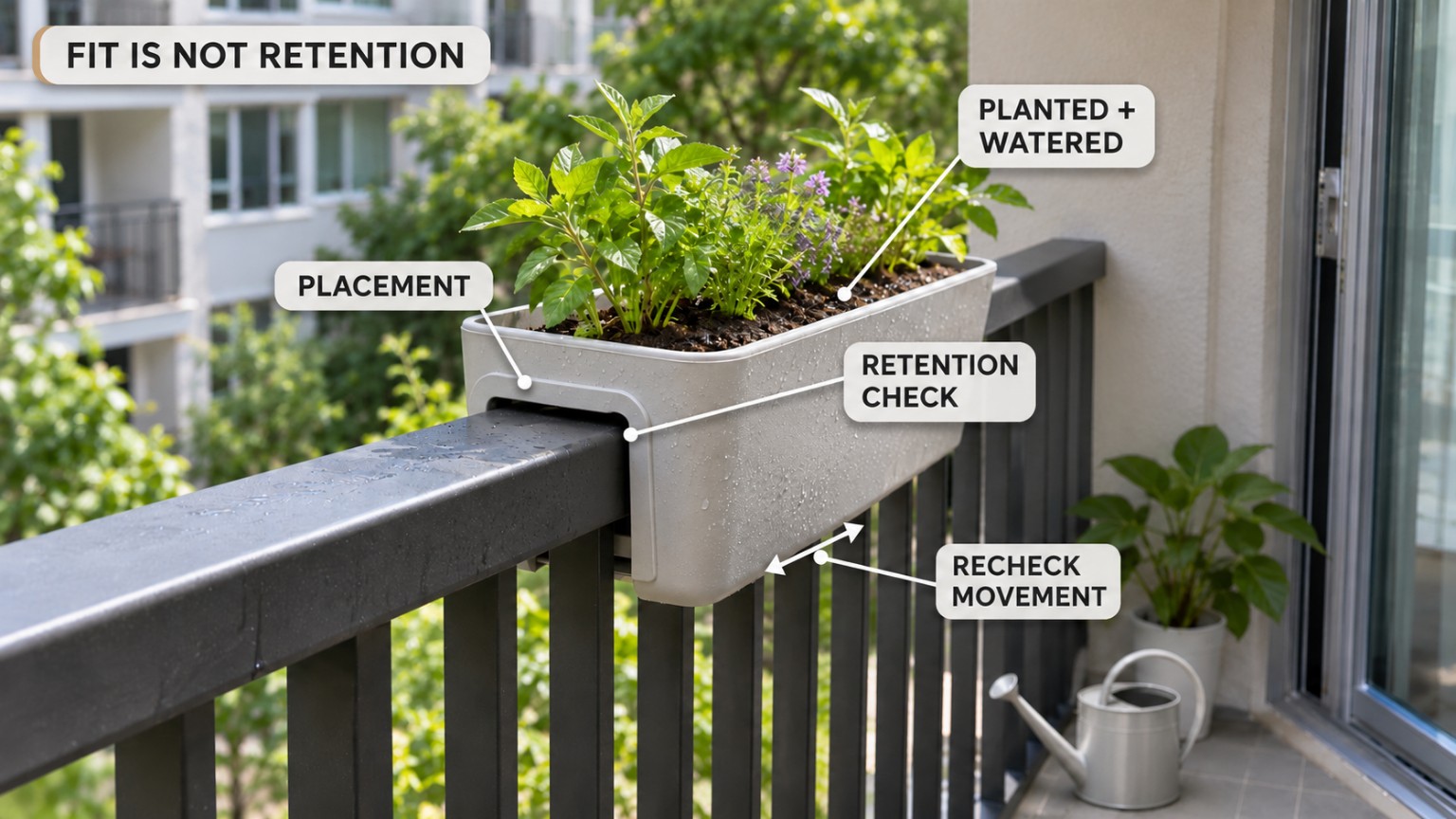
A planter can physically fit and still be poorly retained. After establishing that the geometry appears compatible, the next question is what prevents the planter from shifting, rotating, lifting, sliding, or disengaging during normal use.
Use the manufacturer’s exact installation method for the exact product. Do not improvise a tie, bracket, screw, shim, adhesive, or secondary attachment unless that method is permitted by the product instructions and the property rules.
For a rental balcony, verify the installed condition from several directions:
- Can the planter move sideways along the rail or balusters?
- Can it tilt outward or inward?
- Can normal watering or handling change the seated position?
- Can the planter be bumped by a person, chair, door, or maintenance activity?
- Is any documented retention feature fully engaged?
If the product documentation does not establish retention strength for the actual installation, treat that strength as unknown.
6. Wet soil changes the real working condition
A planter is not used empty. Soil, water, the plant, roots, liner, and retained moisture all contribute to the installed mass. That means the relevant condition is the planted and watered condition, not the empty planter sitting on a scale or product page.
Do not invent a wet-load number from planter dimensions alone. Soil composition, fill depth, retained water, plant size, and drainage behavior can change the result substantially.
For both products reviewed in this guide, the available product documentation does not establish a verified safe installed wet-load capacity for the exact renter setup. That remains an unknown that should not be converted into a guarantee.
When assessing the setup, consider the full chain: planter, contents, attachment interface, railing or balusters, building rules, and the consequence if the planter shifts or falls.
7. Drainage is useful, but drainage does not solve the load or fall-risk question
Drainage holes are documented for the EMSCO planter. Drainage and a liner are documented for the Sprout variant reviewed here. Those features help describe how water may leave the planter, but they do not prove a particular wet weight, leak behavior, retention level, or safe installation.
Check where drainage water will go on the actual balcony. Avoid directing runoff onto neighbors, walkways, electrical equipment, finishes, or areas where building rules prohibit it. Keep drains and maintenance access clear.
A planter that drains can still remain heavier after watering than when empty. Treat drainage and load as related but separate checks.
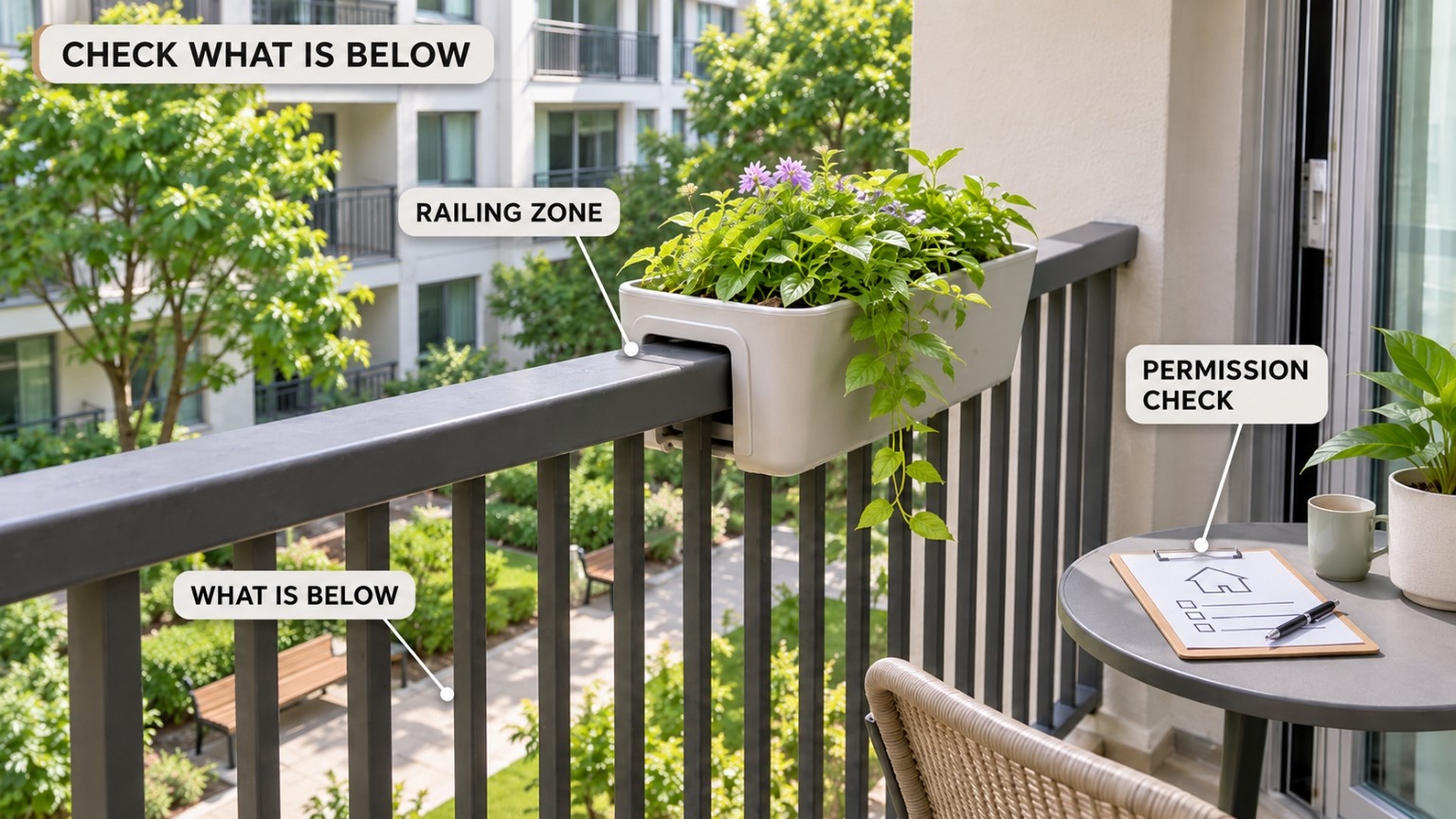
8. Falling-object risk changes the standard for a balcony installation
A railing planter may be above another balcony, walkway, vehicle area, courtyard, or public space. That makes a loss-of-retention event more consequential than a planter tipping over on a ground-level patio.
Do not infer fall safety from the words “railing planter,” “no drill,” or “easy install.” The available product documentation does not establish certified retention strength, a wind rating, or a universal fall-safe claim for either product.
If the installation location creates a meaningful falling-object hazard, resolve that condition before purchase and installation. Building management, lease rules, manufacturer instructions, or a qualified assessment may impose requirements that a shopping guide cannot replace.
9. Wind exposure is an unknown unless the exact installation has documented support
Balcony wind can vary by height, orientation, surrounding buildings, weather, and local turbulence. A planter that feels stable by hand is not evidence of a tested wind rating.
The available product documentation does not establish a wind-resistance rating for the EMSCO 2441-1 or the Sprout blue 3-pack reviewed here. Do not create one from planter shape, material, railing fit, or user reviews.
If wind exposure is material at the balcony, treat that as a separate safety question. Do not use an unsupported statement such as “secure in high winds” or “windproof” as a buying claim.
10. Check landlord and building permission before installation
Rental and condominium rules may restrict anything attached to balcony railings, visible exterior changes, objects projecting beyond the railing line, drainage, or items that could fall from height. A product being removable does not automatically make it permitted.
Before buying, check the lease, house rules, building handbook, or management guidance that applies to the unit. If approval is required, obtain it for the intended installation rather than assuming that a no-drill product qualifies automatically.
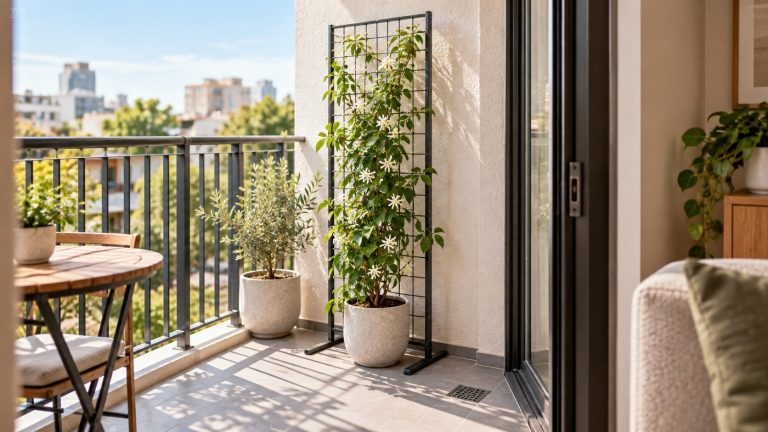
This is also a useful place to compare with other renter-oriented balcony equipment. A freestanding balcony trellis solves a different space problem because it uses floor area instead of relying on the railing. Neither form is automatically safer or more appropriate; each creates a different fit and stability workflow.
11. Compare the two products by verification task
EMSCO Group Bloomers Railing Planter 2441-1
Identity:
- Brand: EMSCO Group
- Product: Bloomers Railing Planter with Drainage Holes
- Model: 2441-1
- Color: terracotta
- UPC: 072358024410
Documented physical details:
- Published dimensions: 9.5 × 23.75 × 10.5 inches
- Attachment concept: over-rail
- Published railing-width range: 1.25–3.875 inches
- Material: HDPE resin
- Drainage holes: documented
Verify before buying:
- actual top-rail width and profile;
- full seated geometry on the exact railing;
- installed retention and movement;
- wet planted condition;
- drainage path;
- landlord or building permission;
- falling-object exposure.
Not established by the available documentation: safe installed wet-load capacity, wind resistance, retention strength, and relevant certification.
Sprout Railing Planter — Blue 3-Pack
Identity:
- Brand: Sprout
- Variant: blue / 3-pack
- Model: unknown
- SKU: unknown
- UPC: unknown
Documented physical details:
- Attachment concept: between vertical balusters
- Documented baluster gap: 3.5–4 inches
- Material: UV-protected polypropylene
- Drainage: documented
- Liner: documented
Verify before buying:
- actual clear gap between the intended balusters;
- baluster geometry and planter seating;
- installed retention and movement;
- wet planted condition;
- drainage path;
- landlord or building permission;
- falling-object exposure.
Not established by the available documentation: exact model identifiers, overall dimensions, capacity, product weight, secondary retention, safe installed load, and wind resistance.
These two products should not be ranked from the documented facts alone. They solve the railing-fit problem in different ways. The practical comparison is whether the exact attachment concept can be verified against the exact balcony railing and allowed installation.
12. Renter fit-and-safety checklist before ordering
- RAILING TYPE: Identify whether the setup uses a top rail, vertical balusters, glass, decorative metal, or another geometry.
- MEASURED FIT: Measure the exact rail width or baluster gap required by the product’s attachment method.
- RAILING SHAPE: Verify that the planter can seat as intended, not merely that one dimension falls inside a published range.
- RETENTION: Identify what keeps the planter from shifting, rotating, lifting, sliding, or disengaging.
- NO-DRILL: Treat no-drill only as a modification characteristic, not as evidence of fall safety.
- WET CONDITION: Evaluate the planter when filled, planted, and watered rather than when empty.
- DRAINAGE: Confirm where runoff goes and whether balcony drains stay accessible.
- FALLING-OBJECT RISK: Check what is below and what the consequence would be if retention failed.
- WIND: Keep wind performance unknown unless the exact product and installation have documented support.
- PERMISSION: Check lease, landlord, condominium, or building rules before installation.
- MAINTENANCE: Keep safe access for watering, pruning, inspection, and removal.
- MOVE-OUT: Confirm the planter can be removed without unapproved modification or damage.
13. A simple verification sequence
- Photograph or sketch the exact railing section where the planter would go.
- Identify whether the product needs top-rail width or baluster spacing.
- Measure that geometry at the actual installation point.
- Compare the measurement with the exact product documentation.
- Check surrounding clearance and whether the planter can seat fully.
- Identify the documented retention method.
- Consider the planted and watered condition, not just the empty planter.
- Check what is below the railing and whether falling-object risk is material.
- Check landlord or building permission.
- If any critical fit, retention, load, or permission point remains unknown, resolve it before ordering or installing.
Bottom line
A railing planter can free up balcony floor space, but it transfers the buying decision to the railing interface. For renters, the important questions are whether the exact railing geometry matches the attachment method, whether the installed planter remains retained, what happens in the wet planted condition, and whether the property allows the installation.
The EMSCO Group Bloomers 2441-1 and the Sprout blue 3-pack illustrate two different approaches: over-rail versus between-baluster. Their published fit dimensions should be used only for the geometry they actually describe.
Do not turn no-drill into a fall-safe claim. Do not turn a published fit range into a universal-fit claim. Do not invent wet-load, retention, or wind-safety numbers when the available product documentation does not establish them. A good renter setup is one whose fit, retention, consequences, and permission can all be verified before the planter goes onto the railing.