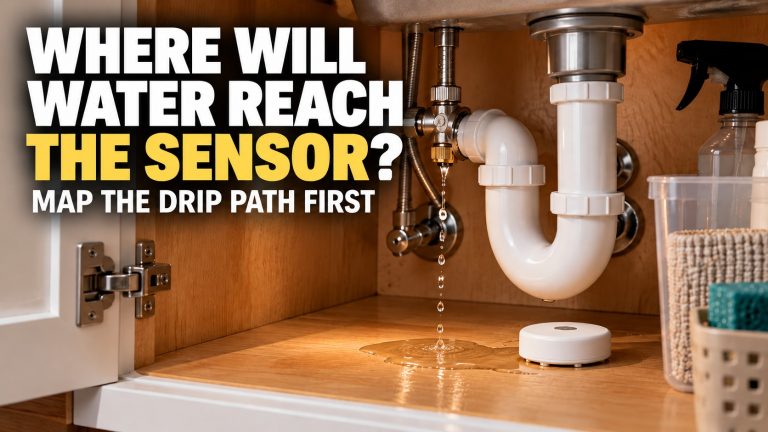
Sink Faucet Splash Guards for Small Rental Kitchens: Check the Faucet Base and Drainage Path Before You Buy
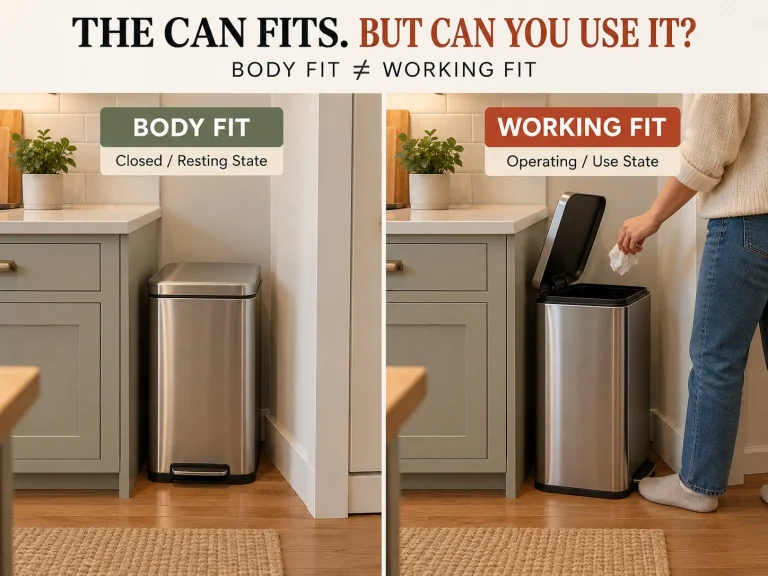
A sink faucet splash guard looks like one of the easiest kitchen accessories to buy. It sits around the faucet, catches water, and seems as if it should solve the wet-counter problem with almost no planning.
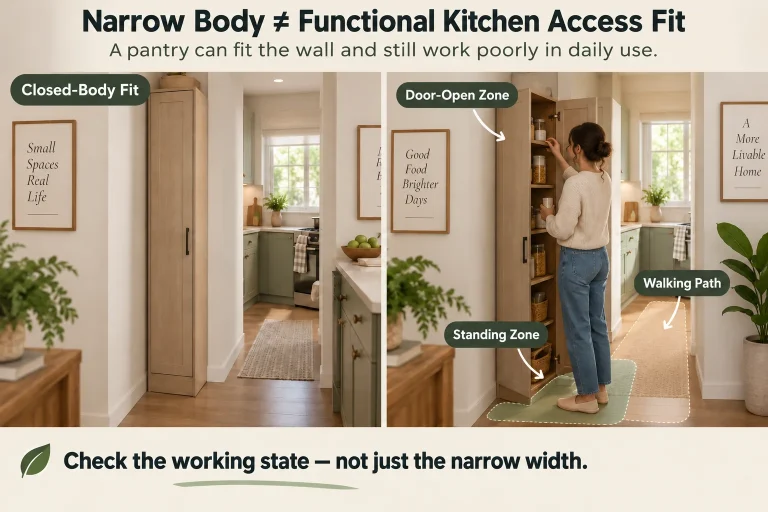
In a small rental kitchen, the fit can be more complicated.
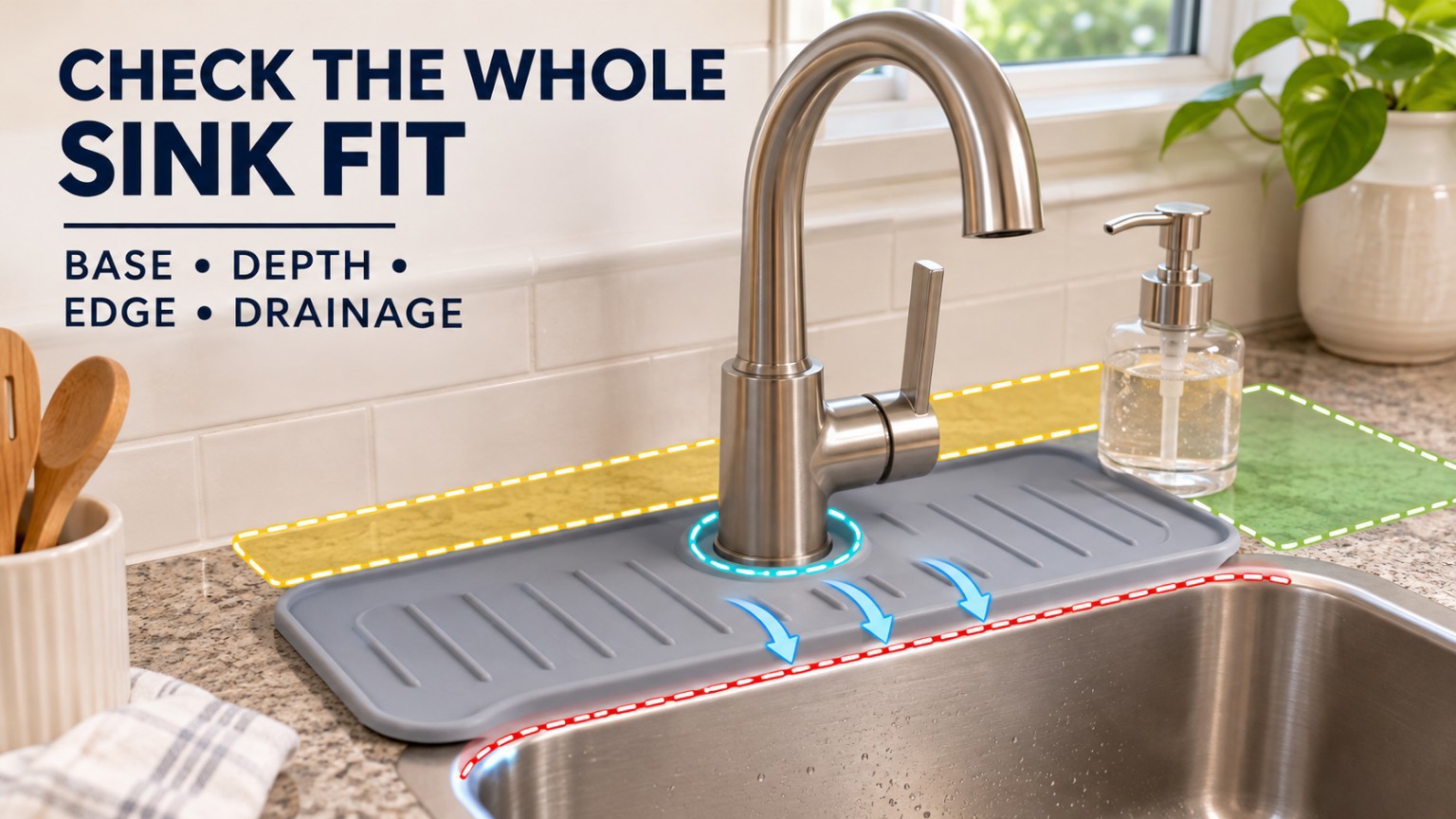
The faucet base may be wider than the opening. The counter behind the faucet may be too shallow. The sink edge may sit too far forward or too high for the mat’s drainage path. A soap dispenser or handle may occupy the same space. A guard that appears to direct water toward the sink may not actually do so on your counter geometry.
That is why the useful buying question is not simply, “Is this mat 24 inches long?”
It is: “Will this exact guard fit around this exact faucet, sit correctly on this counter, and send routine splash water somewhere useful without creating a new obstruction?”
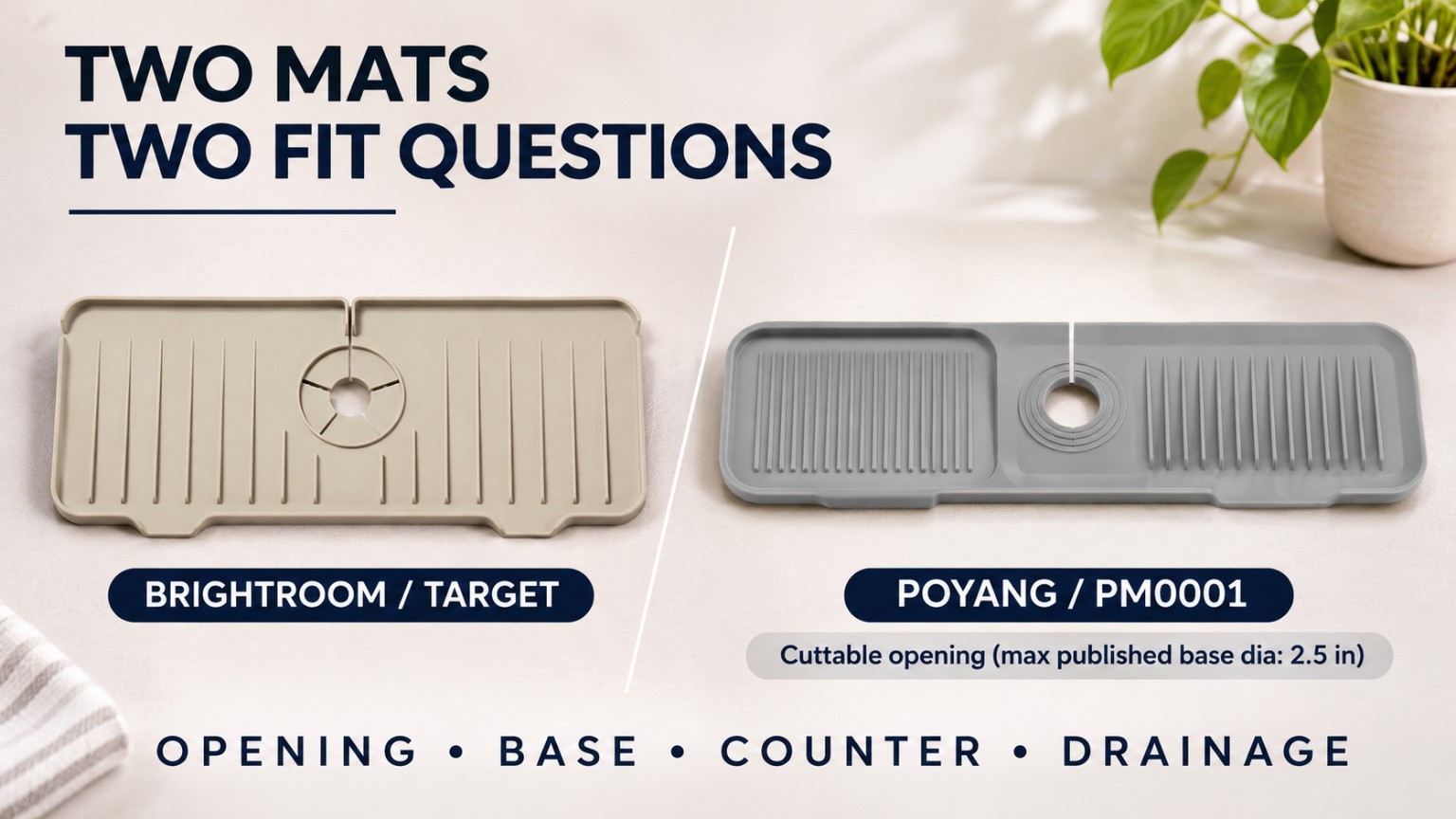
This guide compares two locked examples without ranking them: the Brightroom / Target Sink Faucet Splash Guard, TCIN 94253432, and the POYANG 24-inch Silicone Draining Mat, model PM0001.
The Brightroom product has unresolved fit details that matter before purchase: its faucet-opening size and drain-outlet geometry are not established in the locked research.
The POYANG product has a published maximum faucet-base diameter of 2.5 inches and documents a cuttable hole, but the exact finished opening after cutting is still unknown.
Those differences make both products useful examples of the same fit-first lesson: the headline product format does not prove real counter fit.
Quick answer: measure the faucet base before the mat
Start at the faucet.
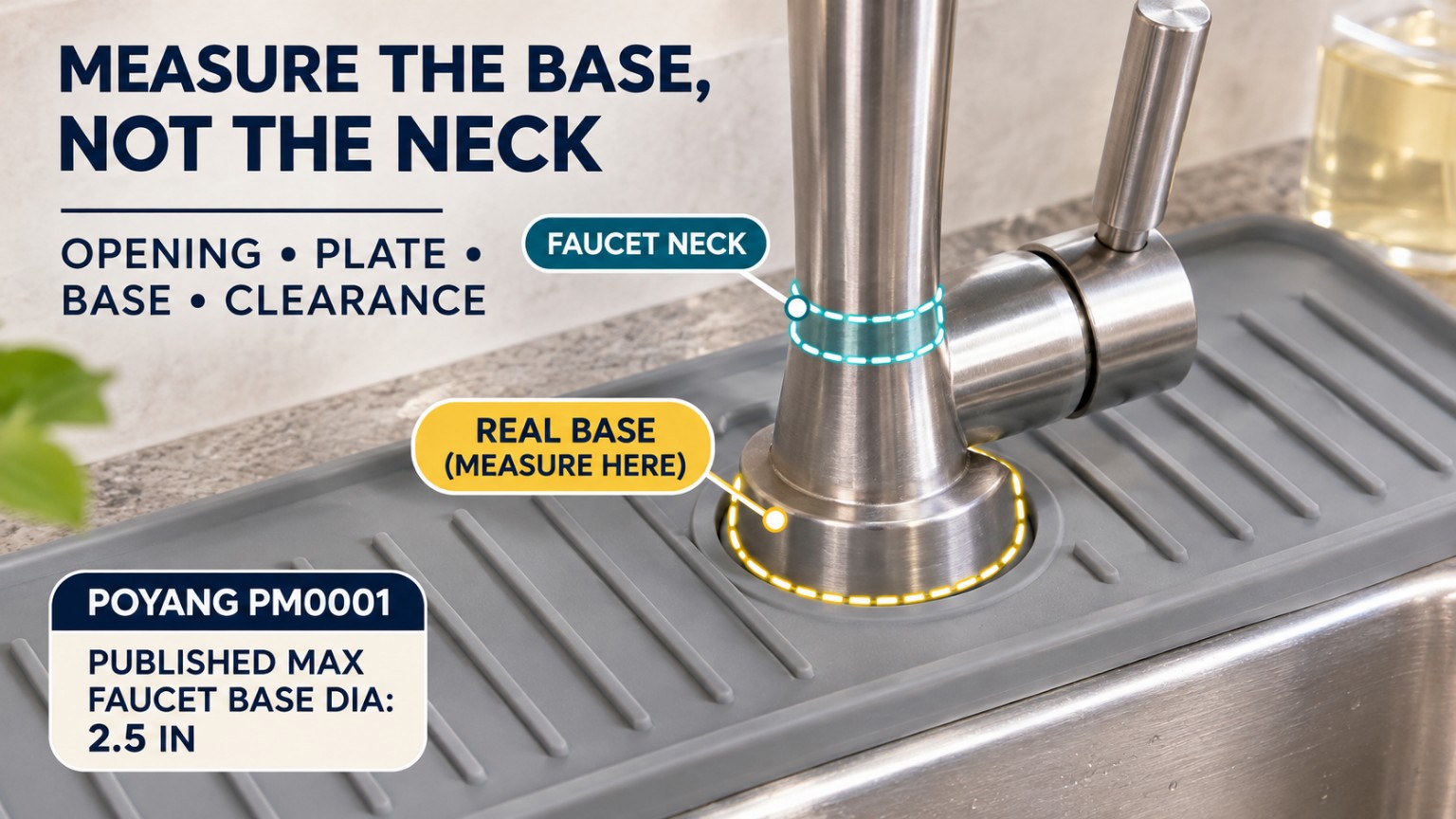
Measure the outside diameter or maximum width of the faucet base where the guard must pass around it. Do not measure only the narrow faucet neck above the counter. The guard has to work at the actual counter-level interface.
Then measure the counter space behind the faucet, the distance from the faucet base to the sink edge, and the space occupied by handles, soap dispensers, sprayers, filter hardware, or other fixtures.
After that, look at the expected water path.
A splash guard can catch routine drips and splashes, but catching water and draining water are two separate jobs. The geometry of the sink edge and counter determines whether water can actually move toward the basin instead of collecting somewhere else.
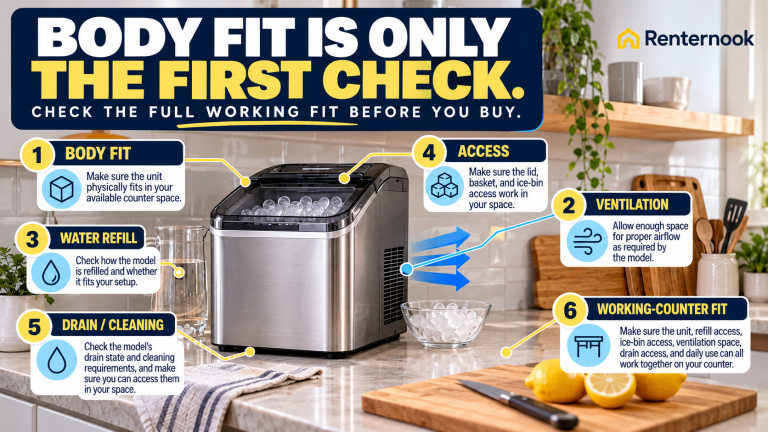
For a fit-first purchase, treat these as separate gates:
- Faucet-base fit.
- Counter-depth fit.
- Sink-edge relationship.
- Drainage path.
- Cut or opening fit.
- Daily-use workflow.
If one gate is unknown, keep it unknown until you can verify it.
1. Check the faucet-base interface first
The center opening is the first place a faucet splash guard can fail.
A product photo can make an opening look generous because the pictured faucet has a narrow base. Your faucet may have a larger escutcheon, a wider cylindrical base, a square base, a deck plate, or hardware that expands near the counter.
Measure the part the guard must actually surround.
If the product uses a fixed opening, compare that opening with the faucet base and any surrounding plate.
If the product allows cutting, do not assume that “cuttable” means “fits every faucet.” Cutting only gives you an adjustment method. You still need enough material, a workable shape, and a finished opening that can sit around the hardware without forcing or distorting the mat.
For the Brightroom / Target guard, the locked research does not establish the faucet-opening size. That means the opening cannot be treated as a confirmed fit point.
For the POYANG PM0001, the published maximum faucet-base diameter is 2.5 inches. Use that as a product-specific gate. If the relevant faucet base is larger, do not assume cutting automatically extends the product beyond the published fit boundary.
2. Measure the real counter depth behind the faucet
Length across the sink is easy to notice. Front-to-back depth is easier to miss.
In a small kitchen, the strip of counter behind the faucet may be shallow. The backsplash may begin almost immediately behind the faucet base. There may also be caulk lines, raised sink rims, window trim, wall-mounted hardware, or an uneven transition that changes how a flexible mat sits.
Measure from the rear of the faucet base to the backsplash or wall.
Then measure from the faucet base toward the sink.
The guard needs enough counter contact to sit where intended without folding up the wall, riding over the sink edge in an uncontrolled way, or bunching around fixtures.
This is especially important in rental kitchens because the sink and faucet may have been replaced at different times. Two kitchens with the same nominal counter depth can have very different usable space around the faucet.
Do not use the overall countertop depth as your working measurement. Measure the actual zone where the guard will sit.
3. Map the sink edge and drainage direction
A splash guard is not only a shape around the faucet. It is part of a small water-management path.
Ask where water is supposed to go after it lands on the surface.
If the product is intended to direct water toward the sink, check whether the mat can reach or align with the sink edge in your setup. A raised sink rim, thick rear lip, unusual basin position, or gap between the faucet and sink may change the path.
Do not assume gravity alone proves drainage.
A flexible mat can sit differently depending on the counter surface, faucet position, nearby fixtures, and how its front edge meets the sink.
The locked research does not establish the Brightroom product’s drain-outlet geometry. That means we cannot claim that its outlet will align with every sink or that it will drain correctly on every counter.
The same caution applies to the POYANG mat. A draining design still depends on the installed relationship between the mat and the sink.
This is the same reason it helps to measure the sink and faucet together when buying other sink-area accessories. The product is not working on an empty countertop; it is working inside a geometry shared by the faucet, sink edge, counter, and surrounding tools.
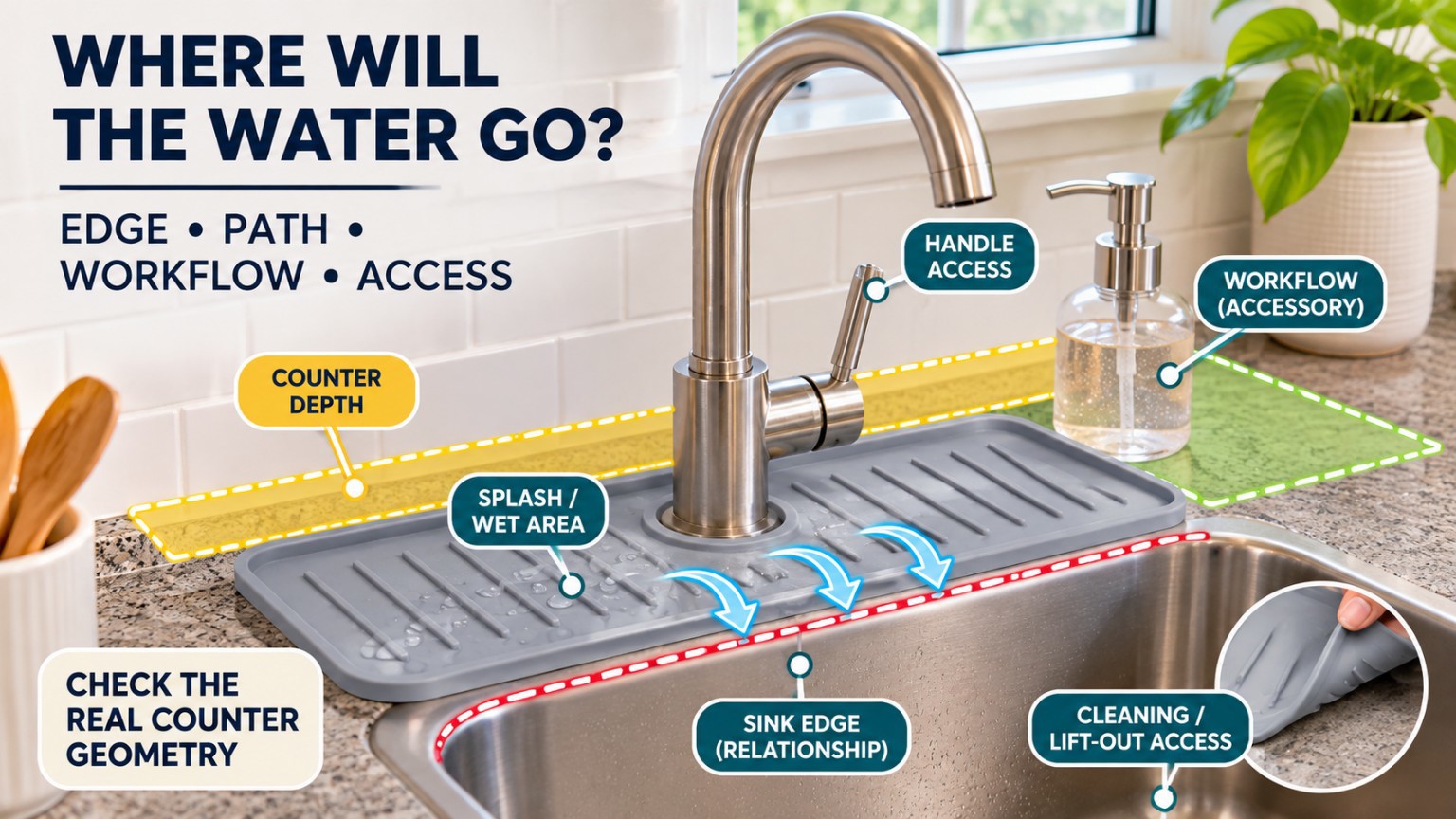
4. Check the faucet position relative to the sink
Not every faucet sits the same distance from the basin.
Some faucets are mounted very close to the rear sink edge. Others sit farther back on the countertop. Some sinks have a thick deck between the faucet and basin. Others use a narrow rim.
That distance matters because a guard or draining mat may need to bridge the space between the faucet base and the sink edge.
Measure the gap.
Then look at the vertical relationship. If the sink edge is raised above the counter, water may not follow the same path shown in a product image with a flatter installation.
A splash guard that fits around the faucet can still fail the workflow test if its front edge cannot interact cleanly with the sink.
5. Treat “cuttable” as a fit variable, not a universal-fit claim
The POYANG PM0001 documents a cuttable hole.
That feature can be useful because faucet bases vary, but it creates a second measurement problem: the product before cutting and the product after cutting are not exactly the same fit object.
The locked research gives us a published maximum faucet-base diameter of 2.5 inches.
What it does not give us is the exact finished opening created by every user after cutting.
That finished opening depends on where the cut is made and how the material behaves around the specific faucet base.
For that reason, do not turn “cuttable” into “custom fit.”
A better buying process is:
- Measure the faucet base.
- Compare it with the product’s published fit boundary.
- Study the documented cut area.
- Plan the cut conservatively.
- Preserve enough material for the mat to sit as intended.
- Do not assume a larger cut is automatically acceptable.
If your faucet base is near the published limit, the cut itself becomes a meaningful part of the fit decision.
6. Brightroom / Target: the main question is what has not been verified
The Brightroom / Target Sink Faucet Splash Guard, TCIN 94253432, belongs in this comparison because it addresses the same buyer job: managing routine splash and drip water around the faucet area.
But two fit details remain unresolved in the locked research.
The faucet-opening size is unknown.
The drain-outlet geometry is unknown.
Those are not minor omissions for a fit-first purchase. They are two of the most important interfaces between the product and the kitchen.
Before buying this product for a specific sink, verify the opening against the actual faucet base and inspect how the product is expected to meet the sink edge.
Do not infer opening dimensions from a listing photo.
Do not infer outlet width or alignment from perspective.
And do not assume that because the guard can sit behind a faucet, its water path will automatically line up with your sink.
For this product, the best next step is not to guess. It is to verify those two interfaces before purchase.
7. POYANG PM0001: the published 2.5-inch faucet-base limit is only one gate
The POYANG PM0001 is identified in the locked research as a 24-inch silicone draining mat.
Its documented cuttable hole gives the buyer an adjustment step that the article can discuss directly.
The locked product research also provides a maximum published faucet-base diameter of 2.5 inches.
That number is useful, but it does not finish the fit check.
A faucet base within 2.5 inches does not prove that the entire mat fits the counter.
You still need to verify the rear counter depth, sink-edge relationship, nearby fixtures, and water path.
The exact finished opening after cutting also remains unknown.
So the correct interpretation is:
- 2.5 inches is a product-specific faucet-base gate.
- It is not a universal compatibility statement.
- It is not a promise that the cut will be neat or that the finished opening will sit perfectly around every faucet shape.
- It is not a drainage guarantee.
Use the published diameter together with the real counter geometry.
8. Compare the products by fit problem, not by winner
These two products create different verification burdens.
Brightroom / Target:
- The faucet opening must be verified because its size is unknown in the locked research.
- The drain-outlet geometry must also be verified.
- The buyer should not treat listing appearance as dimensional proof.
POYANG PM0001:
- The product documents a cuttable hole.
- The maximum published faucet-base diameter is 2.5 inches.
- The exact finished opening after cutting remains unknown.
- The buyer still has to verify counter depth and drainage geometry.
This is not a “better versus worse” comparison.
It is a comparison of what you know before purchase and what you still need to check.
The product with more published fit information can still be wrong for a particular counter.
The product with less published information may work, but the missing dimensions need verification rather than assumption.
9. Check the daily counter workflow
A guard can fit physically and still make the sink area annoying to use.
Look at everything that normally lives near the faucet.
- Soap dispenser.
- Dish soap bottle.
- Sponge holder.
- Hand sprayer.
- Filter hardware.
- Faucet handle.
- Countertop water filter.
- Drying rack.
- Cleaning brush.
The mat occupies counter area that may already have a job.
Check whether the faucet handle can move freely. Check whether a soap dispenser can still be used without sitting awkwardly on top of the mat. Check whether the mat interferes with a sprayer hose or another fixture.
Then think about cleaning.
Can the guard be lifted without moving half the sink setup?
Can you wipe the counter beneath it?
Can you access the faucet base and caulk line?
In a small rental kitchen, convenience often depends on how many objects have to be moved for one simple task.
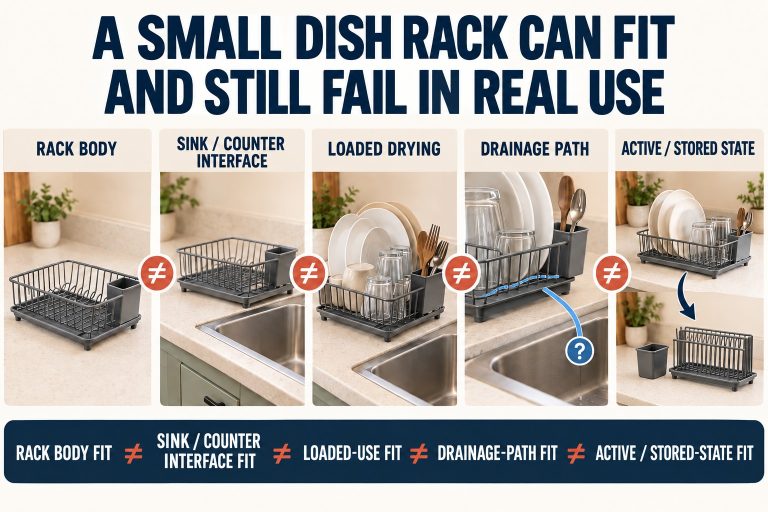
The same sink-to-drying workflow logic used for small dish drying racks applies here: fit is not only about whether an object occupies the counter. It is also about whether the surrounding routine still works after the object is added.
10. Keep splash management separate from plumbing leaks
A faucet splash guard is not a plumbing repair.
If water is coming from a supply connection, faucet body, handle, cartridge, hose, drain assembly, or another plumbing component, placing a silicone mat around the base does not resolve the source of that leak.
This article is about routine splash and drip management at the counter surface.
That distinction matters because a wet counter can have more than one cause.
If the faucet or plumbing is leaking, diagnose the leak separately.
Do not use a splash guard to hide a persistent water source.
A product can help manage normal water around a sink without being leak-proof or leak-repair equipment.
11. Do not turn drainage into a mold-prevention claim
It is tempting to describe a draining mat as a product that prevents mold or keeps the sink area permanently dry.
That goes beyond what this fit-first comparison should claim.
Moisture conditions depend on how much water reaches the area, whether the mat actually drains in the installed geometry, how often the surface is cleaned, ventilation, residue, and whether moisture remains trapped beneath or around the product.
The safe claim boundary is narrower.
A splash guard or draining mat may help manage routine water around the faucet when it fits and is used as intended.
Do not claim that it prevents mold.
Do not claim that it creates a leak-proof zone.
Do not claim that every installation drains completely.
The buyer still needs to clean and inspect the area as part of the normal kitchen workflow.
12. Fit-first checklist before ordering
Use this checklist at the actual sink.
Faucet base
Measure the maximum width or diameter at counter level, including any plate or enlarged base that the opening must work around.
Rear counter depth
Measure from the back of the faucet base to the backsplash or wall.
Faucet-to-sink distance
Measure from the faucet base toward the nearest relevant sink edge.
Sink rim
Note whether the rear sink edge is flush, raised, thick, rounded, or otherwise likely to affect the mat.
Fixtures
Mark handles, soap dispensers, sprayers, filter hardware, and other objects occupying the same counter zone.
Opening fit
For Brightroom / Target, verify the opening because the locked research does not establish its size.
For POYANG, compare the faucet base with the published 2.5-inch maximum and plan the documented cut carefully.
Drainage path
Look at where routine splash water can actually travel from the guard toward the sink.
Counter workflow
Check whether the product leaves enough room for normal faucet use, soap, cleaning, and nearby accessories.
Cleaning access
Make sure the guard can be removed or lifted as needed so the counter and faucet base remain accessible for cleaning.
Unknowns
If the opening size, outlet geometry, or finished cut is unknown, do not fill the gap with an estimate.
13. Make the purchase decision in the right order
Start with the kitchen, not the product photo.
- First, measure the faucet base.
- Second, measure the real counter zone behind and around it.
- Third, map the sink edge and the intended drainage direction.
- Fourth, identify every nearby fixture that competes for the same space.
- Fifth, compare those measurements with the product’s documented fit information.
For the Brightroom / Target guard, verify the faucet opening and outlet geometry before treating the fit as solved.
For the POYANG PM0001, use the published 2.5-inch faucet-base maximum as one gate, then verify the counter and drainage geometry separately.
Only after those checks should color, appearance, and other secondary preferences decide between acceptable options.
Bottom line
A sink faucet splash guard can be useful in a small rental kitchen, but it should be treated as a fitted sink-area accessory rather than a universal piece of silicone.
The critical interfaces are the faucet base, the real counter depth, the sink edge, the opening or cut, the drainage path, and the surrounding workflow.
The Brightroom / Target guard has two important unresolved fit details in the locked research: faucet-opening size and drain-outlet geometry.
The POYANG PM0001 provides a published maximum faucet-base diameter of 2.5 inches and documents a cuttable hole, but the exact finished opening remains unknown.
Neither product should be described as universally compatible, leak-proof, mold-preventing, or guaranteed to drain correctly in every kitchen.
Measure the sink area first. Preserve unknowns. Then choose the product whose real geometry can be verified against the kitchen you actually have.