Slim Laundry Hampers for Small Apartments: Measure Parked Fit, Access, and Transport Before You Buy
A slim laundry hamper can look like an easy small-apartment purchase until it fits the floor footprint but becomes awkward to open, blocks a walkway, cannot be lifted out of its corner, or is difficult to move to the washer when full.
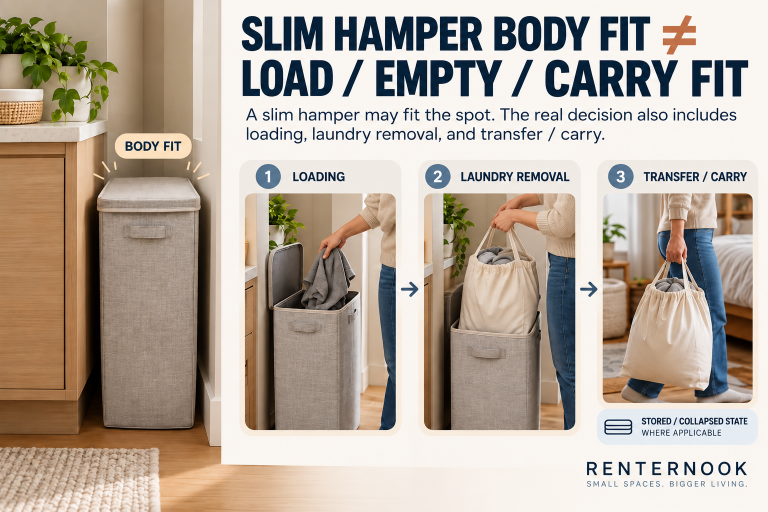
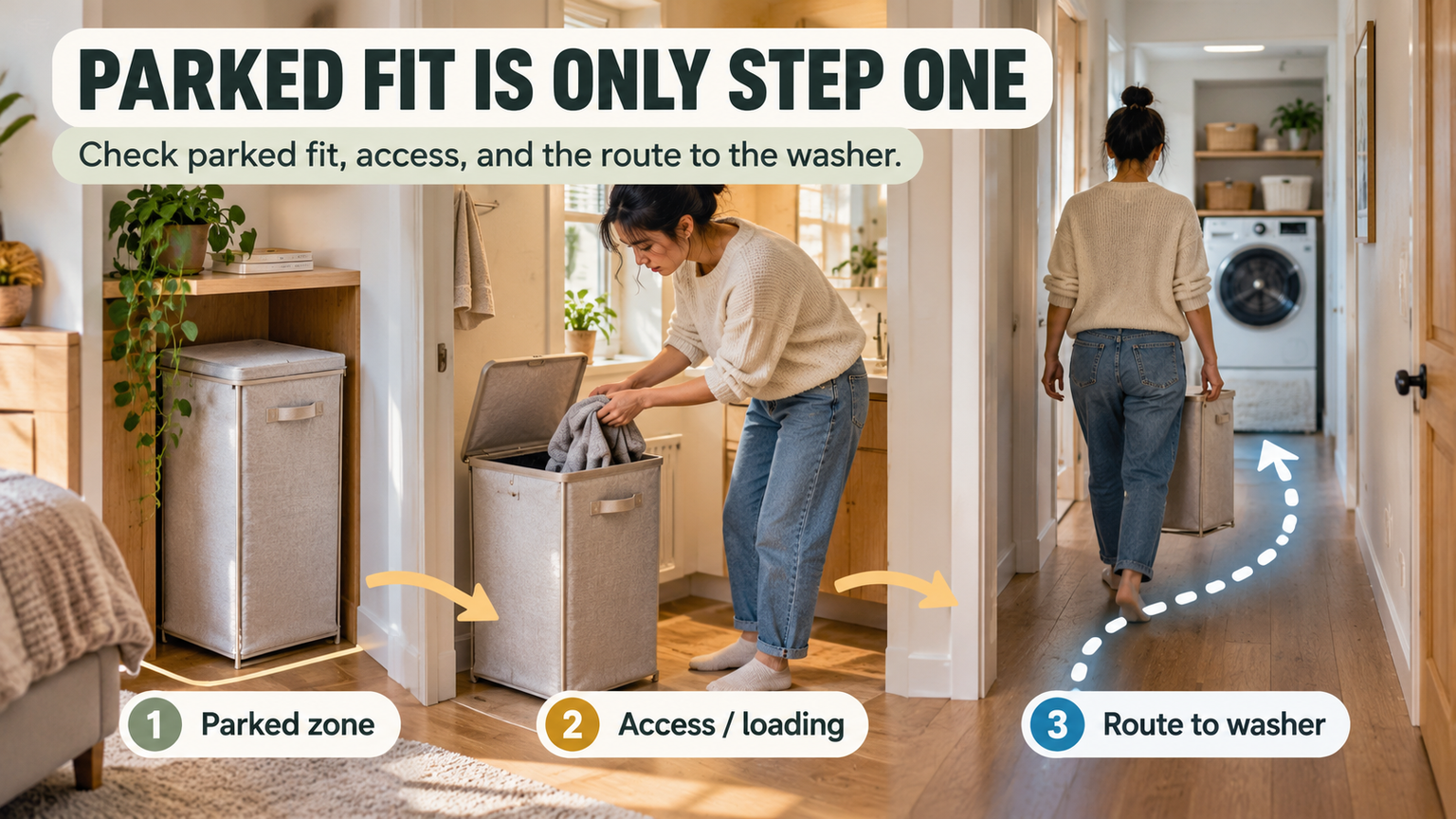
That is why the smallest published dimension is only one part of the decision. A hamper can fit while parked and still fail during loading, bag removal, sorting, or transport.
For a small apartment, the useful question is not just, “How narrow is the hamper?” It is, “Will this exact laundry-storage format fit where I want to park it, remain accessible there, and work through the route from dirty-clothes storage to the washer?”
This guide compares four locked laundry-storage archetypes without ranking them:
- IKEA PURRPINGLA Laundry Bag with Stand, article 406.094.06 — narrow dual-sort laundry storage
- IKEA JÄLL Laundry Bag with Stand, article 305.536.07 — fold-away laundry storage
- Brabantia Stackable Laundry Box 35L, SKU 120428 — stackable front-access laundry storage
- Yamazaki Home Tosca Rolling Wire Basket, product 4778 — rolling laundry transport
The goal is to match the format to the real apartment workflow, not to treat one published measurement as proof of full working fit.
Why a Slim Published Dimension Is Not Enough
A slim laundry hamper is often selected for a bathroom gap, closet edge, bedroom corner, hallway recess, or narrow utility area. In those spaces, a small width can matter. But width alone does not tell you whether the hamper will work once you start using it.
A real fit decision can depend on:
- the full floor footprint
- the product’s external dimensions
- the available vertical space
- the room needed above a top opening
- the space needed to remove a bag or liner
- the number of laundry compartments
- the product’s storage format
- the path used to reach the opening
- the route from the parked position to the washer
- the way the hamper behaves when loaded
- frame or assembly requirements
- wheels, grips, handles, or folding parts
Some of those details are published. Others are specific to the room. Several remain unknown for the locked products unless the manufacturer has verified them.
For that reason, treat a published body dimension as a product specification, not as proof of full working clearance.
Start With Two Separate Fit Questions
Before comparing products, separate the decision into two states.
1. Parked fit
Parked fit asks whether the hamper can occupy the intended storage position without colliding with the surrounding space.
Measure:
- usable floor width
- usable floor depth
- available height
- nearby walls or cabinetry
- baseboards or trim
- doors or drawers that open into the same zone
- walking space that must remain clear
A hamper can pass the parked-fit check and still fail the second state.
2. Use, access, and transport fit
This asks whether the hamper still works when you actually load laundry, sort it, remove a bag, open a lid or front access point, fold the product, grip it, roll it, or carry laundry to the washer.
The required working envelope may be larger than the parked envelope.
For example, a top-opening design may need vertical clearance above the published body height. A removable bag may need space to lift upward. A rolling basket may need enough path width and turning space to leave its parked position.
Those working clearances are not automatically included in a simple width × depth × height listing.
What to Measure Before Shopping
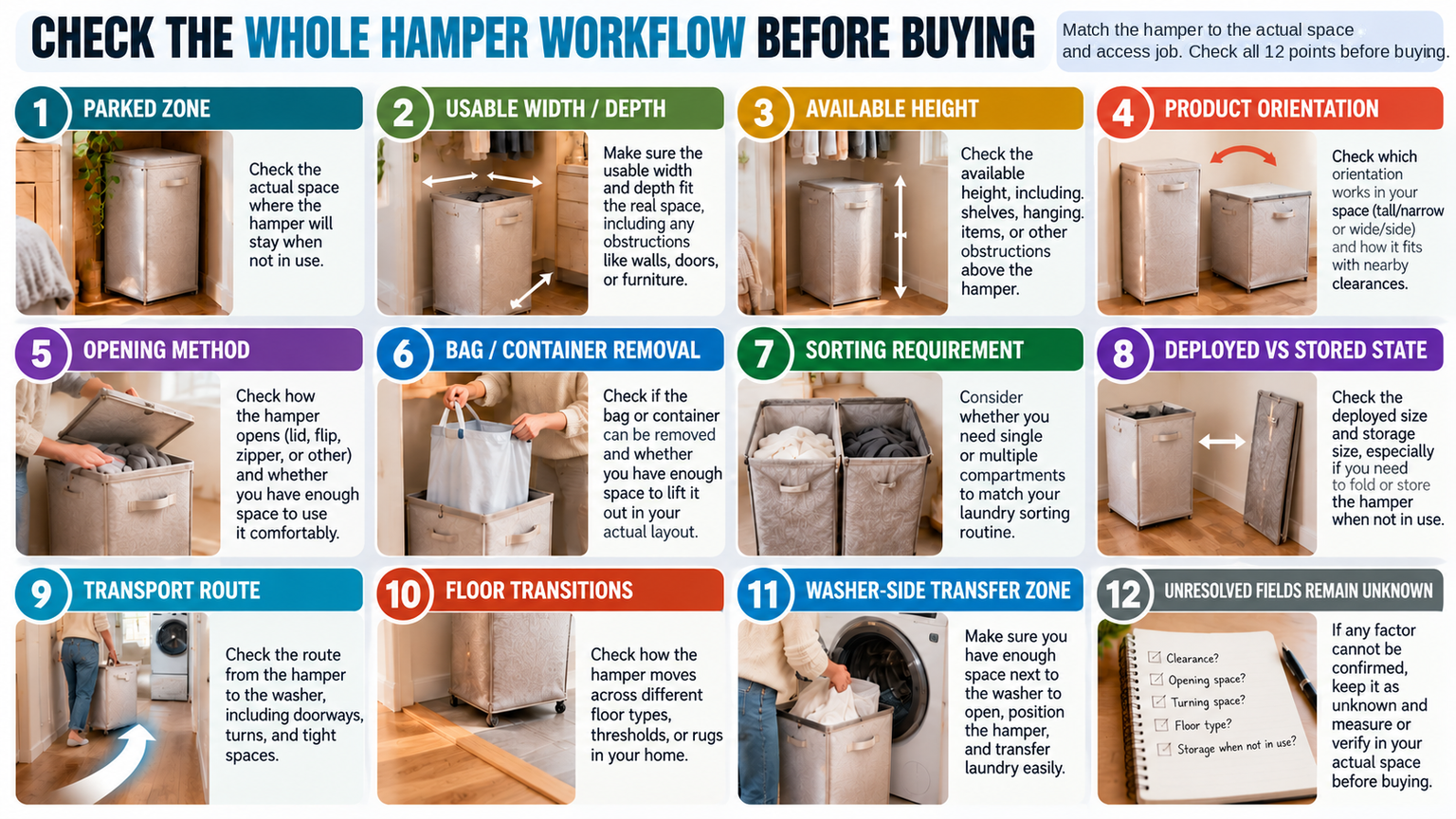
1. Available floor footprint
Measure the exact rectangular or irregular area where the hamper will sit.
Do not assume the visible gap is fully usable. Check baseboards, door trim, pipes, cabinet edges, wall projections, and other objects that reduce the real footprint.
If the location is beside a washer, vanity, dresser, or closet, also check whether those items need service or opening clearance.
2. External dimensions
Use the manufacturer’s published body dimensions as the starting envelope.
Keep the orientation straight. A product listed with length, width, and height may not use the same dimension labels as another product. Match the actual product orientation to your real floor space instead of comparing a single number out of context.
3. Height and vertical clearance
Measure from the floor to the lowest overhead obstruction that matters in use.
A top-opening hamper may require more than its published body height if you need to lift laundry out from above. A removable inner bag may require additional upward movement.
The exact opening or removal clearance remains unknown unless published or measured in the real room.
4. Opening clearance
Identify how the product is accessed.
The locked set includes top opening, top-and-front access, and open-top formats. Each creates a different working-space problem.
Check whether a shelf, counter, hanging clothes, wall edge, or adjacent furniture interferes with the access method.
5. Bag or liner removal clearance
If a bag is removable, ask where it moves when you take it out.
A bag that lifts upward may need more vertical space than the parked body. It may also widen or change shape once loaded.
For the locked products, do not assume an exact bag-removal envelope unless it is verified.
6. Capacity
Capacity helps describe how much laundry storage the manufacturer publishes, but capacity does not prove room fit or carrying comfort.
Compare capacity only after the product fits the physical space and workflow.
7. Sorting format
Ask whether you need one laundry stream or more than one.
A two-compartment design can support sorting at the parked position. A one-compartment design may suit a simpler workflow. Multiple separate stackable boxes can also create separate streams, but stacking behavior, maximum stack count, and stacking load must remain within verified evidence.
8. Storage format
The four locked products represent different architectures:
- removable fabric bag on a frame
- foldable bag with stand
- stackable fabric box with top and front access
- open-top rolling wire basket
Those formats change the space needed for parking, access, collapse, loading, and transport.
9. Access in a narrow placement
Measure whether you can actually reach the opening once the hamper is installed.
A body can fit between two fixed surfaces while your hand, laundry, or removable bag still lacks usable access.
10. Transport route to the washer
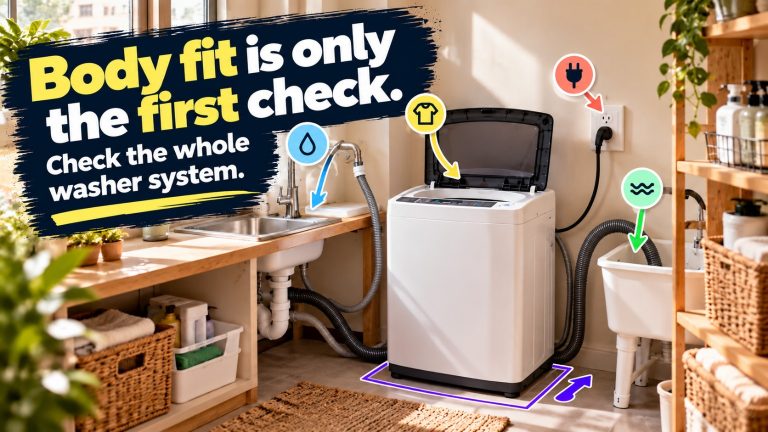
Trace the route from the parked position to the washer.
Check:
- doorway width
- hallway width
- corners
- thresholds
- rugs or carpet transitions
- stairs, if relevant
- the final loading position at the washer
The product’s body dimensions do not prove loaded transport behavior through that route.
11. Parked position during daily use
Decide whether the hamper remains in place while laundry is added and removed, or whether it will be moved frequently.
That distinction changes the value of removable bags, folding frames, front access, handles, and wheels.
12. Assembly and frame requirements
A hamper with a stand or frame occupies a defined structure even when the bag itself looks flexible.
Check what must remain assembled in the parked position. If a product folds, confirm whether you will realistically fold it between uses or keep it deployed.
Published folded dimensions remain unknown where they are not provided in the locked evidence.
Four Laundry-Storage Archetypes
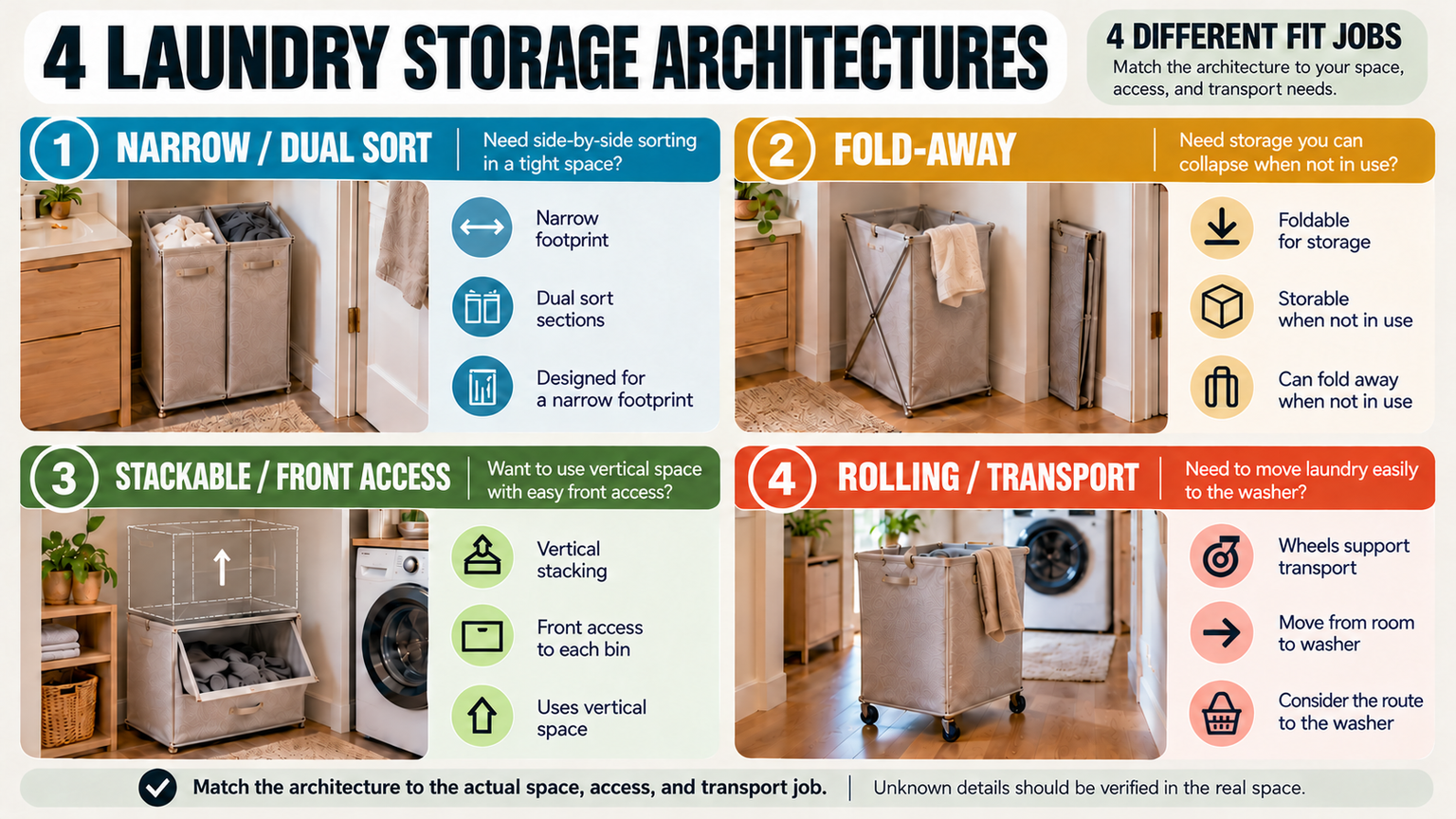
These products are useful as four different decision formats. They should not be read as a product ranking.
R1 — IKEA PURRPINGLA Laundry Bag with Stand, 406.094.06
PURRPINGLA is the narrow dual-sort format in the locked set.
Published dimensions are 8 inches wide, 17 1/4 inches deep, and 22 1/2 inches high. Published capacity is 11 gallons. The published maximum load is 282 ounces, approximately 17.6 pounds.
It has two compartments and uses a removable fabric bag with a steel frame. The opening is at the top. The bag is removable, and the bag has a handle for transport.
The key decision is not simply that one published dimension is 8 inches. The buyer still needs to verify the full 8 × 17 1/4-inch floor envelope, the 22 1/2-inch body height, the space above the top opening, and the clearance needed to remove the bag.
For a narrow placement, the two-compartment format can matter if sorting at the storage point is part of the workflow. But the exact opening clearance, bag-removal space, and real-world gap fit remain unknown until checked against the room.
Loaded transport behavior also remains unverified. A handle is present on the bag, but that does not prove how the loaded bag will behave for every user or route.
R2 — IKEA JÄLL Laundry Bag with Stand, 305.536.07
JÄLL represents the fold-away format.
Published dimensions are 16 1/2 inches long, 17 inches wide, and 23 1/2 inches high. Published capacity is 13 gallons. The published maximum load is 282 ounces, approximately 17.6 pounds.
It has one compartment and uses a foldable bag with stand. The opening is at the top, and the product is published as foldable.
This changes the decision compared with a permanently rigid hamper. Folding can matter when the buyer wants to store the laundry container away at some times rather than keep it deployed continuously.
However, the locked evidence does not provide the folded dimensions. That means the buyer should not infer how small the folded package becomes or whether it will fit a specific storage slot after folding.
When deployed, the full published 16 1/2 × 17-inch floor envelope still matters. The top opening also needs usable access above the 23 1/2-inch body height.
The one-compartment format should be evaluated against the buyer’s sorting routine rather than compared as inherently superior or inferior to a two-compartment system.
R3 — Brabantia Stackable Laundry Box 35L, SKU 120428
The Brabantia Stackable Laundry Box represents the stackable and front-access format.
Published dimensions are 14.6 inches long, 12.6 inches wide, and 17.5 inches high. Published capacity is 35 liters, approximately 9.2 gallons.
Each box has one compartment. The format is a stackable fabric box with both top and front access. It folds flat, and integrated grips support transport.
This architecture creates a different small-space decision. The buyer may be interested in vertical use because the product is identified as stackable, while front access can matter when reaching a lower box.
But several stacking questions remain outside the locked evidence. The load limit is unknown. Maximum stack count is unknown. Stacking load, stacked stability, and the exact clearance needed to use the front opening are also unknown.
Therefore, do not turn the word “stackable” into a universal stacking claim. If multiple boxes are part of the plan, verify the manufacturer’s current stacking guidance and test the intended loaded arrangement.
The front-access feature also does not prove that a box can be accessed inside every narrow gap. The actual door or flap movement and hand clearance must work in the real placement.
R4 — Yamazaki Home Tosca Rolling Wire Basket, Product 4778
The Tosca Rolling Wire Basket represents the rolling transport format.
Published dimensions are 18.7 inches long, 11.02 inches wide, and 24.02 inches high. Published capacity is 55 liters, approximately 14.5 gallons. The published maximum load is 17.6 pounds.
It has one compartment and uses an open-top rolling wire-basket format. The published materials are steel and wood. Transport features include a handle and wheels. Assembly is described by the manufacturer as minimal.
The decision here is strongly tied to movement. A buyer considering this format should measure not only the parked footprint but also the path needed to roll the basket to the washer.
Wheel protrusion, turning radius, floor compatibility, carpet rollability, threshold compatibility, and loaded transport behavior remain unknown in the locked evidence.
For that reason, the presence of wheels should not be treated as proof that the basket will roll easily on every apartment floor or through every route.
The open-top format also changes access. It may not require a lid-opening motion, but the buyer still needs enough vertical and hand clearance to load and unload laundry where the basket is parked.
Model-Specific Comparison
| Product | Decision archetype | Published exterior size | Capacity | Compartments | Access / format | Transport feature | Published load limit |
|---|---|---|---|---|---|---|---|
| IKEA PURRPINGLA 406.094.06 | Narrow / dual sort | 8 W × 17 1/4 D × 22 1/2 H in | 11 gal | 2 | Top-opening removable fabric bag with steel frame | Bag handle | 282 oz / approx. 17.6 lb |
| IKEA JÄLL 305.536.07 | Fold-away | 16 1/2 L × 17 W × 23 1/2 H in | 13 gal | 1 | Top-opening foldable bag with stand | Not separately verified here | 282 oz / approx. 17.6 lb |
| Brabantia Stackable Laundry Box 35L, 120428 | Stackable / front access | 14.6 L × 12.6 W × 17.5 H in | 35 L / 9.2 gal | 1 per box | Top and front access; folds flat | Integrated grips | Unknown |
| Yamazaki Home Tosca Rolling Wire Basket 4778 | Rolling / transport | 18.7 L × 11.02 W × 24.02 H in | 55 L / 14.5 gal | 1 | Open-top rolling wire basket | Handle and wheels | 17.6 lb |
The table is a specification reference. It does not establish buyer-specific working clearance, access clearance, or transport compatibility.
How to Match the Format to the Laundry Job
If the priority is sorting at the parked position
The first question is how many laundry streams you actually need before wash day.
PURRPINGLA has two compartments. That is a verified structural difference from the three one-compartment products in the locked set.
The decision still includes access. Two compartments are only useful if both openings remain reachable in the chosen placement and the removable bag can be taken out when needed.
If the priority is putting the hamper away between uses
JÄLL is the foldable bag-and-stand format.
The buyer should separate “foldable” from “verified folded size.” Folding is supported by the evidence, but the folded dimensions are not.
If the intended workflow depends on sliding the folded product behind a door, under furniture, or into a specific closet slot, measure that storage location and verify the folded package before relying on the plan.
If the priority is vertical organization with access to a lower unit
The Brabantia 35L box combines a stackable format with front access.
That can make it relevant to a vertical laundry setup, but the decision requires more than the body dimensions of one box.
If you intend to stack multiple units, keep these questions explicit:
- How many units does the manufacturer support in the intended configuration?
- What loaded weight is supported?
- How stable is the loaded stack?
- How much front clearance is needed to load and unload the lower box?
- Can the top opening still be used where the stack is parked?
Those answers are not established by the locked evidence and should remain unknown until verified.
If the priority is moving laundry to the washer
The Tosca basket includes both a handle and wheels.
That makes the transport route a central part of the purchase decision. Measure the narrowest point between the parked location and the washer and look for direction changes, rugs, thresholds, and doorway transitions.
The published width of 11.02 inches is useful, but it does not establish wheel protrusion, turning radius, or loaded maneuverability.
Capacity Is Only One Part of the System
The four products publish different capacities:
- PURRPINGLA: 11 gallons
- JÄLL: 13 gallons
- Brabantia Stackable Laundry Box: 35 liters / 9.2 gallons
- Tosca Rolling Wire Basket: 55 liters / 14.5 gallons
Those values help describe the manufacturer’s stated storage volume, but a larger capacity does not resolve the small-space decision by itself.
A higher-capacity hamper may require a larger floor envelope or greater transport effort. A lower-capacity unit may require more frequent trips to the washer. A two-compartment product may split its storage differently from a single-compartment one.
The right capacity therefore depends on household laundry volume, wash frequency, sorting routine, and the available physical space.
Those household variables are buyer-specific and are not inferred here.
Top Access, Front Access, and Open-Top Use
Access architecture changes the working envelope.
Top-opening formats
PURRPINGLA and JÄLL use top openings. The Brabantia box also has top access.
For these formats, measure above the hamper. If the product sits under a counter, shelf, hanging rail, or wall cabinet, the body can fit while the opening becomes inconvenient or unusable.
The exact required top-opening clearance is not published in the locked evidence.
Front access
The Brabantia box adds front access.
Front access can change how the box is used in a vertical arrangement, but the exact front-clearance requirement remains unknown. The buyer still needs enough space for the opening movement, a hand, and the laundry itself.
Open-top rolling format
The Tosca basket is open at the top.
This removes a separate lid-opening step, but it does not remove the need for overhead access. The user still needs room to place laundry into the basket and remove it at the parked location.
Removable Bags, Grips, Handles, and Wheels
Transport features should be checked as part of the whole route.
PURRPINGLA uses a removable bag with a handle. The Brabantia box has integrated grips. The Tosca basket has a handle and wheels.
Those are verified product features. They do not establish universal carrying comfort, loaded balance, rolling performance, or threshold compatibility.
For a real apartment workflow, test or verify:
- whether the loaded product can clear the narrowest doorway
- whether the user can lift or pull it from the parked position
- whether the route requires tight turns
- whether the route crosses rugs, thresholds, or carpet
- whether the product needs to be carried on stairs
- whether the washer loading area has room to park the hamper during transfer
Loaded transport behavior remains unknown unless supported by product-specific evidence.
What the Published Specifications Do Not Prove
The locked product evidence is useful, but several buyer-critical questions remain unresolved.
Do not infer the following from the body dimensions or format labels alone:
- exact top-opening clearance
- exact bag-removal space
- fit in a particular apartment gap
- folded dimensions where they are not published
- loaded carrying behavior
- stacking load for the Brabantia box
- maximum stack count
- loaded stack stability
- exact front-access clearance
- wheel protrusion
- turning radius
- compatibility with every hard floor
- carpet rollability
- threshold compatibility
- access while parked in every location
An unknown field is not zero. It is not a positive result. It is not a negative result.
It means the current evidence does not establish the answer.
A 12-Step Pre-Buy Fit Check
Use this sequence before buying a slim laundry hamper for a small apartment.
Step 1 — Mark the parked zone
Identify the exact floor area where the hamper will remain during normal use.
Step 2 — Measure usable width and depth
Measure the real space after accounting for trim, baseboards, pipes, door swing, and nearby furniture.
Step 3 — Measure available height
Check the body-height limit and any overhead shelf, counter, rail, or cabinet.
Step 4 — Match the product orientation
Do not compare only the smallest published dimension. Map the full length or depth and width to the actual room orientation.
Step 5 — Check the opening method
Verify top, front, or open-top access in the real location.
Step 6 — Check bag or container removal
For removable bags or boxes, confirm that the removal path exists and that the product can clear nearby obstructions.
Step 7 — Decide the sorting requirement
Confirm whether one compartment, two compartments, or multiple separate boxes match the household workflow.
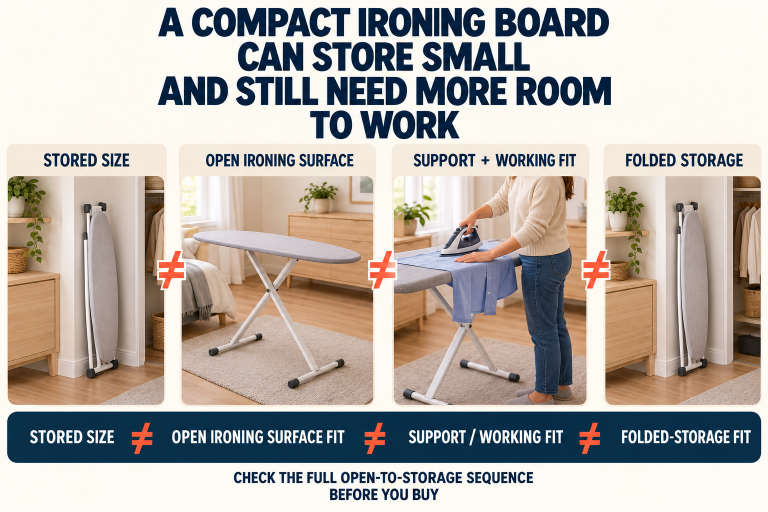
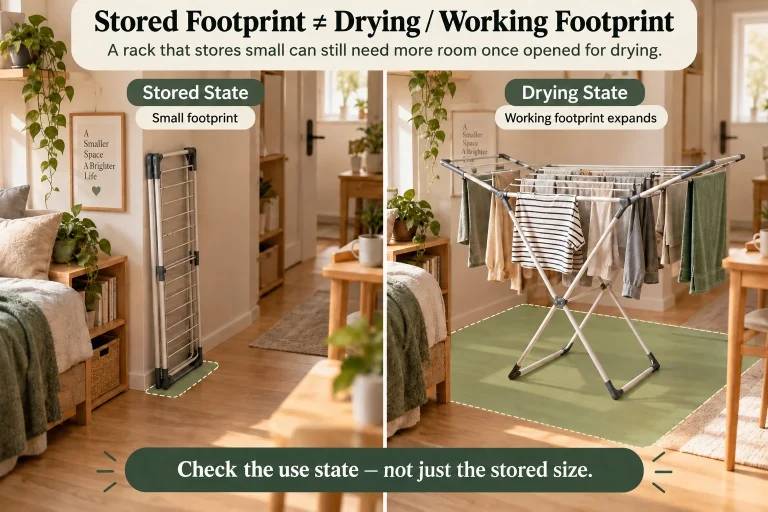
Step 8 — Confirm deployed versus stored state
If folding or stacking is part of the plan, distinguish the normal working state from the stored or collapsed state.
Step 9 — Trace the transport route
Measure the route to the washer, including the narrowest doorway and any direction changes.
Step 10 — Check the floor transitions
Identify rugs, carpet, thresholds, or uneven surfaces that could affect rolling or dragging.
Step 11 — Check the washer-side transfer zone
Confirm there is enough room to place or hold the hamper while moving laundry into the washer.
Step 12 — Keep unresolved fields visible
If opening clearance, folded dimensions, loaded movement, stacking limits, or wheel behavior matters to the setup and remains unknown, verify it before purchase.
Four Decision Paths
The locked set can be summarized as four different laundry-storage paths.
PURRPINGLA: choose this archetype when the decision centers on a narrow parked footprint plus two-way sorting, then verify top access and removable-bag clearance.
JÄLL: choose this archetype when fold-away behavior matters, then verify both the deployed footprint and the still-unknown folded dimensions for the intended storage location.
Brabantia Stackable Laundry Box: choose this archetype when vertical organization and front access matter, then verify stacking guidance, load, stability, and front-access clearance before building a multi-box system.
Tosca Rolling Wire Basket: choose this archetype when the laundry route to the washer is a major part of the job, then verify wheel behavior, turning space, floor conditions, and the real loaded route.
These are decision archetypes, not universal prescriptions.
The Fit-First Rule for Small-Apartment Laundry Storage
For a slim laundry hamper, the smallest published dimension does not prove that the product will work in the real apartment.
The practical decision is the full system:
parked footprint + body dimensions + vertical clearance + opening access + bag or liner removal + capacity + sorting format + storage architecture + narrow-space access + transport route + parked workflow + frame or assembly requirements.
Measure the parked zone first. Then measure the working zone. Match the product architecture to the actual laundry routine, and keep every unsupported field visible as unknown until it is verified.