
Compact Dryers for Small Apartments: Check Venting, Power, Door, and Installation Fit Before You Buy
A compact dryer can look small enough for an apartment and still fail the installation.
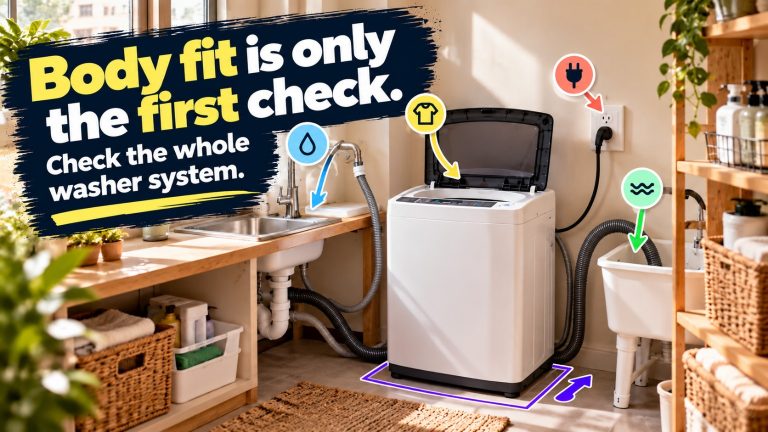
The cabinet is only one part of the system. A real fit check also has to cover the door, the vent or condensate path, the electrical supply, the way the dryer is supported or stacked, and the maintenance access you will need after installation.
That is the core rule for this guide:
BODY FIT DOES NOT PROVE INSTALLATION FIT.
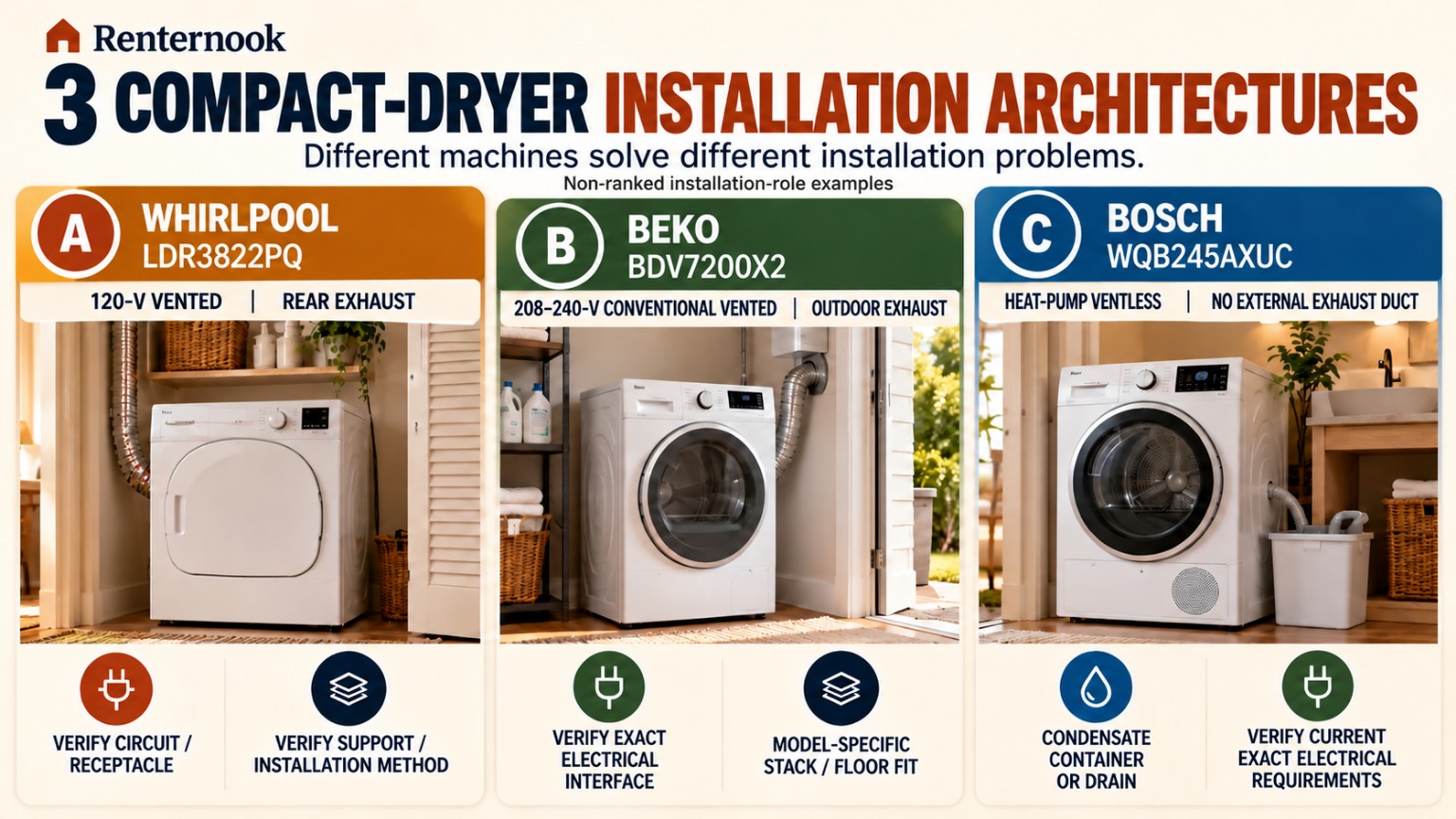
The three dryers below are not ranked. They represent three different installation architectures:
- Whirlpool LDR3822PQ — 120-V vented compact dryer with flexible installation options.
- Beko BDV7200X2 — 208–240-V conventional vented compact dryer with fixed stackability requirements.
- Bosch WQB245AXUC — ventless heat-pump compact dryer with a condensate workflow.
The useful buying question is not “Which one is best?” It is:
Can this exact dryer be installed, powered, opened, vented or drained, serviced, and used normally in my apartment?
Start With the Installation System, Not the Cabinet Size
A dryer that physically fits between two walls is not automatically installable.
Before comparing products, check seven layers:
- Body / placement — Does the dryer cabinet fit the intended location?
- Door / load access — Can the door open far enough to load and unload normally?
- Vent / condensate — Where does moisture leave the machine?
- Power / circuit — Does the apartment provide the electrical supply the exact model requires?
- Mount / stack / floor — How is the machine supported, installed, or stacked?
- Lint / service — Can you access the filters, ducting, drain path, or service points?
- Normal operation — Can the machine operate without blocking the room or creating an unworkable maintenance routine?
These layers should stay separate.
120 V does not prove outlet suitability.
208–240 V does not prove receptacle compatibility.
Vented does not prove one universal duct length.
Ventless does not mean installation-free.
Heat pump does not remove condensate decisions.
Stackable does not mean universally compatible.
Wall-mountable does not mean renter-approved.
Body depth does not equal door-open depth.
And if a material detail is not established, keep it unknown rather than turning it into a pass, fail, or zero.
Quick Comparison: 3 Compact-Dryer Installation Architectures
| Product | Architecture role | Key published fit facts | Main apartment-fit question |
|---|---|---|---|
| Whirlpool LDR3822PQ | 120-V vented compact / flexible installation | 23 7/8 in W × 21 7/8 in D × 31–32 5/16 in H with feet; 36 in door-open depth; 3.4 cu ft; 120 VAC / 60 Hz; minimum 15-A circuit; max 12-A draw; rear vent only | Can the apartment support the exact rear-vent path, electrical circuit, door-open depth, and chosen mounting / floor configuration? |
| Beko BDV7200X2 | 208–240-V conventional vented / fixed-stackable | 23 1/2 in W × 23 in D × 33 11/16 in H; 40 7/8 in door-open depth; 208/240 V, 60 Hz; 2000–2400 W; rated 10 A; minimum 15-A breaker; vented outdoors | Does the apartment have the correct electrical interface, a compliant outdoor exhaust route, and the required working depth? |
| Bosch WQB245AXUC | Heat-pump ventless / condensate workflow | 23.5 in W × 33.25 in H × 26 in closed depth; 43.5 in door-open depth; 4.0 cu ft; ventless heat-pump system; condensate must still go to a container or drain | Is the condensate path, electrical supply, door-open space, and service access workable even without an external exhaust duct? |
The important difference is not which machine is “better.” The important difference is what kind of installation problem each architecture creates.
1. Whirlpool LDR3822PQ — 120-V Vented Compact / Flexible Installation
The Whirlpool LDR3822PQ is a 3.4-cu-ft compact front-load dryer that uses a vented drying system and a 120-V electrical supply.
For planning, use the values from Whirlpool’s exact W11462154B Dimension Guide rather than silently mixing dimensions from the commerce page.
Published planning dimensions are:
- 23 7/8 in wide
- 21 7/8 in deep
- 31 to 32 5/16 in high with feet
- 36 in deep with the door open
- power cord length listed at 71 7/16 in
The published capacity is 3.4 cu ft.
Power fit
Whirlpool publishes:
- 120 VAC
- 60 Hz
- minimum 15-A circuit
- maximum 12-A draw
That makes this model materially different from many conventional electric dryers, but it still does not prove that an existing apartment outlet or circuit is suitable.
The circuit, receptacle, grounding, and installation condition still need to match the exact installation requirements.
Vent fit
This is a vented dryer.
The published exhaust arrangement is rear-only.
Whirlpool’s published maximum vent length for the configuration used in the dimension material is 36 ft. The Dimension Guide also provides the exhaust outlet position, including an exhaust height range of 3 1/8 to 4 3/8 in and a side offset of 11 7/8 in.
Those values are useful for planning the connection point.
They are not permission to assume that every apartment can use a 36-ft duct run. The actual exhaust route, fittings, termination, and building rules still control the installation.
Installation fit
Whirlpool presents this model as a flexible-installation compact dryer. The first-party materials establish options that can include floor use and product-specific mounting / mobility configurations.
Do not convert that into a universal renter-safe claim.
A wall-mount or alternate support option still depends on the exact installation method, wall or floor condition, hardware, and housing rules.
Door / load access
Use 36 in door-open depth for planning the working access envelope.
Do not assume the closed-body depth of 21 7/8 in represents the real loading depth.
Whirlpool source material contains a door-reversibility conflict for this model. Because the research evidence did not resolve that conflict, this article does not claim that the door is reversible or non-reversible.
Lint / service
The product uses a lint screen and a vented exhaust path. Plan for normal access to the lint screen and for the exhaust system to remain inspectable and serviceable.
Important unknowns / conflicts
- Door reversibility: source conflict — no single editorial claim.
- Net weight: unknown for a single-value editorial claim.
- Current direct owner-manual URL: not found in the sources reviewed for this guide; do not infer manual-specific facts beyond what those sources establish.
- Commerce-page depth vs exact Dimension Guide: use the Dimension Guide planning values above; do not silently merge values.
Check before buying
- Does the 23 7/8 × 21 7/8-in body fit the intended position?
- Is 36 in of door-open depth workable?
- Can the rear exhaust route reach an approved termination without relying on an invented universal duct rule?
- Is the actual circuit and receptacle suitable for the exact 120-V installation?
- If you intend to mount or otherwise configure the dryer beyond a normal floor installation, is that method allowed and structurally appropriate for your home?
- Can you reach the lint screen and vent system for routine maintenance?
2. Beko BDV7200X2 — 208–240-V Conventional Vented / Fixed-Stackable
The Beko BDV7200X2 is a 24-inch-class front-load vented electric dryer.
Published specification dimensions are:
- 23 1/2 in wide
- 23 in deep
- 33 11/16 in high
- 40 7/8 in deep with the door open
- 68 in stacked height in the published stack configuration
- published cutout: 36 in H × 24 3/4 in W × 25 in D
Capacity: preserve the source distinction
Beko’s first-party sources use slightly different rounded capacity values:
- product page: 3.8 cu ft
- specification sheet: 3.7 cu ft
- manual: 3.77 cu ft
These refer to the same model family but should not be silently collapsed into one supposedly exact number.
For fit decisions, cabinet, access, power, and exhaust requirements matter more than choosing one rounded capacity label over another.
The research also records a dry-load figure of 15.5 lb / 7 kg where published.
Power fit
Beko publishes:
- 208/240 V
- 60 Hz
- 2000–2400 W
- rated 10 A
- minimum 15-A breaker
- included power cord length about 4.9 ft
The manual contains a model-specific 4-wire connection workflow and warns against using an extension cord, multi-plug, or adapter.
A 208–240-V requirement does not by itself prove that an apartment’s receptacle is compatible. Receptacle type, wiring, grounding, circuit condition, and local installation requirements still need to match the exact model instructions.
Vent fit
This is a conventional vented dryer.
Beko requires the exhaust to terminate outdoors using appropriate rigid or flexible metal ducting. The manual specifically warns against exhausting into a chimney, wall, ceiling, attic, crawlspace, or concealed building space.
The permitted run depends on the duct configuration rather than one universal maximum.
The manual provides configuration examples for rigid duct runs including:
- 0 elbows: 92 ft
- 1 elbow: 82 ft
- 2 elbows: 72 ft
- 3 elbows: 62 ft
- 4 elbows: 52 ft
Treat those as configuration-dependent examples from the exact manual, not as one blanket limit for every installation.
Door / load access
The door is right-hinged and the exact manual/spec evidence establishes non-reversible for this model.
Use the published 40 7/8-in door-open depth when checking loading access.
Stack / installation fit
The BDV7200X2 is stackable only through the model-specific stacking arrangement. The sources reviewed for this guide identify stacking kit 2979540100.
“Stackable” therefore does not mean compatible with any washer or any generic stacking hardware.
The apartment must still support the stack configuration, required clearances, electrical connection, exhaust route, and service access.
Lint / service
Beko instructs the user to clean the lint filter before or after each load.
The exhaust and internal duct path also require periodic inspection / cleaning or service as described in the manual.
That means a compact placement must still leave a practical maintenance path.
Important source distinctions
- Capacity: preserve 3.7 / 3.77 / 3.8 cu ft as source-specific rounding rather than pretending they are one exact published value.
- Weight: the reviewed first-party sources contain differences between specifications and product-page values. No buying decision in this article depends on choosing one rounded weight value.
- Vent run: configuration-dependent; do not publish one universal maximum independent of bends and duct geometry.
Check before buying
- Does the 23 1/2 × 23-in body fit the location?
- Is 40 7/8 in of door-open depth workable?
- Does the apartment provide the correct 208/240-V installation and receptacle interface?
- Can the exhaust reach outdoors through a compliant metal-duct route?
- If stacking, is the exact washer / dryer combination compatible with the specified stacking kit?
- Can you reach the lint filter and service the exhaust path after installation?
3. Bosch WQB245AXUC — Heat-Pump Ventless / Condensate Workflow
The Bosch WQB245AXUC is a 4.0-cu-ft compact heat-pump dryer.
It is ventless, which removes the need for an external exhaust duct.
It does not remove installation planning.
Published dimensions include:
- 23.5 in wide
- 33.25 in high
- 26 in closed depth on the current specification material
- 43.5 in depth with the door open
The manual also provides a 24.125-in body-only depth measurement, and the adjustable feet can add up to 5/8 in.
Those measurements describe different reference conditions. Do not silently merge them into one supposedly universal depth.
Door / load access
The machine is front-loading.
The current source set identifies a right-hinged, reversible door.
Use 43.5 in door-open depth when checking whether the machine can be loaded normally in a narrow apartment space.
Ventless does not mean moisture disappears
The WQB245AXUC uses a heat-pump / condensation system rather than an external exhaust duct.
Moisture still has to leave the machine as condensate.
The first-party documentation supports two condensate workflows:
- collection in the machine’s condensate container; or
- direct discharge to wastewater using the drain arrangement described in the manual.
The manual provides drain-position guidance for the exact hose setup, including published height ranges for specific installation cases.
So the right question is not “Do I need a vent?”
It is:
Where will the condensate go every cycle, and can I maintain that path reliably?
A ventless dryer can therefore solve an exhaust-routing problem while creating a different drain / container workflow that still needs space and access.
Power fit
The sources reviewed for this guide contain conflicting first-party values for weight, power, and protection / circuit-related fields across current Bosch sources.
Those conflicts are intentionally preserved.
This article therefore does not publish a single reconciled wattage, protection value, or weight.
Do not average the values and do not silently choose one source as universally controlling without a specific adjudication.
For installation, verify the current exact Bosch installation requirements against the apartment’s electrical supply before purchase.
Stack / installation fit
Bosch presents the model as part of its compact laundry system, but stacking remains a model-specific installation question.
“Stackable” does not mean universal compatibility. The supporting washer, stacking hardware, floor condition, clearances, and service access all still matter.
Lint / service fit
Heat-pump dryers still require routine lint / filter maintenance and access to the condensate system.
A closet or niche that makes the dryer difficult to service is not a complete fit even if the cabinet slides into place.
Important unknowns / conflicts
- Weight: source conflict — reviewed first-party sources contain differing values; no single-value editorial claim.
- Power / wattage: source conflict — no single-value editorial claim.
- Protection / circuit-related value: source conflict — no single-value editorial claim.
- Closed depth: current spec and manual expose different measurement bases; preserve the published reference condition rather than silently collapsing them.
Check before buying
- Does the 23.5-in-wide cabinet fit the location?
- Is 43.5 in of door-open depth workable?
- Will condensate be collected in the container or sent to a drain?
- If using direct drainage, can the exact hose routing and drain position be installed as Bosch specifies?
- Does the apartment’s electrical supply match the current exact installation requirements?
- If stacking, is the exact Bosch configuration supported?
- Can filters and condensate components be reached for routine maintenance?
How to Check a Compact Dryer Before You Buy
1. Measure the body
Start with width, closed depth, and height.
Do not stop there.
Published body dimensions tell you whether the cabinet can occupy the location. They do not establish loading access, duct routing, drain routing, or service access.
2. Measure the door-open state
For the three products compared in this guide, published door-open depth is materially larger than closed depth:
- Whirlpool LDR3822PQ: 36 in
- Beko BDV7200X2: 40 7/8 in
- Bosch WQB245AXUC: 43.5 in
Check the actual walkway, nearby cabinetry, door swing, and loading position using the open-door state.
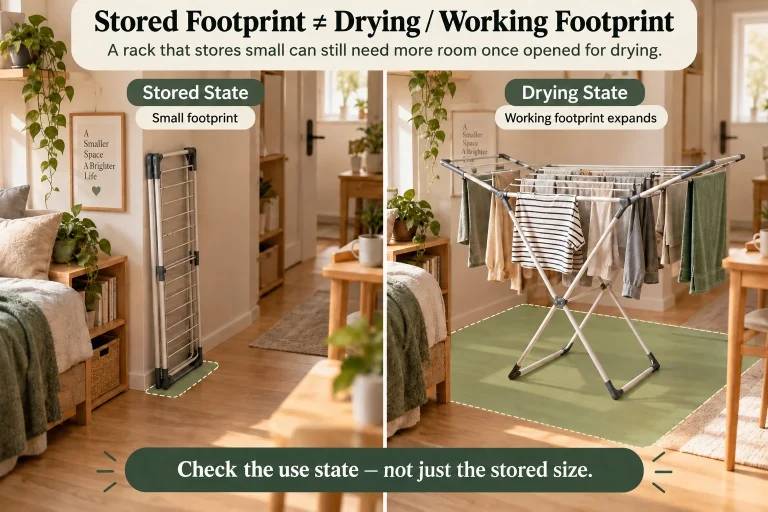
BODY DEPTH ≠ DOOR-OPEN DEPTH.
3. Decide how moisture leaves the dryer
For Whirlpool and Beko, the problem is an exhaust path.
For Bosch, the problem is a condensate path.
Those are different installation systems.
For vented models, verify outlet position, duct material, bends, total route, outdoor termination, building / lease restrictions, and service access.
For the ventless heat-pump model, verify condensate container workflow or direct drain workflow, drain position, hose routing, and access for cleaning and service.
Ventless means no external exhaust duct. It does not mean no moisture-management decision.
4. Verify the exact electrical interface
Whirlpool publishes a 120-V / 60-Hz installation with a minimum 15-A circuit and a maximum 12-A draw.
Beko publishes 208/240 V / 60 Hz, 2000–2400 W, rated 10 A, and a minimum 15-A breaker, with a model-specific 4-wire workflow.
Bosch’s current first-party sources contain conflicting electrical / protection values, so this article does not collapse them into one number.
Do not judge electrical compatibility by voltage alone.
Verify the exact receptacle, circuit, grounding, and current installation instructions for the exact model.
5. Check the support / stacking system
A dryer can be floor-installed, mounted through an approved product-specific method, placed on casters or feet where allowed, or stacked with a compatible washer and stacking kit.
These options are not interchangeable.
STACKABLE ≠ UNIVERSALLY COMPATIBLE.
WALL MOUNTABLE ≠ RENTER APPROVED.
The apartment, wall or floor, hardware, lease rules, and exact product instructions all matter.
6. Protect service access
For vented dryers, plan access to the lint screen, exhaust connection, duct inspection / cleaning, and service points.
For a heat-pump ventless dryer, plan access to lint / filter components, condensate components, drain connection where used, and service points.
A dryer that fits only when all maintenance access is blocked is not a complete fit.
7. Check normal apartment use
Before buying, test the installation as a routine, not as an empty rectangle.
Ask whether the dryer door can open while the room is in normal use, whether a person can stand in front of it to load and unload, whether the exhaust or drain path interferes with other appliances or storage, whether the lint filter can be cleaned without moving the machine, whether the machine can be serviced later, and whether the lease, building, or utility setup allows the required installation.
Lease and building permission are property-specific unknowns until verified for your home.

Fit-First Compact Dryer Checklist
Before ordering a compact dryer, confirm:
- [ ] exact model number;
- [ ] cabinet width, closed depth, and height;
- [ ] door-open depth;
- [ ] door hinge / reversibility only where source evidence is clear;
- [ ] vented vs ventless architecture;
- [ ] exhaust outlet position or condensate workflow;
- [ ] duct route or drain route;
- [ ] exact voltage and circuit requirements;
- [ ] exact receptacle / wiring compatibility;
- [ ] stacking kit or mounting method where relevant;
- [ ] floor / wall / washer compatibility;
- [ ] lint / filter access;
- [ ] exhaust or condensate service access;
- [ ] normal loading / unloading space;
- [ ] lease / building permission;
- [ ] any field that remains unknown or source-conflicted.
If a material field is not established, stop at unknown until you verify it.
Common Compact Dryer Buying Mistakes
Mistake 1: Measuring only the cabinet
A 22- or 26-inch closed depth can become a much larger working depth when the door is open.
Use the door-open measurement for loading access.
Mistake 2: Treating 120 V as automatic apartment compatibility
Whirlpool’s 120-V architecture is materially different from a conventional 208–240-V electric dryer, but voltage alone does not establish receptacle or circuit suitability.
Mistake 3: Treating 208–240 V as one universal plug setup
Beko’s published voltage range still has to be matched to the exact wiring and connection instructions.
Mistake 4: Assuming “vented” tells you the whole duct plan
Whirlpool and Beko are both vented, but their vent evidence is different.
Do not copy one model’s length or routing rule onto the other.
Mistake 5: Assuming “ventless” means no moisture-management work
Bosch eliminates the external exhaust duct, but condensate still has to be collected or drained.
Mistake 6: Assuming stackable means any washer can go underneath
Stacking hardware and compatibility are model-specific.
Mistake 7: Assuming wall mounting is automatically rental-friendly
A manufacturer-supported mounting method does not establish landlord, lease, or building approval.
Mistake 8: Resolving source conflicts by averaging
Do not average conflicting weights, wattages, protection values, or dimension references.
If the research evidence does not establish one controlling value, keep the field source-conflicted or unknown.
Which Compact-Dryer Architecture Fits Your Apartment?
Consider the Whirlpool LDR3822PQ role if
- a 120-V compact-dryer architecture is relevant to your electrical situation;
- you can provide a compliant rear exhaust route;
- the 36-in door-open depth works;
- you can verify the exact support / mounting method you intend to use.
This is an installation-role example, not a recommendation that the dryer will work in every 120-V apartment.
Consider the Beko BDV7200X2 role if
- your apartment can support the exact 208/240-V installation;
- you have a compliant outdoor exhaust route;
- the 40 7/8-in door-open depth works;
- the fixed stack configuration or floor installation matches your laundry setup.
Consider the Bosch WQB245AXUC role if
- an external exhaust route is the main obstacle;
- you can manage condensate through the supported container or drain workflow;
- the 43.5-in door-open depth works;
- you can verify the current exact electrical requirements rather than relying on a conflicted single value.
These three roles solve different installation problems. None is a universal winner.
Final Takeaway
A compact dryer should be treated as an installation system, not just a small appliance cabinet.
The real fit includes:
body + door + moisture path + power + support / stack + service + normal operation.
The Whirlpool LDR3822PQ shows how a compact 120-V vented dryer can still depend on a specific rear-exhaust and installation plan.
The Beko BDV7200X2 shows how a conventional vented compact dryer depends on the exact 208–240-V electrical interface, outdoor exhaust route, and model-specific stack arrangement.
The Bosch WQB245AXUC shows that removing the external vent does not remove installation decisions; the moisture path becomes a condensate workflow instead.
Start with the exact apartment installation conditions.
Then choose the architecture that fits them.
How We Researched This Guide
Renternook compared current first-party manufacturer information for the exact products and model numbers listed here. We did not physically test these dryers.
Dimensions, electrical requirements, venting / condensate details, installation requirements, and maintenance instructions are included only where the accepted first-party source set established them. Where first-party sources conflict, the conflict is preserved instead of being silently averaged or normalized. Where a material field remains unknown, it remains unknown.
Price, stock, seller status, featured offer status, and affiliate eligibility are not treated as durable product facts in this guide.
Product Sources Reviewed
Whirlpool LDR3822PQ
- Product page: https://www.whirlpool.com/laundry/stackable-laundry/p.3.4-cu.-ft.-compact-front-load-dryer-with-flexible-installation.ldr3822pq.html
- Dimension Guide W11462154B: https://www.whirlpool.com/content/dam/global/documents/202009/dimension-guide-w11462154-revb.pdf
- Feature / specification sheet: https://www.whirlpool.com/content/dam/global/documents/202003/specification-sheet-ldr3822pspecsheetv01.pdf
- Current direct owner / installation manual URL: not found in the sources reviewed for this guide.
Beko BDV7200X2
- Product page: https://www.beko.com/us-en/products/dryers/23-503937-electric-air-vented-front-load-dryer-bdv7200x2
- User manual: https://www.beko.com/content/dam/united-states-us-aem/united-states-us-aemProductCatalog/product-documents/7185881520-BDV7200X2/en-US-7185881520-202402191123801-User-Manual—File-Longen-US.pdf
- Specification sheet: https://www.beko.com/content/dam/bekoglobal/us/en/pdf/product/7185881520.pdf
Bosch WQB245AXUC
- Product page: https://www.bosch-home.com/us/en/product/washers-and-dryers/tumble-dryers/compact-dryers/WQB245AXUC
- Support page: https://www.bosch-home.com/us/support/list/WQB245AXUC
- Manual: https://media3.bosch-home.com/Documents/9001914004_B.pdf
- Current specification sheet: https://media3.bsh-group.com/Documents/24375691_WQB245AXUC_Spec_Sheet.pdf