Portable Washing Machines for Small Apartments: Check the Whole System Before You Buy
A portable washing machine can look like an obvious small-apartment upgrade. It is smaller than a full-size washer, often marketed for compact spaces, and may be easier to move than a conventional machine.
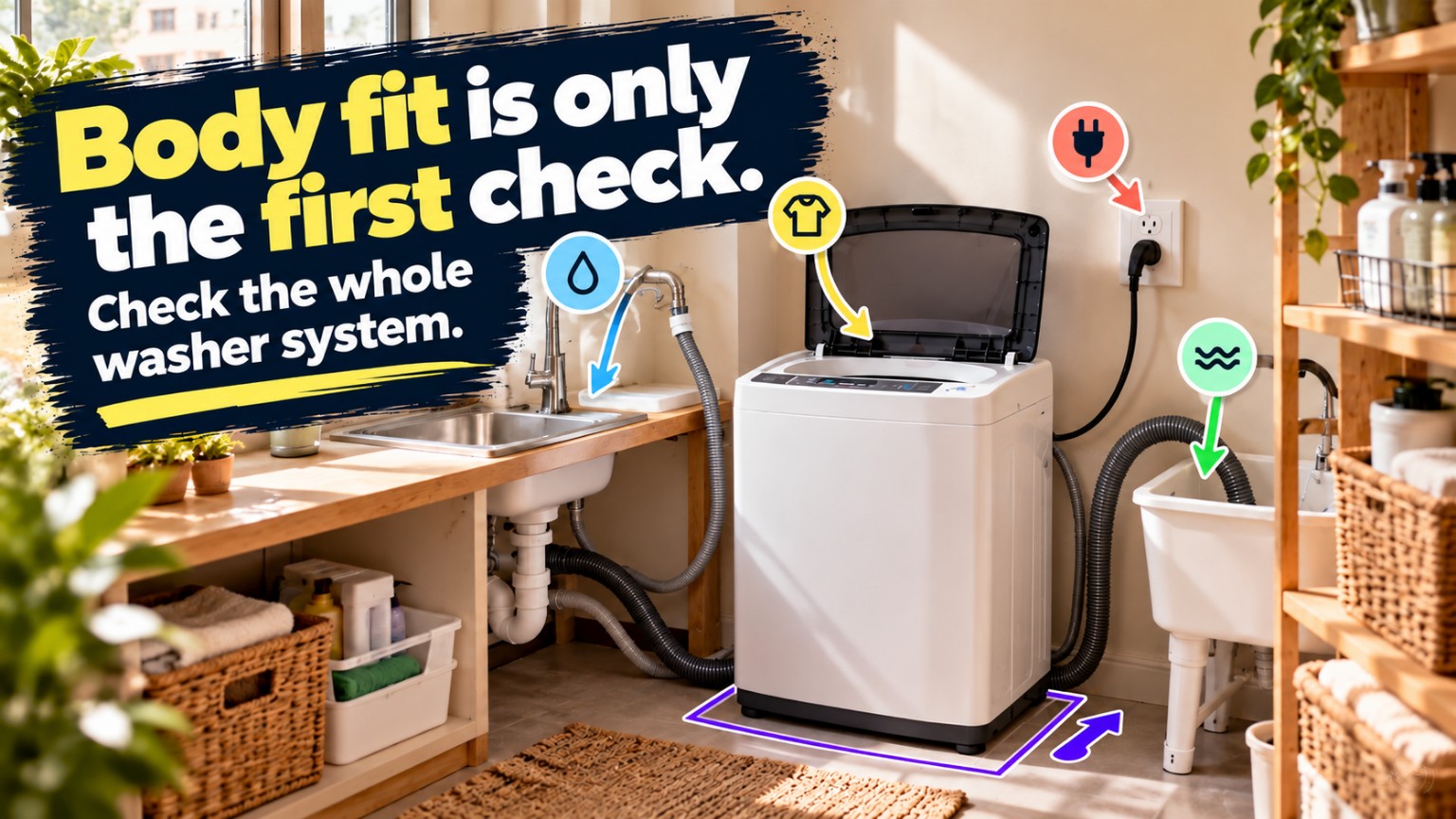
But the body size is only one part of the fit problem.
A washer can fit beside a cabinet and still fail because the faucet connection does not match. It can reach the sink and still fail because the drain route is wrong. It can clear the wall with the lid closed and still become awkward once you need to load it. It can have rollers and still require hoses and power to be disconnected before you move it. A semi-automatic twin-tub model can avoid one plumbing architecture and replace it with a much more hands-on fill, transfer, and drain workflow.
That is the Fit-First rule for this category:
Body / storage fit ≠ water-inlet / fill fit ≠ drain-route fit ≠ load-access fit ≠ operating / leveling fit ≠ disconnect / storage fit.
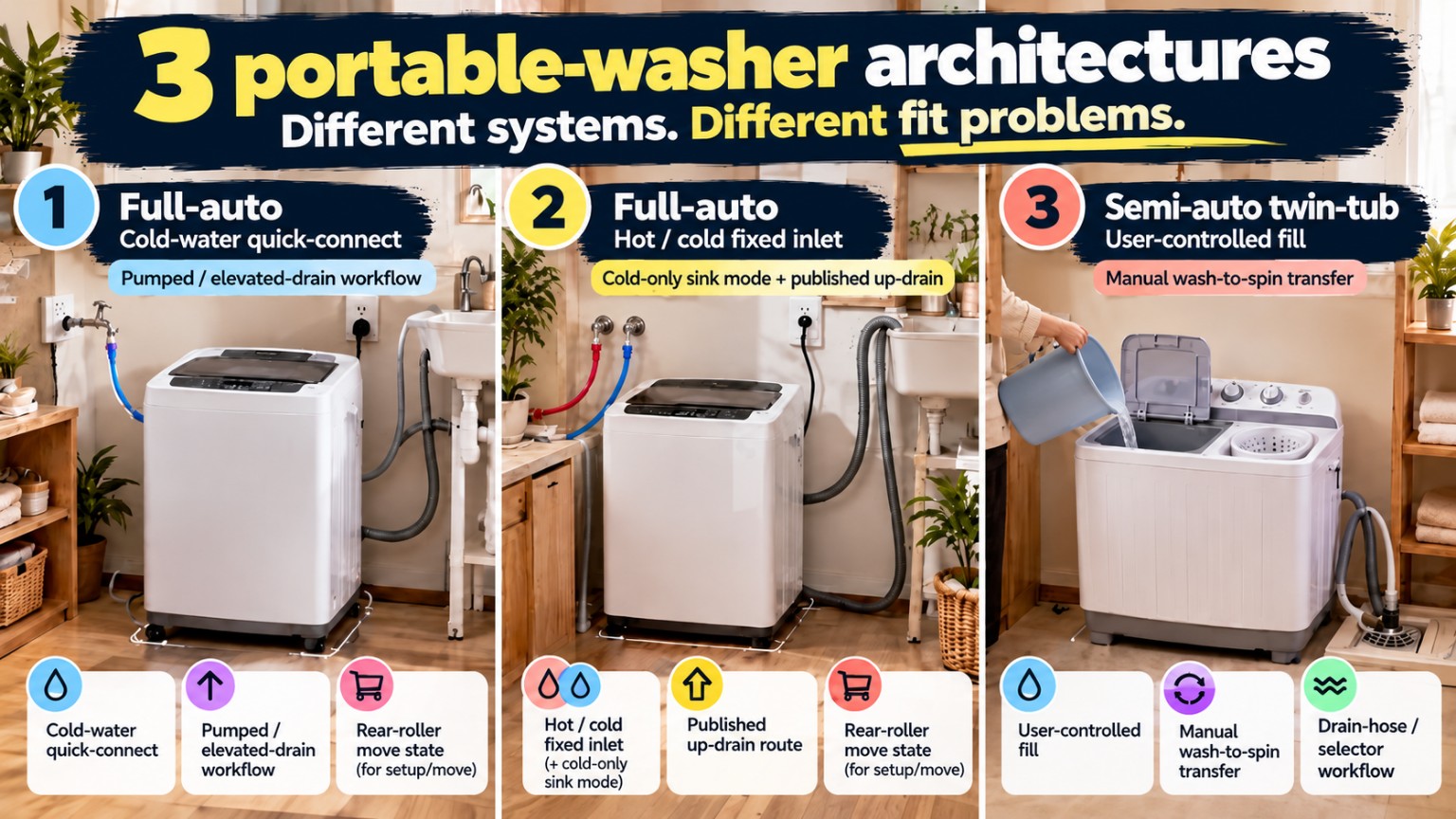
This guide compares three non-ranked portable washer architectures:
- BLACK+DECKER BPWM09W — fully automatic, cold-water quick-connect washer with a pumped drain workflow and rear rollers.
- Avanti CTW14X0W-IS — fully automatic washer with fixed hot/cold inlet capability plus a cold-only sink-adapter mode and rear rollers.
- Pyle / Pure Clean PUCWM23 — semi-automatic twin-tub washer with user-controlled water fill, separate wash and spin tubs, manual load transfer, and a drain-hose / drain-selector workflow.
The purpose is not to name a winner. It is to show why three machines that can all be called portable create three different apartment-fit problems.
Start With the Washer System, Not the Washer Body
Before comparing capacities or dimensions, map the complete laundry workflow.
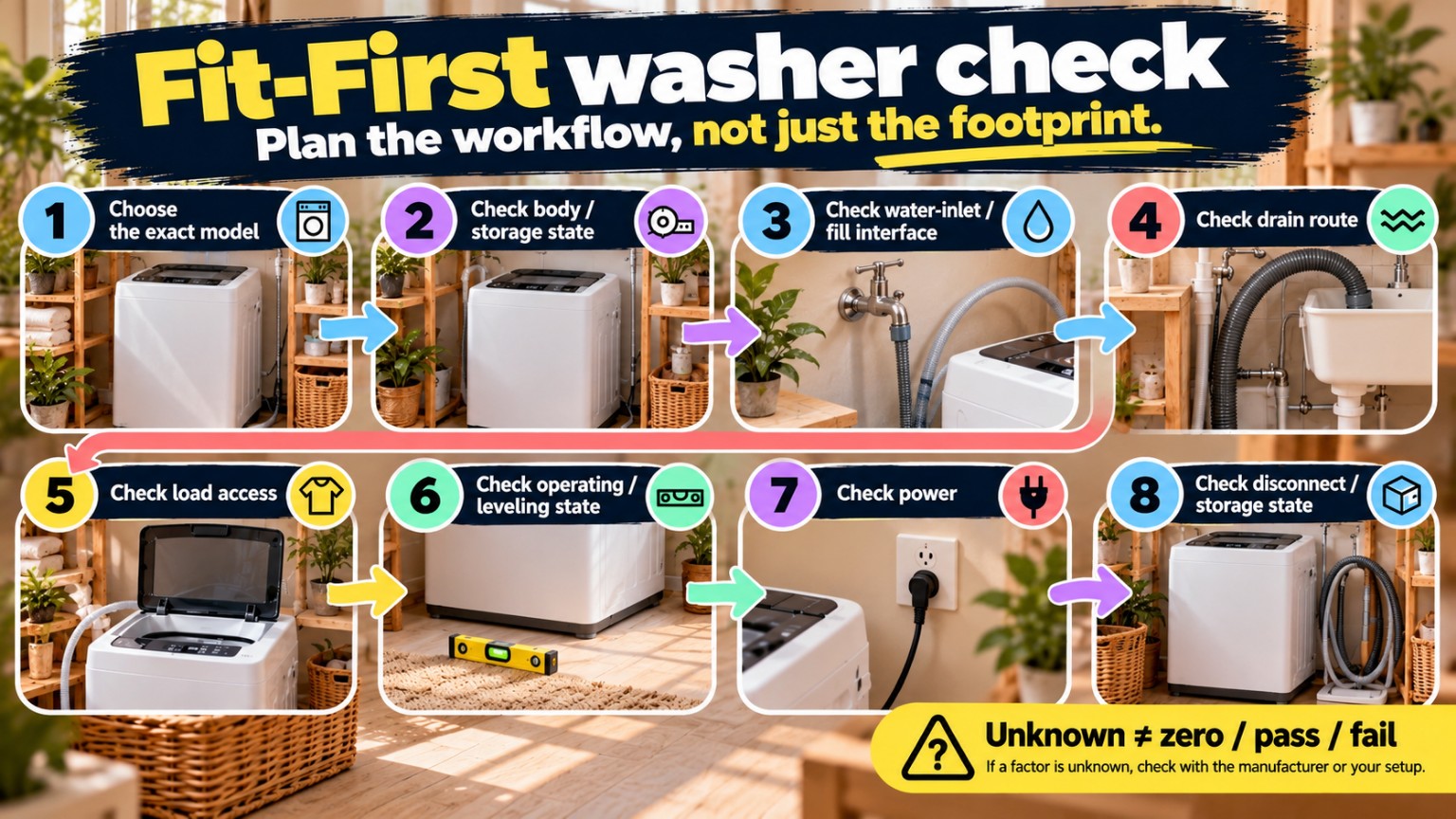
A useful decision chain is:
- Identify the exact model.
- Check the body and intended storage state.
- Check the water-inlet or manual-fill interface.
- Check the full drain route.
- Check top-load access and working clearance.
- Check the operating surface and leveling requirement.
- Check the electrical requirement.
- Check what must be disconnected, drained, moved, or stored after use.
- Preserve every unsupported field as unknown.
That sequence matters because portable does not mean self-contained.
A compact cabinet still needs a place to operate. A faucet adapter still depends on the faucet. A drain hose still depends on the drain route. A top-loading lid still needs usable access above the machine. A roller-equipped washer still has connected utilities while it is operating.
Three Portable-Washer Architectures Compared
| Product | Architecture | Published body / weight | Capacity | Water-inlet / fill state | Faucet / adapter state | Drain architecture | Load access | Operating / leveling state | Mobility | Power | Disconnect / storage state |
|---|---|---|---|---|---|---|---|---|---|---|---|
| BLACK+DECKER BPWM09W | Fully automatic top-load | 17-11/16 in W x 18-1/16 in D x 31-1/2 in H; 44.1 lb | 0.9 cu. ft.; published laundry load up to 6.6 lb | Cold water only | Quick-connect sink adapter included; compatibility is not universal | Pumped drain workflow; manual publishes a recommended 35 in / 90 cm standpipe height | Top load; lid-open clearance not established here | Hard, level operating surface; adjustable front leveling leg | Two rear rollers for relocation | AC 120V / 60Hz; manual specifies a 15A-or-higher wall socket for the washer | Hoses and power remain part of the system; portable does not mean roll-away-ready while connected |
| Avanti CTW14X0W-IS | Fully automatic top-load | Current page publishes 19.75 x 20.00 x 33.25 in without explicit axis labels; 44.10 lb | 1.38 cu. ft. | Fixed hot/cold inlet capability; sink-faucet mode uses cold inlet | Sink attachment / faucet adapter workflow is supported; compatibility is not universal | Published up-drain architecture; drain-hose highest point 2.5–3.25 ft above floor | Top load; lid-open clearance not established here | Hard, level operating surface | Rear rollers for relocation | 120V; current product page publishes 15A / 120V | Sink-mode hose connection and drain route must be undone or secured before storage; portable does not mean connected roll-away use |
| Pyle / Pure Clean PUCWM23 | Semi-automatic twin-tub | 22.2 x 13.9 x 23.6 in published, but axis order is not established here; weight not used because available sources conflict | Wash tub 7.7 lb; spin tub 3.3 lb | User-controlled water fill | Faucet-adapter inclusion not established | Drain hose plus drain selector; pump vs. gravity, allowable drain height, and universal drain compatibility are not established | Separate top-access wash and spin tubs; manual transfer between tubs | Stable operating surface required; exact leveling hardware not established here | Casters / wheels not published | 110V; wash motor 250W and spin motor 120W published | Water handling, load transfer, draining, and hose placement are part of the manual workflow; storage footprint not established |
The table is intentionally non-ranked.
Each model exposes a different interface problem. A reader whose sink works with one architecture may have no usable route for another. A reader who wants one-button automatic operation may reject the twin-tub workflow even if its body fits. A reader who can manually fill a washer may not need the same faucet connection at all.
Unknown is not zero, pass, or fail. If a field is not cleanly established, it stays unknown.
1. BLACK+DECKER BPWM09W: Cold-Water Quick-Connect + Pumped Drain
The BPWM09W is a fully automatic top-loading portable washer with a published 0.9 cu. ft. capacity. BLACK+DECKER currently publishes unit dimensions of 17-11/16 inches wide x 18-1/16 inches deep x 31-1/2 inches high, a 44.1 lb unit weight, and a laundry-load figure of up to 6.6 lb.
It is also the cleanest example of why a portable washer is a connected system, not a rolling box.
Water fit: cold water only
This model is designed for cold-water operation.
The supplied system includes a water supply hose and a quick-connect sink adapter. That gives the machine a renter-relevant temporary connection architecture, but it does not make every faucet compatible.
Do not translate “quick connect” into “fits any faucet.”
Before buying, inspect the exact faucet you intend to use:
- Is the faucet geometry compatible with the adapter system?
- Can the connection be made securely without interfering with the sink or surrounding fixtures?
- Can the faucet remain accessible during operation?
- Can the hose reach without tension or kinking?
The manual also treats water pressure as part of proper filling. That means the faucet interface is not merely a question of whether two parts can be physically attached.
Drain fit: the pump route has a real destination requirement
The BPWM09W uses a pumped drain workflow.
Its manual publishes a recommended standpipe height of 35 inches / 90 cm and instructs the user to route the drain hose through the drain-hose clip to the standpipe.
That is useful because it gives this exact model a documented elevated-drain route.
But the safe claim stops there.
A pumped washer does not automatically work with every drain location or every drain height. The receiving drain still has to match the hose route and the model instructions.
If your plan is to drain into a sink, tub, standpipe, or another destination, map the complete hose path before purchase. Do not assume that “it has a pump” removes the drain-fit problem.
Operating fit: hard and level still matters
The manual calls for a hard, level operating surface. The washer has an adjustable front leveling leg.
That means the floor is part of the machine system.
A narrow alcove may fit the cabinet but still be a poor operating location if the floor is soft, uneven, unstable, or does not leave enough access to level the machine.
The top-loading lid also means you need working access above the machine. The exact lid-open clearance is not established in this evidence set, so do not convert the closed-body height into a complete vertical-clearance claim.
Mobility fit: rear rollers are for relocation, not connected operation
BLACK+DECKER publishes two rear rollers, and the manual describes tilting the washer back onto those rollers to move it.
That supports a move-and-store workflow.
It does not support the idea that the washer should be rolled around while operating or while hoses and power are still connected.
The practical sequence is closer to:
stop -> disconnect / secure utilities -> prepare the washer for movement -> tilt onto rear rollers -> relocate or store.
That distinction is the whole point of the Fit-First test.
2. Avanti CTW14X0W-IS: Fixed Hot/Cold Capability + Cold-Only Sink Mode
The Avanti CTW14X0W-IS is a 1.38 cu. ft. fully automatic top-load portable washer.
Avanti’s current product page publishes a unit dimension string of 19.75 x 20.00 x 33.25 inches and a unit weight of 44.10 lb.
The current page does not explicitly label the axes in that dimension string, so this guide does not silently reorder it into width, depth, and height.
That may look overly cautious, but this is exactly the kind of detail that matters when a buyer is trying to fit a machine into a tight opening.
Water fit: two connection modes create two different workflows
The Avanti manual supports hot and cold water inlet connections when both supplies are available.
It also documents a sink-faucet connection mode, and for a normal kitchen-sink tap it directs the user to use the inlet hose with the cold-water inlet.
Those are not the same installation architecture.
A fixed-inlet setup may suit a laundry connection with dedicated hot and cold supply. A temporary sink workflow is a different use case, with different questions around faucet geometry, hose routing, disconnection, and storage.
So the right question is not simply “Does it connect to water?”
It is:
Which water mode will I actually use in this apartment?
Then verify that exact mode.
Faucet fit: sink attachment does not mean universal sink compatibility
Avanti’s current product page says the washer includes a sink attachment and can hook up to a standard sink faucet.
The manual also provides faucet-selection guidance and an adapter workflow.
That supports the existence of a temporary sink connection. It does not prove compatibility with every faucet shape, sprayer head, pull-out fixture, aerator thread, or installation condition.
Treat the faucet as a component of the purchase decision.
If you cannot describe exactly how the inlet hose will connect to your actual faucet, the water-fit check is not complete.
Drain fit: up-drain capability still needs a route
The locked product evidence establishes a published up-drain workflow for this exact model.
The evidence does not lock whether that up-drain architecture should be classified as pump-based or gravity-based, so this guide does not infer either mechanism.
For this exact model, the published drain route places the highest point of the drain hose 2.5–3.25 ft above the floor. That is a product-specific routing requirement, not a universal portable-washer drain rule.
So the safe conclusion is:
The machine supports a published up-drain architecture, with the drain-hose highest point 2.5–3.25 ft above the floor; the full route still needs to be checked against the manual and the apartment.
Do not turn a published up-drain route into “drains anywhere.”
Operating and movement fit
Avanti instructs the user to select a hard, level operating surface. The manual also describes moving the washer by tilting it back onto its rear rollers and pushing it forward.
Again, rollers solve only one part of the workflow.
They help relocate the body. They do not erase the need to deal with the inlet hose, drain hose, and power connection.
The lid-open clearance is also not established here, so leave real loading access as a measurement task for the buyer.
3. Pyle / Pure Clean PUCWM23: Manual Fill + Twin-Tub Workflow
The PUCWM23 changes the architecture more dramatically than the two fully automatic models.
It is a semi-automatic twin-tub machine with one tub for washing and a separate tub for spin drying.
Pyle publishes a 7.7 lb wash-load capacity and 3.3 lb spin-dryer capacity, with a 250W wash motor, 120W spin motor, 110V power supply, and a 2.2 ft drain hose.
Pyle also publishes dimensions of 22.2 x 13.9 x 23.6 inches, but the axis order is not cleanly established in the locked evidence. Do not silently turn that string into width x depth x height.
The product’s weight is also excluded from this comparison because available source values conflict.
Fill fit: user-controlled water changes the faucet problem
The PUCWM23 product description instructs the user to add detergent and water to the machine.
That makes the water workflow fundamentally different from an automatic washer that depends on a fixed inlet valve and controlled filling sequence.
This can be useful in a small apartment where a permanent washer hookup is not part of the plan.
But manual fill does not mean zero setup constraints.
You still need to decide:
- where the machine will sit while being filled;
- how water will reach the wash tub;
- how much handling is comfortable for your routine;
- how spills will be controlled;
- how the machine will be drained afterward.
Faucet-adapter inclusion is not established here, so this guide does not promise one.
Load access: the twin-tub workflow requires manual transfer
The washer and spin sections are separate.
That means the operating sequence includes a physical transfer from the wash tub to the spin tub.
This is not just a feature difference. It is a space-and-access difference.
You need enough top access to:
- load the wash tub;
- add water and detergent;
- remove wet laundry;
- transfer it into the spin tub;
- unload it again after spinning.
If the machine is stored under a counter, shelf, desk, or other low surface, the body may fit while the real workflow does not.
Drain fit: a hose exists, but the route is still bounded
Pyle publishes a drain hose and a drain-selector control.
The exact evidence used here does not cleanly establish:
- whether the system should be characterized as pumped or gravity-only;
- a universal allowable drain height;
- compatibility with every sink, tub, floor drain, or standpipe.
Those unknowns matter.
A drain hose is not the same thing as a verified drain destination.
Before purchase, the user should determine exactly where the hose will terminate and whether that route matches the manual.
Mobility and storage: compact is not the same as wheeled
Pyle calls the unit compact and portable, but casters or wheels are not published for this locked model.
So do not assume a roll-away workflow.
The storage footprint is also not established beyond the published body-dimension string, whose axis order remains unknown here.
If your plan depends on moving the washer into a closet after every use, that movement is a real task to evaluate rather than a benefit to infer from the word “portable.”
Body Fit Is Only Gate One
The easiest part of the buying process is usually measuring the machine body.
Do that first, but do not stop there.
For a tight apartment location, record:
- the available floor rectangle;
- wall, cabinet, door, and furniture conflicts;
- the route used to bring the washer into the apartment;
- the route used to move it between storage and operating positions;
- hose and cord space behind or beside the machine;
- top access for loading;
- any clearance needed to make or release utility connections.
For R1, the published body dimensions have a clean axis order.
For R2, preserve the current page’s dimension string without silently assigning axes.
For R3, preserve the published dimension string but treat the axis order as unknown.
That is better than pretending inconsistent product data is more precise than it really is.
Water-Inlet / Fill Fit: Match the Machine to the Actual Faucet Workflow
The three products show three distinct water approaches.
BPWM09W
Cold-water automatic fill through the inlet system, with a quick-connect sink adapter included.
CTW14X0W-IS
Hot/cold fixed-inlet capability, plus a separate sink-faucet mode that uses the cold inlet.
PUCWM23
User-controlled water fill into the wash workflow.
None of those architectures is automatically better.
They answer different apartment constraints.
The right choice depends on what your space can actually support every laundry day.
A renter who has a compatible sink and wants automatic cycles may prefer an inlet-hose workflow. A renter with an awkward faucet but an easy manual-fill method may tolerate a semi-automatic workflow. A buyer with dedicated hot/cold hookups may care about fixed-inlet capability more than temporary sink use.
The decision should follow the apartment, not the marketing category.
Drain-Route Fit: Trace the Entire Hose Path
Do not buy a portable washer until you can draw the drain path.
Start at the machine’s drain outlet and trace the route all the way to the destination.
Check:
- where the hose exits the washer;
- how far it must travel;
- whether the route creates sharp bends or kinks;
- whether the hose can be secured;
- whether the destination can accept the discharge;
- whether the model has a documented drain-height requirement;
- whether the route interferes with doors, cabinets, or foot traffic.
For the BPWM09W, the manual publishes a recommended 35 in / 90 cm standpipe height.
For the Avanti, the published up-drain route places the highest point of the drain hose 2.5–3.25 ft above the floor. That product-specific range does not establish universal drain compatibility.
For the PUCWM23, the drain hose and selector are established, while pump/gravity characterization and drain-height limit remain unknown.
Drain hose ≠ universal drain compatibility.
Load-Access Fit: Measure the Human Workflow
All three machines use top access, but the operational demand is not identical.
The two fully automatic models need room for normal top loading and unloading.
The PUCWM23 needs top access to both tubs and adds a manual transfer step between wash and spin.
That makes load access a human-factors problem, not just a lid problem.
Check whether you can comfortably:
- open the machine;
- reach the bottom of the tub;
- add and remove laundry;
- operate the controls;
- transfer wet laundry between tubs where required;
- do all of that without pulling the machine into an unsafe or unstable position.
The exact lid-open clearance for R1 and R2 is not established in the locked evidence, so measure from the actual product documentation or the physical unit if that dimension is critical to your installation.
Operating / Leveling Fit: Portable Still Needs a Stable Place to Run
A washer moves water and spins a load. The operating surface matters.
The BLACK+DECKER and Avanti manuals both make level placement part of setup. R1 provides an adjustable front leveling leg; for R2, this guide preserves only the locked requirement for a hard, level operating surface.
Do not treat rollers as operating supports or as permission to run the machine on an unstable surface.
For any model, check that the operating location is:
- stable;
- appropriate for the appliance instructions;
- level or capable of being leveled as required;
- protected from a hose route that can be kicked, crushed, or pulled;
- accessible enough to respond quickly if a leak occurs.
The exact leveling hardware for the PUCWM23 is not established here, so that field remains bounded.
Power Fit: Voltage Is Only the First Check
The locked power states are:
- BPWM09W: AC 120V / 60Hz; manual specifies a 15A-or-higher wall socket for the washer.
- CTW14X0W-IS: current product page publishes 15A / 120V.
- PUCWM23: 110V, with 250W wash and 120W spin motors published.
Those labels do not establish universal compatibility with every apartment outlet, extension arrangement, shared circuit, or electrical condition.
120V label ≠ universal outlet / circuit compatibility.
Follow the exact manual for the selected model and do not invent an extension-cord or shared-outlet solution when the manufacturer instructions do not support it.
Disconnect / Storage Fit: This Is Where “Portable” Gets Tested
A machine that will stay in one operating position has one workflow.
A machine that will be stored after every wash has another.
For a move-and-store plan, write the sequence before purchase.
For example:
- Finish the cycle.
- Confirm the machine has drained as required.
- Turn off the water source where applicable.
- Release pressure and disconnect the inlet according to the manual.
- Secure or drain the inlet and drain hoses as required.
- Unplug the machine safely.
- Prepare the body for movement.
- Move it using the model’s supported method.
- Store it without crushing hoses or creating a retained-water problem.
The details differ by machine.
R1 and R2 have rear rollers, but that does not make them roll-away-ready while utilities remain connected.
R3 does not have published wheels or casters in the locked evidence, so storage movement must not be assumed to be easy just because the machine is marketed as portable.
Portable ≠ roll-away without disconnect.
Fit-First Pre-Buy Checklist
Use this checklist with the exact model you are considering.
1. Exact product identity
- Confirm the exact model number.
- Do not mix specifications from a similar capacity or newer revision.
2. Body and storage state
- Record the published dimensions exactly as labeled.
- If the axis order is not published, do not guess it.
- Measure the operating location.
- Measure the storage location if different.
- Measure the movement path between them.
3. Water-inlet / fill interface
- Is the model automatic-fill or user-fill?
- Cold only, hot/cold, or another documented configuration?
- What exact faucet or water source will be used?
- Is an adapter included for this exact model?
- Is compatibility with your exact faucet actually established?
4. Drain route
- Where will the drain hose terminate?
- How far and how high must the water travel?
- Is the drain pumped, gravity-based, or not cleanly established?
- Does the manual publish a drain-height rule?
- Can the hose be routed without kinks or trip hazards?
5. Load access
- Is there enough top access to load and unload?
- Does the machine require transfer between wash and spin tubs?
- Can you reach the controls in the actual operating position?
6. Operating / leveling state
- Is the floor stable and suitable?
- Can the machine be leveled as required?
- Are rollers or casters being mistaken for an operating surface?
7. Power
- What does the exact manual require?
- Is the intended outlet appropriate for the model?
- Does your plan depend on an extension cord or shared circuit that the manual does not support?
8. Disconnect / storage workflow
- What must be turned off or disconnected?
- What happens to residual water?
- Where do the hoses go during storage?
- How is the machine actually moved?
- Is the storage footprint itself established?
9. Apartment and lease boundary
- Does the building or lease allow the appliance and the intended hookup?
- Are there building rules around washers, drain connections, leak risk, or water use?
- Do not infer permission from the word “portable.”
Claim and Unknown Boundary
This article deliberately does not claim that:
- any faucet adapter is universal;
- any sink attachment is universal;
- any drain hose works with every drain;
- a pumped drain works at any height;
- published capacity equals the load you personally should put into every cycle;
- rollers or casters make a washer safe to move during operation;
- a portable washer is automatically allowed by an apartment building or lease;
- 120V labeling proves compatibility with every outlet or circuit;
- a semi-automatic machine has no installation or operating constraints;
- an unknown specification should be treated as zero, pass, or fail.
Product boundaries preserved in this guide include:
- BPWM09W quick-connect compatibility: not universal.
- BPWM09W lid-open clearance: unknown here.
- CTW14X0W-IS current dimension string: published without explicit axis labels; not silently reordered.
- CTW14X0W-IS pound-load figure: unknown here.
- CTW14X0W-IS lid-open clearance: unknown here.
- CTW14X0W-IS pump vs. gravity characterization: not established / not inferred.
- PUCWM23 dimension axis order: unknown.
- PUCWM23 net weight: conflict / not published in this comparison.
- PUCWM23 faucet-adapter inclusion: unknown.
- PUCWM23 pump vs. gravity characterization: unknown.
- PUCWM23 drain-height limit: unknown.
- PUCWM23 wheels / casters: not published.
- PUCWM23 storage footprint: unknown.
That is not missing editorial work. It is the correct boundary between evidence and assumption.
Conclusion: Buy the Workflow, Not the Label
A portable washer for a small apartment is not just a compact appliance.
It is a temporary or semi-permanent system made of:
machine body + water source + fill interface + drain route + load access + level operating surface + power + disconnect / storage workflow.
The BLACK+DECKER BPWM09W, Avanti CTW14X0W-IS, and Pyle / Pure Clean PUCWM23 demonstrate three different ways to build that system.
R1 centers on cold-water quick-connect operation, pumped drainage, leveling, and a rear-roller move state.
R2 adds a choice between fixed hot/cold inlets and a cold-only sink mode, with its own drain and disconnect workflow.
R3 replaces the automatic inlet-and-cycle architecture with manual fill, separate wash and spin tubs, manual load transfer, and a more hands-on drain process.
None of those architectures is automatically the best.
The right model is the one whose entire operating chain works in your exact apartment without requiring you to invent a faucet fit, drain fit, clearance, electrical condition, building permission, or storage state that the evidence does not actually establish.
If the body fits but the system does not, the washer does not fit.
FAQ
Can a portable washing machine be used in any apartment?
No universal claim is safe. The physical machine may fit while the water connection, drain route, power requirement, operating surface, or building / lease rules do not. Check both the exact product manual and the rules for the apartment before purchase.
Does a faucet adapter fit every kitchen sink?
No. A faucet adapter or sink attachment should be treated as an exact-interface component, not a universal compatibility guarantee. Verify the actual faucet geometry and the instructions for the exact washer.
Can I roll a portable washer away after every load?
Some models, including the BPWM09W and CTW14X0W-IS, document rear rollers for relocation. That does not mean the machine should be moved while operating or while water hoses and power remain connected. The disconnect and residual-water workflow is part of the move-and-store plan.
Is a semi-automatic twin-tub washer easier to install?
It uses a different workflow, not a constraint-free one. The PUCWM23 supports user-controlled water fill and separate wash and spin tubs, but the buyer still needs a stable operating place, a workable drain route, top access, power, and a practical way to transfer wet laundry between tubs.
Does a drain pump mean I can drain anywhere?
No. Pumped drainage does not establish unlimited height or universal drain compatibility. Use the exact model’s published drain instructions. Where the limit is not cleanly established, keep it unknown rather than guessing.