Countertop Ice Makers for Small Kitchens: Check the Full Working Fit Before You Buy
A countertop ice maker looks simple at first: set it on the counter, add water, and make ice. In a small kitchen, however, the machine’s closed-body dimensions are only the first part of the decision.
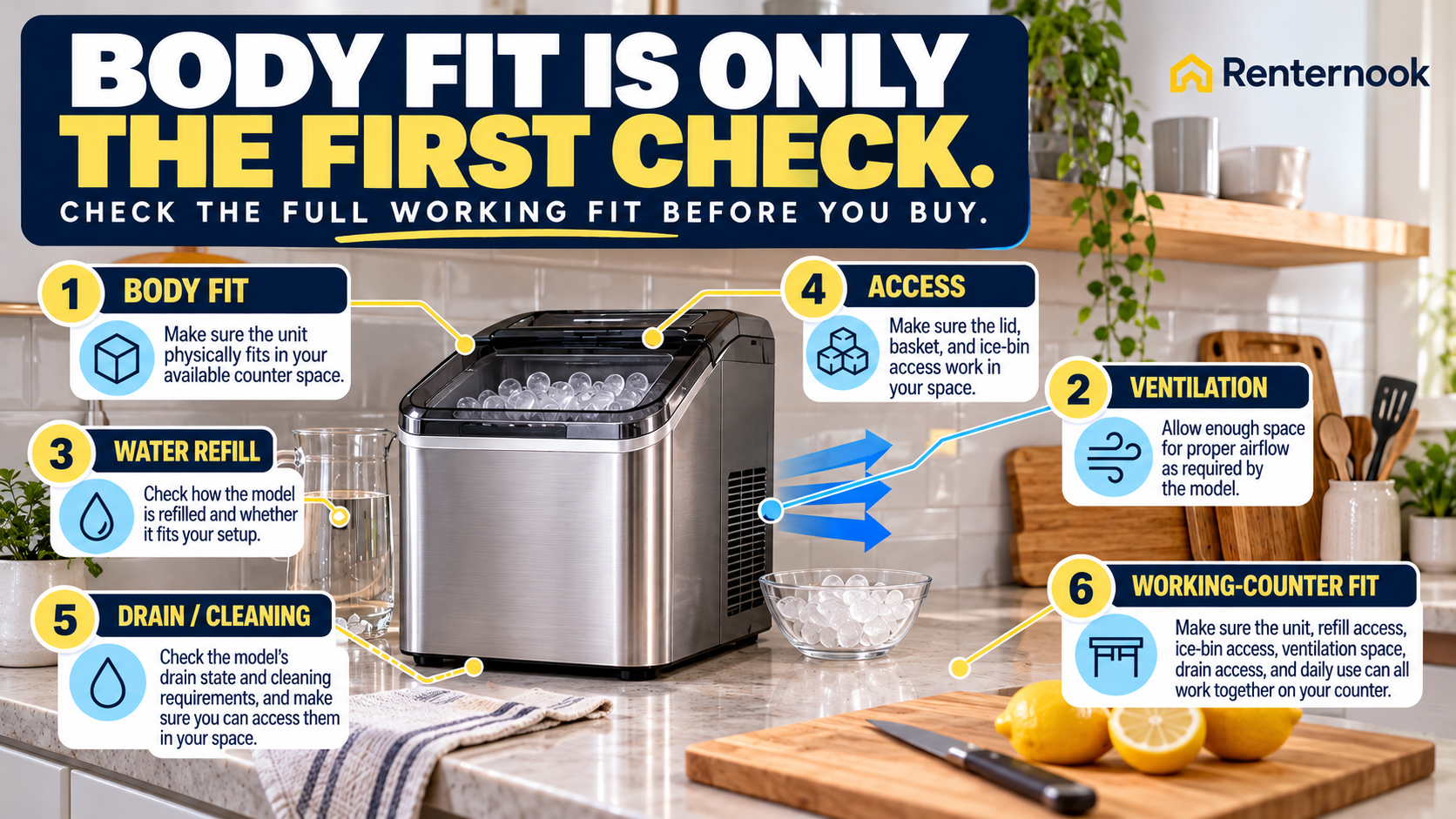
A unit can physically fit on the counter and still be awkward or unsuitable in normal use. It may need ventilation space around the cabinet. The lid or ice basket may need room to open and lift out. Water may have to be added manually from above. Cleaning or draining may require access to a plug or drain point. The cord and outlet have to work in the intended location. And the ice bin itself should not be mistaken for freezer storage.
That is the central fit problem for this category:
Body fit ≠ ventilation fit ≠ water-refill fit ≠ ice-bin/access fit ≠ drain/cleaning fit ≠ working-counter fit.
This buying guide uses three current countertop ice makers as non-ranked examples of different working-fit architectures:
- Newair NIM026MS00 — bullet ice, compact manual reservoir, no self-clean role.
- Gevi KNOVA IMND0 — nugget ice, published 6-inch ventilation clearance, self-clean, and a manual drain-plug state.
- Euhomy LunaArc, first-party support SKU IM022-L — clear crescent ice, removable water tank and ice bin, gravity bottom-side drain plug, adjustable ice thickness, and an explicit non-freezer storage boundary.
The purpose is to compare exact-model working-fit architectures, not to rank the products.
Start With the Exact Model, Not the Category
Countertop ice makers can look similar while using different water, ventilation, drain, cleaning, and access arrangements. That makes exact model identity the first check.
A useful decision sequence is:
- Confirm the exact model.
- Check body dimensions.
- Check ventilation clearance.
- Check the water-supply or reservoir architecture.
- Check lid and bin access.
- Check ice format and storage state.
- Check drain and cleaning access.
- Check power.
- Check the normal working location.
Do not fill a missing field from a sibling model, another region, a retailer listing, or a category norm. If an exact-model field is not established, keep it unknown.
Three Countertop Ice Maker Architectures Compared
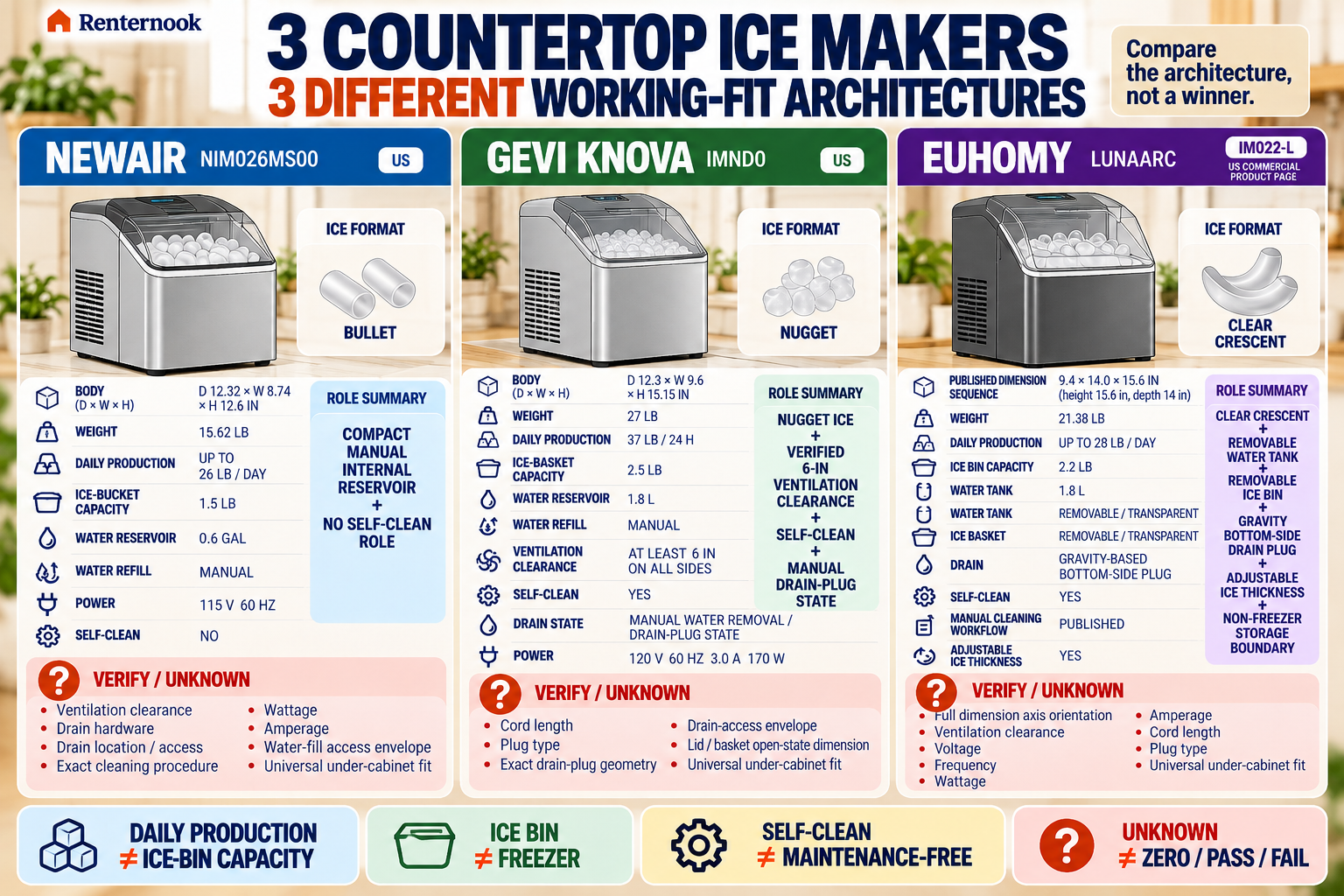
The three models below are useful because they expose materially different working-fit states. They are not ranked.
Physical fit and ice format
| Product | Body dimensions | Weight | Ice format |
|---|---|---|---|
| Newair NIM026MS00 | D 12.32 x W 8.74 x H 12.6 in | 15.62 lb | Bullet |
| Gevi KNOVA IMND0 | D 12.3 x W 9.6 x H 15.15 in | 27 lb | Nugget |
| Euhomy LunaArc / support SKU IM022-L | Published sequence 9.4 x 14.0 x 15.6 in; height 15.6 in and depth 14 in established; full axis orientation partially unknown | 21.38 lb | Clear crescent |
Production and water setup
| Product | Published daily production | Ice-bin / basket capacity | Reservoir / water tank | Water refill |
|---|---|---|---|---|
| Newair NIM026MS00 | Up to 26 lb/day | 1.5 lb | 0.6 gal reservoir | Manual |
| Gevi KNOVA IMND0 | 37 lb/24 h | 2.5 lb basket | 1.8 L reservoir | Manual |
| Euhomy LunaArc / support SKU IM022-L | Up to 28 lb/day | 2.2 lb bin | 1.8 L removable transparent tank | Removable tank architecture |
Operating requirements
| Product | Ventilation | Drain | Cleaning | Power |
|---|---|---|---|---|
| Newair NIM026MS00 | Unknown | Drain hardware/location unknown | No self-clean | 115 V, 60 Hz; wattage and amperage unknown |
| Gevi KNOVA IMND0 | At least 6 in on all sides | Manual water removal / drain-plug state | Self-clean | 120 V, 60 Hz, 3.0 A, 170 W |
| Euhomy LunaArc / support SKU IM022-L | Unknown | Gravity-based bottom-side plug | Self-clean; manual cleaning workflow published | Unknown |
Several boundaries in this table matter.
First, published daily production is not the same thing as ice-bin capacity. A machine may be able to produce many pounds across a day while holding only a much smaller amount at one time.
Second, an ice bin is not a freezer. Produced ice should not be assumed to remain frozen indefinitely in the machine.
Third, Gevi’s published 6-inch ventilation requirement belongs to the Gevi KNOVA IMND0. It should not be copied to Newair or Euhomy when those exact-model clearance values are not established.
1. Body Fit Is Only the Closed-State Check
Start with the dimensions of the exact machine and the actual counter location.
The Newair NIM026MS00 is published at D 12.32 x W 8.74 x H 12.6 inches. Gevi KNOVA IMND0 is D 12.3 x W 9.6 x H 15.15 inches. Euhomy publishes a 9.4 x 14.0 x 15.6-inch sequence for LunaArc, with height established at 15.6 inches and depth at 14 inches, but the full axis orientation is not fully established in the evidence used here.
That last point is important: do not silently reorder an unlabeled dimension sequence merely to make a table look cleaner. If the manufacturer evidence does not establish the full axis mapping, preserve that uncertainty.
Even when width, depth, and height are known, body height alone does not prove under-cabinet operating fit. The machine still has to work in its normal use state.
2. Ventilation Fit Can Change the Real Counter Footprint
A compact cabinet can require more space than its body dimensions suggest once ventilation is included.
For the Gevi KNOVA IMND0, the published ventilation requirement is at least 6 inches on all sides. That is a material working-fit constraint. The machine’s 12.3 x 9.6 x 15.15-inch body is therefore not the entire space claim for normal operation.
For the Newair NIM026MS00, exact ventilation clearance is not established in the evidence used here. For Euhomy LunaArc, exact ventilation clearance is also unknown.
That means the correct comparison is not:
- Gevi needs clearance, while the others need none.
The correct comparison is:
- Gevi has a verified numeric clearance requirement.
- Newair and Euhomy have no exact numeric ventilation clearance established in this evidence set.
Unknown does not mean zero.
If your intended location is below upper cabinets, beside a wall, or between appliances, ventilation should be checked before treating the body dimensions as a pass.
3. Water-Refill Fit Is a Daily-Use Question
All three examples use internal water storage rather than a verified universal plumbed water connection.
The Newair NIM026MS00 has a 0.6-gallon reservoir with manual refill. Gevi KNOVA IMND0 has a 1.8-liter reservoir with manual refill. Euhomy LunaArc uses a 1.8-liter removable transparent water tank.
Those architectures create different working questions.
For a manual internal reservoir, ask whether you can comfortably add water where the machine will actually sit. The exact water-fill access envelope for the Newair is not established here, so do not invent an overhead-clearance number.
For the Euhomy removable-tank design, the tank itself has to be removable and replaceable in the planned location. A removable tank can simplify one part of the refill workflow, but it still requires a workable access path.
Do not convert any of these examples into a universal water-connection claim. The article evidence does not establish universal plumbing compatibility, and no such claim is needed for the fit decision.
4. Lid and Ice-Bin Access Can Make a “Fit” Machine Hard to Use
Closed-body dimensions describe the machine when it is sitting still. They do not automatically describe the space needed to open a lid, remove a basket, pull out a tank, or reach the ice.
This matters especially under upper cabinets or shelves.
The Gevi KNOVA IMND0 has a 2.5-pound ice basket, but the exact lid/basket open-state dimension is not established in the evidence used here. Newair’s exact water-fill access envelope is also unknown. Euhomy has a removable transparent ice bin and removable water tank, but the complete operating-access envelope is not reduced to one verified clearance number here.
The safe approach is practical: identify every part you have to open, lift, pull, remove, fill, or replace during normal use, then check whether the intended counter location allows those actions.
A machine that fits while closed can still fail the access test.
5. Daily Production and On-Hand Ice Are Different Decisions
Production numbers are easy to overread.
The Newair NIM026MS00 is rated for up to 26 pounds of ice per day and has a 1.5-pound ice bucket. Gevi KNOVA IMND0 lists 37 pounds per 24 hours with a 2.5-pound basket. Euhomy LunaArc is rated for up to 28 pounds per day with a 2.2-pound ice bin.
These are different variables.
Daily production describes a manufacturer-published production basis across time. Bin or basket capacity describes how much ice can be held in the machine’s collection container at one time.
Do not use the daily production number as if it were the amount of ice sitting ready in the bin. Do not use the bin capacity as if it were the machine’s daily output.
And do not treat either number as guaranteed real-world household output. Actual conditions can affect how a machine performs in use, so the published figure should remain a published production rating rather than a universal promise.
6. Ice Format Changes the Product Role, Not the Ranking
The three products also illustrate three different ice formats:
- Newair NIM026MS00: bullet ice.
- Gevi KNOVA IMND0: nugget ice.
- Euhomy LunaArc: clear crescent ice.
Those differences are useful because they show that a countertop ice maker buying decision is not only about dimensions. The format may be part of why a shopper is considering one architecture over another.
But the format should not be turned into a universal performance ranking. This guide does not claim that bullet, nugget, or clear crescent ice is inherently better.
The relevant question is whether the exact machine that produces the format you want also works in the available location.
7. The Ice Bin Is Not Freezer Storage
Countertop ice maker bins should not be treated as if they guarantee freezer-like long-term storage.
For Euhomy LunaArc, the evidence specifically preserves a non-freezer storage boundary. More broadly within this article, the correct decision rule is simple:
Ice bin ≠ freezer.
That means a published bin capacity is a holding-capacity figure, not proof that every piece of produced ice will remain frozen indefinitely inside the machine.
If long-term frozen storage matters to your use case, treat storage after production as a separate workflow rather than silently assigning freezer behavior to the countertop ice maker.
8. Drain and Cleaning Fit Can Be Easy to Miss
Drainage and cleaning are part of the working fit because they affect where the machine can be serviced and how easily water can be removed.
The three models differ materially here.
Newair NIM026MS00
The locked evidence says self-clean: no. Exact drain hardware, drain location/access, and the exact cleaning procedure are not established in this evidence set.
That does not mean there is no drain path or no cleaning requirement. It means those fields should remain unknown rather than being filled by inference.
Gevi KNOVA IMND0
Gevi has a self-clean function. The evidence also establishes a manual water-removal / drain-plug state. Exact drain-plug geometry and the full drain-access envelope remain unknown.
Self-clean does not mean maintenance-free. A cleaning function is one part of the maintenance workflow, not proof that no other cleaning, draining, or handling is required.
Euhomy LunaArc
Euhomy has self-clean, a published manual cleaning workflow, and a gravity-based bottom-side drain plug.
That bottom-side drain location is a useful fit-state example because gravity drainage can make the surrounding counter location matter. The user has to be able to access the drain arrangement and manage water removal in the real working location.
A drain plug does not mean drain-free operation. It means drainage is part of the machine’s service state.
9. Power Fit Still Belongs in the Decision
Power should be checked against the exact model and region rather than assumed from the category.
For Newair NIM026MS00, the established power fields are 115 V, 60 Hz. Wattage and amperage remain unknown in this evidence set.
For Gevi KNOVA IMND0, the established power fields are 120 V, 60 Hz, 3.0 A, 170 W.
For Euhomy LunaArc, the power fields in this evidence set remain unknown.
Do not borrow voltage, amperage, wattage, plug type, or cord length from a sibling model or another region. Do not claim universal outlet fit. And do not turn wattage alone into an energy-savings claim.
The practical check is whether the exact model’s documented power requirements work with the actual outlet and placement plan.
10. Working-Counter Fit Is the Final Check
The final decision should be made with the machine in its full use cycle, not just its closed state.
For the intended counter location, ask:
- Does the exact body fit?
- Is any required ventilation space available?
- Can you refill the reservoir or remove the water tank without obstruction?
- Can the lid, basket, and ice bin be accessed?
- Can you remove or store produced ice as needed?
- Can the drain or water-removal state be handled in that location?
- Can cleaning access be completed there?
- Does the exact model’s power requirement work with the outlet setup?
- Can all of those states coexist without turning the surrounding counter into an unusable workspace?
This is the difference between a countertop measurement and a working-counter fit.
Product Profiles: Three Different Working-Fit States
Newair NIM026MS00: Compact Bullet-Ice, Manual-Reservoir Architecture
The Newair NIM026MS00 provides a relatively compact physical example in this set at D 12.32 x W 8.74 x H 12.6 inches and 15.62 pounds. It makes bullet ice, is rated for up to 26 pounds per day, has a 1.5-pound ice bucket, and uses a 0.6-gallon manually filled reservoir.
Its role in this comparison is especially useful because it preserves several unknowns that buyers should not silently erase. Exact ventilation clearance, drain hardware, drain location/access, exact cleaning procedure, wattage, amperage, water-fill access envelope, and universal under-cabinet fit are not established here.
It also has no self-clean function in the locked evidence. That makes the cleaning-access question more important, not less. The correct response is to verify the exact cleaning and drain workflow before treating a counter location as workable.
Gevi KNOVA IMND0: Nugget-Ice With a Verified Clearance Requirement
The Gevi KNOVA IMND0 provides the strongest numeric ventilation example in the set. Its body is D 12.3 x W 9.6 x H 15.15 inches, it weighs 27 pounds, and the manufacturer documentation establishes at least 6 inches of ventilation clearance on all sides.
It makes nugget ice, lists 37 pounds per 24 hours of production, has a 2.5-pound ice basket, and uses a 1.8-liter manual-fill reservoir. It also has self-clean and a manual drain-plug state.
Its established power fields are 120 V, 60 Hz, 3.0 A, and 170 W.
Several fields still remain unknown: cord length, plug type, exact drain-plug geometry, drain-access envelope, lid/basket open-state dimension, immediate in-stock state, and universal under-cabinet fit.
The lesson is not that the Gevi is “harder to place.” The lesson is that this exact model has a published clearance requirement that must be included in its real working envelope.
Euhomy LunaArc: Removable Tank, Clear Crescent Ice, and Gravity Drain
Euhomy LunaArc contributes a different use-state architecture. It makes clear crescent ice and is associated with first-party support SKU IM022-L. The manufacturer publishes a dimension sequence of 9.4 x 14.0 x 15.6 inches; height is established at 15.6 inches and depth at 14 inches, while full axis orientation remains partially unknown in the evidence used here.
The unit weighs 21.38 pounds, is rated for up to 28 pounds of ice per day, and has a 2.2-pound ice bin. It uses a 1.8-liter removable transparent water tank and a removable transparent ice basket.
It also has a gravity-based bottom-side drain plug, self-clean, a published manual cleaning workflow, and adjustable ice thickness.
Its role is especially helpful for showing two boundaries. First, removable components create their own access requirements. Second, the product documentation preserves a non-freezer storage boundary: the ice bin should not be treated as freezer storage.
Power fields and exact ventilation clearance remain unknown in this evidence set, so they should stay unknown rather than being borrowed from another Euhomy model or regional variant.
Fit-First Checklist Before You Buy
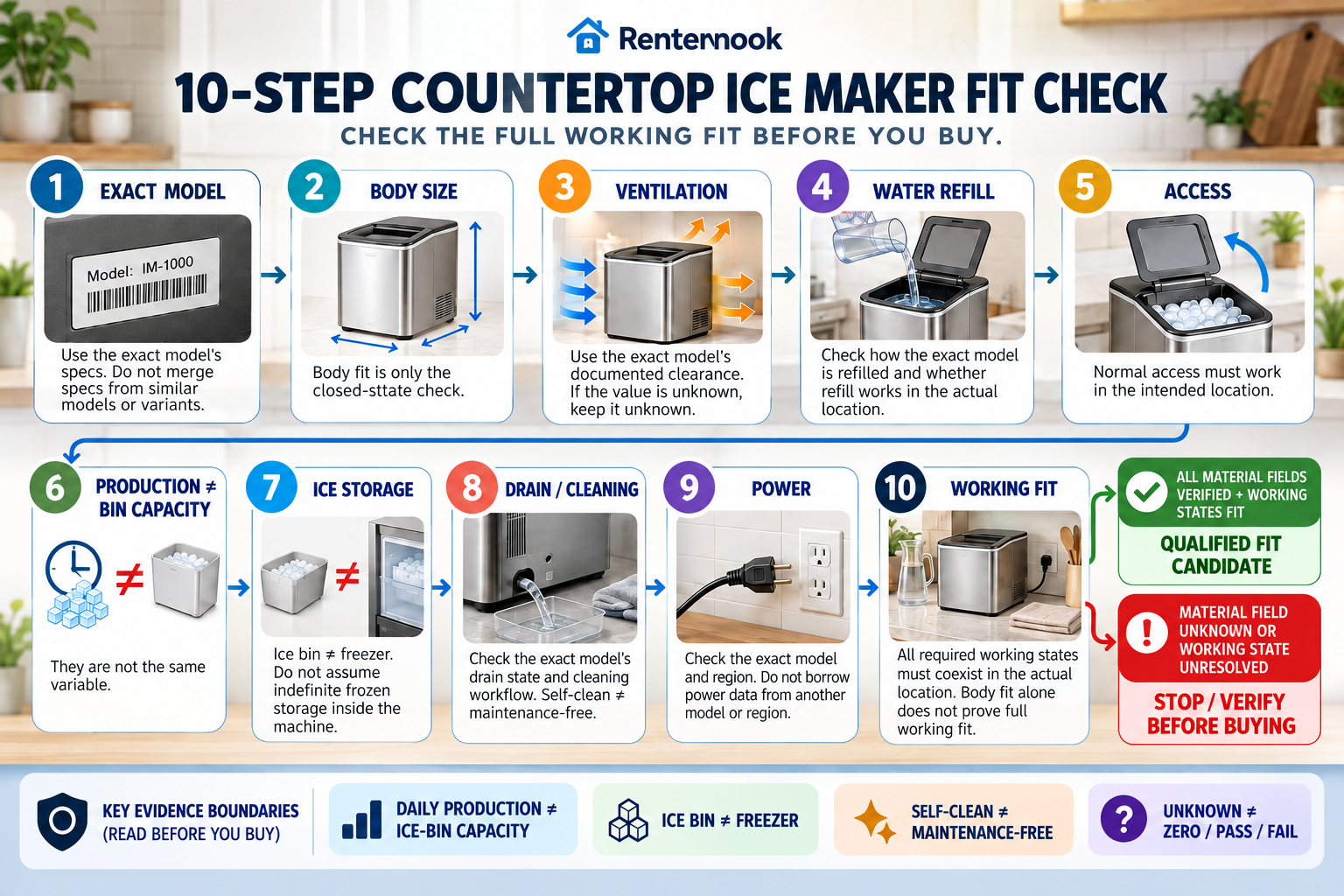
Use this checklist with the exact countertop ice maker you are considering.
- Confirm the exact model number. Do not merge specifications across similar names or variants.
- Record the body dimensions. Keep the manufacturer’s axis labels when they are established; do not silently reorder ambiguous sequences.
- Verify ventilation clearance. If no numeric clearance is established, mark it unknown rather than zero.
- Map the water-refill workflow. Identify whether the reservoir is filled in place or a tank must be removed.
- Check lid, basket, and bin access. Make sure normal access works in the intended location.
- Separate daily production from bin capacity. They are not the same variable.
- Treat the ice bin as a holding bin, not automatically as a freezer. Do not assume indefinite frozen storage.
- Verify the drain state. Check whether draining is manual, gravity-based, or otherwise documented for the exact model.
- Verify the cleaning workflow. Self-clean does not mean maintenance-free.
- Check exact-model power requirements. Do not borrow regional power data.
- Test the normal working-counter envelope. Confirm that refill, access, drainage, cleaning, power, and surrounding counter use can coexist.
What the Specs Do — and Do Not — Prove
A fit-first comparison only works when each specification stays in its proper role. A published number can answer one question without proving the next one.
- Daily production is not the same as ice-bin capacity. One describes output over time; the other describes how much ice the machine can hold at once.
- An ice bin is not a freezer. Bin capacity does not prove indefinite frozen storage.
- Body height does not prove under-cabinet operating fit. Ventilation, lid access, refill access, drainage, and cleaning still have to work in the real location.
- Self-clean does not mean maintenance-free. It is one documented cleaning function, not proof that no other cleaning or draining is required.
- A drain plug does not mean drain-free operation. It confirms that a drain state exists.
- Gevi’s published 6-inch ventilation requirement belongs to the Gevi KNOVA IMND0. Do not transfer that number to Newair or Euhomy.
- Do not assume a universal water connection, universal outlet fit, energy savings from wattage alone, or that one ice format is universally better.
If a field has not been verified for the exact model, keep it unknown. Unknown simply means the evidence stops there; it should not be treated as zero, a pass, or a fail.
Conclusion
For a small kitchen, the right countertop ice maker is not simply the one with the smallest body or the highest daily production number.
A reliable purchase decision checks the complete working system: exact model, body dimensions, ventilation, refill method, lid and bin access, ice format and storage state, drainage, cleaning, power, and the normal working-counter location.
The three examples make that difference visible. Newair NIM026MS00 represents a compact bullet-ice and manual-reservoir architecture with several material unknowns that still require verification. Gevi KNOVA IMND0 shows how a published 6-inch ventilation requirement can materially expand the working envelope. Euhomy LunaArc adds removable water and ice components, gravity drainage, and an explicit reminder that an ice bin is not freezer storage.
Those architectures are not presented in purchase order. The useful question is narrower and more practical:
Can this exact countertop ice maker actually work in your available kitchen location through refill, ice access, drainage, cleaning, power, and normal daily use?
If that full working fit is established, the body dimensions finally mean something useful.
FAQ
Is the daily ice-production number the same as the amount of ice the machine can hold?
No. Daily production and bin or basket capacity are separate manufacturer-published fields. For example, Newair NIM026MS00 is rated for up to 26 pounds per day but has a 1.5-pound ice bucket. Gevi KNOVA IMND0 lists 37 pounds per 24 hours with a 2.5-pound basket. Euhomy LunaArc is rated for up to 28 pounds per day with a 2.2-pound bin.
Does a self-clean function mean the ice maker is maintenance-free?
No. In this guide, self-clean is treated as one documented cleaning function, not proof that the machine requires no additional cleaning, draining, or access.
Does a drain plug mean the machine is drain-free during normal ownership?
No. A drain plug is evidence of a drain state, not evidence that water management disappears. Gevi has a manual drain-plug state, while Euhomy LunaArc has a gravity-based bottom-side drain plug.
Can I assume an ice maker will fit under upper cabinets if its body height fits?
No. Body height is only one measurement. Ventilation, lid or basket access, refill access, drain access, and the machine’s normal operating state also matter. Exact under-cabinet operating fit must be checked for the intended location.
Is a countertop ice maker’s bin a freezer?
Do not assume that. This guide preserves the boundary that an ice bin is not freezer storage and should not be treated as proof of indefinite frozen holding.