Small Dish Drying Racks for Small Kitchens: Check the Sink-to-Storage Fit Before You Buy
A small dish drying rack can look compact on a product page and still be the wrong fit for a small kitchen.
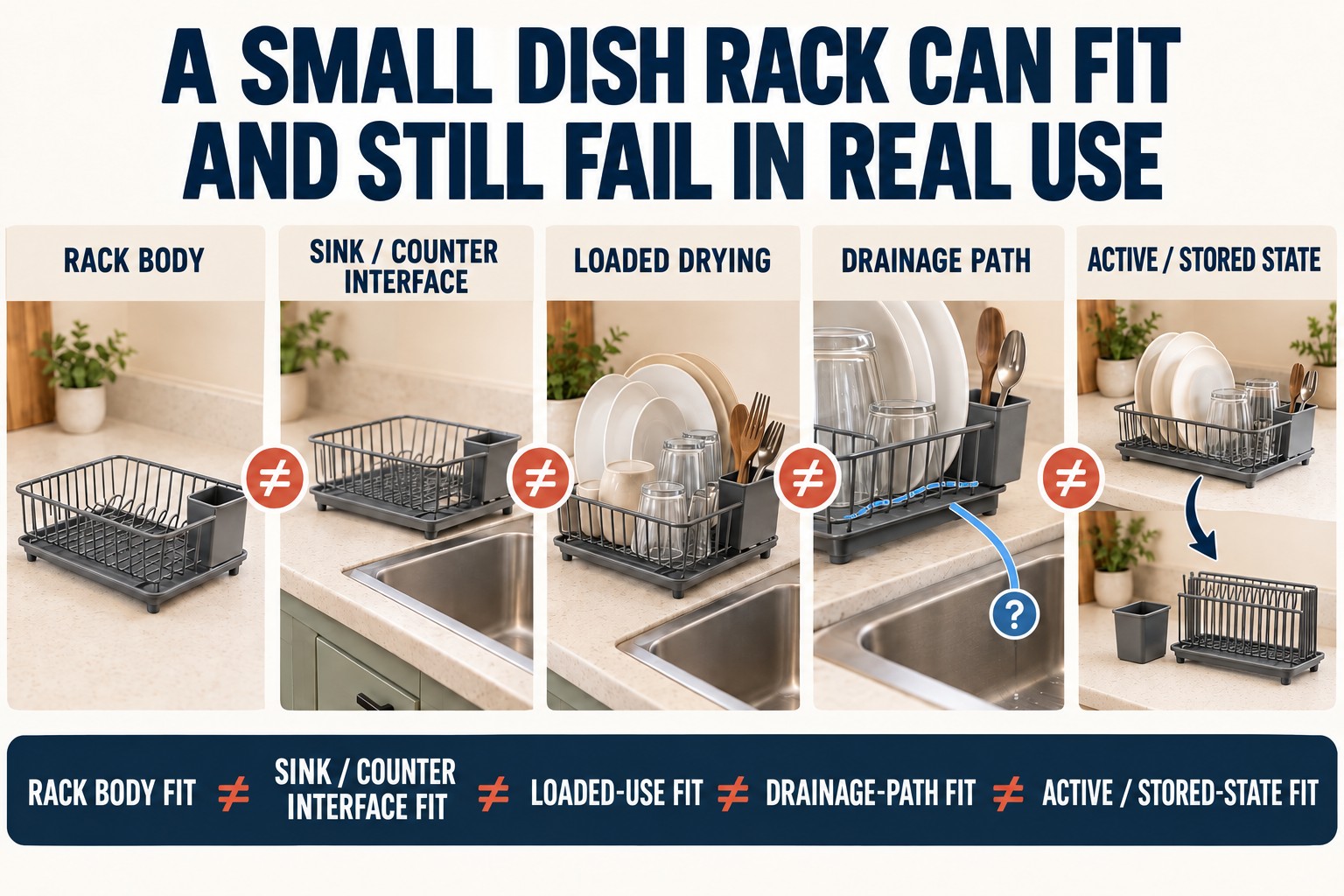
The reason is simple: the rack body is only one part of the decision.
The rack still has to sit on the counter or span the sink the way the exact product requires. It has to work after plates, glasses, cutlery, and other items are actually loaded. Water still needs an intended path after washing. The rack also has to avoid conflicts with the faucet, backsplash, sink edge, counter edge, or other fixed parts of the kitchen.
Then there is one more state people can miss: what happens when the rack expands, folds, closes, separates, or needs to be put away.
That is why this guide uses a fit-first rule:
RACK BODY FIT ≠ SINK / COUNTER INTERFACE FIT ≠ LOADED-USE FIT ≠ DRAINAGE-PATH FIT ≠ ACTIVE / STORED-STATE FIT
The goal is not to find the smallest-looking rack.
The goal is to find a dish-drying system whose complete working state makes sense in your actual sink-and-counter setup.
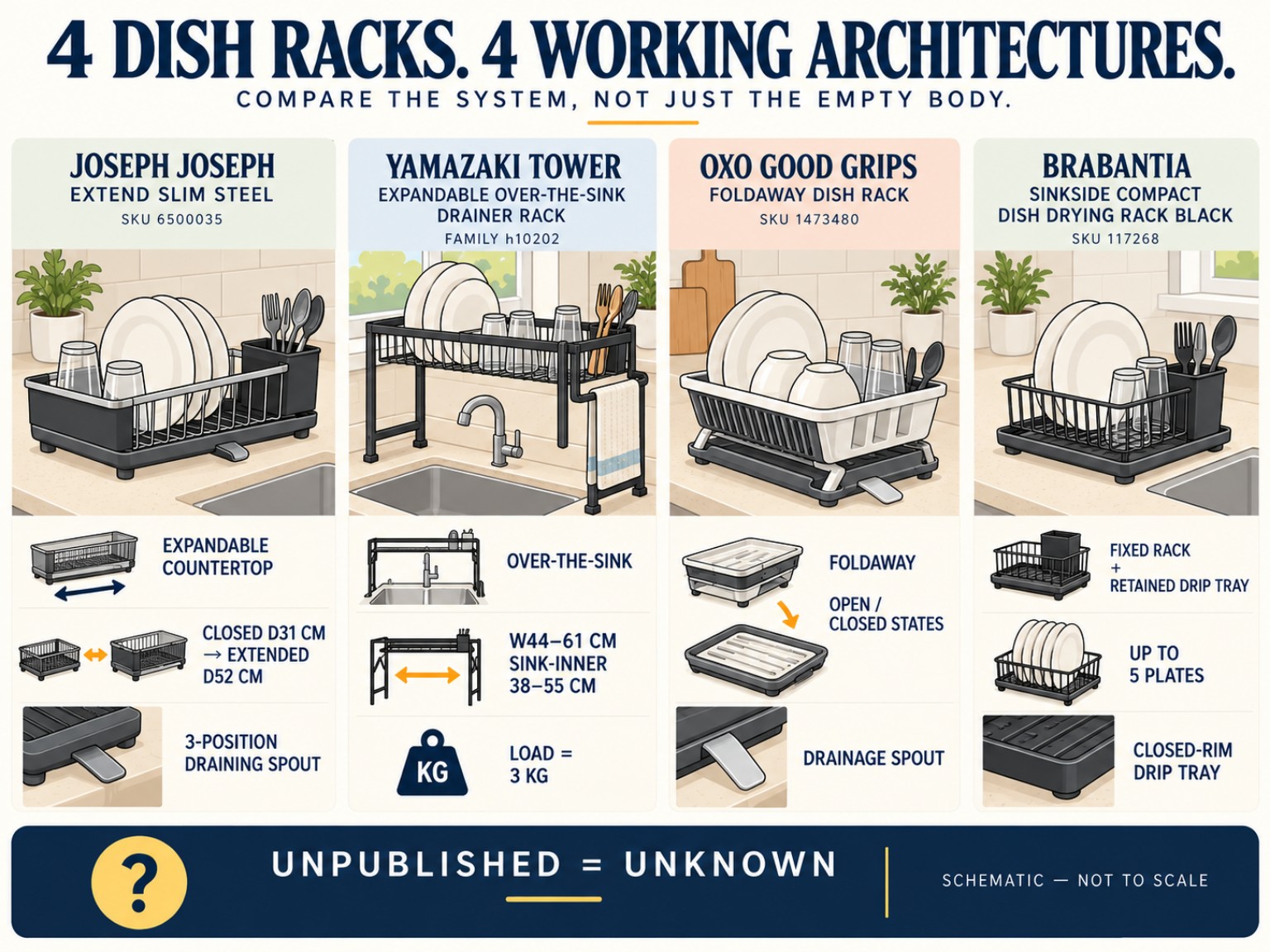
Quick Comparison: 4 Small Dish Drying Racks
| Product | Published body / active-state facts | Placement / support interface | Drainage architecture | Transition / stored-state evidence |
|---|---|---|---|---|
| Joseph Joseph Extend Slim Steel — SKU 6500035 | Closed H16 × W23 × D31 cm; fully extended H16 × W23 × D52 cm | Narrow expandable drainer; exact sink/counter/faucet/backsplash compatibility remains product- and kitchen-specific | Three-position adjustable draining spout | Sliding tray expands drying area; dismantles for cleaning; dismantled storage dimensions UNKNOWN |
| Yamazaki Tower Expandable Over-the-Sink Drainer Rack — family h10202 | W44–61 × D17.5 × H1.6 cm; published sink-inner range 38–55 cm; published load 3 kg | Over-the-sink expandable support architecture | No separate drain board or spout specified in the locked evidence | Expandable width published; no folded storage state published; stored dimensions UNKNOWN |
| OXO Good Grips Foldaway Dish Rack — SKU 1473480 | Open 19.4 × 15.5 × 5.125 in; closed 19.4 × 12.5 × 3.875 in | Dish-rack body with published open / closed states; exact sink/counter/faucet/backsplash compatibility UNKNOWN | Drainage spout | Foldaway open / closed state published; plate-rack configuration changes |
| Brabantia SinkSide Compact Dish Drying Rack Black — SKU 117268 | H12.5 × L46.3 × W20 cm; product weight 1 kg | Fixed compact countertop rack; marketed for limited countertop space; silicone caps | Closed-rim drip tray retains water; ribs support airflow; no direct-to-sink spout published | Rack and drip tray can be used together or separately; cutlery basket removable; no folded state published; stored dimensions UNKNOWN |
Important: Published rack dimensions do not automatically tell you what the rack will occupy after dishes are loaded, where water will actually travel in your kitchen, or whether the faucet and backsplash remain unobstructed.
If a required value is not published in the locked evidence, keep it UNKNOWN.
The Main Problem: The Rack Body Is Not the Whole Working State
A dish rack is easy to judge while empty.
You can read the product dimensions. You can see the frame or tray. You can compare the width or depth with a patch of counter.
But a small kitchen introduces several interfaces at once.
A countertop rack uses counter area and still has to work with the sink edge and water path.
An over-the-sink rack depends on the support geometry around the sink rather than counter footprint alone.
An expandable rack has more than one active size.
A foldaway rack has an open state and a closed state.
A rack with a retained drip tray handles water differently from a rack with a draining spout or an over-the-sink support architecture.
Those differences are why “small” cannot be reduced to one product dimension.
For this article, the useful question is:
What does the exact rack require from the sink, counter, loaded dishes, drainage path, nearby fixtures, and transition or stored state?
That is the question the six-step method below is designed to answer.
Product 1: Joseph Joseph Extend Slim Steel — SKU 6500035
The Joseph Joseph Extend Slim Steel is a narrow expandable drainer with two published body states in the locked evidence.
Published dimensions:
- Closed: H16 × W23 × D31 cm
- Fully extended: H16 × W23 × D52 cm
The change between 31 cm and 52 cm matters because this product does not have one fixed working depth.
Its sliding tray expands the drying area, so the kitchen has to accommodate the state you actually plan to use rather than only the smaller closed body.
Published drying and drainage features
The locked first-party evidence establishes:
- three-position adjustable draining spout
- adjustable steel prongs
- removable cutlery pot
- knife slot
- sliding tray that expands the drying area
- dismantling for cleaning
Those features describe the product architecture, but they do not prove universal fit.
The adjustable spout tells you that the product includes an intended drainage mechanism. It does not establish that the spout will reach the sink correctly in every counter layout, and it does not establish drainage performance in your kitchen.
The closed and fully extended dimensions tell you the rack-body states. They do not establish the projection of real plates, glasses, cookware, or cutlery once the rack is loaded.
What the published evidence helps you check
For a small kitchen, this product gives you a clear reason to measure at least two body states:
- the closed rack body
- the fully extended rack body
Then check where the draining spout would need to point in each state you expect to use.
Do not stop at “31 cm fits.”
If you expect to extend the rack, the 52 cm state is part of the real working-fit decision.
Keep UNKNOWN
The locked evidence does not establish:
- load rating
- plate count
- maximum plate diameter
- loaded projection
- exact sink compatibility
- exact counter compatibility
- faucet clearance
- backsplash clearance
- universal counter clearance
- drainage performance
- dismantled storage dimensions
- material performance
UNKNOWN means UNKNOWN.
Do not convert the adjustable spout into a claim that drainage will work in every layout, and do not convert the expandable body dimensions into a claim about loaded-dish projection.
Product 2: Yamazaki Tower Expandable Over-the-Sink Drainer Rack — family h10202
The Yamazaki Tower option uses a different interface from the countertop racks in this comparison.
Its core architecture is an expandable rack intended to work over the sink.
Published dimensions:
- width: 44–61 cm
- depth: 17.5 cm
- height: 1.6 cm
- cutlery pocket: W7 × D2.5 × H7 cm
Published sink-inner range:
- 38–55 cm
Published load:
- 3 kg
The locked evidence also establishes:
- expandable width
- standing-dish slits
- two cutlery pockets
- non-slip design
These facts make the support interface especially important.
The rack is not being judged only by whether a 44–61 cm product body exists in the kitchen. It has to work with the sink geometry the product is designed around.
Use the published sink range carefully
The published 38–55 cm sink-inner range is useful evidence.
But it is not permission to infer every other fit condition.
The locked evidence does not establish the required sink-lip support width, universal faucet clearance, universal backsplash clearance, or loaded projection.
So the correct use of the 38–55 cm range is narrow:
Compare it with the relevant sink-inner measurement for the exact kitchen.
Do not extend that number into other compatibility claims the evidence does not support.
Drainage-path boundary
No separate drain board or draining spout is specified in the locked evidence for this product.
That is a meaningful architectural difference from the Joseph Joseph and OXO products, but it is not a performance claim.
The article does not assign a drainage rate, drainage efficiency, or universal water-management result to the rack.
Transition / stored state
The 44–61 cm expandable range is published.
A separate folded storage state is not.
Do not turn the narrow end of the expandable range into a claimed storage dimension unless the product evidence explicitly defines it that way.
Keep UNKNOWN
- individual item-level product number beyond the locked family identity h10202
- loaded projection
- dish count
- maximum plate size
- required sink-lip support width
- faucet clearance
- backsplash clearance
- drainage rate
- drainage performance
- folded storage state
- stored dimensions
- material performance
The 3 kg load figure is published and may be used.
Everything else stays inside the evidence boundary.
Product 3: OXO Good Grips Foldaway Dish Rack — SKU 1473480
The OXO Good Grips Foldaway Dish Rack is the product in this set with the clearest published open-versus-closed body dimensions.
Published dimensions:
- Open: 19.4 × 15.5 × 5.125 in
- Closed: 19.4 × 12.5 × 3.875 in
The locked evidence identifies the product as stainless steel, but this article does not convert material identity into a material-performance claim.
Published drying and drainage features
The evidence establishes:
- drainage spout
- fold-down plate rack for larger items
- internal cup rack for glasses
- published open / closed state
- plate-rack configuration changes
Those features make the transition-state check central to this product.
The open rack is the drying state.
The closed rack is a different physical state.
The plate-rack configuration can also change depending on the items being dried.
For a small kitchen, that means the buyer should not evaluate the product using only one set of dimensions.
Check the open state and the closed state separately
The open dimensions tell you the rack-body envelope in use.
The closed dimensions tell you the smaller published body state after folding.
Neither set of dimensions proves the projection of real dishes after loading.
And the drainage spout does not prove that its reach or position will work with every sink-counter relationship.
Keep UNKNOWN
- load rating
- plate count
- maximum plate size
- loaded projection
- sink compatibility
- counter clearance
- faucet clearance
- backsplash clearance
- spout reach
- spout position range
- drainage performance
- material performance
The open / closed dimensions are published.
Do not replace the missing fields with generic dish-rack assumptions.
Product 4: Brabantia SinkSide Compact Dish Drying Rack Black — SKU 117268
The Brabantia SinkSide Compact Dish Drying Rack Black is a fixed compact countertop rack paired with a retained drip tray.
Published identity:
- SKU 117268
- EAN 8710755117268
Published dimensions:
- H12.5 × L46.3 × W20 cm
- product weight: 1 kg
The product is marketed for limited countertop space, and the locked evidence also establishes silicone caps.
That description can help identify the intended use context, but it does not create a universal “small counter” threshold.
Published loaded-use features
The evidence establishes:
- capacity for up to 5 plates
- flat section for glasses or other items
- removable cutlery basket
The “up to 5 plates” figure is useful, but it is not the same thing as a load rating and does not establish a maximum plate diameter.
Drainage architecture
This product uses a closed-rim drip tray that retains water.
The tray includes ribs that support airflow.
No direct-to-sink draining spout is published in the locked evidence.
That means its drainage architecture is different from the spout-based products in this comparison.
But the article does not turn tray design into a claim about drainage or evaporation performance.
It also does not invent the amount of water the tray can retain.
Transition / stored state
The rack and drip tray can be used together or separately.
The cutlery basket is removable.
No folded state is published.
Those separable components are useful to understand, but they do not establish a published stored footprint.
Keep UNKNOWN
- load rating
- maximum plate diameter
- loaded projection
- sink compatibility
- faucet clearance
- backsplash clearance
- universal counter clearance
- tray water capacity
- drainage performance
- evaporation performance
- stored dimensions
- material performance
The rack may be described as compact, but “compact” does not replace measuring the actual counter and sink interface.

The Sink-to-Storage 6-Step Working-Fit Check
The four products above use different architectures, but they can all be evaluated with the same decision sequence.
The purpose of the method is not to produce a winner.
It is to stop one published dimension or one product feature from being treated as proof that the entire working state fits.
Step 1: Verify Exact Product / Variant
Start with identity.
Confirm the exact product name, SKU, model, or family identifier available in the evidence before using any specification.
For this article, the locked identities are:
- Joseph Joseph Extend Slim Steel — SKU 6500035
- Yamazaki Tower Expandable Over-the-Sink Drainer Rack — family h10202
- OXO Good Grips Foldaway Dish Rack — SKU 1473480
- Brabantia SinkSide Compact Dish Drying Rack Black — SKU 117268
Then write down the published body dimensions and the active states the product actually supports.
This matters because an expandable rack, an over-the-sink rack, a foldaway rack, and a fixed rack with separable tray components do not have the same working-state logic.
If the product identity does not match the evidence you are reading, stop before carrying the specification forward.
Step 2: Check Placement / Support Interface
Next, identify how the exact product occupies the kitchen.
The relevant interface in this set may be:
- a countertop rack body
- an expandable countertop body
- an over-the-sink support architecture
- a fixed rack with a retained drip tray
- a rack with open and closed states
Compare the published product body with the actual counter, sink, and support geometry that matters for that product.
Do not use “compact” as a universal threshold.
Do not assume a product fits a sink because its outer dimensions look close.
For the Yamazaki rack, use the published sink-inner range of 38–55 cm as the supported compatibility evidence available here.
For the other products, exact sink compatibility remains UNKNOWN unless the locked evidence establishes it.
Step 3: Check Loaded Drying State
An empty dish rack is not the loaded-use state.
Use only the loading information the exact product evidence supports.
In this set:
- Yamazaki publishes a 3 kg load figure.
- Brabantia publishes capacity for up to 5 plates.
- Joseph Joseph load, plate count, and maximum plate diameter remain UNKNOWN.
- OXO load, plate count, and maximum plate size remain UNKNOWN.
Also distinguish rack-body dimensions from the real shape created by plates, glasses, cutlery, and larger items.
If loaded projection is not published, keep it UNKNOWN.
Do not invent a loaded height, depth, width, or universal dish clearance from the empty rack body.
Step 4: Trace the Drainage Path
Now follow the product’s documented water-management architecture.
The four products do not use the same system.
- Joseph Joseph: three-position adjustable draining spout.
- Yamazaki: no separate drain board or spout specified in the locked evidence.
- OXO: drainage spout.
- Brabantia: closed-rim drip tray that retains water, with ribs supporting airflow; no direct-to-sink spout published.
This step asks where the product is designed to direct or retain water relative to the sink-and-counter layout.
It does not ask you to invent drainage performance.
A spout is evidence of a drainage design, not proof that it reaches every sink.
A drip tray is evidence of a retained-water design, not proof of a drainage or evaporation rate.
If drainage performance is not published, it stays UNKNOWN.
Step 5: Check Faucet / Backsplash / Adjacent Interference
A rack can fit its nominal counter or sink area and still conflict with something nearby.
Check the real relationship with:
- faucet body
- faucet handle or moving parts
- backsplash
- sink edge
- counter edge
- wall
- other fixed adjacent objects
This article does not provide a universal clearance number.
The locked product evidence does not establish universal faucet or backsplash clearance for these racks.
So published product dimensions are only inputs to this check.
They do not prove interference-free fit by themselves.
If the needed clearance is not published, measure the actual kitchen relationship rather than turning the missing value into a pass.
Step 6: Check Transition / Stored State
Finally, check what changes when active use ends or the product changes configuration.
For the four locked products:
Joseph Joseph Extend Slim Steel
Check the closed H16 × W23 × D31 cm state and the fully extended H16 × W23 × D52 cm state separately.
It dismantles for cleaning, but dismantled storage dimensions are not published in the locked evidence.
Yamazaki Tower Expandable Over-the-Sink Drainer Rack
Check the published 44–61 cm expandable width as an active-state range.
No folded storage state is published.
Do not label 44 cm as a storage dimension unless the evidence explicitly supports that interpretation.
OXO Good Grips Foldaway Dish Rack
Check both published states:
- open 19.4 × 15.5 × 5.125 in
- closed 19.4 × 12.5 × 3.875 in
The foldaway state is part of the product’s working-fit decision, not an afterthought.
Brabantia SinkSide Compact Dish Drying Rack
The rack and drip tray can be used together or separately, and the cutlery basket is removable.
No folded state is published.
Stored dimensions remain UNKNOWN.
The rule for Step 6 is simple:
Use published transition or storage dimensions when they exist. Keep unpublished storage dimensions UNKNOWN.
Four Different Working-State Architectures
This is not a ranking.
The four products solve the drying-space problem in different ways, so the useful comparison is architectural.
Joseph Joseph: Expand the drying body
The key published state change is the move from D31 cm closed to D52 cm fully extended.
The decision therefore includes both body states and the three-position draining spout.
The unresolved questions are the ones the evidence does not establish: real loaded projection, exact sink/counter relationship, spout reach in a specific kitchen, and drainage performance.
Yamazaki: Use the sink as the support interface
The key published evidence is the expandable 44–61 cm width, 38–55 cm sink-inner range, and 3 kg load.
That makes sink geometry part of the product decision from the beginning.
But the published sink-inner range does not establish every support dimension or every faucet / backsplash relationship.
OXO: Separate open-use and closed states
The key published distinction is open versus closed dimensions.
That makes the transition state unusually visible in the evidence.
The unresolved fit questions remain the loaded projection, exact sink/counter interference, and drainage-spout reach in a specific kitchen.
Brabantia: Fixed rack plus retained-water tray
The key architecture is a fixed countertop rack with a closed-rim drip tray, removable cutlery basket, and the option to use rack and tray together or separately.
Its published “up to 5 plates” capacity helps describe loaded use, but it does not establish load rating, maximum plate diameter, or loaded projection.
Claim and UNKNOWN Boundaries
The most important evidence rule in this article is:
UNPUBLISHED ≠ PASS
and
UNPUBLISHED ≠ FAIL
It means:
UNKNOWN.
Published load / capacity evidence in this article
Joseph Joseph Extend Slim Steel
- load rating = UNKNOWN
- plate count = UNKNOWN
- maximum plate diameter = UNKNOWN
Yamazaki Tower Expandable Over-the-Sink Drainer Rack
- published load = 3 kg
- dish count = UNKNOWN
- maximum plate size = UNKNOWN
OXO Good Grips Foldaway Dish Rack
- load rating = UNKNOWN
- plate count = UNKNOWN
- maximum plate size = UNKNOWN
Brabantia SinkSide Compact Dish Drying Rack
- published capacity = up to 5 plates
- load rating = UNKNOWN
- maximum plate diameter = UNKNOWN
Keep UNKNOWN unless exact product evidence establishes it
- loaded projection
- sink compatibility beyond the exact published compatibility evidence
- counter clearance
- faucet clearance
- backsplash clearance
- universal clearance
- drainage performance
- spout reach unless published
- drip-tray water capacity unless published
- storage dimensions unless published
- material performance
Do not convert a product image, a body dimension, a drainage feature, or the word “compact” into one of those claims.
Final Buying Check
Before buying a small dish drying rack for a small kitchen, run the decision in this order.
1. Verify the exact product
Are you looking at the same SKU, model, or family that the specification belongs to?
2. Check the placement / support interface
Does the rack body and support architecture work with the actual sink and counter geometry?
Use published compatibility only where it exists.
3. Check the loaded drying state
What does the exact evidence establish about load, dish capacity, holders, and configuration?
What remains UNKNOWN after dishes are added?
4. Trace the drainage path
Does the product use a spout, over-sink architecture, or retained drip tray?
How does that documented design relate to the actual sink-and-counter layout?
Do not substitute a drainage feature for unproven drainage performance.
5. Check interference
Will the rack’s real active state conflict with the faucet, backsplash, sink edge, counter edge, wall, or adjacent fixed object?
If the needed clearance is unpublished, measure the kitchen rather than inventing a universal number.
6. Check the transition / stored state
What happens when the rack expands, closes, folds, separates, or needs to be put away?
Use published dimensions where they exist.
Keep unpublished stored dimensions UNKNOWN.
Final Takeaway
A small dish drying rack is not automatically a good small-kitchen rack just because its empty body looks compact.
The body may fit while the support interface does not.
The support interface may work while the loaded dishes create a different working envelope.
The rack may hold the intended items while the drainage path does not suit the sink-and-counter relationship.
And the active state may work while the transition or stored state creates a new space problem.
That is why the better buying question is not:
“Is this dish rack small?”
It is:
“Will this exact rack work from sink interface to loaded drying to drainage to storage in my actual kitchen?”
For a small kitchen, that is the difference between buying a rack that fits as an object and choosing one that fits as a working system.