Compact Ironing Boards for Small Spaces: Check the Open-to-Storage Fit Before You Buy
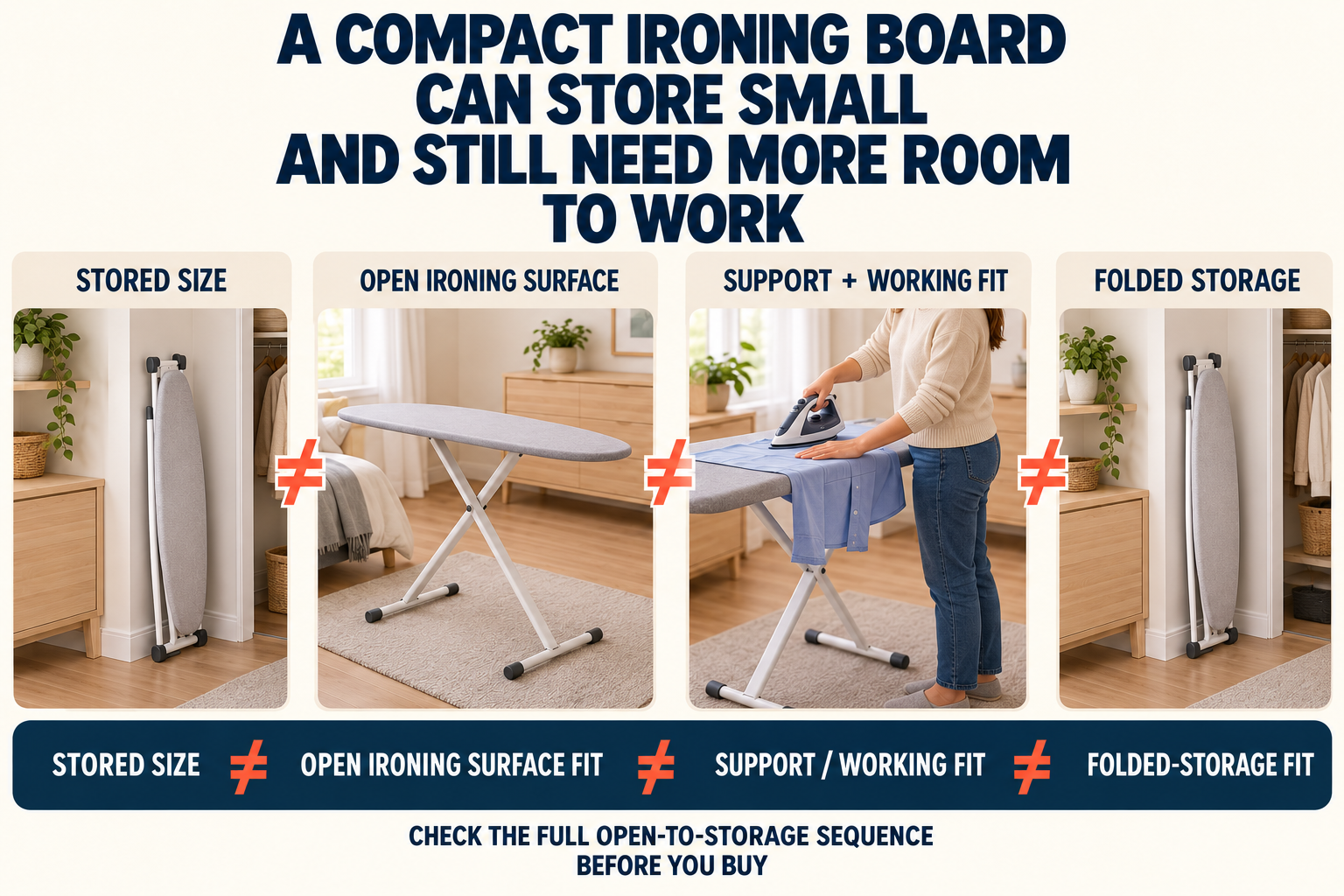
A compact ironing board can look easy to store and still be awkward to use in a small home.
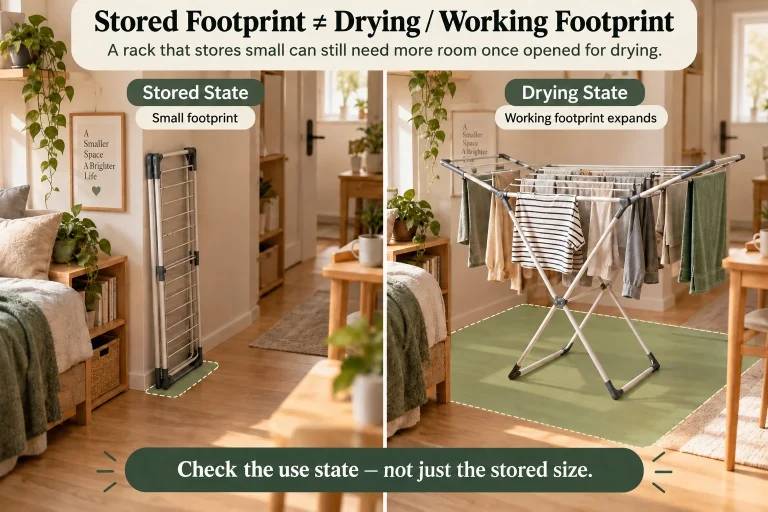
The reason is that stored size is only one part of the decision.
A board still needs enough usable ironing surface for the work you plan to do. A tabletop model still depends on a suitable supporting table or other solid surface. A freestanding model creates its own floor footprint, leg geometry, working height, and iron-rest relationship. Then the board has to move from the open working state back into whatever folded or stored state the exact product actually supports.
That is why this guide uses a fit-first rule:
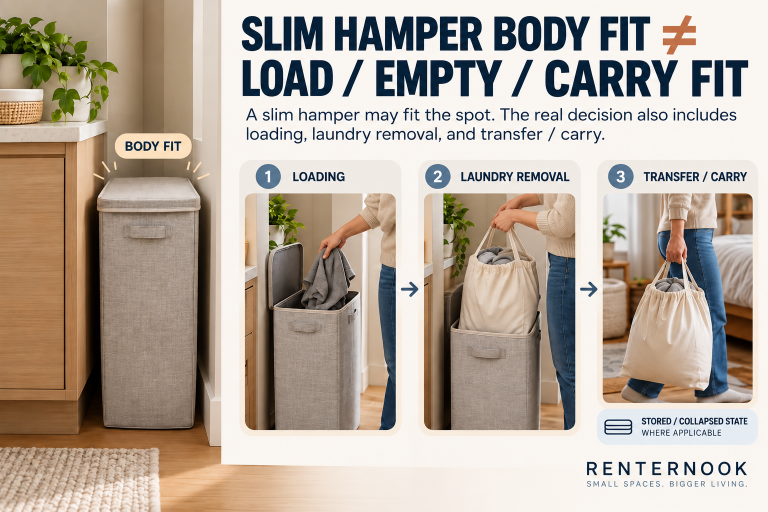
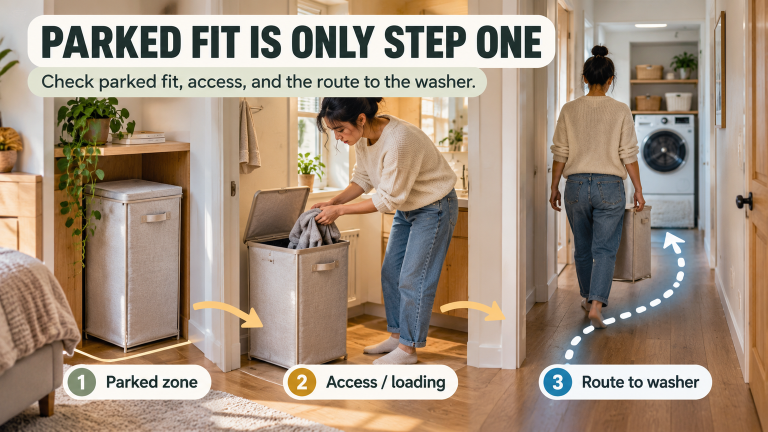
STORED SIZE ≠ OPEN IRONING SURFACE FIT ≠ SUPPORT / WORKING FIT ≠ FOLDED-STORAGE FIT
The goal is not to find the board that looks smallest in a product photo.
The goal is to find an ironing setup whose full open-to-storage sequence makes sense in your actual room.
Quick Comparison: 4 Compact Ironing Boards
| Product | Published open / working evidence | Support architecture | Fold / storage evidence |
|---|---|---|---|
| Joseph Joseph Pocket 90cm Folding Ironing Board — SKU 50009 | Ironing surface 90 × 33 cm; surface height 11 cm above tabletop | Tabletop; adjustable non-slip feet | Board folds in half; integrated iron storage; closed H45.5 × W34 × D15.5 cm; separate hanging hook |
| IKEA JÄLL — 402.428.89 | Published working dimensions L73 × W32 × H13 cm | Simple tabletop board; foldable legs; must stand on a flat surface | Manufacturer states it folds flat and can hang on a hook on a door or in a wardrobe; exact folded dimensions UNKNOWN |
| Minky Ergo Table Top — HH41400118 | Open H7 × W69 × D34 cm; ironing surface 69 × 34 cm; published working height 3.5–7 cm | Tabletop; must rest on a table or other solid surface; non-slip feet | Folded height 3.5 cm; legs fold flat; iron rest retracts; exact folded length / width not separately published |
| Leifheit Air Board S Basic — 72584 | Ironing surface 110 × 30 cm; adjustable working height 77–88 cm | Freestanding full-height board; height-adjustable underframe; fixed iron rest | Folded 144 × 40 × 8 cm; transport lock; full open floor footprint UNKNOWN |
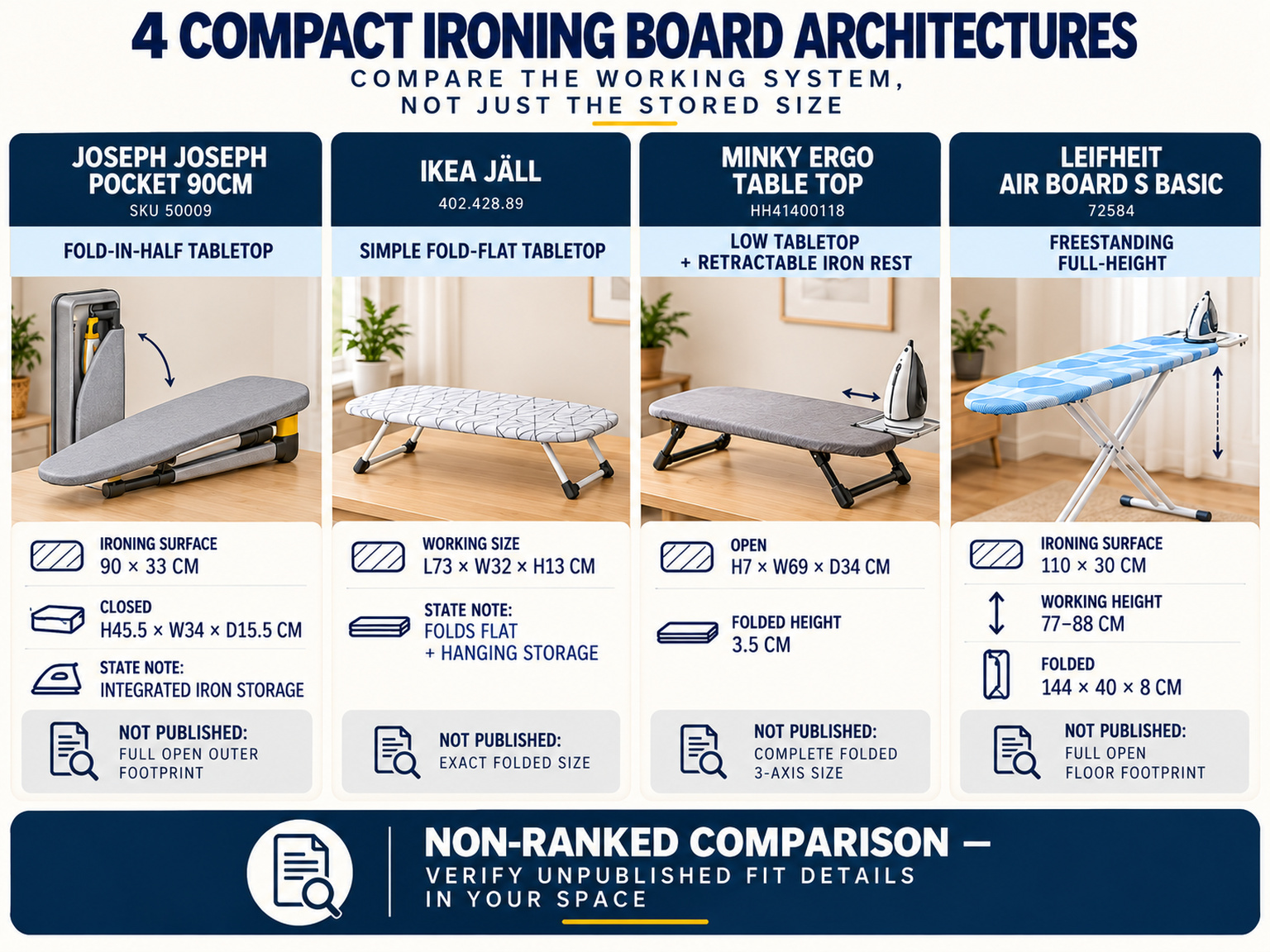
Important: Ironing-surface dimensions do not automatically tell you the full open footprint, the space needed by the iron or iron rest, the user working clearance, or the folded storage envelope.
If a required value is not published in the locked evidence, keep it UNKNOWN.
The Main Problem: “Compact” Changes Between Stored and Open States
An ironing board can be compact in one state and demanding in another.
A fold-in-half tabletop board may store in a relatively short closed envelope, but it still needs a suitable tabletop and enough open surface for use.
A simple fold-flat tabletop board may hang away neatly, but the phrase “folds flat” does not tell you the exact folded thickness unless the manufacturer publishes it.
A low tabletop board with a retractable iron rest may reduce working height, but the iron-rest projection can still matter while the board is in use.
A freestanding board may fold to a narrow stored thickness and still require floor room, leg spread, working height, user position, and garment movement in the open state.
Those are different fit questions.
For this article, the useful question is:
What does this exact ironing board require when it is open, supported, used with the iron and garment, folded down, and finally stored?
That is the question the seven-step method below is designed to answer.
Product 1: Joseph Joseph Pocket 90cm Folding Ironing Board — SKU 50009
The Joseph Joseph Pocket 90cm is the fold-in-half tabletop architecture in the locked set.
Its published ironing surface is 90 × 33 cm, and the open surface sits 11 cm above the tabletop.
Those numbers describe the usable board surface and its height above the supporting table. They do not establish the full outer footprint once the board, feet, iron, garment movement, and nearby objects are considered.
Published storage state
The locked first-party evidence publishes the closed envelope as:
- H45.5 cm
- W34 cm
- D15.5 cm
The board folds in half and includes an integrated iron-storage compartment. A separate hanging hook is also part of the storage architecture.
That gives this product a relatively clear transition from open use to a defined closed state.
But the presence of a hanging hook does not prove that every door, wardrobe rail, panel, or storage position is compatible.
Support and placement
The board uses a tabletop architecture with adjustable non-slip feet.
The manufacturer also supplies a bracket, screws, and wall plugs for wall-mounted storage of the folded unit.
For this article, that wall hardware is treated only as part of the product’s storage logic.
This is not a wall-mount installation guide, and no wall type, anchor suitability, fastener compatibility, or installation clearance is inferred here.
Use and storage conditions
The locked evidence also establishes:
- cover top: 100% cotton
- underlay: 100% polyester felt
- iron must cool to room temperature before it is placed in the storage compartment
- cover must be dry before folding and storing
These conditions matter because the fold-down sequence is not simply “finish ironing and close the board.”
The exact product instructions add cooling and drying conditions before storage.
Keep UNKNOWN
The locked evidence does not establish:
- full open outer footprint
- exact foot-contact envelope
- maximum support load
- maximum iron size for the integrated storage compartment
- minimum supporting-table dimensions
- user working clearance
- universal hanging compatibility
The closed dimensions are useful storage evidence.
They are not a substitute for the missing open-state fit information.
Product 2: IKEA JÄLL — Article Number 402.428.89
The IKEA JÄLL is the simplest fold-flat tabletop architecture in the locked set.
The published working dimensions are:
- length: 73 cm
- width: 32 cm
- height: 13 cm
Use those as the published working dimensions available in the locked evidence.
Do not silently relabel them as a different measurement category that IKEA did not separately publish in the evidence set.
Support requirement
The JÄLL is a tabletop board with foldable legs.
The safety requirement in the locked evidence is clear:
It must stand on a flat surface.
That means the board itself does not remove the need to evaluate the supporting furniture.
A tabletop board is not proof that any dining table, desk, kitchen counter, sideboard, or other surface is suitable.
The support still has its own size, condition, material, height, load, heat, and stability considerations.
Where those values are not published for the exact board/support combination, they remain outside the evidence.
Fold-flat and hanging state
IKEA states that the board:
- folds flat
- can be hung on a hook
- can be hung on a door
- can be hung in a wardrobe
That is useful evidence about the intended storage mode.
It does not establish universal door or wardrobe compatibility.
More importantly, the exact folded product dimensions are not published in the locked evidence.
A package size of 74 × 32 × 2 cm is published, but package size is not the same thing as folded product size.
Do not use the 2 cm package dimension as a folded-thickness claim.
Material facts
The locked evidence establishes:
- steel frame
- powder-coated finish
- 100% cotton fabric
- non-woven polyester filling
Those material facts do not prove a universal heat, steam, load, or durability outcome.
Keep UNKNOWN
The locked evidence does not establish:
- exact folded envelope
- exact folded thickness
- iron rest — none is published in the locked evidence
- maximum load
- foot-contact envelope
- minimum support-table size
- steam-generator compatibility
- universal door / wardrobe hanging fit
For a small space, the JÄLL is a good example of why “folds flat” and “exact stored thickness” are not interchangeable claims.
Product 3: Minky Ergo Table Top — SKU HH41400118
The Minky Ergo Table Top is the low tabletop architecture with a retractable iron rest.
The locked evidence publishes the open dimensions as:
- H7 × W69 × D34 cm
The published ironing surface is:
- 69 × 34 cm
Published working height is:
- 3.5–7 cm
This product is useful in the comparison because the open state is more explicitly described than with some of the other tabletop boards.
Support architecture
The Minky must rest on:
- a table
- or another solid surface
Non-slip feet are published.
That tells you the board is designed around a supporting surface, but it still does not prove that every available table, counter, desk, or worktop is suitable.
The exact support surface still has to make sense for the real use case.
Iron-rest architecture
The Minky includes a retractable iron rest.
That creates a working-state component that can change the usable envelope compared with the board body alone.
The locked evidence does not publish the exact deployed projection of that rest, so the full working reach remains UNKNOWN.
Do not infer the deployed rest envelope from the board dimensions.
Folded / storage state
The published folded height is:
- 3.5 cm
The manufacturer states that the board folds flat and the rest can be retracted.
However, exact folded length and width are not separately published in the locked evidence.
So the folded state is only partially defined.
You know the published folded height.
You do not have a complete published three-axis folded envelope.
Material and iron compatibility
The locked evidence establishes:
- 100% cotton cover
- heat-reflective metallic coating
- suitable for irons
- suitable for steam generators
- product weight 0.81 kg
The steam-generator compatibility here is product-specific evidence for the Minky model.
Do not transfer that compatibility to another ironing board in the comparison.
Keep UNKNOWN
The locked evidence does not establish:
- maximum load
- exact retracted iron-rest envelope
- exact deployed iron-rest projection
- minimum supporting-surface dimensions
- user working clearance
- complete three-axis folded size
Product 4: Leifheit Air Board S Basic — Product Number 72584
The Leifheit Air Board S Basic is the only full-height freestanding architecture in the locked four-product set.
Its published ironing surface is:
- 110 × 30 cm
Its adjustable working height is:
- 77–88 cm
Unlike the three tabletop models, this board creates its own support structure through a freestanding underframe.
That changes the fit question from “what table supports the board?” to “what floor area and working space does the open frame require?”
Open working state
The locked evidence confirms:
- freestanding full-height folding board
- height-adjustable underframe
- fixed iron rest
- 110 × 30 cm ironing surface
- 77–88 cm working-height range
But the full open floor footprint is UNKNOWN.
The fixed iron-rest dimensions are also UNKNOWN, and the total open length including that rest is UNKNOWN.
So the published surface size must not be treated as the complete open envelope.
Folded / storage state
The folded dimensions are explicitly published as:
- 144 × 40 × 8 cm
The board also includes a transport lock intended to prevent unintended opening.
This is the cleanest full three-axis folded envelope in the locked four-product comparison.
It still does not tell you where the board will fit best in a real home.
You still have to compare 144 × 40 × 8 cm with the exact storage location you plan to use.
Floor-use evidence and safety boundary
The manufacturer describes the frame as stable and also describes the underframe as compensating for floor differences up to 10 mm.
However, the locked safety instruction says:
Do not use on uneven surfaces.
That safety instruction controls the article language.
The 10 mm compensation feature must not be converted into a claim that uneven-floor use is safe.
Material and iron compatibility
The locked evidence establishes:
- special-plastic ironing surface
- Thermo-Reflect cover
- suitable for standard irons
- suitable for steam irons
- fixed iron rest
The manufacturer recommends its Air Board Express range for steam-generator irons.
Therefore, this article does not convert standard-iron or steam-iron compatibility into steam-generator compatibility for the Air Board S Basic.
Keep UNKNOWN
The locked evidence does not establish:
- full open floor footprint
- fixed iron-rest dimensions
- total open length including iron rest
- maximum load
- user working clearance
- iron working clearance
Four Different Working Architectures
This is not a ranking.
The four locked products solve the small-space ironing problem in different ways.
Joseph Joseph: Fold the board body in half
The key distinction is the fold-in-half tabletop body plus integrated iron storage and a published closed envelope.
That makes the storage state unusually clear.
The unresolved side of the decision is the full open outer footprint and the exact supporting-table requirement.
IKEA JÄLL: Keep the tabletop architecture simple
The key distinction is a basic tabletop board with folding legs and intended hanging storage.
The unresolved storage issue is equally important: “folds flat” is published, but exact folded dimensions are not.
Minky Ergo Table Top: Add a retractable iron rest
The key distinction is a low tabletop board with a retractable iron rest and a published folded height.
The unresolved question is the complete folded and deployed envelope, especially the iron-rest projection.
Leifheit Air Board S Basic: Use a freestanding full-height frame
The key distinction is the full-height freestanding architecture with adjustable working height, fixed iron rest, and a published 144 × 40 × 8 cm folded envelope.
The unresolved open-state question is the full floor footprint and total length including the rest.
The comparison therefore reinforces the core thesis:
Stored size, open ironing surface, support / working fit, and folded-storage fit are separate decision fields.
The Open-to-Storage 7-Step Ironing-Board Fit Check
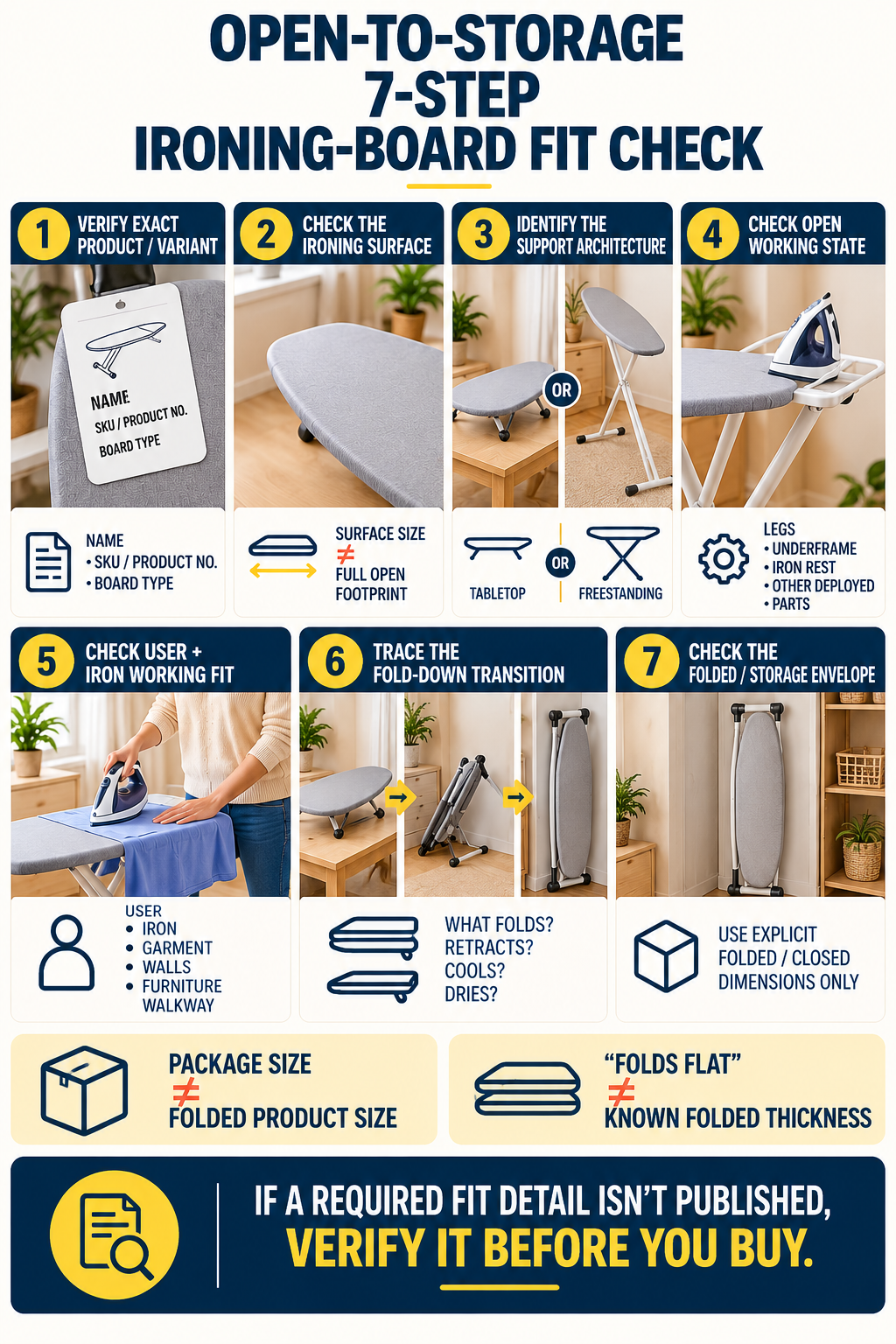
Use the following sequence before buying a compact ironing board for a small space.
Step 1: Verify Exact Product / Variant
Start with identity.
Confirm the exact:
- product name
- SKU or product number
- board type
- supported iron type where published
For this article, the locked identities are:
- Joseph Joseph Pocket 90cm — SKU 50009
- IKEA JÄLL — 402.428.89
- Minky Ergo Table Top — HH41400118
- Leifheit Air Board S Basic — 72584
Do not borrow dimensions, folded states, compatibility, or support requirements from a similar-looking model.
If the identity does not match the evidence, stop before carrying the specification forward.
Step 2: Check the Ironing Surface
Use the exact published ironing-surface dimensions where they exist.
In this set:
- Joseph Joseph: 90 × 33 cm ironing surface
- Minky: 69 × 34 cm ironing surface
- Leifheit: 110 × 30 cm ironing surface
- IKEA: the locked evidence publishes working dimensions L73 × W32 × H13 cm; do not silently convert that into a separately specified ironing-surface claim
The important rule is:
IRONING SURFACE SIZE ≠ FULL OPEN WORKING FOOTPRINT
An ironing surface tells you the work area of the board.
It does not automatically include legs, underframe, feet, iron rest, integrated storage elements, garment movement, user position, or nearby clearances.
Step 3: Identify the Support Architecture
Classify the board first:
- tabletop
- or freestanding
Then check the exact placement requirement.
Tabletop boards
Joseph Joseph, IKEA JÄLL, and Minky are tabletop architectures.
That means the board depends on another surface.
For IKEA, the board must stand on a flat surface.
For Minky, it must rest on a table or other solid surface.
For Joseph Joseph, adjustable non-slip feet are published, but minimum table dimensions and maximum support load remain UNKNOWN.
Do not treat “tabletop” as proof that any table or counter is suitable.
Freestanding board
The Leifheit uses its own underframe.
That removes the need for a separate supporting table, but it introduces a floor footprint and frame geometry that must be checked in the open state.
The full open floor footprint remains UNKNOWN in the locked evidence.
Step 4: Check Open Working State
Now look beyond the ironing surface.
Check the published open-state components that can affect the real working envelope:
- board height
- legs or underframe
- feet
- iron rest
- iron storage
- hanging or fold mechanisms where relevant
- any other deployed component
For example:
- Joseph Joseph publishes 11 cm surface height above the tabletop, but not the full outer open footprint.
- IKEA publishes working dimensions L73 × W32 × H13 cm, but not an exact folded envelope.
- Minky publishes open H7 × W69 × D34 cm and includes a retractable rest whose exact deployed projection is UNKNOWN.
- Leifheit publishes 77–88 cm working height but not the full open floor footprint or total open length including its fixed rest.
If full open footprint is not published, keep it UNKNOWN.
Do not manufacture an open footprint by adding unrelated dimensions together unless the manufacturer explicitly defines that relationship.
Step 5: Check User + Iron Working Fit
The board can fit as an object and still be awkward to use.
Check the exact space around the board for:
- standing or seated position
- iron position
- hand movement
- garment movement
- garment overhang
- nearby wall
- nearby furniture
- walkway
- door swing or circulation path where relevant
Do not use a universal clearance number.
This article does not claim that every user needs the same space around the board.
Body size, ironing style, garment type, iron type, board height, and room geometry can all change the working envelope.
If the clearance is not published, measure the actual room and the actual way you expect to use the board.
Step 6: Trace the Fold-Down Transition
Do not jump directly from open size to stored size.
Check the transition itself.
Ask:
- What folds?
- What retracts?
- What must be removed?
- What must cool?
- What must dry?
- What changes position before storage?
For the locked products:
Joseph Joseph
The board folds in half.
The iron must cool to room temperature before it goes into the storage compartment, and the cover must be dry before folding and storage.
IKEA JÄLL
The legs fold and the board is described as folding flat.
Exact folded thickness remains UNKNOWN.
Minky
The legs fold flat and the iron rest retracts.
The published folded height is 3.5 cm, while folded length and width are not separately published.
Leifheit
The freestanding frame folds into a published 144 × 40 × 8 cm storage envelope, with a transport lock to prevent unintended opening.
The transition step matters because different boards require different actions before the final stored state is reached.
Step 7: Check the Folded / Storage Envelope
Use only explicit folded or closed dimensions.
Joseph Joseph
Closed:
- H45.5 × W34 × D15.5 cm
IKEA JÄLL
Exact folded dimensions:
- UNKNOWN
Package size:
- 74 × 32 × 2 cm
Do not substitute package size for folded size.
Minky Ergo Table Top
Published folded height:
- 3.5 cm
Exact folded length and width:
- UNKNOWN
Leifheit Air Board S Basic
Folded:
- 144 × 40 × 8 cm
The rule for this final step is simple:
PACKAGE SIZE ≠ FOLDED PRODUCT SIZE
and
“FOLDS FLAT” ≠ KNOWN FOLDED THICKNESS
If the manufacturer does not publish a complete folded envelope, do not invent one.
Material Fit and Iron-Compatibility Boundaries
The four boards do not have identical material or iron-compatibility evidence.
Do not normalize those differences.
Joseph Joseph
Published material facts include a 100% cotton cover top and 100% polyester felt underlay.
The locked evidence also gives storage instructions about cooling the iron and drying the cover before folding and storage.
No steam-generator compatibility is established in the locked evidence.
IKEA JÄLL
Published material facts include a powder-coated steel frame, 100% cotton fabric, and non-woven polyester filling.
Steam-generator compatibility remains UNKNOWN.
Minky Ergo Table Top
The 100% cotton cover has a heat-reflective metallic coating.
The locked evidence states suitability for irons and steam generators.
That claim is specific to this Minky product.
Leifheit Air Board S Basic
The locked evidence states suitability for standard irons and steam irons.
The manufacturer recommends another Leifheit range for steam-generator irons.
Therefore, this article does not label the Air Board S Basic as steam-generator compatible.
Claim and UNKNOWN Boundaries
The most important evidence rule in this article is:
UNKNOWN ≠ PASS
It also does not mean automatic failure.
It means the evidence has not established the field.
Keep UNKNOWN unless exact product evidence establishes it
Across this comparison, do not infer:
- universal full open footprint
- universal user working clearance
- universal iron clearance
- universal iron projection
- universal support load
- universal minimum tabletop size
- universal stability
- universal hanging compatibility
- universal storage method
- universal steam-generator compatibility
- missing folded dimensions
Do not borrow a published number from one product and apply it to another.
Do not use package dimensions as product dimensions.
Do not use product photos to invent an exact clearance or projection.
Do not turn a manufacturer feature into a universal compatibility claim.
What Is Explicitly Excluded From This Article
Three product groups were not included in the locked primary comparison.
Brabantia Ironing Board A — reserve only
The research found strong first-party evidence, but the retrieved general product dimensions were not explicitly labeled as folded dimensions in the locked evidence.
It remains reserve only and is not part of the four-product article set.
Polder Tabletop Ironing Board — hold
The first-party page contains a product-code conflict between the page identifier and product-spec section.
Exact identity remains unresolved.
UNKNOWN is not converted into a product lock.
Honey-Can-Do compact tabletop boards — not primary
The current first-party collection showed relevant compact tabletop products as sold out, and the architectures duplicated roles already covered in the locked set.
They remain outside the primary comparison.
These exclusions are governance controls, not rankings of product quality.
Final Buying Check
Before buying a compact ironing board for a small space, run the decision in this order.
1. Verify the exact product
Are the product name, SKU or product number, architecture, and compatibility evidence tied to the exact model you are considering?
2. Check the ironing surface
Does the published work surface make sense for the garments and tasks you actually expect to iron?
Do not confuse surface dimensions with full open footprint.
3. Identify the support architecture
Is the board tabletop or freestanding?
If tabletop, what exact support surface will carry it?
If freestanding, what floor relationship does the frame create?
4. Check the open working state
What happens when legs, underframe, iron rest, storage features, and other deployed parts are actually in use?
Keep unpublished full open footprint UNKNOWN.
5. Check user + iron working fit
Can you stand or sit, move the iron, move the garment, and keep the surrounding circulation path usable in the actual room?
Do not rely on a universal clearance number.
6. Trace the fold-down transition
What folds, retracts, cools, dries, or has to be repositioned before the board can be stored?
7. Check the folded / storage envelope
Use only explicit folded or closed dimensions.
Do not substitute package size.
Do not turn “folds flat” into a made-up thickness.
Final Takeaway
A compact ironing board is not automatically a good small-space board just because it stores neatly.
The folded board may fit while the open ironing surface does not suit the task.
The surface may suit the task while the tabletop support or freestanding frame does not suit the room.
The support may work while the iron rest, user position, garment movement, or nearby furniture creates a different working envelope.
And the open setup may work while the fold-down or storage state creates another problem.
That is why the better buying question is not:
“Is this ironing board compact?”
It is:
“Will this exact board work from open ironing surface to support, user-and-iron movement, fold-down transition, and final storage in my actual space?”
For a small home, that is the difference between buying a board that stores small and choosing one that works as a complete open-to-storage system.